

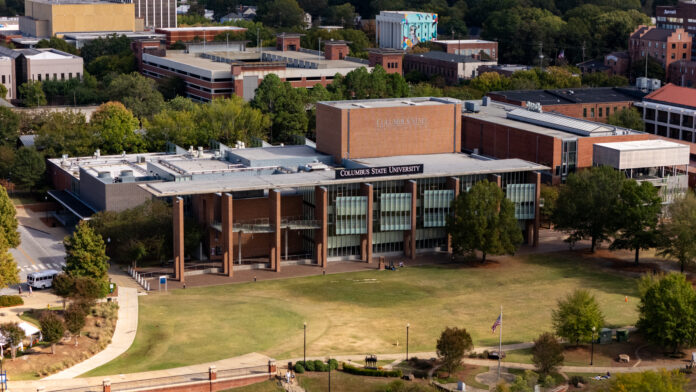
Columbus State University contributed over $322 million to the regional economy in Fiscal Year 2025, marking nearly a 7% rise from the previous year, as detailed in anew economic impact report from the University System of Georgia.
“As a leading state university in Georgia, we are dedicated to helping make the Chattahoochee Valley a thriving and economically prosperous community,” said Dr. Stuart Rayfield, president of Columbus State University. “Our students and their success are central to this mission. As they study, graduate and make their homes in the area, they drive local innovation and prosperity.”
Columbus State’s influence on its seven-county West Georgia service area—Chattahoochee, Harris, Marion, Muscogee, Stewart, Talbot and Troup counties—includes:
- $254.8 million in direct personal spending by students and in university spending on personnel and operations (up 5.8% vs. FY24).
- $67.2 million generated through the re-spending of those dollars throughout the region (up 11.1% vs. FY24).
- Students’ personal expenditures accounted for $30.8 million of the overall re-spending within the local community (up 11.8% vs. FY24).
Employment Impact
Columbus State has traditionally been one of the region’s key employers. This year’s study highlights its significant employment impact on campus and across the seven-county area, supporting 2,681 jobs in West Georgia. Columbus State’s job creation closely mirrored the University System of Georgia’s trend: for every on-campus job, institutional spending generated about two off-campus jobs.
Value of a Columbus State degree
A related study on lifetime earnings shows that, across the state, USG students who graduated in FY25 and are employed in Georgia are projected to have lifetime earnings of $249 billion. This is $77 billion (31%) higher than what they would have earned without their degrees. On average, each graduate’s work-life earnings increase by about $1 million.
The same study revealed that Columbus State University ranks second among the nine state universities in the University System of Georgia for expected lifetime earnings. The CSU Class of 2025 is projected to earn a total of $5.6 billion over their careers, which is $1.6 billion more than they would have earned without their degrees. This projection is based on the 1,748 certificates and degrees awarded by Columbus State in 2025:
- A bachelor’s degree, on average, adds $1.4 million in lifetime earnings potential over that of a high school diploma in Georgia.
- A master’s degree adds $1.7 million in lifetime earnings potential over that of a high school diploma in Georgia.
- A doctorate adds $2.4 million in lifetime earnings potential over that of a high school diploma in Georgia.

“A USG degree isn’t just a diploma. It’s a gamechanger for our students and a major win for Georgia’s economy,” USG Chancellor Sonny Perdue said. “Adding $25 billion to the state and giving our graduates a $1.4 million lifetime boost shows the real power of public higher education. When our students succeed, they put strong skills, a great work ethic and real value right back into Georgia communities.”
Rayfield noted that the value of a higher education degree is intertwined with long-term student success, community impact and economic competitiveness—three rungs of Columbus State’s five-year strategic plan. Responsible stewardship, managing institutional resources and sustainability, is a fourth strategic priority.
Both studies were conducted by Dr. Jeffrey M. Humphreys, director of the Selig Center for Economic Growth in the University of Georgia’s Terry College of Business, on behalf of USG. For comprehensive USG data and complete reports, visit the University System of Georgia website.
Don’t miss what everyone in town is talking about.
Join 4,000+ locals and choose our free newsletter covering news, events and the stories shaping our region.