
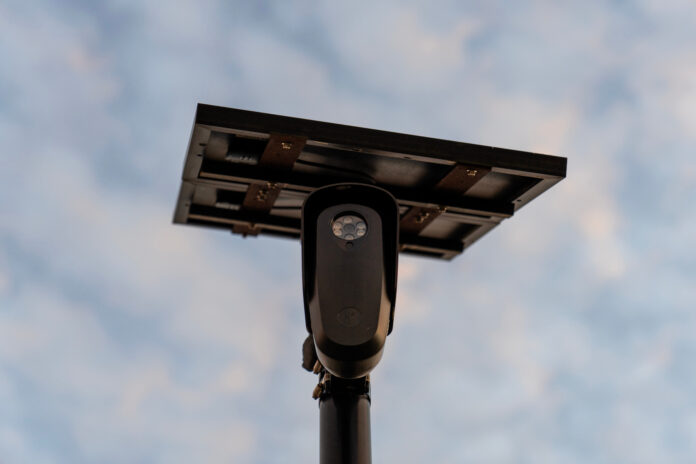
CLARKESVILLE, Ga. — Habersham County residents are getting a detailed look at how their sheriff’s office uses Flock license plate reader technology.
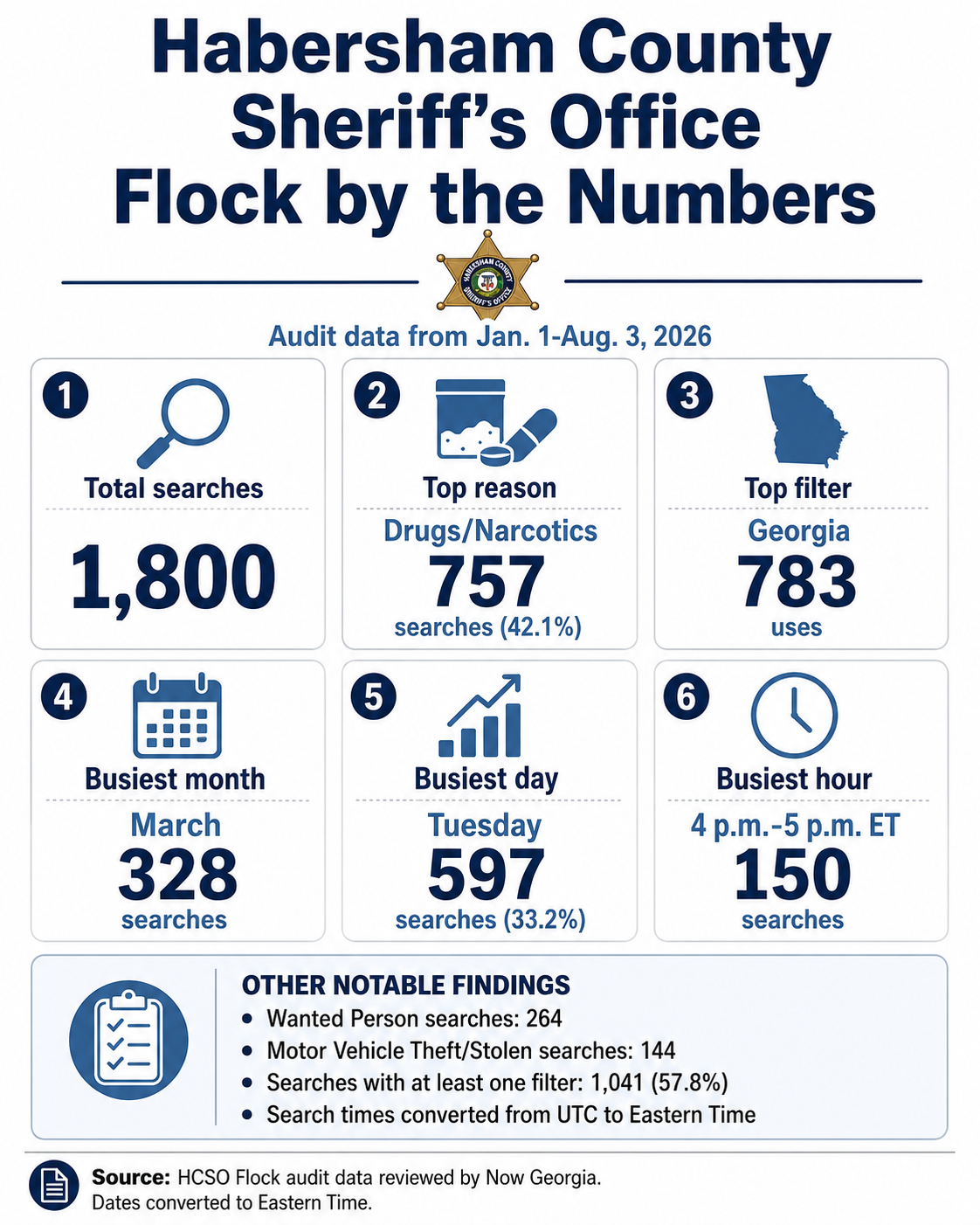
In response to an information request from Now Georgia as part of an investigative series examining Flock use across Northeast Georgia, the Habersham County Sheriff’s Office (HCSO) provided its written policies governing the technology, along with audit data showing 1,800 searches conducted between Jan. 1 and Aug. 3, 2026.
The disclosure provides a window into both sides of the technology: what deputies use it for and the safeguards Habersham County Sheriff Robin Krockum has put in place to prevent abuse.
“The nature of our job requires a unique balance between public safety and public trust,” Krockum told Now Georgia. “The public has put a lot of faith in the sheriff’s office.”
That trust has already been tested.
Krockum previously conducted a proactive internal audit of Flock use that led to the arrest of Christian Brewer for alleged misuse of the system. The case provided a real-world example of why the agency’s audit trail and supervisory controls matter.
“There is also a balance between standing by your employees when they are right, as well as holding them accountable when they are wrong,” Krockum said.
RELATED
- Georgia saw the license plate reader problem coming
- Local Flock audit finds Stephens County policy violation; Hall County cites “technical difficulties
- Flock announces changes amid backlash
- What the Flock? Why Flock cameras are rewriting the rules of public surveillance
What does HCSO use Flock for?
License plate readers (LPRs) photograph license plates passing cameras and convert those images into searchable information that can include the plate number, time, and location.
HCSO’s policy describes LPR systems as investigative tools that can assist deputies with BOLOs, attempts to locate people or vehicles, child abductions, AMBER Alerts, missing-person cases, stolen vehicles, and wanted persons. The policy says the technology must be used strictly for legitimate law-enforcement purposes.
Now Georgia’s review of the 1,800 audit entries in Habersham County’s Flock records show narcotics investigations were the most common stated reason for a search.
Drugs/Narcotics accounted for 757 searches, or 42.1% of the total. Wanted-person or fugitive searches ranked second with 264 searches, followed by 144 searches involving stolen or potentially stolen motor vehicles.
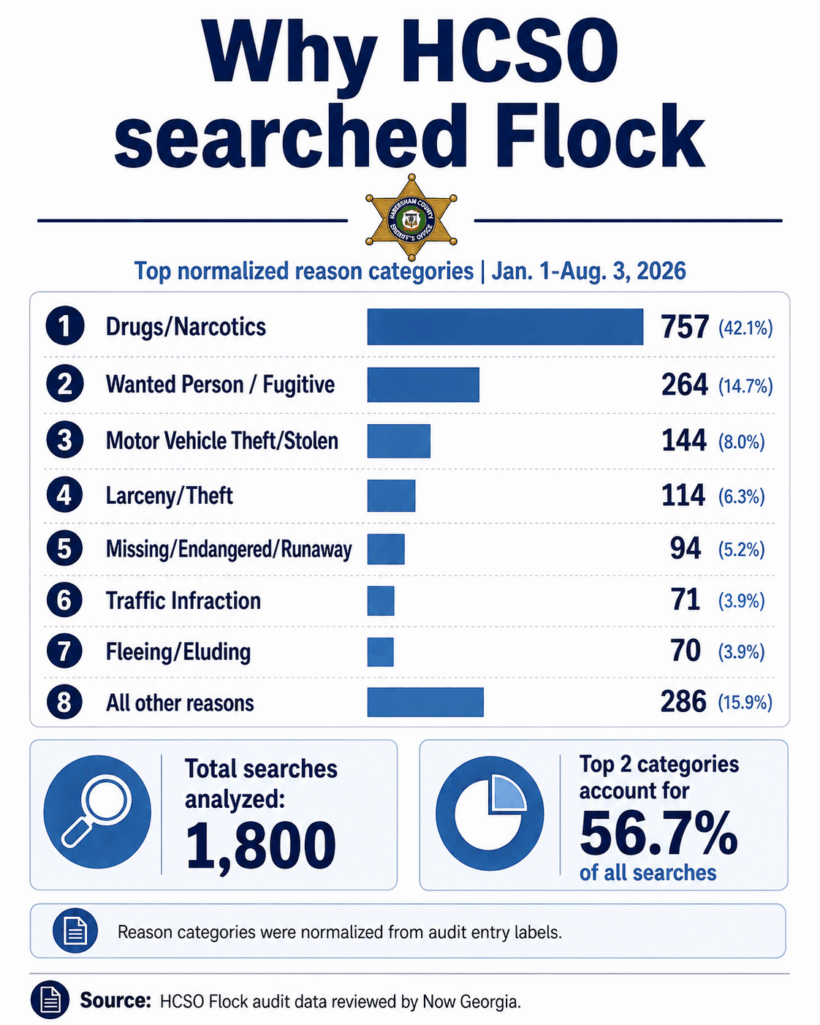
Other frequently listed reasons included larceny and theft investigations, missing or endangered people, traffic infractions, and fleeing or eluding cases.
The records also show Georgia was the most commonly selected search filter, appearing 783 times, while Tennessee appeared 150 times.
Search activity peaked in March, with 328 searches. Tuesdays were the busiest day of the week, accounting for 597 searches, or roughly one-third of all activity. After converting the audit timestamps from UTC to local Eastern time, the busiest hour was 4 p.m. to 5 p.m., with 150 searches.
Those numbers represent searches, not individual criminal cases. One investigation can generate multiple Flock searches as investigators change dates, locations, vehicle descriptions, or other search parameters.
What deputies cannot do
The agency’s policy places explicit limits on the system.
LPR technology cannot be used for personal reasons, political purposes or other non-law-enforcement activity. The policy also prohibits using the system to monitor people solely because of race, ethnicity, religion, political affiliation or other constitutionally protected characteristics. General surveillance without a legitimate law-enforcement purpose is also prohibited.
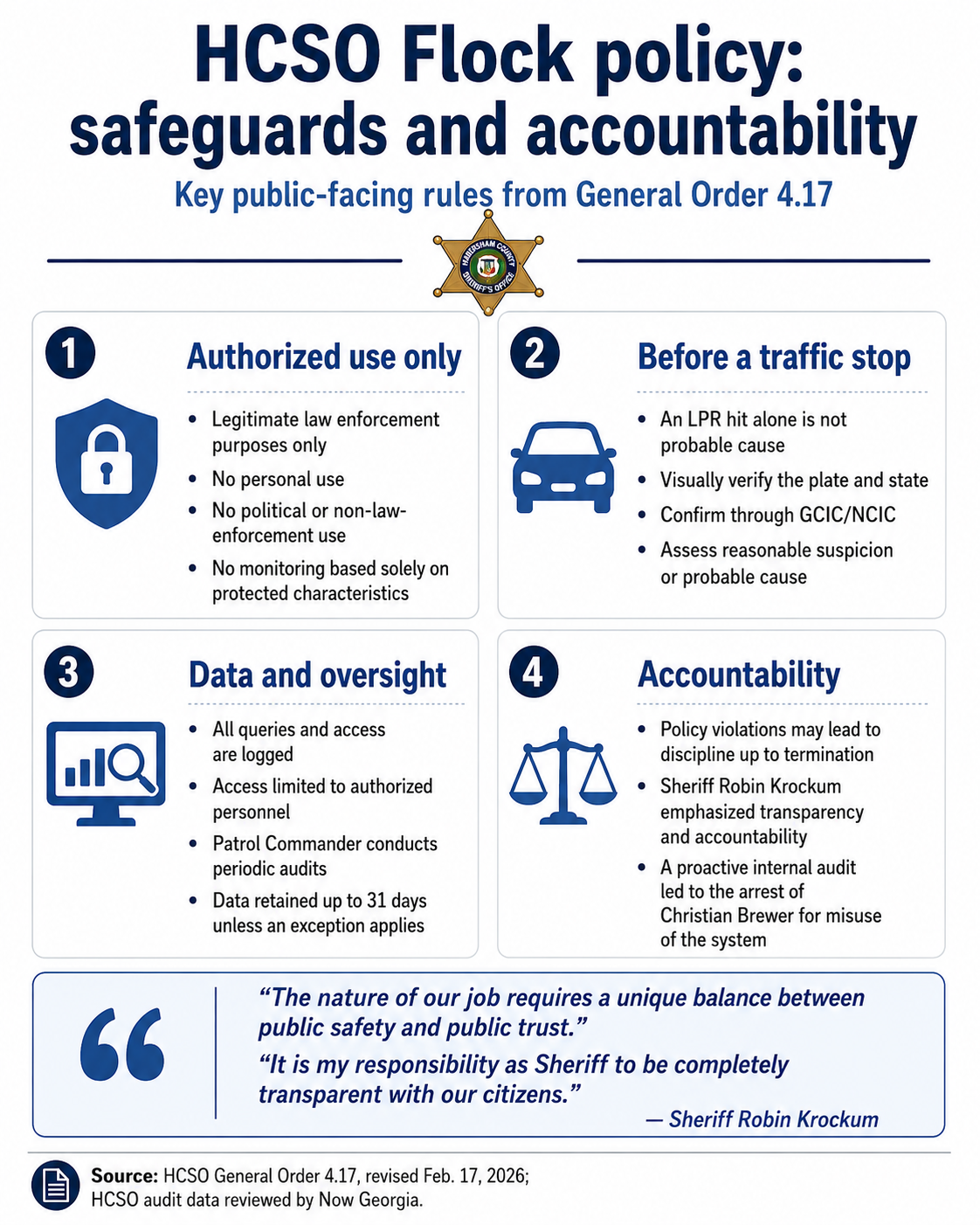
Only trained and authorized personnel are allowed to access the system.
The policy also addresses a common misconception about Flock alerts: a camera hit does not automatically give a deputy probable cause to stop a vehicle.
Before taking enforcement action based on an alert, deputies are required to visually verify the tag number and state, confirm the plate’s status through GCIC or NCIC, and determine whether reasonable suspicion or probable cause exists under the circumstances.
Manual entries require additional documentation, including a valid case number, the investigating deputy, contact information, and the reason for the entry.
Every search leaves a record
Perhaps the most important accountability provision is that all queries and system access are logged and subject to administrative review.
The Habersham County Sheriff’s Office Patrol Commander serves as the LPR administrator and is specifically responsible for conducting periodic audits of access and usage. Violations can result in progressive discipline up to and including termination, according to the policy.
HCSO generally limits retention of LPR data on its systems to 31 days, although information connected to an active criminal investigation, evidence, or a lawful preservation request may be retained longer.
The current General Order was originally issued in 2012 and revised on Feb. 17, 2026. It bears Krockum’s authorization.
For Krockum, releasing both the policy and the accompanying audit information is part of making sure residents do not simply have to take the agency’s word about how the technology is being used.
“It is my responsibility as sheriff to be completely transparent with our citizens,” Krockum said.
The records give the public something more concrete to measure that promise against: the rules deputies are expected to follow, the digital trail their searches leave behind, and an example showing that when an audit uncovers suspected misuse, the sheriff’s office is willing to act.
Don’t miss what everyone in town is talking about.
Join 4,000+ locals and choose our free newsletter covering news, events and the stories shaping our region.