

CLARKESVILLE, Ga. – As automated license plate readers have drawn growing scrutiny across Northeast Georgia, three other cameras have been watching vehicles and people in Clarkesville with considerably less attention.
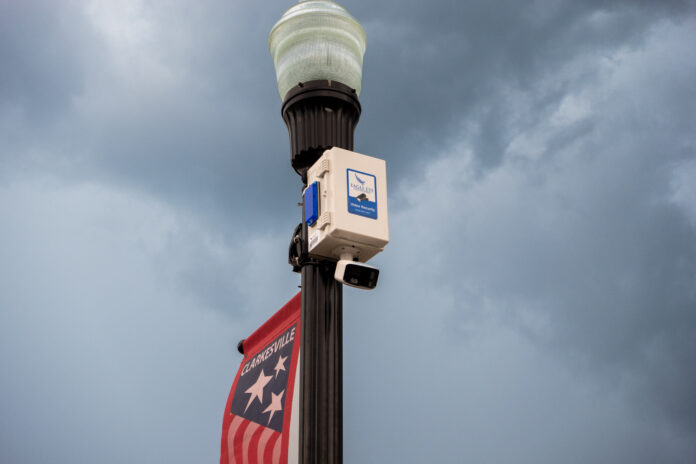
The cameras are part of an Eagle Eye Networks cloud-based video surveillance system the City of Clarkesville purchased last year. Two overlook parking areas on the east and west sides of the downtown square, while a third watches the Mary Street Park area near the soccer field and pickleball courts.
They are not Flock Safety cameras, and Clarkesville says it is not using them as automated license plate readers. But the company behind them offers technology capable of doing some remarkably similar things. Plus more.
That distinction — between what a surveillance system can do and what a government agency has actually enabled it to do — is an important one.
What Clarkesville bought
The city purchased three Eagle Eye Camera Direct Cabinet DX01 cellular systems through Omega Technology Group.
The April 2025 quote put the one-time cost at $9,000, or $3,000 per camera location when hardware, installation, and implementation costs were combined. The system also carried $5,550 in annual expenses — $1,850 per location — including cloud recording, cellular modem management and cellular data service. The original quote totaled $14,550 for the initial purchase and first year of service.
That is higher than the roughly $3,500 annual cloud-storage figure reported when Now Georgia first wrote about the cameras in July 2025.
The cameras themselves are not ordinary security cameras.
According to Eagle Eye’s DX01 specification sheet, each camera combines two 5-megapixel sensors to produce an 8-megapixel, 180-degree stitched image. They include microphones, speakers, and illumination that can reach about 65 feet. Eagle Eye specifically lists parking lots, roadways, sports fields, and other large outdoor areas as intended applications.
The Direct Cabinet system also uses cellular connectivity to send surveillance footage to Eagle Eye’s cloud platform without requiring wired internet service.
Similar technology, different use
The comparison to Flock becomes more interesting when looking beyond the hardware and at Eagle Eye’s larger software ecosystem.
Eagle Eye offers License Plate Recognition analytics that can extract plate numbers and vehicle characteristics. Its Vehicle Surveillance Package can store plate-related information, search for a particular plate across cameras and locations, maintain vehicle lists, and generate real-time alerts when configured vehicles are detected. Searches can also use characteristics including vehicle make, color, direction and body type.
Those functions bear obvious similarities to features that have placed Flock systems under increased public scrutiny.
Eagle Eye also markets artificial-intelligence-based video searching. Its Smart Video Search can identify people, vehicles, and objects and search retained footage using characteristics such as clothing color, vehicle type, make, and color. However, Eagle Eye’s documentation says that particular Smart Video Search feature requires cameras connected through an Eagle Eye Bridge or CMVR and is not available to Camera Direct devices streaming directly to the cloud — the type Clarkesville purchased.
Clarkesville officials say none of the license plate, facial recognition, or AI capabilities are being used on the city’s three cameras.
The city’s stated purpose remains video surveillance and parking monitoring.
Who can watch?
According to information provided to Now Georgia, access is limited to the Clarkesville Police Department and the city’s IT department. Officials say the cameras are not constantly monitored.
Video is typically retained for up to two weeks, according to the city, although the original purchase quote specifically lists an Eagle Eye VMS service described as “30 Days Cloud Recording.” That difference between the city’s stated retention practice and the purchased service’s description is not explained in the records provided.
Who is watching the watchers?
The city also says it currently has no policy governing internal audits of camera-user activity, and no internal audits have been conducted.
That stands out because Eagle Eye itself describes an “audit log” as a system that tracks user actions and account changes.
For now, Clarkesville’s cameras remain conventional surveillance cameras by the city’s choice, rather than an active license plate tracking system.
But the technology behind them illustrates a broader issue emerging as communities debate Flock: modern surveillance is increasingly defined not simply by the camera hanging on the pole, but by the software, subscriptions, and permissions operating behind it.
And sometimes, the difference between a security camera and a far more powerful surveillance tool may be a feature that has — or has not — been turned on.
Don’t miss what everyone in town is talking about.
Join 4,000+ locals and choose our free newsletter covering news, events and the stories shaping our region.