
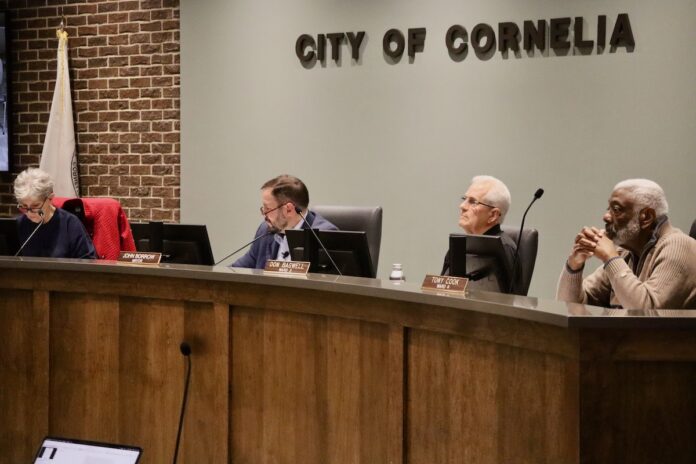
CORNELIA, Ga. — Cornelia city officials defended a proposed 2-mill property tax increase Tuesday, citing an unusual decline in the city’s tax digest, rising operating costs and declining revenue from multiple sources.
The Cornelia City Commission held the first of three required public hearings on increasing the city’s millage rate from 9.5 to 11.5 mills. Two additional hearings are scheduled for Oct. 6 at noon and 6 p.m.
City Manager Donald Anderson said the city faces what he described as a unique financial situation after the city’s tax digest experienced $1.64 million in negative inflationary growth.
“Our rollback rate is actually higher than our current millage rate,” Anderson said.
The decline in the tax digest equates to approximately $100,000 in lost revenue, he said.
Anderson said a preliminary budget has already been cut by more than $1 million from department heads’ requests, while the proposed transfer from the Water and Sewer Fund has increased from $1 million to $1.5 million. Even with those adjustments, the city faces a projected $817,841 deficit, he said.
One mill currently generates approximately $327,536 in revenue for the city. Increasing the rate to 11.5 mills would reduce the projected deficit to about $162,769, which Anderson said could be addressed using fund balance.
Assessments behind revenue decline
Anderson said the city’s financial problems stem largely from declining property assessments.
Cornelia saw less than $4 million in new construction added to its tax digest, but that growth was offset by reassessments and successful property assessment appeals that reduced property values.
“We have seen a lot of properties reassessed and dropped, and most of them have — the value has dropped over 50% from what it was assessed last year,” Anderson said.
He said the city has been issuing refunds to property owners throughout the year because taxes were initially collected based on higher assessed values.
The situation has puzzled city officials, Anderson said, particularly because other governments in Habersham County saw increases in their tax digests.
According to figures discussed during the meeting, Habersham County’s inflationary value increased by $74 million, while Clarkesville, Demorest, Mt. Airy and Alto also experienced increases. Cornelia, Baldwin and Tallulah Falls saw declines.
“It’s not that we’re looking to raise taxes,” Anderson said. “It’s that the revenue is down.”
Anderson said he has worked in local government for 30 years and has never encountered a situation where a government’s calculated rollback rate was higher than its current millage rate because of a decline in its tax digest.
Cornelia’s current millage rate is 9.5 mills, while its rollback rate is 9.51 mills, he said.
The city is also seeing lower-than-expected revenue from business licenses, franchise fees and other sources, Anderson added.
Officials say services must be funded
Commissioner Don Bagwell said the proposed increase ultimately comes down to the cost of providing essential city services.
He identified water, sewer, fire protection, police protection and sanitation as the fundamental responsibilities of municipal government.
“If you want to have a certain range of services and a certain quality of life, you’ve got to fund those things somehow,” Bagwell said.
Bagwell said city officials have already substantially reduced the proposed budget and examined what services and expenses can be eliminated.
“We don’t want to raise taxes on ourselves, much less you,” he said. “But the fact is, is we’ve got to come up with the funds.”
He pointed to rising costs for operating city government and rejected the idea that the proposed increase was the result of unnecessary spending.
“It’s not a matter of City Council taking junkets to Las Vegas,” Bagwell said. “It is a matter of us keeping our citizens safe and properly serviced with water and sewer and fire and police protection.”
Mayor John Borrow said city leaders are trying to balance rising costs against maintaining the level of services residents expect.
“I don’t have an agenda. I want lower taxes,” Borrow said. “I think all of us want lower taxes, and then the question comes back, OK, then how do you get it done, and still maintain the services, or what impact does that have on the services?”
Borrow also recounted previous frustrations with property assessments involving two major industrial facilities in Cornelia. He said the companies invested tens of millions of dollars in their properties several years ago, yet their assessed values declined by millions of dollars.
Borrow and Anderson wrote to the Habersham County Board of Tax Assessors questioning how the assessments could decrease following the investments, but the board maintained its decisions, Borrow said.
Anderson explained that the Board of Tax Assessors operates independently from the county commission in determining property values.
FLOST could lower taxes next year
Despite the proposed increase, Anderson said passage of the Floating Homestead Local Option Sales Tax, or FLOST, referendum in November could allow Cornelia to substantially reduce its millage rate next year.
Based on preliminary revenue projections, Anderson said the city could reduce its millage rate by approximately four mills if voters approve the sales tax.
Collections would begin next year, and the revenue would be required to go toward reducing property taxes, he said.
The commission’s first public hearing Tuesday was the first of three required hearings on the proposed millage rate. The remaining hearings will be held Oct. 6 at noon and 6 p.m.
Zoning ordinance posted for public feedback
In other business, commissioners approved a motion to post a proposed amendment to the city’s zoning ordinance governing accessory buildings.
The action does not constitute final approval of the ordinance.
Borrow explained that posting the ordinance will allow the city to gather public feedback before commissioners take a final vote.
“People like it, probably the commissioners are going to vote and say yes,” Borrow said. “And if we get public feedback saying we hate it, then they probably won’t.”
The proposed amendment would address regulations for accessory buildings in residential areas.
Gate approved after children take city equipment for joyride
Commissioners unanimously approved the installation of an automated gate at a city-owned property on Moss Street after two children recently got onto a city-owned wheel loader and took it for a joyride.
The property is used to store city equipment and materials and is the only city facility without an automated gate, Anderson said.
The children did not leave the property with the equipment.
“Luckily, they didn’t make it out of the property, or it would have been a real bad situation,” Anderson said.
The city received a quote of $10,843.95 to install the gate. Because the expense was not included in the current budget, commissioners also approved a budget amendment using fund balance to pay for the project.
Don’t miss what everyone in town is talking about.
Join 4,000+ locals and choose our free newsletter covering news, events and the stories shaping our region.