

ATHENS, Ga. – A University of Georgia Police Department IT employee used the agency’s license plate reader system to conduct 85 unauthorized searches involving his wife’s hit-and-run crash and a theft at a private business, according to an internal affairs investigation.
Ben Stephens had administrative access to manage the department’s Flock system, but that access did not authorize him to investigate cases on his own. Investigators found he searched for two vehicles without supervisory approval or requests from the agencies handling the incidents.
The department sustained violations of its license plate reader policy and employee conduct standards against Stephens. Crime Analyst Megan Thompson also received a sustained conduct violation and a letter of reprimand following the investigation.
Stephens was placed on administrative leave Sept. 3, and UGA Workforce Engagement was notified. The report does not identify his final employment disposition or document a criminal charging decision involving either employee.
An audit uncovers the searches
According to the report, Chief Clark ordered a review of the department’s Flock usage after learning of concerns about the cameras and reports of misuse elsewhere in Georgia and across the country.
Deputy Chief Derrick Gregory reviewed employee activity and identified searches by Stephens, who was neither a sworn officer, criminal investigator, nor crime analyst.
Stephens was trained in digital forensics and could assist criminal investigations upon request. His Flock access allowed him to create accounts, manage settings, test features, and help users navigate the system.
Investigators examined 123 searches associated with his account: 66 involving a red Dodge pickup, 19 involving a silver Toyota Corolla and 38 associated with a university police investigation.
The report ultimately found the 38 searches connected to the university case appeared legitimate. It classified the other 85 as unauthorized.
A stolen set of tires and rims
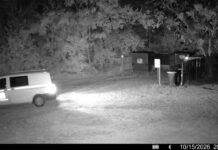
The largest group involved a theft at Superior Fence and Rail in Jackson County during the Thanksgiving holiday in 2025.
Stephens told investigators he visited the business for a fencing quote and noticed a company truck sitting on blocks after someone stole its tires and rims. He helped retrieve surveillance footage showing a red pickup.
Business owner Kim Meyers told investigators Stephens’ wife worked next door — a distinction from describing the theft as occurring at her workplace.
Stephens acknowledged searching Flock on three occasions in December 2025, totaling 66 queries. He did not locate the pickup.
Asked what prompted him to use the system, Stephens described it as “just the spark of the moment,” according to the report.
He did not seek permission or notify his chain of command. In a follow-up interview, he said he retrieved the surveillance footage on his day off without university equipment, but conducted the Flock searches at work using his departmental computer.
The hit-and-run involving his wife
Another 19 searches involved a silver Toyota Corolla connected to a crash while Stephens’ wife was driving his vehicle.
Stephens told investigators Athens-Clarke County police took a report, but the recorded license plate did not match the suspected vehicle. He said he reviewed dispatch information, identified what he believed was an error, and searched for the vehicle himself.
He subsequently asked Thompson to search the plate and forward information to Athens-Clarke County police.
Thompson told investigators she reviewed the report, searched the Georgia Crime Information Center and used Flock after identifying what she believed was the correct plate. She said she believed her searches were legitimate because she had a case number.
The investigator documented four Flock searches by Thompson and an email providing information to the investigating agency.
Thompson also disclosed that Stephens had previously expressed concerns about his Flock usage. She advised him to stop searching but did not notify her chain of command.
The report sustained a conduct violation against Thompson. Its conclusion did not separately sustain an ALPR policy violation against her.
Discipline and unanswered questions
The department’s policy restricts license plate reader use to legitimate law enforcement purposes by properly trained personnel. It identifies possible consequences for unauthorized use, including criminal prosecution, personal liability, and discipline up to termination.
During a follow-up interview, Stephens expressed concern about whether the matter was criminal. Investigator Britney Green reiterated that she was conducting an administrative investigation to determine whether department policies had been violated.
The report says consultation with the Georgia Bureau of Investigation indicated Stephens had not searched the state or national crime information systems. That finding concerned those separate databases; it did not change the sustained findings involving Flock.
The records leave unresolved what further action followed: Stephens’ final discipline, whether either employee’s system access was restricted, and whether the findings were referred for an independent criminal review.
Green also reported finding no previous complaints of a similar nature in either employee’s personnel file.
Don’t miss what everyone in town is talking about.
Join 4,000+ locals and choose our free newsletter covering news, events and the stories shaping our region.