
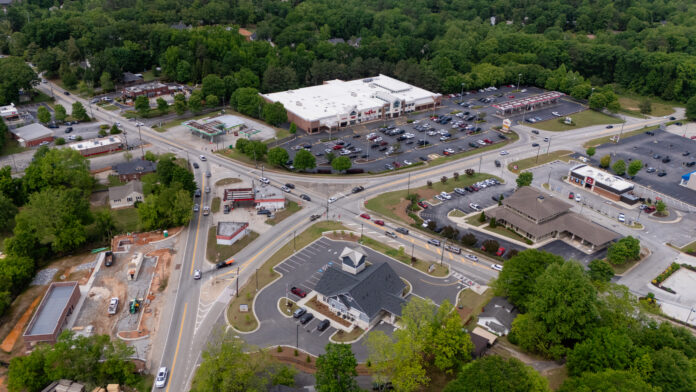
CLARKESVILLE — Proposed roundabouts at the intersection of Ga. 17 and Rocky Branch Road in Clarkesville and near Hardman Farm on the Helen Highway in White County remain “to be determined,” according to the Georgia Department of Transportation.
The projects are still in the early consideration phase, even as one nearby roundabout project is already moving into construction planning.
Ga. 197 roundabout contract already awarded
The Georgia Department of Transportation has awarded a $3.3 million contract to build a single-lane roundabout at the intersection of Ga. 197 South and Ga. 385/17 in Clarkesville.
The project includes installation of a video detection system to improve traffic monitoring and operations. It is expected to be completed by Sept. 30, 2028.
Georgia Department of Transportation officials say roundabouts are becoming more common across Northeast Georgia as a long-term strategy to improve safety and traffic flow.
Safety and traffic benefits
Nathan Johnston, district communications manager for GDOT’s Northeast Region, said roundabouts reduce the severity of crashes while keeping traffic moving more efficiently than traditional signalized intersections.
Nathan Johnston said roundabouts “improve both safety and traffic flow” by slowing vehicles and changing crash angles, which reduces the likelihood of serious injuries.
“They reduce serious crashes like head-on and right-angle collisions by slowing vehicles down and changing the angle of impact,” Johnston said. “At the same time they keep traffic moving by allowing drivers to yield instead of stopping at a signal, which helps reduce delays and congestion. They are also more reliable and cost effective over time since they do not rely on signals or power.”
Data-driven approach
Johnston said national and state traffic data support the use of roundabouts in appropriate locations.
“Safety and traffic data consistently show that roundabouts are one of the most effective intersection designs for reducing severe crashes and improving overall operations,” he said. “National studies, including data from the Federal Highway Administration, show that roundabouts can reduce fatal and serious injury crashes by up to 80 percent compared to traditional intersections.”
He added that roundabouts also eliminate many of the conflict points that lead to severe collisions and can improve traffic efficiency, particularly during off-peak hours.
GDOT evaluates crash history, traffic volumes and projected growth when determining whether a roundabout is appropriate.
“When that data shows a pattern of severe crashes or increasing congestion, a roundabout is often one of the safest and most effective solutions we can implement,” Johnston said.
Part of statewide safety strategy
Johnston also said roundabouts are part of a broader statewide safety effort aimed at reducing serious injuries and fatalities on Georgia roads.
He said GDOT uses a data-driven approach to identify intersections with high crash rates, higher speeds or growing traffic demand.
“Yes, residents will likely continue to see more roundabouts across Habersham, White, and surrounding counties in the coming years, particularly in areas experiencing population growth, increased traffic volumes, or a history of serious crashes,” he said. “GDOT evaluates every intersection individually, and while roundabouts are not the solution everywhere, they have proven to be a safe and efficient option in many locations across Northeast Georgia.”
He added that the agency typically targets stop-controlled or signalized intersections where crash patterns indicate a need for improvement, as well as corridors experiencing rapid growth where future demand is expected to increase.
“Ultimately, roundabouts are one of several tools we use to improve safety and mobility, and they play an important role in helping us move toward safer roads across the state,” Johnston said.
Don’t miss what everyone in town is talking about.
Join 4,000+ locals and choose our free newsletter covering news, events and the stories shaping our region.