
Publisher’s Note: This is the latest in an ongoing series of articles examining Flock camera use in Northeast Georgia. The data presented was obtained through Open Records Requests filed under Georgia’s Open Records Act.
CLEVELAND, Ga. — Dozens of Georgia law enforcement employees have been fired or resigned—and several have been arrested—since scrutiny of the Flock Safety license plate reader system exposed lax safeguards that left sensitive vehicle data vulnerable to unauthorized searches.
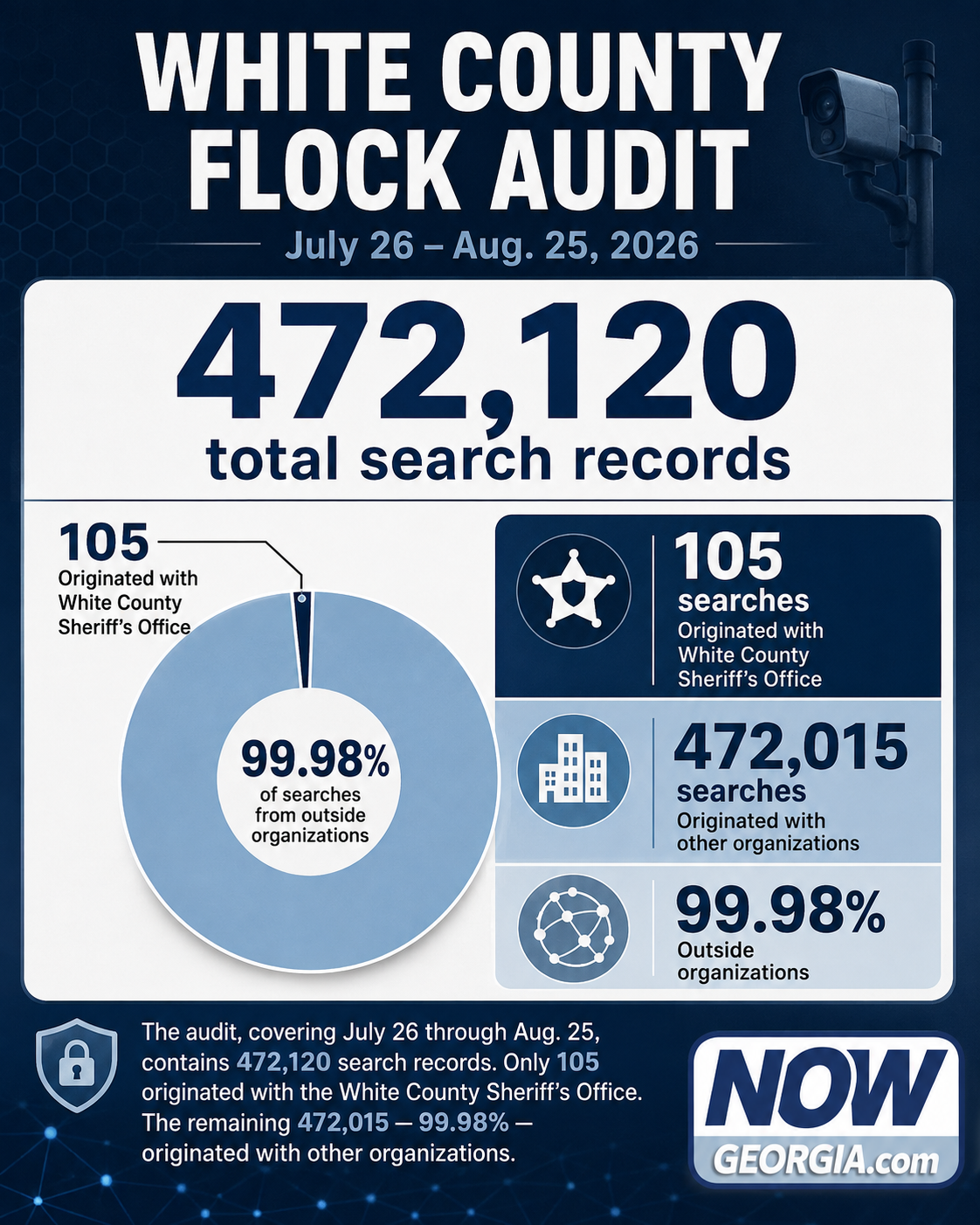
Against that backdrop, a 30-day audit of White County’s Flock network shows limited use by local deputies but extraordinary reach beyond the county: White County Sheriff’s Office personnel conducted just 105 searches, while the county’s cameras were included in more than 472,000 searches originating from nearly 3,000 other law enforcement organizations.
The audit, covering July 26 through Aug. 25, contains 472,120 search records. Only 105 originated with the White County Sheriff’s Office. The remaining 472,015, or 99.98%, originated with other organizations.
What the numbers mean
The audit does not mean outside agencies specifically searched for 472,015 vehicles in White County, or that White County cameras produced that many results.
Flock says a search is permanently recorded in the audit log of every participating agency whose cameras were included. A single nationwide or multistate search can therefore generate entries across thousands of Flock networks, even if no White County vehicle is detected.
Still, the scale illustrates how deeply White County’s cameras are connected to a nationwide law enforcement network.
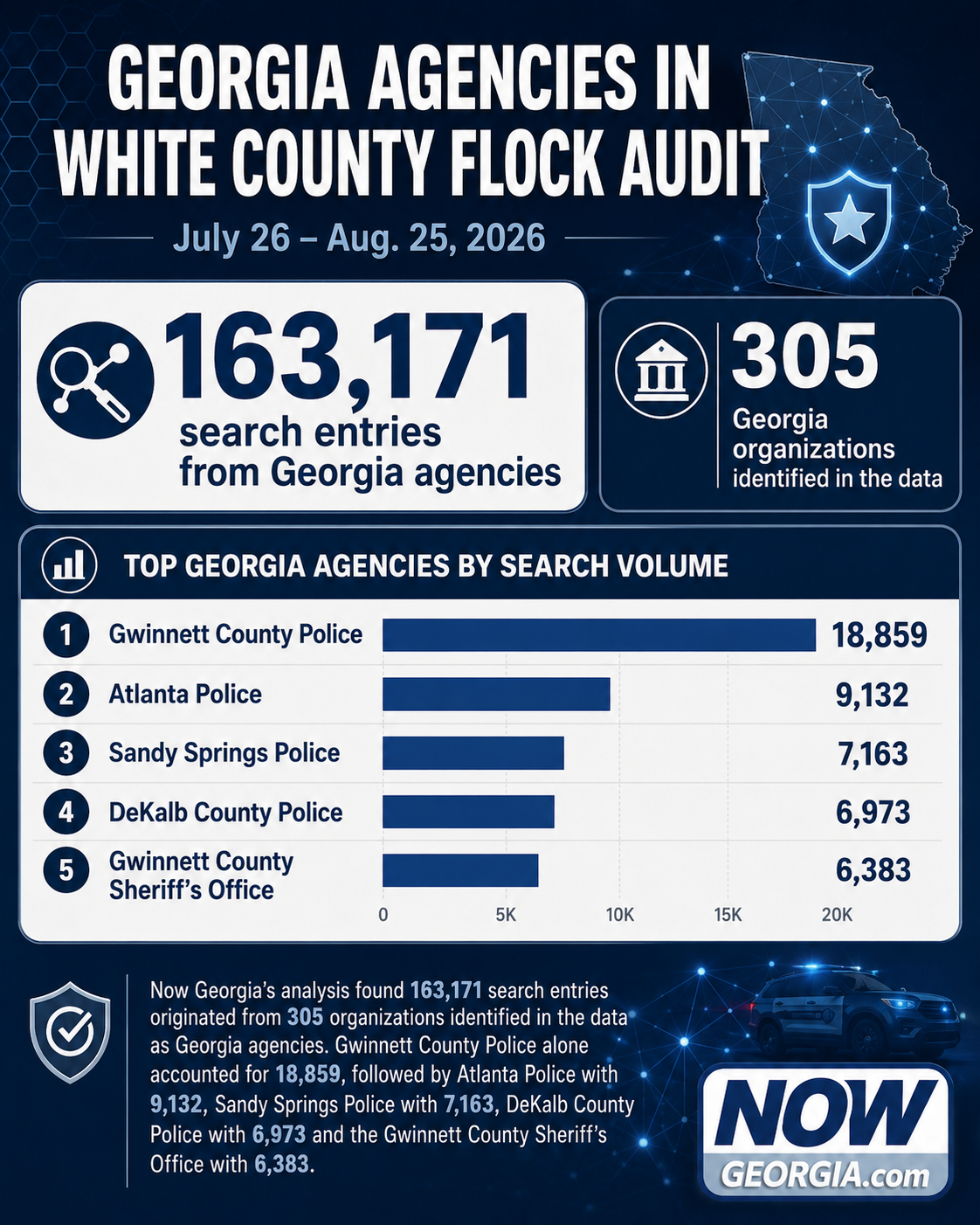
Now Georgia’s analysis found that 163,171 entries originated from 305 organizations identified as Georgia agencies. Gwinnett County Police accounted for 18,859, followed by Atlanta Police with 9,132, Sandy Springs Police with 7,163, DeKalb County Police with 6,973, and the Gwinnett County Sheriff’s Office with 6,383.
More than 320,000 entries in White County’s audit came from searches that simultaneously accessed more than 5,000 Flock networks.
No local misuse identified
White County’s own use was considerably smaller. Its 105 searches involved investigations of hit-and-run crashes, child abuse, theft, financial crimes, wanted people, narcotics, assaults and other offenses.
Capt. Clay Hammond told Now Georgia the Sheriff’s Office currently has 58 authorized Flock users.
“We have conducted periodic audits and have found no misuse within our agency,” Hammond said.
Nothing in the records reviewed by Now Georgia establishes that a White County employee used Flock for personal or otherwise unauthorized purposes. However, individual users’ names and license plate numbers were redacted, limiting the ability to independently determine whether one person repeatedly searched for a particular vehicle.
Questions about search documentation
The audit does raise questions about whether several searches met the documentation requirements of the Sheriff’s Office’s newly revised Automatic License Plate Reader (ALPR) policy.
The policy was revised Aug. 7 and electronically signed by Sheriff Rick Kelley on Aug. 20. It requires historical searches to include a valid offense or incident type, a case or CAD event number, and a “complete reason.” It also prohibits generic or incomplete explanations when more information is available.
Of the 105 searches conducted during the audit period, 72 have a blank case-number field. Because the policy changed during that period, the missing numbers alone do not establish violations.
Four searches conducted between when Kelley signed the revised policy and Now Georgia received the search records stand out.
Three historical searches on Aug. 21 list only “Traffic Infraction” as the reason, contain no case number, and cover approximately 14 to 30 days of records. An Aug. 23 search lists only “Wanted Person (Arrest Warrant/Fugitive)” and also contains no case number.
The audit does not show whether CAD numbers or additional documentation exist elsewhere. Still, the information visible in the records appears inconsistent with the policy’s requirement that users provide complete search reasons.
Another Aug. 23 wanted-person search requested approximately 83 days of history, although White County’s policy establishes a 30-day operational retention period. That search included a specific investigative reason and case number and covered 794 networks.
The records do not establish that 83 days of White County data were available. Older detections may have been unavailable or could have come from another participating network.
Safeguards take on new urgency
White County’s written audit requirements are among the more detailed reviewed by Now Georgia.
The policy requires monthly reviews of ALPR audit reports and a detailed random audit of at least five users each month. Hall County also requires documented monthly audits. Habersham County calls for periodic audits, while Rabun County’s policy makes system activity subject to review without establishing a fixed interval.
Those safeguards have taken on greater urgency as Georgia agencies confront the consequences of unauthorized Flock searches.
Audits in Habersham County led to the arrests of two former investigators accused of improperly using the system. Hall County’s review found that seven employees accessed Flock data for reasons unrelated to law enforcement. Three were fired, and four resigned while under investigation.
White County’s records tell a different story so far: limited local use, no identified personal misuse and a policy requiring regular oversight, but a camera network accessible through hundreds of thousands of searches originating far beyond the county line.
SEE ALSO
‘Law enforcement failed, and Flock failed’: Hall sheriff responds to misuse
Don’t miss what everyone in town is talking about.
Join 4,000+ locals and choose our free newsletter covering news, events and the stories shaping our region.