


You get pulled over by a local sheriff’s deputy, hand over your driver’s license and wait. A few minutes later, federal immigration agents arrive. You might start wondering when your local sheriff’s office became an immigration enforcement agency.
Well, there’s a federal law for that. And, in typical government fashion, we have given it a combination of numbers and letters that means absolutely nothing to the average citizen: 287(g).
On Nov. 20, I published an article titled “Habersham seeks dismissal as driver challenges wait for ICE during traffic stop.”
The article examines a federal lawsuit involving a Habersham County sheriff’s deputy, a traffic stop along Highway 365, and the subsequent detention of a driver by federal immigration authorities.
It also presents an opportunity to educate our readers about the relationship between local law enforcement and U.S. Immigration and Customs Enforcement (ICE), where that authority comes from and, perhaps more importantly, where it ends.
So, welcome back to Street Smart.
What exactly is 287(g)?
In 1996, Congress passed the Illegal Immigration Reform and Immigrant Responsibility Act, adding Section 287(g) to the Immigration and Nationality Act.
Today, that authority is found under 8 U.S.C. § 1357(g).
The law allows the federal government to enter into written agreements with state and local law enforcement agencies, authorizing designated officers to perform certain federal immigration enforcement functions.
Think of it as a limited delegation of federal authority.
A Georgia sheriff’s deputy remains a Georgia sheriff’s deputy. However, after receiving the required training and authorization, that deputy may perform specific immigration enforcement duties under ICE supervision.
Notice I said specific duties.
Signing a 287(g) agreement does not magically turn every officer in a department into a federal immigration agent. No federal badge hides behind the signature page.
Three agreements, three different responsibilities
Not all 287(g) agreements are created equal. ICE operates three models, each providing different levels of authority.
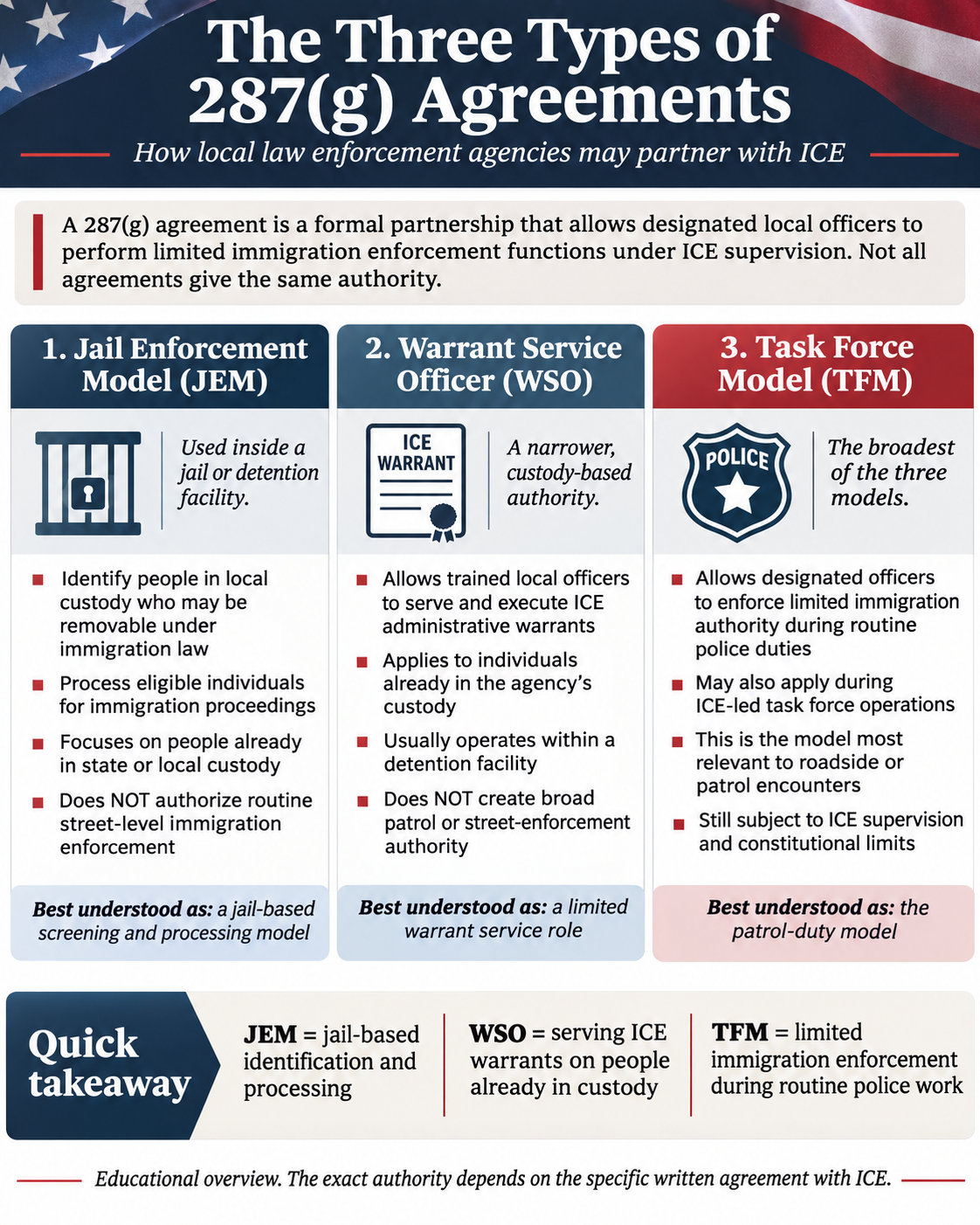
Jail Enforcement Model (JEM): This model allows designated officers to investigate the immigration status of individuals already in state or local custody and process eligible individuals for immigration proceedings.
Warrant Service Officer (WSO): This model allows designated officers to serve and execute administrative immigration warrants on individuals already in their agency’s custody.
Task Force Model (TFM): This model allows designated officers to exercise limited federal immigration enforcement authority during their routine police duties or while participating in ICE-led operations.
That third model is particularly important when discussing roadside encounters.
An agency participating in a jail-based program does not automatically have the same immigration enforcement authority as an agency participating in the Task Force Model.
The details are contained in the written agreement between ICE and the participating agency.
Does Georgia require these agreements?
On May 1, 2024, Gov. Brian Kemp signed House Bill 1105, known as the Georgia Criminal Alien Track and Report Act of 2024.
Under O.C.G.A. § 35-1-17(b)(2), Georgia law states:
“A local agency shall seek such memorandums of understanding annually when no current memorandum of agreement is in effect.”
Anyone who has attended one of my law enforcement classes knows how much emphasis I place on the difference between the words may and shall.
May provides discretion. Shall establishes a requirement.
Georgia requires local law enforcement agencies to seek these agreements when one is not already in effect. However, the statute does not specifically require agencies to participate in the Task Force Model.
Can officers contact ICE without an agreement?
Absolutely.
Under 8 U.S.C. § 1357(g)(10), local law enforcement officers do not need a 287(g) agreement simply to communicate or otherwise lawfully cooperate with federal immigration authorities.
There is a difference, however, between communicating with a federal agency and independently exercising that agency’s enforcement authority.
I can call the FBI. That doesn’t make me an FBI agent.
The same principle applies to ICE.
What about the Fourth Amendment?
Here is where things get interesting, particularly in the Habersham County case.
In Rodriguez v. United States, 575 U.S. 348 (2015), the U.S. Supreme Court established that officers cannot prolong a traffic stop to conduct an unrelated investigation without an independent legal justification.
Checking a driver’s license, verifying identity, checking for outstanding warrants, and examining vehicle registration are ordinary responsibilities during a traffic stop.
However, extending that detention for an unrelated investigation requires additional legal justification.
A 287(g) agreement does not eliminate that constitutional requirement.
In the Habersham County lawsuit, Sgt. Adam Ivester maintained that he contacted ICE because he questioned whether the photograph on the driver’s license matched the driver. The driver’s attorney disputes that there was an issue with the license.
The distinction between verifying someone’s identity and prolonging their detention for an immigration investigation is central to the lawsuit.
As reported in my Nov. 20 article, those legal questions remained unresolved.
Immigration violations are not always crimes
Another common misunderstanding is that every violation of federal immigration law constitutes a criminal offense.
It does not.
Remaining in the United States beyond the expiration of an authorized visa, for example, generally constitutes a civil immigration violation. Improper entry and certain unlawful reentries, however, can constitute federal criminal offenses.
That distinction matters because criminal enforcement authority and civil immigration enforcement authority are not necessarily interchangeable.
It is also one reason Congress established a mechanism for delegating specific immigration enforcement powers to local officers.
Authority comes with limitations
Whether you support or oppose local law enforcement’s involvement in immigration enforcement, understanding the law is important.
A 287(g) agreement is a mechanism Congress created to extend certain federal immigration enforcement powers to designated state and local officers. Georgia law requires local agencies without an agreement to seek one, and the specific agreement defines the scope of that delegated authority.
But neither a federal agreement nor a state statute excuses an officer from complying with the Constitution.
The next time you hear that your local police department or sheriff’s office has entered into a 287(g) agreement, you are now better equipped to ask the right questions: Which model? What authority has been delegated? And what limitations apply?
Congratulations. You have survived another lesson in government acronyms, federal statutes, and constitutional law without having to attend a single day of the police academy.
That’s what being Street Smart is all about.
Don’t miss what everyone in town is talking about.
Join 7,000+ locals and choose our free newsletter covering news, events and the stories shaping our region.