
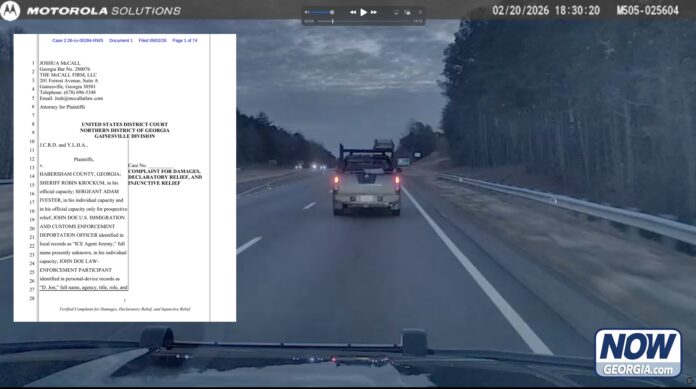
CORNELIA, Ga. – A Habersham County deputy says he called federal immigration agents because the photo on a driver’s license did not look like the man behind the wheel. The driver, José Carlos Rivas Diaz, says he handed over his own license and was left waiting while the deputy arranged for agents to take him into custody. In a Nov. 17 response, Rivas Diaz and his wife asked a federal judge to let their lawsuit over the Feb. 20 stop proceed.
The stop was the first of four in Habersham County that evening examined by The Atlanta Journal-Constitution. The newspaper reported that it could find no apparent traffic violation in the records or footage for three of the stops. In Rivas Diaz’s case, the defense points to a specific moment on the dashcam. The couple argues that even if the deputy had grounds to pull him over, he still had to justify keeping him there.
Eleven minutes on Highway 365
Sgt. Adam Ivester pulled over Rivas Diaz’s Nissan pickup around 6:30 p.m. on Highway 365 near Kudzu Hill. In an incident report dated Aug. 18, nearly six months later, Ivester wrote that both passenger-side tires had crossed the white line at the edge of the road. Defense attorneys say the crossing is visible about one minute and 43 seconds into the dashcam recording. Rivas Diaz recalled in a sworn statement that Ivester told him there was a problem with his truck’s lights.
Ivester wrote that Rivas Diaz’s hands shook as he retrieved his Maryland license. The sergeant said he questioned whether the photo matched and contacted U.S. Immigration and Customs Enforcement because its agents had access to more identification tools. A screenshot from Ivester’s personal phone shows that he sent a photo of the license, shared his location and wrote, “This don’t really look like the same dude.”
The attorney for Rivas Diaz, Josh McCall, told Now Georgia, “There is no issue with my client’s license”.
A federal arrest report adds what happened on the other end of that request. ICE officers and Border Patrol agents were waiting at the sheriff’s substation in Cornelia when the call came in around 6:32 p.m. Some began checking records. Others went to the roadside, where they questioned Rivas Diaz about his identity and immigration status. The report says agents confirmed his identity through biometrics, determined the Salvadoran citizen lacked authorization to remain in the United States and took him into custody. It also records that he had no criminal history.
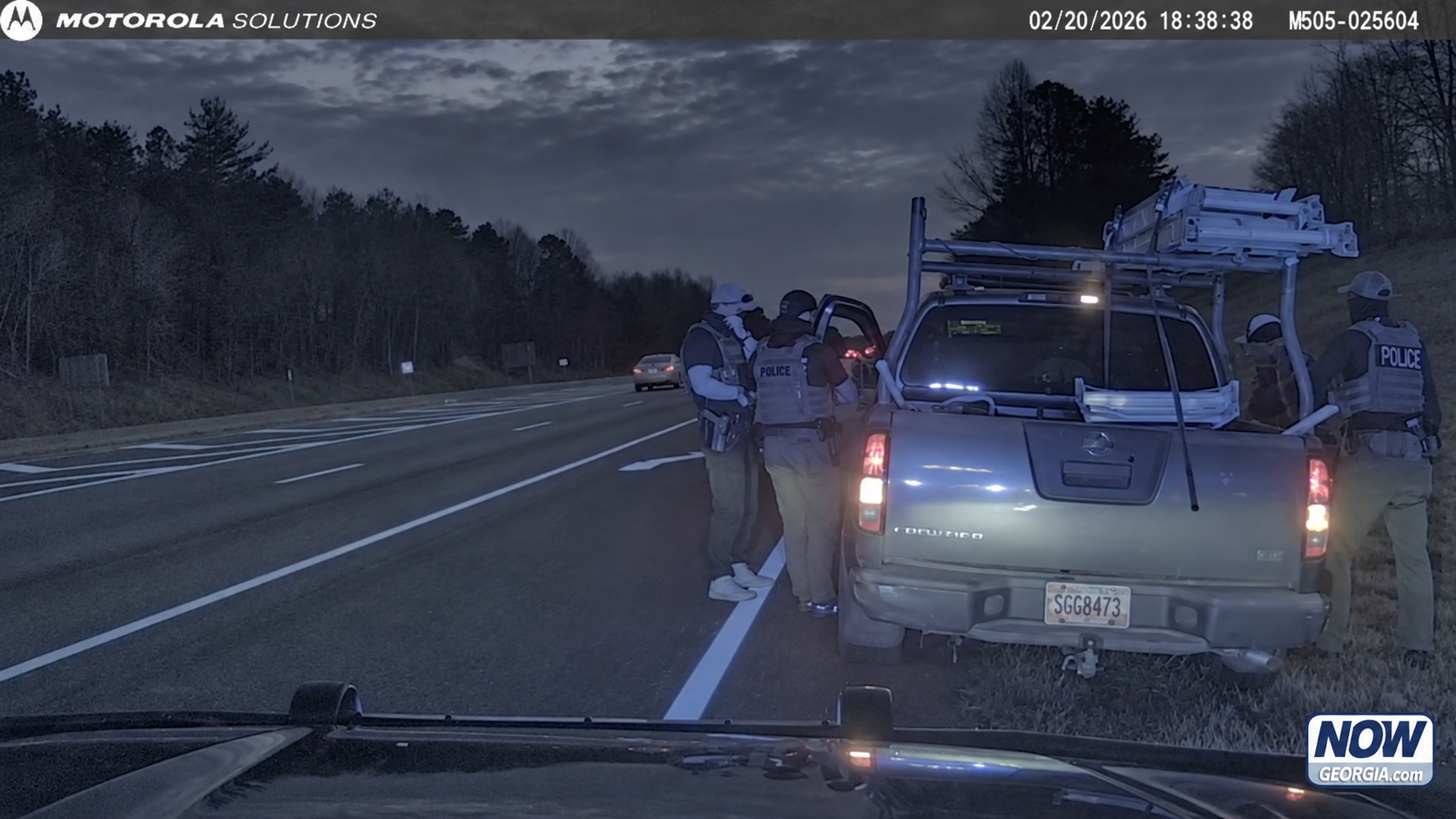
Federal agents arrived about five and a half minutes after Ivester returned to his patrol car with the license, according to the court’s account. At 6:41 p.m., Ivester closed the traffic stop with a verbal warning. Rivas Diaz’s daughter said in a sworn statement that the family called hospitals, police and the morgue looking for him that night. She said she spotted his pickup the next morning, unlocked, with the keys on the driver’s seat. He spent several weeks at the Stewart Detention Center before his release on bond.
McCall told Now Georgia, “My client was not hiding from law enforcement,” McCall said. He said Rivas Diaz works in Habersham County remodeling homes and has a daughter who serves in the Navy.”
What the judge has decided
Checking a driver’s license is part of a traffic stop. Under the U.S. Supreme Court’s decision in Rodriguez v. United States, an officer needs an independent legal basis to add time for an unrelated investigation. That distinction puts the purpose of those roadside minutes at the center of the case. Was Ivester still verifying the driver’s identity, or was he holding Rivas Diaz for a separate immigration inquiry?
On Sept. 9, U.S. District Judge Richard W. Story declined to issue a temporary restraining order. He found the proposed restrictions too vague and the likelihood of another stop too speculative to justify emergency relief. He also wrote that the claim over the length of the stop “certainly appears to have merit,” while emphasizing that the facts were too unsettled to predict whether Rivas Diaz would prevail. Two days later, Story authorized limited requests for records from Ivester and Sheriff Robin Krockum to help identify the federal participants.
Habersham County, Krockum and Ivester moved for dismissal Nov. 3. They argue that the video supports the stop, that Ivester is entitled to qualified immunity and that the county does not control the sheriff’s law-enforcement decisions. Rivas Diaz and his wife, Yanira Lizeth Hernández Andrade, dispute what the video proves and argue that the records support their claim that deputies targeted Hispanic workers for immigration screening.
“I just want to make sure the law applies to all of us,” McCall said. The court orders reviewed for this story leave those questions unresolved.
Don’t miss what everyone in town is talking about.
Join 7,000+ locals and choose our free newsletter covering news, events and the stories shaping our region.