
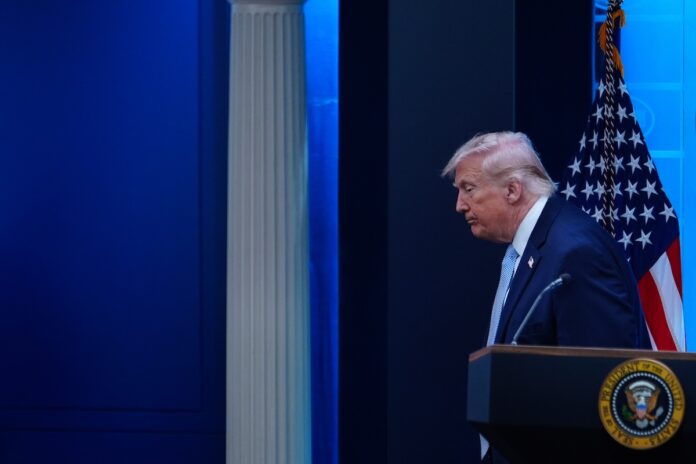
(States Newsroom) — President Donald Trump is again demanding Congress pass a sweeping set of voting restrictions and refuses to rule out sending troops to the polls, as Democrats and voting rights groups assemble a sprawling effort to guard against federal election interference.
The fight over election security is intensifying in Washington, D.C., as the White House and its allies seek to rewrite rules around voter registration and mail-in ballots ahead of the November midterm elections. The stakes of the contests are massive — control of Congress and the future of Trump’s legislative agenda.
Trump wants lawmakers to attach the SAVE America Act to unrelated housing and surveillance legislation after it stalled in the U.S. Senate. The SAVE bill would require individuals to show documents, such as a passport or birth certificate, proving their citizenship to register to vote. It would also mandate voters show photo ID to cast a ballot.
“Voter I.D., and Proof of Citizenship, must be approved, NOW,” Trump wrote Saturday on Truth Social, his social media platform. On Wednesday, he took to social media again to call for the firing of the Senate parliamentarian and suggested she’s an impediment to passage of the bill.
“We need THE SAVE AMERICA ACT passed, and NOW,” Trump wrote.
Democrats and voting rights advocates say the measure would cause chaos if passed this close to the election. They warn it would disenfranchise voters and create additional obstacles to voting for married women and others who have changed their names.
Vote possible soon
The Senate may hold another vote as early as this week on adding the SAVE America Act to a budget reconciliation bill. Senators rejected a prior effort to advance the legislation in a 48-50 vote in April, but Sen. John Kennedy, a Louisiana Republican, has vowed to try again.
The SAVE America Act is popular among Republicans in the U.S. House, which passed the bill in February. But a handful of Senate Republicans have joined Democrats in opposing the proposal, which doesn’t have enough support to overcome a filibuster.
“It is voter suppression with a suit and tie,” Senate Minority Leader Chuck Schumer, a New York Democrat, said Tuesday in a speech at a progressive conference.
Some House Republicans have kept up pressure on the Senate to act. During a House Administration Subcommittee on Elections hearing Wednesday, Rep. Mary Miller, an Illinois Republican, called for the passage of the bill multiple times.
“American citizens deserve secure elections and to know that their votes are guaranteed,” Miller said.
Thune blames Democrats
Senators spent several weeks this spring debating the legislation before moving on to other business. Senate Majority Leader John Thune, a South Dakota Republican, on Monday said the chamber held a “robust debate” but indicated senators were unlikely to return to the legislation.
Speaking about the bill in the past tense, Thune cast the measure as a political cudgel that Republicans would use against Democrats in November.
“Democrats are on the record against all of it,” Thune said on the Senate floor. “And we’ll be sure the American people know that Democrats are blocking commonsense policies that have broad support from the American people.”
Democrats, fearing that Trump may try to assert unilateral control over elections regardless of whether the legislation advances, have begun outlining how they plan to combat any attempted election takeover.
Schumer on Tuesday said Senate Democrats are launching an election protection task force. The group, which will include 11 senators and election experts, will be prepared to mount “lawsuit after lawsuit” throughout the election process.
“Let me be very clear: local officials run elections. Voters decide elections. Donald Trump does not,” Schumer said.
Troops at polling places
In describing their concerns, Schumer and others point to Trump’s refusal earlier this month to close the door on deploying troops to polling places. Defense Secretary Pete Hegseth also recently dismissed the possibility as a “gotcha hypothetical” without actually ruling it out.
Federal law prohibits federal troops and agents at election sites in nearly all circumstances.
“I’d do anything necessary to make sure we have honest elections,” Trump told reporters when asked about sending troops of immigration agents to the polls.
Trump’s critics also emphasize his efforts to overturn his 2020 election loss and his continuing portrayal of the contest as stolen. He has pardoned rioters who stormed the Capitol on Jan. 6, 2021, disrupting Congress’ certification of the election.
On Monday, the Justice Department announced the creation of a $1.776 billion fund to compensate Trump allies who say they were victims of past administrations.
“This is pure fraud and highway robbery,” Rep. Jamie Raskin, a Maryland Democrat, said in a statement.
Executive orders
Preparations for possible interference in the midterms come amid a series of steps by the Trump administration over the past year aimed at giving the White House greater authority over elections — though the U.S. Constitution says they are administered by the states.
Trump signed an executive order last year that sought to mandate proof of citizenship to vote in federal elections, but the measure was blocked in court. He signed another order in March restricting the sending of ballots through the mail; a federal judge is expected to rule soon on a request to halt its enforcement.
Trump this week attacked Maryland officials over a mistake that caused voters to receive incorrect mail-in ballots for the state’s June primary. Maryland election officials have faulted a vendor for the error and are resending the ballots, but the president has called for a Justice Department investigation.
“You want to have proof of citizenship, you want to have voter ID, you want to have all these things. But to me, maybe the worst of all is the mail-in ballots,” Trump told reporters on Monday.
DOJ battles states
For months, the Department of Justice has demanded states turn over sensitive personal data on voters, such as driver’s license numbers, partial Social Security numbers and dates of birth.
It has sued 30 states and the District of Columbia for the information, which it plans to run through a computer program called SAVE at the Department of Homeland Security to identify possible noncitizens.
Federal judges have so far ruled against the Justice Department. Several voting rights groups have also sued to block the DOJ effort, alleging the Trump administration wants to build an illegal national voter database.
Anthony Nel, a Texas resident and one of the plaintiffs in the lawsuit, said in a statement that his voter registration was canceled a month after SAVE wrongly identified him as a possible noncitizen.
“The DOJ should not be building a national database out of our most sensitive, personal information when it can’t even get this right,” Nel sai
Don’t miss what everyone in town is talking about.
Join 4,000+ locals and choose our free newsletter covering news, events and the stories shaping our region.