
CLARKESVILLE — Habersham County’s long-debated Unified Development Ordinance is unlikely to come up for a vote in June, as commissioners continue working through zoning issues and public concerns that officials say could shape the county for decades.
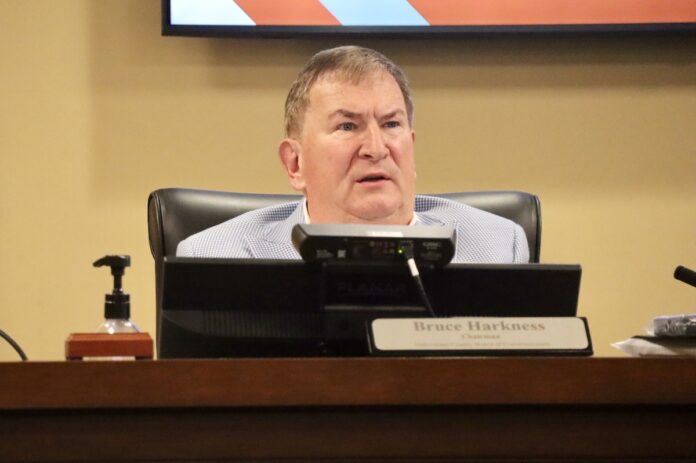
Following Monday night’s meeting of the Board of Commissioners, Chairman Bruce Harkness told Now Georgia the board is not ready to move forward that quickly.
“I don’t think we will be able… to get it on a vote for June,” Harkness said. “This is going to affect our county for generations. This is one of the most important votes that we’ve taken in my six years as a commissioner and my 18 years in public service here in the county.”
“We do not need to rush this,” he added. “We need to make sure that we’re doing the right thing… and be thinking about our people at the same time.”
The comments come just days after a packed public town hall drew more than 150 residents, many of whom raised concerns about how the proposed ordinance could impact property rights, density and the county’s rural character.
‘Still in the question stage’
During Monday’s work session, Harkness made clear the board is still far from final decisions.
“I think we’re still in the question stage. I don’t want to be rushing this,” he said.
He also indicated additional public engagement is likely before any vote is scheduled.
“I still think we’re probably going to have to have some more meetings on this, maybe even another town hall,” Harkness said.
Planning Director Mike Beecham agreed, telling commissioners that internal work is still needed before returning to the public with a revised plan.
“I think we need a meeting to go over the map and get it the way y’all are comfortable with it, and then present that to the public,” Beecham said.
Lot size divide draws pushback
One of the most contentious issues remains proposed differences in minimum lot sizes
between the north and south ends of the county — a point Harkness said is generating significant feedback.
“I’m getting some pullback on the north end of the county… a lot of people are saying, ‘Why have the dividing line?’” he said.
Under the current proposal, smaller lots could be allowed in the southern portion of the county, while larger minimums would apply in the north.
“South end, two acres. North end, five acres. That is a big conflict,” Harkness said.
The divide reflects an effort to direct higher-density growth toward areas with more infrastructure, but critics have questioned whether the approach is fair or consistent.
Zoning map errors, philosophy under review
Much of Monday’s discussion focused on correcting zoning maps that were part of the draft ordinance and drew criticism during the town hall.
Beecham said some residential properties were inadvertently placed into new commercial zoning districts during the drafting process.
“There are a large number of residential subdivisions that… had ended up in one of the commercial districts that we are fixing as we find them,” he said.
He explained the issue stems in part from how the county translated its future land use map into a zoning map, with some mixed-use areas being shifted into new commercial categories.
At the same time, Beecham noted the situation is not entirely new.
“There’s a whole bunch of residential properties in Habersham County that are currently zoned HI,” he said, referring to heavy industrial zoning.
Using examples from across the county, Beecham said staff are trying to apply a consistent approach — moving established neighborhoods into residential categories while leaving room for commercial or industrial growth in key areas.
“If it’s an existing residential area that’s been there for years and years, I don’t necessarily want to hurt those folks,” he said.
But that approach raises a broader policy question for commissioners: whether zoning should reflect how land is used today or how it is expected to develop in the future.
“Do you want to zone it to where we think it’s going to be developing toward in the future, or what is currently used?” Beecham asked.
He described zoning maps as inherently flexible.
“Zoning is… a living document,” he said.
Harkness pushed back slightly on that idea, noting the legal implications of zoning decisions.
“They also say zoning can be illegal taking property owner’s rights,” he said.
Next steps unclear
Commissioners did not take any action on the ordinance Monday, and no timeline has been set for a vote.
Instead, officials indicated the next phase will likely include additional internal meetings to refine the zoning map, followed by another round of public engagement.
For Harkness, the focus remains on getting the details right — even if it takes longer than initially anticipated.
“We need to make sure that we’re not rushing anything and do what’s right for our people,” he said.
Don’t miss what everyone in town is talking about.
Join 4,000+ locals and choose our free newsletter covering news, events and the stories shaping our region.