

(GPB News) – As Americans prepare to celebrate the country’s 250th birthday, a number of newly published books are taking a look at Revolutionary times.
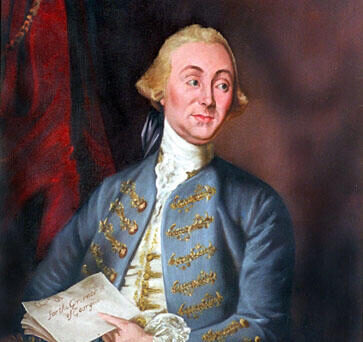
In Georgia, Atlanta writer, historian and social studies teacher Greg Brooking is out with the first-ever biography of the man who served as Georgia’s colonial governor in 1776.
His book, From Empire to Revolution: Sir James Wright and the Price of Loyalty in Georgia, provides a vivid, blow-by-blow account of the British Empire’s last years in Georgia.
GPB’s Orlando Montoya spoke with Brooking about what made him a good and bad governor for British colonists living in Georgia at the time — starting with the good.
Greg Brooking: He was ideally suited to be a colonial governor. He was born in England to a family of some renown. His grandfather was King James II’s chief justice. His father brought the family to Charleston initially, where his father was the royal chief justice of South Carolina. So he had a foot in both camps. He had a foot in England and he had a foot here in America. He aligns himself with Georgia’s burgeoning planter class, the elite. And he continues to grow Georgia both in terms of population and economic viability, but also in terms of geographic land mass. He purchases close to 5 million acres of land from various native tribes over two different deals that augments Georgia’s geography as well as population.
Orlando Montoya: So he had tangible success in the years leading up to the revolution here, but yet he failed in stopping it in Georgia. What made him a bad governor?
Greg Brooking: I’m not sure I would say he was a bad governor in any way, except for he was incapable of understanding the revolutionary mind. He was a true conservative of the 18th century. He believed that government should be conducted by the wealthy elite who have been educated, who serve the public interest. And he was very popular. He was the only governor of the 13 colonial colonies to successfully distribute stamps during the Stamp Act crisis in 1765. That cost him a good bit of capital to do so. By 1773, he has been baroneted by King George III, so he becomes Sir James Wright for his services to Georgia. But then at the same time, the Boston Tea Party happens. And Britain’s response to the Boston Tea Party was to drop the hammer on Massachusetts and Bostonians by issuing what became to be known as the Coercive or the Intolerable Acts. Those were so punitive that Georgians started to fear that if they can do that to Boston and Massachusetts, they can it to Savannah and Georgia. And the tide shifts in Georgia, but all along the 13 colonies, the tide shifts as a result of the Coercive Acts.
Orlando Montoya: In some respects, he sounds like he was on the side of the revolutionaries in some way because he advised top officials in Parliament in 1774 that Parliament should grant representation to the Americans.
Greg Brooking: Yeah, he was ahead of the time in a couple of instances. That you mentioned there is great. Even before that, in 1765 and ’66, he’s advising Parliament to do similar things so as to avoid these problems in the future. And had they heeded those suggestions, who knows what would have happened? Certainly counterfactual history is tough to contemplate, but still. And he was opposed to the Stamp Act. He thought it was bad legislation.
Orlando Montoya: He told the Liberty Boys, “You may be advocates for liberty; so am I, but in a constitutional and legal way.”
Greg Brooking: I’m glad you brought that quote up because I was about to mention that. Yes, and that is him in a nutshell. He figured in his mind that they were going down a path to destruction.
Orlando Montoya: One reason I like the book is because it all sort of puts you in the mind of the people at the time and it kind of makes you think “What would I have done?” Because, in this case, the conservative position would have been the position to stay with the crown
Greg Brooking: Right.
Orlando Montoya: And the radical liberal position, if we can even use those terms,
Greg Brooking: Right, right.
Orlando Montoya: would have been to go with these rebels. And so I think the point of your book is that this was really a civil war.
Greg Brooking: Yeah, this was. Aside from maybe New Jersey, the fighting in Georgia and South Carolina is the bloodiest and nastiest in the American Revolution. You know, it’s not just between families breaking up, father staying loyal to the crown, his rebellious sons joining the patriot movement, but between families. There is indiscriminate killing on both sides.
Orlando Montoya: What do we know about his enslaved property?
Greg Brooking: Good question. He leaves Georgia in 1776 as either the wealthiest or second-wealthiest Georgian. His lieutenant governor, John Graham, may have been slightly wealthier, but they were both large, large planters. James Wright owned 11 plantations. He enslaved, at the time of the Revolution, 523 humans. When he is arrested and then sent into exile, those are confiscated by the rebels.
Orlando Montoya: And finally, how does it feel to be talking at America’s 250th anniversary about a Loyalist?
Greg Brooking: Right. It’s actually really interesting. I wish I had been bright enough to time this that way. … It’s just how the book ended up being published. So it wasn’t in concert thinking that I could take advantage of this time period.
Orlando Montoya: Well, we’re all celebrating the victorious side.
Greg Brooking: Right. And it’s really interesting because I really like talking about those with lesser representation in the typical historical narrative. You know, to the victor go the spoils, but also go the stories. And when you win wars, it’s your story of the war that’s taught. And that’s still true. I’d never heard of Loyalists growing up, but they are now just now starting to get their due as — not just necessarily worthy adversaries, if that’s even the correct phrasing — but as Americans. Demographically, they fit into every category that patriotic Americans or rebels fit into. Some were wealthy, some were middle-class. They just chose what was, in their mind, stability and patriotism, right? It’s just patriotism to their current country. They believed, in many cases, the same things that the Patriots believed about the taxation and the legislation that was coming from Britain, but they didn’t think that you could just rebel. They thought that you had to go through these legal measures, and sometimes legal measures aren’t enough.
Orlando Montoya: Well, Greg Brooking, it’s been fascinating talking to you. I appreciate you being here and I appreciate the book. It’s called From Empire to Revolution: Sir James Wright and the Price of Loyalty in Georgia. Thank you.
Greg Brooking: Thank you so much.
Greg Brooking spoke with Orlando Montoya for the latest episode of Narrative Edge.
Brooking also will be on a panel of authors that Orlando is moderating on Thursday, July 9, about Georgia’s pivotal role in the American Revolution.
And finally, don’t forget to watch Marked!, GPB’s 12-episode video series about the American Revolution in Georgia.
Don’t miss what everyone in town is talking about.
Join 4,000+ locals and choose our free newsletter covering news, events and the stories shaping our region.