
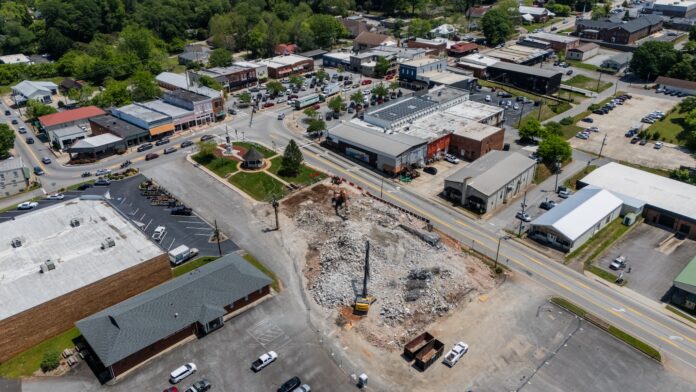
CLARKESVILLE — The Clarkesville City Council on Tuesday continued discussions on the long-debated redevelopment of 555 Monroe Street, emphasizing parallel planning for a proposed downtown hotel and a future fire station, though no formal votes were taken.
The agenda item focused on the city’s path forward for the former courthouse property, which has been identified in prior studies as a potential mixed-use site anchored by a boutique hotel alongside public safety facilities.
Mayor Franklin Brown said the city’s long-term approach centers on addressing multiple infrastructure and development needs at once, including fire protection, utilities and downtown economic growth.
“What we do have is an infrastructure issue for our fire department. They need better accommodations, period,” Brown said, adding that the city originally acquired the property with both a fire station and income-producing development in mind.
Brown said engineering and planning work is underway, including early design discussions, while water and wastewater infrastructure needs will extend over a five- to eight-year planning horizon.
“All three projects will move forward simultaneously,” Brown said. “Nothing’s going to be first place or second place.”
Brown also pointed to potential public-private partnership models through the Downtown Development Authority as the city considers how to finance and structure redevelopment.
Local business owner and Downtown Development Authority member Joey Duncan said Clarkesville has successfully used similar partnership structures in prior downtown projects.
“In order for the city to be able to do that with a public-private partnership, fund that project and the DDA can stay on as a participant,” Duncan said.
He added that past projects have combined local funding, state programs and private investment, with the DDA sometimes maintaining ownership before eventual sale or reinvestment of proceeds.
Master urban planner Lew Oliver outlined a broader vision for the Monroe Street site, calling it a key opportunity to shape downtown Clarkesville’s long-term identity.
“You’re designing for the experience, first for the flow of the experience,” Oliver said, emphasizing integration of infrastructure, access, and pedestrian design.
Oliver urged the city to consider a charrette-style planning process that brings together elected officials, engineers, residents and potential developers early in the design phase to build consensus.
He also addressed public discussion about green space, arguing that downtown civic space must be intentional and functional rather than passive land preservation.
“There’s definitely a place for green space. Clarkesville is surrounded by green space,” Oliver said. “But what we don’t have is a real town center.”
He said successful downtowns must prioritize walkability, economic activity and connectivity to retain younger residents and attract visitors.
During public comment, Clarkesville resident Dale Latty urged the council to slow the process and begin a formal charrette focused specifically on fire station placement before advancing broader redevelopment plans.
Latty questioned whether combining a fire station and hotel on the same property was practical and suggested alternative sites should be considered.
“The fire station should be a charrette,” Latty said.
Mayor Brown responded that the city has already evaluated multiple potential fire station sites, including the old garment factory property and other parcels, and determined they do not meet operational or financial constraints.
“We have evaluated everything for the fire station,” Brown said. “We don’t have $2 million for the next best site.”
Brown also cited ISO rating requirements that he said limit where a fire station can be located relative to the city center in order to maintain insurance rates and emergency response standards.
“[We] have to be within certain distance and proximity to our town center,” he said.
Following adjournment, Brown reiterated that all three major efforts — fire station planning, infrastructure upgrades and downtown redevelopment — remain in early stages and will proceed on overlapping timelines.
“There is no date. There is no deadline,” Brown said. “It will happen organically.”
He added that the city is still in a discovery phase involving state and federal review, engineering assessments and future financing strategies.
Separately, Councilwoman Leigh Johnston said Clarkesville’s current trajectory is defined by managing existing traffic and capturing more economic activity from pass-through visitors.
“We are just trying to accommodate and maintain that growth where it’s appropriate for the citizens that are already here,” Johnston said.
She said the city’s goal is to enhance downtown with sidewalks, pedestrian improvements and small-scale development that supports restaurants and retail while preserving the community’s character.
On the fire station debate, Johnston said public safety requirements and ISO standards significantly constrain site selection, requiring proximity to the town center to maintain insurance rates and response times.
She said the city has evaluated multiple properties but limited availability and cost constraints narrow viable options.
“We have to be within a mile from city center,” she said, noting that some commonly suggested parcels fall outside those parameters.
Johnston added that while timelines remain uncertain, the city is moving through early assessment and engineering phases that will shape the final design and sequencing of projects.
Don’t miss what everyone in town is talking about.
Join 4,000+ locals and choose our free newsletter covering news, events and the stories shaping our region.