The Leopards aim to take a significant step forward this year, with a solid group of skilled players returning. Banks County still faces a tough schedule overall, but should show significant improvement in year two under Todd Winter.
Head Coach: Todd Winter (2nd Season) 2024 Record: 2-8; No Playoffs
Offense: Triple Option
Lane Morris returns as the starting QB, and Davian Knox at RB will be the main ball-carrier. Caden Watson will once again be the go-to option at WR if Banks needs to throw the ball.
Defense: Multiple
Knox, Dayden Rogers, and Haiden Williamson stand to have a big season for Banks County on the defensive side of the ball.
Trenches: Strong. This will be the biggest area of strength for the Leopards.
Strengths & Areas of Focus
Strengths: OL, according to Winter.
Focusing On: “Strength and conditioning,” says Winter.
Hall County Sheriff’s Office investigators arrested a Lula teenager on Tuesday for alleged possession of child sexual abuse material.
18-year-old Jaylen Malik Bell was taken into custody on July 15 after being interviewed at the sheriff’s office headquarters. He remains in the Hall County Jail without bond.
The arrest followed a two-month investigation by the sheriff’s Internet Crimes Against Children (ICAC) unit. Investigators launched the case on May 16 after receiving a cyber tip from the National Center for Missing and Exploited Children.
According to the sheriff’s office, Bell uploaded multiple sexually explicit images of children to his email account. Investigators obtained a warrant for his arrest and charged him with six counts of sexual exploitation of children.
U.S. Marshals arrested a Cornelia man in Hall County on Friday, July 11, after he spent eight months on the run, authorities announced Wednesday.
The Habersham County Sheriff’s Office had been searching for 45-year-old Omar Cruz-Juarez since November 13, 2024. That’s when investigators charged him with multiple felonies related to a reported incident in the unincorporated part of Habersham.
Cruz-Juarez faces serious charges, including aggravated child molestation, two counts of aggravated sodomy, sexual battery, and four counts of child molestation.
Deputies listed him among Habersham County’s most wanted fugitives shortly after the charges were filed.
As of Wednesday, Cruz-Juarez remains in custody at the Habersham County Detention Center. Law enforcement officials say they are not releasing additional details about the case at this time.
During the town of Alto’s city council meeting, the town’s police chief Josh Ivey reported that someone had shot at the police department’s door with a BB gun on July 7.
An Alto officer discovered three small holes in the window tint of the shattered glass door before the office opened. The officer also found BB pellets on the ground inside the department building, Ivey said.
“You can actually see [the shooting] happen on video, but the person is just out of range of the camera,” he said. Ivey confirmed that a suspect is under investigation for the incident.
The door was replaced shortly after the incident, costing around $400, according to Ivey.
This is not the first time an Alto city property door has been damaged recently. The little free library in Alto City Park was recently damaged both by BB pellets and by someone ripping the library door completely off its hinges.
“Both instances at the park were on video,” Ivey said. “We were not able to determine who shot at the library, but we were able to determine who tore off the door.”
The suspect who tore off the door was described as a juvenile frustrated with his girlfriend who took out his anger on the library.
No other information is known about the incidents at this time.
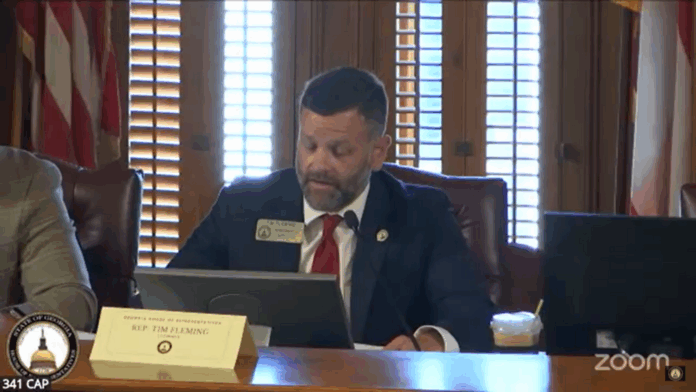
Committee chair Rep. Tim Fleming conducts the first meeting of the Blue-Ribbon Committee on Election Procedures in July 2025.
(Credit: Georgia House of Representatives YouTube)
A committee of lawmakers examining how elections are run held its first meeting Tuesday at the state Capitol.
The House of Representatives study committee on election procedure heard from state officials on the role of the State Election Board, Georgia’s voter roll maintenance process, and voter registration procedures. Members of the public also gave their testimony on concerns around elections.
Rep. Tim Fleming, who has filed paperwork to begin fundraising for a 2026 Georgia secretary of state campaign, chairs the committee.
“We are not here to litigate past elections, but rather to prepare Georgia for the future, to make sure that every legal vote counts, that voters have confidence in the system, and that our processes are secure, efficient and fair,” he said.
Vice Chair Victor Anderson said that the first meeting served as an “educational” meeting to provide members with background knowledge on current election procedures, and that the committee will be working with local elections officials in subsequent meetings.
The committee plans to hold five more meetings and then issue recommendations for elections policies that could become bills next year when the General Assembly reconvenes.
Peter Hubbard won Tuesday’s runoff for the Democratic primary for a seat on the Georgia Public Service Commission. (Photo contributed by Peter Hubbard)
(Georgia Recorder) — Peter Hubbard, a clean energy advocate, secured the Democratic Party nomination for the District 3 Georgia Public Service Commission seat Tuesday evening.
His decisive victory allows him to advance to November’s general election, where he will face GOP incumbent Commissioner Fitz Johnson.
The commission regulates utilities like Georgia Power and plays an important role in deciding how much Georgians pay for those services.
“I am grateful to be nominated the Democratic PSC candidate for District 3,” Hubbard said in a statement Tuesday night. “The PSC general election this Nov. 4 matters to all Georgians because power bills are skyrocketing, no one is holding the current Republican PSC accountable, and voters have the power to change that.”
Hubbard’s victory was thanks to more than 18,000 votes over Keisha Sean Waites, his opponent, who found greater success in the first round of voting last month. Despite winning 47% of primary votes in June, Waites came up short Tuesday and lost the chance to take on Johnson in the fall. The former state representative and previous Atlanta City Councilwoman focused her campaign on her legislative experience and public service history.
Keisha Waites was the top vote-getter in the first round of voting last month, but she came up short in Tuesday’s runoff. (Photo contributed by Keisha Waites)
Waites vowed Tuesday night to stay engaged in this year’s election.
“We will support the Democratic nominee Peter Hubbard and work tirelessly to ensure a victory in the general election this November. Our focus now shifts to uniting behind a shared vision for a Public Service Commission that truly serves the public,” Waites said in a statement.
District 3 includes Clayton, DeKalb and Fulton counties. Dekalb and Fulton were two counties where Hubbard was able to run up the score Tuesday night. He received thousands of more votes than Waites in each county, a lead that helped cement his victory.
After his second-place finish in the primary last month, Hubbard worked to overcome Waites’ initial advantage. His strategy included a long list of endorsements and an attack website that targeted Waites.
The AJC reported Tuesday that the Hubbard campaign purchased a website domain previously owned by Waites and used it to criticize Waites’ political career and her qualifications to serve on the commission.
With more than a dozen endorsements posted on his personal website, the support of Georgia officials and activists also became a prominent part of Hubbard’s campaign. Georgia Sen. Elena Parent, state Rep. Saira Draper, and Atlanta City Councilman Jason Dozier were some of the most notable supporters.
As a statewide election, all active Georgia voters who did not cast Republican ballots in last month’s primary were eligible to vote in Tuesday’s runoff. Despite over 7 million active voters across the state, voter turnout remained low.
Rising utility rates and increased energy demands dominated the primary election campaigns, and those debates will likely continue ahead of the general election. The sitting commissioners have faced criticism for allowing Georgia Power to raise rates by an average of $43 per month since 2023.
The winners of the November election will be the first elected commissioners since 2020. Regularly scheduled PSC elections were delayed after a 2020 lawsuit challenged the statewide electoral process and its impact on Black voters. The lawsuit is currently pending with the 11th U.S. Circuit Court of Appeals and still has the potential to cause additional delays.
The District 2 PSC seat will also be on the November ballot. In that race, Democrat Alicia M. Johnson is aiming to unseat Republican incumbent Commissioner Tim Echols, who has held the seat since 2011.
Fitz Johnson, the GOP incumbent who ran unopposed in the District 3 Republican primary, hopes to be elected after a 2021 appointment to the commission by Gov. Brian Kemp.
Fitz Johnson was appointed to the District 3 seat in 2021. (Photo from the Governor’s Office)
“The Public Service Commission may not grab headlines, but it’s one of our last lines of defense against the kind of energy chaos we’re seeing in California,” Johnson said in a Tuesday statement. “Georgia can’t afford rolling blackouts or unchecked spending. I’m committed to keeping energy reliable, affordable, and grounded in conservative principles.”
If Hubbard’s attempt to replace Johnson is successful, he could be the only Democrat on the regulatory board that currently consists of five Republicans. A Tuesday statement from both Republican incumbents facing voters this year pledged their joint support and shared goal of protecting Georgia from “liberal overreach.”
“We are a united front,” the candidates said in a joint statement. “We are committed to defending Georgia ratepayers, standing against reckless progressive agendas, and ensuring that our state remains a national model for affordable, reliable energy.”
Hubbard showed a similar sense of solidarity with the District 2 Democratic candidate, Alicia Johnson.
“Democrats Peter Hubbard and Dr. Alicia Johnson are the best choice for the PSC in November because they come ready with experience, plans, and grit to fight for seniors, low income households, and all those who deserve a lower power bill,” Hubbard said.
The winner of this year’s election will serve a one-year term and be back on the ballot again next year. The special PSC general election is scheduled for Nov. 4. Early voting starts Oct. 14.
Ella Miller as Matilda (left), Daniel Purcell as The Escapologist, Grace Thompson as The Acrobat, and Lisa Smith as Mrs. Phelps (far right) perform in "Matilda the Musical," opening July 16, 2025, at the Habersham Community Theater in Clarkesville. (Carly McCurry/Now Habersham)
During Monday’s dress rehearsal at the Habersham Community Theatre, the cast of Matilda the Musical delivered a performance brimming with energy and invention. Clever stagecraft, infectious choreography, and pitch-perfect humor brought Roald Dahl’s beloved story to life, reminding audiences that courage, cleverness, and a fierce sense of justice can still topple tyranny—even when tyranny comes in the form of a hammer-throwing headmistress.
A story of justice that endures
For the uninitiated, Matilda tells the story of an extraordinary little girl with an insatiable appetite for books and a keen moral compass. Matilda Wormwood, born into a family of boorish, self-absorbed grifters, finds refuge in reading and learning. At school, she faces the tyrannical Miss Trunchbull, a headmistress so terrifying she hurls children across the playground by their pigtails. But through her wit, resilience, and a touch of telekinesis, Matilda fights back—not just for herself but for her classmates and her teacher, Miss Honey.
Chris Parker as Miss Trunchbull, the students of Crunchen Hall, and Abigail Taylor (left) as Miss Honey perform at HCT’s dress rehearsal of “Matilda the Musical” on July 14, 2025. The show opens July 16 and runs through August 3. (Carly McCurry/Now Habersham)
The tale, first published in 1988 and adapted for the stage in 2010, resonates because it taps into something deeply human: the yearning for fairness. Children, more than anyone, need to believe the world can be set right. Dahl’s story suggests that through courage and cleverness, even the smallest among us can upend injustice and claim happiness, not just for ourselves but for others, too.
A magnetic Matilda
It helps, of course, to have a Matilda who radiates the infectious spirit and sweetness of the original character. That evening, young Ella Miller did exactly that—commanding the stage with the precocity of a young Natalie Wood. Her British accent, carried even through her songs, lent an authenticity rare in a performer so young. With exaggerated gestures and bold, expressive movements, she embodied the clever, defiant heroine.
Miller shares the role with Alivia Worsham. The young actresses perform on alternating schedules, as do the other young cast members, due to the demands of their roles.
Scene stealers abound
Joshua Gamboa (left), Abigail Taylor (center), and Julianna Weyrich (right) perform at the Habersham Community Theatre in Clarkesville. (Carly McCurry/Now Habersham)
Around the production’s lead swirled a vibrant, colorful ensemble. Julianna Weyrich brought glittering energy to Mrs. Wormwood, Matilda’s narcissistic and appearance-obsessed mother. In her scenes with Rudolpho—a flamboyant dance instructor brought to life by Joshua Gamboa—Weyrich embraced a delicious caricature of the restless housewife, all manicures and microwaved dinners.
Gamboa, for his part, oozed the carefully rehearsed confidence of a self-styled sophisticate, his exaggerated Latin accent deployed when it suited him and conveniently dropped when it did not. Together, they had the audience in stitches.
Clark Ivie, as Mr. Wormwood, displayed excellent physical comedy abilities. With his garish 1970s Danny DeVito–chic costumes and hapless bluster, he formed a delightfully dysfunctional double act with his onstage son, Michael Wormwood, played by Eye’N Banks. Their dynamic offered moments of humor that offset the story’s darker themes.
Eye’N Banks (left) and Clark Ivie present a dynamic father and son duo in “Matilda the Musical,” now playing at the Habersham Community Theatre in Clarkesville. (Carly McCurry/Now Habersham)
Another standout, Oliver McFaddin, seemed as if he had wandered straight out of Oliver Twist—a young actor born to play a put-upon British schoolboy. With expressive eyes and impeccable comedic timing, McFaddin brought Bruce Bogtrotter—the hapless, cake-eating bandit—to life. His songs were delivered with an endearing mix of mischief and vulnerability, earning some of the night’s most resounding applause.
Oliver McFaddin (center) takes the stage as Bruce Bogtrotter, with Levi Rudeseal (left), who alternates in the role on other nights, pictured as Tommy. (Carly McCurry/Now Habersham)
Then there was Mara Bishop, who played Amanda Thripp, the blonde little girl with the pigtails, whose performance quietly became one of the show’s most memorable. In “School Song,” her wide eyes darted in terror at the horrors of Crunchem Hall. Later, her “flight” across the stage—propelled by the fearsome Miss Trunchbull—was a crowd favorite.
Bishop, who shares the role with Hallie Hatchett on alternating schedules, wasn’t the lead. Still, her impeccable dancing and genuine expressions underscored one of Matilda’s key truths: even small players can make a big impact.
Mara Bishop (second from left, front row) portrays the pigtail-wearing wonder Amanda Thripp. (Carly McCurry/Now Habersham)
Hilarious & delightfully grotesque
The musical numbers, composed by Tim Minchin, struck a perfect balance between irreverence and poignancy. “This Little Girl is a Miracle,” sung by Abigail Taylor as Miss Honey, showcased her endearing soprano, casting a gentle spell over the room. Meanwhile, “When I Grow Up” delivered a gut punch of quiet longing. As the children sang of their visions for adulthood—equal parts hopeful and heartbreaking—the parents in the audience grew sentimental.
As Miss Honey in Matilda the Musical, Abigail Taylor (right) pairs a consistent British accent and an exceedingly pleasant soprano with a sweet, honeyed appearance that brings the character to life. (Carly McCurry/Now Habersham)
Choreography, crafted by director Chris Parker, brimmed with bold, angular movements that mirrored the show’s quirky sensibilities. Parker also starred as Miss Trunchbull, his towering presence and hilariously grotesque mannerisms striking a delicate balance between menace and absurdity.
Chris Parker directs, choreographs, and stars as Miss Trunchbull. The lights suggest intensity, serving as cues to the audience. (Carly McCurry/Now Habersham)
The lighting design was particularly clever, using bursts of red to heighten fear and punctuate comedic beats. Combined with costumes ranging from early-20th-century circus flair to gothic school uniforms and Wormwood family ensembles dripping with gaudy tackiness, the visual storytelling felt as rich and layered as the narrative itself.
A legacy of mischief and magic
Since its West End premiere in 2011 and Broadway debut in 2013, Matilda the Musical has enchanted audiences worldwide, winning seven Olivier Awards and five Tonys. Though the original Broadway run ended in 2017, touring and regional productions continue to breathe new life into Dahl’s creation. This production proves why: Matilda isn’t just a story about a precocious little girl; it’s a timeless reminder of the power of reading, justice, and kindness.
The Wormwood family (Ella Miller, Eye’N Banks, Clark Ivie, and Julianna Weyrich) gathers in their living room. Their very postures suggest much about their characters. (Carly McCurry/Now Habersham)
In an era when children confront a world that often feels chaotic and unfair, Matilda offers a vital reassurance. Evil may loom large, but courage and cleverness can still prevail. And in that victory, happiness is not only possible—it’s deserved.
At the final bow, it was clear: this cast had worked hard and poured their hearts into the performance. For seven months, they had been learning and living with their characters. The result was a production brimming with energy, humor, and that elusive touch of magic Dahl would surely have approved of.
Performances of Matilda the Musical run July 16–20, July 23–27, and August 2–3, 2025. Weeknight and Saturday shows are at 7:30 p.m. with 2 p.m. Sunday matinees and an extra matinee on Saturday, August 2. Tickets are available for purchase online.
This article has been corrected to reflect that Mara Bishop performed on the night of this review.
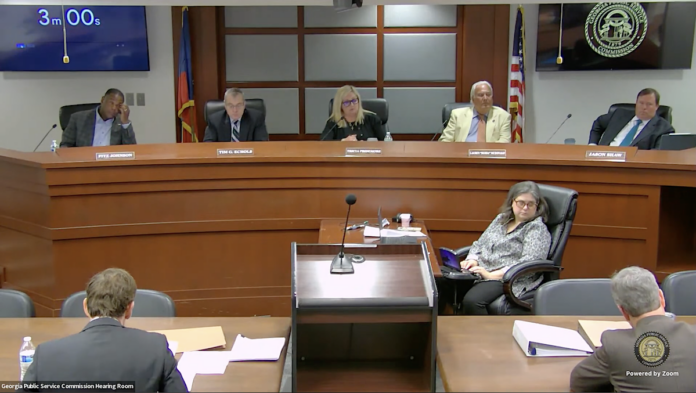
Georgia Public Service commissioners, from left, Fitz Johnson, Tim Echols, Tricia Pridemore, Lauren "Bubba" McDonald Jr., and Jason Shaw. (PSC livestream image May 2023)
(Georgia Recorder) — Georgia Power will expand its renewable energy generation and keep some of its coal plants open longer than previously planned under a compromise deal approved by state regulators Tuesday.
The Georgia Public Service Commission unanimously approved the deal that maps out Georgia Power’s energy plans for the coming years, despite objections from consumer advocates who claimed the agreement violates a previous commission order. Although several interest groups requested changes, the commissioners did not propose any amendments before voting.
“As our state continues to grow and thrive, the approval of this comprehensive plan helps to ensure we have the resources and programs we need to reliably and economically meet the future energy needs of our customers,” said Georgia Power CEO Kim Greene in a statement.
The plan predicts skyrocketing growth in energy demand, mostly due to data centers, and lays out how the utility will meet it, through a mix of building new power plants and upgrading old ones. The plan extends two coal plants beyond their previously proposed closure dates, a controversial move because of coal’s intensive greenhouse gas emissions contributing to climate change. It also approves updates to existing nuclear reactors, hydroelectric plants and transmission lines.
Before seeking bids for new resources — a process due to start in October — Georgia Power will need to refine its forecast and provide regular updates on growing demand. The company’s projections on demand were a major point of contention throughout the proceedings, with critics arguing it overestimates how much energy new customers like data centers will actually need and how quickly that demand will come.
“With unprecedented grid growth ahead for Georgia, this Integrated Resource Plan puts us on the right path to meet everyone’s needs,” said commissioner Tim Echols in a statement. “I wish it had more solar, more storage, more energy efficiency — but it strikes a good compromise in the spirit of collaboration.”
The most strident objections to the agreement came from consumer advocates who felt that the energy efficiency provisions violated a previous commission order.
In 2023, those advocates signed on to a settlement agreement that raised power rates to pay for construction costs at Plant Vogtle, in exchange for an expansion of a senior discount program and an increase in energy efficiency savings. While the utility initially proposed an energy efficiency target that matched the Vogtle deal, the agreement approved Tuesday falls short of that amount.
“This is an incredible blow to Georgia Power’s credibility and the credibility of the IRP process,” said Codi Norred, executive director of Georgia Interfaith Power and Light, one of the advocacy groups that signed the Vogtle agreement, in a statement. “I can’t see how anyone would come to the negotiation table with Georgia Power in good faith again after witnessing the bait and switch the company just pulled off with the commission’s blessing.”
Echols expressed the same concern in a hearing last week, but ultimately voted for the agreement without proposing any changes.
Georgia Power and the commission’s staff maintain they did not violate the Vogtle agreement, which said only that the utility would “propose and support” the higher efficiency goal, known as a DSM savings target, and allowed that commission staff could advocate for a different figure. In a filing last week, the utility argued the new deal “still results in one of the highest DSM savings targets to be approved in recent history, and certainly better than what may have occurred if the Vogtle Prudence Stipulation had not been approved by this Commission.”
“Georgia Power fulfilled its obligations under the Vogtle Prudence Stipulation and no reasonable interpretation of that document could determine otherwise,” that filing read.
This coverage is made possible through a partnership between WABE and Grist, a nonprofit environmental media organization.
Philadelphia Phillies Kyle Schwarber celebrates after winning the tiebreaker at the MLB baseball All-Star game between the American League and National League, Tuesday, July 15, 2025, in Atlanta. (AP Photo/Brynn Anderson)
ATLANTA (AP) — Kyle Schwarber went 3 for 3 in the first All-Star Game home run swing-off to put the National League ahead 4-3 following a 6-6 tie in which the American League rallied from a six-run deficit on Tuesday night.
In baseball’s equivalent of soccer’s penalty-kicks shootout, the game was decided by having three batters from each league take three swings each off coaches. The change was agreed to in 2022 to alleviate the concern of teams running out of pitchers.
Schwarber was named All-Star MVP after going 0 for 2 with a walk in the game.
Players from both teams stood outside their dugouts during the swing-off, jumping and shouting after each homer from their side. When Jonathan Aranda’s last swing for the AL fell short, NL players circled around Schwarber to celebrate.
“It was awesome,” Schwarber said. “The guys were really into it. They were yelling, screaming, cheering me on every swing. And then when that last one goes over, they were all pumped. It was a lot of fun.”
Brent Rooker put the AL ahead by homering on his last two swings, and Kyle Stowers — subbing for Eugenio Suárez — hit one.
Randy Arozarena boosted the AL lead to 3-1, and Schwarber was successful on all three tries, going down to a knee as he sent the one into the Chop House seats in right.
Aranda failed on all three tries, hitting the right-field wall with his second, and the NL didn’t have to use its last batter, two-time Home Run Derby champion Pete Alonso, as it won for just the second time in the last 12 All-Star Games. The AL leads 48-45 with two ties.
Ketel Marte’s two-run double in the first had put the NL ahead, and Alonso’s three-run homer off Kris Bubic and Corbin Carroll’s solo shot against Casey Mize opened a 6-0 lead in the sixth.
The AL comeback began when Rooker hit a three-run pinch homer against Randy Rodríguez in a four-run seventh that included Bobby Witt Jr.’s RBI groundout.
Robert Suarez allowed consecutive doubles to Byron Buxton and Witt with one out in ninth, and Steven Kwan’s infield hit on a three-hopper to third off Edwin Díaz drove in the tying run.
Joe Torre, the 84-year-old former Yankees manager, went to the mound for a pitching change in the eighth to take the ball from Shane Smith and hand it to Andrés Muñoz. The Hall of Famer was picked as a coach by current New York skipper Aaron Boone, who managed the AL.
Heat on the mound
Paul Skenes, the first pitcher to start the All-Star Game each of his first two seasons, struck out Gleyber Torres and Riley Greene in a perfect first that included Aaron Judge’s inning-ending groundout. The 23-year-old right-hander reached 100 mph on four of 14 pitches.
Jacob Misiorowski, a controversial inclusion after pitching in just five major league games in his rookie season, fired nine pitches of 100 mph or more in a one-hit eighth 34 days after his major league debut. The 23-year-old righty, added to the NL roster by baseball Commissioner Rob Manfred, reached 102.3 mph.
There were 21 pitches of 100 mph or more, down from a record 23 last year but up from 13 in 2023, 10 in 2022 and one in 2021.
Robot umpire debuts
Four of five challenges were successful in the first use of the robot umpire in the All-Star Game
Athletics rookie Jacob Wilson also was successful as the first batter to call for a challenge, reversing a 1-0 fastball from Washington’s MacKenzie Gore in the fifth inning that had been called a strike. Mets closer Edwin Díaz and Blue Jays catcher Alejandro Kirk also won challenges, and Marlins outfielder Kyle Stowers lost one.
Earning a hand
Freddie Freeman was removed for Alonso with two outs in the third inning, giving the crowd of 41,702 a chance to cheer a player who spent 12 seasons with the Braves and helped win the 2021 World Series title.
Jazz Chisholm Jr. arrived in a Valentino smoking jacket and Christian Louboutin shoes. Instead of having players line up on the foul lines as they were introduced, they walked to a four-level red podium stretching across the infield dirt with flashing lights, smoke a DJ and dancers.
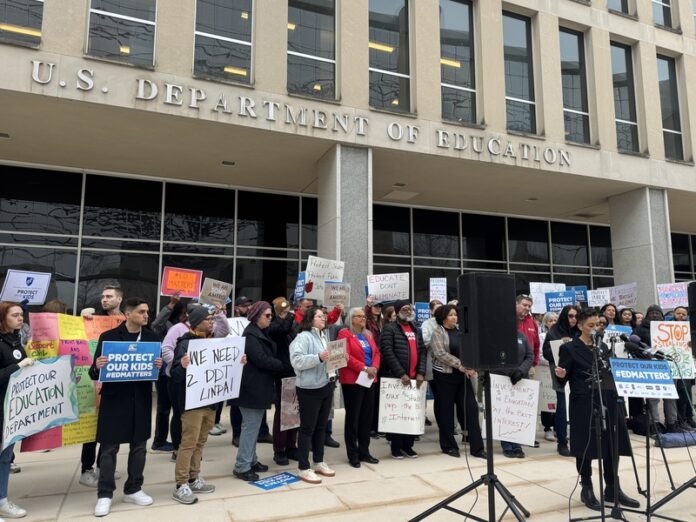
Keri Rodrigues, president of the National Parents Union, speaks at a rally on Friday, March 14, 2025, in Washington, D.C, protesting the U.S. Education Department’s mass layoffs and President Donald Trump’s plans to dismantle the agency. (Shauneen Miranda/States Newsroom)
WASHINGTON (States Newsroom) — The U.S. Department of Education has emerged as central in the struggle over control of the power of the purse in the nation’s capital.
Democrats in Congress are pushing back hard on the Trump administration’s freeze of $6.8 billion in funds for after-school programs and more at public schools, some of which open their doors a few weeks from now. California alone lost access to $939 million and every state is seeing millions of dollars frozen.
At the same time, the Supreme Court on Monday slammed the door on judicial orders that blocked the dismantling of the 45-year-old agency that Congress created and funds.
The nation’s highest court cleared the way for the administration to proceed, for now, with mass layoffs and a plan to dramatically downsize the Department of Education that President Donald Trump ordered earlier this year.
In her scathing dissent, Justice Sonia Sotomayor wrote that “the majority is either willfully blind to the implications of its ruling or naive, but either way the threat to our Constitution’s separation of powers is grave.”
Sotomayor, joined by Justices Elena Kagan and Ketanji Brown Jackson, wrote that the president “must take care that the laws are faithfully executed, not set out to dismantle them.”
“That basic rule undergirds our Constitution’s separation of powers,” she wrote. “Yet today, the majority rewards clear defiance of that core principle with emergency relief.”
Just a day after the Supreme Court’s decision, House Speaker Mike Johnson told reporters at a Tuesday press conference that while he hasn’t had a chance to digest the Supreme Court’s order, he also knows that “since its creation, the Department of Education has been wielded by the executive branch.”
“I think that was the intent of Congress, as I understood it back then. We have a large say in that, but we’re going to coordinate that with the White House,” the Louisiana Republican said.
“If we see that the separation of powers is being breached in some way, we’ll act, but I haven’t seen that yet,” he added.
Letters from Democrats on frozen funds
Two letters from Senate and House Democrats demanding the administration release the $6.8 billion in federal funds for various education initiatives also depict the Education Department as a key part of the tussle between the executive branch and Congress.
Just a day ahead of the July 1 date when these funds are typically sent out as educators plan for the coming school year, the department informed states that it would be withholding funding for programs, including before- and after-school programs, migrant education, English-language learning and adult education and literacy, among other initiatives.
Thirty-two senators and 150 House Democrats wrote to Education Secretary Linda McMahon and Office of Management and Budget Director Russ Vought last week asking to immediately unfreeze those dollars they say are being withheld “illegally.”
“It is unacceptable that the administration is picking and choosing what parts of the appropriations law to follow, and you must immediately implement the entire law as Congress intended and as the oaths you swore require you to do,” the senators wrote in their letter.
The respective top Democrats on the Senate Appropriations Committee and its subcommittee overseeing Education Department funding, Sens. Patty Murray of Washington state and Tammy Baldwin of Wisconsin, led the letter, alongside Vermont independent Sen. Bernie Sanders, the ranking member of the Senate Committee on Health, Education, Labor and Pensions.
In the lower chamber, House Democrats wrote that “without these funds, schools are facing difficult and unnecessary decisions on programs for students and teachers.”
“No more excuses — follow the law and release the funding meant for our schools, teachers, and families,” they added.
Georgia’s Rep. Lucy McBath led the letter, along with the respective top Democrats on the House Committee on Education and Workforce, its subcommittee on early childhood, elementary and secondary education and its panel on higher education and workforce development: Reps. Bobby Scott of Virginia, Suzanne Bonamici of Oregon and Alma Adams of North Carolina.
Democratic attorneys general, governors file suit
Meanwhile, a coalition of 24 states and the District of Columbia sued the Trump administrationon Monday over those withheld funds, again arguing that Congress has the power to direct funding.
The states suing include: Arizona, California, Colorado, Connecticut, Delaware, Hawaii, Illinois, Maine, Maryland, Massachusetts, Michigan, Minnesota, Nevada, New Jersey, New Mexico, New York, North Carolina, Oregon, Rhode Island, Vermont, Washington state and Wisconsin.
Pennsylvania Gov. Josh Shapiro and Kentucky Gov. Andy Beshear, both Democrats, also signed onto the suit filed in a Rhode Island federal court.
“Not only does Congress require that Defendants make funds available for obligation to the States, Congress, in conjunction with (Education Department) regulations, also directs the timing of when those funds should be made available,” the coalition wrote.
An analysis earlier in July by New America, a left-leaning think tank, found that the top five school districts with the greatest total funding risk per-pupil include those in at least two red states: Montana’s Cleveland Elementary School District, Kester Elementary School District and Grant Elementary School District, along with Oregon’s Yoncalla School District 32 and Texas’ Boles Independent School District.
The think tank notes that program finance data was not available for Massachusetts, New Hampshire, New York and Wisconsin.
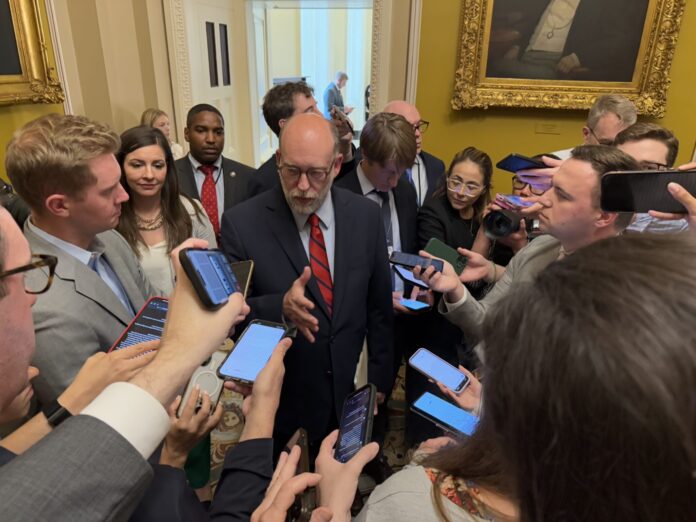
White House budget director Russ Vought speaks with reporters inside the U.S. Capitol building on Tuesday, July 15, 2025. (Jennifer Shutt/States Newsroom)
WASHINGTON (States Newsroom) — The U.S. Senate on Tuesday night moved one step closer to canceling $9 billion in previously approved funding for several foreign aid programs and public broadcasting after GOP leaders addressed some objections.
Nearly all the chamber’s Republicans voted to begin debate on the bill, though Maine’s Susan Collins, Kentucky’s Mitch McConnell and Alaska’s Lisa Murkowski opposed the procedural step along with every Democrat.
The 51-50 vote marked a significant moment for President Donald Trump’s rescissions request, which faced more headwinds in the Senate than in the House. Vice President JD Vance cast the tie-breaking vote.
Trump proposed doing away with $1.1 billion for the Corporation for Public Broadcasting that lawmakers had approved for the next two fiscal years as well as $8.3 billion from several foreign aid accounts.
The Corporation for Public Broadcasting provides funding to National Public Radio, the Public Broadcasting Service and local media stations throughout the country.
Senate Majority Leader John Thune, R-S.D., said before the vote that some of the progress stemmed from removing a spending cut for the President’s Emergency Plan for AIDS Relief, or PEPFAR, a global health program to combat HIV/AIDS launched by former President George W. Bush.
“There was a lot of interest among our members in doing something on the PEPFAR issue and that’s reflected in the substitute,” Thune said. “And we hope that if we can get this across the finish line in the Senate that the House would accept that one small modification.”
South Dakota Republican Sen. Mike Rounds, who had raised concerns about cutting funding for rural public broadcasting stations run by tribal communities, announced a few hours before the vote he’d reached an agreement with the White House.
“We wanted to make sure tribal broadcast services in South Dakota continued to operate which provide potentially lifesaving emergency alerts,” Rounds wrote in a social media post. “We worked with the Trump administration to find Green New Deal money that could be reallocated to continue grants to tribal radio stations without interruption.”
Rounds said during a brief interview that $9.4 million will be transferred from an account within the Interior Department directly to 28 Native American radio stations in nine states.
“I had concerns specifically about the impact on these radio stations that are in rural areas with people that have basically very few other resources, and to me, they got caught in the crossfire on public broadcasting,” Rounds said. “And so I just wanted to get it fixed and I was successful in getting it fixed.”
White House budget director Russ Vought told reporters after a closed-door lunch meeting with Republican senators that he didn’t want to get “too far ahead” of discussions, but that his office was working with GOP senators to ensure certain local broadcast stations “have the opportunity to continue to do their early warning system and local reporting.”
Maine’s Collins wants more details
Senate Appropriations Chairwoman Collins, who voiced reservations about several of the rescissions during a June hearing, said preserving full funding for PEPFAR represented “progress.”
But Collins said a few hours before the vote she still wants more details from the White House budget office about the exact source of the other $9 billion in cuts to previously approved spending.
“One of the issues, which I raised at lunch, is the total is still $9 billion and it’s unclear to me how you get to $9 billion, because he’s listed a number of programs he wants to, quote, protect,” Collins said, referring to Vought. “So we still have the problem of not having detailed account information from OMB.”
Collins, R-Maine, then held up a printed version of the 1992 rescissions request that President George H.W. Bush sent Congress, which she said was “extremely detailed” and listed each account.
“I would contrast that to the message that we got for this rescission, which just has a paragraph and doesn’t tell you how it’s broken down in each program,” Collins said, adding she’s still “considering the options.”
The Senate’s procedural vote began a maximum of 10 hours of debate that will be followed by a marathon amendment voting session that could rework the bill. A final passage vote could take place as soon as Wednesday.
Trump expected to send more requests
The House approved the legislation in June, but the measure will have to go back across the Capitol for a final vote since the Senate is expected to make changes.
The effort to cancel funding that Congress previously approved in bipartisan government funding bills began last month when the Trump administration sent Congress this rescission request.
The initiative, led by White House budget director Vought, is part of Republicans’ ongoing efforts to reduce federal spending, which totaled $6.8 trillion during the last full fiscal year.
Vought expects to send lawmakers additional rescissions proposals in the months ahead, though he hasn’t said publicly when or what funding he’ll request Congress eliminate.
Once the White House submits a rescission request, it can legally freeze funding on those accounts for 45 days while Congress debates whether to approve, amend, or ignore the proposal.
Johnson slams funding for public media
House Speaker Mike Johnson, R-La., said during a press conference before the PEPFAR removal was announced that he hoped the Senate didn’t change the bill at all.
“I’ve urged them, as I always do, to please keep the product unamended because we have a narrow margin and we’ve got to pass it,” Johnson said. “But we’re going to process whatever they send us whenever they send (it to) us and I’m hopeful that it will be soon.”
Johnson said canceling the previously approved funding on some foreign aid programs and the Corporation for Public Broadcasting represented “low-hanging fruit.”
Federal funding for public media, Johnson said, embodied a “misuse of taxpayer dollars” on organizations that produce “biased reporting.”
“While at its origination NPR and PBS might have made some sense, and maybe it does now,” Johnson said. “But it shouldn’t be subsidized by taxpayers.”
Trump has also sought to encourage Republican senators to pass the bill without making any significant changes.
“It is very important that all Republicans adhere to my Recissions Bill and, in particular, DEFUND THE CORPORATION FOR PUBLIC BROADCASTING (PBS and NPR), which is worse than CNN & MSDNC put together,” Trump wrote on social media last week. “Any Republican that votes to allow this monstrosity to continue broadcasting will not have my support or Endorsement. Thank you for your attention to this matter!”
Erin London is set to close at the end of July. (Chaz Mullis/NowHabersham.com)
Clarkesville clothing boutique Erin London will be closing its doors for good at the end of July. The store first opened in October of 2007 on the city square.
“We are so incredibly thankful for every customer who has shopped with us, laughed with us, shared life with us, and supported our little store over the years,” the store shared on Facebook. “You’ve become like family, and we’ll never be able to express how much that has meant.”
Meg Luke, the store’s owner, has operated the boutique ever since she graduated college. She cited financial concerns as the reason for the closure. “Retail’s changing and I think it’s time for [the store] to come to an end,” she said.
Luke said she does not plan to open another location. The other Erin London employees are looking for opportunities elsewhere.
In light of the closure, Erin London announced a 30% off storewide sale with an additional 30% off for all clearance items. The store’s furniture, fixtures, racks, and displays are also for sale.