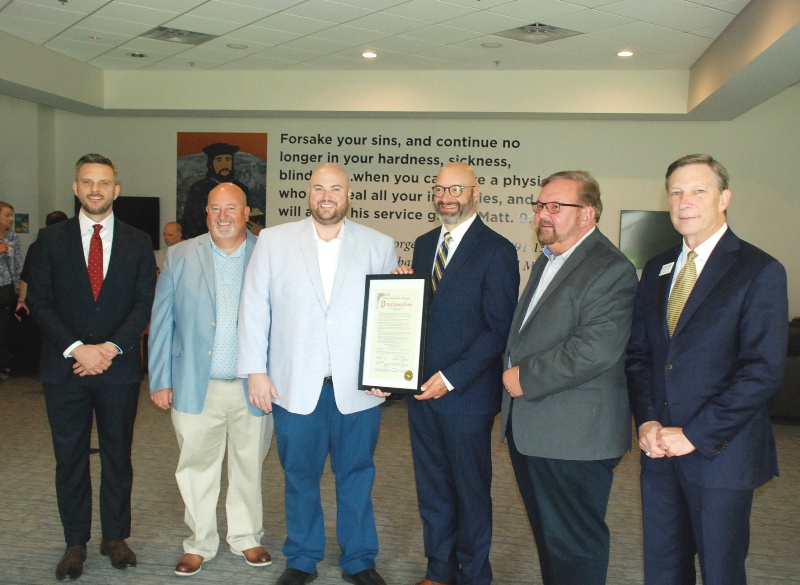
Dr. Marty Carnes TMU, Dr. Chris Childs, TMU Alumni Assoc. President, Cleveland Mayor Josh Turner, TMU President Dr. Emir Caner, Dr. Barry Thompson, TMU Board of Visitors Chairman and Dr. David Drake, TMU. (Dean Dyer/wrwh.com)
CLEVELAND – Friday was Truett McConnell University’s 75th Anniversary Day as proclaimed by the White County Board of Commissioners and Cleveland City Council. On July 23, 1946, the school established its charter. The university held a ceremony to mark the occasion.
TMU President Dr. Emir Caner told the crowd that the vision for the institution started in 1944 with four pastors and three laypeople at a prayer meeting in Blairsville. They prayed for a college in the North Georgia Mountains. Two years later, with the help of Cleveland citizens and the Georgia Baptist Convention, Truett McConnell Junior College was chartered.
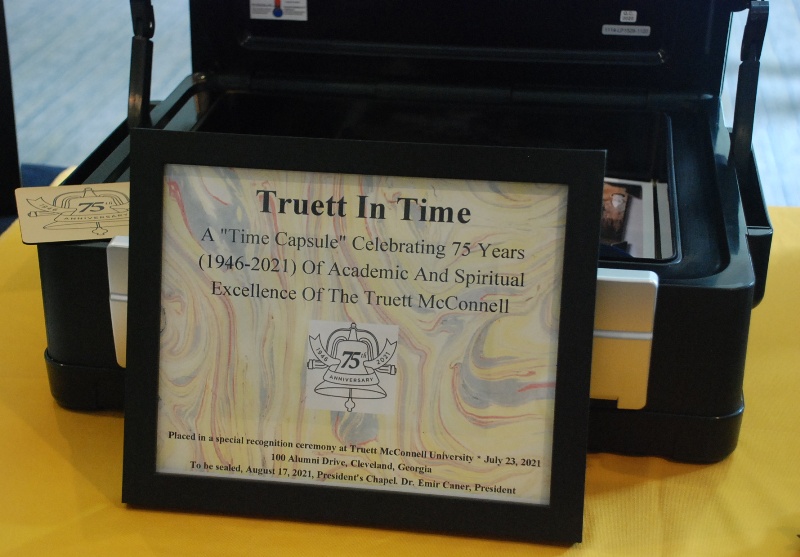
As part of Friday’s celebration Dr. David Drake, Director of Alumni and Church Relations at TMU, said they have collected items of the University’s history that will be placed in a time capsule that will reside on the campus and will be opened in 2046, the 100th anniversary. (Dean Dyer/wrwh.com)
Now a four-year university, Truett McConnell has 55 programs of study and offers undergraduate and post-graduate degrees.
Dr. Caner told the crowd, “We exist for the glory of our Lord Jesus Christ to stand firm on scripture and win people to Jesus, and that vision hasn’t changed since September 1944.”
The college will observe its anniversary throughout the coming year.
GAINESVILLE — OSHA has fined four companies nearly $1 million in penalties after investigating a deadly nitrogen leak at a poultry processing plant in Gainesville. The leak on January 28 killed six workers and injured at least a dozen others.
The workers were killed near the start of their shift at the Foundation Food Group plant when a freezer malfunctioned, releasing colorless, odorless nitrogen into the air. The liquid nitrogen is used to freeze chicken. The six workers died of asphyxiation.
Three of the plant’s maintenance workers, who, according to OSHA, had never trained on the deadly effects of nitrogen exposure, entered the freezer room without precautions and were overcome immediately. Other workers entered the room and were also overcome. The three maintenance workers and two other workers died immediately, and a sixth died on the way to the hospital. At least a dozen of the injured workers needed hospital care.
OSHA’s investigation found that Foundation Food Group and three other companies with roles at the plant failed to implement necessary safety procedures to prevent the leak and train workers on the hazards of liquid nitrogen. Workers were not equipped with the knowledge or equipment needed to save lives, OSHA said.
The agency cited Foundation Food Group of Gainesville; Messer LLC of Bridgewater, New Jersey; Packers Sanitation Services Inc. Ltd. of Kieler, Wisconsin; and FS Group Inc. of Albertville, Alabama, with a total of 59 violations and proposed $998,637 in penalties.
In announcing the penalties, U.S. Labor Secretary Marty Walsh said the deaths and injuries caused by the leak “were entirely avoidable.”
OSHA cited Foundation Food Group Inc. for 26 serious violations, including six willful violations for exposing workers to thermal injuries and suffocation hazards. Investigators found the company failed to “develop, document and use lockout procedures” and “did not inform employees that liquid nitrogen, an asphyxiate, was used in the onsite freezer.” In addition, OSHA cited Foundation Food Group for “failing to train workers on the hazards of liquid nitrogen, and not training employees on the emergency procedures they can take to protect themselves,” among other violations. The company faces nearly $600,000 in fines.
The company in charge of cleaning and sanitation services at the plant, Packers Sanitation Services, was cited for 17 serious and two repeat violations. OSHA says the company failed to train workers on the hazards of liquid nitrogen and anhydrous ammonia and did not ensure emergency eyewashes were available and unobstructed. OSHA cited the employer in 2017 and 2018 for similar violations, the Labor Department says.
OSHA fined Packers Sanitation nearly $287,000 in connection with the deadly nitrogen leak. The company released a statement saying its employees were not on-site or involved in the operation or maintenance of the equipment that failed. “While we cooperated with OSHA during the review, we fundamentally disagree with these citations and plan to contest them,” the statement said.
The industrial gas company Messer LLC, which provided nitrogen to the plant, was cited by OSHA for six serious violations totaling $74,118 in penalties. The Bridgewater, New Jersey, company said that it works with its customers on how to safely and properly operate and maintain the equipment.
In addition to the OSHA fine, Messer faces a number of wrongful death lawsuits.
A fourth company, FS Group, which manufactures and services equipment, was cited with eight serious violations for failing to train workers on health hazards related to liquid nitrogen. OSHA fined the company $42,325.
“This horrible tragedy could have been prevented had the employers taken the time to use – and teach their workers the importance of – safety precautions,” says OSHA Regional Administrator Kurt Petermeyer in Atlanta. “Instead, six workers died as a result of their employers’ failure to follow necessary procedures and to comply with required safety and health standards. We hope other industry employers learn from this terrible incident and comply with safety and health requirements to prevent similar incidents.”
The companies have 15 days to contest the findings.
The Biden administration is boosting resources to answer a spike in COVID-19 cases in some parts of the country as the delta variant spreads. Lines were short this week at a Norcross vaccination drive-thru. (John McCosh/Georgia Recorder)
WASHINGTON (GA Recorder) — Amid a rise in infections and hospitalizations from the surging delta variant of COVID-19, the Biden administration is boosting money and other assistance to the hardest-hit areas of the country.
This week, just three states with lower vaccination rates — Florida, Texas and Missouri — accounted for 40 percent of all cases nationwide. One in five cases occurred in Florida alone.
Federal public health officials on Thursday announced $1.6 billion in money from the pandemic relief package approved earlier this year will be used to increase testing and mitigation in high-risk group settings, like homeless shelters, substance abuse treatment centers and prisons.
Another $100 million will be sent to rural health clinics to pay for more vaccine education and outreach in communities that generally have seen the slowest vaccine uptake.
As they send more resources, federal health officials emphasized that those spikes in infections and hospitalizations typically are occurring in regions that have the lowest rates of vaccination.
“If you are not vaccinated, please take the delta variant seriously,” said Dr. Rochelle Walensky, director of the Centers for Disease Control and Prevention, during a press briefing. “This virus has no incentive to let up, and it remains in search of the next vulnerable person to infect.”
Georgia’s vaccine rate has also been low, spurring Vice President Kamala Harris to visit the state last month in an effort to convince skeptical residents.
The state ranks 45th in the nation for the percentage of adults who are fully vaccinated, according to CDC data compiled by the New York Times.
But Georgia has so far avoided the rise in infections and hospitalizations taking hold in other states. Georgia has an infection rate of 12 per 100,000 residents, the same as the national average. In Georgia, 10 residents out of every 100,000 are hospitalized for COVID-19, higher than the national average of eight but much lower than in Florida and Missouri, where those numbers are 21 and 25.
Still, Georgia’s cases have been rising — the 14-day case average is up 220% compared to the national average of 171%, the Times reports.
Several Georgia counties stand out from the rest as hotspots: in Chattahoochee County on the western border, there were 1.9 cases for every 100 residents over the last two weeks, according to state data, and in neighboring Stewart County, that number is .7 per 100 residents.
Two counties bordering Florida also have elevated rates — Camden and Charlton have rates of .78 and .85 per 100, respectively.
Federal “surge response” teams have been working with governors and local public health officials. They’ve provided technical expertise on genetic sequencing, data analysis, and outbreak response to Missouri, Illinois and Colorado, said Jeff Zients, the White House’s COVID-19 response coordinator.
In North Carolina, FEMA will be deploying mobile vaccination clinics, Zients said.
FEMA and Department of Health and Human Services staffers have been on the ground in Nevada to assist in the COVID-19 response. HHS Secretary Xavier Becerra visited on Thursday to check in on the mitigation efforts.
The national vaccination campaign did dramatically curb the virus’ spread by late spring, but vaccinations have stalled across the country, with 68% of U.S. adults having received at least one shot.
There are wide variations regionally, and the number of infections and hospitalizations has begun to rise again as the more contagious delta variant surges. The seven-day average of U.S. cases has gone up 53% compared to the previous seven-day average, according to data from the CDC.
Hospitalizations are up 32%, and deaths have risen 19%. Ninety-seven percent of those cases are occurring among the unvaccinated, according to federal health officials.
But there may be shifting views toward the vaccine in areas of the country that have been most reluctant. In the past week, five states with the highest case rates — Arkansas, Florida, Louisiana, Missouri, and Nevada — had higher rates of people getting newly vaccinated compared to the national average, Zients said.
While some parts of the country have begun to reconsider or reinstate mandates on wearing face masks amid the surging cases, CDC officials so far are not calling for any changes. The agency’s recommendations say unvaccinated individuals should wear masks and that those who are vaccinated can do so at their own discretion.
Georgia Lt. Gov. Geoff Duncan introduced Thursday a $250 million tax credit plan to allow residents and corporations to write checks directly to law enforcement agencies to hire new officers and provide better pay and training. (Stanley Dunlap/Georgia Recorder)
ATLANTA (GA Recorder) — The sharp uptick in violent crime around Atlanta is prompting state leaders to create new ways to pay for more police officers on the streets and provide other resources for law enforcement.
Republican Lt. Gov. Geoff Duncan Thursday said he would ask the General Assembly to create a $250 million tax credit program for donations made directly to local law enforcement agencies to hire additional officers and increase officer’s pay and training.
Duncan proposes to allow individuals and corporations to receive 100% dollar-for-dollar statewide tax deduction. It is now the third crime-fighting spending proposal state leaders unveiled within a week.
“It should be no surprise that every state leader is concerned with the exponential rise in crime here in Georgia, especially in our Capital city,” Duncan said. “Rising crime is affecting individuals, businesses, and Georgia families, and combatting this problem will not be accomplished by one solution alone. My goal is to bolster law enforcement agencies across our state by giving each community the tools necessary to prevent and stop crime.”
But former Democratic House Minority Leader Bob Trammell said on Twitter letting people directly write checks to their police department and sheriff’s office is problematic.
“Honest question. Does this mean that someone can get a tax credit for a kickback payment?” Trammell wrote in a tweet. “Seems like this proposal hasn’t been thought out much. Nothing good about legalizing corruption.”
Georgia Republicans Gov. Brian Kemp and House Speaker David Ralston are also proposing to use millions of dollars in state money to support law enforcement. At the same time, they are ripping into Atlanta’s leadership for its violent crime rate as they elevate the issue in a ramp up to the 2022 campaign season.
Ralston announced Wednesday he wants the state to spend $75 million to reinforce local policing.
His plans call for using $25 million to give $1,000 one-time bonuses for local police officers and sheriff’s deputies; $3 million to hire 20 new state troopers to patrol in metro Atlanta; $10 million to increase salaries for prosecutors and public defenders and $20 million for the Georgia Bureau of Investigation.
Ralston is proposing $7 million to provide more mental health crisis beds through the Department of Behavioral Health and Developmental Disabilities.
The spending proposals follow a record increase in revenue in Georgia, with the state reporting a $3.2 billion jump in tax collections for the year that ended in June.
But it’s not just the GOP with grand plans to lower the crime statistics.
On July 16, Atlanta Mayor Keisha Lance Bottoms announced a $70 million initiative recommended by her Anti-Violence Advisory Council.
That funding would help hire 250 police officers, create an office focused on reducing violence, expand the use of the department’s camera network system, install 10,000 street lights and more.
Republican officials say the rising crime levels can be traced to criticism of police they said lowered officer morale and resulted in fewer officers patrolling the streets and rising gang activity. The Georgia Sheriff’s Association and Department of Public Safety leaders also supported the low morale theory during Monday’s meeting of the state House Public Safety & Homeland Security Committee.
During that hearing, Kemp promised to call for a special fall legislative session where he’ll call for a focus on crime reduction and measures to institute better pay for state troopers and restrict local governments from easing prosecution policies.
The GOP’s new crime-fighting priorities are a departure from the bipartisan approach to criminal justice reform the past couple of years with the overhaul of the state’s citizen’s arrest statute, the passage of Georgia’s first hate crimes law and early probation termination.
Democratic lawmakers introduced bills during the 2021 legislative session mandating officers wear body cameras, banning the use of chokehold techniques and more, but none gained traction with the Republican majority.
Black Widow marks the first MCU movie in two years and it pretty much follows in the tradition of the other 20-something movies in this series: Huge special effects sequences, complex character development, zippy one-liners, and the post-credit scene that hints for more installments to come.
So, does Black Widow measure up to the best MCU has given us? Not quite.
Of course, Scarlett Johansson is back as the sexy but dangerous Natasha Romanoff aka Black Widow in this semi-prequel and picking up during the middle of the events of Captain America: Civil War.
We get the backstory on Romanoff as a Russian girl living in Ohio with her family who are having to flee after her father Alexia Shostakov, aka the Red Guardian (David Harbour) steals intel from S.H.I.E.L.D. Rachel Weisz costars as his wife Melina, a former Black Widow. She also has a sister named Yelena.
They arrive in Cuba where Alexia’s boss, Dreykov (Ray Winstone) puts both Natasha and Yelena through training to become Black Widows themselves in his organization known as the Red Room. Natasha defects from the Red Room and joins S.H.I.E.L.D. We all know where her story goes from here.
Years later, Natasha reconnects with Yelena (Florence Pugh from Little Women) and the two are hoping to rejoin forces to save their parents who are being held hostage by the Red Room.
What I’ve liked about the majority of the MCU movies was the way that they were able to combine superhero spectacles and yet give us something that didn’t feel monotonous by the end. Black Widow breaks that mold with an incoherent plot and its inability to establish unique and memorable characters.
I also feel like the action sequences were standard MCU fare where nothing felt like anything was at stake.
Johansson has shined before as this character, but previously, she brought a sense of depth and poignancy to the role that is puzzlingly missing in this movie. Plus, some of the characters such as her parents feel one-note despite Harbour’s attempt at comic relief. Even he can’t pull it off with such mediocre material.
Black Widow might be passable for those who are undemanding, but knowing what the MCU is capable of, we should expect more and better. I just hope they don’t go down the same road that some of the more recent Star Wars and Fast and Furious movies followed.
Grade: B-
(Rated PG-13 for intense sequences of violence/action, some language and thematic material.)
On Saturday, July 24, Air Methods Corporation, operator of AirLife, will host a blood drive from 10 a.m. until 4 p.m. at its base at the Habersham County Airport. Blood donations will go to support the regional LifeSouth blood bank.
“The summer is typically a tough time for blood collections. Patients in area hospitals rely on volunteer blood donors throughout the summer to ensure that blood is there when they need it most,” says LifeSouth’s Donor Recruiter Jennifer Griffeth.
All donors will receive a free t-shirt and have a chance to see the medical helicopters AirLife uses to transport patients.
To donate blood, you must be at least 17 years old (16 with parental permission), weigh at least 110 pounds, and be in good health. A photo ID is also required.
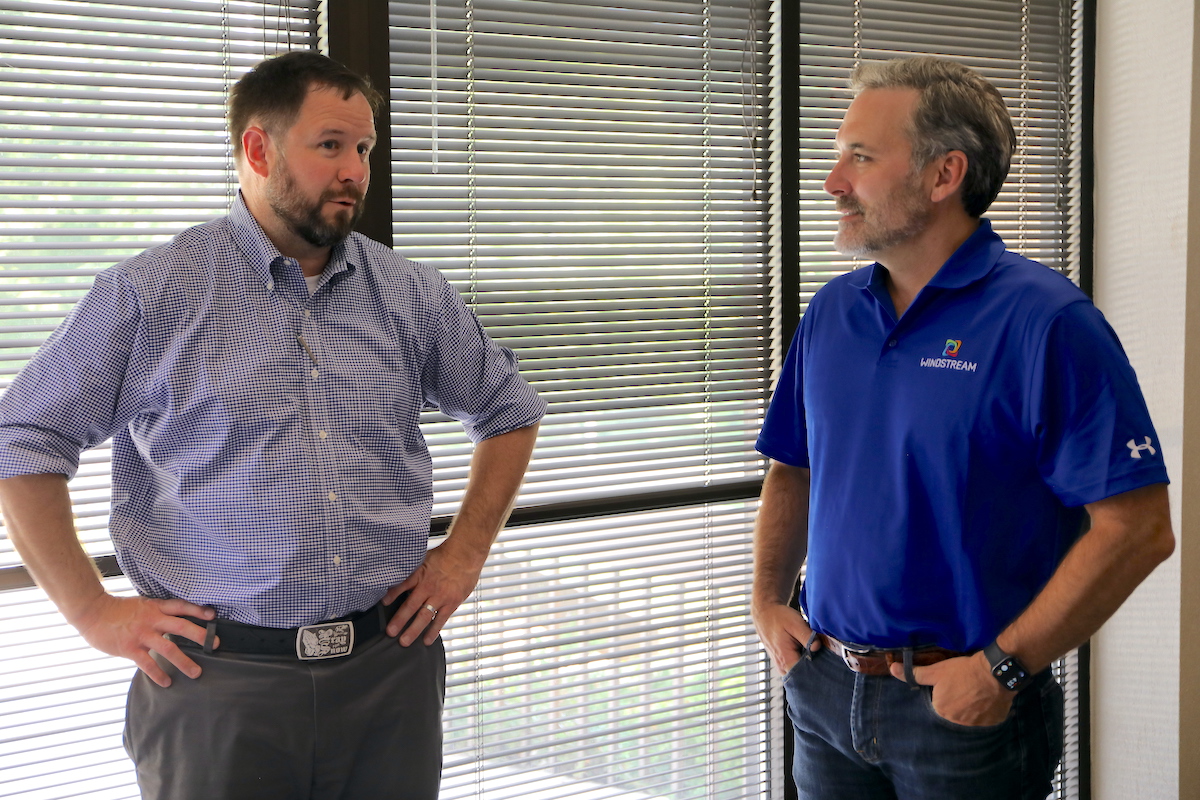
Cornelia Mayor John Borrow meets with Windstream CEO Tony Thomas during a recent visit to Windstream's Georgia headquarters in Cornelia.
CORNELIA – After suffering years of withering criticism about its broadband service, Windstream is working hard to change its image. Windstream CEO Tony Thomas recently visited the company’s Georgia headquarters in Cornelia. He met with Windstream’s new Outside Plant Engineering and Construction team to craft a plan for boosting local investments and expand the availability of gig internet speeds across the state.
This past May, the company announced it would internalize its engineering and fiber construction operations. The company says moving those jobs in-house will ensure “the people that build the network will also operate it.”
Windstream announced that J. Berkshire, previously president of state operations for Kinetic in Georgia, has moved into a new role as vice president of engineering and construction. The company will take over construction from outside contractors in 2022 with teams based in more than 70 locations across the 18 states Windstream serves. The company plans to add nearly 1,000 jobs as a result.
Those changes and the commitment to more local investment are potentially good news for consumers. Windstream critics have long accused the company of providing inadequate, unreliable Internet service, especially in rural areas where subscribers have few, if any, other options. In the past, consumers and government officials have accused Windstream of advertising and charging for speeds it did not deliver. In 2014, Windstream reached a $600,000 settlement with the state of Georgia for alleged false advertising. In 2016, former 9th District Congressman Doug Collins took the fight with the Arkansas-based company all the way to Capitol Hill. In February 2019, Windstream filed for bankruptcy but emerged from it a year and a half later after trimming its debt by more than $4 billion and reorganizing its governance.
But that is all in the past where Windstream hopes to leave it. During his recent visit to Cornelia, Thomas met with local officials to talk up future investments and hiring. “It was a pleasure meeting Tony Thomas and the rest of the team during their recent visit to Habersham County,” said Cornelia Mayor John Borrow. “We had a great discussion about the investments Windstream has made and continues to make in our community.”
Since Thomas assumed the role of CEO in 2014, Windstream says its Kinetic broadband service has invested over $500 million in Georgia.
“We are seeking community partners to continue our network expansion across rural Georgia,” said Thomas. “In the first half of 2021, we have enabled over 23,000 locations with fiber technology and are looking to impact that many or more locations in the second half of the year.”
The company provided a list of 47 Georgia towns and cities where it says internet service improvements have been made this year. Northeast Georgia communities listed include Blairsville, Braselton, Clarkesville, Clayton, Cleveland, Commerce, Cornelia, Dahlonega, Helen, Hiawassee, Jefferson, Lavonia, and Tallulah Falls.
Windstream is moving its engineering and construction operations in-house to operate more efficiently and better manage costs for fiber construction and maintenance.
“The investment in infrastructure and employment will provide high-speed, reliable internet to more of our citizens than ever before,” said Borrow, adding, “We are grateful that Windstream’s Georgia headquarters is based in Habersham County. We’re especially grateful for the jobs and economic impact Windstream provides to our community.”
Earlier this year, Windstream opened three new retail locations in Toccoa, Cleveland, and Byron. The company now operates a total of eleven retail outlets in Georgia, including one in Cornelia.
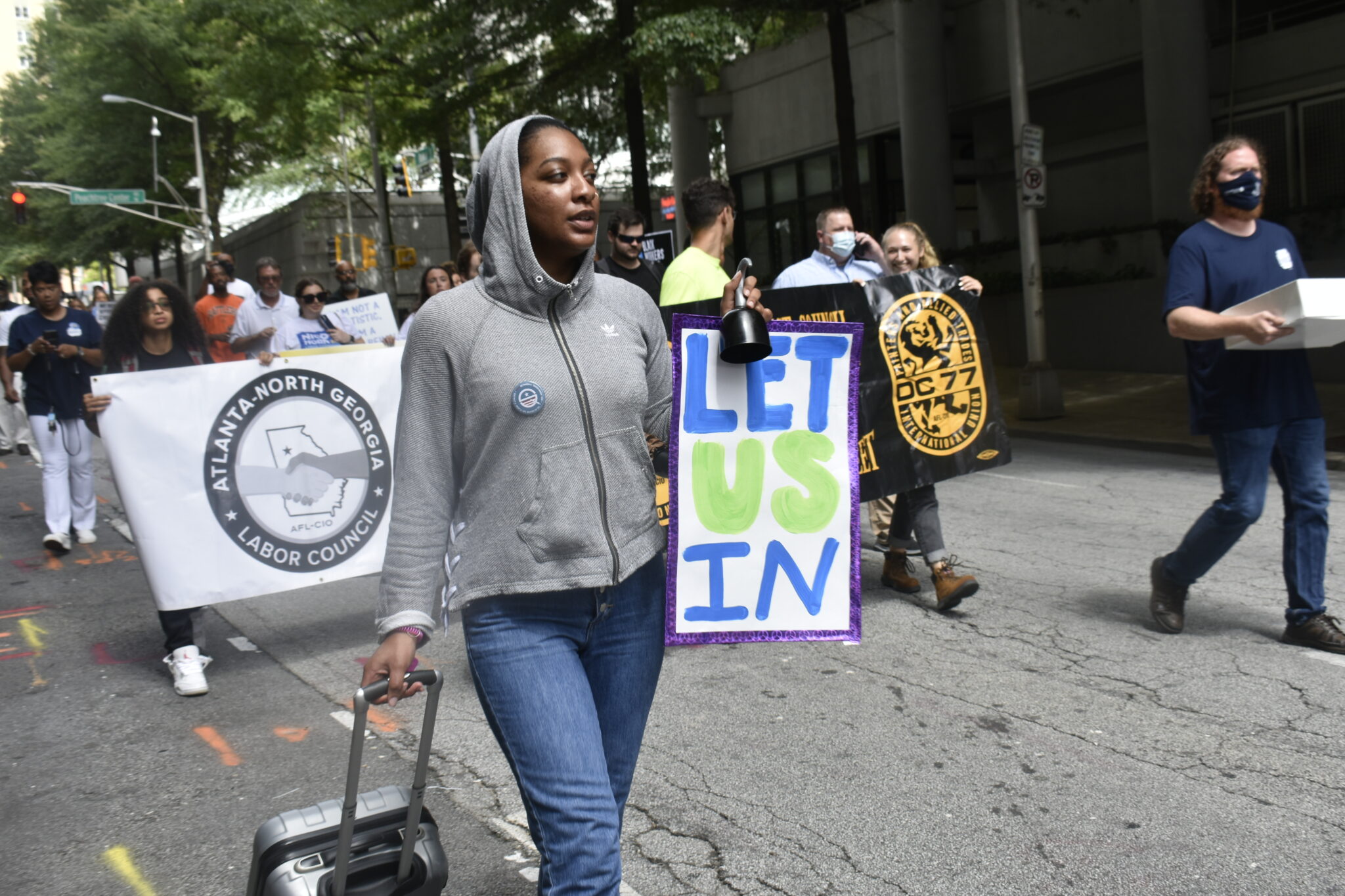
Klaire Gumbs, an organizer with the New Georgia Project, marches to the Georgia Department of Labor headquarters in Atlanta. (Ross Williams/Georgia Recorder)
(GA Recorder) — The Georgia Department of Labor is paying more than $6.6 million a year for 21 career centers that have been closed to the public since March 2020, according to leases maintained by the State Properties Commission.
In pre-pandemic times, the centers offered services like resume fine-tuning and job hunt help, but the department closed the doors of the brick-and-mortar havens for displaced workers last March as the pandemic began to reach across the state.
More than a year later, as businesses are inviting customers back indoors and expanded federal help for out-of-work Georgians has ended, those in-person career services are still not available, and some are demanding to know why.
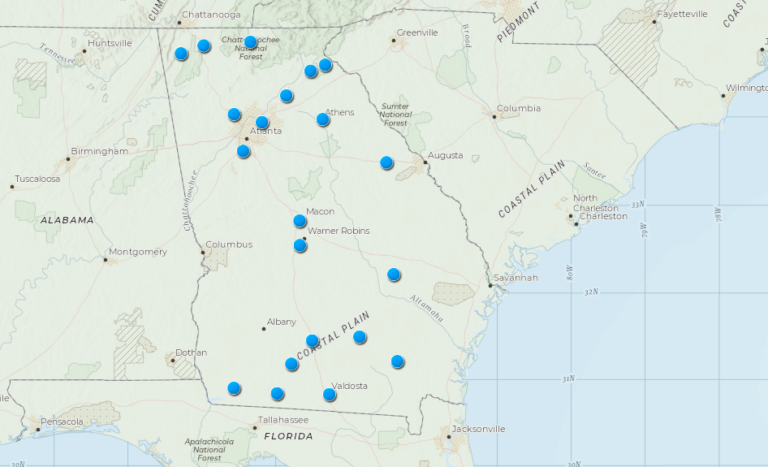
These 21 Georgia Department of Labor career centers, including those in Athens, Gainesville, Toccoa and Cornelia, cost taxpayers more than $6 million per year but are currently closed to the public. (Map created via ArcGIS Online map hosted by Esri.)
“Everything else is opened up, except for the Department of Labor career center offices, as they’re driving people back to work by reinstating work search requirements for the meager unemployment benefits that are still available to workers,” said Ryan Richardson, program coordinator for the Atlanta-North Georgia Labor Council. “People want to be working. That’s not the issue. The issue is that the jobs and the support network is not there. We’re still living in a pandemic moment, and if they were really serious about it, they would be opening up the career centers.”
Richardson was one of several dozen people who marched to the state labor department headquarters in downtown Atlanta Wednesday for a demonstration. The protesters said they want the labor offices to reinstate the federal benefits, clear up backlogs, provide prompt service and reopen career centers.
When they arrived, Richardson led a chant of “open the doors, open the doors!”
The Georgia Department of Labor website lists 41 career centers across the state, some of which are owned by the department, including the Atlanta center. At least 21 are leased, to the tune of millions per year, according to documentation the Georgia Recorder obtained through a records request.
The buildings are owned by entities ranging from local development authorities to city officials and real estate investors. Some locations are storefronts in shopping centers.
The Norcross facility is in a plaza alongside other government facilities like the state Department of Driver Services and the Gwinnett County Department of Family and Children Services. The parking lot in front of that building was empty Wednesday morning with a sign on the door dated March 16, 2020, saying the facility is temporarily closed.
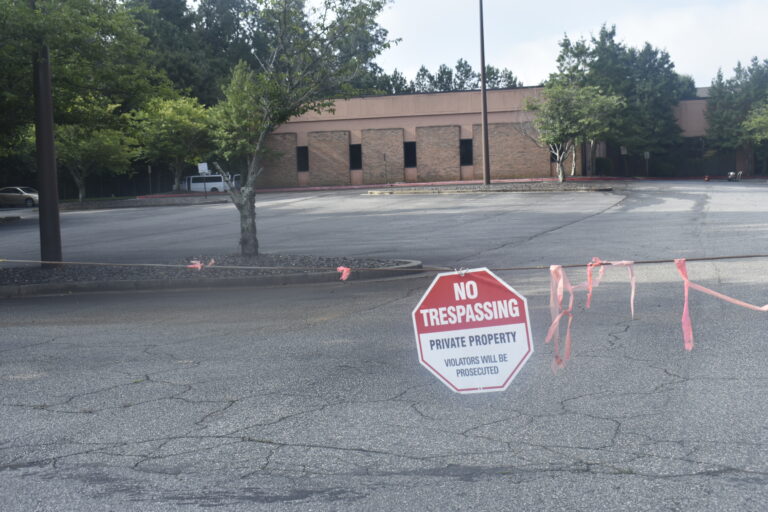
A no trespassing sign hangs in front of the Georgia Department of Labor career center in Kennesaw. Leasing the building costs taxpayers more than $667,000 per year. (Ross Williams/Georgia Recorder)
That 37,000-square foot career center costs taxpayers more than $800,000 per year, according to the State Properties Commission records.
The entrance to the Cobb County center across the street from Kennesaw State University’s Fifth Third Bank Stadium is roped off with signs reading “no trespassing.” A security guard stationed in the parking lot advised would-be visitors Thursday that the lot was closed to the public.
Two centers in Athens and College Park cost taxpayers more than $1 million per year each, according to the State Properties Commission records. The labor department disputes the College Park lease rate provided by the commission that manages the state’s rental property, saying the price to rent that space is closer to $223,000.
A list of leased career centers and the cost to the state can be viewed here.
‘We haven’t had a day off’
Labor Commissioner Mark Butler objected to the suggestion that keeping the doors closed to the public is a waste of taxpayer money because employees still work from there answering phones and handling claims.
“We utilize those centers fully, with our employees working, helping Georgians seven days a week,” he said. “We haven’t had a day off, and we haven’t basically been closed since this began. We have been working constantly. None of my folks went home when the pandemic started. Nobody has worked harder in the state of Georgia than the men and women of the Georgia Department of Labor for the last 16 months.”
All of his staff members who worked in reemployment at the centers have been temporarily reassigned to help handle the influx of claims since the pandemic began in March 2020, he said.
Butler expressed frustration that some believe they could solve problems with their claims if the centers were open when in reality, the centers were used exclusively for things like reemployment training before the pandemic. Other services like eligibility reviews and appeals have been done over the phone for years, he said.
“They think that they can show up at the career center, they’ve been told by their state (representative), or their state senator in some cases, ‘If you could just get in here, you could get your case heard,’ and that’s not true,” Butler said.
A no trespassing sign hangs in front of the Georgia Department of Labor career center in Kennesaw. Leasing the building costs taxpayers more than $667,000 per year. Ross Williams/Georgia Recorder
Security is another concern, Butler said. The pandemic jobless crisis has caused some to experience long delays. Others disagree with their rejections. Some of these people have responded with threats, which have been investigated by the police, Butler said.
“We’ve had our employees followed to their cars, pictures taken of them. People have sent them emails showing pictures of them with their grandkids and saying, ‘I know where you live,’” Butler said. “And so we’re taking this kind of thing very seriously.”
The labor department has plans to reopen all of the career centers. Butler declined to provide a timeline or any further information, citing security concerns.
Department spokeswoman Kersha Cartwright said resuming career center operations will be a gradual process.
“We won’t open all of them at one time. It’s going to be a soft opening. It’ll probably be an appointment-based system when we do reopen for people to come in and get support with reemployment and to utilize the internet and whatever else they might require at the center,” she said.
Labor Department employees with other duties have been switched to helping handle claims, but with unprecedented levels of layoffs at the height of the pandemic, displaced workers across Georgia have reported endless rings on the other line when they call for assistance.
A duty and responsibility
Others are finding the only jobs available in their communities are in different fields than they worked in before and offer lower pay. Workers who previously labored in low-pay, high-stress fields like food service are more interested than ever in starting new careers, making the services the career centers used to provide more needed than ever, said Atlanta-North Georgia Labor Council Executive Director Sandra Williams.
“The duty and responsibility of career centers is to work directly with workers that are seeking training, seeking opportunity, seeking answers to questions,” she said. “Without those doors being open and constantly getting recordings and not getting callbacks, workers are at their wit’s end. It is frustrating. You want me to go back, but you want me to go back for less.”
Those who want that kind of assistance should instead reach out to WorkSource Georgia, a service of the Technical College System of Georgia, Butler said.
“That’s not handled in Georgia Department of Labor and hasn’t been for six years,” Butler said. “That is WorkSource, Georgia, so you need to contact one of those offices and see if they’re open. That’s where somebody can get (Workforce Innovation and Opportunity Act) money, training money, to where they have their training paid for. That’s handled by the Technical College System of Georgia. They moved that out from the Department of Labor back in the Nathan Deal administration.”
WorkSource Georgia offers services ranging from resume help to classroom lessons to on-the-job instruction.
But a few years ago, there was a push to consolidate workforce development resources, said Kristin Laarhoven, executive director of workforce development at the Technical College System of Georgia, and many of their offices are located inside Department of Labor buildings.
“The majority of the offices, we are co-located with the Georgia Department of Labor, and so most of our offices that were not co-located are open, but we are still closed at the centers where we’re tenanted with the Department of Labor,” she said.
“For better or worse, we’ve had to up our web presence in the civil service, well in the future and offering more options to people, but I don’t think necessarily one is better than the other, it just goes to needing to meet customers where they are,” she added.
And WorkSource Georgia’s offices have not seen a major spike in demand since Georgia’s economy began to reopen, Laarhoven said.
“Frankly, we just haven’t seen that rush to receive services,” she said. “I’m curious, just a contributing factor of what it’s going to look like a couple of months from now, now that Georgia is no longer participating in the increased unemployment insurance benefits. I can see that kind of having an effect on people wanting to potentially come in to get training after that.”
Enrollment could also increase in a month or two as people become more comfortable going out in public, and parents with children home for the summer will no longer have to find someone to mind the kids while they seek job training, she added.
Let them eat cake
Wednesday’s demonstration was timed to coincide with Butler’s birthday. Richardson carried a sheet cake festooned with gummy worms and “GA Chamber of Commerce forced 347,000 workers to eat cake” in icing, a reference to the deposed French queen Marie Antoinette.
Demonstrators wished Labor Commissioner Mark Butler a not-so-happy birthday. Ross Williams/Georgia Recorder
Georgia’s job numbers are improving, but the past year has presented challenges for Butler. Last month, Georgians who have had trouble receiving benefits sued him, alleging the state broke the law in its delays returning claims.
Fellow Republican Bruce Thomas, a state senator from White, is challenging Butler in next year’s election and is so far winning the money race.
Three Democrats also have their eyes on Butler’s title: East Point state Rep. William Boddie, state Sen. Lester Jackson of Savannah and Nicole Horn, an Atlanta businesswoman and consultant.
Horn, a regular figure at recent protests at the department’s Atlanta headquarters, railed against the delay in reopening the career centers at Wednesday’s rally.
“Career centers are supposed to be open so that we can find jobs that align with people’s skills so that we can find jobs that pay for rent, pay for child care, pay for food,” she said. “I’ve talked to Georgians across our state, and I’ve heard some heartbreaking stories. I’ve talked to people who said, ‘Yeah, I am back at work. I’m working at a job that I’m making less at, and I’m being evicted from my home because I didn’t get my unemployment benefits on time.’ This matters. Mark Butler, where are you?”
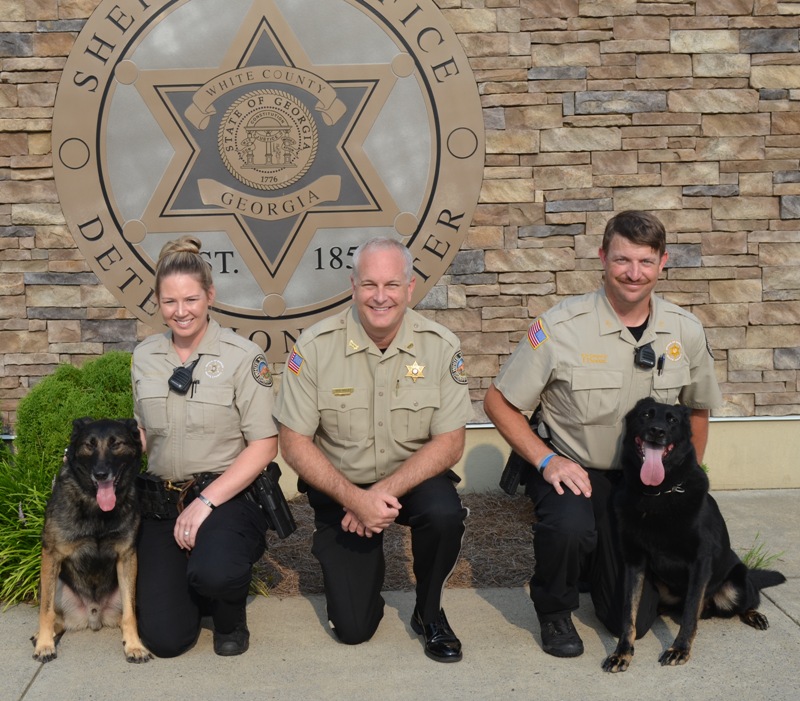
There are four new officers on patrol in White County. On July 23, Sheriff Rick Kelley, center, introduced the county's new K-9 units. They are Officer/Trainer Erin Thomas and K-9 Henzo and Officer/Trainer John Thomas and K-9 Skuter.
CLEVELAND — The White County Sheriff’s office has four new officers patrolling the county. Deputy Erin Thomas and her K-9 Henzo and Deputy John Thomas and his K-9 Skuter have joined the department’s ranks.
Sheriff Rick Kelley introduced the new K-9 units to the public on Friday. The sheriff’s office purchased Henzo from the Riverdale Police Department and Skuter from Clayton County Police. “We acquired the dogs and their handlers came with them,” Kelley tells Now Habersham. The Thomases, who are married, filled existing positions within the sheriff’s office.
Henzo is trained for drug intervention and tracking, while Skuter is a drug, tracking, and apprehension dog.
Kelley says his office paid for the dogs with seized assets money and contributions people made for needed equipment. “Those dogs are just a valuable tool for our patrol deputies to have access to while they are on their shifts,” Kelley adds.
The K-9s have only been with the department for a short time, but Henzo has already helped Cleveland Police make an arrest. Kelley says Skuter has also assisted with a couple of drug arrests.
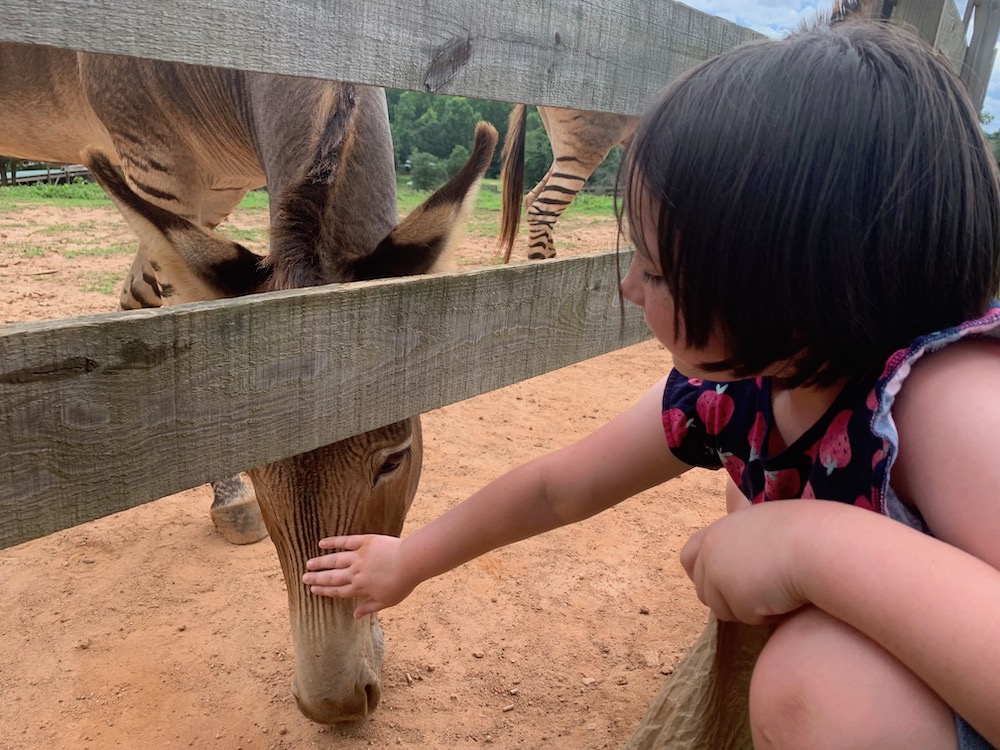
The author's granddaughter, Ava Shaw, pets Pippi the zedonk at the Chestatee Wildlife Preserve. Pippi is a cross between a zebra and donkey. She's one of more than 100 animals being cared for at the wildlife refuge east of Dahlonega in Northeast Georgia. (Photo Jenna Shaw)
These days, zoos are part of an ethical discussion about the rights of animals held in captivity. There are valid arguments on both sides. The Chestatee Wildlife Preserve east of Dahlonega offers a different option for those wanting to see and interact with unusual animals.
As a wildlife refuge, Chestatee is a non-profit organization dedicated to rescuing and caring for hurt, neglected, or aging animals. The Preserve is home to over 100 exotic and native animals. Many were no longer wanted by traveling circuses and found their way to Chestatee. Owner C. W. Wathen started the refuge when someone offered to trade him two zebras for two miniature horses. Wathen accepted the zebras, an act that spurred his interest in exotic animals. As he took in more animals, Wathen paid for their care through his construction day job.
Three-year-old Caleb Shaw was fascinated by the zebras. (Photo Jenna Shaw)
Over time, Wathen has recruited and trained volunteers to work at the refuge. He’s also found donors, such as grocers, who provide fresh vegetables that have aged past their prime to feed the animals. It’s become a community endeavor.
Wathen and his animals have appeared on National Geographic and Animal Planet. The Georgia State Legislature has recognized him for his work with rescue animals.
Despite glowing reports, the wildlife refuge was struggling to keep afloat financially. That all changed in 2010 when a zebra named Zeke met a donkey named Sarah.
Pippi the zedonk
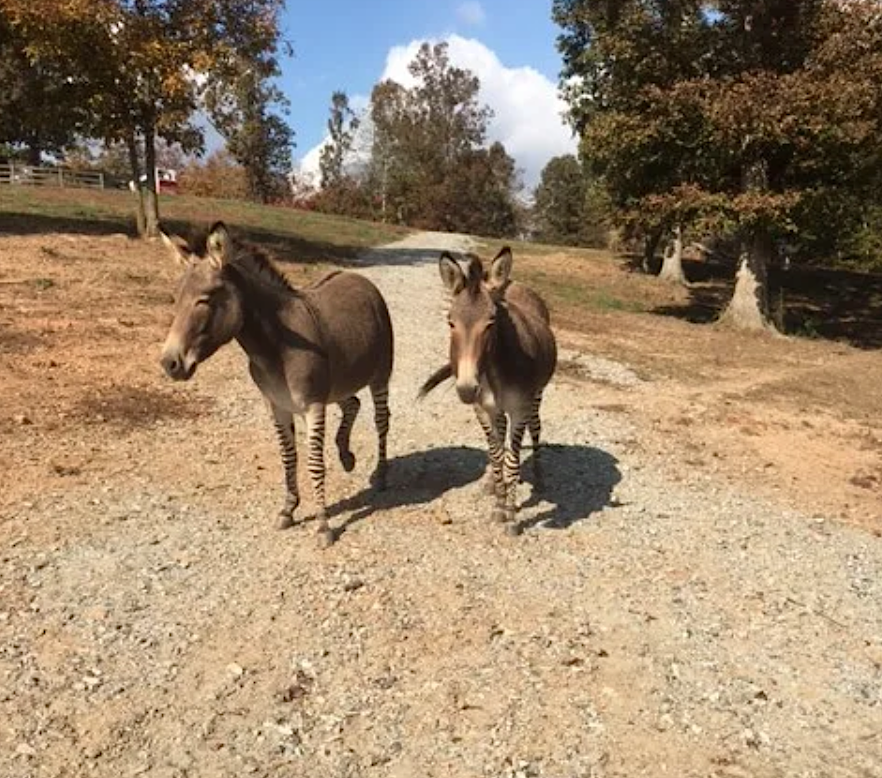
The zedonk, a half-breed zebra/donkey, has an unusual mixture of markings. (Photo Jenna Shaw)
Zeke was the lone zebra at the wildlife refuge with a hip problem that should have prevented him from mating. It didn’t. He fathered a female with Sarah. Their offspring is unusual and stunning – they call her a zedonk.
Chestatee is not the only place in the world where you can see a zedonk, but it was possibly the first. The birth attracted tourists from around the country and globe. Some came to spend a few hours; others came to spend several days. All were fascinated by Pippi, the baby zedonk with the striped legs of a zebra and the body of a donkey.
(photo courtesy Chestatee Preserve)
Pippi is no longer the only zedonk on the property.
Zedonks are interesting animals to watch. Their coloring and striping are unique to their parents, while many of their personality characteristics seem all zebra. In fact, the soft, sweet sound they make is from their zebra blood, nothing like that of a donkey.
Other animals
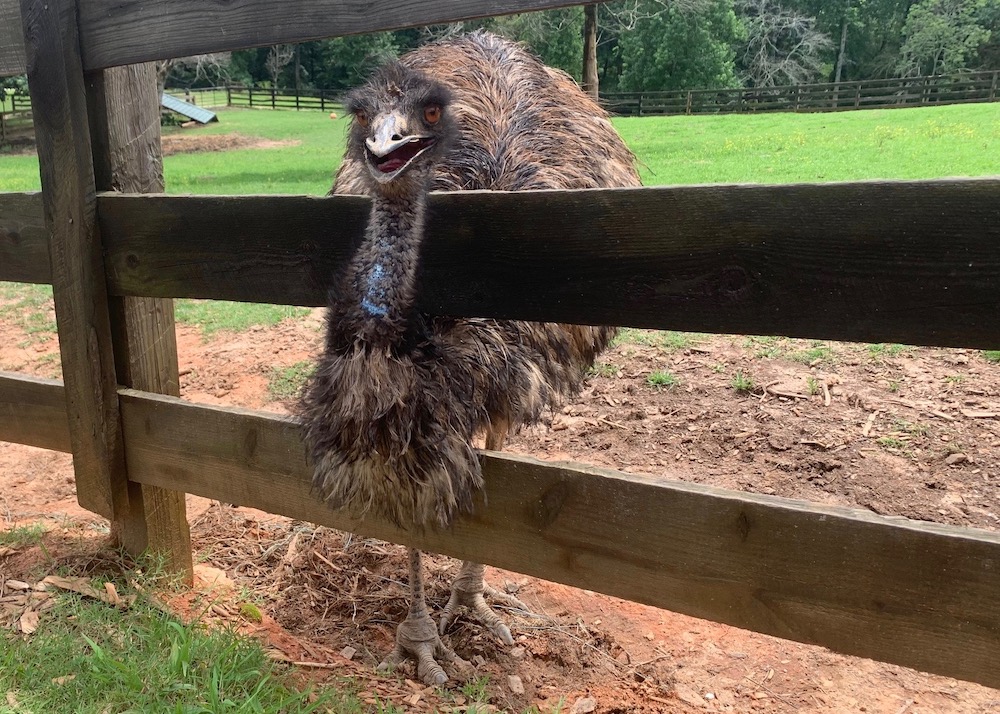
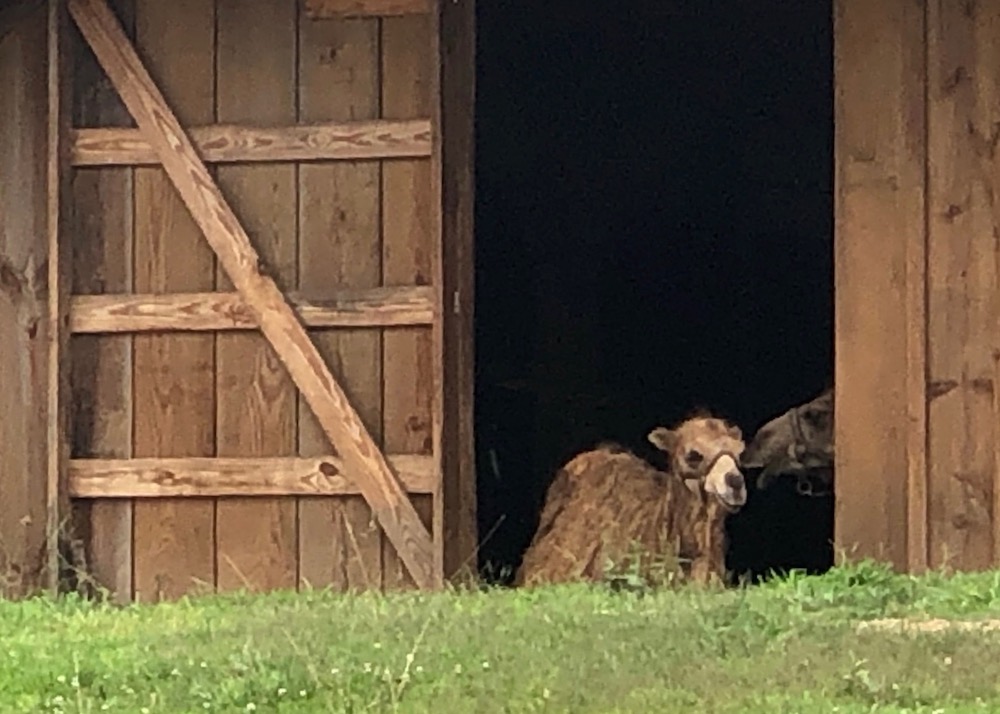
There are plenty of other exotic animals to see on the 25-acre refuge. Besides zebras, donkeys, and zedonks, the refuge has black bears and a grizzly bear, white tigers and a golden Bengal, elk and deer, as well as camels, wolves, tortoises, and a variety of exotic birds, including emus.
The refuge is laid out to allow you to see the animals but not get too close. Some animals can be fed as you go, like the zebras and the zedonks, while others, like the bears and the tigers, are kept at a distance. You may purchase $5 bags of food at the entrance.
1 of 9
Chestatee Wildlife Preserve takes in abandoned and neglected animals. It has a wide variety of species, including tigers. (photo courtesy Chestatee Wildlife)
Sloths are among the more than 100 animals that live at the preserve. (photo courtesy Chestatee Preserve)
Zebras, camels, tortoises, and emus are among the animals that can be seen. (Photos Jenna Shaw)
Chestatee has a bamboo jungle children can explore.
Details
The Chestatee Wildlife Preserve is located in Lumpkin County at 469 Old Dahlonega Highway, Dahlonega, Georgia 30533. The refuge is open seven days a week. Admission is $10 for children under eleven and $15 for all others. The refuge is open daily from 10 am – 4 pm, but the last entry is at 2:45 pm. Watch for Wathen or a family member as you pull into the parking lot. Someone is usually nearby to greet you.
There’s not a lot of shade, so use sunscreen and take water with you. There are picnic tables throughout the refuge if you want to take your own lunch. However, you are asked to remove all your trash as you leave.
Donations are accepted and appreciated. Monetary donations can be given through the Preserve’s website. Also appreciated are gifts of fresh fruits, meats, and vegetables.
Examples of canned foods: potatoes, green beans, carrots, salmon, pumpkin, chickpeas, pitted black olives, tuna, chicken, sliced beets, artichoke hearts, kidney beans, cranberry sauce, pears, and peaches.
Examples of fresh produce: Kale, greens, corn on the cob, peaches, grapes, bananas, strawberries, blueberries, apples, oranges, and pineapples. We always need peanut butter, jelly, raisin bread, beef, and chicken.
Judy Coker Williams, age 70, of Cornelia, Georgia, died Thursday, July 22, 2021.
No formal services are planned at this time.
Arrangements have been entrusted to the Whitfield Funeral Homes & Crematory, North Chapel at 245 Central Avenue, Demorest, Georgia 30535. Telephone: 706-778-1700.
Do you include hanging baskets in your landscape? It’s hard not to love them. The combinations of what to include are endless. One of the most appealing characteristics is the baskets can be made of plastic with a wire hangar, in other words, how you are apt to find them at Lowe’s or other garden centers, decorative wrought iron or wire with a coco liner, or even wicker.
As a bonus, they can take your eye to new heights, literally. I have shepherd’s hooks that are four feet tall and some that are eight feet tall, and several sizes in between. They add an interesting dimension to your garden.
Endless combinations
You can use almost any plant in a hanging basket, including perennials. I’ve used daylilies and ivy leaf geraniums, sweet potato vines, and coleus, purslane, vinca, begonias, fuschia, and petunias, creeping jenny, and ivy. The rule of thumb for planting a container applies well to planting hanging baskets, a thriller, a filler, and a spiller, or even just a beautiful spiller.
I usually don’t do a single variety planting in one container but this year I put one deep pink petunia in a 16″ wire basket with a coco liner, and boy is she happy! Kinda lonely in the beginning but now spreading, as they do, and spilling down all sides.
One petunia in a 16″ decorative wire hanging basket.
Caring for petunias
If petunias are one of your go-tos for hanging baskets, urns, or in the ground here are some tips for best results.
Care of petunias includes regular watering and as much sunlight as possible to promote multiple blooms. Spreading ground cover petunias are pickiest about water; weekly waterings should be included in the care of petunias. While petunias will grow in a partially shaded location, a fuller and more abundant bloom is produced in full sun. Soil prepared before planting petunias should have well-composted organic matter worked in. Care of petunias will include regular fertilization with a balanced, water-soluble fertilizer designed for blooming plants. As they are heavy feeders, petunias care will also include weekly feedings. Proper light, water, and fertilization when caring for petunias will ensure a long season of beautiful blooms.
Petunia varieties and characteristics
Grandiflora
Flowers are 3-5 inches across; flower forms can be single or double and some are ruffled
Most grandifloras have a mounded habit but a few are trailers.
The flowers don’t hold up in bad weather, have fewer blooms and the plants can become rangy late in the summer
Multiflora and Floribunda
Flowers are smaller than grandiflora; available in singles, doubles, upright, and cascade.
Plants are more compact than grandifloras.
These bloom prolifically; plants are more weather-resistant than grandifloras
Wave Petunias
A newer type of petunia series.
They are actually a floribunda-type petunia and are seed grown.
The series started with purple wave and has gone on from there.
All the wave petunias have, to varying degrees, a cascading/prostrate habit.
Waves are very heavy feeders and should be fed weekly with a water-soluble fertilizer and a slow-release fertilizer such as Osmocote should be incorporated into the soil at the time of planting.
Supertunia
A newer type of petunia series; flowers are 3-4” across.
They are vegetatively propagated known to vine more than 3 feet in length.
Supertunias are also very heavy feeders and should be fed weekly with a water-soluble fertilizer or a slow-release fertilizer.
Surfina Petunias
These are typically the plants seen in Europe cascading from flower boxes.
They aren’t quite as aggressive as supertunias, making them more manageable.
Many of the Surfina varieties have a distinctive veining pattern in the blooms.
Calibrachoa and Million Bells
Calibrachoa isn’t a true petunia, but looks like one and can be treated as such.
The fast-growing plant has a low-growing, compact habit and it blooms prolifically all season long. Calibrachoa is vegetatively propagated.
A good range of colors is available.
Prefers being planted in containers rather than flower beds.
1 of 4
Surfina petunia
Calibrachoa or Million Bell
Floribunda petunia
spotted blue petunia
While we are on the subject, as beautiful as they are, I have a love-hate relationship with Million Bells. My sister and I call them, here today, gone tomorrow. I have talked to many gardening experts about this beautiful specimen in the petunia family. I always get advice like, “water more” or “water less” “feed more”, blah, blah, blah. I’ve tried all of that over the years and, yet, they can still disappear almost overnight. Exasperating!
But I still love all of the varieties, even occasionally a Calibrachoa, especially when I see pictures of them, in someone else’s garden.