Jim Beck is awaiting sentencing at his home in Carrollton after being convicted of fraud and money laundering charges on July 22, 2021. (file photo)
ATLANTA — A jury today convicted suspended Georgia insurance commissioner Jim Beck of all 37 counts of fraud and money laundering charges against him. Beck’s conviction caps off a two-week federal trial.
Beck, who was indicted months after being elected to statewide office in 2019, was accused of masterminding a scheme to steal more than $2.5 million from state-created insurance company Georgia Underwriting Association. Beck managed the state-chartered private insurer before he took office as the state’s top insurance regulator.
Prosecutors argued Beck dreamed up a scheme to funnel money to himself through a series of companies without providing many of the services he told investigators he performed.
“The evidence makes completely clear that Jim Beck … is a thief,” Assistant U.S. Attorney Brent Gray said at trial. “He is an ordinary, plain, fast-talking — and rich — fraudster.”
But defense attorney Bill Thomas repeatedly told jurors that investigators didn’t understand the insurance business and that prosecutors hadn’t provided enough evidence to merit a conviction. He told jurors, “the government just has it wrong in this case” because Beck’s work transformed GUA from a longtime money-loser to a strongly profitable entity.
After Beck was suspended, Governor Brian Kemp appointed John King as Georgia Insurance and Fire Safety Commissioner. In a statement released Thursday, King said: “While today is a somber one for our state, I commend the U.S. Attorney’s office and our law enforcement professionals for their work bringing this case to a close and ensuring justice for the gross misuse of Georgia Underwriting Association dollars.”
“When Governor Kemp appointed me to this role, I was tasked with restoring integrity and ethics to this office, and that’s been my priority since day one. I look forward to continuing to move this Agency into the future, leaving behind the corruption of the past and putting Georgia consumers first.”
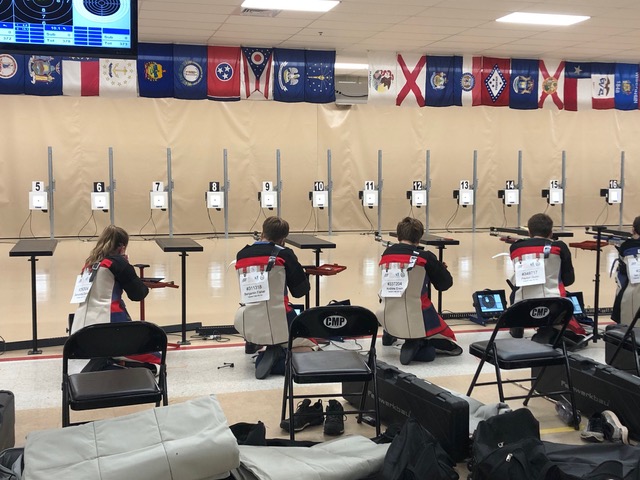
In just four short years, the TFS Rifle Team made it to national competition. Here the team is shown competing in the National 3P Air Rifle Championships. Pictured, left to right, are Sam Stamey, Andrew Erwin, Ben Fisher, Peyton Gunn. (Lane Gresham/Tallulah Falls)
The best precision rifle teams, precisely 50 of them, from across the country took part in the National Championships in Anniston, Alabama, and Camp Perry, Ohio. Tallulah Falls School earned a spot with a solid showing at regionals, taking Andrew Erwin, Ben Fisher, Peyton Gunn, and Sam Stamey to the National 3P Air Rifle Championships.
“We were not expecting to make the National Championship, but we were excited to be there,” says coach Tim Stamey. “The score our team shot at regionals was just enough to squeak them in.”
While riflers in both Alabama and Ohio were competing, electronic targets synced the locations in real-time.
Perfection for a team was found in a score of 2,400. A Texas-based team shot 2,363. TFS finished 49th in the two-day event.
“I’m extremely proud of this team,” states Stamey. “To make it to this level is a great achievement! Since the birth of our rifle team only four short years ago, we have seen an individual (Sam Stamey) make it to the National Junior Olympic Championship (60 shot Standing), and a team (Gunn, Fisher, Stamey, Erwin) make it to the National 3 Position Championship. Pretty amazing if you ask me.”
Next month, TFS opens a new rifle season and will be looking to fill three slots opened up by recent graduates. The team will enter into GHSA competition and will chase a state title.
Compared with other states, Georgia has a stunningly low rate of referring poor children to specialty services under Medicaid, according to a recently released report.
The health screenings of Medicaid kids and the subsequent “corrective treatments’’ are required under the Early and Periodic Screening, Diagnostic and Treatment (EPSDT) program.
The goal of EPSDT is to provide early detection and treatment of health conditions so that children and adolescents covered by Medicaid can get appropriate preventive, dental, mental health, developmental and other specialty services.
Georgia in 2019 had 1.4 million children eligible for EPSDT. The report’s figures show the state is doing health screenings at recommended levels.
But just 30,000 Georgia kids that same year were referred to corrective treatment for a health condition.
That compares with Illinois, also with 1.4 million eligible kids, which referred more than 500,000 for services in 2019.
Other states with a comparable number of eligible children include Ohio, with 1.4 million eligible, referring 459,000 for corrective treatment, and North Carolina, with 1.3 million eligible kids, referring 84,000 for specialized care.
And Alabama, with just 668,000 eligible for EPSDT – less than half of Georgia’s total – referred 147,000, nearly five times the number referred by Georgia.
“Georgia is not fulfilling its legally mandated requirement to serve children with disabilities through EPSDT,’’ said Devon Orland, litigation director for the Georgia Advocacy Office, which advocates for people with disabilities or mental illness.
State health officials are aware of the EPSDT problem, she added.
The Georgia Department of Community Health pointed out that the level of screenings for health conditions meets American Academy of Pediatrics guidelines. But the agency did not address the low number of referrals to services.
“EPSDT is one of, if not the, most robust and critical health benefits children receive,” said Erica Fener Sitkoff, executive director of the advocacy group Voices for Georgia’s Children. “It seems a truthful and data-driven conversation between providers, [insurers] and state and community advocates about this report could get at causes and solutions regarding this disheartening lack of referrals.”
A puzzling number
The figures in the National Health Law Program report came from the federal Centers for Medicare and Medicaid Services, which gets its referral data directly as reported by state Medicaid programs.
The report does not speculate about why the numbers of children referred for corrective treatment are extraordinarily low in Georgia.
Dan Young of NHeLP, a nonprofit public interest organization, said Wednesday that the Georgia referral number is so low that at first, he thought it was some sort of error.
“I wondered if I made a mistake,’’ he told GHN.
But he said he has since noted that a big dropoff in referrals began in 2014.
“We know that the earlier a child is receiving care, the earlier they get treatment, the healthier they’re going to be in the long run,’’ Young added. “You catch issues before they become bigger problems.’’
A large majority of children in Georgia Medicaid are covered by managed care companies called care management organizations.
Young
The Georgia Quality Healthcare Association, a trade organization that represents Medicaid insurers, declined to comment on the referral pattern.
A denial of rights?
Susan Goico, the director of the Disability Integration Project at the Atlanta Legal Aid Society, said the EPSDT benefit is invaluable to a child’s development.
“Kids have a special right under Medicaid, so if a health care professional determines a Medicaid service is medically necessary to correct or ameliorate the condition, the child is entitled to it,’’ Goico said. “It’s concerning that so few children are being referred to treatment. It doesn’t add up.’’
She speculated that the causes of the low referrals could include providers not knowing the child is entitled to special help, insurer denial of those services, and other bottlenecks to getting care.
“How does a mom figure out how to navigate this system, especially with a kid with a disability?” Goico said. “Many times the families get burned out [over their inability to get necessary services], and the kid goes to foster care.’’
Orland of the Georgia Advocacy Office said children with psychological, developmental or intellectual disabilities are particularly at a disadvantage because of barriers to treatment.
“There is no true mechanism for parents to gain services in a realistic way,’’ she said. “The state must provide case management. Families are left to flounder to find the services that children need.
“We’re at a place where the only place we can get kids what they need is through litigation.’’
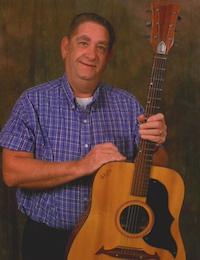
Junior Lee Williams, age 75 of Demorest, Georgia went home to be with the Lord on Wednesday, July 21, 2021, following an extended illness.
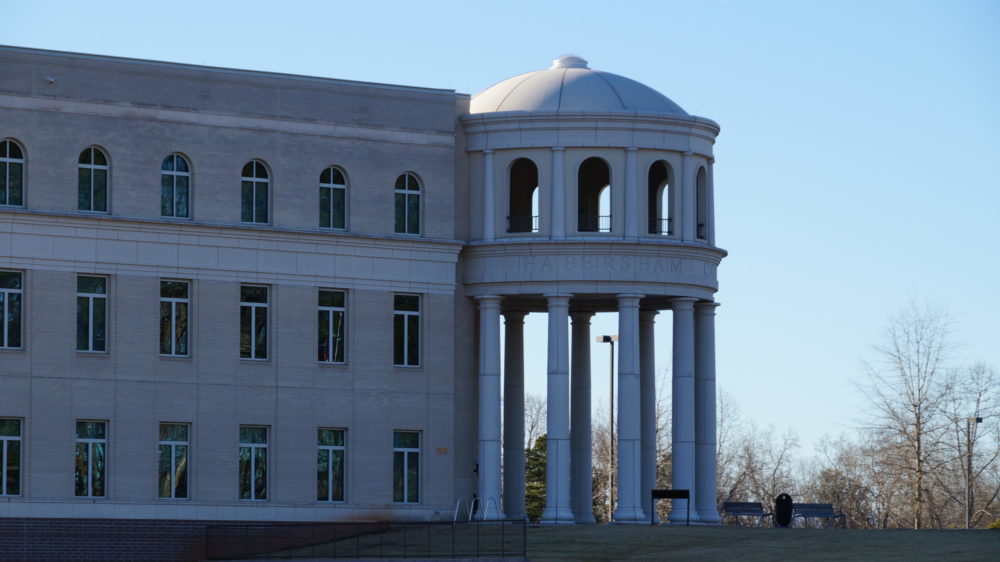
Born in Demorest, Georgia on April 29, 1946, he was a son of the late Doyle & Sally Tench Williams. Junior earned his masonry degree from North Georgia Technical College. He retired from Habersham Mills (Russell Corporation) as a security guard with many years of dedicated service. Junior was a very devoted husband, father, grandfather, brother, & friend. He was a wonderful, hardworking man who never met a stranger. In his spare time, Junior enjoyed woodworking, listening to good Bluegrass music, and was a very talented musician who could play anything. He attended Baldwin Congregational Holiness Church.
In addition to his parents, he was preceded in death by his loving wife, Betty Ann Nicholson Williams and 7 siblings.
Survivors include his children, Chris Kastner of Demorest, GA; Mark & Lisa Williams of Clarkesville, GA; Debbie & Ronnie Elliott of Cornelia, GA; Angie & Lee Anderson of Clarkesville, GA; Judy & Gary Haygood of Toccoa, GA; Lonnie & Lynn Scroggs of Lavonia, GA; Lora Scroggs of Cornelia, GA; sister & brother-in-law, Carolyn & Donnie Canup of Demorest, GA; brother-in-law & sister-in-law, Paul E. Nicholson, Jr. & Shirley Nicholson of Toccoa, GA; grandchildren, Jeremy Thomas, Josh & Laura Anderson, Jessica & Brandon Thompson, Nathan & Kristen Williams, Taylor & Hannah Haygood, Matti Haygood, & Kash Kastner; 10 great-grandchildren, nieces, nephews, other relatives & friends.
Funeral services are scheduled for 11:00 a.m. Friday, July 23, 2021, at Hillside Memorial Chapel in Clarkesville with Rev. Kenneth McEntire officiating. Interment will follow in the Hills Crossing Baptist Church Cemetery.
The family will receive friends at the funeral home from 6:00 p.m. until 8:00 p.m. on Thursday.
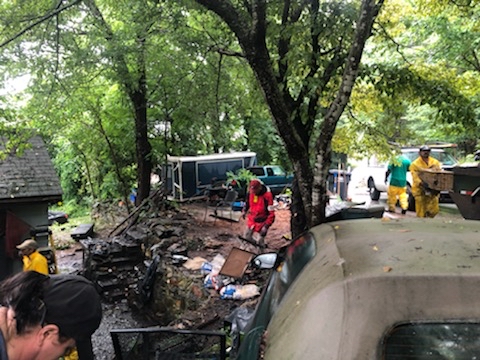
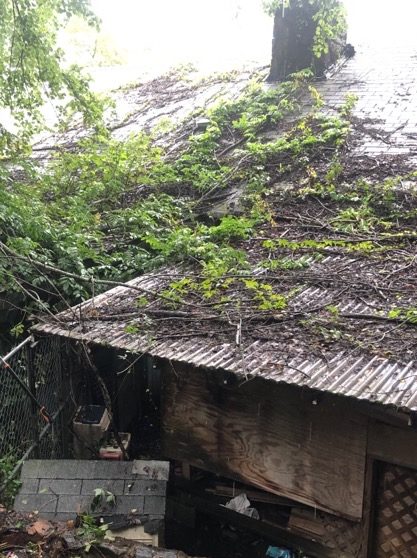
TALLULAH FALLS – More than a dozen volunteers showed up in the rain Tuesday to help a local veteran clean up his Tallulah Falls property. They worked from early morning until mid-afternoon loading two dumpsters with trash and debris.
“We took down trees, trimmed bushes, and took a dump truck load of gravel for the parking area,” says local contractor James Welborn. Welborn helped organize the cleanup effort with Tallulah Falls Police Chief Tonya Elrod and fellow Habersham Countian Bob Williams.
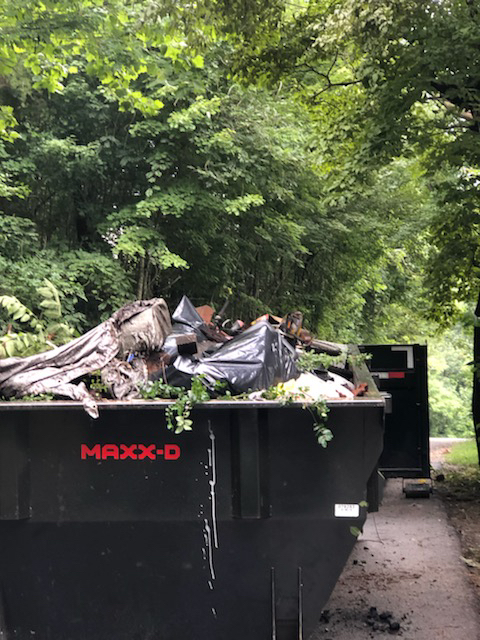
Volunteers filled two dumpsters full of trash and debris. Another community cleanup day is set for Saturday, July 24, starting at 7:30 a.m.
According to Elrod, volunteers shed “blood, sweat, and tears” cleaning up the overgrown property. “We made great progress today,” she says, adding she’s “super thankful for the few that turned up to help.”
Around nineteen volunteers showed up at the worksite on July 20, half as many as were expected. Organizers suspect heavy rain kept many people away. They hope that won’t be the case this weekend.
The group has scheduled another community cleanup day starting at 7:30 a.m. on Saturday, July 24. Organizers invite anyone 16 or older who’d like to help to attend.
“I’m a little disappointed that more volunteers didn’t show up today, but we’re hoping for a better turnout on Saturday,” says Elrod. “We still have a long way to go.”
Cross Cut Tree Service and HEMC in Clarkesville are working together to remove trees from the property. Lowe’s in Cornelia and Fieldale Farms also offered help. The local Veterans of Foreign Wars Post 7720 donated money.
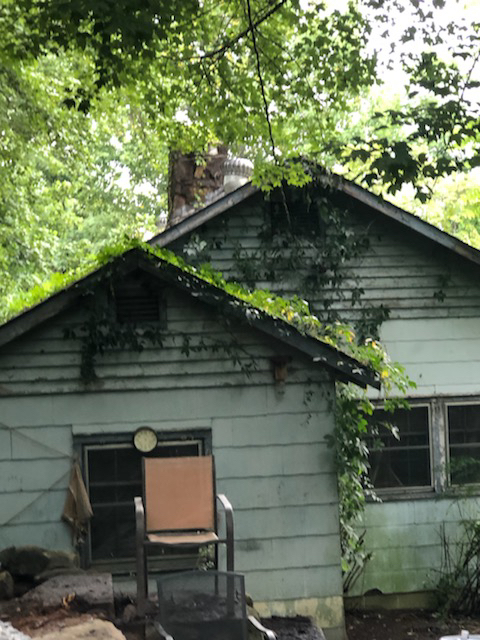
Even with the small army of volunteers they’ve recruited, it’s going to take more manual labor and resources to get the job done. “The house is beyond repair,” says Welborn. He estimates it would cost between $100,000 and $120,000 to rebuild. The group intends to reach out to a local charitable builder’s organization to see if they’ll help.
“I’ve got a week to figure out how to get this house torn down and a mini-home built for him,” Welborn says, referring to the veteran whose name is not being released publicly out of respect for his privacy.
In the meantime, Chief Elrod has arranged for the veteran and his service dog to stay in a hotel. The management even arranged for a mobile groomer to come to them. The VFW is said to be working with the veteran on his VA benefits.
Although the volunteer labor pool was a bit shallow on Tuesday, Welborn calls it “a very blessed day.” He’s hoping for another one Saturday. If you’d like to volunteer, you may drop in throughout the day starting at 7:30 a.m. on July 24. Look for the check-in signs on Main Street in Tallulah Falls, just off U.S. 441/GA 15.
Hollywood Baptist Church invites the community to a family event on Sunday, July 25th, from 4-7 p.m. (Photo by HBC)
Hollywood Baptist Church wants the community to know that it cares, that’s why it’s hosting a FREE community event from 4-7 p.m. this Sunday, July 25.
Organizer Brittni Johnson explains the church wants to offer a fun time to families in the community, as well as some assistance.
“We are offering haircuts for kids, a hot dog meal for all participants, and a bounce house for the children.”
The church will also be giving out Kona Ice and a bag of school supplies and coupons to each family. The church will also have a fire truck there and will be offering car seat safety checks.
For more information, call 706-754-6790.
Hollywood Baptist Church is located at 208 Hollywood Church Road, Clarkesville, Georgia 30523. Chuck Johnson is the pastor.
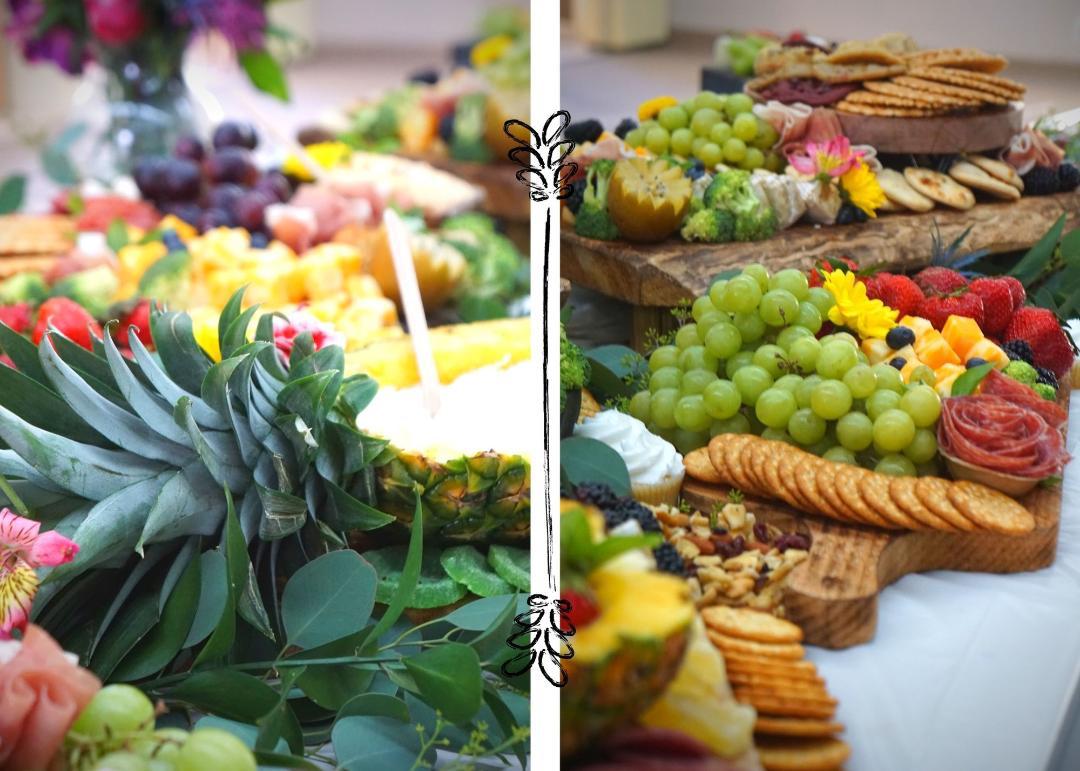
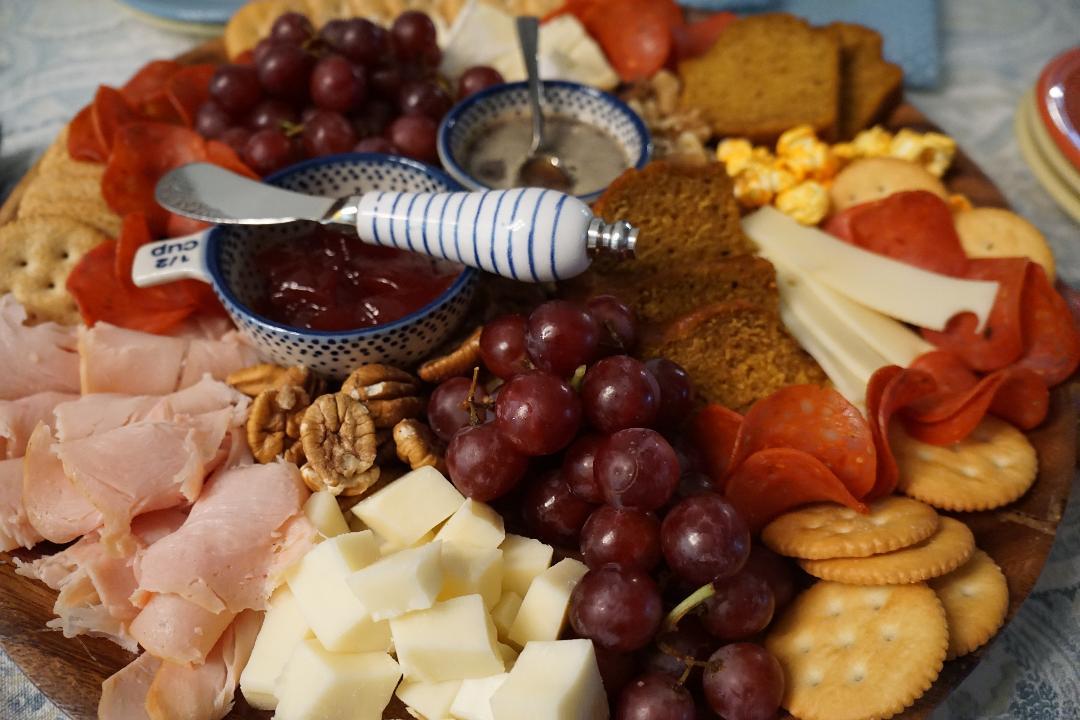
These photos show just how artistically a charcuterie board can be arranged. (Photo Jenna Shaw)
Charcuterie or charcuterie boards have become the rage lately. The word charcuterie is a French word that originally referred to smoked or dried meats and a variety of cheeses. The charcuterie board, then, was a way of serving a variety of meats and cheeses to be sampled. But, oh my goodness, has the use of the charcuterie board come a long way in the last few years.
Tammy Fleming, the owner of Crossroads Cafe in Demorest, has been creating charcuterie boards for years. She always packed the wooden boards when the family went on vacation and used them throughout the vacation to feed the family and keep the time spent in the kitchen to a minimum.
Tammy’s daughter, Kaitlin Ellison, has picked up that tradition and now runs Cross The Board, a new division of Crossroads Cafe. Cross The Board specializes in catering events and creating unique gifts of food. Kaitlin has become one of the local experts in how to create a charcuterie board.
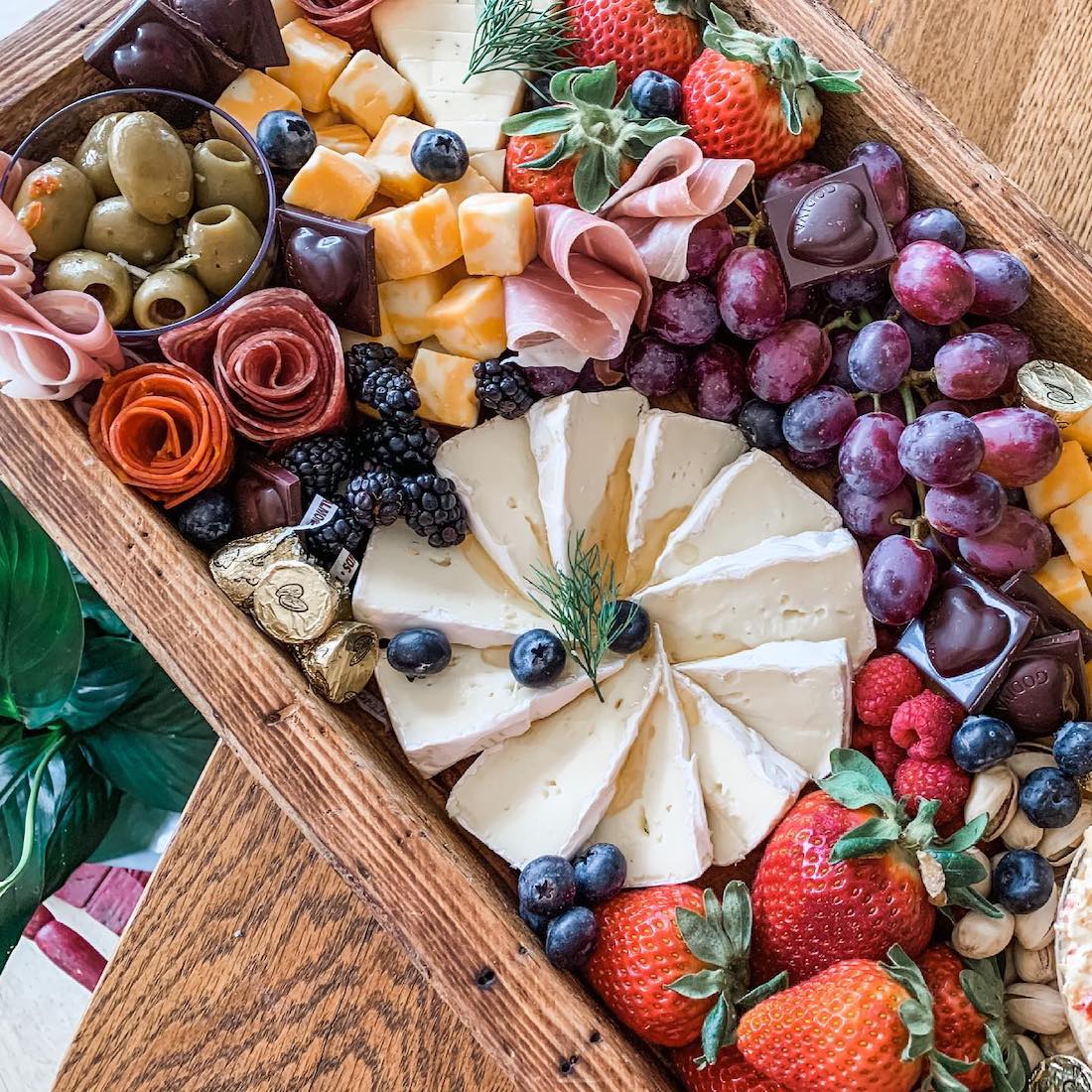
Doesn’t this make you want to just graze? (Photo courtesy of Cross The Board)
Charcuterie boards in the United States tend to have much more than just meats and cheeses, typically adding fruits, sweets, nuts, and sauces. According to Kaitlin, all these extras are referred to as charcuterments.
Cross The Board provides charcuterie feasts for wedding receptions, baby and bridal showers, and home parties. Kaitlin also provides boards that can be gifted for any number of reasons – like a housewarming gift, a get-well gift, or a birthday gift. The possibilities are endless.
How to put together a charcuterie board
I recently attended a class at my church that Kaitlin taught. Not only did she provide an amazingly beautiful charcuterie display for us to graze on, she also provided the ingredients and led us to create one to take home. It was a fun, informative, and creative evening.
From what I’ve read recently, people don’t always start the process the same way. Kaitlin has a step-by-step process and, after working through it, it makes sense to me. She divides the food she’s going to use into four sections: (1) fruit, (2) cheese, (3) sweets, and (4) meats. Her reason for the order is that, by waiting until the end of the board to add the meat, she doesn’t worry about keeping the meat unrefrigerated for long. So, here’s Kaitlin’s step-by-step instructions.
These six-steps show you just how to create your own charcuterie board. (Photos Jenna Shaw)
(1) Choose your board and add serving bowls.
Kaitlin used multiple boards in the charcuterie she did for us. In fact, it was large enough to feed 30 people. She planned out the boards, using them to create height and distinct areas.
Charcuterie boards can be purchased in most home goods stores and on Amazon. The prices vary, based on the size of the boards and the kind of wood used. By using multiple smaller boards, Kaitlin’s display was intricate and interesting. If you’re interested in using charcuterie boards while entertaining, consider starting small and then adding other boards as you go.
Kaitlin uses small bowls for sauces and things like pimento cheese that needs to be kept together. Put the bowls on the empty boards where you think they’ll make the most sense. You can use bowls from you already have, but keep the size in mind as you choose them.
(2) Add fruit.
Group fruit together in sections, but depending on how large the charcuterie is, you may need to spread them throughout. Keep fruit in groups by color, and spread them around to bring those colors throughout the boards. Kaitlin holds back the blackberries and the blueberries, because she uses those for filler and for accessorizing at the end.
(3) Add cheese.
You want to use several types of cheeses with different flavors and textures. Use a soft cheese like brie, and then an aged cheese like Colby Jack. Brie can be sliced and spread out to give it a fan-like shape. An aged cheese can be purchased already sliced or in cubes, which will help save preparation time.
(4) Add sweets.
Kaitlin used mini-frosted cupcakes that she placed in groups around the outside of the charcuterie. She also worked in a variety of cookies and crackers into areas on the board. You could add rolls and breadsticks as well.
(5) Add meats.
Kaitlin used salami and pepperoni. Other meats could include sliced prosciutto, sliced summer sausages, and chorizo. Round salami slices can be folded in half and then in half again, and lined up on the board to create a salami river. Round pepperoni slices can be folded in half and then rolled into a cone shape. By adding extra slices of pepperoni, a pepperoni rose is formed. (If you look at the feature photo you’ll see an example of both.) This should not be a surprise, but on Pinterest, I saw several tutorials of how to create the salami river roll and the pepperoni rose.
(6) Add sauces and finishing touches.
Kaitlin had a chocolate fudge sauce next to the strawberries, and a marshmallow fruit dip next to the grapes. She also had a special sauce of maple syrup, brown sugar, honey and cinnamon to drizzle over the cupcakes. I was told to use more brown sugar than anything else, a little maple syrup, just a little bit of honey and a dash of cinnamon. I haven’t tried to make it yet, but it was incredibly good. (I licked the spoon.)
Add other sauces and last-minute additions. Some of those could be spicy, such as mustard, olives, and honey mustard dipping sauce. Others could be sweet, such as fig preserves or strawberry jam. You can also scatter a few berries around and add fresh herb leaves to finish it off.
Here’s what our finished boards from the class looked like. (Photo Jenna Shaw)
Possible charcuterie board options
If you want to do some research, go to Pinterest and search “charcuterie board ideas.” You’ll be amazed at the possibilities. Boards can be small or large. The boards can be designed to feed an army or dinner for two. So, size matters.
Also, charcuterie boards can be created for appetizers, dinner, dessert, and even breakfast. There’s no limit to how the boards can be used. If you can dream it, you can do it.
Why create a charcuterie board
I’ll give you a couple of reasons of why a charcuterie board is a great thing to know how to do.
First, the charcuterie board is designed to give people options to graze,. That means that it is a great way to entertain. Instead of sitting in a more formal setting, your guests can move around, sample a bit of everything, eat until they’re stuffed, and talk to each other the entire time. It’s a casual and fun way to entertain.
Second, it’s actually less labor-intensive than cooking a big meal for a big group. Everything on the board can be cold, nothing has to be cooked, and much of it can be purchased already prepared.
It only took Kaitlin about an hour to put the board together for our gathering. That’s not a lot of time to prepare to feed 30 people and clean up was a snap.
Here’s proof of how much we enjoyed the class. This board is mine, with help from my daughter and grandchildren. They’ve loved making it and loved eating it for lunch. We made this one up from stuff mostly in the fridge and the pantry.
We made this one up for lunch with the children helping. They’ve asked for it every day now for lunch. (Margie Williamson/Now Habersham)
Kaitlin is available to do a class for your group or to cater your event. You can reach her online at Cross The Board, or by phone at 706-968-1709.
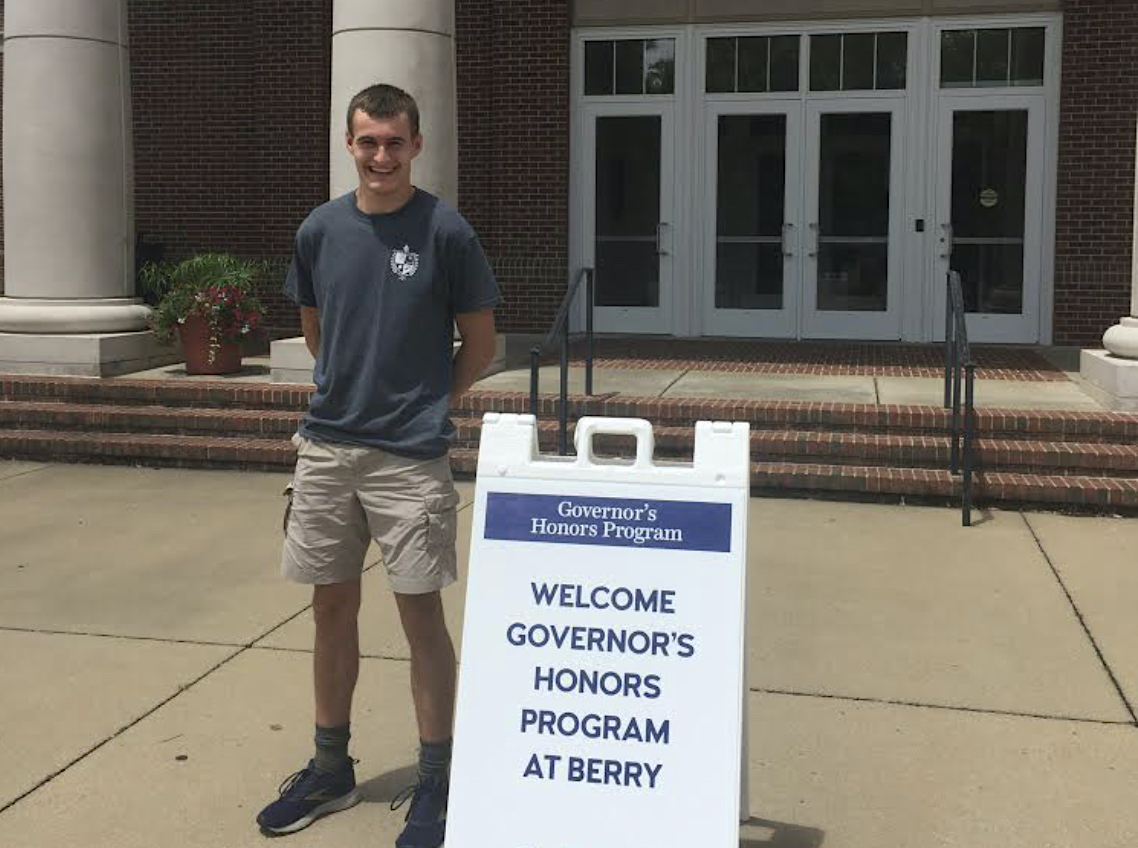
Evan Prince of Rabun Gap was among 684 students statewide accepted into this year's Governor's Honors Program at Berry College in Rome.
Tallulah Falls School senior Evan Prince of Rabun Gap, selected for the prestigious Governor’s Honors Program in Mechanical and Electrical Engineering, finished up his summer tenure at Berry College recently.
“GHP was a humbling experience where I got to see the talent of students from all over Georgia. I majored in Engineering with a focus on Mechatronics,” Prince said. “We were given everything we possibly could have needed to plan and build a major project while I was there. That project was one of the highlights.”
According to the website, GHP is a four-week residential summer program for gifted and talented high school students who will be rising juniors and seniors during the program. The program offers instruction significantly different from the typical high school classroom. It is designed to provide students with the academic, cultural, and social enrichment necessary to become the next generation of global critical thinkers, innovators, and leaders.
Prince is one of 684 finalists in the state-wide program, held each summer at no cost to participants.
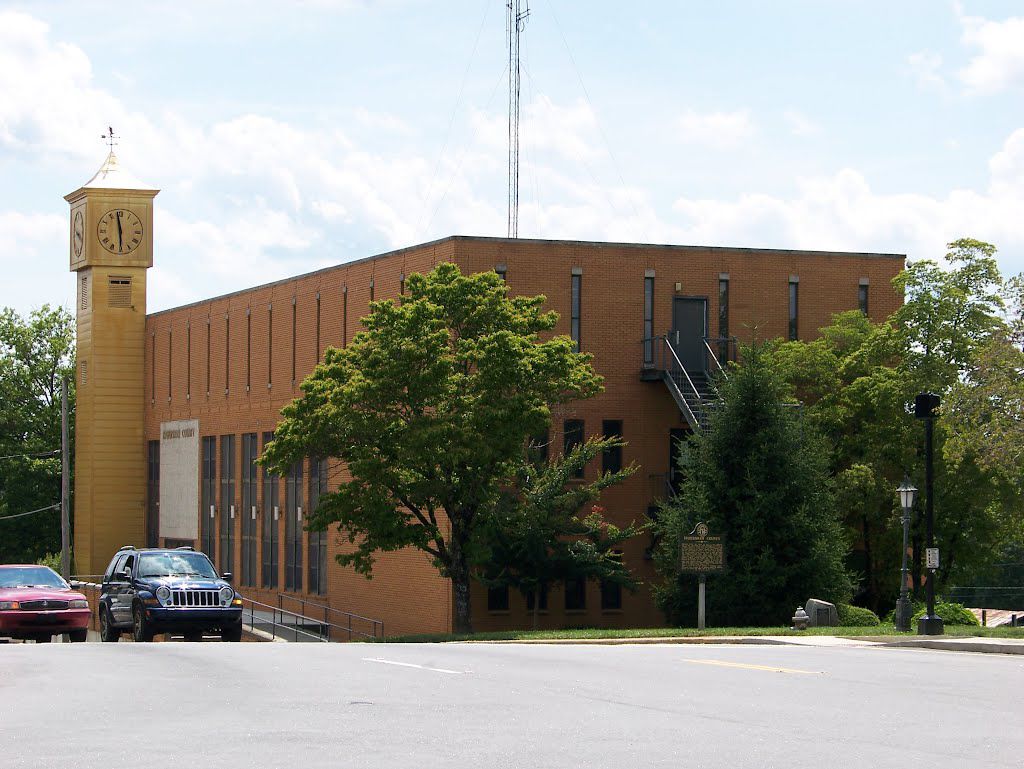
The old Clarkesville courthouse, built in 1963, has sat empty for years.
As the City of Clarkesville looks to further develop the downtown area, Lew Oliver of Lew Oliver Inc. is looking at restoring and repurposing the old Clarkesville courthouse, which could save it from demolition.
Oliver discussed bringing apartments or a hotel to the old courthouse with the county commission at their Monday work session, but put an emphasis on apartments. Oliver will have an apartment developer visit the courthouse this Thursday, and believes he can bring in more.
“Clarkesville is in transition,” Oliver tells the commission. “A lot of growth is headed this way, like it or not.”
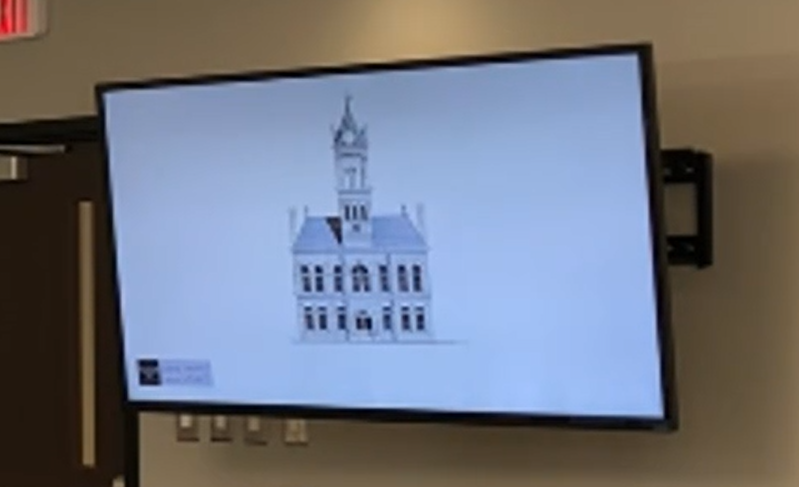
Oliver has compiled images and records of the courthouse’s original design to inspire his plans for reconstruction.
There is a need for affordable housing in Habersham county, and with nearby colleges like North Georgia Technical College, Piedmont University and Lanier Tech, there is a market for apartments in the area. Oliver estimates that the old courthouse could be put in “prime condition” for between $6-8 million dollars. He believes the courthouse could fit about 50 one-bedroom apartments, and that a parking solution is possible to support those possible residents.
A previous developer had similar plans. In 2019, the commission approved a contract to sell the old courthouse to Wayne Enterprises South LLC for $1 million. The deal fell through last year.
The courthouse has been slated for demolition for months now, but there are those who prefer to see it renovated. Many disdain the 70’s style yellow brick exterior and brassy gold bell tower, but there is something nostalgic about having the courthouse building sit in the center of town where courthouses have stood since 1821.
Also, renovating it could save the county money.
“I’ve been hearing that there were potential developers that wanted to come to Clarkesville […] and developers are seeing the potential of the courthouse,” Commissioner Bruce Harkness tells Now Habersham. “If we have to take $500,000 of taxpayer money to tear it down, [and] we could sell it for $750,000, it makes a whole lot more money for the county to sell it as is rather than spending a ton of money to tear it down.”
With support from the county and city of Clarkesville, Oliver will be able to bring in more plans, drawings and ideas for the restoration. For now, the commission has tabled demolition until September.
CLEVELAND – Authorities are investigating the death of a Sautee man who died early this morning after a fight with his dad.
Around 4:50 a.m. Tuesday, deputies responded to a report of a domestic dispute on Boco Hills Road. White County Sheriff Rick Kelley says there was a physical altercation between the father and son. As a result, the son, 34-year-old Anthony Orem Chambers, died at the scene from a gunshot wound.
Kelley says it appears that the shooting was in self-defense. There are no charges at this time.
White County investigators requested the GBI’s assistance with the case. The investigation is ongoing.
Nancy Elizabeth Armistead Alford, age 84 of Clarkesville, went home to be with the Lord on Sunday, July 18, 2021.
Born in Decatur, Georgia on March 11, 1937, Mrs. Alford was the daughter of the late Jack and Martha Horton Armistead. She was a graduate of Decatur High School and worked as an operator for Southern Bell. She later retired as a Sales Executive with AT&T.
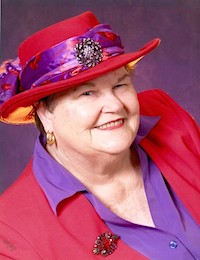
Mrs. Alford had a love for wearing hats and was the Queen Bee with the Red Hat Society. After retiring to the Northeast Georgia Mountains, Mrs. Alford became an active member of Bethlehem Baptist Church where she also sang in the choir and served in other ministry opportunities. She had worked part-time at Lovell, Duvall & Miller as well as Woods Furniture and was also a member of the local McDonald’s “Liars Club”. Mrs. Alford loved genealogy work and she was also an artist and pianist. She was also a member of the Habersham County Tea Party. In addition to her parents, Mrs. Alford is preceded in death by son Daniel Alford and nephew Shane Armistead.
Survivors include her son and daughter-in-law Larry and Becky Alford of Clarkesville, brother Donald Armistead of Panama City, Florida, special nephew Dr. Stephen “Bo” Armistead of Panama City, Florida, grandchildren Jerry Alford (Rachel) of Walnut Grove, Cody Alford (Georgia) of Murrayville, Lisa Appling (Chad) of Jefferson, and Jimmy Jeter (Candice) of Greenwell Springs, Louisiana, as well as five great-grandchildren, extended family and many friends.
Funeral services will be held at 10:00 AM on Thursday, July 22, 2021, at Bethlehem Baptist Church. Dr. Craig Ward, Pastor Brent Lord, and Pastor John Wood will officiate with interment to follow the service in the church cemetery. Ladies in attendance are asked to wear a hat to the service in honor of Mrs. Alford. The family will receive friends at the funeral home on Wednesday, July 21, 2021, from 4-8 PM.
In lieu of flowers, the family request that memorial donations be made to Bethlehem Baptist Church, P.O. Box 488, Clarkesville, GA 30523, or by visiting www.bbcofclarkesville.org, select give online and enter “In Memory of Nancy Alford” in the optional memo.
The Habersham County Commission has filled its county clerk and interim county manager positions after a two-month search following the resignations of former County Manager Phil Sutton and former County Clerk Lindsay Underwood.
The commission unanimously voted in an executive session following their July 19 meeting to hire Brandalin Carnes as the new county clerk. The clerk position was vacated by Lindsay Underwood in May of this year, and Carnes, who previously served as deputy clerk, has been serving in her place since.
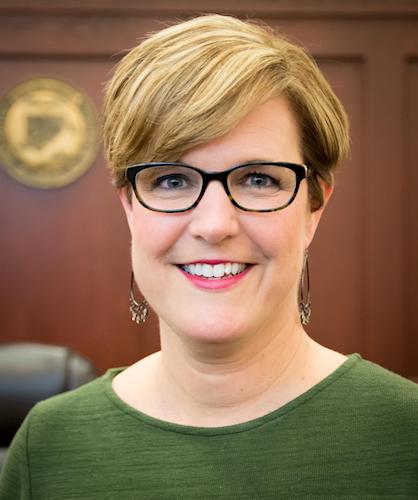
Alicia Vaughn is set to hold the interim county manager position for the next four to six months. (image via Catoosa County government website)
Interim County Manager Alicia Vaughn, who the commission appointed July 9, is now heading the search to find a new deputy clerk. The commissioners are still on the hunt for a permanent county manager, though.
The Habersham County Commissioners voted 4-0 at their July 19 meeting to enlist the help of the University of Georgia’s Carl Vinson Institute of Government (CVIOG) in their search for a new county manager.
The search with CVIOG has a proposed timeline of three months. Vaughn is set to hold the interim position for the next four to six months, though she says she plans to apply to fill the county manager position.
COVIG’s services will cost the county $9,470, which Chairman Dustin Mealor says is a reasonable price for an executive search service. The service will help the county assess their needs and desired qualifications, run ads and assist in the search for a qualified individual to take over the position. The county has the option to also use COVIG’s services for the interviewing process, with an additional fee of $1,500 per interview session.
You can watch the full recording of the July 19 commission meeting here.




 The goal of EPSDT is to provide early detection and treatment of health conditions so that children and adolescents covered by Medicaid can get appropriate preventive, dental, mental health, developmental and other specialty services.