Home Blog Page 156

Wrap your hands around a cup of mulled holiday cheer at Hardman Farms Victorian Christmas

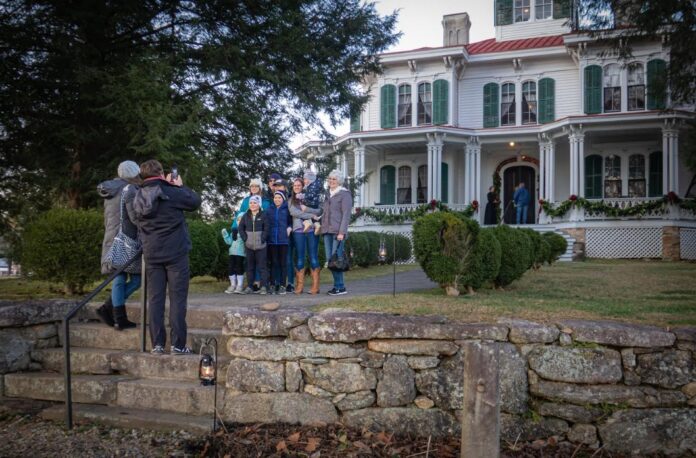
Families gather on the front steps of the Hardman Farm house for photographs during Victorian Christmas at Hardman Farm State Historic Site, with the 19th-century home decorated for the season behind them.

Hardman Farm State Historic Site extends an invitation that requires no persuasion, for the prospect speaks for itself. On selected evenings in December, the house known as West-End opens its doors to guests who wish to spend a Christmas as the Nichols family once did, in the year 1877, when the Nacoochee Valley offered both society and seclusion in agreeable measure.

Reenactors in period dress gather around a table inside the Hardman Farm house during Victorian Christmas at Hardman Farm State Historic Site, portraying a 19th-century holiday evening with cards, conversation, and refreshments by the hearth. (Photo by Hardman Farms)

Like a Currier and Ives postcard, horse-drawn wagons move along the old Unicoi Turnpike, a road that once carried traders through the valley and now carries visitors nostalgic for a past they never knew. The dim glow from the windows guides the way, and the house stands like an elegant matron ready to receive, dressed in garlands arranged with care and the confidence of a practiced host.

Within, individuals dressed as members of the Nichols household receive their guests. These reenactors portray Captain Nichols and his wife, Kate, along with their daughter, Anna Ruby, her grandmother, Mrs. Augusta Latimer, and friends gathered for the season. They converse with visitors as hosts once did, offering warmth and welcome. Each room reveals a tradition of the Victorian Christmas, from the decorations to the rituals that marked the holiday as a social occasion meant to distract from the bleakness of dark December.

Reenactors in period dress gather on the stairs of the beautiful West End mansion at Hardman Farms. (Photo by Hardman Farms)

“You’ll feel like you’ve been transported to Christmas past,” said Sarah Summers, Hardman Farm’s assistant manager. “It’s a dose of Christmas magic, and a memorable event for the whole family.” Guests walk through the mansion and interact with reenactors who explain various Victorian Christmas traditions. Local guest musicians fill the mansion with the sounds of Christmas each evening.

The kitchen draws visitors next, guided by the sweet scent of baking. There, cooks prepare sorghum-ginger cookies using syrup grown, pressed, and bottled on the farm itself. The process connects the table to the land and reminds guests that celebration once depended on what a household could produce as much as what it could purchase.

Beyond the kitchen, Santa waits in the carriage house, ready to greet visitors without the hurried press and long lines at the mall. Nearby, guests gather at the fire pit for s’mores or step inside the visitors center to browse holiday gifts made by local artists and craftspeople. Each choice invites conversation and a cup of holiday cheer warmed between both hands.

Reenactors prepare sorghum-ginger cookies in the historic kitchen at Hardman Farm State Historic Site as families gather during Victorian Christmas, watching the baking process and sampling treats made from sorghum grown on the farm. (Photo by Hardman Farms)

Hardman Farm offers this Victorian Christmas on Friday and Saturday evenings; its final open days are on 19 and 20, from 4 to 7 o’clock. Tickets remain available through the Georgia State Parks website, with options for individuals, families, and groups. The farm also welcomes inquiries by phone for those who prefer to make arrangements by voice.

At Hardman, Christmas unfolds with such care and propriety that one cannot doubt the hosts’ regard for the estate and company both. Tradition here does not insist upon observation alone; it flourishes through participation. Received into a tradition where laughter travels across generations and makes room for one more voice by the fire.

Suspects wanted for Eufaula triple shooting

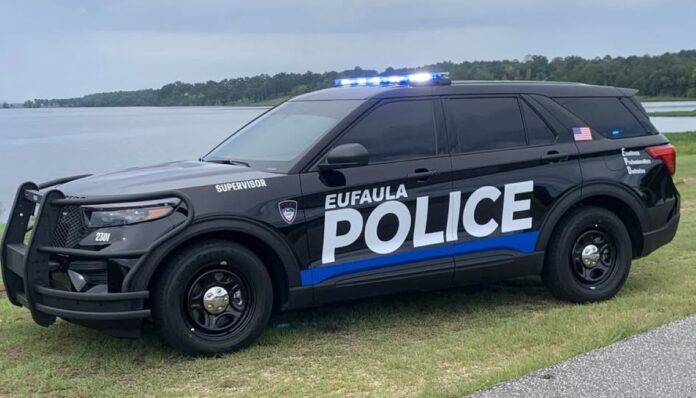
Eufaula police investigate triple shooting/NowGeorgia.com

On 16 December 2025 at approximately 6:40 p.m., three individuals knocked on a door at the Bluff Park Apartments complex. Once the door was opened the three individuals began firing over 30 rounds into the apartment striking three individuals. Two were severely injured and a third suffered minor wounds. Other residents in the apartment, including children were not injured.

The three suspects and driver of the gray Charger have been identified. For their alleged involvement, the driver of the vehicle, Makalya Henderson, 23, has been arrested,
Two of the suspects are Rayji Ajerrion Davis, 22, Lagarrius Blount, 18 are still at large and considered armed and dangerous. The third suspect was arrested today. Due to the age of the suspect, a name cannot be released.

If you have any information on this incident or any other crimes, we urge you to contact the Criminal Investigations Division at 334-687-1200 or the ANONYMOUS tip Line at 334-687-7100.

Raccoon tests positive for rabies

The Georgia Department of Public Health encourages people to stay away from wildlife to prevent the possible spread of rabies. (photo by Ennif Pendahl on Unsplash)

A raccoon from the Timbercreek subdivision near Whitesville Road was tested on December 17, 2025, by the Georgia Public Health Laboratory and found to have rabies. Residents and visitors of this area are strongly advised to take the following precautions: If you know of anyone that may have come in contact with a raccoon, contact Columbus Environmental Health office, Columbus Animal Care and Control Center and have them contact their physician.

*Do not pick up or handle any stray or wild animals.
*Report any animal bites and/or scratches.
*Contact Columbus Animal Care and Control Center to report any animals which are behaving strangely or aggressively.
*If your pet or livestock is behaving strangely or is injured contact your local veterinarian immediately.
*Teach children about the dangers of stray and wild animals.
*Have all of your dogs and cats vaccinated against rabies.

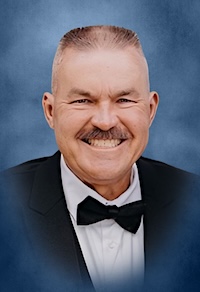
Anthony Eugene “Tony” Crane

Anthony Eugene “Tony” Crane, age 67, of Clarkesville, Georgia, went home to be with the Lord on Monday, December 15, 2025, surrounded by the love of his family.

Born on November 3, 1958, in Mecklenburg, North Carolina, Tony was the beloved son of the late Marvin Ellis “Tookie” Crane and Doris Burgess Crane. He was a proud graduate of Habersham Central High School, Class of 1976, where the roots of many lifelong friendships were formed.

Tony devoted over 31 years of his professional life to Hardy Chevrolet of Gainesville, where he earned a reputation as a top salesman and, more importantly, as a trusted friend. His warm smile, integrity, and genuine care for others left a lasting impression on colleagues and customers alike.

Outside of work, Tony found joy in life’s finer pleasures. He loved collecting coins, admiring fast cars, and enjoying fine dining. An outdoorsman at heart, he cherished time spent fishing and being surrounded by nature. Yet above all else, Tony’s greatest passion was his family. He was a steady rock, a devoted husband, a loving father, and a proud Pawpaw. His greatest blessings were his children, and nothing brought him more joy in recent months than his precious granddaughter, Ellie.

A man of deep faith, Tony was a faithful member of The Torch Worship Center, where his love for the Lord and his kind spirit shone brightly.

In addition to his parents, Tony was preceded in death by his older brother, Steve Crane.

Those left to cherish his memory include his wife of 28 years, Elizabeth Keller Crane; daughter and son-in-law, Tori Crane Allen and Tanner Allen; son, Tyler Crane; granddaughter, Ellis Laine “Ellie” Allen; sister-in-law, Debbie Crane; niece, Mandy Crane Wade and husband Jason; great-nephew, Tanner Wade; mother-in-law, Rose Armour; sister-in-law, Cindy Ferguson; brother-in-law & sister-in-law, Dennis & Cassie Keller; and many other special friends who were truly like family.

Tony Crane will be remembered for his unwavering faith, generous heart, and the deep love he had for his family. His legacy of kindness and devotion will live on in all who were blessed to know him.

Funeral services will be held at 1:00 p.m. on Saturday, December 20, 2025, from the Chapel of McGahee-Griffin & McEntire Funeral Home, with Pastor Mike Franklin and Rev. Earl Pirkle officiating. Interment will follow in Hillside Gardens Cemetery in Clarkesville.

The family will receive friends at the funeral home from 4:00 p.m. until 8:00 p.m. on Friday, December 19, 2025.

An online guest registry is available for the Crane family at www.mcgaheegriffinandmcentire.com.

McGahee-Griffin & McEntire Funeral Home of Cornelia, Georgia (706-778-8668) is in charge of arrangements.

Five big political questions for Georgia going into 2026

U.S. Sen. Jon Ossoff, outgoing U.S. Rep. Marjorie Taylor Greene and term-limited Gov. Brian Kemp are at the center of some of the biggest political storylines in Georgia going into the new year. (Ross Williams/Georgia Recorder)

(Georgia Recorder)- Gov. Brian Kemp is entering his final year in office. Georgia Republicans find themselves at a crossroads as they fight over his successor. Democratic U.S. Sen. Jon Ossoff is gearing up for the biggest fight of his young career. And one of Georgia’s most outspoken members of Congress is on her way out the door.

With 2025 coming to a close, several big questions are looming on the horizon. A transition of power is set to unfold at the governor’s mansion this time next year, and Republicans must decide who (and what) comes next. Ossoff will again aim to shatter fundraising records and defy expectations as he fights for a second term. And Democrats are in search of a new leader who can capitalize on a turbulent political climate.

Here are five big questions facing Georgia heading into the new year.

Will the Georgia GOP embrace the MAGA brand in 2026?

It wasn’t long ago when then-Secretary of State Brian Kemp sought an endorsement from President Donald Trump to help win his party’s nomination for governor. The two have had a rather icy relationship in the years since but seem to have somewhat patched things up.

But behind the scenes, a proxy war is well underway between the two leaders and their inner circles: Lt. Gov. Burt Jones is seeking to drop the word “lieutenant” from his title, and the president has thrown his full support behind the Butts County native and longtime friend.

Two other statewide officials are standing in Jones’ way to the GOP nomination, though: Attorney General Chris Carr and Secretary of State Brad Raffensperger. Kemp is unlikely to publicly take sides, but many of his closest allies and advisers have ties with Carr’s campaign. Both Carr and Raffensperger have butted heads with White House, particularly after the 2020 election, which means they run the risk of splitting the anti-Trump lane in the primary,

Regardless of who wins the primary, the future of the Georgia Republican Party and its image is set to be decided next spring.

Can Ossoff do it again?

Nearing the end of his first six-year term, Ossoff is preparing for what might be the biggest test of his short career. As the only Democrat running in a state Trump carried last year, he is a sitting duck for national Republicans as they fight to expand their Senate majority.

But Republicans must sort out their own messy primary before they can turn their attention to the 38-year-old Atlanta Democrat, who will be armed with a multimillion dollar warchest. The Republican primary has turned into a three-way battle between U.S. Reps. Mike Collins of Jackson and Buddy Carter of St. Simons Island, along with attorney and former football coach Derek Dooley.

Dooley, whose father Vince spent more than two decades as the “top dog” at the University of Georgia, has been endorsed by Kemp and is being boosted by many fundraising committees and leadership groups aligned with the popular Republican – who declined to enter the race himself despite heavy recruitment efforts. Carter and Collins are both trying to make inroads with the president’s supporters, though the president himself has yet to pick a side.

Ossoff will need to walk a very narrow line in his fight for a second term: he must channel the frustration of an angry Democratic base while also convincing swing voters and independents that Trump isn’t fulfilling his promise to lower prices. But as one of the most prolific fundraisers in his party, he will start off in a strong position as his Republican rivals fight it out.

Can Georgia Democrats end 20-year drought?

Democrats in Georgia may have found success in recent presidential and U.S. Senate contests. But it has been two decades since the party last won a race for a statewide constitutional office at the top of the ballot. After a string of recent wins in off-year special elections and a chaotic first year of Trump 2.0, Georgia Democrats sense a rare opening to finally break their losing streak for high-profile statewide offices.

But Stacey Abrams, the two-time nominee for governor who has become one of the party’s most recognizable faces, is unlikely to be the one leading the way. Just like their Republican counterparts, Democrats must also find a new standard-bearer who can lead them into next year’s elections.

Despite the renewed optimism, however, the biggest headlines in the race for governor have been about who isn’t running rather than who is: Abrams, former state Sen. Jason Carter and even U.S. Rep. Lucy McBath (D-Marietta) have chosen to stay on the sidelines, even though each one would have entered the race as a prohibitive favorite.

The race for governor has so far been slow to take off: many of the candidates don’t have the name recognition or a national fundraising network like Abrams, so they will be spending a lot of time introducing themselves to primary voters ahead of a likely runoff.

But as the party faces questions about the types of leaders that are needed for this moment, do they run the risk of nominating candidates who won’t unify a frustrated base?

How will Brian Kemp spend his final year in office?

The sun is setting on Kemp’s two-term tenure in the state’s top office: this time next year, the departing incumbent will be preparing to hand the keys to the governor’s Buckhead estate over to his successor.

As we wait to find out who will follow, we are also going to get a better look at how Kemp plans to cement his legacy. He will enter his final legislative session in January with a lot less leverage over his Gold Dome allies, many of whom are already grinding axes in Republican primaries or are candidates for higher office themselves. How the lame duck Kemp wields his remaining power over Republican lawmakers, who have worked hand in hand with him to enact his agenda and raise money for Republican causes, will be a key part of how his time in office will be remembered.

But he is placing a lot of his remaining capital in the race for U.S. Senate – a primary contest he could have had all locked up by now had he decided to run. A family friend of the Dooleys, Kemp wasted no time endorsing the ex-Volunteers coach’s campaign to unseat Ossoff. But his decision to stay out of the race and endorse an untested candidate has not gone over well with some in his party.

Poll after poll shows that Kemp is the most popular elected leader in the state. And at 62, it is not inconceivable that he could wind up on the ballot again in the near future. For now, his main focuses are the upcoming legislative session and boosting Dooley’s Senate bid. But Republican legislators and primary voters will be the ones who decide how much he gets done in his final year.

MTG’s next move?

U.S. Rep. Marjorie Taylor Greene’s surprise exit from Congress following her public falling out with Trump has become one of the biggest headlines of the year. And for good reason: Greene was one of the president’s most ardent supporters on Capitol Hill.

Greene first arrived in Congress in 2021 as one of the most controversial and outspoken members of her party. But she has been growing more critical of the Trump administration as his second term got underway. Things between the two escalated over the summer as Greene emerged as one of the few voices in her party to support the release of all files related to the late disgraced financier Jeffrey Epstein.

The biggest question that will follow the Rome Republican on her way out the door: What will she do next?

It’s no secret that Greene was contemplating a run for higher office next year; Democrats even tried goading her into challenging Ossoff. But Trump and White House officials were said to have talked her out of a statewide campaign after internal numbers made them nervous about her chances.

While she is unlikely to be a candidate for office next year, her involvement on the campaign trail supporting the Republican ticket will be closely watched. It could also give us a glimpse into whether or not the 51-year-old has any appetite to run for office again.

Georgia is entering 2026 with more questions than answers. With Kemp on his way out, both parties have just one year to nominate and rally around new leaders. Ossoff’s race for a second term will hinge on how well he can navigate a divided and unhappy electorate. And Greene’s next moves could give us an early look at her future plans.

It’s more than just elections on the line: it’s the direction of the state and the political futures of many key power players that could all be decided by this time next year.

Thomas County Central makes history in rout of Gainesville in title game

Thomas County Central came into the State Championship not only undefeated, but with an offense that averaged 53.3 points per game and needed a whopping 46 points to become the all-time highest-scoring team in Georgia football history. The #2 Yellow Jackets (15-0) did just that, hanging a 62-21 win over #1-ranked Gainesville (12-3) on Wednesday at Mercedes-Benz Stadium.

Thomas County rolled up a quick lead. As Jaylen Johnson threw a 27-yard TD pass to Gary Pringle, and later in the quarter, Johnson (3-star, uncommitted) kept the ball on a 10-yard TD. The Yellow Jackets were up 14-0 just over halfway through the first, as Kharim Hughley (3-star, Clemson) and the Red Elephants couldn’t get much going offensively.

The defense played well early on, with 5-star defensive end Xavier Griffin (Alabama) piling up the tackles (13 in total). In the second, Hughley found Cameron James on a check down, and he went the distance for a 45-yard TD to get Gainesville within 14-7.

Midway through the second, Thomas County Central added another on a Christian Lawrence (3-star, Wilford) 8-yard TD to make it 21-7. They didn’t let up, as Johnson again found Pringle to open the second half on a long TD and the 28-7 advantage.

Controversy came next, as Gainesville’s Legend Wilmont took the ensuing kickoff back for a TD, though several Yellow Jackets thought they heard a whistle. The touchdown was taken off the board, negating a critical score for the Red Elephants.

The sides traded turnovers, as Jeremiah Proctor picked off Johnson, then Dwight Lewis fumbled it away moments later. It all unraveled after that for Gainesville.

TCC made it 34-7 on a 27-yard TD run for Johnson. Gainesville would finally get back on the board with a 9-yard TD run by Hughley. Thomas County Central would score four more times, though, all by Christian Lawrence.

He notched a 71-yard TD, 45-yard TD, 20-yard TD, and a 6-yard score. Hughley added a 59-yard TD within that.

Hughley had 128 rushing yards and passed for 113, accounting for three TDs for the Red Elephants. Lawrence had 380 rushing yards and five TDs, while Johnson threw for 165 and two scores and rushed for 79 and another two touchdowns.

John F. Kennedy Center to be renamed the Trump-Kennedy Center, White House says

The John F. Kennedy Center for the Performing Arts, which the White House said will be renamed the Trump-Kennedy Center. (Photo courtesy of Kennedy Center)

WASHINGTON (States Newsroom) — The John F. Kennedy Center for the Performing Arts, a prestigious cultural hub in the nation’s capital, will be renamed the Trump-Kennedy Center, White House press secretary Karoline Leavitt announced Thursday.

The renaming comes after President Donald Trump named himself chair of the board in February in a major shake-up. He later fired the Kennedy Center president as well as board members appointed by President Joe Biden before appointing his own members.

Leavitt said the board unanimously approved the name change. However, a federal statute appears to prohibit the renaming of portions of the center, which is considered a living memorial to Kennedy.

“After December 2, 1983, no additional memorials or plaques in the nature of memorials shall be designated or installed in the public areas of the John F. Kennedy Center for the Performing Arts,” according to the U.S. code. 

Congress likely would need to change the law for the center to be renamed officially.

The Kennedy Center was renamed in 1964 to honor President John F. Kennedy, who was assassinated.

Leavitt said the renaming was “because of the unbelievable work President Trump has done over the last year in saving the building. Not only from the standpoint of its reconstruction, but also financially, and its reputation.”

“Congratulations to President Donald J. Trump, and likewise, congratulations to President Kennedy, because this will be a truly great team long into the future!,” she wrote.

Since the president’s takeover of the center, major artists and performers have canceled performances or boycotted performing. The artist Issa Rae, and the musical “Hamilton” will no longer perform at the center and dozens of cast members of “Les Misérables” refused to perform for Trump officials earlier this year.

White County Animal Shelter waives adoption fees through Christmas

The White County Animal Shelter is offering free adoptions of cats and dogs through Christmas. (White County)

CLEVELAND, Ga. — White County Animal Control is waiving adoption fees for dogs and cats through Christmas as part of an “Empty the Shelter” holiday adoption event.

The promotion includes free adoptions, microchipping and completion of a standard pet adoption agreement. Adopters are responsible for any additional spay or neuter-related fees.

Shelter officials say the goal is to place animals in permanent homes while creating space for pets that may come into care during the busy holiday season.

White County Animal Control is located at 680 Industrial Blvd. in Cleveland. The shelter is open Monday through Friday from 8 a.m. to 6 p.m.

More information is available by visiting the shelter in person to meet available animals.

Rural schools hit by Trump’s grant cuts have few options for making up for the lost money

Students work together on a science, technology, engineering and mathematics challenge, facilitated by the Kentucky Science Center, in Simpsonville Elementary School, Nov. 18, 2025, in Simpsonville, Ky. (AP Photo/Jon Cherry)

SHELBYVILLE, Ky. (AP) — When the funding for Shannon Johnson’s job as a school mental health counselor came to an abrupt end, two years into a five-year grant, she thought about the work left to be done.

Johnson taught elementary and middle-school students in rural Kentucky how to navigate conflict, build resilience and manage stress and anxiety before a crisis happens. Few districts, especially rural ones, can dedicate a full-time role to early intervention amid a national shortage of mental health staff.

But the Trump administration discontinued her grant, giving her a sudden end date. So when another job opened in Shelby County Public Schools — this one not reliant on federal grants — she took it.

The district 30 miles east of Louisville does not plan to fill her former position. Without the federal money, it cannot.

Federal dollars make up roughly 10% of education spending nationally, but the percentage is significantly higher in rural districts, which are not able to raise as much money on property taxes.

When the funding is reduced, many districts have no way to make up the lost money.

Since President Donald Trump’s administration began its sweeping examination of federal grants to schools and universities, millions of dollars for programs supporting mental health, academic enrichment and teacher development have been withheld or discontinued. The Republican administration says the grants do not focus on academics and they prop up diversity or inclusion efforts that run counter to White House priorities.

Some grant cancellations have been temporarily paused during legal challenges. But for schools whose states are not fighting Washington’s decisions, there is little relief to be found.

That is the case in Kentucky. Nine rural school districts that received grants to hire counselors will have to decide whether they can afford to keep them. Already, more than half those counselors have left for other jobs.

To keep jobs supported by lost grants, schools must make other cuts

Federal money supports school programs for the most disadvantaged students, such as those with disabilities, kids learning the English language and children living in poverty. Some is appropriated by Congress for bipartisan priorities such as reducing barriers to education and improving youth mental health.

In Shelby County, where federal spending makes up about 18% of schools’ budgets, it also helps pay for teacher development opportunities — a key to staff retention — plus expanded after-school offerings that include tutoring, clubs and transportation.

The programs are not political, Superintendent Joshua Matthews said, and the funding loss only hurts students.

“I don’t know about everywhere in the country,” Matthews said. “But I can tell you in Shelby County, our teachers show up every day to make for sure that our kids are well taken care of, and we’re not promoting anything one way or the other.”

Even current levels of funding sometimes do not feel like enough, Matthews said. The district could try to use state or local money to help sustain the programs, but at the cost of paying for field trips or keeping class sizes small, he said.

For the counselors leaving districts that cannot afford to extend their positions, their youth mental health work is left unfinished.

“We had our minds and our goals and our plans really prepped for five-year work,” Johnson said. “We can’t really see a lot of change through systems in a year.”

The deep uncertainty has required educators to be prepared for an abrupt halt to their work while they look for ways to keep momentum, said Brigitte Blom, president and CEO of the Prichard Committee for Academic Excellence, which administers a federal grant for Shelby County and other school systems in Kentucky to expand engagement with the community and families.

“We have encouraged them to think about sustainability two years sooner than we would have,” she said.

In December, Blom learned that the administration would discontinue the federal grant.

Rural schools have few other places to turn for help

In Washington County, a rural district south of Shelby County with roughly 1,800 students, the grant helped launch a mentoring program, a career exploration class and expanded after-school academics. Schools with those programs have seen reductions in absenteeism, said Tracy Abell, the district’s community schools director.

As federal money begins to dwindle, the effects will not be immediate. Superintendent Robin Cochran said it may take years for districts to see the gaps that emerge from programs that end today. Eventually, rural schools run out of options.

When larger districts lose funding, they may need to scale back programs. “For us, it means that it goes away,” Cochran said.

Shelby County has used funding from the same federal grant to expand its community schools program, seeking out new partnerships with city government and local businesses for more classroom and after-school learning. In Simpsonville, when the city parks department noticed a shortage of fresh vegetables at its farmers market, the district saw an opportunity for Simpsonville Elementary School, just down the street.

There, students in Katie Strange’s class now learn about agriculture, biology and ecology by growing produce for the market. Strange incorporated the work of the garden — germination, planting and harvesting — into her lessons, while parents and community organizations volunteered supplies and time to build a set of garden beds, funded by the community schools grant.

Although deer ate much of the lettuce, Strange said the school cafeteria was able to collect enough leafy greens to serve the students for lunch — a highlight for the kids. In November, long after the growing season had ended, members of the school’s garden club still spoke over each other with rushed excitement, recounting the harvest.

Fourth grader Stefan Viljoen explained how they treated the garden with deer repellent and listed out their crops.

“We grew cherry tomatoes, regular tomatoes,” he started to say.

“Cucumbers!” second grader Raylee Longacre interjected. “And we tried to make them into pickles.”

“They didn’t taste too good,” said Savannah Cull, a third grader.

Nate Jebsen, the district’s community schools director, said that without dedicated funding for a role like his, the work to pursue such partnerships would fall to administrators who are already stretched thin.

Schools see a difficult path to bringing back grant-funded staff

In Eminence Independent Schools, just north of Shelby County, Emily Kuhn hopes her district will be able to extend her role as a school counselor beyond the end of this school year, when the money for the position runs out. In her district, with two schools and just under 1,000 students, the grant-funded role came without the administrative tasks most counselors juggle and focused on working with students on their mental health and emotional skills.

“It takes more than one year to build that with people here, because they’re a very tight-knit, small community,” Kuhn said. “I’ve noticed a huge difference this year compared to last, of kids coming in and trusting me.”

The Ohio Valley Educational Cooperative, which manages the grant that funded Kuhn and Johnson’s jobs, unsuccessfully appealed the administration’s decision to discontinue the funding, said Jason Adkins, chief executive officer. The federal lawsuit filed to challenge the grant’s termination temporarily restored the funding, but only for a subset of districts, not including those in Kentucky.

This fall, the U.S. Education Department announced it would seek new applicants for the school mental health grants it pulled back. The Ohio Valley cooperative reapplied but was not awarded the new grant, Adkins said. Even if the cooperative had won the money, that would not have helped the staff originally hired. The new guidance limits recipients to hiring school psychologists and not counselors.

In the initial grants, the organization focused on hiring counselors, in part because of a shortage of psychologists in rural areas, Adkins said. School psychologists require more training and are in high demand in larger, urban districts. The goal was to hire quickly and start boosting mental health support right away.

Even if there was the money to hire more psychologists, Adkins said, he was unsure whether there would be enough applicants to fill those roles.

Story written by AP Education reporter Annie Ma 

James Gilbert Bellotte, Jr.

James “Shorty” Gilbert Bellotte, Jr., age 71, of Lula, passed away peacefully on Wednesday, December 10, 2025. He was born on December 26, 1953, in Atlanta.

With a profound sense of honor and dedication, he served his country in the Navy, embodying the spirit of resilience and commitment that marked his life.

He was preceded in death by his loving and devoted wife, Kathryn “Kathy” Farmer Bellotte, who was his steadfast partner in life. James is also reunited with his parents, James Gilbert Bellotte, Sr. and Elizabeth Shelnutt Bellotte, and siblings Keith Bellotte and Marlene Kingsbury.

James was a beloved father, brother, and friend, remembered for his warmth and kindness. He is survived by his children: James Adrian Bellotte, Dustin Bellotte, Shawn Atkins (Tammy), Allen Dover, Latasha Bellotte, Amanda Dover, Layla Padgett (Chris). His legacy continues through his grandchildren: David Worley, CJ Padgett, Evelyn Padgett, Colten Padgett, Ayden Bellotte, Austin Bellotte, Alexis Gee, Jessie Gee II, Chase Gee, Elizabeth Bellotte, Katlyn Atkins, Brian Bagwell; great-grandchildren: Lorelei Gee-Richards, Amora Escobar-Gee, Anden Atkins, Brinlee Jackson, Sebastian Bagwell, Isabelle Bagwell; brothers: Herbert Bellotte (Shelby), Tony Wilson; sisters: Brenda Aldridge (James Turpin), Teresa Mote, Loretta Meeks, Tammy Greenway.

James had many proud accomplishments throughout his life. He cherished the moments spent with his family, often sharing his passion for raising animals and enjoying the great outdoors through hunting and fishing. These pastimes brought him joy and connected him with both nature and his loved ones.

A funeral service will be held in the Chapel of McGahee-Griffin & McEntire on Friday, December 19, 2025, at 2:00PM.

The family will receive friends on Thursday, December 18, 2025, from 3:00 PM to 5:00 PM and again from 6:00 PM to 8:00 PM at the funeral home.

An online guest registry is available for the Bellotte family here.

McGahee-Griffin & McEntire Funeral Home of Cornelia, Georgia (706/778-8668) is in charge of arrangements.

City Councilor: ‘A job offer was made’

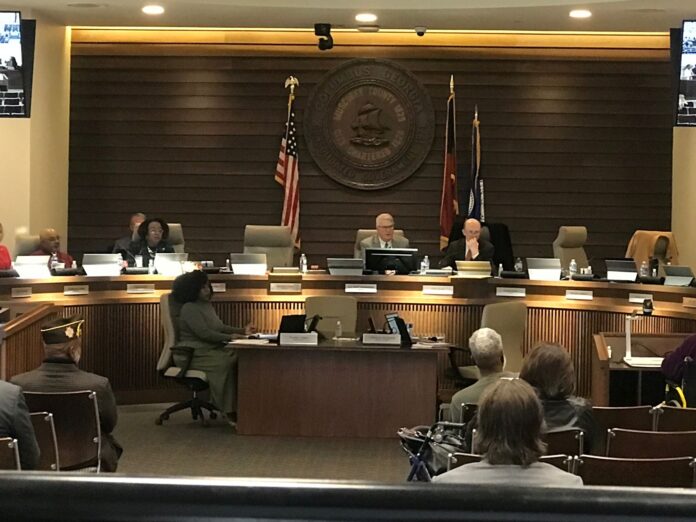
Columbus City Council/NowGeorgia.com

City Councilor Toyia Tucker took to social media to share with her followers a job offer was made for the city manager position. “When I hear a BLATANT lie on the news that a job offer wasn’t made by CCG regarding the City Manager Search, it’s highly disappointing and disgraceful!” Tucker told her followers.

Tucker told Now Network News a job offer was made and not accepted. Without naming any individual by name on social media, Tucker said the person was highly qualified. “The person is Well Qualified and I will not continue to support the ostrich’s head in the sand. Yes…I want TEAM cohesiveness but for many residents I have spoken with, they are saying enough is enough and so am I! Stop the madness!!! I thank the individual who was a finalist and offered the job and I absolutely hate that you are not recognized as being a worthy candidate for this position! Your work is well respected by so many and just know, I will continue to celebrate you and thank you for the work you do locally! Please continue serving with pride and honor!!!!” Tucker wrote.

The district 4 city councilor filed an open records request for the mayor to release the names of the top 5 finalists for city manager. Her request was denied by the city attorney. Tucker argued that once an offer was made the city charter allowed for that information to be made public. The lack of transparency regarding the search for a city manager has led to a clash between the mayor and some city council members.

The mayor has said publicly he doesn’t want the city to have a reputation for making potential employees names public. Mayor Henderson has declined multiple calls for comment from Now Network News.


Alto council meets today with GMA consultant as 2026 budget remains unresolved

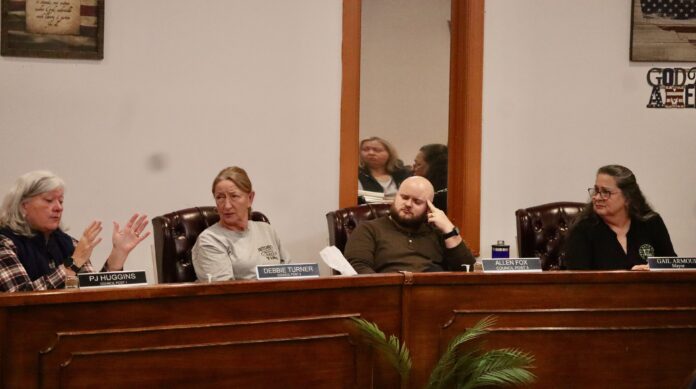
The Alto Town Council hears from water department employees during Friday's emergency meeting. (Patrick Fargason/Now Habersham)

ALTO, Ga. — The Alto mayor and town council will meet Thursday, Dec. 18, with Georgia Municipal Association consultant Pete Pyrzenski to discuss planning and other town issues, including the still-unadopted 2026 budget that has been tabled multiple times over the past several months.

Budget process began in October

The meeting is scheduled for 1 p.m. and follows a prolonged budget process that began in October with public hearings on a proposed millage rate increase and has yet to result in a final spending plan for the coming year.

Council members voted in late October to raise the town’s millage rate to 6.2 mills to help address a projected deficit, restoring the rate to a level last seen in 2016. CFO Linda Turner said at the time the increase was necessary to stabilize revenues as Alto worked to finalize its 2026 budget.

Tabled budget

Despite that action, the council has twice delayed adoption of the budget. A draft budget totaling about $1.22 million was presented in November but did not fully close a projected deficit of roughly $79,000, prompting the council to table the vote for further review. The budget was tabled again at the council’s Dec. 9 meeting.

Budget uncertainty has coincided with broader operational concerns, including challenges within the town’s water department that were the focus of a specially called meeting on Friday.

Focused on planning

At last week’s meeting, council said the city is focused on long-term planning while pausing any immediate policy changes. Councilwoman PJ Huggins said no changes to water department policy will be made until the city meets with Pyrzenski on Thursday.

The upcoming meeting with Pyrzenski is expected to give the council an opportunity to review budget assumptions, long-term planning needs and other governance issues as Alto works toward adopting a final 2026 budget.

No formal vote is expected during Thursday’s session, but the discussion will help guide next steps in the budget process.