
Home Blog Page 149

Western intelligence suspects Russia is developing new weapon to target Musk’s Starlink satellites

FILE - In this time-exposure photograph, a SpaceX Falcon 9 rocket with the 25th batch of approximately 60 satellites for SpaceX's Starlink broadband network lifts off from the Space Launch Complex 40 at the Cape Canaveral Space Force Station in Cape Canaveral, Fla., late Wednesday, April 28, 2021. (AP Photo/John Raoux, File)

Two NATO-nation intelligence services suspect Russia is developing a new anti-satellite weapon to target Elon Musk’s Starlink constellation with destructive orbiting clouds of shrapnel, with the aim of reining in Western space superiority that has helped Ukraine on the battlefield.

Intelligence findings seen by The Associated Press say the so-called “zone-effect” weapon would seek to flood Starlink orbits with hundreds of thousands of high-density pellets, potentially disabling multiple satellites at once but also risking catastrophic collateral damage to other orbiting systems.

Analysts who haven’t seen the findings say they doubt such a weapon could work without causing uncontrollable chaos in space for companies and countries, including Russia and its ally China, that rely on thousands of orbiting satellites for communications, defense and other vital needs.

Such repercussions, including risks to its own space systems, could steer Moscow away from deploying or using such a weapon, analysts said.

“I don’t buy it. Like, I really don’t,” said Victoria Samson, a space-security specialist at the Secure World Foundation who leads the Colorado-based nongovernmental organization’s annual studyof anti-satellite systems. “I would be very surprised, frankly, if they were to do something like that.”

But the commander of the Canadian military’s Space Division, Brig. Gen. Christopher Horner, said such Russian work cannot be ruled out in light of previous U.S. allegations that Russia also has been pursuing an indiscriminate nuclear, space-based weapon.

“I can’t say I’ve been briefed on that type of system. But it’s not implausible,” he said. “If the reporting on the nuclear weapons system is accurate and that they’re willing to develop that and willing to go to that end, well it wouldn’t strike me as shocking that something just short of that, but equally damaging, is within their wheelhouse of development.”

Kremlin spokesman Dmitry Peskov didn’t respond to messages from the AP seeking comment. Russia has previously called for United Nations efforts to stop the orbital deployment of weapons and President Vladimir Putin has said Moscow has no intention of deploying nuclear space weapons.

Weapon would have multiple targets

The intelligence findings were shown to the AP on condition that the services involved were not identified and the news organization was not able to independently verify the findings’ conclusions.

The U.S. Space Force didn’t respond to e-mailed questions. The French military’s Space Command said in a statement to the AP that it could not comment on the findings but said, “We can inform you that Russia has, in recent years, been multiplying irresponsible, dangerous, and even hostile actions in space.”

Russia views Starlink in particular as a grave threat, the findings indicate. The thousands of low-orbiting satellites have been pivotal for Ukraine’s survival against Russia’s full-scale invasion, now in its fourth year.

Starlink’s high-speed internet service is used by Ukrainian forces for battlefield communications, weapons targeting and other roles and by civilians and government officials where Russian strikes have affected communications.

Russian officials repeatedly have warned that commercial satellites serving Ukraine’s military could be legitimate targets. This month, Russia said it has fielded a new ground-based missile system, the S-500, which is capable of hitting low-orbit targets.

Unlike a missile that Russia tested in 2021 to destroy a defunct Cold War-era satellite, the new weapon in development would target multiple Starlinks at once, with pellets possibly released by yet-to-be launched formations of small satellites, the intelligence findings say.

Canada’s Horner said it is hard to see how clouds of pellets could be corralled to only strike Starlink and that debris from such an attack could get “out of control in a hurry.”

“You blow up a box full of BBs,” he said. Doing that would “blanket an entire orbital regime and take out every Starlink satellite and every other satellite that’s in a similar regime. And I think that’s the part that is incredibly troubling.”

System is possibly just experimental

The findings seen by the AP didn’t say when Russia might be capable of deploying such a system nor detail whether it has been tested or how far along research is believed to be.

The system is in active development and information about the timing of an expected deployment is too sensitive to share, according to an official familiar with the findings and other related intelligence that the AP did not see. The official spoke on condition of anonymity to discuss the nonpublic findings.

Such Russian research could be simply experimental, Samson said.

“I wouldn’t put it past some scientists … to build out something like this because it’s an interesting thought-experiment and they think, you know, ‘Maybe at some point we can get our government to pay for it,'” she said.

Samson suggested the specter of a supposed new Russian threat may also be an effort to elicit an international response.

“Often times people pushing these ideas are doing it because they want the U.S. side to build something like that or … to justify increased spending on counterspace capabilities or using it for a more hawkish approach on Russia,” she said.

“I’m not saying that this is what’s happening with this,” Samson added. “But it has been known to happen that people take these crazy arguments and use them.”

Tiny pellets could remain undetected

The intelligence findings say the pellets would be so small — just millimeters across — that they would evade detection by ground- and space-based systems that scan for space objects, which could make it hard to pin blame for any attack on Moscow.

Clayton Swope, who specializes in space security and weaponry at the Center for Strategic and International Studies, a Washington, D.C.-based security and policy think tank, said if “the pellets are not trackable, that complicates things” but “people would figure it out.”

“If satellites start winking out with damage, I guess you could put two and two together,” he said.

Exactly how much destruction tiny pellets could do isn’t clear. In November, a suspected impact by a small piece of debris was sufficient to damage a Chinese spacecraft that was meant to bring three astronauts back to the Earth.

“Most damage would probably be done to the solar panels because they’re probably the most fragile part” of satellites, Swope said. “That’d be enough, though, to damage a satellite and probably bring it offline.”

‘Weapon of fear’ could threaten chaos

After such an attack, pellets and debris would over time fall back toward Earth, possibly damaging other orbiting systems on their way down, analysts say.

Starlink’s orbits are about 550 kilometers (340 miles) above the planet. China’s Tiangong space station and the International Space Station operate at lower orbits, “so both would face risks,” according to Swope.

The space chaos that such a weapon could cause might enable Moscow to threaten its adversaries without actually having to use it, Swope said.

“It definitely feels like a weapon of fear, looking for some kind of deterrence or something,” he said.

Samson said the drawbacks of an indiscriminate pellet-weapon could steer Russia off such a path.

“They’ve invested a huge amount of time and money and human power into being, you know, a space power,” she said.

Using such a weapon “would effectively cut off space for them as well,” Samson said. ”I don’t know that they would be willing to give up that much.”


Kathryn Kimbrell Rider

Kathryn Kimbrell Rider, age 93, of Cornelia, Georgia, went home peacefully to be with the Lord on Saturday, December 20, 2025.

Born on February 11, 1932, in Mount Airy, Georgia, Kathryn was the second of ten children born to the late Tom and Bonnie Pitts Kimbrell. From an early age, she learned the values of faith, hard work, and devotion to family—principles that guided her throughout her long and meaningful life.

Kathryn devoted many years of faithful service to Fieldale Farms Corporation, where she retired after a dedicated career. Above all else, she was a family woman. She was a loving mother, grandmother, great-grandmother, and great-great-grandmother whose life revolved around caring for others. Her gentle spirit, warm smile, and steady presence will be remembered by all who were blessed to know her. When her health allowed, she attended Mount Airy Baptist Church, where her faith was quietly lived out through kindness and compassion.

In addition to her parents, Kathryn was preceded in death by her son, James Rider, Sr.; her daughter, Janice Anderton; her brothers, Loyd Kimbrell, Joe Kimbrell, Howard Kimbrell, Wilkie Kimbrell, Edward Kimbrell, and Ralph Kimbrell; and her sister, Betty Payne.

She is survived by her children and their families: her son and daughter-in-law, Tommy Harold and Terry Rider; her daughter and son-in-law, Betty “BJ” and Walter Tigrett; and her daughter-in-law, Dorothy Rider. She is also survived by her brothers and sisters-in-law, J.C. and Mary Kimbrell, Efford Kimbrell, and Carol Kimbrell. Kathryn leaves behind a cherished legacy through her grandchildren, Judy Dyer, James Rider, Jr., Ronnie Hunter (Michelle), Johnny Rider (Wilma), Tim Moore (Mary), and Bobby Moore (Trissy); sixteen great-grandchildren; and twenty great-great-grandchildren. She is also fondly remembered by many nieces, nephews, extended relatives, and dear friends.

Funeral services are scheduled for 11:00 a.m. on Tuesday, December 23, 2025, from the Chapel of McGahee-Griffin & McEntire Funeral Home, with Rev. Scott Ledbetter and Chaplain Susan Collins officiating. A private family interment will follow in East View Cemetery in Mount Airy.

The family will receive friends at the funeral home from 9:30 a.m. until the service hour on Tuesday.

The family would like to express their deepest gratitude and heartfelt appreciation to Kathryn’s devoted caregivers and the hospice team, whose love, grace, gentleness, and compassionate care brought comfort and dignity to her during this journey.

An online guest registry is available for the Rider family at www.mcgaheegriffinandmcentire.com.

McGahee-Griffin & McEntire Funeral Home of Cornelia, Georgia (706-778-8668) is in charge of arrangements.

Powerball jackpot climbs to $1.6 billion, among largest lottery prizes ever in U.S.

(NowGeorgia.com)

The Powerball jackpot now stands at an estimated $1.6 billion, making it one of the largest lottery prizes in U.S. history, Powerball officials said Sunday.

No ticket matched all six winning numbers on Saturday — white balls 4, 5, 28, 52, 69 and red Powerball 20. That sets up the fifth-largest U.S. jackpot ever for Monday’s drawing, according to a news release from Powerball.

The biggest U.S. jackpot was $2.04 billion in 2022. The winner bought the ticket in California and opted for a lump-sum payment of $997.6 million.

The odds of winning Monday’s jackpot, which is the fourth-largest in Powerball history, are 1 in 292.2 million, according to Powerball.

The winner can opt for a lump-sum payment estimated at $735.3 million or an annuitized prize estimated at $1.6 billion. Both prize options are before taxes.

The annuity option offers one immediate payment followed by 29 annual payments that increase by 5% each year, Powerball said.

Powerball is available in 45 states, Washington, D.C., Puerto Rico and the U.S. Virgin Islands. It is overseen by the Multi-State Lottery Association, a nonprofit group made up of state lotteries. Profits from ticket sales are used by states to support public education and other services.

Time to SHINE is running out 

SHINE is a tribute to Christmas at the Columbus Botanical Garden.

The annual holiday light display at Columbus Botanical Garden is sold out for Sunday, December 21, but there are two nights remaining for those families who appreciate amazing exterior illumination. Tickets are still available on Monday and Tuesday, December 22 and 23, from 6:00 pm until 9:00 pm. 

Thousands of light displays delight visitors at SHINE.

If you ever drove around Columbus looking for great Christmas light displays, chances are you visited the Ludy Christmas Spectacular on Ironstone Drive, complete with more than 500,000 lights and a show synchronized to music. The annual tradition for more than 14 years also raised more than $200,000 for charities. 

Some of the Ludy’s lighting is now featured at the SHINE display at the Columbus Botanical Garden on 40 acres at 3603 Weems Road. 

Two nights remain to sparkle and shine at the Columbus Botanical Garden.

So much Christmas lighting and so little time to see it. For ticket information visit here: https://www.columbusbotanicalgarden.org/shine-2025

Habersham County Officials launch ‘Secure Homes, Safe Kids’ initiative to distribute free gun locks

The gun lock on this pistol is similar to the device local officials will be handing out to Habersham families as part of the new "Secure Homes. Safe Kids." initiative. The Habersham County School District is teaming up with local law enforcement agencies to provide the gun locks free of charge to help prevent accidental shootings.

HABERSHAM COUNTY, Ga. — In a unified effort to improve student safety and reduce firearm-related tragedies, the Habersham County School District and local law enforcement agencies have announced the launch of the SECURE HOMES, SAFE KIDS Initiative. The new collaborative program will provide firearm locks to community members free of charge.

The initiative comes in response to alarming data regarding youth safety. According to the Johns Hopkins University Center for Gun Violence Solutions, firearms are currently the leading cause of death for young people ages 1-17 in Georgia. Officials emphasize that unsecured firearms significantly increase the risks of both suicide and unintentional shootings among children and teens.

The impact of secure storage

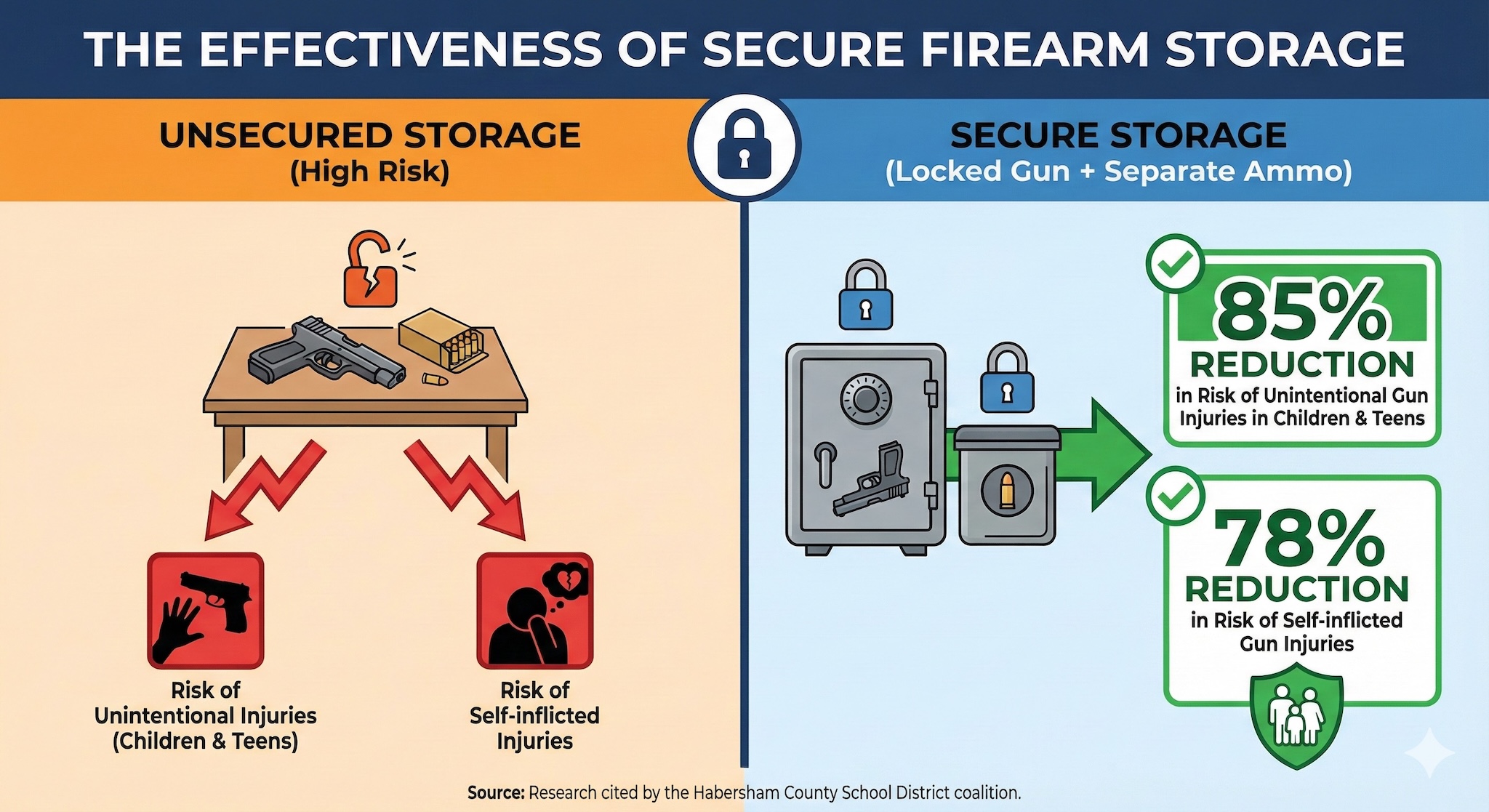
The coalition aims to educate the public on the effectiveness of proper firearm storage. Research cited by the district indicates that when guns are locked and secured—with ammunition stored separately—the risk of unintentional gun injuries in children and teens drops by 85%. Furthermore, secure storage results in a 78% reduction in the risk of self-inflicted gun injuries.

“The safety and well-being of our students is the absolute highest priority for both the Habersham County School District and all first responders serving in our community,” the district stated in a press release.

(NowHabersham.com)

A community-wide partnership

The initiative represents a broad partnership between education and law enforcement sectors. Led by the Habersham County Schools Police Department, the program includes support from:

The Mountain Judicial Circuit District Attorney’s Office, Child Fatality Review Committee, Habersham County Sheriff’s Office, and police departments in Baldwin, Cornelia, and Tallulah Falls.

“I am very optimistic that this initiative will be another positive, effective step towards a safer community,” said Murray Kogod, Habersham County Schools Director of School Safety and Chief of Police.

How to obtain a free gun lock

(NowHabersham.com)

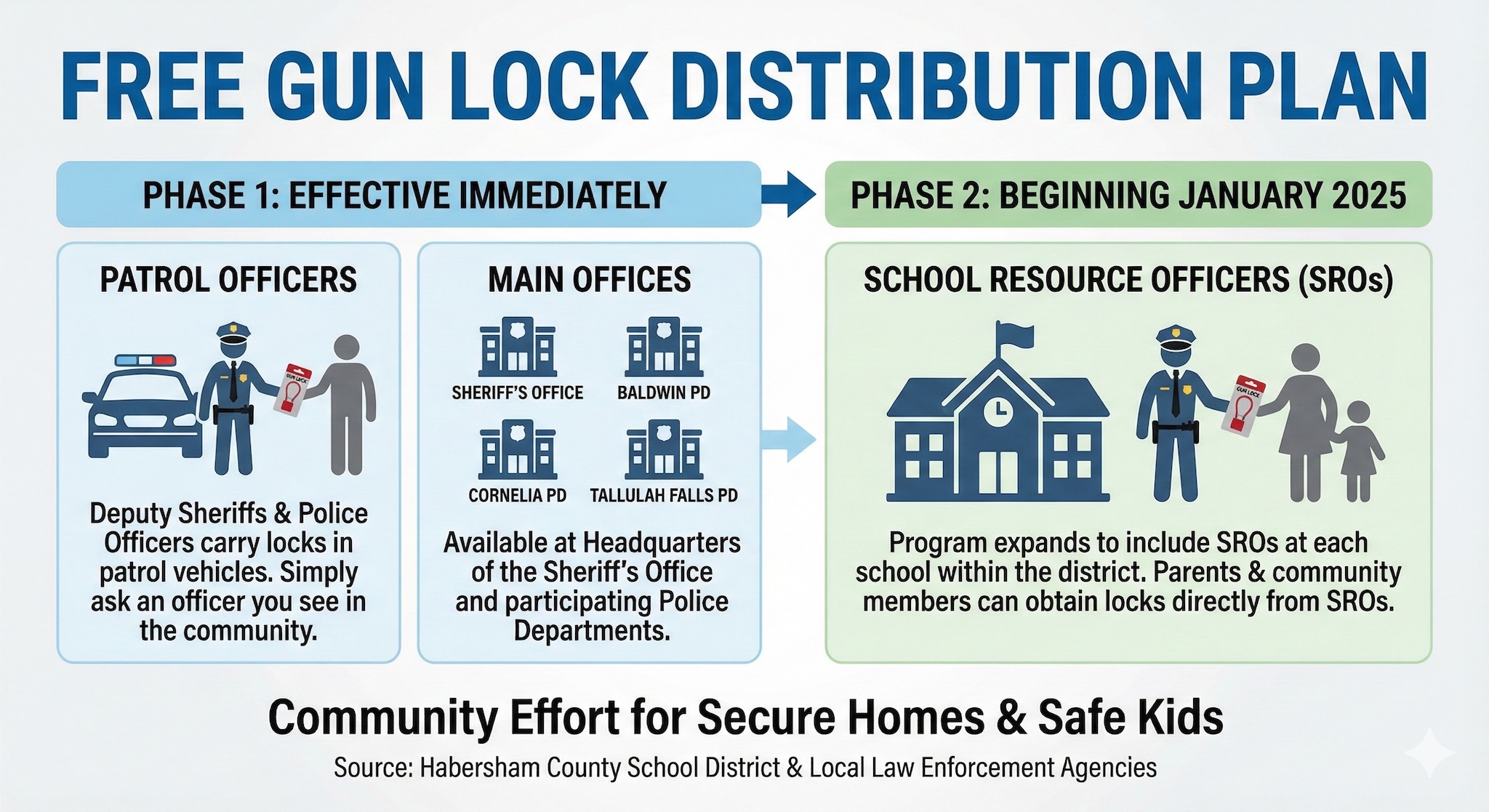
Community members can obtain a lock through several avenues, with distribution rolling out in two phases:

Phase 1 (Effective Immediately):

Residents may request a free lock from:

• Patrol Officers: Deputy sheriffs and police officers will carry locks in their patrol vehicles. Residents can simply ask an officer they see in the community.

• Main Offices: Locks are available at the headquarters of the Sheriff’s Office and the participating police departments (Baldwin, Cornelia, and Tallulah Falls).

Phase 2 (Beginning January 2025):

Following the New Year, the program will expand to include School Resource Officers (SROs). At that time, parents and community members will be able to obtain locks directly from the SROs at each school within the district.

Lyndon House Arts Center opens call for artists for 51st juried exhibition

The Lyndon House Arts Center (Visit Athens)

ATHENS, Ga. — The Lyndon House Arts Center is accepting online submissions for its 51st Juried Exhibition, inviting visual artists from the Athens area to apply beginning Jan. 6.

Submissions will be accepted exclusively through ArtCall.org from 7 a.m. Jan. 6 through 11:59 p.m. Jan. 20. The exhibition will be juried by Michelle Yun Mapplethorpe, director and chief curator of the Katonah Museum of Art in Katonah, New York.

Artists ages 18 and older who live in the Athens area may submit up to three works for consideration. The entry fee is $35. Eligible counties include Banks, Barrow, Clarke, Elbert, Franklin, Greene, Hall, Hart, Jackson, Madison, Morgan, Oconee, Oglethorpe, Walton and Wilkes.

An application clinic will be held from noon to 3 p.m. Saturday, Jan. 17, in the Community Room at the Lyndon House Arts Center for artists who need in-person assistance with the online submission process. No appointment is required, and participants are asked to bring all required materials in digital format.

Juror selections will be completed by Jan. 29. Artists whose work is selected will deliver their pieces to the arts center from 10 a.m. to 4 p.m. on Friday, Feb. 13, and Saturday, Feb. 14.

The 51st Juried Exhibition will open March 19 and remain on view through May 16. All exhibitions at the Lyndon House Arts Center are free and open to the public.

The Lyndon House Arts Center is located at 211 Hoyt St. and operates Tuesday and Thursday from 10 a.m. to 8 p.m., and Wednesday, Friday and Saturday from 10 a.m. to 5 p.m. Children must be accompanied by an adult.

For more information, call 706-613-3623 or visit www.accgov.com/exhibits.

Fiery wrong-way crash kills two on Athens GA 10 Loop

(NowGeorgia.com)

ATHENS, Ga. — A wrong-way crash on the GA 10 Loop in Athens early Sunday killed two people and injured several others, according to police.

Officers were first alerted around 12:08 a.m. on Dec. 21 to reports of a wrong-way driver on the GA 10 Inner Loop at Chase Street. Minutes later, dispatchers received a crash report at Oglethorpe Avenue, said Athens-Clarke County Police Lt. Katie Jenkins.

According to Jenkins, the investigation revealed that 26-year-old Desiree Browning of Lawrenceville was driving a Kia Seltos in the wrong direction on the Inner Loop. The Kia struck a Mercedes-Benz, then a Ford Expedition, before continuing the wrong way and colliding head-on with a Toyota Camry.

After the final impact, the Kia came to rest on the cable barriers and caught fire.

The driver of the Toyota, 25-year-old Soonhoon Choi of Athens, died at the scene. A passenger in the Toyota was taken to a local hospital and remains in critical condition.

Browning also died at the scene. A passenger in the Kia was transported to a local hospital and is listed in critical condition. The occupants of the Mercedes-Benz and Ford Expedition suffered non-life-threatening injuries, said Jenkins.

Police have not released any further details of the crash. It remains unclear why Browning was traveling in the wrong direction. The incident remains under investigation.

This is the eighth fatal crash in Athens-Clarke County this year, bringing the total number of traffic deaths in 2025 to 10.

Fortson crash leaves one dead

One dead in Fortson crash/NowGeorgia.com

A Fortson crash in the early morning hours of December 21, 2025 has claimed the life of Brandon Terran McRae. According to the Muscogee County Coroner’s office the 39-year-old veered off the road at Forston and County Place. His vehicle hit a tree and he was ejected from the vehicle.

McRae was pronounced dead at the scene from blunt force trauma. The manner of death was ruled accidental.

LaGrange police investigate shooting

LaGrange police investigate shooting (NowGeorgia.com)

On December 20, 2025, at around 7:03PM, LaGrange Police Officers responded to 1203 Elm Street, in reference to shots fired. Upon arrival, officers located David Clark who was suffering from a gunshot wound to his right arm. Officers provided medical assistance to Clark until LaGrange Fire and Troup AMR arrived on scene. The Criminal Investigation Division was notified to respond and continue the investigation. Clark was transported to a medical facility for further treatment.

Anyone with information pertaining to this investigation are encouraged to contact Detective C. Brown at 706-883-2620.

Individuals who wish to remain anonymous can submit tips through the Tip411 system. This can be done via the mobile application, through the online portal, or by texting the keyword LAGRANGE to 847411. These channels are designed to ensure the public can share critical information confidentially and securely.

Opioids may increase risk of C. diff infections, new UGA research finds

Doctors should consider a patient’s risk of infection when prescribing opioids, the researchers behind the new study said. (Andrew Davis Tucker/UGA Today)

Opioid use may weaken immune systems, leaving patients more vulnerable to infection, according to new research from the University of Georgia.

The study looked at the highly contagious Clostridioides difficile, also known as C. diff, a bacterium that infects the colon and causes severe diarrhea, nausea, and vomiting.

About 500,000 people get it each year, and in the most serious cases, C. diff can be deadly. People taking certain antibiotics or with weakened immune systems are especially at risk of developing the disease, and using opioids could be another risk factor, according to the paper.

The meta-analysis examined four studies of almost 120,000 patients. The researchers found that about 31% of patients who were prescribed and taking opioids caught C. diff, compared to 17% of patients who weren’t using them.

“Opioids mess with the gut microbiome, and that creates an environment that is more likely to support C. diff colonization,” said Pooja Gokhale, lead author of the study and a doctoral candidate in UGA’s College of Pharmacy. “And because opioids can lead to immunosuppression, you’re more susceptible to infections in general, and of course, C. diff is a highly infectious disease.”

Opioid prescriptions still serve an important role in certain cases. Researchers said doctors should consider the individual patient’s needs.

“It has to be case by case. Each patient has a very different history,” said Gokhale. “If it’s a healthy young patient, physicians may not be as concerned about the risk, but hospitalized or immunocompromised patients are already at high risk.”

The study was published in the American Journal of Infection Control.

Go West, Young Man: The first climb

Editor’s note: In July 2025, Now Habersham weathercaster Tyler Penland headed west to hike and camp in Yellowstone National Park. His latest “Go west, young man” series features the stunning images he captured and the stories he brought back.

Getting around on the Beartooth Plateau in a car is nothing short of a miracle of human engineering in most cases. There is only one main road, the Beartooth Highway, but there are numerous dirt roads that dot the landscape. My final goal of my trip out west was to summit the highest mountain I’ve yet to hike: the 12,000ft Mt. Rearguard. We could plainly see our target from the Beartooth pass, but getting there isn’t quite so easy.

Mt. Rearguard as viewed from the Beartooth Pass

A drive all the way to the bottom of the plateau nearly to the town of Red Lodge allows you to hop a dirt road and drive another 8 miles back roughly in the direction you came from. However, this dirt road spits you out at the parking lot for the Glacier Lake Trailhead. Here, we loaded up our 40-50lb overnight bags and set out on a trek that would just about beat me by the end of the next day.

There’s really no way around it when you are in the Beartooth Mountains: it is going to be steep. In this case, very steep. An unmaintained social trail runs up from the Glacier Lake trail and it was certainly cut with no regard for the people going up it. Used mainly by people going up to fish the high elevation lakes, this trail runs through some of the most remote, rugged scenery you can imagine. However, this ruggedness also means absolute, unmatched beauty. We were rolling in just as the wildflower season was peaking. This area, that is currently covered in several feet of snow as of December, was a beautiful green mountainside in late July.

Unnamed trail to Shelf Lake, Montana

As we climbed our way to the top I had to take many breaks. The weight of the pack combined with the quickly increasing elevation was absolutely wearing me out. We gained about 1500ft of elevation in right at 3 miles, mostly done in small spurts of 100-200ft at a time and more gradual rises in between. After a couple hours we found our way just beneath Shelf Lake. Here, the creek blows through the countless rocks and with the blue skies above it really looked out of this world.

Stream alongside the unnamed trail. (Photo: Tyler Penland)

The good news for my lungs is that just above that next rise lay Shelf Lake: our stopping spot for the day.

Shelf Lake sits right at 10,100ft above sea level. It is a true glacial lake surrounded by plenty of rocks and a sheer cliff dropping into one side. Up here, the wind almost never stops blowing and it never gets very warm. This particular day was warmer than most, with highs in the 50s and overnight lows around freezing.

Shelf Lake, Montana (Photo: Tyler Penland)

We spent most of the afternoon fishing this small lake. We had initially planned on traversing up to Moon Lake, just above Shelf, but decided to save our energy for our climb the next day. The view looking back from near our campsite was absolutely spectacular. You could see how far we had climbed from deep in the valley and from here you begin to get a sense of the scale of just how vast this place is.

View from near Shelf Lake, Montana (Photo: Tyler Penland)

We caught some absolutely gorgeous native brook trout in the lake, and learned a lesson about keeping a couple to eat while they are biting. Our plan for fish chowder for supper quickly went south as they stopped biting before we were ready to eat. So, we went to plan b and had our pre-packed meals. After eating I took my camera and set out to capture the countless wildflowers blooming here. I had long dreamed of seeing the wildflower blooms at high elevations, including the lupines. I got my wish, because hundreds of purple lupines dotted the landscape.

Lupines blooming along the shores of Shelf Lake, Montana (Photo: Tyler Penland)
Wildflowers blooming along the shores of Shelf Lake, Montana (Photo: Tyler Penland)

The sunset that night was beautiful, but it was soon time for bed. After all, we had a long day ahead of us the next day.

Check out Tyler’s other articles in this series

Without pennies, should retailers round up or down? States offer their 2 cents.

(Stateline News) — As pennies vanish from the American landscape, many businesses are clamoring for federal guidance on how to handle cash transactions in a penniless world.

Should retailers round up or down? Should they round in favor of the customer? Or in favor of the business?

So far, calls for federal direction have gone unanswered. Some businesses are setting their own policies, but states are now beginning to act amid growing uncertainty.

While the question revolves around only a few cents per transaction, it does raise important consumer protection and legal questions for states to consider. Retailers must weigh threats of potential lawsuits, while policymakers worry about protecting the most vulnerable consumers who rely on cash for everyday purchases.

President Donald Trump in February moved to eliminate the penny from U.S. pocketbooks, citing the high cost of minting them — about 3.7 cents per penny. But even before the coin’s final production run last month, U.S. retailers and banks were reporting widespread penny shortages.

To provide clarity, lawmakers in New York have proposed legislation mirroring Canada’s rounding standard — up or down to the nearest five cents. And officials in Georgia and Utah have issued nonbinding guidance to businesses.

“States do not have the luxury of waiting for the federal government,” said Katherine Tschopp, senior associate at government relations firm MultiState.

Complicating the issue are the growing number of jurisdictions requiring businesses to accept cash — a move aimed at protecting vulnerable consumers who may not have access to credit cards or electronic payment systems.

In November, New York became the ninth state to add such a rule, according to tracking from MultiState. At least eight major cities also require businesses to accept cash.

In the absence of federal action, I think it’s important that the states act to provide clarity — clarity for everybody: clarity for the consumer, as well as the merchant and the state. – New York Democratic Assemblymember John T. McDonald III

A bipartisan group of federal lawmakers have proposed legislation in the U.S. House and Senate to require all cash transactions be rounded to the nearest five cents, but neither proposal has made it to a floor vote.

The record-breaking federal government shutdown and heated debate on health insurance subsidies have sidelined the penny discussion, Tschopp said. She thinks the federal government will likely determine a national rounding policy — eventually. But in the meantime, she expects more states to weigh in.

New York Democratic Assemblymember John T. McDonald III said he agreed with Trump’s move to phase out the costly production of the penny. But businesses are asking for some kind of guidance now, he said.

“In the absence of federal action, I think it’s important that the states act to provide clarity — clarity for everybody: clarity for the consumer, as well as the merchant and the state,” McDonald told Stateline.

Approaches to rounding

McDonald’s proposed legislation mirrors Canada’s rounding policy following the 2012 elimination of its one-cent coin. His bill calls for so-called symmetrical rounding of after-tax cash purchases to the nearest five-cent mark. Purchases ending with one, two, six or seven cents would be rounded down. And purchases ending in three, four, eight or nine cents would be rounded up.

So, a consumer would get no cash back from a $1.99 purchase. But a retailer would hand over a nickel to someone spending $1.97.

McDonald sits on the National Conference of State Legislature’s State and Local Taxation Task Force that has been examining the penny issue. That task force has recommended symmetrical rounding as the fairest method for merchants and consumers.

McDonald noted that the NCSL group reached a bipartisan consensus on the issue. And he said he’s found no opposition from New York businesses or consumer groups on his bill.

“In this day and age where we seem to have a lot of fractious conversations on other issues, it’d be nice to find something that actually we can all agree on,” he said. “And to have it start with the good old little penny would be a good spot.”

On Wednesday, South Dakota Republican state Sen. Tim Reed urged state lawmakers to start communicating with agencies, retailers and the public over the issue.

A co-chair of the NCSL task force, he said businesses need guidance and consumers may need reassurance. While he acknowledged concerns about “strategic pricing” — in which retailers set prices to push rounding to their advantage — the group’s report characterized that as a “limited risk.”

“Everybody’s thinking, ‘Oh, I’ll get overcharged, or I’ll get undercharged,’” Reed said at an NCSL virtual event about the penny. He said it would be good for people to know that “really this is all going to kind of wash out in the end.”

New York Democratic state Sen. James Sanders Jr. said the cash acceptance law he sponsored earlier this year ensures people without access to smartphones or banking are not excluded from commerce. That law also says customers paying with cash cannot be charged more than other buyers.

“Otherwise, you absolutely have a two-tiered system,” he said, noting that cash is “a lifeline” for working families, older adults, immigrants and small businesses.

Sanders said he would prefer for retailers to round down to the nearest nickel on cash transactions to protect consumers.

“For the large corporations, this could be a difference of hundreds of thousands of dollars if they are steadily rounding up,” he said. While each rounding transaction represents a loss or gain of only a few cents, Sanders said, “multiply that by tens of thousands of people, and you’ve effectively raised the price of your product without any type of sanction.”

Sanders said he plans to introduce legislation on the matter soon, but added that he remains open to McDonald’s current proposal of symmetrical rounding. More than anything, he said, businesses desire some kind of guidance.

“We’re not trying to cheat business. We’re just trying not to be cheated by business,” he said. “The people I’ve been speaking to are honest souls, and they just want to know the right thing to do in a penniless society.”

A rapid change

The U.S. Mint in Philadelphia struck the last penny on Nov. 12, but pennies were already scarce at that time.

By mid-November, more than 100 of the government’s 165 coin distribution sites across the country were without pennies, according to the Retail Industry Leaders Association, which represents major chains including CVS, Target and 7-Eleven.

In a November survey of its members, that organization found six national chains had more than 1,000 stores that had no pennies.

The association said most of its survey respondents were rounding cash transactions to the benefit of customers — always down to the nearest five cents. While it’s fair for shoppers, it’s “costing businesses millions of dollars as small amounts add up across thousands of daily cash transactions.”

While states weigh the issue, the association is pushing for a federal answer.

“We are urging the federal government to quickly address the problem, to allow for uniform adjustments by retailers that operate in a multitude of states,” Austen Jensen, the organization’s senior executive vice president of public affairs, said in a statement to Stateline.

Other groups, including the American Bankers Association, have also pushed for federal action.

“They’re obviously concerned about it and wanting a federal fix,” said Christopher Phillips, a partner at law firm Holland & Knight. “The government fairly abruptly decided they weren’t going to mint any more pennies and these shortages of pennies spread fairly quickly across the country.”

For retailers, the problem is both practical and legal, said Phillips, who represents payment system companies and financial technology firms.

In many of the jurisdictions that require merchants to accept cash, the laws explicitly forbid charging cash customers more — and have a per-transaction fine for violations, raising the possibility of big fees. And Phillips said merchants could face class-action lawsuits for rounding policies in which plaintiffs argue they are charged more than advertised or face unfair or deceptive business practices.

Federal regulations also ban retailers from charging more for purchases made with food stamps, through the Supplemental Nutritional Assistance Program, or SNAP. Cash rounding policies complicate that rule, as some customers would be charged less for certain cash purchases than those using SNAP cards.

“The unintended consequences of these administrative actions, and these laws and how they flow together to create real problems that were certainly never envisioned,” Phillips said.

So far, merchants have come up with their own policies.

Because of the penny shortage, the East Coast convenience store chain Sheetz asked customers to move to cashless payments or round up to support charitable causes. It even offered free beverages for those willing to cash in 100 pennies.

Kwik Trip, which operates convenience stores across the Midwest, in October announced its registers would automatically round down cash transactions to the nearest nickel in favor of customers.

But without a federal standard, the landscape is patchy, Phillips said. Rounding creates a winner and a loser in each cash transaction. Some companies have pushed to standardize their practice across the country, but others will only choose to round down if required.

“Others are like, ‘You know what? This is actual money for us,’” he said. “‘We’re not just going to give it up for the sake of convenience.’”