
(GPB News) – The U.S. Department of Education wants to increase competition in the realm of college and university accreditation.
This summer, a new entity called the Commission for Public Higher Education (CPHE) is taking a series of steps to get ready to do just that.
Once it gets up and running, many large colleges and universities across the South could be answering questions from CPHE about what they teach, how they evaluate faculty and how they spend their money.
The new accreditor could be the first to come as the Trump administration aims to shake up the business of college and university accreditation.
‘A very mysterious industry’
Although it’s a big deal in the academic world, accreditation isn’t something most people pay much attention to, except in the rare cases when it’s revoked.
“We are a very mysterious industry to those that are less familiar with the work,” said Heather Perfetti, president of the Middle States Commission on Higher Education (MSCE).
Her agency reviews the performance of more than 500 academic institutions across the country.
Like other accreditors, MSCE looks at graduation rates, enrollment, financial stability, curriculum, faculty qualifications and many other data points in a multi-year process that ensures schools meet standards of quality.
“We are data-driven,” Perfetti said. “We expect our institutions to be data-driven. And we are all leveraging data very differently and more consistently now than years ago.”
If a school isn’t accredited by a U.S. Department of Education-recognized agency, its students can’t receive federal financial assistance, transfer academic credits or get many professional licenses based on their degrees.
The department recognizes about three dozen institutional accrediting agencies nationwide.
But, in many regions, public higher education tends to be dominated by one accreditor.
In the case of Florida and Georgia, the accreditation giant is the metro Atlanta-based Southern Association of Colleges and Schools’ Commission on Colleges (SACS-COC).
Its president, Stephen Pruitt, notes that, in many other countries, the government alone is responsible for educational quality.
“What has really set American higher education apart has been accreditation,” Pruitt said. “But the reality is the capacity for [government] to really dig in and do the reviews they need to do and keep the watch on things is just not typically something that government is set up to do. But that is all we do.”
SACS-COC accredits about 780 institutions across 11 states.
Florida weighs in
Florida Gov. Ron DeSantis first took aim at SACS-COC in 2022, when he signed into law a bill that would require schools overseen by Florida’s Board of Regents to seek accreditation from different agencies in consecutive accreditation cycles.
Three years later, he announced the creation of CPHE, which is a consortium of six conservative-led Southern states, including Florida, North Carolina, Tennessee and Texas.
In a news conference at Florida Atlantic University in Boca Raton, he accused SACS-COC of being more interested in diversity, equity and inclusion (DEI) than in academic outcomes.
“This endeavor will introduce a new accreditor into the marketplace,” DeSantis said. “It will upend the monopoly of the woke accreditation cartels and it will provide institutions with an alternative that focuses on student achievement rather than the ideological fads.”
Since then, CPHE has been minimally staffed and funded primarily by Florida taxpayers through the state’s Board of Governors Foundation while it works with its founding university systems on funding.
The organization is waiting on the federal agency’s recognition, which could happen in 2027 or 2028, before it acts as the sole accreditor for its founding member institutions.
Georgia weighs in
The University System of Georgia (USG) announced its participation in CPHE in the summer of 2025, following a vote by the state’s Board of Regents.
But higher education officials in the Peach State framed their reason for joining the new accreditor less in terms of ideology and more in terms of bureaucracy.
“We think it will cut down on a lot of the busy work reports that seem to be there just to make time,” said USG Chancellor Sonny Perdue. “Many of our institutions had complaints about being burdened by the timeline and people hours that it took to comply with many of the things that SACS-COC had been asking for.”
Georgia schools long have complained about SACS-COC’s administrative delays and documentation requirements.
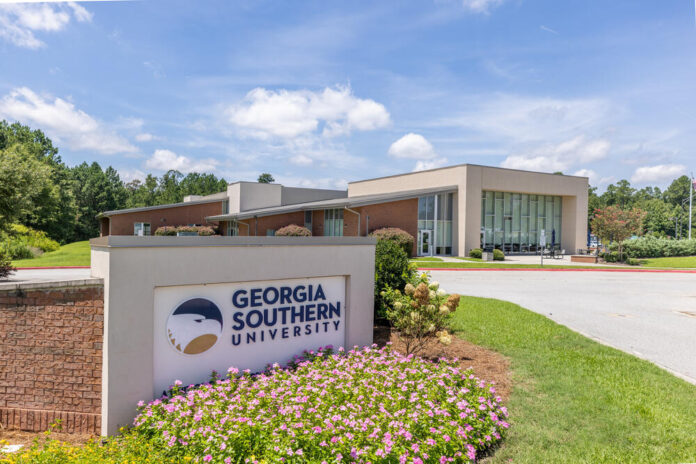
Two Georgia institutions, Columbus State University and Georgia Southern University, are expected to be among the first to be accredited by CPHE.
Perdue said USG chose those two schools because of their accreditation cycles with SACS-COC.
They’re expected to remain with the current accreditor while CPHE gets up and running.
SACS-COC responds
Pruitt took over the leadership role at the South’s largest accreditor less than a year ago.
Since then, he said that SACS-COC has taken steps to address concerns raised by DeSantis and Perdue.
“I called for our standards to be revised immediately,” Pruitt said. “You’re going to see a significant reduction in the number of standards that our institutions will be responsible for, while still holding a level of quality.”
Pruitt also said that SACS-COC has reduced by half the number of so-called “substantive changes” for which accredited institutions must request the agency’s approval before implementing.
“Substantive changes” include anything from starting, stopping or changing degree programs to building a new campus or instituting online classes.
He said the agency has reduced the time that it takes to review such requests from months to weeks.
And as far as being “woke” is concerned, he said that, while the agency did have a position paper on diversity, equity and inclusion, it was not part of its standards and was revoked at the first board meeting that he led as president.
“We were, I think, the only accreditor that did not have DEI standards,” Pruitt said. “I think all the other ones did, but yet somehow we got pegged with that.”
Directly contradicting DeSantis, he said that SACS-COC is concerned more about student outcomes, student needs and workforce development than “any ideological issues.”
Pruitt said that he doesn’t think much about CPHE and that he has “enough on my plate to worry about.”
Faculty concerns
The same can’t be said of Matthew Boedy, president of the Georgia conference of the American Association of University Professors.
The birth of CPHE makes him uneasy, to say the least.
Boedy, who teaches composition at the University of North Georgia, has spent the last year writing and campaigning against the nascent accreditor in large part because of its founding rationale, as expressed by DeSantis and others.
Many vocal right-wing critics of higher education, such as the slain political activist Charlie Kirk, long have argued that colleges and universities have become “indoctrination factories” for liberal ideas.
Boedy is concerned that the new accreditor has a requirement that aims to address so-called “intellectual diversity” on campuses.
“Right now, we’re not judged on ‘intellectual diversity,'” he said. “We’re judged on student outcomes, our own personal research outcomes, teaching outcomes and what generally is called ‘student success.'”
Boedy fears that the new requirement will be used as a cudgel to silence campus voices that challenge the prevailing right-leaning politics of CPHE states.
“That particular phrase [‘intellectual diversity’] has come from conservatives who attack higher education, who don’t like accreditation,” he said. “If this group is interested in efficiency and less paperwork and less bureaucracy, they’re adding a whole other thing that could be addressed by academic freedom.”
Boedy questioned how the new requirement will be enforced and sees CPHE as a “fox guarding the henhouse,” since it’s a consortium of states reviewing other state-run institutions.
Many accreditors, like SACS-COC, also include private schools.
Perdue dismissed Boedy’s concerns. He said that CPHE’s board of accreditors would have “peer review.”
And, as far as any fears about ideological requirements, Perdue asked, “Why would a faculty member be concerned about ‘intellectual diversity?'”
Perdue pointed to the involvement of CPHE’s founding chairman, Mark Becker, the highly regarded former president of Georgia State University.
“He would not be part and parcel of any kind of political agenda from an academic accreditation perspective,” said Perdue, who announced his intention to retire as USG chancellor in April.
Pushing Georgia schools toward CPHE could be one of Perdue’s last major moves in his four decades of public life. Perdue served two terms as Georgia governor and served as U.S. Secretary of Agriculture in the first Trump administration.
Next steps
CPHE is expected to make moves this summer to ramp up its operations, while it continues to wait for recognition from the U.S. Department of Education.
Those moves include hiring its first CEO, conducting site visits for selected institutions and training and orienting its Accreditation Advisory Committee and Peer Visiting Teams.
It expects to make its first accreditation decisions this fall.
And while it remains to be seen what tangible impact CPHE will have on its member institutions, professors, students and states at large, it’s already caused a stir among those in higher education who know and care about accreditation.
“There will be new accreditors that are coming into being for different reasons and different purposes,” Perfetti said. “My position and our commission’s position is, ‘We welcome the competition.'”
The new agency also could presage changes coming nationwide.
Under proposed federal regulations adopted by a negotiated rulemaking committee in May, all U.S. institutional accreditors must have in place the means to address “]”intellectual diversity” on campuses.
“So, CPHE is basically 13 months ahead of the pack,” said Cameron Howell, a senior advisor to the new agency.
It also expects to expand beyond its first cohort of states.
Don’t miss what everyone in town is talking about.
Join 4,000+ locals and choose our free newsletter covering news, events and the stories shaping our region.