
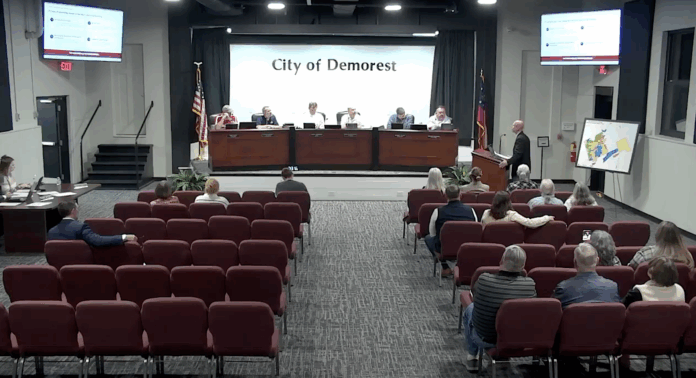
DEMOREST, Ga. — The Demorest City Council approved a rezoning request Nov. 10 that will allow a proposed 34-home subdivision off Saluda Drive, reversing an earlier denial of the same request in April.
The council’s decision came after another contentious public hearing, with residents raising concerns about flooding, erosion, sewer capacity and emergency access. The proposal from McCain Investment Properties LLC involves 10.74 acres behind the existing Hancock Meadows subdivision.
The property is currently zoned agricultural. The applicant requested a change to R-2 multifamily residential zoning to accommodate 34 detached single-family homes. Although R-2 is classified as multifamily residential, the applicant’s representative, Matt Benson, emphasized that the proposal does not include apartments, townhouses or condominiums.
Benson said the development would have a density of 3.16 homes per acre, below the four units per acre allowed under R-1 zoning. He said the R-2 classification was needed to meet the proposed lot sizes, not to build multifamily housing. He also argued that the proposal is consistent with the city’s 2023 joint comprehensive plan, which identifies the area as a suburban transition character area and anticipates single-family residential development at moderate to higher densities.
The council denied the same request in April following objections from nearby residents.
MORE Demorest meeting ends in shouting after Musselwhite defends record
Residents raise flooding concerns
Rick Austin, whose property adjoins the proposed development, again urged the council to deny the request. He presented video showing flooding along Double Springs Road and described the force of the water and its effects on nearby properties.
Austin said the proposed subdivision would have a single entrance and exit crossing a creek that floods. He warned that flooding could cut off access for residents and emergency responders. He also raised concerns about sewer infrastructure in the floodplain, including elevated manholes and a sewer main that he said are submerged during flooding. Austin said infiltration during wet weather has contributed to capacity problems and alleged that raw sewage overflows have been documented in nearby waterways.
Austin questioned why detailed hydrological and drainage studies had not been completed before the rezoning decision. He said the city’s application requirements call for a preliminary grading and drainage conceptual plan and argued that the submitted materials did not adequately address those issues.
He also cited concerns about school transportation, saying 12 school buses travel Double Springs Road daily and that the road serves as a detour when problems occur on U.S. 365.
Benson countered that many of the concerns involved existing conditions that were not caused by the proposed development.
He argued that it would be unfair to prevent the property owner from developing land in a manner consistent with the comprehensive plan because of existing flooding, erosion or sewer issues. He said the proposed conditions would prevent the development from making those problems worse.
Benson pointed to a condition requiring a downstream hydrological assessment under the Georgia Stormwater Management Manual. The assessment would have to demonstrate that post-development peak flows would not exceed existing flows during 25-, 50- and 100-year storms.
He also cited conditions requiring compliance with state erosion and sedimentation requirements and city codes.
Benson said detailed engineering work typically follows a zoning decision because developers are unlikely to spend significant sums on engineering before knowing whether the proposed land use will be approved.
Council members split on request
Councilman Donnie Bennett said he lives downstream from the property and has heard concerns from neighbors who also live in the affected area.
Bennett described erosion along a creek near one neighbor’s home, saying repeated flooding has eaten away at the woman’s yard and brought water closer to her house.
He also raised concerns about two special-needs school buses that travel the road twice daily. Bennett said one of the students lives nearby and that the possibility of the student having to stand in floodwater was disturbing to him.
Before speaking, Bennett asked whether he should recuse himself because he lives near the property. City Attorney Thomas Mitchell advised that recusal was not necessary.
The council initially voted on a motion by Councilman Jimmy Davis to deny the application, seconded by Bennett. Davis and Bennett voted in favor of denial, while Councilmen Shawn Allen and Andrew Ferguson voted against it. Mayor Jerry Harkness broke the 2-2 tie by voting against the motion to deny.
Allen then moved to approve the application, with Ferguson seconding. Allen and Ferguson voted in favor, while Davis and Bennett opposed. Harkness again broke the tie, this time voting in favor of approval.
Approval includes development conditions
The approval includes a requirement that homes have a minimum of 1,500 square feet. Benson had requested that minimum during the hearing, rather than the 1,000-square-foot minimum otherwise allowed under the R-2 classification.
The conditions also limit the development to no more than 34 detached single-family homes and include requirements for downstream hydrological assessments and erosion and sedimentation controls.
The council discussed a rental restriction as well. Mitchell read proposed language adding an exception to Condition 3 for homeowners experiencing hardship.
“Provided, however, if an owner experiences a hardship requiring rental of the residence, such rental shall not count towards the 10% limitation,” Mitchell said.
The exception would allow a homeowner facing a hardship to rent the residence without having that rental count toward the development’s 10% rental limit.
Harkness asked Mitchell where the required hydrology studies would be submitted for review.
Mitchell said the studies would have to be submitted to the city to obtain final plat approval. If the city is not the issuing authority, he said, the studies would have to be approved by the state.
The approval allows the applicant to proceed with designing and laying out the subdivision under the conditions established by the council. It does not, by itself, authorize construction.
Don’t miss what everyone in town is talking about.
Join 4,000+ locals and choose our free newsletter covering news, events and the stories shaping our region.