

WASHINGTON (States Newsroom) — U.S. Speaker Mike Johnson announced Friday afternoon the House will not even consider a Senate-passed funding bill for the Department of Homeland Security, likely prolonging the shutdown that began in mid-February.
Johnson, R-La., said during a press conference the House will instead take up an eight-week stopgap spending bill for the department, which has little chance of moving through the Senate.
That chamber left Capitol Hill for a two-week spring break just before dawn and even if they returned, Democrats will not provide the votes needed to move past a 60-vote procedural hurdle to end debate.
“We’re going to send that over to the Senate and we hope that they’ll accept that,” Johnson said.
President Donald Trump hasn’t weighed in publicly on whether he would sign either of the bills and the White House did not respond to a request for comment. But Johnson said Trump backs his path forward.
“I spoke to the president a few moments ago,” he said. “He understands exactly what we’re doing and why, and he supports it.”
Trump said Thursday evening he planned to sign an order that would provide pay for Transportation Security Administration workers, which a senior administration official said would come from Republicans’ signature tax and spending bill.
Johnson said he would schedule a vote on the bill “as soon as possible,” but did not give any more details. The temporary funding patch would reopen DHS through May 22.
Senate Minority Leader Chuck Schumer, D-N.Y., wrote in a social media post that any stopgap bill to fund DHS “that locks in the status quo is dead on arrival in the Senate, and Republicans know it.”
“We’ve been clear from day one: Democrats will fund critical Homeland Security functions—but we will not give a blank check to Trump’s lawless and deadly immigration militia without reforms,” Schumer wrote.
The development reduces hope for the tens of thousands of federal workers within DHS who have gone without a full paycheck since the stalemate began when Senate Democrats demanded new constraints on immigration enforcement after federal officers shot and killed two U.S. citizens in Minneapolis.
Immigration and Customs Enforcement as well as Customs and Border Protection have been largely exempt from the impacts of a shutdown since Republicans approved tens of billions for their operations in their “big, beautiful” law. But federal workers throughout other DHS agencies, including the Federal Emergency Management Agency, the Secret Service and TSA aren’t in the same situation.
Overnight Senate vote
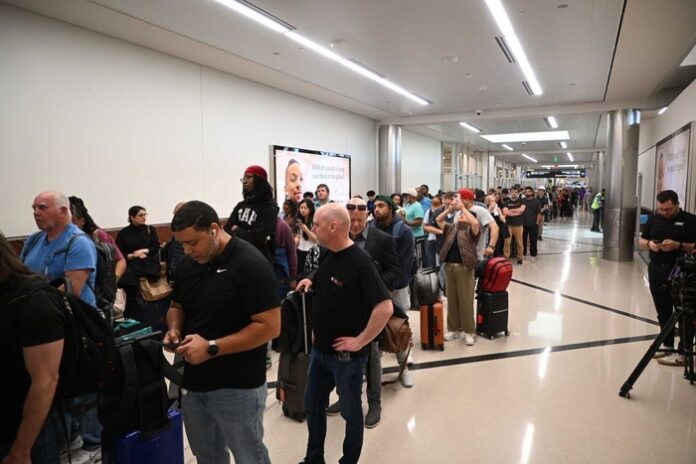
The Senate approved a modified DHS spending bill by voice vote around 2:30 a.m. Eastern after a week of mounting pressure on lawmakers to end the stalemate that has led to hourslong wait times in airport security lines.
The Senate-passed DHS bill didn’t include funding for ICE or Border Patrol. GOP lawmakers signaled ahead of the vote they’ll try to pass another boost in funding for immigration enforcement and deportation in a second party-line package later this year.
Senate Majority Leader John Thune, R-S.D., said during brief floor debate that funding DHS through a “piecemeal” approach wouldn’t have happened if Democrats handled negotiations differently.
“They wanted reforms to Immigration and Custom Enforcement, and Republicans offered to give that to them,” he said. “The White House made offer after offer putting forward a robust list of additional reforms. And Democrats just kept moving the goal posts, and today they just walked away.”
Democrats, he said, “might think twice before” before they tried to use this as a campaign issue during November’s midterm elections, when voters throughout the country will decide whether Republicans keep both chambers of Congress.
“We could be standing here right now passing a funding bill with a list of reforms, if Democrats had made the smallest effort to actually reach an agreement, but they didn’t, because it’s now clear to everyone, Democrats didn’t actually want a solution,” he said. “They wanted an issue, politics over policy, self-interest over reform, pandering to their base over actually solving a problem.”
Schumer said the bill to fund most of DHS “could have been accomplished weeks ago if Republicans hadn’t stood in the way.”
“Democrats held firm in our opposition that Donald Trump’s rogue and deadly militia should not get more funding without serious reforms, and we will continue to fight for those reforms,” he said.
More money for immigration deportations pledged
Missouri Sen. Eric Schmitt said he and other Republican lawmakers would seek to bolster funding for immigration and deportations through budget reconciliation, the complex process the party used last year to approve its “big, beautiful” law.
That, he said, would allow Republicans to move funding through the Senate with just a simple majority vote, skipping the procedural steps that would otherwise require 60 senators to end debate on a bill.
“To my Democrat colleagues, this bill is the moderate option. What’s coming next is going to supercharge deportations,” he said. “To my Republican colleagues, let this be a rallying cry every time the Democrats obstruct the safety of American families, the wall gets 10 feet higher and ICE gets another $100 billion.”
New Jersey Sen. Andy Kim said Democrats have been clear for months they would “not support providing more funding for ICE without also including common sense reforms to rein in the abuses we have seen in Minnesota and elsewhere, particularly after two Americans were shot and killed.”
“All we’ve been demanding here is what the American people are demanding — body-worn cameras; no masks; keeping ICE agents out of our hospitals, schools and churches; and ensuring ICE follows the same practices and procedures as local law enforcement,” he added.
‘Republicans have relented’
Senate Appropriations Chairwoman Susan Collins, R-Maine, wrote in a statement that earlier negotiations included “proposals to expand the use of body-worn cameras; limit civil immigration enforcement in sensitive areas such as schools and hospitals; increase oversight of detention facilities; and implement visible officer identification.”
“While Republicans worked in good faith to try to reach agreement, Democrats remained intransigent and unreasonable with their list of demands,” she wrote.
Senate Appropriations Committee ranking member Patty Murray, D-Wash., wrote in a statement that since “Republicans have relented” lawmakers were “on track to fund the areas we agree on and get TSA agents paid, get our airports moving again, and fund important disaster relief and cybersecurity work.”
“But it is a shame that instead of working with Democrats to land the plane on several common-sense reforms to ICE and Border Patrol that the White House had already agreed to, Republicans walked away from constructive conversations and ultimately rejected some basic steps to reform these agencies,” she wrote. “I will keep fighting to secure real, meaningful steps to help rein in these rogue agencies—we just need Republicans to join us.”
Don’t miss what everyone in town is talking about.
Join 4,000+ locals and choose our free newsletter covering news, events and the stories shaping our region.