
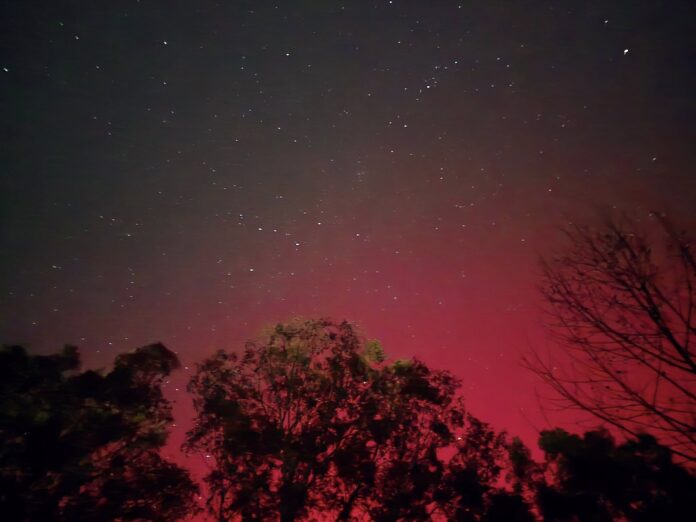
Social media has been seeing red for the past few nights, in all the best ways. The pictures that have been lighting up posts have been spectacular from Chicago, to Columbus, Georgia, to Clayton, Alabama, west to Colorado Springs, and points in between.
Janet Davis, former President and CEO of Kinetic Credit Union, retired in 2018. She has since traveled the world, including Iceland and Finland, searching for the Northern Lights. She found them looking up in her own backyard.
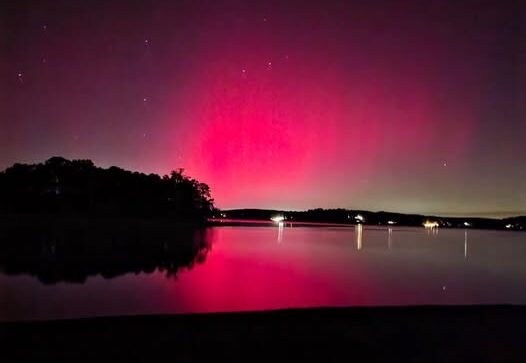
The activity was the result of a phenomenon called coronal mass ejections, (CMEs) massive blasts of plasma and magnetic fields from the sun’s outer atmosphere that grow as they hurtle towards Earth.
A geomagnetic storm happens when charged particles from the sun’s atmosphere interact with the Earth’s magnetic field. In addition to creating displays of color, such storms can disrupt technology on Earth, from satellites and GPS to radio communications and the power grid.
What sounds like a Star Wars movie has created much excitement for free entertainment.
This solar storm was so extreme that disturbances in Earth’s magnetic field will continue tonight, November 13–14. That means the possibility of another chance for bright auroras, even in places that rarely see them.
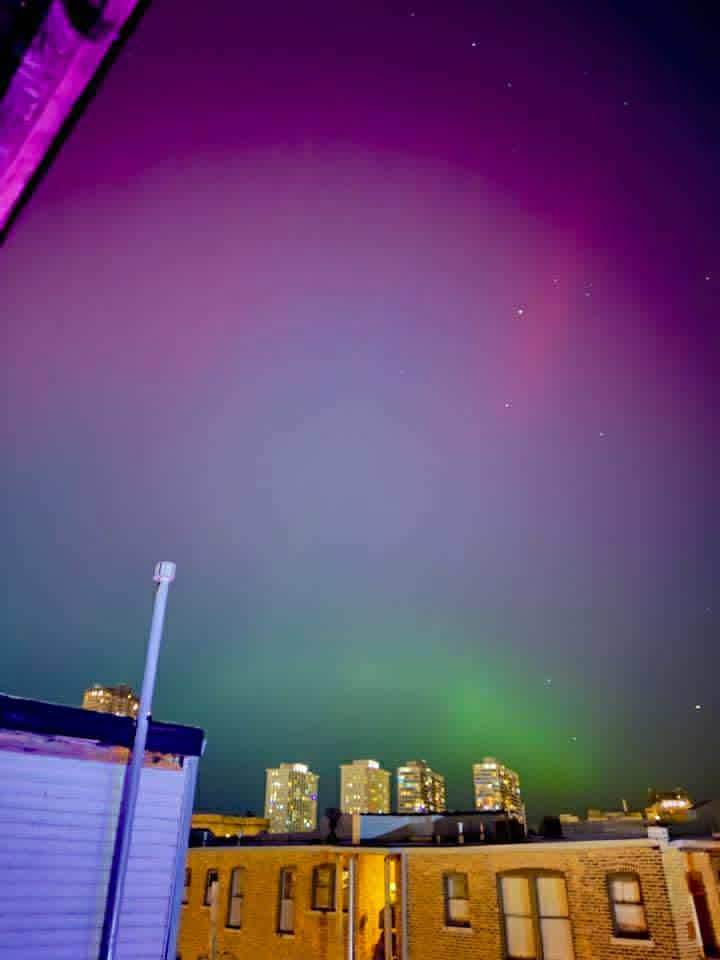
Will the show continue tonight, Nov. 13? Maybe. According to the Space Weather Predict, a branch of the National Oceanic and Atmospheric Administration, the geomagnetic storm that stirred up the aurora borealis is expected to continue, though the light show will possibly not be as strong.
For the best viewing, move away from city lights and avoid trying to see them on the night of a full moon. The best time to view the aurora in our area should be between 7:00 pm and 10:00 pm.
If you’re looking to photograph the aurora, use a tripod to keep the camera stable. Shooting at night means keeping the camera shutter open longer. That could create a blurry image if the camera is bumped or not held steady. Also, use a wide-angle lens to capture as much of the sky as possible.
You can also use a smartphone, but a tripod is still recommended. Use a remote or set the camera timer, so you won’t have to tap the screen to take a photo. Also, turn off the flash and set the camera to night mode.
Good luck and happy skywatching!