
WASHINGTON (States Newsroom) — The Trump administration released its fiscal 2027 budget request Friday, asking Congress to increase spending on defense programs by 43% and decrease funding for non-defense accounts by 10%.
The proposal kicks off what will be a monthslong process on Capitol Hill as lawmakers write the dozen annual government funding bills ahead of the Oct. 1 deadline.
Congress rarely adheres to the president’s request entirely, and didn’t do so last year, rejecting many of the proposed cuts, including to health and education.
Last year’s process, the first of President Donald Trump’s second term, was considerably rocky, leading to a 43-day shutdown that began in October, a brief partial shutdown that ended in early February and an ongoing shutdown for the Department of Homeland Security.
This budget request proposes Republicans again use the complex budget reconciliation process they used last year to enact the “big, beautiful” law to further bolster spending on the Pentagon and DHS.
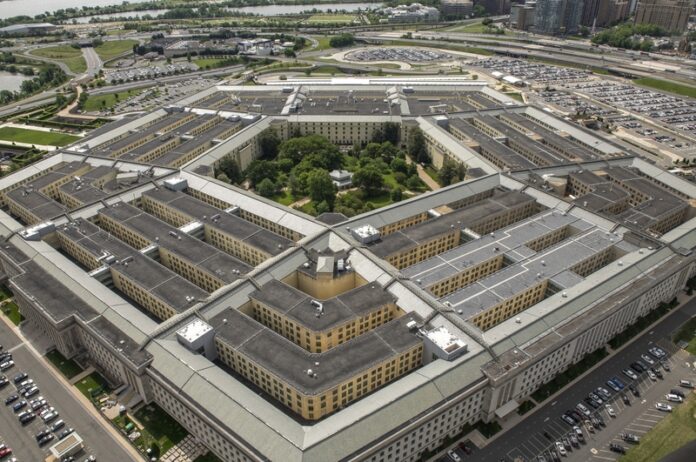
The Defense Department would have its budget raised to $1.5 trillion, a $445 billion increase over its current funding level. The administration proposes lawmakers put $1.1 trillion of that in the annual spending bill that would require bipartisan support to move through the Senate and place the other $350 billion in the partisan reconciliation bill.
“America has already begun to strengthen and reinvigorate the military by committing tens of billions of dollars to new and innovative programs such as the Golden Dome for America, and making critical investments in the defense industrial base,” the document states. “By continuing to provide the resources necessary to rebuild America’s military, the Budget re-establishes deterrence, revives the warrior ethos of America’s Armed Forces, and prioritizes investments against the most acute national security threats.”
Department-by-department requests
The budget asks that lawmakers also increase spending on:
- The Energy Department by $4.8 billion, or 10%, to $53.9 billion.
- The Justice Department by $4.7 billion, or 13%, to $40.8 billion.
- The Veterans’ Affairs Department by $11.5 billion, or 9%, to $144.9 billion in discretionary spending.
The proposal asks Congress to decrease spending on:
- The Agriculture Department by $4.9 billion, or 19%, to $20.8 billion.
- The Commerce Department by $1.3 billion, or 12.2%, to $9.2 billion.
- The Education Department by $2.3 billion, or 2.9%, to $76.5 billion.
- The Environmental Protection Agency by $4.6 billion, or 52%, to $4.2 billion.
- The Department of Health and Human Services by $15.8 billion, or 12.5%, to $111.1 billion.
- The Department of Housing and Urban Development by $10.7 billion, or 13%, to $73.5 billion.
- The Interior Department by $2.3 billion, or 12.9%, to $15.9 billion.
- The Labor Department by $3.5 billion, or 25.9%, to $9.9 billion.
- The Small Business Administration by $671 million, or 67%, to $329 million.
- The State Department and other international programs by $15.5 billion, or 30%, to $35.6 billion.
- The Transportation Department by $1.6 billion, or 6.2%, to $26.6 billion.
- The Treasury Department by $1.5 billion, or 12%, to $11.5 billion.
The budget proposes $63 billion in funding for the Department of Homeland Security, which doesn’t yet have its appropriations bill from the current year for comparison.
Senate Appropriations Committee Chairwoman Susan Collins, R-Maine, said in a statement there are issues with some of its proposals for both defense and domestic spending.
“While there are some improvements over last year’s domestic discretionary budget request, including full support for the Pell Grant program, the request has several shortcomings,” she said. “For example, the proposal includes unwarranted funding cuts in biomedical research. It would also terminate worthwhile programs like LIHEAP, which helps low-income families and seniors to pay their energy bills during the cold winter and hot summer months, and TRIO, which assists low-income, first-generation students in pursuing higher education.”
Collins indicated she may bolster defense spending for a certain type of ship that she views as essential to the country’s military.
“The request for just one DDG-51, the workhorse of the U.S. Navy, is insufficient to counter the ever-growing Chinese fleet, which now exceeds the size of the American Navy, as well as other global threats,” she said.
Privatizing TSA screening
The president’s request asks lawmakers to cut funding for the Federal Emergency Management Agency’s non-disaster grant program and to begin the process of offloading security screening at the nation’s airports.
“The Budget begins the privatization of TSA’s airport screeners by requiring small airports to enroll in the Screening Partnership Program, under which TSA pays for private screeners at designated airports,” it states. “The airports that already use this program have demonstrated savings compared to Federal screening operations. The move would yield cost savings compared to Federal screening and begin reform of a troubled Federal agency.”
The budget asks Congress to provide an increase of $1.7 billion to the Bureau of Prisons to improve working conditions and pay, with $152 million of that going to the first year costs to “rebuild Alcatraz as a state-of-the-art secure prison facility.” The Bureau of Prisons has been evaluating whether to restore the closed California facility.
The budget proposes increases in funding for Trump’s efforts to improve the District of Columbia, including a $10 billion Presidential Capital Stewardship Program run through the National Park Service and $403 million for a new Transportation Department program to upgrade security in the Metro system and other local projects.
The National Aeronautics and Space Administration, which launched the Artemis II mission this week to orbit the moon, would receive a $5.6 billion, or 23%, cut under Trump’s budget proposal to a total funding level of $18.8 billion.
It asks Congress to decrease funding for the International Space Station by $1.1 billion and “prioritizes the rapid development and deployment of commercial space stations, while also keeping the safe de-orbit of the ISS on track for 2030.”
Dems reject ‘bleak’ budget
Washington Democratic Sen. Patty Murray, ranking member on the Appropriations Committee, wrote in a statement that the budget request was “bleak and unacceptable.”
“President Trump wants to slash medical research to fund costly foreign wars,” she wrote. “It doesn’t get more backward than that, and the only responsible thing to do with a budget this morally bankrupt is to toss it in the trash.”
Murray added that she expects Congress to pursue bipartisan spending bills, just as lawmakers did during last year’s process, including investments in domestic issues.
“This week, President Trump said that our country cannot afford to help families with child care or health care—but his own budget proves what a ridiculous farce that is,” she said. “Imagine how many families we could help if, instead of giving the Pentagon more money than they can even figure out what to do with, we cut people’s heating bills in half and made child care affordable for every family in America.”
Senate Budget Committee ranking member Jeff Merkley, D-Ore., wrote in a statement the request lacks detail for programs that run outside of the annual budget and appropriations process, like Medicare, Medicaid and Social Security.
“Going back decades, presidents have sent to Congress detailed budgets with 10 years’ worth of detailed plans – outlining their approach to tax policy and our growing debt, as well as the solvency of our biggest programs like Medicare and Social Security,” he wrote. “This budget doesn’t do any of that. It’s just an out-of-touch plea for more money for guns and bombs, and less for the things people need, like housing, health care, education, roads, scientific research, and environmental protection.”
Minnesota Democratic Rep. Betty McCollum, ranking member on the Defense Appropriations Subcommittee, said the Pentagon doesn’t have an issue with how much in taxpayer money lawmakers allocate, but “a problem with efficiently spending the funding that Congress has provided them – and accounting for it.”
“The President’s request for $1.15 trillion in defense spending is outrageous and unacceptable, especially when President Trump and Congressional Republicans intend to make further cuts to critical services that Americans rely on at home,” she said. “Our nation cannot be secure without investments in our country’s critical health care, education, nutrition, and infrastructure.”