ATLANTA — State officials urged Georgians to stay off the roads and prepare for worsening conditions overnight as a winter storm continued to impact much of the state, bringing freezing rain, sleet, high winds and the threat of downed trees and power lines.
During a Sunday press conference, Josh Lamb, director of the Georgia Emergency Management and Homeland Security Agency, said resources have been pre-deployed across North Georgia and are available where needed as conditions evolve.
Lamb said the state has positioned 17 Starlink units and satellite phones, deployed generators to affected areas, and activated chainsaw strike teams. Personnel from the Georgia Forestry Commission, state agencies and the Georgia National Guard are assisting with debris removal and emergency response. Shelters are open in Rabun, White and Towns counties, and Georgia State Parks have opened warming stations, with parking and pass fees waived for those seeking shelter.
Officials emphasized public safety guidance, including staying indoors, keeping pets inside, checking on elderly or disabled relatives, and using space heaters safely. Lamb urged residents to use flashlights instead of candles during power outages and warned against using ovens, grills or generators indoors due to the risk of carbon monoxide poisoning.
Road conditions deteriorating
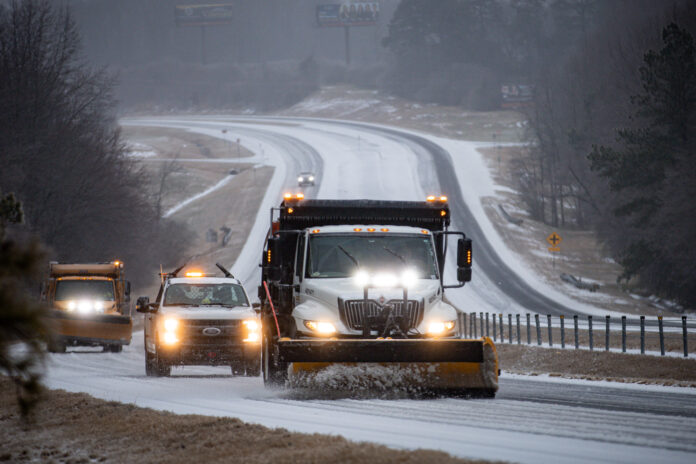
Georgia Department of Transportation Commissioner Russell R. McMurry said GDOT crews began pre-treating roads Friday night, covering roughly 18,000 miles statewide with 1.5 million gallons of brine and spreading about 2,500 tons of salt and aggregate as precipitation moved in.
McMurry said 70 additional staff members and 42 pieces of equipment have been redeployed to address the so-called “wedge” of freezing rain stretching from east metro Atlanta through Augusta, Athens, Gainesville and along the Interstate 85, Ga. 365/985 and Ga. 400 corridors.
As of Sunday, GDOT reported 24 state routes had experienced closures, primarily in North Georgia counties including White, Habersham, Towns and Union, largely due to falling trees.
“If a roadway looks good now, don’t expect it to stay that way overnight,” McMurry said, warning of a refreeze as temperatures drop and additional freezing rain and sleet move through. He said crews will remain on 12-hour shifts until conditions improve and again urged motorists to stay home.
Crashes down as drivers heed warnings
Georgia Department of Public Safety Commissioner Billy Hitchens said compliance with travel warnings has helped limit crashes.
Since 6 p.m. Saturday, DPS has responded to 775 total calls, including 25 crashes and 95 motorist assists. Hitchens said traffic volumes were significantly reduced, and troopers remain positioned to assist motorists and respond to emergencies, particularly in North and Northeast Georgia.
Hitchens reminded drivers who must travel to slow down, avoid cruise control on icy roads, increase following distance and give road crews extra space to work.
National Guard, weather officials monitoring overnight risks
Major Gen. Richard Wilson, commanding general of the Georgia Army National Guard, said Gov. Brian Kemp has authorized up to 500 National Guardsmen for storm response. About 120 soldiers, airmen and State Defense Force volunteers were pre-positioned in Northeast Georgia ahead of the storm, focusing on clearing roads for first responders and supporting power restoration in Stephens, Rabun and White counties.
Teams are also standing by to move critical supplies by ground or air if needed, Wilson said, adding that coordination with federal partners is ongoing should additional resources be required.
State meteorologist Will Langston said officials are especially concerned about falling trees and power lines overnight as wind gusts of 20 to 30 mph combine with saturated ground and ice accumulations.
“Even areas that don’t see much ice could still see trees and power lines coming down,” Langston said, noting the risk is higher where freezing rain develops.
Officials urged residents to limit travel, monitor local alerts and follow guidance from emergency officials as the storm continues. Updates will be shared through local emergency management agencies and the GEMA website as conditions change.