

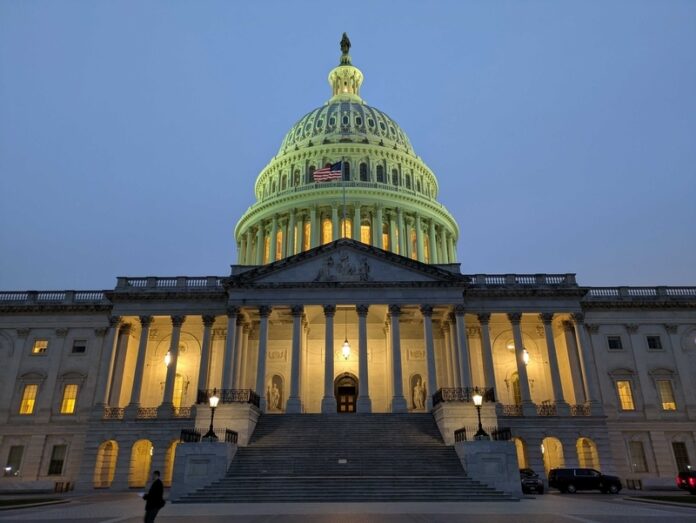
WASHINGTON — The U.S. House approved a stopgap spending bill Tuesday that would keep the government up and running through the fall, sending it to the Senate, where lawmakers expect to rework the measure.
Congress must pass a government funding bill before the new fiscal year starts on Oct. 1 in order to avoid a shutdown just weeks before the November midterm elections.
The 220-205 mostly party-line vote represents House Republicans’ opening salvo in negotiations, though without Democratic support it won’t be able to advance in the Senate.
House Appropriations Chairman Tom Cole, R-Okla., said during floor debate that GOP leaders hope passing the stopgap spending bill months before the start of the next fiscal year will avoid another shutdown.
“For anyone questioning this legislation, the facts are simple — it extends the government funding deadline to Dec. 4, denying any party the opportunity to manufacture leverage before elections,” Cole said. “It contains no poison pills or partisan riders. It prevents harmful disruptions to our national security and the vital programs our constituents rely on.”
Connecticut Democratic Rep. Rosa DeLauro, ranking member on the committee, opposed the stopgap, saying it would “allow Homeland Secretary (Markwayne) Mullin to transfer billions of dollars to the Border Patrol.”
Republicans, she said, “refused” to change that aspect of the bill after Democrats “shared language to fix it.”
“We cannot in good conscience allow billions of dollars to flow to these agencies without major reforms to keep our constituents safe from further violence,” DeLauro said.
Democrats don’t want a government shutdown but also don’t want “to rush” the process and omit the list of anomalies just sent up by the White House, she said.
Those tweaks to funding levels are commonly added to stopgap spending bills but weren’t included in House Republicans’ measure because it was written before the White House sent a list of requested anomalies to lawmakers Monday.
“There are over 50 programs listed by the agencies to take some action so that they can be protected during a continuing resolution,” DeLauro said, using the technical term for a short-term funding bill.
The changes would support wildfire suppression activities, housing assistance for tens of thousands and programs that help people in rural communities afford their utilities.
“Rushing this bill to the floor haphazardly without carefully considering the various needs that must be met is no way to govern,” DeLauro said. “And it is irresponsible.”
Senate anticipates changes
Senate Appropriations Committee Chairwoman Susan Collins, R-Maine, said earlier in the day that she was working with the committee’s top Democrat, Washington Sen. Patty Murray, to draft a continuing resolution of their own.
“It appears that there is good faith on the Democratic side to try to pass the CR and avoid a government shutdown, which is always a disaster,” Collins said.
Murray said the House’s stopgap spending bill has “problems” that will need to be fixed in order to move through the Senate.
“We just got the anomalies last night and both of us are trying to figure out the best way to get it put together,” Murray said.
Appropriations status
Lawmakers must lean on a stopgap spending bill because they will, once again, fail to complete work on the dozen annual government funding bills before the deadline.
The House has passed three of its spending bills. The Senate hasn’t passed any, in part, because the committee hasn’t released a single bill. The two chambers will need to begin negotiations at some point to settle on a total spending level for the 12 bills and how that roughly $1.9 trillion will be broken down among thousands of federal agencies and programs.
That means the earliest the full-year government spending bills would become law is during the lame-duck session that is set to last for about five weeks between the election and the start of the new Congress in January.
Lawmakers could also pass a series of stopgap funding bills instead of completing negotiations on the full-year appropriations bills.
Don’t miss what everyone in town is talking about.
Join 4,000+ locals and choose our free newsletter covering news, events and the stories shaping our region.