

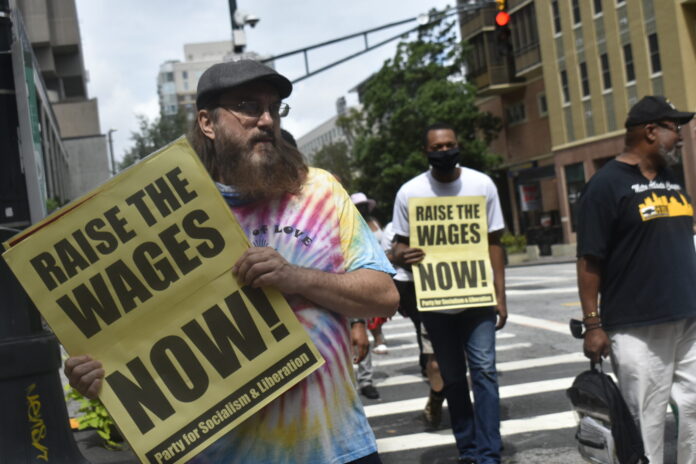
(Georgia Recorder) — Georgia has made modest gains, but remains one of the worst states to be a worker in 2026, according to a new report from Oxfam America.
The state’s top leaders often tout Georgia’s credentials as “the best place to live, work and raise a family,” but this year’s rankings — which span all 50 states, the District of Columbia and Puerto Rico — place Georgia near the bottom of the list.
The report, which scores states based on policies around wages, worker protections and right to organize laws, lists Georgia in 46th place, behind other southern states like Florida, Louisiana and Texas. Other neighboring states, including Alabama, South Carolina and Tennessee, fall even further behind due to factors like low minimum wages and “right-to-work” laws, which Oxfam says curbs union activity.
“The South still remains the region with the weakest protections for workers’ rights to organize and collectively bargain,” the report states.
The Georgia Department of Labor did not respond to a request for comment. In a release sent late last month, the department touted low unemployment in regions across the state. Georgia’s unemployment rate was 3.3% in July compared with 4.1% for the nation.
For most workers, Georgia’s minimum wage mirrors the standard set by the federal government, making it the lowest that is legally possible to pay non-tipped workers at $7.25 an hour, while tipped workers are paid at a rate of $2.13 per hour. Oxfam argues that the $7.25 hourly wage only covers 18% of living expenses for a family of four, and notes that state law doesn’t allow local jurisdictions to voluntarily raise their minimum wage.
Sandra Lee Williams, the president of the Atlanta-North Georgia Labor Council, added that a small number of certain exempt workers, including some domestic and farm workers, earn less than the federal minimum wage.
“There are people today that still, in this state, make $5.15 [per hour],” she said. “It does not default to $7.25 for certain categories of work.”
She added that unions, which covered only 5.1% of Georgia workers last year according to the Bureau of Labor Statistics, often provide benefits and protections for workers that go beyond personal finances.
“It’s not just about wages,” she said. “It is quality of life.”
According to Oxfam, the Peach State’s policies on organized labor prevent collective bargaining for agricultural workers, allow companies to retaliate against employees for reporting wage theft and prohibit local jurisdictions from regulating rideshare companies like Uber and Lyft. Those laws lead the state to be placed dead last in the right to organize metric, tying with Arkansas, Mississippi, North Carolina, South Carolina and Texas for a score of zero.

There are some bright spots to Oxfam’s report: Georgia tied for 24th place in the rankings for worker protections alongside Idaho, Montana and New Mexico thanks to policies that protect against child labor and require workers to receive equal pay across gender and race. The state also emerged from the bottom five states in the overall ranking, largely because of a state law passed in 2020 that requires employers to provide a private lactation space and paid break time to breastfeeding workers who need to pump.
But Williams said Georgia still has a long way to go in order to become a more worker-friendly state. New laws that expand paid leave for all workers, expand Medicaid, establish new workplace safety policies and enable employees to retrain for new positions if their jobs are eliminated by AI, she said, would go a long way in ensuring that workers are able to flourish in Georgia.
“It cannot continue to be the best place for businesses, and the worst place for workers,” she said.
Don’t miss what everyone in town is talking about.
Join 4,000+ locals and choose our free newsletter covering news, events and the stories shaping our region.