

(GPB News) — About a month out from Election Day, the race to be the next governor of Georgia is in full swing. Both candidates have pinned healthcare reform at the top of their to do list.
Democrat Keisha Lance Bottoms and Republican Rick Jackson have promised to address healthcare access on day one, if elected, campaigning on separate plans and priorities.
In a conference room full of nurses on a Friday in August, Bottoms highlighted a key pillar of her campaign — a full expansion of Medicaid. That would bring coverage under the program to people living up to 138% of the Federal Poverty Level, and an increased monetary match from the federal government along with its implementation.
“And it’s something that will be a No. 1 priority for me on Day 1,” Bottoms said. “I am going to get to work to prepare our state agencies for Medicaid expansion and I’m going to do everything in my power to bring our legislature along with us.”
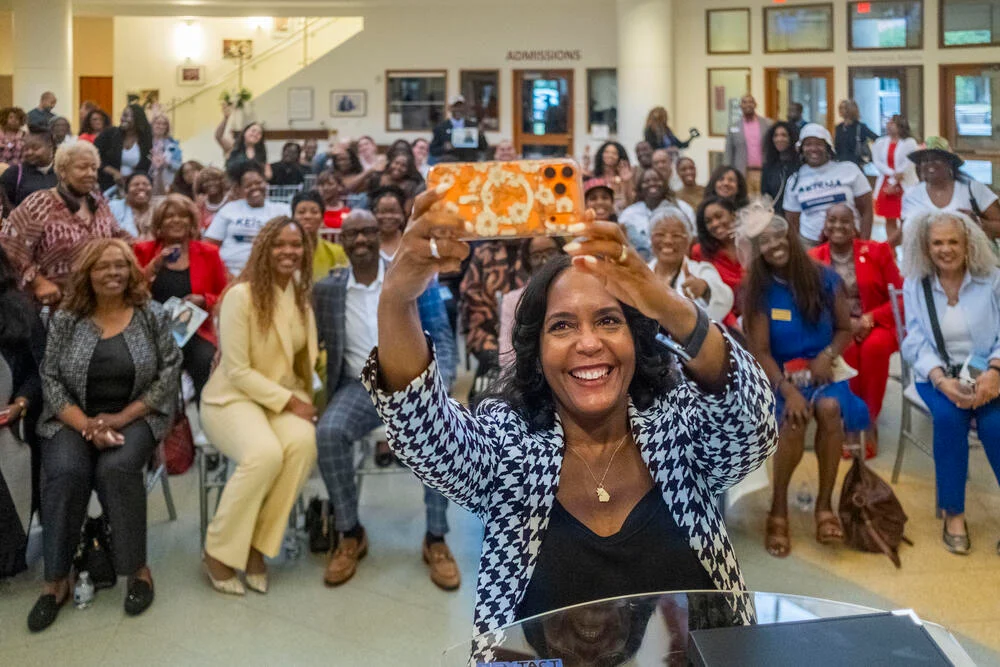
For Bottoms, up against Jackson, a billionaire healthcare executive, it’s important that message resonates. Especially among undecided voters like Lorna Williams, a nurse in nearby Villa Rica.
“Being a campaign stop being here, I actually feel kind of special,” Williams said.
Because even as a healthcare worker, Williams said seeing a doctor under the current way things are is challenging. She sees far more patients seeking care in emergency rooms where they’re guaranteed to see a doctor regardless of their ability to pay, than from their primary care physician.
“You know, even having insurance, I struggle to pay the hospital bills for my own care,” she said.
Meanwhile, the expiration of federally funded enhanced subsidies on Affordable Care Act plans has caused monthly insurance costs for millions to skyrocket.
Williams is someone who’s needed help from social safety net programs in the past. So, she said she likes the Democrats’ plan to pursue a full expansion of Medicaid.
“So that it includes more families,” she said. “And then [to] actually broaden what it covers would be good too.”
But now, because of the passage of President Trump’s One Big Beautiful Bill in summer 2025, any plan to expand Medicaid comes with a major caveat: work requirements.
Dozens of states face new reporting requirements
Under the bill, most adults covered by Medicaid in states that have expanded the program will have to prove they’re working at least 80 hours a month in order to keep their coverage, with some exceptions.
So far, these work requirements have hit Nebraska and Montana.
If Georgia did expand Medicaid, the up to half a million people estimated to be newly eligible would be subject to these rules, too.

(Sofi Gratas/GPB News)
Georgia has already been experimenting with this model. An alternative to full Medicaid expansion, the Pathways to Coverage Program offers low-cost insurance to adults who can work. Certain training, education and volunteer hours also count. Getting this program underway has been a priority of Gov. Brian Kemp’s tenure.
Georgia was the second state to try out this model, under what’s called a Section 1115 waiver, following Arkansas’s implementation of similar work requirements under the first Trump administration.
But since Pathways’ own work requirements went into effect in 2023, the program has reached only a fraction of people eligible for it, according to the state’s own data.
Leah Chan is with the Georgia Budget and Policy Institute, which oversees the Pathways to Coverage Monitoring Project.
“What we know from Georgia’s experience, and from the experience of other states who’ve instituted some sort of work requirement tied to public benefits, is that work requirements do not work,” Chan said.
She means they make getting health insurance difficult, and then in turn, don’t actually help people find long-term employment as promised. In fact, many Medicaid beneficiaries already work.
These programs can also be expensive. A report by the U.S. Government Accountability Office released last year said that administrative expenses for Pathways had surpassed the amount spent on healthcare.
Despite concerns, the Centers for Medicare and Medicaid Services under President Trump approved an extension to Georgia’s Pathways program through at least the end of this year.
“So thinking about what is in the state’s control … there are policy choices we can make to reduce the burden on caseworkers, to better leverage our technology,” Chan said.
Chan tries to emphasize that improving the state’s eligibility system isn’t only a win for Medicaid recipients.
“It’s good for all of us,” she said. “It’s costs savings for the state.”
One population has been able to reap some benefits of full expansion — pregnant people.
In 2022, Kemp extended Medicaid to 12 months postpartum for families at or below 220% of the Federal Poverty Level. There are no work requirements.
That coverage goes beyond just labor and delivery — it includes primary care and even some specialty care, said Margaret Master, executive director of the Healthy Mothers Healthy Babies Coalition of Georgia.
This has opened doors for people previously unable to get even routine care for chronic conditions. But even several years after its implementation, Master has learned many doctors and people eligible are still confused about what postpartum Medicaid is. The coalition has been collecting testimony on how well the program works for an analysis of its impact.
“In terms of the full promise of that extended coverage, it has been more focused in just covering pregnancy and not having people understand the full benefits,” Master said.
She worries that with the federal government’s new mandate of Medicaid work requirements will come even more confusion, and less enrollment. Already Georgia ranks among states with the poorest health outcomes for moms and babies.
Master would like to see more people eligible for Medicaid under full expansion. At the same time, she understands the complexity of having to expose a whole new group of people to a new eligibility mandate.
She hopes Georgia’s gubernatorial candidates are thinking about this, too.
“I would evaluate plans based on like the complexity to get it, the complexity, to keep it. And that undermines coverage,” she said. “But also … supporting patients to follow up on what they need to follow-up on might be a barrier if the clarity of what’s available or not available to a patient is hard for a provider to understand.”
Similar priorities with different approaches
For Bottoms, the Democrat, improving the current system would mean ending Pathways first — getting Georgia a higher federal match for its Medicaid program in the process — and dealing with the new federal work requirements later. Her campaign says Bottoms opposes the “unnecessary bureaucracy” of work requirements.
“But we’ve got to claw back some of this money that we have spent on programs that have proven not to work,” Bottoms told reporters in August.
She has so far been optimistic about her ability to get the state’s Republican majority on board.
Jackson, the Republican health care executive running against Bottoms, rejects full Medicaid expansion.
Instead, on Day 1 he’s proposed presenting lawmakers with another alternative — a program for adults, like Pathways, with work requirements.

(Grant Blankenship / GPB News)
Jackson’s campaign hasn’t made it clear exactly who would be eligible for this unnamed program, including whether or not it will expand eligibility to people making more than around $15,000 a year, or 100% of the Federal Poverty Level.
But, they say, it will require a new Section 1115 waiver submitted to the federal government — a new proposed pilot project.
It may also depend on a 90% financial match from the federal government, said Garrison Douglas, Jackson’s campaign spokesman.
“His focus is going to be making sure we’re going to be continuing to make sure we have a strong relationship with the federal government and be able to make that ask,” Douglas said.
States that take on full Medicaid expansion can depend on this match. But Georgia’s Department of Community Health has requested it for the Pathways program, saying they need financial support for an expected bump in enrollment, since the work requirements outlined in H.R. 1 are less strict than Pathways.
However, Jackson’s ultimate plan seems to be to get more people on private insurance, and maintain commercial coverage for people who would otherwise be eligible under full Medicaid expansion.
It’s a federal rule that you cannot be eligible for both Medicaid and for savings on the price of a Marketplace plan.
“Look, I was on welfare,” he told reporters earlier this summer. “These people don’t want to be on welfare for their whole life. They have pride. If they get on to commercial insurance, that’s a first stop of success for them. And so they can grow their career. So that’s what I want to do.”
Neither campaign has provided details about what their plans will cost the state. Both plans will depend on much more cash from the federal government.
Don’t miss what everyone in town is talking about.
Join 4,000+ locals and choose our free newsletter covering news, events and the stories shaping our region.