The Georgia Senate is requesting a $409 million adjustment to the state budget to build a mental health hospital that would be the first of its kind in decades.
Tentatively planned to be built in the Atlanta or Augusta area, the proposed forensic mental health facility would be a place to treat people that local sheriffs say get stuck in their jails and on the street, because of behavioral health or mental health crisis.
This kind of facility is only possible because the state has been released from a 2010 settlement with the U.S. Department of Justice over its historic treatment of mentally ill people.
The Georgia Department of Behavioral Health and Disabilities announced in January its request to terminate all mental-health-related provisions of the settlement agreement in a joint filing between the department, DOJ and an independent reviewer.
Under the settlement agreement, Georgia promised to establish a system of care for people in mental health crisis. That’s included building crisis stabilization centers, a statewide crisis help line, mobile crisis units, peer support centers and establishing the Georgia Housing Voucher program.
The idea was to get the majority of people out of state hospitals and back into their communities for care.
“We’ve worked really hard to provide those services and communities,” Sen. Blake Tillery said on Friday. “We’ve done a pretty good job. But there are some people who we still need to have in the state’s mental health hospitals.”
During a hearing on the Senate budget, Tillery made the case that under the settlement agreement, and despite spending millions to meet its requirements, the state has been “hamstrung” to address the criminalization of mentally ill people.
If approved, the facility could take one to two years to be up and running, he said.
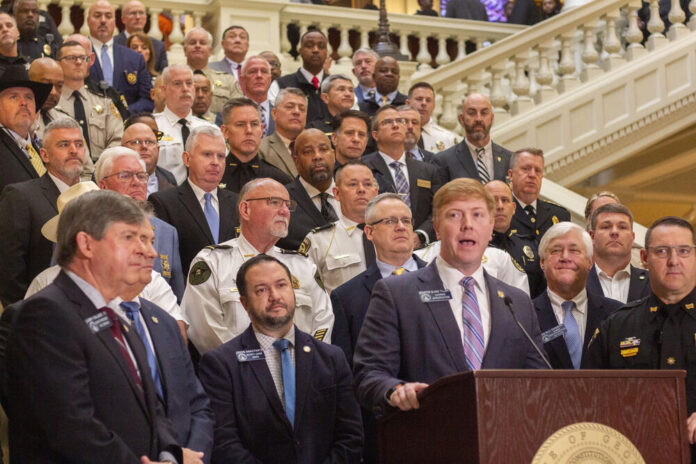
Local sheriffs from Chattooga to Forsyth county stood behind Tillery as he presented the proposal to the public.
“They are screaming at us and saying, can you hear us?” he said. “We’re telling them today, yes, we do.”
A ‘burden’ on local law enforcement
The Department of Behavioral Health and Developmental Disabilities has invested millions in infrastructure for people in mental health crisis, including those with substance use disorder or other behavioral health needs. A majority of that work is done by the states Community Service Boards.
But it is local jails that end up managing many of these cases.
Atlanta Police Chief Darin Schierbaum said his metro precinct gets roughly 19 mental-health related calls a day, from threats of suicide, to concerns about family members who haven’t taken their medication.
He said as far as resources go, the emergency room at Grady Hospital and the Center for Diversion and Services in Fulton County — previously reported to be severely underused — aren’t enough.
“This allows the pipeline from the courtroom back to the street to be diverted to a care facility where the individuals get the treatment they need,” Schierbaum said of the new facility.
Of the total number of inpatient hospital beds proposed in the facility, 200 would be set aside specifically for people who need forensic evaluations in preparation to stand trial. Georgia has hundreds of people waiting on these services.
-
RELATED: Overwhelmed with mental health calls, six rural sheriffs make their own plan for better response
“Sheriffs have been sounding the alarm bells for years,” said Ron Freeman, president of the Georgia Sheriff’s Association. “No mentally ill person gets better in jail.”
What about other proposals for care?
Gov. Brian Kemp’s latest budget includes $5.2 million to bolster Georgia’s 988 hotline services and $2.7 million to annualize funding the state’s community-based forensic services.
There’s also $9.4 million for 404 additional slots under the Georgia Housing Voucher program, part of a final investment under the settlement agreement.
Attorney Susan Walker Goico with the Atlanta Legal Aid Society calls the voucher program lifesaving.
“It provided people not just a roof over their head, right, but it’s a place to begin your mental health recovery,” Goico said. “What we know is that when you’re homeless and your main concern is where am I going to sleep tonight, or if you’re in a shelter or without any home, it’s really difficult to begin mental health recovery and addiction recovery.”
It’s the same kind of thinking that drives homeless coalitions to support a housing first model.
While lawmakers and DBHDD Commissioner Kevin Tanner have celebrated the termination of the mental health provisions of the settlement agreement, Goico is cautiously optimistic.
“What I’m hopeful for is that now we can build on the successes of the settlement agreement and the infrastructure that was created,” she said. “It’s not a time to take our foot off the gas.”
Sen. Kay Kirkpatrick, vice chairman of the Senate Committee on Health and Human Services, said lawmakers are not viewing the opening of a new facility as a way to house people long term.
“They’re there for treatment,” she said. “Some people have to be in the hospital a long time, but a lot of other people are there because they have some kind of acute episode and then they’re stabilized.”
She said the proposed investment in a new mental hospital works in tandem with a proposal she’s sponsoring.
Georgia’s Medicaid-funded home and community-based services allow people who are elderly, disabled and medically fragile to get services at home, outside of hospitals and institutions. Senate Bill 428 aims to make eligible many of the same adults who might be treated at the new hospital, those with mental illness who often become frequent visitors of jails and emergency rooms, because they can’t afford primary care.
“I’m not sure that we can throw enough resources at mental health, and I think it takes kind of all levels of care,” Kirkpatrick said.
If the bill passes, the Department of Community Health would still need federal approval to offer this coverage.
This article comes to Now Habersham in partnership with GPB News