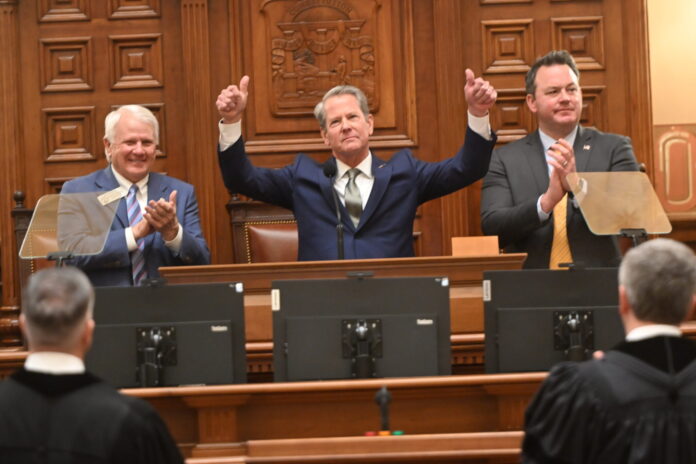
(Georgia Recorder) — Georgia Gov. Brian Kemp called for an expedited income tax rate cut and another tax rebate, new spending for law enforcement retirement savings and funding for a needs-based scholarship program in his annual state of the state address Thursday before the Georgia General Assembly.
The speech — Kemp’s eighth and final address as governor — highlighted many of the policies that have shaped his legacy, including his efforts to raise wages for teachers and other state employees, issue tax rebates during years the state had a revenue surplus and shore up the state’s multibillion-dollar reserves. According to Kemp’s projections, Georgia’s state reserves and rainy day fund combined will have more than $10 billion by the time he leaves office. The state’s current reserves sit at $14.6 billion.
“There’s no question the state of our state is stronger, more prosperous and safer today than it was in January of 2019,” he told lawmakers.
But Kemp’s speech also highlighted the rising costs of living across the state, and cautioned lawmakers against taking the state’s economic stability for granted.
“The reality is that too many of our citizens are still struggling to make ends meet and everyday costs are still too high,” he said. “Groceries, rent, insurance, clothes for the kids, it all adds up to more than it used to.”
In his speech, Kemp also previewed his priorities for his last legislative session as governor, which includes a proposal to accelerate a plan lowering the state income tax rate below 5%.
Kemp’s proposed tax cut would bring the state’s income tax rate to 4.99%, down from 5.19%. His proposal would take effect for this year’s tax year and cost the state about $750 million each year in future lost revenues.
“This will fulfill a promise to the people of the state that I made during my re-election campaign to lower our state income tax rate to under 5% and with the General Assembly’s passage and my signature, it will come a full three years ahead of schedule,” he said.
But there is a push in the Senate to move aggressively toward eliminating Georgia’s income tax. A special Senate panel recently released a plan that would waive the tax on up to $50,000 a year for individuals and $100,000 for married couples starting in 2027 – and eliminate the income tax entirely by 2032. Republican House leaders say they are also readying a bill that would nix the property tax on primary residences.
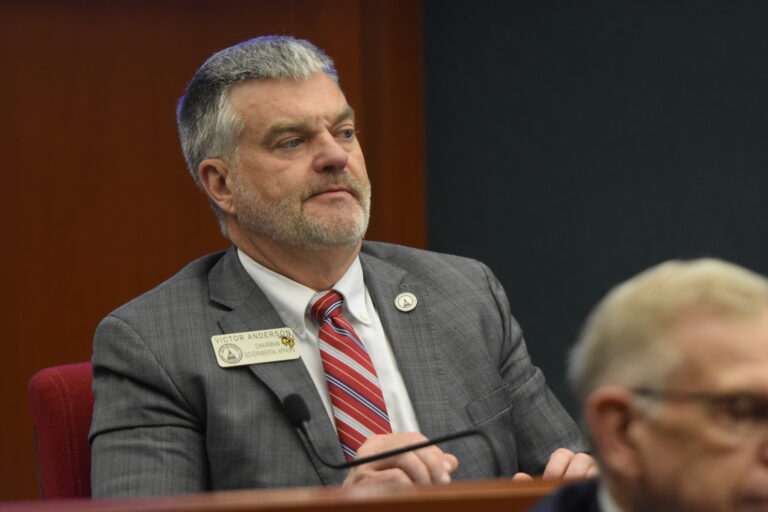
Rep. Victor Anderson, a Cornelia Republican and chair of the House Governmental Affairs Committee, said that with Kemp’s proposed accelerated income tax cut, lawmakers could consider some sort of property tax relief reduction without impacting local government services.
“I also think there’s plenty of room for us to work with our local government on property taxes and still allow them to provide the services the citizens need,” Anderson said.
Notably absent from Kemp’s speech were discussions of hot-button social issues like banning diversity, equity and inclusion efforts or restricting access to gender-affirming care.
Instead, Kemp centered his speech on cost-of-living issues, including a proposal to distribute a one-time $2,000 bonus to state employees, and fund a needs-based scholarship for Georgia students that had previously been funded through private donations.
The University System of Georgia Foundation’s DREAMS Scholarship would complement the state’s existing HOPE Scholarship, which is awarded to students based on merit. Under Kemp’s proposed budget, the DREAMS Scholarship would receive a one-time contribution of $325 million from the state to create more opportunities for Georgia residents to graduate without student debt.
“I believe we owe it to every child to ensure they start out on a level playing field, no matter their zip code,” Kemp said.
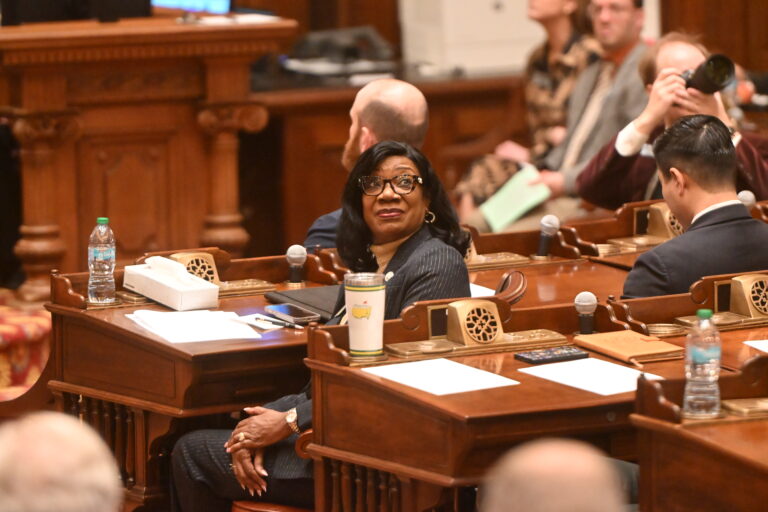
House Minority Leader Carolyn Hugley applauded Kemp’s push to fund the scholarship during his final year in office.
“We’ve been asking for a need-based scholarship for years,” she told reporters after the speech. “As you know, HOPE started out as a needs-based proposition, and they turned it into a merit-based scholarship. So I’m happy that on his way out the door, he’s giving a nod to something that we’ve been asking for for several years.”
But Hugley, a Columbus Democrat, also criticized Kemp’s proposal to send out one-time tax rebates to Georgia residents, saying it would not go far enough to address the state’s affordability issues.
This year’s rebates, which also require lawmakers’ approval, would be the fourth time Georgia taxpayers received an extra payment in recent years, and it would again show up as $250 for individuals, $375 for head of household and $500 for married couples filing jointly. All told, the rebates would cost the state’s rainy day funds about $1.2 billion.
The rebates “will not take care of the needs that most families are thinking about,” she said. “They’re thinking about child care. They’re thinking about paying rent. But a one-time $250, a one-time $500, what is that really going to do?”
In the official Democratic response to Kemp’s address, Hugley argued that Republican-led plans to eliminate the state income tax and property taxes would primarily benefit wealthy Georgians, while placing an increased burden on families and local governments.
“This is not tax relief,” Hugley said. “This is cost shifting.”
Kemp also released his budget proposals Thursday. Here are some other notable details from his spending plans:
Kemp’s budget would use $46.4 million to replace the recent reduction of federal funding for a key food aid program, the Supplemental Nutrition Assistance Program. The cuts were included in last year’s One Big Beautiful Bill Act. The governor’s plan would also add about $18 million to go toward reducing the state’s payment error rate to avoid future federal funding cuts to the program.
Roughly $2 billion in Kemp’s proposed budget would go toward highway improvements around metro Atlanta, and another $250 million would be allocated to local road projects. Rural parts of the state would also receive $100 million to strengthen or replace failing bridges, and $35 million for natural gas infrastructure upgrades. He highlighted these infrastructure projects at Wednesday’s Eggs and Issues event.
The proposal would also include $5 million to fund a full hand recount for this year’s election, and another $1.8 million to help scan and tabulate ballots based on the human-readable text.
The new spending will bring the size of this year’s budget up to $42.3 billion. Next year’s budget, which will take effect in July, is set at $38.5 billion.
The governor sets the spending levels each year in his budget proposals, and while lawmakers can’t increase the money available, they can move money around in the budget to reflect their own priorities. Lawmakers are set to hold budget hearings next week.
Georgia Recorder editor Jill Nolin and reporter Alander Rocha contributed to this report.