

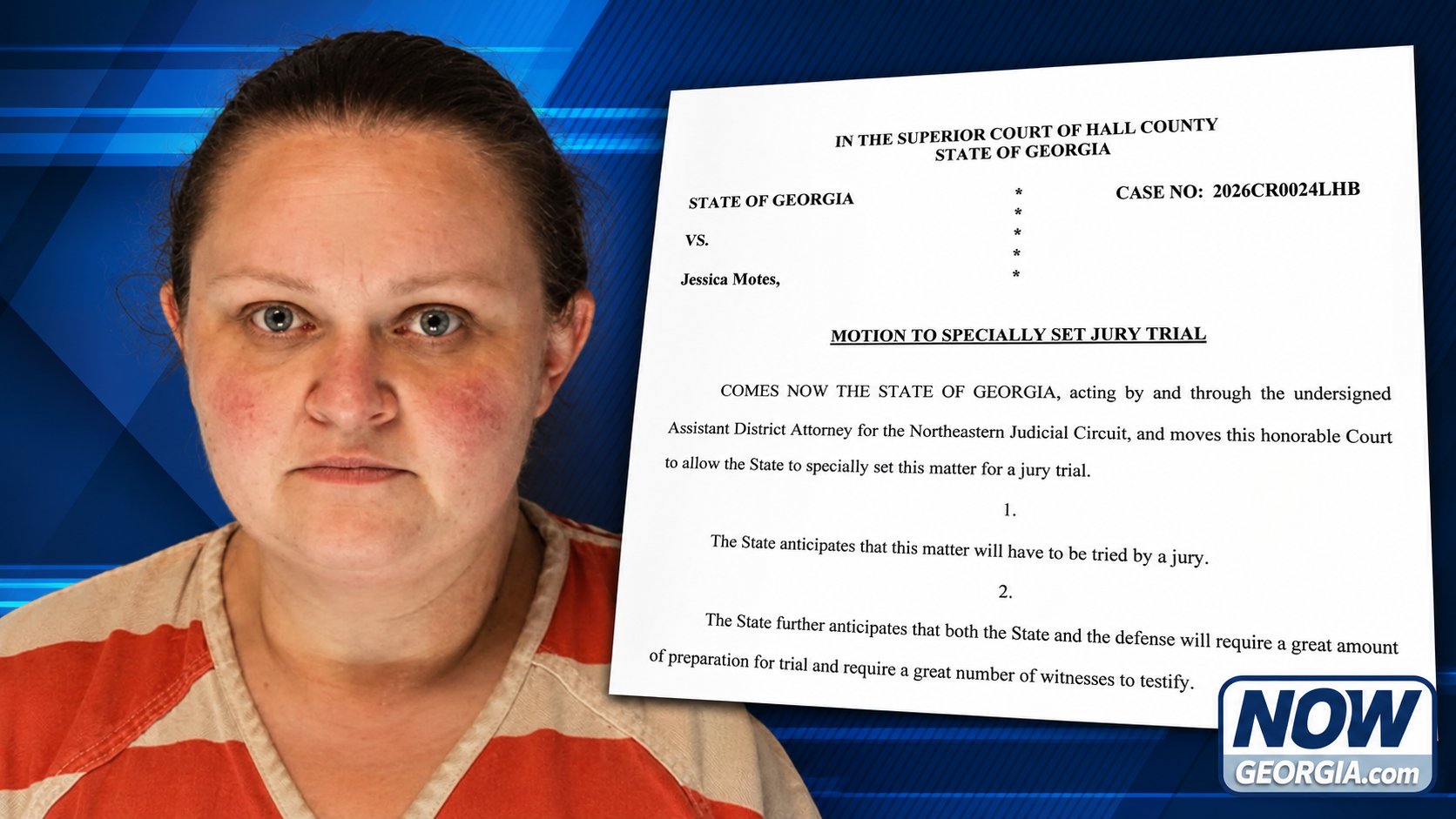
GAINESVILLE, Ga. – Another attempt to dismiss the murder indictment against Jessica Maria Motes has failed. On Monday, Nov. 23, Hall County Superior Court Judge Lindsay Burton rejected the defense’s argument that the grand jury that indicted Motes was unconstitutionally assembled.
The ruling leaves intact all five criminal charges against Motes, who faces the death penalty in connection with the October 2025 death of 4-year-old Autumn Fox.
The latest developments also include hundreds of hours of recorded jailhouse telephone conversations that prosecutors are collecting as evidence, and a possible delay in the trial until fall 2027.
Challenging the grand jury
The defense filed its original motion on July 14, arguing that the process used to assemble the Hall County grand jury violated Georgia law, the state and federal constitutions, and the Jury Composition Rule established by the Supreme Court of Georgia.
An amended motion followed on Aug. 31.
Defense attorneys argued that the method used to assemble the 2025 Hall County Master Jury List resulted in the underrepresentation of certain demographic groups, particularly African Americans and men.
The defense identified three primary concerns:
– Duplicate entries resulting from the combination of driver’s license and voter registration records.
– Differences between the demographic composition of Hall County’s population and its master jury list.
– The exclusion of individuals with felony convictions whose civil rights had subsequently been restored.
The court heard arguments on Sept. 3 before receiving additional written briefs from both parties.
Unlike the jury that will eventually determine Motes’ guilt or innocence, the grand jury was responsible for determining whether sufficient evidence existed to formally charge her.
Thousands excluded from jury eligibility
Among the issues examined by the court were 6,842 individuals identified as having felony convictions between 1957 and 2025 and residing in Hall County.
The defense argued that some individuals whose civil rights had been restored may have been improperly excluded from the master jury list and that those exclusions disproportionately affected African Americans and men.
However, the court found that the defense’s expert had verified only six Hall County residents whose rights had been restored and who were excluded from the list.
Burton determined that the disparity established by that evidence, when compared with a jury list containing approximately 140,000 records, was not statistically significant.
The court also examined demographic differences between the county’s jury-eligible population and the master jury list.
According to Monday’s order, the absolute disparity for males was 1.48 percentage points, while the disparity for African Americans was 0.46 percentage points.
The court found both differences were within constitutionally acceptable bounds.
Duplicate records or duplicate jurors?
The defense’s expert identified 7,226 records associated with 3,613 individuals believed to have duplicate entries on the master jury list.
However, testimony from the executive director of the Council of Superior Court Clerks of Georgia established that multiple records appearing to relate to a single individual did not necessarily constitute duplicates under Georgia’s Jury Composition Rule.
The council uses identifying information to distinguish individuals and conducts quality-control checks when compiling county jury lists.
The court also acknowledged testimony that some apparent duplicate entries involving women could be attributed to name changes.
Burton concluded that the defense had not demonstrated a substantial deviation from Georgia’s jury composition requirements or a constitutional violation warranting dismissal of the indictment.
The prosecution will proceed.
Hundreds of hours of jailhouse conversations
Meanwhile, the amount of evidence prosecutors must review continues to grow.
During Monday’s proceedings, Assistant District Attorney Harold Buckler addressed Motes’ extensive use of the jail’s telephone system, which has reportedly generated hundreds of hours of recorded conversations.
Burton granted the prosecution’s request to supplement discovery monthly as additional evidence becomes available.
Discovery is the process through which evidence is exchanged between prosecutors and defense attorneys before trial.
The contents of those conversations and their potential significance to the prosecution’s case have not been established in the newly filed order.
Thirteen months since Autumn’s death
Thursday will mark 13 months since authorities discovered Autumn Fox’s body inside the trunk of Motes’ Nissan Sentra in the Sam’s Club parking lot in Oakwood.
Investigators allege the child suffered blunt-force injuries, a broken arm, and exposure to fentanyl, methamphetamine, and xylazine.
A Hall County grand jury returned a five-count indictment against Motes on Jan. 12, charging her with:
– Malice murder
– Felony murder
– First-degree cruelty to children
– Aggravated battery
– Concealing the death of another
Prosecutors announced in March that they would seek the death penalty after Motes rejected a plea agreement that would have resulted in life imprisonment without the possibility of parole.
Motes pleaded not guilty on July 8.
As Now Georgia previously reported, defense attorneys filed 59 distinct motions in October addressing everything from the constitutionality of capital punishment to evidence, witness testimony, jury selection and courtroom procedures.
Monday’s ruling addresses the grand jury composition challenge, not the entirety of those outstanding motions.
Trial could move to fall 2027
Previously scheduled for June 21, 2027, Motes’ jury trial could now take place in September or October 2027.
Another round of pretrial motions hearings is scheduled for the week of March 8, 2027.
Should the trial take place in October, it would coincide with the second anniversary of Autumn Fox’s death.
Don’t miss what everyone in town is talking about.
Join 7,000+ locals and choose our free newsletter covering news, events and the stories shaping our region.