
If Taylor Swift wrote a play about the women of the French Revolution, this would be it. Piedmont University’s production of The Revolutionists stages history as girl talk, manifesto, and rollicking reckoning.
The play imagines a meeting between four women who never shared a room: playwright Olympe de Gouges, assassin Charlotte Corday, former queen Marie Antoinette, and Haitian revolutionary Marianne Angelle. The script blends puns, expletives and pointed speeches with moments of confession and conflict. In short, it feels like a concept album set in 1793.
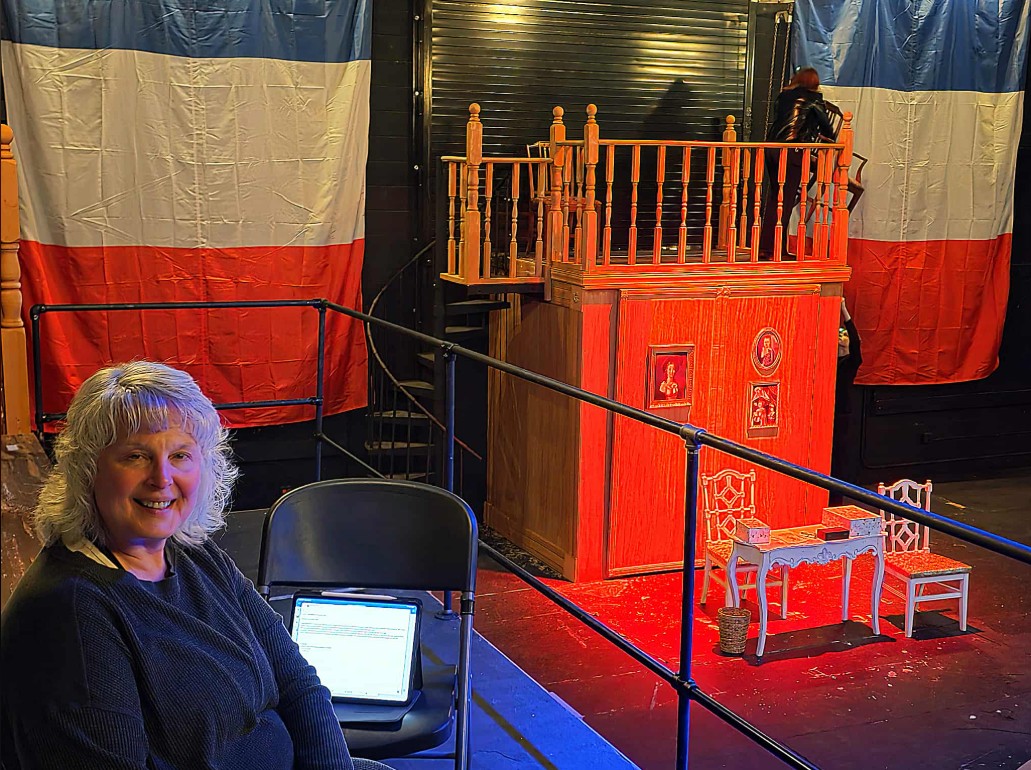
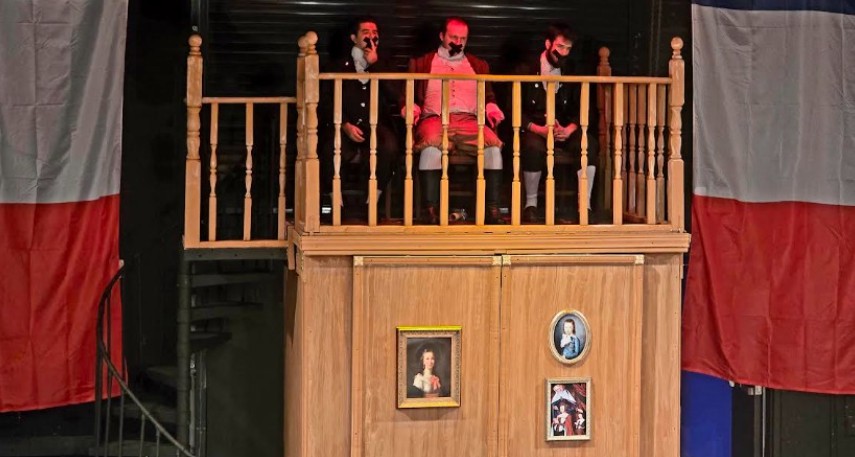
The theatre becomes part of the conversation. Tiered risers climb the walls, forcing the audience upward while a central platform drops below eye level. A railing divides the space. Two French tricolors stretch across the wall and chandeliers hang overhead like relics of a fallen court. The layout echoes the gallery of the National Assembly during the Reign of Terror. The audience looks down into the chamber on the actors as if they themselves serve as judges in a tribunal.
All performers in The Revolutionists are Piedmont students, and the production operates as part of the program. Director Kathy Blandin frames the work as practical education. Theatre, in this context, teaches craft, discipline, and collaboration alongside traditional text analysis. When asked about the play, she calls it an “irreverent” and “comic” look at women during resistance and revolution. In her director’s note, she connects her choice directly to the 2022 overturning of Roe v. Wade. “Apparently, it has been declared ‘open season’ on women’s rights,” she writes, “and I believe this play is more relevant than ever.”
Dakota Rose Chen’s Olympe de Gouges moors the play with control and conviction. She defends art as a weapon and witness. When she promises to help Charlotte Corday craft final words before execution, the promise draws fire. Marianne Angelle demands accountability. The conflict exposes the play’s central question: Does art shape history or simply frame it?
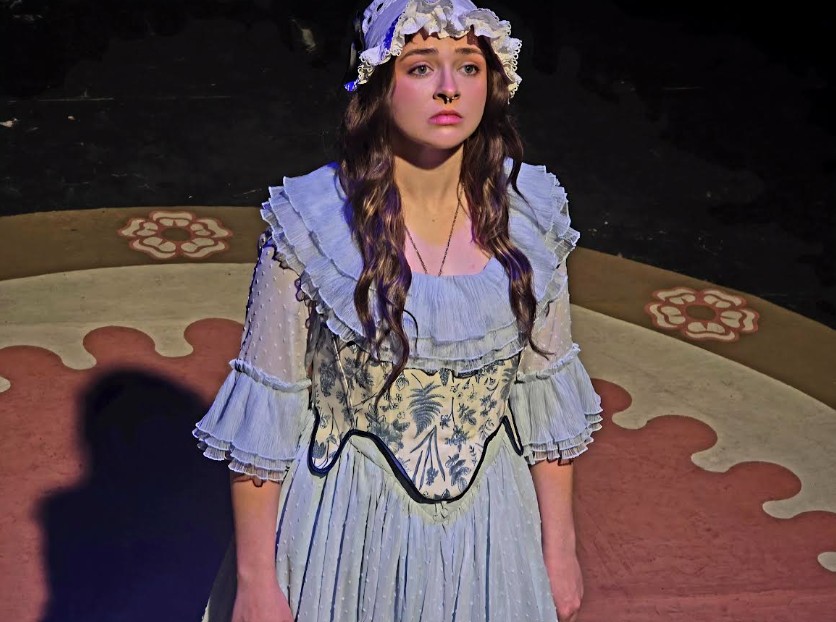
Kattie Smith, who bears a striking resemblance to the woman she portrays, strides onto the stage with knife-sharp precision as Charlotte Corday. “I’m not here to make a story. I’m here to make history,” she declares. She speaks of sacrifice for the greater good. She reminds the room that history judges slowly. She wields wit like a blade, leaning into puns and conviction as the assassin of Jean-Paul Marat.
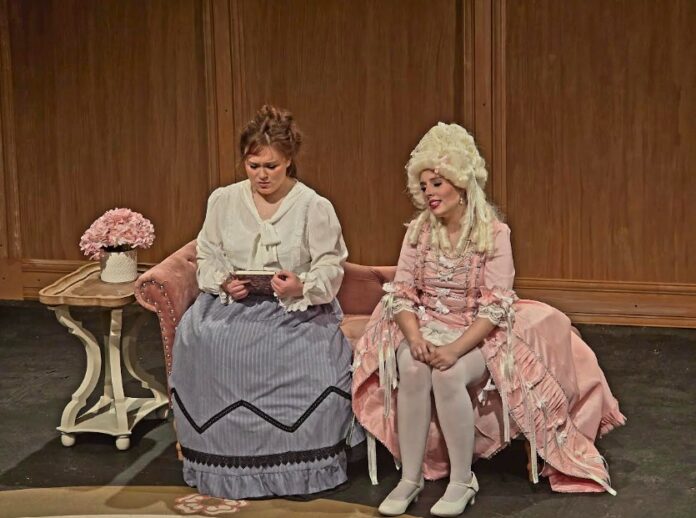
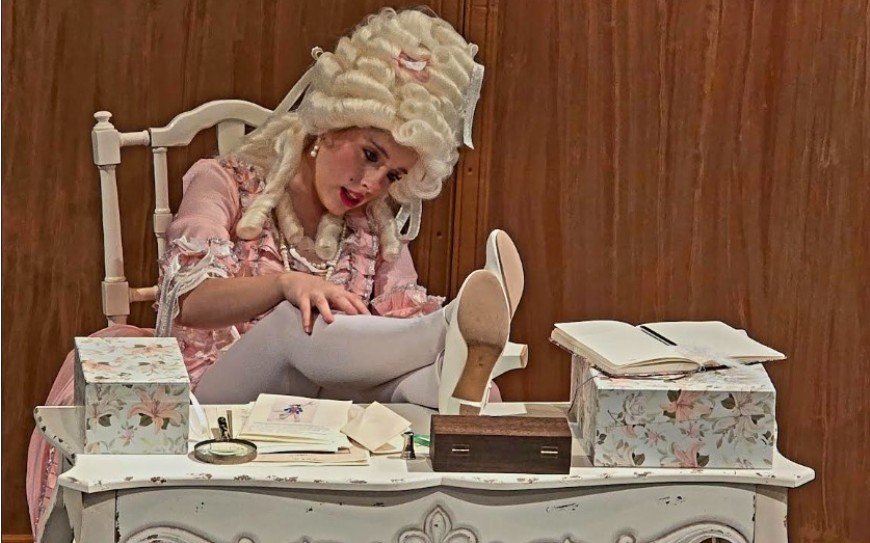
Yet it is Nealy Webster’s Marie Antoinette who steals scene after scene. She sweeps in with theatrical air, sashaying hips and a crown of curled blond hair. Her face broadcasts every flicker of feeling to the audience, and her exaggerated gestures channel Lucille Ball, blending physical comedy with royal bravado. Her arrival into the production is like the arrival of an impeccably frosted cake set at the center of the table, both announcing and fulfilling the occasion.
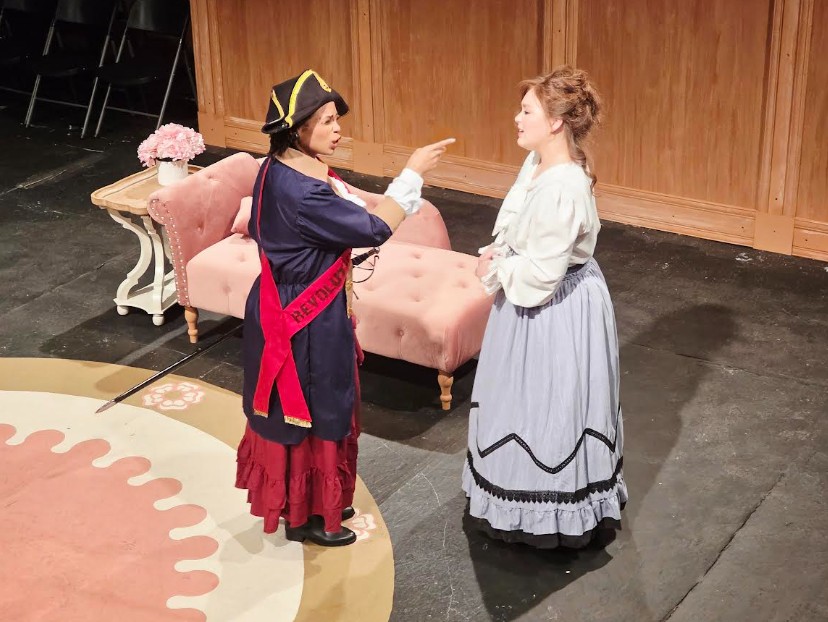
If Webster elevates, Delyna Fuller’s Marianne Angelle grounds it. She opens the production with a pointed finger and lofty lectures, lambasting each woman in their turn. Yet, as the play progresses, she shifts from prosecutor to friend, forming relationships and extending empathy where she once pressed constant critique. She loves her husband without apology, rejecting the caricature of the man-hating revolutionary. She stands beside Charlotte before her execution and later demands that Olympe live up to her promises. Her power emerges most clearly in vulnerability, especially in her exchange with Antoinette about separation, loss, and the cost a woman pays for power.
The set captures the period. A rose-pink chaise longue introduces a note of femininity against an otherwise spare chamber. The emptiness of the room echoes the austerity of the Reign of Terror. Oversized flags of the revolution dominate the walls, their scale suggesting patriotism in the inhale and oppression in the exhale.
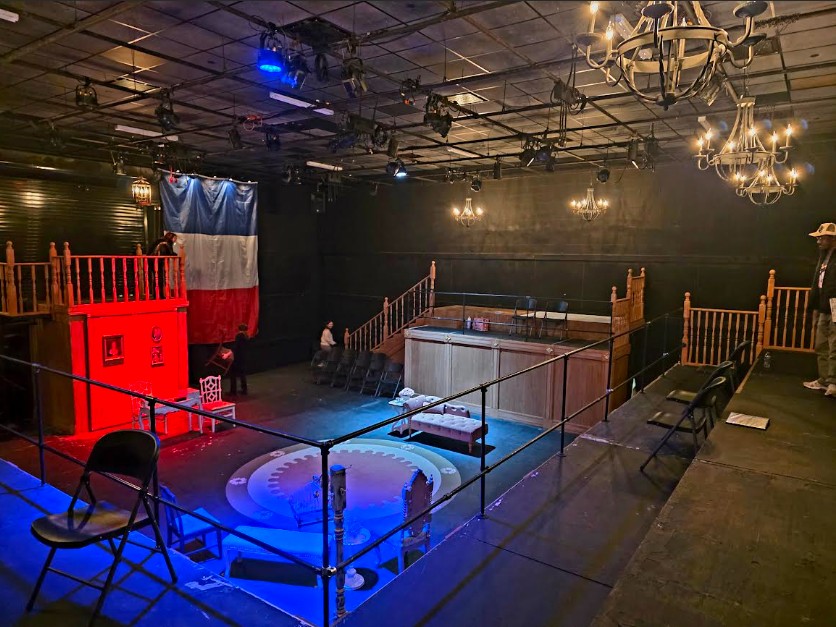
The show runs Thursday through Saturday at 7:30 p.m. and Sunday at 2:00 p.m. The house seats 70. Tickets cost $10 for adults and $5 for seniors and outside students. Admission is free for Piedmont faculty, staff, and students. In the black box venue, history stands at eye level. The women look up from the center of the floor and demand a voice.
“Look up. Find your light. And say it loud.”
The line lands as an invitation and command.