

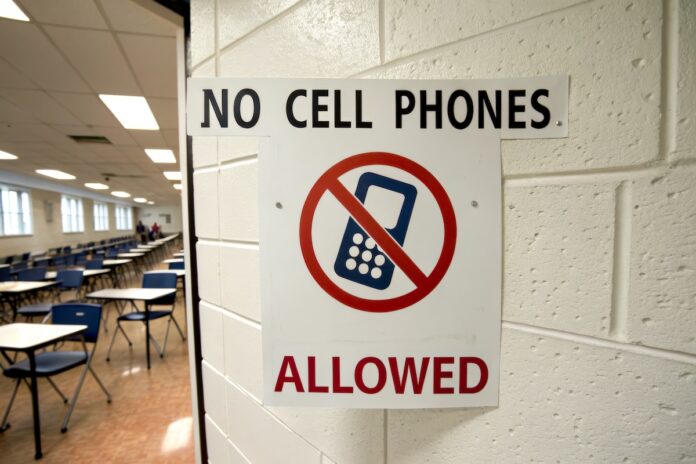
Next fall, every public elementary and middle school in Georgia will require students to “unplug” during school hours. The mandate, passed as House Bill 340, requires Georgia’s K-8 public schools to ban personal communication devices beginning July 1, 2026.
Lawmakers on both sides of the aisle supported the move, citing concerns that phones distract from learning and fuel the youth mental health crisis.
“Anytime you have a bill that’s passed in California and Florida, you know you’re probably onto something that’s pretty popular,” said Rep. Scott Hilton, a Republican from Atlanta, during a recent forum on cellphone use.
A national wave with Georgia in the middle
Georgia’s new law joins a surge of restrictions across the country. Thirty-five states now limit student phone use in some way, a shift that’s happened quickly since Florida became the first to enact a law in 2023.
Some states, like Kentucky, go further, banning phones during all instructional time through high school. Georgia’s law stops short, applying only to elementary and middle schools. Still, several local districts are already ahead of schedule.
Henry County Schools, south of Atlanta and home to 40,000 students, not only complies but has extended its ban through high school. Administrators say the results are clear: fewer distractions, more engaged students, and teachers who can spend time teaching rather than policing devices.
Georgia students adjust
In metro Atlanta, McNair High School has required students to lock up their phones during class since last year.
At first, students resisted. “Most of them did not want to turn in their phones,” said junior Audreanna Johnson. They were used to texting friends in other classrooms to “see what’s the tea.”
Now, Johnson says the pushback is fading. “More students are willing to give up their phones and not get distracted.” Still, she admits she misses listening to music through her headphones when working independently.
Parents remain uneasy
If students are slowly adapting, parents remain divided. A survey of 125 Georgia school districts by Emory University found parental resistance is the top obstacle to enforcing restrictions.
Johnson’s mother, Audrena, worries about safety. She wants to know instantly if something happens at her child’s school, like the day a fight broke out involving someone who wasn’t a McNair student. “My child having her phone is very important to me,” she said.
Jason Allen of the National Parents Union says that tension is widespread. “We just changed the cellphone policy, but aren’t meeting the parents’ needs in regards to safety and really training teachers to work with students on social emotional development,” Allen said.
Teachers welcome the change
Teachers, on the other hand, have largely embraced restrictions. Emory professor Julie Gazmararian, who studied a phone ban in Marietta schools, said educators reported fewer disruptions and more teaching time.
“They were saying that kids are talking to each other in the hallways and in the cafeteria,” she explained. “And in the classroom, there is a noticeably lower amount of discipline referrals.”
Research still unfolding
Gazmararian is still compiling numbers on grades and discipline, and cautioned that her work may not be able to answer whether bullying has been reduced or mental health improved.
Social media use clearly correlates with poor mental health, but research can’t yet prove it causes it, according to Munmun De Choudhury, a Georgia Tech professor who studies this issue.
“We need to be able to quantify what types of social media use are causing harm, what types of social media use can be beneficial,” De Choudhury said.
A cultural test ahead
As the deadline nears, Georgia finds itself in the middle of a national experiment — trying to roll back students’ near-constant connection to their phones.
The challenge will be balancing academic focus with safety and parental concerns, while helping students learn how to manage their digital lives.
If early adopters like Henry County and Marietta are any indication, classrooms may become calmer and more focused. But the bigger test is whether Georgia families — and students — can learn to live without the devices that have defined a generation.