

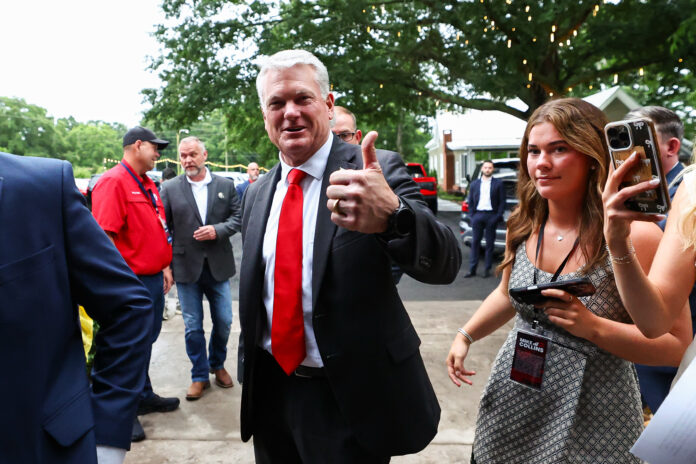
ATLANTA (AP) — Rep. Mike Collins on Tuesday defeated first-time candidate Derek Dooley for the Republican U.S. Senate nomination in Georgia, advancing to face Democratic Sen. Jon Ossoff for a seat that will help determine control of Capitol Hill for the final years of Donald Trump’s second presidency.
President Donald Trump will be a key fault line in the general election matchup. Collins, who was endorsed by Trump on Sunday, has identified closely with the president since he first won his House seat in north Georgia in 2022. A trucking company owner and son of a congressman, Collins campaigns as a self-described “MAGA warrior.”
Ossoff, first elected in 2020, has blasted Trump as a “national embarrassment” who is using the presidency to enrich himself and his family. The 39-year-old is the lone Senate Democrat running in a state that Trump won in 2024. Democrats face tremendous pressure to hold his seat as they try to gain a net of four seats to claim a Senate majority.
Senate contest previews a titanic fall fight
Republicans have not won a U.S. Senate contest in Georgia since 2016, Trump’s first election.
Despite his ties to Trump and the Republican base, Collins has argued that he can build a broad coalition, and he plans to use immigration as a contrast with Ossoff. In the House, Collins sponsored the Laken Riley Act, a 2025 law that requires immigrants accused of certain crimes to be detained. It is named for a Georgia nursing student killed in 2021 by a Venezuelan man who was in the U.S. illegally. Ossoff voted against a version of the legislation before backing the final proposal after Trump’s return to power.
Collins won the nomination despite his Republican opponents highlighting a House ethics complaint that accuses him of abusing taxpayer funds by paying the girlfriend of his former top adviser for congressional job duties she allegedly did not fulfill. After an initial investigation, a federal panel forwarded the matter to the House Ethics Committee.
The congressman begins his general election campaign at a financial disadvantage. Collins raised about $4.9 million through the end of May, and reported having less than $1.2 million remaining. Through late April, the last time Ossoff had to file before his primary, the incumbent had raised $60.4 million and had $32.5 million on hand.
Georgia voters also were nominating a Republican in the gubernatorial contest to face former Atlanta Mayor Keisha Lance Bottoms, a Democrat.
Trump picked his candidate for governor 10 months ago, endorsing Burt Jones, the Georgia lieutenant governor who was part of Trump’s attempt to overturn his 2020 defeat to former President Joe Biden. In that race, it was Kemp who made a late-hour endorsement, announcing his support for Jones on Sunday.
The power of Trump’s endorsement — and Kemp’s — is being tested by billionaire Rick Jackson, whose campaign has spent more than $100 million, mostly out of his own pocket, to win the nomination.
Polls closed at 7 p.m.
What voters in Georgia are saying
Voters Jenny Beth Martin and Debbie Dooley — who has no relation to Derek Dooley — were split over which Republican has the best chance of defeating Ossoff.
Martin, who supported Collins, says energizing the conservative base is necessary to protect Republican majorities that aren’t populated with Republican “anti-Trumpers” or “liberals like Jon Ossoff.”
But Debbie Dooley, who voted for Derek Dooley, said Collins has too much baggage and is too closely tied to the far-right to win.
“He will drag down the whole Republican ticket in Georgia,” she predicted. “This is about actually winning. It’s not about just following Donald Trump.”
Gubernatorial primary is a unique challenge for Trump
The president’s preferred primary candidates have a strong record so far in 2026. But none have faced a self-funded rival with Jackson’s spending power.
Jackson, a 71-year-old business owner, amassed a fortune from his company that provides contract healthcare personnel, and he’s used it to blanket television and online platforms with ads. Appealing to hard core Trump supporters, he’s pledged that immigrants in Georgia illegally will be “deported or departed.” He promises a slew of tax cuts. And previewing a potential general election argument, he’s played up his biography as a product of the state foster care system and featured his grandchildren advising him on how to make friendlier ads.
Jones, 47, comes from a wealthy family but is running a more modest campaign. Framing himself as a “proven leader,” Jones proposes eliminating Georgia’s state income tax — without detailing how he’d make up the revenue. And he trumpets his presidential seal of approval and time as a University of Georgia football player in the 1990s. As lieutenant governor, Jones pushed legislation that ultimately did not pass but would have disqualified Jackson’s company from receiving taxpayer-funded contracts.
Trump did not travel to Georgia to campaign with Jones but he’s given the lieutenant governor a fresh round of support on social media and called in to a telephone rally during the early voting period.
“Burt was strongly committed to my Campaign in 2016, 2020, and 2024, and worked tirelessly to help us WIN. He has been with us from the very beginning,” Trump posted on Truth Social last week.
Runoffs for elections chief could shape 2028
Georgia’s secretary of state race was open for the first time since Trump’s attempts to subvert the 2020 election, famously pressuring outgoing Secretary of State Brad Raffensperger to “find 11,800 votes” to overtake Biden. Raffensberger refused.
For his potential successor, Republicans were left to choose between an outright election denier, Vernon Jones, and a state lawmaker, Tim Fleming, who avoids explicitly disputing the president’s 2020 election lies. They went with Fleming, who won the nomination on Tuesday.
Jones, a perennial candidate who was once a Democrat, embraced Trump’s “stop the steal” movement and said he stood “with those who believe there was election fraud.” Fleming, who once served as deputy secretary of state, has said there were “irregularities” in 2020, a word choice that has become code for Republicans who want neither to ratify nor call out Trump’s errant claims.
Democrats voted for Penny Brown Reynolds — a former state judge in Fulton County who also served in the Biden administration as deputy assistant secretary for civil rights for the Department of Agriculture — over Dana Barrett, a Fulton County commissioner.
MORE ELECTION RESULTS
Don’t miss what everyone in town is talking about.
Join 4,000+ locals and choose our free newsletter covering news, events and the stories shaping our region.