Home Blog Page 990

Proposed cell tower in Baldwin met with opposition

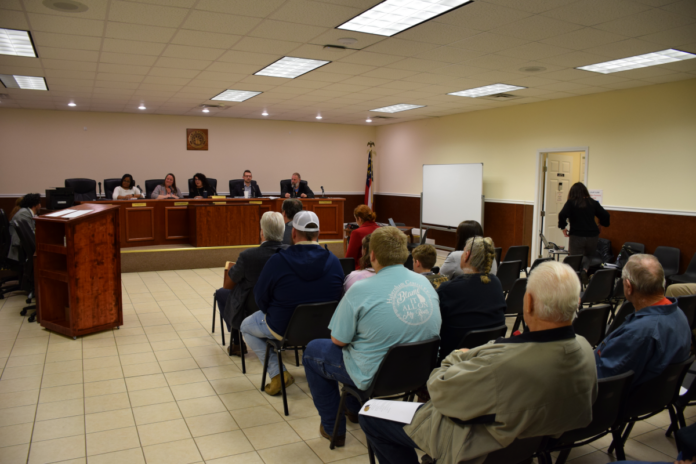
Several people attended the cell tower public hearing at the Baldwin work session Tuesday night. (Jerry Neace/NowHabersham.com)

Several people attended the Baldwin City Council work session Tuesday night for a public hearing on a proposed T-Mobile cell tower. Five people spoke in opposition to the tower that would be located near downtown Baldwin, in close proximity to Baldwin Elementary School and the Habersham County Airport.

Vertical Bridge wants to build the tower to improve cell service for residents in the area. Company attorney Mattaniah Jahn outlined the project for the city council and about a dozen residents who turned out for the hearing. Jahn told them Vertical Bridge looked at different locations around Baldwin. According to a study they conducted, she said the location at Traditions Drive would provide the best coverage.

Following Jahn’s presentation, Baldwin Mayor Stephanie Almagno opened the floor to anyone wanting to speak in favor of the proposed project. No one came forward. However, several filed to the podium when she opened the floor to those opposed to the cell tower.

Family concerned about health effects
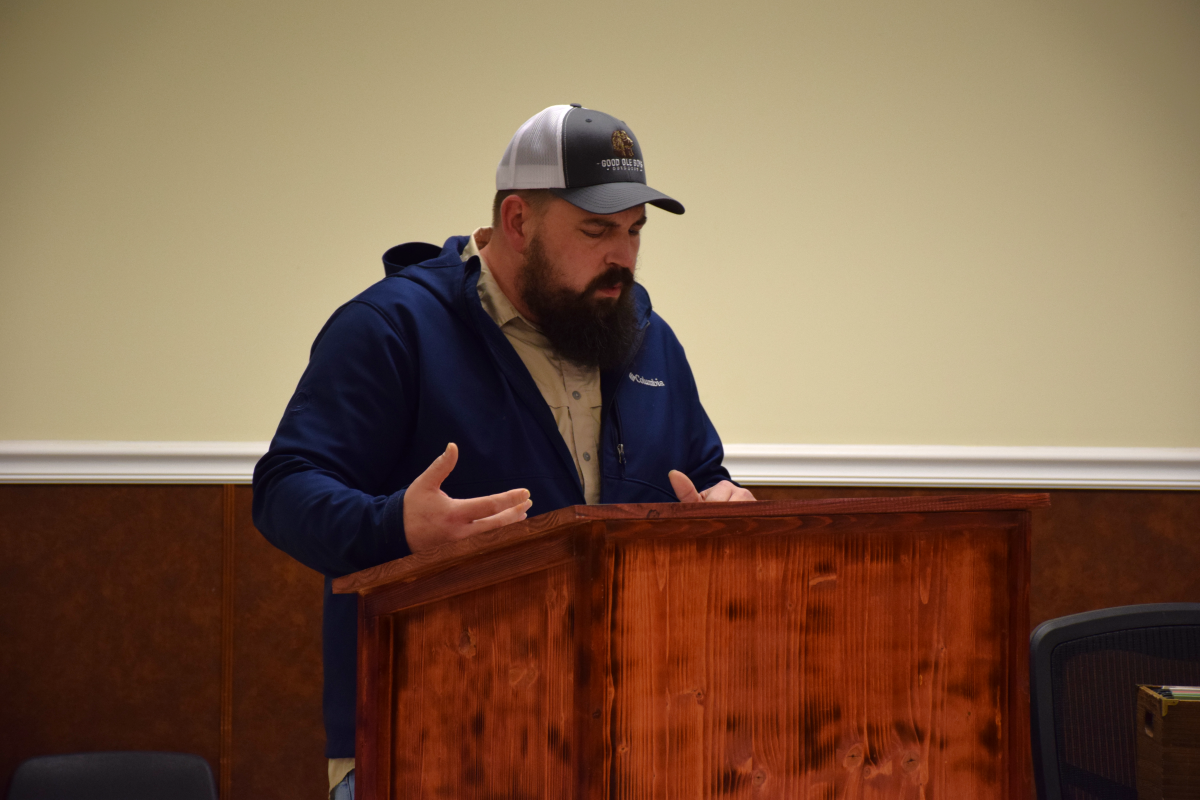
Baldwin resident Mike Tope expressed the health concerns he has for his family should the tower be built adjacent to his property. (Jerry Neace/NowHabersham.com)

Baldwin resident Mike Tope voiced his opposition to the cell tower. His property is next to the site where the tower would be located.

“We are adjacent to this property. We live right next to it. The cell tower that is proposed is roughly 298 feet from our house, not property, house. This will have a direct impact on me and my family especially,” Tope stated.

Tope worries about the potential negative health effects the radio frequency waves would have on his family. He referenced studies that conclude a recommended safe distance from a cell tower is 500 meters (1,640 feet).

“If this cell tower is approved, really, there is no doubt we would have to sell our house, and that would be devastating for us. This is our home. This is where we want to be,” Tope told the city council.

County concerned about airport safety

Ralph Taylor from the Taylor and Hunt Law Group, which represents Habersham County, spoke in opposition to the tower as it relates to airport safety for approaching and departing aircraft.

“I am here to voice the county’s concerns and objections to this variance application before you. We believe this tower is going to present a clear and present danger to the operations of the airport,” Taylor stated.

He explained to the council that the tower would be a 300-foot obstruction within one mile of the airport, with planes taking off and landing.
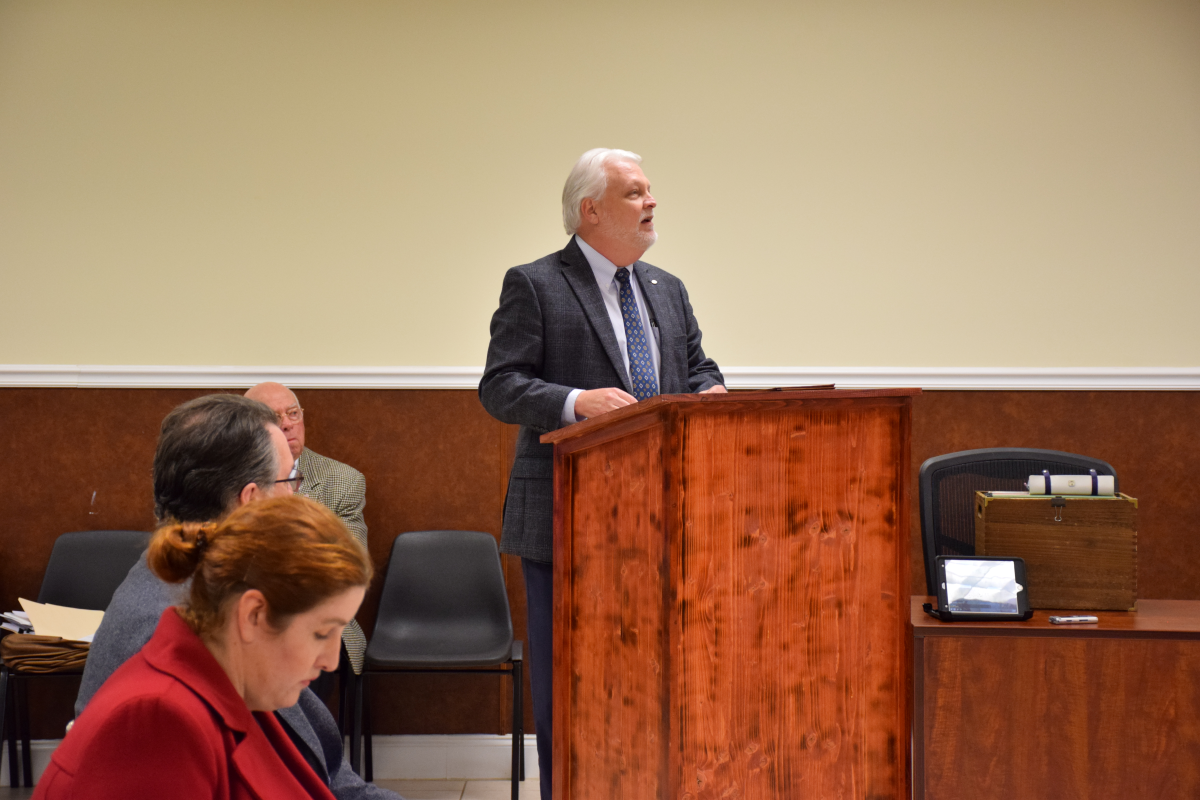
Habersham County Attorney Ralph Taylor expressed the county’s concerns about airport safety should the tower be built. (Jerry Neace/NowHabersham.com)

Taylor added that the city’s ordinance contained an airport overlay district. In that ordinance, it provides language that the airport should receive notice of this type of application to elicit comments on how this tower may affect the airport.

“For those reasons, we would ask the council to consider denying the application,” said Taylor.

Airport Commission ‘strongly against’ cell tower

Baldwin resident and former Habersham County Commissioner Andrea Harper added her voice to the chorus of opponents. She assisted with Baldwin’s comprehensive plan and said she was honored to have done so. However, “This is actually against your comp plan. It says that you will respect and maintain your neighborhood residential areas.”

“So not only are you tempting fate with your comp plan, but you’re also going against your actual overlay district ordinance,” said Harper. “I am asking that you vote against the tower at any height and against the variance.”

Habersham County Airport Commission Vice-Chairman D. Higgins also addressed the council.

“I just want to get on the record that the Habersham County Airport Commission is against the tower being placed there,” he said.
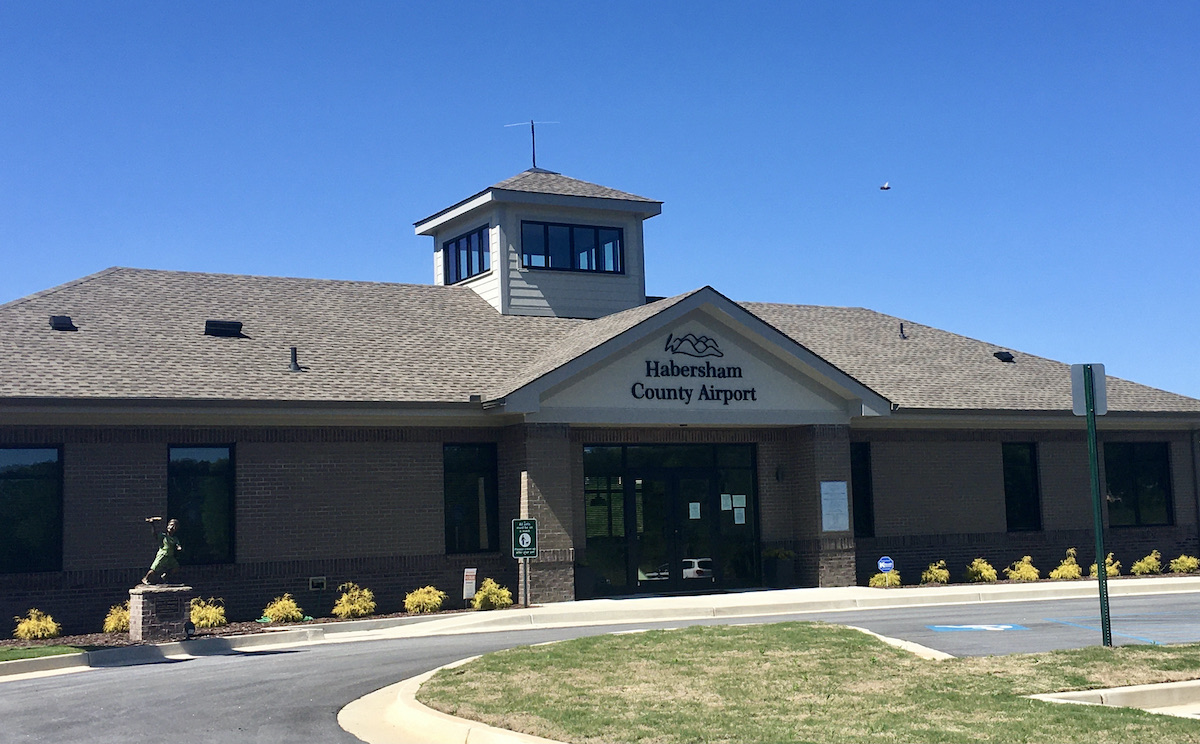
The Habersham County Airport is located in Baldwin, Georgia. (NowHabersham.com)

Higgins added, “We are strongly against the tower. It may not be a hazard per se for navigation, but if you’re flying and you lose an engine and you have to turn quickly to get back to the runway, you don’t want a 250-foot obstacle in your way.”

Baldwin Councilmember Maarten Venter pointed out that the airport has helicopters landing and taking off from the airport that don’t utilize the runway flight path. They are able to enter and depart from the airport in all directions.

Councilmember appears skeptical

Local attorney Doug McDonald expressed his concern over the letter issued by the FAA stating that they determined that there was no hazard to air navigation. He explained the FAA could not compel the council to approve the application.

“The FAA letter cannot tell you what to do. They can’t make you give a permit. They do not govern the city of Baldwin,” he told city leaders.

McDonald also stated that to have a civilized society, we must have rules. “T-Mobile is asking you to change your rules,” he said.

Jahn agreed with McDonald, stating that the FAA can’t tell the council what to do, but she added that the FAA can tell Vertical Bridge not to build the tower.
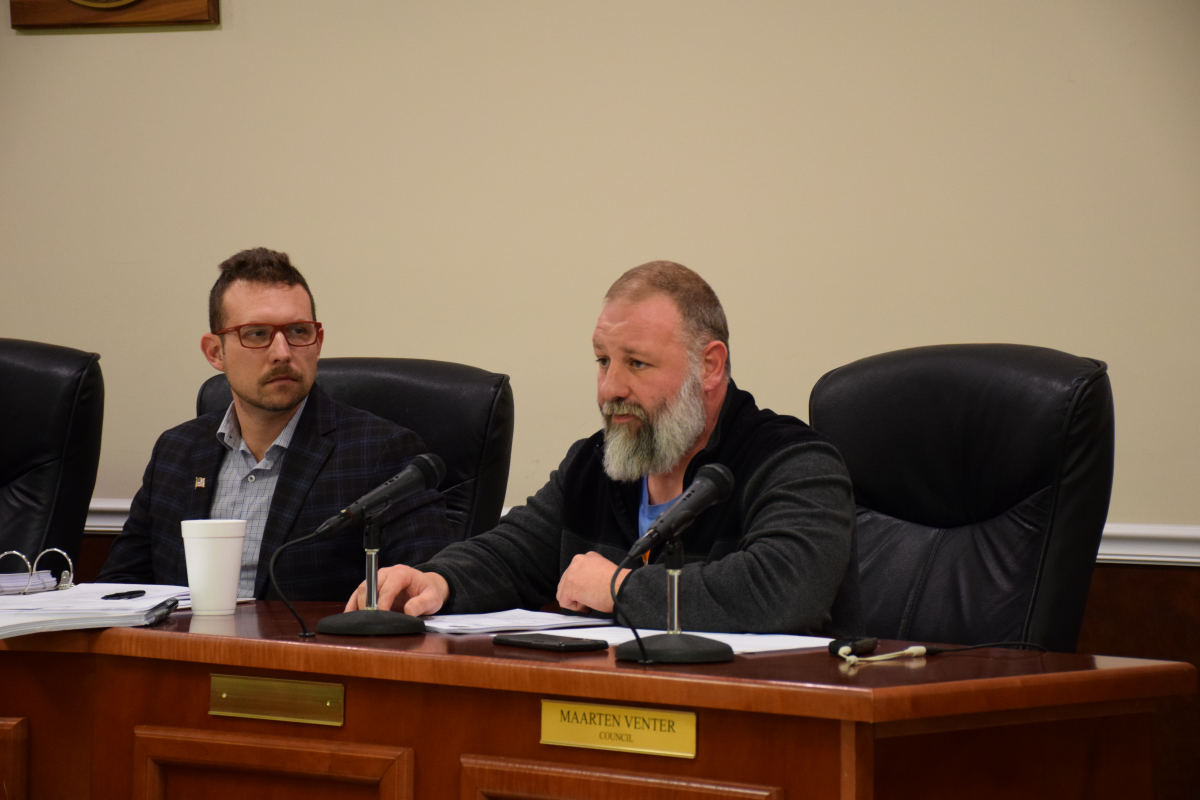
Council Member Maarten Venter (right) expressed his opinion on the location of the tower in Baldwin. (Jerry Neace/NowHabersham.com)

Councilman Venter stated that he understood the need for cell service in the area.

“We have to keep in mind that this is more than just technology. I understand. I work with cell signals every day. I understand the difficulties.”

However, Venter appeared skeptical about the tower’s proposed location.

“You’ve got these two towers on either side of Baldwin, and they’re outside the city limits, and now you want to plant this giant tower in the middle of Baldwin,” he said. Venter continued, “It seems to me that there’s plenty of other options available. I’m sure there’s something else that can be done other than slapping that tower in the middle of Baldwin.”

Jahn explained after the meeting the need for the cell tower in the area.

“I presented the case before the council. There’s a lack of coverage in the area, and it’s needed.”

Next steps

Before Vertical Bridge can build the cell tower, it must first get the council to approve a special use permit and variance.

The permit would allow the company to build the cell tower on property zoned R-1, residential, which is not currently allowed. The variance would allow Vertical Bridge to build the tower nearly 100 feet higher than the current 165-foot limit.

City council members will discuss both matters again at their meeting on Feb. 12. They’ll hear the first reading of the proposed ordinance that would allow construction to proceed. The council is due to make its final decision on Feb. 26.

Vertical Bridge has encouraged the Baldwin City Council to approve the first reading as a matter of procedure. The company says it can have a representative available on Feb. 26 to answer any FAA questions ahead of the council’s final vote.

The Baldwin City Council next meets at 6:30 p.m. on Feb. 12 in the Baldwin Municipal Courtroom at 155 Willingham Avenue.

Habersham County expands recycling center opening days

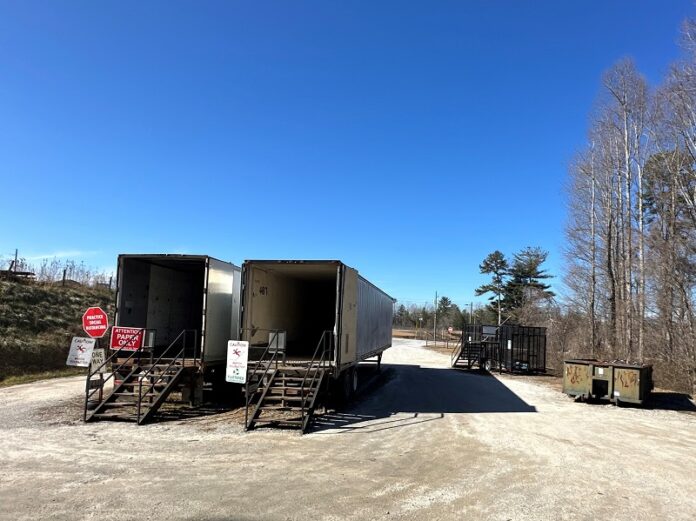
The Clarkesville Recycling Center located at 4142 Toccoa Highway is now open from 8 a.m. to 4:30 p.m. Tuesday through Saturday. The Cornelia Recycling Center on Nicolon Drive is open from 8 a.m. to 4:30 p.m. Monday through Saturday. (Rob Moore/Habersham County)

Habersham County is turning to recycling as one possible solution to its pressing landfill problems. The Clarkesville recycling center is now open Tuesday through Saturday, while Cornelia is open Monday through Saturday.

The move comes on the heels of a recent disturbing report that the Habersham County Landfill, which had been projected to last well into this century, may now be full within 17 years. With additional recycling days, county officials hope they can slow that expiration date.

“We’ve talked to our administration, and we’ve made the decision to open our recycling centers five to six days a week now instead of three days,” said Habersham County Solid Waste Director Johnnie Vickers.

Paper products, including paperboard that is tearable, are accepted. (Rob Moore/Habersham County)

“It’ll be a great opportunity for the citizens to have ample opportunity to come and recycle, whether it’s cardboard or paper or bottles or whatever the case might be. And it will be a lot more convenient for the citizens to do that, so we’re excited about doing that. We look forward to our recycling centers taking in more materials to save life in our landfill. That’s the whole object behind this,” Vickers added.

On Feb. 29, the county will stop accepting construction and demolition waste at the landfill as part of its effort to extend the landfill’s life cycle.

New hours of operation

The Cornelia/Habersham Recycling Center, at 507 Nicolon Drive, Cornelia, is now open Monday through Saturday from 8 a.m. to 4:30 p.m. The Clarkesville Recycling Center, at 4142 Toccoa Highway, Clarkesville, is now open Tuesday through Saturday from 8 a.m. to 4:30 p.m.

This allows Habersham County residents to have five more days to drop off recyclables at one of the centers.

Items accepted

Habersham County recycling centers accept the following items:

  • Glass: clear, green, brown
  • Aluminum cans
  • No. 1 or No. 2 plastic bottles/jugs (look on the bottle or jug for the number inside the recycling triangle)
  • Paper products such as newspapers, some types of computer paper, magazines, books, shredded paper
  • Cardboard

What is not accepted at the recycling centers?

The green glass bin at the Clarkesville Recycling Center is beginning to fill. There also are bins for clear glass and brown glass. (Rob Moore/Habersham County)

Metal and electronics are no longer accepted at the recycling centers. Electronics must be taken to the landfill. There is a $15 minimum charge, then prorated at $55 per ton for metal and electronics.

Mattresses and box springs are NOT accepted at the recycling centers. Please take those items to the landfill. There is a fee of $10 each.

“All we really take at the recycling centers is cardboard, any paper product – if you can tear it, that’s considered paper – then we take plastics, drink bottles, detergent jugs, and we take aluminum, and we take glass,” Vickers said.

“Glass is separated by color, and there are three bins for that. We do not take mattresses. We do not take electronics. And we do not take what we call ‘white goods’. Now, we do take the ‘white goods’ here at the landfill, but there’s a charge for that, to put those off, with the mattresses the same way,” Vickers reminded.

Randy Bruce Gerrin

Randy Bruce Gerrin, age 67, of Cleveland, formerly of Cornelia, passed away on Wednesday, February 7, 2024.

Born on March 16, 1956, in Demorest, he was a son of the late Earl William Gerrin and Lovadia Etta Chastain Gerrin. Mr. Gerrin retired from NOK after several years of service. In his spare time, he enjoyed going to the Toccoa Speedway on the weekends and piddling in his workshop. Most of all, he loved his family, especially his grandchildren.

In addition to his parents, he was preceded in death by his sister, Kathy Sosebee.

Survivors include his daughters and son-in-law: Heather Minutello (Tony) of Cleveland, Kelsi Gerrin of Cornelia, and Katie Gerrin of Cornelia; grandchildren, Paislee Gerrin and Ryker Gerrin; and Colter Bland (on the way); brothers and sisters-in-law, James Gerrin (Susie), Harold Gerrin, Larry Gerrin (Somchit), and Ricky Gerrin (Nancy) all of Cornelia; sister, Barbara Poss of Anchorage, Alaska; several nieces, nephews, cousins, other relatives and friends.

Graveside services are at 1 pm on Friday, February 9, 2024, at Yonah Memorial Gardens with Rev. Johnny Scroggs officiating.

All family and friends should meet at the cemetery by 12:45 pm on Friday.

In lieu of flowers, donations may be made to a charity of your choice in memory of Randy Gerrin.

An online guest register is available and may be viewed at www.mcgaheegriffinandstewart.com.

McGahee-Griffin & Stewart Funeral Home of Cornelia, Georgia (706/778-8668) is in charge of arrangements.

Robert L. “Bob” Hale

Robert L. “Bob” Hale, age 86, of Clarkesville, passed away on Wednesday, February 7, 2024.

Born on May 31, 1937, in Queens Village, New York, he was a son of the late Alfred William Hale and Edna Amelia Hummer Hale. Mr. Hale served his country in the United States Army. After his stint in the military, he went on to work and retire from both Winn Dixie and the Georgia Department of Corrections. He was a man of many talents, which included square dancing, water skiing, and woodworking. He was also known to have a green thumb and enjoyed working with plants and flowers. Bob was a hardworking man who took joy in traveling, cars, and boats. He was a member of Alley’s Chapel Community Church.

In addition to his parents, he was preceded in death by his three brothers.

Survivors include his loving wife of 62 years, Joan P. Hale; son, Robert Lawrence Hale, Jr.; daughters, Connie Smith and Jeanine Russo; eight grandchildren; and five great-grandchildren.

Mr. Hale’s wishes were to be cremated.

An online guest register is available and may be viewed at www.mcgaheegriffinandstewart.com.

McGahee-Griffin & Stewart Funeral Home of Cornelia, Georgia (706/778-8668) is in charge of arrangements.

TFS enjoys historic success at GHSA State Championships; Dampier claims two state titles

Madison Dampier defended her 100 Fly title and won the 200 Free championshihp at the GHSA State Championships at Georgia Tech on Wednesday, Feb. 7, 2024.

Tallulah Falls swimmers competed in the GHSA State Championships on Wednesday, and the meet was marked with unprecedented success as TFS rewrote its history books.

Madison Dampier, last year’s 100 Fly State Champion, defended her title in the event by breaking her own school record in the prelims and then breaking it again in the finals by shaving off over a second. She also won the 200 Free State Championship, breaking the school record in the prelims and again in the finals by taking off another nearly two seconds. Dampier is one of only two athletes in TFS history to have three state titles. Dampier’s time in the 100 Fly is up for All-American consideration.

The Boys 200 Medley Relay earned a podium spot with a 3rd-place finish, putting up a season-best time in the process. That marks the highest-ever finish for a boys relay team in the state finals, and only one other individual has placed 3rd at state for the Indians. The relay team consists of Henry Rickman, Caden Polley, William Xu, and Grayson Penland.

Boys 200 Medley Relay of Henry Rickman, Caden Polley, William Xu, and Grayson Penland (TFS Athletics)

Others to post top-10 finishes include Girls 200 Medley Relay (4th with a school record time), Mattie Patterson (5th in 200 IM & 6th in 100 Fly), Girls 200 Free Relay (5th), Boys 400 Free Relay (6th), Boys 200 Free Relay (8th), and the Girls 400 Free Relay (9th).

The Lady Indians placed 6th as a team, while the Indians were 8th. That marks a program-best for the girls and the second-best finish for the boys.

*NOTE: individuals are limited to competing in two solo events and two relays. Those who had state-qualifying cuts that they didn’t choose to compete in are listed appropriately.

LADY INDIANS – 6th Place

  • Madison Dampier
    • 100 Fly – State Champion (54.99) *School Record (All-American consideration time)
      • 1st in Prelims (56.13) *School Record
    • 200 Free – State Champion (1:52.54) *School Record
      • 1st in Prelims (1:54.48) *School Record

Dampier also had state-qualifying cuts in the 50 Free, 100 Free, 500 Free, 100 Back, 100 Breast, and 200 IM

  • Carsyn Griffis
    • 100 Back – 17th Place (1:07.01)
      • 16th in Prelims (1:06.93)
    • 100 Free – 12th Place
      • 13th in Prelims (1:06.93)
  • Mattie Patterson
    • 100 Fly – 6th Place
      • 5th in Prelims (1:05.26)
    • 200 IM – 5th (2:22.05)
      • 5th in Prelims (2:21.19) *PR

Patterson also had a state-qualifying cut in the 100 Free & 500 Free

  • Girls 200 Free Relay – 5th Place (1:44.93)
    • 9th in Prelims (1:37.19) *SB/.01 second off School Record
  • Girls 400 Free Relay – 9th Place (4:08.86)
    • 10th in Prelims (4:09.07)
  • Girls 200 Medley Relay – 4th Place (1:57.29) *School Record
    • 4th in Prelims (1:58.05) *School Record

INDIANS – 8th Place

  • Henry Rickman
    • 50 Free – 14th Place (23.33)
      • 13th in Prelims (23.30)
    • 100 Free – 11th Place (51.18) *PR
      • 11th in Prelims (51.51) *PR

Rickman also had a state-qualifying cut in the 100 Fly, but swam the 50 Free & 100 Free

  • Boys 200 Free Relay – 8th Place (1:36.87) *SB
    • 6th in Prelims (1:37.19) *SB
  • Boys 400 Free Relay – 6th Place (3:30.97)
    • 4th in Prelims (3:30.89) *SB
  • Boys 200 Medley Relay – 3rd Place (1:45.55) *SB
    • 3rd in Prelims (1:46.20) *SB

TFS boys claim second straight Tri-State Championship; Lady Indians runner-up

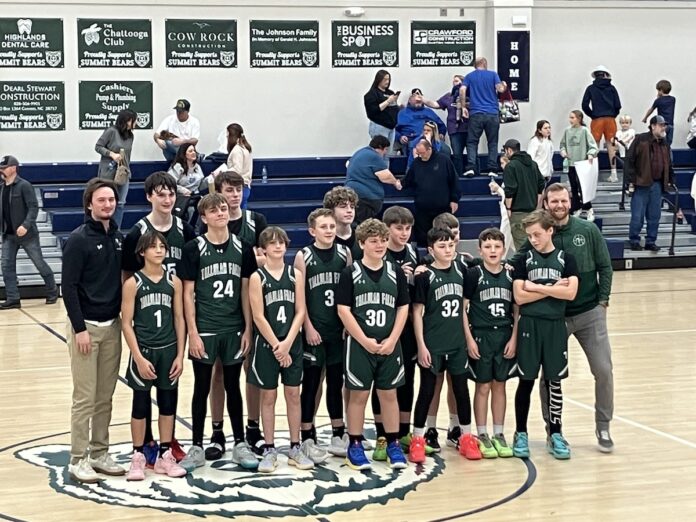
The Tallulah Falls Middle School boys basketball team claimed their second-straight Tri-State title with a win on Feb. 2, 2024, against Towns County. (TFS Athletics)

Third time’s a charm! The MS Indians secured the Tri-State Championship with a thrilling 41-37 over rivals Towns County Saturday on the road. Despite falling short against Towns twice this season, the boys came through when it mattered most. The win punctuates the season with back-to-back titles.

The Indians were behind 18-12 at the half but kept their composure and stuck to the game plan. TFS rallied to outscore Towns 29-19 in the second half on the way to the win.

“This was an overall great game to be apart of,” says coach Nathan Stanley. “The atmosphere was incredible. I am proud of the boys for staying calm and even-keeled the whole game. We stuck with our game plan, and in the end, it made the difference.”

Towns had a 2-0 advantage going into the game.

“We just knew we couldn’t go in with our backs against the wall. We shifted some things around defensively that we haven’t done all year, and that truly made the difference,” Stanley says, calling it a great win for the team and the TFS basketball program.

Brantley Addison led all scorers with 16 points after scoring two points in the first. Lincoln Hicks continued where he left off the past two weeks and went to work in the paint, putting up another big game with 11 points.

Asa Popham continued to show his awareness by distributing the ball all around the court, adding 10 points in the effort. Ethan Phasavang played one of his best games of the year, coming up with key rebounds late in the fourth quarter and invaluable leadership. Grantley Smith had probably the hardest job on the day, according to Stanley, and rose to the challenge of guarding Towns County’s leading scorer, who has been on a tear all year long.

The Indians end the season at 14-4 overall.

Lady Indians

The Lady Indians’ stellar season ended with a 36-18 loss at Summit Charter in the Tri-State Championship game on Saturday.

TFS trailed 23-7 at the half and couldn’t overcome a hot-shooting Summit team. Payton McEntire led with 14 points, and Nora Mitchell and Handley James had two apiece.

The Lady Indians close the season with an 11-8 overall record.

Bill to help Georgians with disabilities gains traction

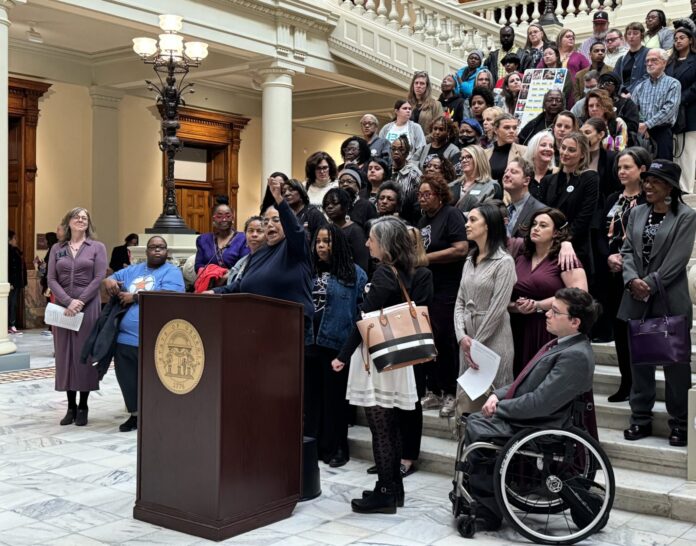
“We need to be at the table, because we are registered voters and we vote and our voices count,” Dorothy Harris, who is a self-advocate from Fitzgerald, said at a press conference held Wednesday at the state Capitol. (Jill Nolin/Georgia Recorder)

(Georgia Recorder) — Advocates are rallying behind a bipartisan proposal to create a new commission focused on Georgians with disabilities in hopes of replicating the success of a group that was behind a landmark mental health bill that passed in 2022.

That bill, sponsored by Atlanta Democratic Sen. Sally Harrell, did not gain traction last year, but it is faring better this session. It cleared a Senate committee last week with a unanimous vote.

The commission was recommended by a Senate study committee that met in 2022 to examine the demand for Medicaid services that are meant to keep people with disabilities out of institutional settings and in their homes and communities.

Supporters say the 22-member commission, made up of experts and advocates, would work to find solutions to tough long-term challenges, probing issues like housing and supportive employment with the goal of helping more people live independently and contribute to their communities.

Diane Wilush, who is president and CEO of United Cerebral Palsy of Georgia and a board member of the state association that represents providers, said the commission is also key for bringing services for people with intellectual and developmental disabilities into the 21st century.

“We operate an antiquated system. A highly complex, somewhat inefficient system. It is very challenging for families and individuals to navigate, and we surely can do better,” Wilush said.

The commission would remain in place for at least five years.

“That would give us enough time to bring the experts together, fix the problems, implement the solutions, and see some results,” Harrell said to her colleagues last week.

On Wednesday, Harrell called on the advocacy community to help keep the momentum going in hopes of soon ending the waiting list for services that has long been a perennial issue under the Gold Dome. Today, more than 7,000 people are on the list.

“We need to end the waiting list for NOW and COMP waivers once and for all. That’s now within sight,” Harrell said at a press conference held Wednesday at the state Capitol.

State revenues had surged following the pandemic, but efforts to spend more of that funding on these services have been slowed by workforce shortages that create another challenge for people with disabilities, even if they have services: finding a professional caregiver.

That’s why advocates are cheering the governor’s decision to include $79 million in next year’s budget to go toward the $107 million needed to fund a $6-per-hour raise for direct-support professionals. The rest of the money to implement the proposal will come from federal pandemic relief aid.

But they are also pushing lawmakers to approve the commission and significantly increase the funding for Medicaid services. This year’s budget included funding for 500 waivers, but as of now, the governor’s proposed spending plan for next year calls for 100 new spots.

The head of the state agency that administers the program recently outlined a plan last month to boost waiver services in the future. Kevin Tanner, the commissioner of the Department of Behavioral Health and Developmental Disabilities, said about 900 people could gain services a year if the state funds 500 new waivers, as about 400 people exit the program annually.

D’Arcy Robb, executive director of the Georgia Council on Developmental Disabilities, argues Georgia can and should move more aggressively to put an end to the waitlist. Instead, she is pushing for 2,400 waivers to be funded next year at a cost of about $65 million. That’s what the Senate study committee recommended in 2022, putting the state on track to fully fund the list in three years.

“The disability community has been underinvested in for so long. We’ve got momentum. People are starting to get what they need, and there are huge possibilities for this community. Georgia just needs to keep going,” Robb said.

Harrell said she thinks it’s reasonable to knock out the waiting list over the next five years, which would be the lifespan of the commission.

Georgia senators debate ending affiliation with American Library Association

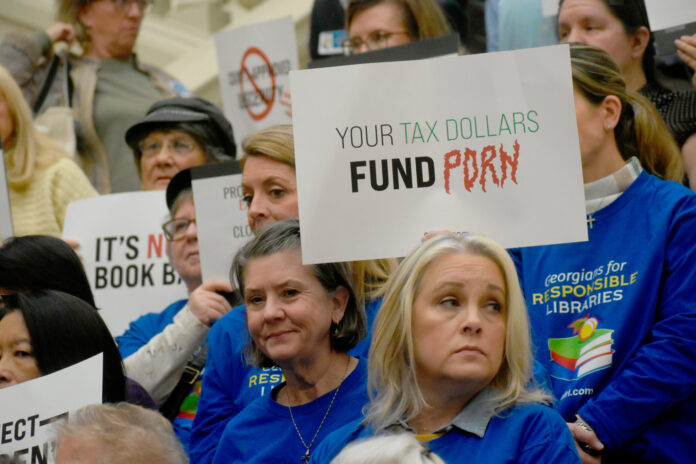
Participants in a Feb. 1 rally at the Georgia Capitol supported a suite of bills they said would remove obscenity from libraries. (Ross Williams/Georgia Recorder)

(Georgia Recorder) — Some conservative state senators want Georgia to become the latest state to pull out of the American Library Association, a nonprofit organization that supports libraries and accredits the schools that train them.

On Wednesday, the Senate Government Oversight Committee heard testimony from Georgia’s top librarian who said the Georgia Public Library Service is already not affiliated with the ALA and a dean at the state’s only university offering a graduate library studies program who said cutting ties with the only accrediting body for degree programs in library and information science could cost millions in tuition.

Under Senate Bill 390, state and local entities would be banned from spending any money on the association, and directors of public library systems would no longer be required to hold a master’s degree from a school with a library program accredited by the ALA.

Montana became the first state to cut ties with the organization after the incoming president referred to herself as a Marxist lesbian in a since-deleted tweet. Several other red states have also withdrawn, with Alabama the latest to join late last month.

Sen. Larry Walker, a Perry Republican, said the genesis for his bill came when his local library accepted an ALA grant for books featuring LGBTQ and diversity as topics, some of which were for the children’s section.

“This, of course, caused some outrage by some members of the local library board when they fully understood the grant after it had already been done, and I was contacted by some citizens, and I went and met with the Houston County Library Board at their regular meeting and expressed my concern and felt like that that was not a reflection of the morals and values of our community and was not appropriate, especially in the children’s section,” he said.

“I thought I would be met with kind of an apology or ‘Oh, we didn’t mean to do this,’ or ‘We won’t do this again,’ or ‘Yes, we’ll segregate this material,’ or ‘We should have thought through this,’ but instead it’s really kind of met with sort of defiance and ‘We need more diversity in our library materials’ and that kind of thing,” he added.


Committee Chair Sen. Marty Harbin, a Tyrone Republican, asked whether the material would violate local obscenity laws.

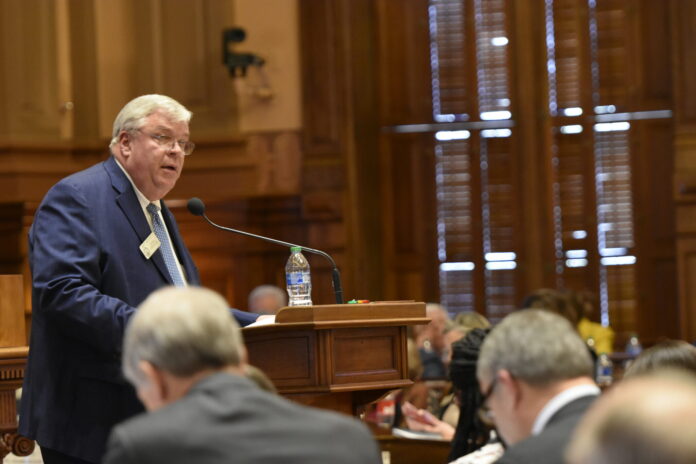
Sen. Larry Walker introduces his bill to withdraw from the American Library Association. (Ross Williams/Georgia Recorder)

“I didn’t see any of the material,” Walker said. “But to me, at some point, a young person does need to be educated on LGBTQ and sexuality and all of that. But I think it’s up to the parents what the appropriate age is to have that conversation. And I don’t want my wife as a grandmother to have a 5-year-old or 6-year-old looking at this kind of material that could be considered pornographic by some people.”

Georgia’s State Librarian, Julie Walker, who is also vice chancellor for libraries and archives in the University System of Georgia, said many library professionals in Georgia don’t agree with the ALA’s positions and libraries’ decisions about collections made at the local level.

She also said the Georgia Public Library Service, unlike its equivalents in other states that ended their membership of the ALA, is already not a member of the ALA.

As the only body that accredits degree programs in library and information science, the ALA is responsible for Valdosta State’s accreditation, but that’s the case even in states that have revoked their affiliation, she said.

“Those states have disaffiliated from ALA, which basically means that the agency similar to my agency has dropped their membership, but they don’t have any legislation currently dealing with ALA, and their accreditation, their library schools are still accredited by ALA, no one has dropped that accreditation.”

David Slykhuis, dean of the James L. and Dorothy H. Dewar College of Education at Valdosta State University, home of Georgia’s only graduate library studies program, said many of the program’s 400 students chose Valdosta because of its accreditation. He said most libraries will only hire people with degrees from accredited programs.

“Losing accreditation would eliminate Valdosta State as a viable (Master of Library and Information Science) degree program for most students,” he said. “The loss of the ability to remain accredited would devastate a program that is bringing in over $3.5 million in tuition revenue to Valdosta State annually. Until another accrediting body can be found or formed, I respectfully ask the bill sponsor and committee for consideration to be able to use privately donated funds to continue our accreditation, at least through our currently approved cycle of 2028.”

Slykhuis said accreditation with ALA costs Valdosta State $1,100 each year.

“I believe Sen. Walker has brought a bill that is needed but needs maybe a little bit of work,” Harbin said.

Speaking to the Recorder after the hearing, Walker said he hopes the bill’s final version will prevent taxpayer dollars from going to the ALA while protecting Valdosta State’s bottom line, and he’s confident he can get that done by Feb. 29, the last day for bills to easily move from one chamber to the other.

“It could be as much as just putting a delayed effective date on the accreditation part,” he said. “You know, right now, the bill as written would go into effect July 1, 2025. I purposely put it out there a little ways already so that people that were currently in the system would have time to react, but we may want to push that out a little bit further.”

“The other thing is maybe we can put some language in there to allow Valdosta State to pay their accreditation fee to ALA with private funds through their foundation because I think they testified it was only $1,100 a year,” he added.

He also said he’s hopeful another accrediting body will materialize soon.

Separately, Gwinnett Republican Sen. Clint Dixon has sponsored SB 394, which aims to bar school libraries from distributing materials deemed “harmful to minors,” require parental consent for children to check out some items, and mandate school systems to only buy books from vendors who use a rating system.

Another proposed Senate bill, SB 154, would remove an exemption for school libraries in the state law against distributing harmful materials to minors, a move librarians say could land them behind bars for doing their jobs.

Bookman: As Georgia hands out big tax breaks, state leaders flunk Medicaid expansion math

According to the author, Medicaid expansion could deliver billions in federal money to Georgia that among other things would help save struggling rural hospitals that are the economic and medical lifelines of their communities. Cuthbert’s hospital closed in 2020. (Jill Nolin/Georgia Recorder)

There is no cogent economic, political, practical or moral justification for the state of Georgia to continue to reject expansion of Medicaid.

There are no more lame excuses, no more what-ifs or just-supposes. There is only cruel obstinance.

Forty states have implemented the program, bringing health care to hundreds of thousands of their citizens and billions of federal dollars to their communities; only 10, including Georgia, continue to balk.

We’ve been told for a decade or more that Georgia couldn’t afford it, yet much poorer states such as Arkansas and West Virginia have managed to swing the expense, and our state’s coffers are now brimming with a $6 billion surplus. We can afford it.

Last year alone, we could afford to give tax subsidies to the film industry worth $1.3 billion, which, according to a state audit, generates less than 20 cents on the dollar in additional state revenue. We could afford to give Rivian $1.5 billion in state and local tax subsidies for its electric-vehicle plant. But we supposedly cannot afford $350 million to cover the state’s share of Medicaid expansion, even though it will bring back literally ten times that much in federal money and provide health insurance for almost half a million Georgians who today have no coverage.

That’s $3.6 billion in federal money left on the table by Georgia each and every year, money that, among other things, would help save struggling rural hospitals that are the economic and medical lifelines of their communities. Think of the lives that could have been saved and improved, the pain and illness eased over that time, but were not.

Over the years, we’ve also been warned that Obamacare would turn out to be a disaster, that it would be repealed and leave the state holding the bag. Well, that didn’t happen and isn’t going to happen. Some 40 million Americans now use Obamacare to provide health insurance, and for the most part, they’re happy with it. In a poll last year for the Kaiser Family Foundation, 59% of American adults reported having a favorable opinion of Obamacare. These days, getting 59% of Americans to agree in support of anything is a minor miracle. And when Donald Trump recently issued a call for repeal of Obamacare should he win election, the response from his usually cult-like fellow Republicans was silence. They wanted no part of that argument.

In other words, like Medicare and Social Security, Obamacare is here to stay.

We also know that none of the 40 states that have expanded Medicaid has become the boiling cesspool of socialism predicted by Obamacare’s opponents. There are no “death panels,” no “death spiral” of costs, and most participating states have cut their uninsured population by at least half.

And what about Georgia and the other nine states that still refuse to participate?

Eight of those 10 states, including Georgia, have life expectancies below the national average.

Nine of the 10 have maternal mortality rates well above the national average, which is tragic because experts say 80% of such deaths are preventable. (Georgia has the nation’s seventh-highest rate of maternal death.)

Nine of the 10 states that haven’t expanded Medicaid, including Georgia, have higher-than-average rates of premature death, meaning people who die before reaching age 75.

Most states that have rejected expansion, including Georgia, have higher-than-average rates of infant mortality. (According to the Centers for Disease Control and Prevention, Georgia was one of just five states in which infant mortality rose significantly from 2021 to 2022.)

Of the 10 states with the highest rates of uninsured, eight have rejected Medicaid expansion. (Georgia has the nation’s third-highest rate of uninsured.)

Confronted with such overwhelming evidence, Georgia Republicans offer no real explanation or justification for their stubborn refusal to help their own constituents.

They offer none because none exists. As in most other states that have refused expansion, they are captives to an archaic mindset that still sees working people not as human beings with human needs but as units of production that must be kept lean and uncertain to guarantee maximum economic efficiency.

U.S. Senate kills immigration overhaul, hits stalemate on Israel, Ukraine aid

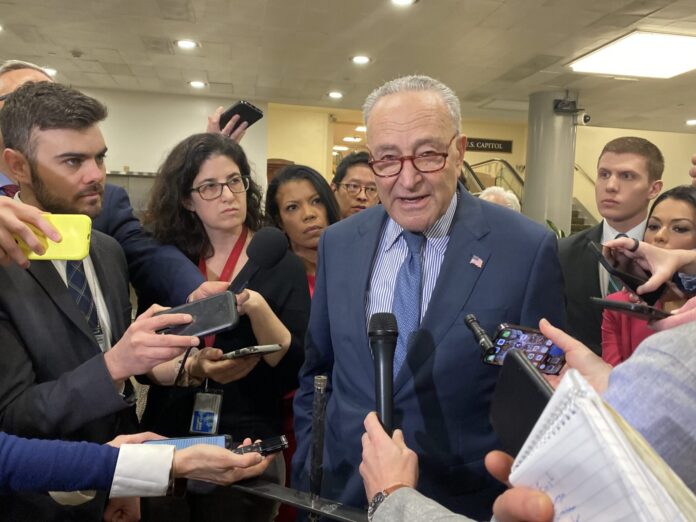
Senate Majority Leader Chuck Schumer, a New York Democrat, speaks with reporters in the basement of the U.S. Capitol on Wednesday, Feb. 7, 2024. (Jennifer Shutt/States Newsroom)

WASHINGTON (States Newsroom) — The U.S. Senate was stuck over whether to begin debate on an emergency spending bill Wednesday night that would provide $95.3 billion in assistance to Ukraine, Israel, and Taiwan — after senators blocked a sweeping larger package that would have overhauled immigration law for the first time in decades.

Republicans said last year that in order to get their support for military and humanitarian assistance to Ukraine, Israel, and Taiwan, they also needed Democrats to broker a deal on changes to immigration law.

GOP leaders, however, rejected that deal after it was released Sunday, leading Democrats to instead back separate assistance for the trio.

The global-aid-only alternative remained on hold Wednesday evening as Republicans and Democrats attempted to broker agreement over amendments.

Texas Republican Sen. John Cornyn said GOP senators still want to address border security and immigration law despite rejecting the package that included those provisions.

“Well, our side is not willing to give up the border fight. So some relating to the border,” Cornyn said.

Republicans are also hoping to get votes on amendments clarifying exactly who gets access to U.S. foreign assistance.

“I think possibly some related to the way the Ukraine money and the Israel money is distributed, some concerns about who might get their hands on it,” Cornyn said.

Senate Minority Whip John Thune, a South Dakota Republican, said before leaving the Capitol on Wednesday evening there are a lot of undecided issues.

“Well, those are all really good questions, and none of which have good answers at the moment,” Thune said.

Immigration deal cast aside

Senate Minority Leader Mitch McConnell had announced Tuesday that the immigration elements of the larger bill were unlikely to get enough support to become law after strong objections from Republicans and pressed for assistance for Ukraine, Israel, and Taiwan to move forward on its own.

Senators still took a procedural vote on whether to advance the bill that included the long-anticipated immigration overhaul, but it failed, 49-50. Sixty votes were needed for it to continue to move ahead, so it fell far short.

Oklahoma Republican Sen. James Lankford, Connecticut Democratic Sen. Chris Murphy, and Arizona independent Sen. Kyrsten Sinema spent the last four months negotiating the changes to immigration law that were scrapped within two days of the bill’s release.

Senate passage of the slimmed-down bill could come after an amendment process that Senate Majority Leader Chuck Schumer said Wednesday morning would be “open and fair.”

The New York Democrat also urged Republican leaders in the House to put the bill up for debate in that chamber should it pass the Senate.

“It doesn’t behoove the speaker well to block everything because 30 hard-right-wing people just want chaos like Donald Trump,” Schumer said.

It was not clear whether that would happen. The GOP-controlled House on Tuesday night failed to pass a standalone bill with $17 billion in aid for Israel.

House GOP leaders had also expressed strong opposition to the combined Senate immigration-global aid deal and said they would not bring it up for debate, adding more fuel to the opposition that torpedoed the package.

The former president, the front-runner for the GOP presidential nomination, has pressed hard for Republicans to reject immigration legislation.

Johnson: ‘A mess what happened here’

Speaker Mike Johnson, a Louisiana Republican, said Wednesday he would wait to see what the Senate can pass before deciding what he might bring to the floor next in that chamber.

“We’re allowing the process to play out and we’ll handle it as it is sent over,” Johnson said. “I have made very clear that you have to address these issues on their own merits.”

Johnson appeared to press for standalone aid to Israel, even though the House was unable to pass its Israel bill this week.

“Israel desperately needs the assistance, everyone knows that,” Johnson said. “Things have changed pretty dramatically since we passed that first Israel package in the House three months ago. Everyone knows the tensions escalated and we need to support it.”

Johnson also sought to rebuff criticism from some fellow Republicans that his inexperience is one of the reasons the House spectacularly failed to pass the Israel bill as well as two articles of impeachment against Homeland Security Secretary Alejandro Mayorkas on Tuesday night.

“It was a mess what happened here, but we’re cleaning it up,” Johnson said. “I don’t think that this is a reflection on the leader; it’s a reflection on the body itself and the place where we’ve come in this country.”

While the process is “messy sometimes,” Johnson said, “the job will be done.”

Fentanyl bill backed by Jelly Roll included

The Biden administration said Wednesday it supports Congress moving forward with legislation providing assistance to Ukraine, Israel and Taiwan while leaving off changes to immigration law.

“We support this bill which would protect America’s national security interests by stopping Putin’s onslaught in Ukraine before he turns to other countries, helping Israel defend itself against Hamas terrorists and delivering life-saving humanitarian aid to innocent Palestinian civilians,” said White House deputy press secretary Andrew Bates.

“Even if some congressional Republicans’ commitment to border security hinges on politics, President Biden’s does not,” Bates added. “We must still have reforms and more resources to secure the border. These priorities all have strong bipartisan support across the country.”

The revised bill the Senate could begin debating soon would provide more than $60 billion in assistance for Ukraine, $14 billion for Israel, and $9 billion for humanitarian aid in Ukraine, Gaza, the West Bank, East Africa, South Asia, and elsewhere, and $4.8 billion for “regional partners” in the Indo-Pacific region that would include Taiwan.

An additional $2.4 billion would go to U.S. Central Command “to replace combat expenditures for weapons in the Red Sea,” according to a summary of the bill. 

The package also includes the Fentanyl Eradication and Narcotics Deterrence or Fend Off Fentanyl Act, a bipartisan bill from Ohio Democratic Sen. Sherrod Brown and South Carolina Republican Sen. Tim Scott.

Country music star Jason “Jelly Roll” DeFord advocated for Congress to pass legislation to address both the supply and the demand for fentanyl during a hearing in January.

Lankford: ‘We have to sit down together’

During debate on Wednesday, senators involved in negotiations or writing the broader bill that included changes to immigration law urged their colleagues to support the bipartisan compromise.

Lankford called on his colleagues to do something to address the nation’s border security and immigration laws, noting that neither party has the support to go at it alone on legislation.

“This very divided nation brings to us a very divided Congress,” Lankford said. “Currently, we have a Republican two-vote majority in the House of Representatives and a Democratic one-vote majority in the United States Senate. It doesn’t get much closer than that.”

“That means if we’re going to solve something, we have to sit down together and solve it. That’s how it works when you make law,” Lankford added. “You can do press conferences without the other side, but you can’t make law without the other side in the United States Senate.”

The Oklahoma Republican detailed the border security and immigration measures he and his two fellow negotiators agreed on following complex talks over several months.

He said that some Republicans voted against advancing the bill with border and immigration changes because they wanted more time to read it, that others voted no because they had policy differences, and that some voted no due to political disagreements.

“Some of them have been very clear with me; they have political differences with the bill,” Lankford said. “They say it’s the wrong time to solve the problem or let the presidential election solve this problem.”

There was a “popular commentator” who told Lankford four weeks ago that if he reached a bipartisan agreement to address border security and immigration law during an election year the commentator would do whatever they could “to destroy” Lankford.

“By the way, they have been faithful to their promise and have done everything they can to destroy me in the past several weeks,” Lankford said without disclosing the name of the commentator.

Sinema: Border security became ‘a talking point for the election’

Sinema said she, Lankford, and Murphy worked through weekends and holidays for months, “negotiating in good faith” to reach a compromise on border security and immigration.

“We produced a bill that finally, after decades of all talk and no action, secures the border and solves the border crisis,” Sinema said. “Our bill was ready for prime time, we were ready to bring the bill to the floor, open it up for debate and amendments. You know, how the Senate is supposed to work.”

“But less than 24 hours after we released the bill, my Republican colleagues changed their minds — turns out they want all talk and no action,” Sinema added. “It turns out border security is not actually a risk to our national security. It’s just a talking point for the election.”

Sinema said she had a “very clear message for anyone using the southern border for staged political events.”

“Don’t come to Arizona; take your political theater to Texas,” she said.

Murray: GOP telling allies ‘our word can’t be trusted’

Senate Appropriations Chair Patty Murray, a Washington state Democrat, urged Republicans to take the issues in the bills seriously and not as a “game,” pointing to the wars in Ukraine and Israel, as well as the Southwest border.

“By voting it down, Republicans will be telling our allies our word cannot be trusted. Telling dictators, like Putin, that our threats are not serious, telling the world American leadership has been hollowed out by Republican obstructionism,” Murray said.

“And let’s be clear, they will be telling the American people they don’t want to solve the crisis at the border, they want to campaign on it,” Murray added. “Because if you genuinely believe something is a crisis you take any step you can to address it, you don’t let a fire burn because Donald Trump wants to campaign on ashes.”

 Ariana Figueroa contributed to this report.

Georgia House backs midyear budget with money for behavioral health, elections

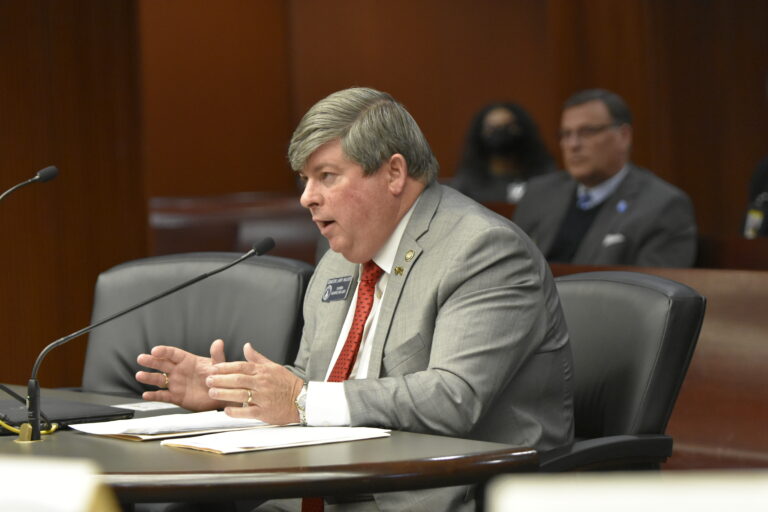
Rep. Matt Hatchett, a Dublin Republican who chairs the House Appropriations Committee, pushed back on changes the governor made to the budget after lawmakers left town last year. (Ross Williams/Georgia Recorder)

(Georgia Recorder) — House lawmakers signed off on the governor’s plan to inject nearly $2 billion in one-time cash into the budget while boosting spending on behavioral health services, election administration, and the state’s prisons.

But they didn’t do so without first acknowledging the long list of legislative changes that were undone with the stroke of the governor’s pen last year. Concerned about a potential economic downturn, Gov. Brian Kemp directed state agencies to disregard more than 130 budget line items that totaled more than $200 million.

Some of the lawmakers’ spending priorities, like hiring additional staff for the Georgia Bureau of Investigation’s crime lab to help address a backlog, were later funded or repurposed. Others are being restored now as lawmakers comb through the governor’s proposed revisions for this year’s budget, which runs through the end of June.

But some of their spurned spending priorities will have to wait for the next budget, said Rep. Matt Hatchett, a Dublin Republican who is the chamber’s top budget writer.

“We are the appropriators,” Hatchett said Wednesday. “And we absolutely have the authority under the Georgia Constitution in setting policy in this state, and the budget is the most direct way we do that.

“We will continue to use the budget in FY 25 to reflect and restate the priorities of this house and the people we represent,” he added.

Kemp unveiled his spending plans last month, calling for pay boosts for teachers, police officers, and other state employees and proposing to spend $1.9 billion of the $11 billion undesignated surplus on one-time projects. The state also has $5 billion socked away in a rainy-day fund.

The governor has proposed a $37.5 billion amended budget for the current year, which is a $5 billion spending jump from the original budget. But he has proposed a $36.1 billion spending plan for the new budget year that starts in July, citing signs of a revenue slowdown.

“You can do a lot of good with $5 billion,” Hatchett said, referring to the governor’s multibillion infusion into the current budget. “Not every item in this budget is glamorous but I can tell you that it’s needed.”

The governor sets the spending level for the budgets, so lawmakers can only move money around in the budget. But even with those constraints on spending, lawmakers find ways to leave their mark.

For example, the continued sharp decline in Medicaid enrollment because of the end to pandemic-era federal protection of health care coverage freed up another $28 million in state funds for lawmakers to allocate. All said, Georgia is set to spend $181 million less on Medicaid this year while also losing hundreds of millions of dollars more in matching federal funds.

As for new spending, House lawmakers shifted more money toward the state Department of Behavioral Health and Developmental Disabilities. Specifically, $2 million will fund a pilot program to test transportation alternatives for people having a mental health crisis as well as $664,000 for an additional 30-bed jail-based competency restoration project in Dodge County and $500,000 to expand mental health services in Warner Robins.

The House proposal puts $5 million toward third-party ballot-text auditing technology to sidestep the QR codes that have become controversial and $110,000 to add watermarks to all paper ballots, which supporters say is designed to improve election security. The House has already passed a bill that would require the watermark on ballots.

Another $1.7 million would cover the cost of postage to inform voters of their new precinct after last year’s court-ordered redistricting do-over.

And House lawmakers added another $4 million to a pilot project to disable cell phones that are snuck into the state’s prisons, bringing the total for that effort up to nearly $10 million. That project will initially focus on the four prisons where the contraband cell phone problem is the worst.

“We’re going to do a test this year to see if we can shut that down but it’s pretty expensive,” Rep. Bill Hitchens, a Rincon Republican who chairs the budget subcommittee focused on public safety, said Tuesday.

The amended budget easily cleared the House Wednesday with a 161-to-2 vote and now moves over to the Senate for more changes.

Krockum retires from Demorest PD; Chastain named new police chief

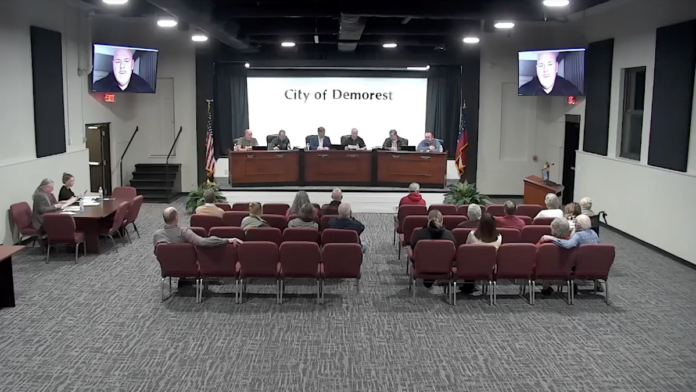
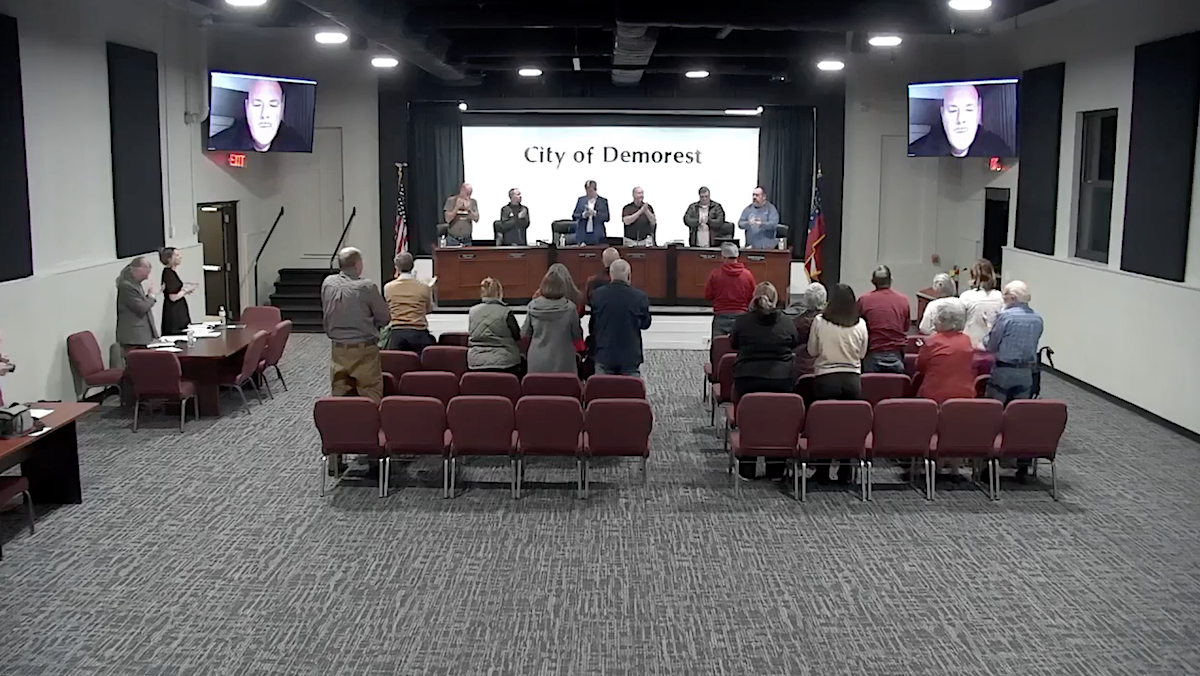
Demorest Police Chief Robin Krockum, seen here on the TV monitors, listens as Demorest City Manager Mark Musselwhite reads his resignation letter aloud. Krockum is resigning effective March 1, ahead of qualifying for sheriff. (livestream image)

Demorest is losing its top cop effective March 1. Police Chief Robin Krockum is retiring to run for Habersham County sheriff.

Krockum, who has served as Demorest’s police chief since 2016, wrote a letter advising city leaders of his decision last Friday, Feb. 2. City Manager Mark Musselwhite read the letter aloud at Tuesday night’s city council meeting. The departing police chief listened in from another location after joining the meeting virtually.

While Krockum referred to it as his “resignation/retirement” letter, Musselwhite made clear the city is “going with retirement.”

READ Krockum’s retirement letter

A ‘new chapter’

In the letter, Krockum expressed his “heartfelt gratitude and respect” for Demorest, where he has spent the bulk of his nearly 30-year law enforcement career.

“My last day with the city will be March 1, 2024,” he wrote, ahead of confirming his plans to run for countywide office. “I plan to qualify for the position of Sheriff in the upcoming primary election. I hope to continue with my career in law enforcement as I start this new chapter in my life.”

After reading the letter, Musselwhite said, “It was tough to receive that letter last Friday, even though we’ve all known for some time that this day was coming.”

Krockum responded, “It was tough to send it, too.”

Outgoing Demorest Police Chief Robin Krockum receives a standing ovation for his many years of service during the Feb. 6, 2024, Demorest City Council meeting. (livestream image)

In December 2022, Chief Krockum announced his intentions to run for sheriff after Joey Terrell announced he would not seek reelection. The city of Demorest is planning a retirement party for Krockum on March 1, with details still to be worked out.

“It will be a tough day,” said Musselwhite before adding, “Robin, we appreciate all your service. It’s been tremendous. I’ve got a great friend in you since I’ve known you.”

Jerry Harkness pointed out he was a kid when Krockum started with the Demorest Police Department in the late 1990s. He’s now the city’s mayor.

“I appreciate your focus on education, on professionalism, and leadership,” Mayor Harkness said. “So, thank you very much for serving the city.”

Chastain named new chief

Although he has planned for his departure from Demorest PD for more than a year, Krockum told the city council, “It wasn’t easy. Like my letter said, it’s nervous excitement. Sometimes you gotta have faith.” He added, “It’s a big step for me. Hopefully, if everything works out, I’ll just be up the street from you.”

Demorest Councilmember Shawn Allen led the city council and audience in a round of applause for Krockum. They gave him a standing ovation.

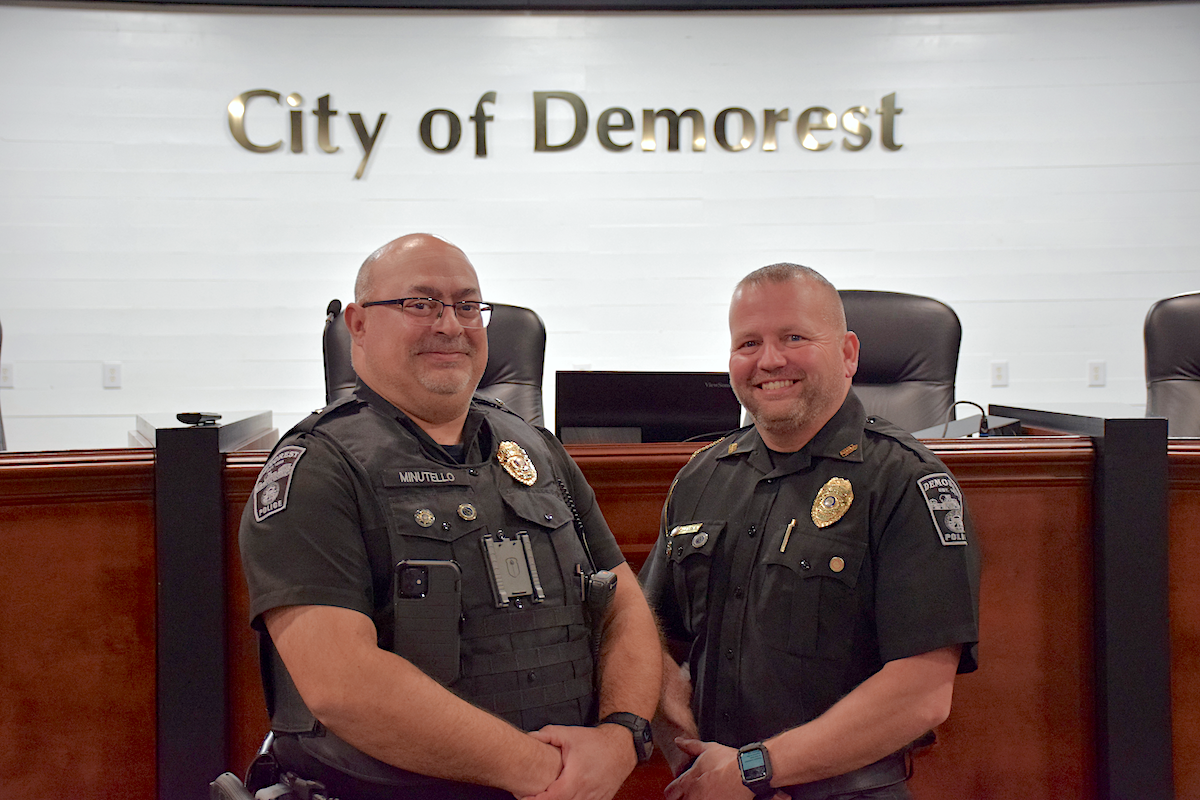
James Minutello (left) and Casey Chastain. Chastain will become the next Demorest Police Chief, and Minutello will become the Assistant Police Chief on March 1. (Jerry Neace/NowHabersham.com)

After the city council unanimously voted to accept Krockum’s retirement, Musselwhite recommended appointing Assistant Police Chief Casey Chastain to succeed him. The council unanimously approved that recommendation. Chastain will be sworn in as Demorest Police Chief on March 1. Officer James Minutello will become the new assistant chief at that time.

“I’m proud for Casey. I know he will do a great job,” Krockum said.

The city council will hold a public pinning ceremony for Chastain during the council’s regular monthly meeting on Tuesday, March 5.