Home Blog Page 989

Space heater may be to blame for Banks County fire

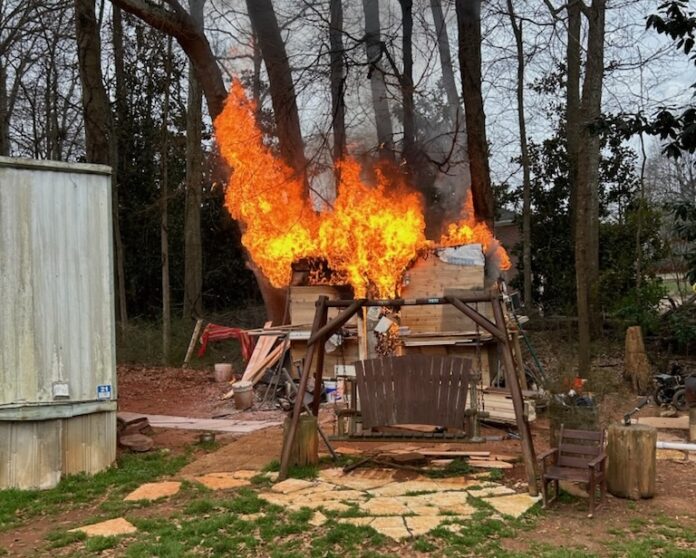
An outbuilding that was used as a residence burned to the ground Friday in Banks County. The blaze broke out shortly after 2:30 p.m. at 100 Cranes Mobile Home Park. 

An outbuilding that was used as a residence burned to the ground Friday in Banks County. The blaze broke out shortly after 2:30 p.m. at 100 Cranes Mobile Home Park.

Firefighters arrived at the scene to find the 100-square-foot structure fully involved in fire. Banks County Fire Chief Steve Nichols says someone was living in the structure but no one was injured. The building was a total loss.

Chief Nichols says the cause of the fire is under investigation, but officials could not rule out the possibility it was accidentally started by a space heater.

2-state drug investigation nets 6 arrests, $340,000 of meth in Athens

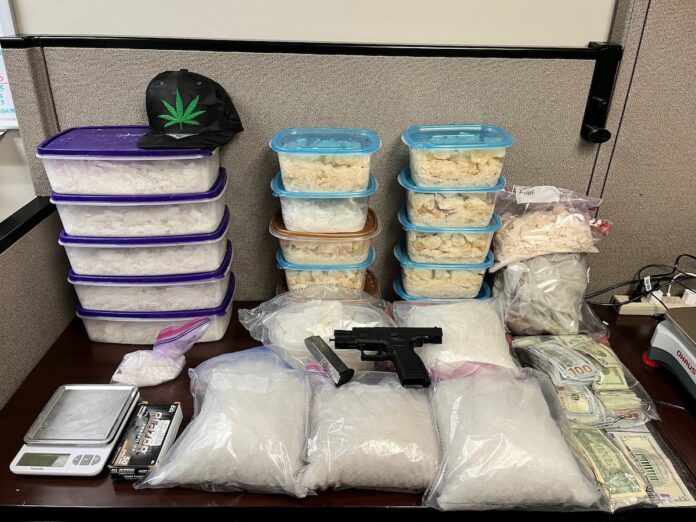
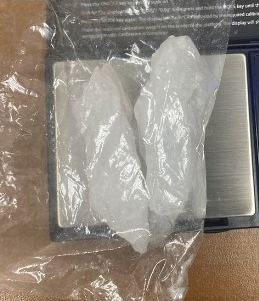
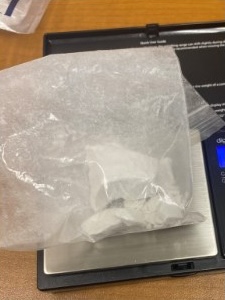
Agents say they seized methamphetamine, cash, and a gun during their search of two trailer parks in Clarke County. (Athens-Clarke County Police Dept. photo)

A drug investigation in Athens led to the recent arrests of six people from Georgia and South Carolina. All of them are charged with trafficking methamphetamine, the Athens-Clarke County Police Department (ACPD) said in a news release.

ACPD said the “lengthy operation” culminated with agents executing search warrants at two trailer parks in Clarke County. Authorities say they seized 39 kilograms of methamphetamine during searches at Hallmark trailer park on Spring Valley Road and Pinewood Estates North trailer park on US Highway 29 North. They also recovered a 9mm handgun and approximately $32,000 in cash.

The operation was carried out by the Northeast Georgia Regional Drug Task Force and a half dozen other law agencies, including the Aiken County, South Carolina, Sheriff’s Office.

Police identified the suspects as Bryant McLaughlin of Dillon, SC; Sammy Fleming of Eastover, SC; Charles Armstrong of Loganville, GA; David Glaze of Monroe, GA; Edgar Garcia-Hernandez of Athens, GA; and Jose Macias Garcia of Athens, GA.

All of them were booked at the Clarke County Jail.

ACPD assisted with the operation, along with the sheriff’s offices in Clarke, Greene, Oglethorpe, and Walton counties.

Five big takeaways from the special counsel’s report on Biden and classified documents

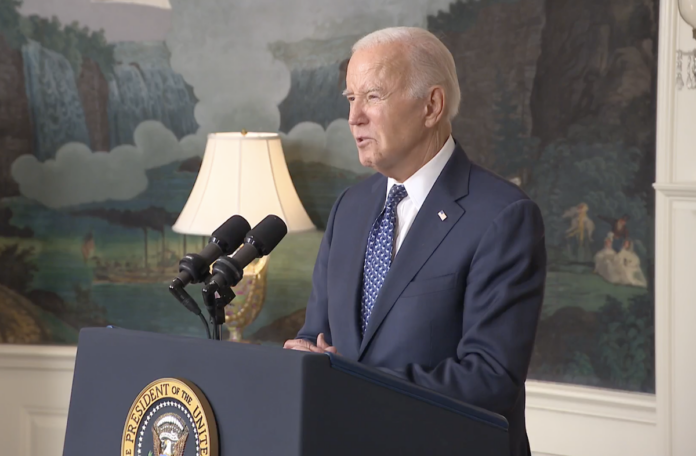
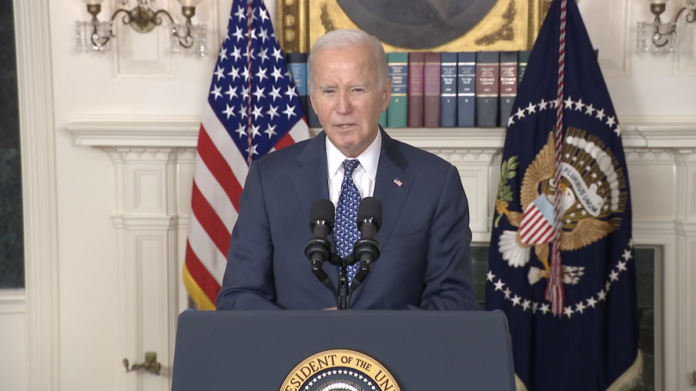
President Joe Biden delivers remarks in the Diplomatic Reception Room of the White House on February 8, 2024 in Washington, DC. Biden addressed the Special Counsel’s report on his handling of classified material, and the status of the war in Gaza. (livestream image)

WASHINGTON (States Newsroom) — Special Counsel Robert Hur’s nearly 400-page report on the classified documents that President Joe Biden kept after leaving office includes new details on why it’s become commonplace for politicians to end up with sensitive information after they leave their posts.

The report also sheds light on why Biden, then a former vice president, shared private information with a ghostwriter. This practice has become ubiquitous for high-profile individuals who want to publish a book without actually writing it themselves.

In total, the report includes an executive summary, 17 chapters, a conclusion and three appendices, covering a total of 388 pages. U.S. Attorney General Merrick Garland announced Hur as the special counsel in January 2023; Trump had appointed Hur to lead the prosecutor’s office in Maryland in 2018. He left in 2021 to join the Gibson, Dunn & Crutcher law firm.

Hur declined to recommend criminal charges for Biden. But there are a lot of new details, including about Biden’s memory, that grabbed headlines, so here’s a breakdown of five key points in the report:

READ Full DOJ report here

Biden’s memory and ‘superfluous’ commentary

The Hur report says one of the reasons prosecutors didn’t bring charges against Biden was that they believed Biden “would likely present himself to a jury, as he did during our interview of him, as a sympathetic, well-meaning, elderly man with a poor memory.”

Lower in the report, it says that during an interview with the special counsel, Biden “did not remember when he was vice president” and that he “did not remember, even within several years, when his son Beau died.”

“And his memory appeared hazy when describing the Afghanistan debate that was once so important to him,” the report said.

Biden, at a press conference on Thursday night, strongly objected to the assertion he could not remember the date of Beau’s death. “There’s even a reference that I don’t remember when my son died,” said Biden. “How in the hell dare he raise that. Frankly, when I was asked the question, I thought to myself it wasn’t any of their damn business.”

Special Counsel to the President Richard Sauber and Bob Bauer, personal counsel to Biden, vehemently rejected all characterizations of Biden’s memory loss in a letter to the special counsel, urging him to amend the report before releasing it publicly.

“We do not believe that the report’s treatment of President Biden’s memory is accurate or appropriate,” they wrote. “The report uses highly prejudicial language to describe a commonplace occurrence among witnesses: a lack of recall of years-old events. Such comments have no place in a Department of Justice report, particularly one that in the first paragraph announces that no criminal charges are ‘warranted’ and that ‘the evidence does not establish Mr. Biden’s guilt.’”

Hur also wrote that Biden’s “inability to recall dates or details of events that happened years ago is neither surprising nor unusual, especially given that many questions asked him to recall the particulars of staff work to pack, ship, and store materials and furniture in the course of moves between residences.”

“The same predictable memory loss occurred with other witnesses in this investigation,” the two Biden lawyers wrote. “Yet unlike your treatment of President Biden, your report accepts other witnesses’ memory loss as completely understandable given the passage of time.”

Ronald Reagan and precedent for holding onto classified materials after leaving office

Biden is far from the first former executive branch official to keep hold of classified or sensitive materials after leaving office instead of transferring those documents to the National Archives, according to the report.

The report says the “clearest example” is former President Ronald Reagan, a Republican who held the Oval Office from 1981 through 1989.

Reagan, the report says, left the White House “with eight years’ worth of handwritten diaries, which he appears to have kept at his California home even though they contained Top Secret information.”

“During criminal litigation involving a former Reagan administration official in 1989 and 1990, the Department of Justice stated in public court filings that the ‘currently classified’ diaries were Mr. Reagan’s ‘personal records,’” the report says. “Yet we know of no steps the Department or other agencies took to investigate Mr. Reagan for mishandling classified information or to retrieve or secure his diaries. Most jurors would likely find evidence of this precedent and Mr. Biden’s claimed reliance on it, which we expect would be admitted at trial, to be compelling evidence that Mr. Biden did not act willfully.”

The report goes on to say that historically, “many former presidents and vice presidents have knowingly taken home sensitive materials related to national security from their administrations without being charged with crimes.”

Biden sought to point this out during interviews with the special counsel.

“During our interview of him, Mr. Biden was emphatic, declaring that his notebooks are ‘my property’ and that ‘every president before me has done the exact same thing,’ that is, kept handwritten classified materials after leaving office,” the report says. “He also cited the diaries that President Reagan kept in his private home after leaving office, noting that they included classified information.”

Biden’s conversations with his ghostwriter

The report talks frequently about Biden’s use of a ghostwriter, including what information Biden shared with him and comments the president made about having classified information after leaving office.

Mr. Biden wrote down obviously sensitive information discussed during intelligence briefings with President Obama and meetings in the White House Situation Room about matters of national security and military and foreign policy,” the report says. “And while reading his notebook entries aloud during meetings with his ghostwriter, Mr. Biden sometimes skipped over presumptively classified material and warned his ghostwriter the entries might be classified, but at least three times Mr. Biden read from classified entries aloud to his ghostwriter nearly verbatim.”

The report says Biden viewed his notebooks as “highly private and valued possessions with which he was unwilling to part.”

“The practices of retaining classified material in unsecured locations and reading classified material to one’s ghostwriter present serious risks to national security, given the vulnerability of extraordinarily sensitive information to loss or compromise to America’s adversaries,” the report says. “The Department routinely highlights such risks when pursuing classified mishandling prosecutions. But addressing those risks through criminal charges, the only means available to this office is not the proper remedy here.”

Deleted then partially recovered evidence

The report also notes that the ghostwriter, identified as Mark Zwonitzer, deleted recordings of conversations with Biden after learning a special counsel was appointed in the case.

“After telling the Special Counsel’s Office what he had done, the ghostwriter turned over his computer and external hard drive and consented to their search,” the report says. “Based on the FBI’s analysis, it appears the FBI recovered all deleted audio files relating to the memoir, though portions of a few of the files appear to be missing, which is possible when forensic tools are used to recover deleted files.”

The ghostwriter didn’t delete “near-verbatim transcripts of the recordings” and did share those with the special counsel, according to the report.

“In his interviews, the ghostwriter offered plausible, innocent reasons for why he deleted the recordings,” the report says. “He also preserved his transcripts that contain some of the most incriminating information against Mr. Biden — including his statement about finding ‘all the classified stuff downstairs’ in 2017 — which is inconsistent with an intent to impede an investigation by destroying evidence. And the ghostwriter voluntarily produced to investigators his notes and the devices from which the recordings were recovered.”

Documents found near dog bed, Zappos box

Appendix A, toward the bottom of the report, describes all the documents found in Biden’s office or home, including their classification levels. It spans 22 pages.

The items included a top-secret document “discussing issues related to Russian aggression toward Ukraine” that was attached to a memo from 2014, a 2009 document from the Office of the Director of National Intelligence detailing topics related to the war in Afghanistan, numerous biographies of unidentified members of “a foreign delegation” and PowerPoint slides detailing options for “the distribution and composition of U.S. forces in Afghanistan after 2014.”

Appendix B details whether certain handwritten materials or notebook entries included classified information. That spans five pages.

Those entries included a 2011 note about a Situation Room meeting with then-President Barack Obama on Afghanistan and Pakistan, a 2014 note about unmanned aerial systems, a 2015 meeting with John Kerry on a “foreign adversary,” and a 2016 entry on counterterrorism discussions.

Documents related to Afghanistan were found in “Biden’s Delaware home: in a badly damaged box in the garage, near a collapsed dog crate, a dog bed, a Zappos box, an empty bucket, a broken lamp wrapped with duct tape, potting soil, and synthetic firewood,” according to the report.

“A reasonable juror could conclude that this is not where a person intentionally stores what he supposedly considers to be important classified documents, critical to his legacy,” the report says. “Rather, it looks more like a place a person stores classified documents he has forgotten about or is unaware of.”

“We have considered —- and investigated —- the possibility that the box was intentionally placed in the garage to make it appear to be there by mistake, but the evidence does not support that conclusion.”

$100,000 reward offered in Jackson County cold case

Josh Adams of Jackson County, Ga., was last seen on May 20, 2013. (Bring Josh Home/Facebook)

A $100,000 reward is being offered for information in the 2013 disappearance of a Jackson County man whose case remains unsolved.

Joshua “Josh” Adams was last seen on May 20, 2013. He was 25 years old at the time.

Adams’ sister announced the reward on social media on Feb. 8, hoping to revive interest in the case and get some answers.

“The reward is being offered to anyone that provides information that leads to the arrest and conviction of the person or persons involved in his disappearance and his discovery,” Shannon Adams Burrell posted.

Burrell noted her brother “had his struggles.” He had completed a six-week rehab in Michigan two weeks before his disappearance. She believes he was involved with “some bad people,” but adds, “he was so much more than that chapter. He was a brother, a son, an uncle, a cousin, a grandson, and so much more!”

The Jackson County Sheriff’s Office shared Burrell’s post on its Facebook page.

“Every day, I wonder what it would be like to have him here playing with my girls. Maybe he’d have kids of his own, and we’d be sharing holidays, birthdays, and other life milestones together. But we won’t get those because someone didn’t know the value of how precious life is, and I believe they chose to take his.”

The day he went missing, Adams’ abandoned vehicle was found in a pasture off Brockton Loop near Jefferson. His wallet, ID, and cell phone were still in the car. His shoes were found by a pond on the property. Authorities searched and drained the pond, but despite extensive ground and air searches, no leads were generated.

Burell pleaded online for help to “bring my brother home.”

“We have not given up and won’t ever give up!” she writes. “$100,000 and your identity doesn’t have to be disclosed. Just come forth with the info.”

Anyone with information about Josh Adams can call the anonymous tip line at 706-367-3784.

Community Mural Project digs into planning before painting

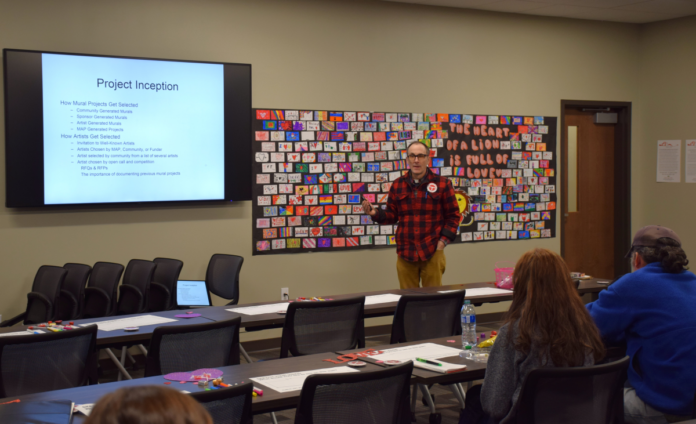
David McShane explained the behind the scenes planning that should go into a community mural project on Thursday. (Jerry Neace/NowHabersham.com)

The Community Mural Project sessions held Thursday in Cornelia gave a behind-the-scenes look at what goes into such a project. The sessions were hosted by David McShane, a renowned Philadelphia mural artist who has more than 20 years of experience and painted more than 200 murals. According to McShane, there is a lot of planning that goes on behind the scenes for a community mural project to be a success.

A community mural project isn’t about painting a wall. It’s about a theme, idea, or historical event in a community that the citizens can get behind and celebrate, explained McShane.

For the community project to get started, “there has to be a vision,” McShane tells the dozen or so people who attended the lunch session on Thursday. That can come from a group or an individual. The vision has to be shared with the community to get their ideas and engagement. Getting the community involved will draw out those who have artistic talent and ability that can assist in turning that vision into a community theme.

Funding sources have to be determined. Grants are available for this type of project, but getting donations and sponsorships helps the project move forward quickly.

Jennifer Herrera of Mt. Airy submitted her idea of the “Tim Loves Tink” mural. (Jerry Neace/NowHabersham.com)

One big factor is location. As Cornelia found out recently, sometimes the owner of the location is not always open to having a mural painted at that location for various reasons. Getting that secured can take some time. Knowing the location gives those planning the mural what size “canvas” they will be working with.

McShane explained to the group knowing the location early will allow the artist to plan how to incorporate the mural into the architecture of the building and the surrounding area. The mural needs to be complementary and not a distraction.

Selecting an artist who does murals can be daunting. McShane explained that many mural artists are sought out by communities, making their time limited. On some occasions, a group of artists may need to be sought out to do the job. Since the government is involved, in many cases, a request for proposal may be advertised to get artists to submit an application for the project with timelines and costs.

Then there is the legal side. McShane explained that this is to protect the city, the artist, and the owner where the mural will be located.

The Community Mural Project sessions were very informative should a community or city leaders decide to do a community mural like so many cities have done.

Art students submit ideas

As part of the Community Mural Project, Habersham County art students submitted their ideas of the mural in Cornelia that were displayed during the lunch session. Also on display were short stories from the community about how the “Tim Loves Tink” story came about. Though know one has ever come forward to tell the real story, the student’s themes tended to gravitate towards an enduring love story that lasts the ages.

Stories and artwork maybe submitted through the end of February and will be displayed at in the lobby in Cornelia City Hall as space allows.

Artwork and stories will be displayed in the lobby at Cornelia City Hall while the community mural project is ongoing.

New location revealed

The mural location will be behind Steve Campbell’s law office just off of Front Street. (Jerry Neace/NowHabersham.com)

The “Tim Loves Tink” community mural project recently had a setback when Norfolk Southern didn’t approve the project to take place at their tunnel on Wells Street, where “Tim Loves Tink” has been displayed for decades.

Cornelia city leaders announced during their commission meeting Tuesday evening that the new location will be on a wall behind Steve Campbell’s law office off of Front Street, adjacent to the old Regions Bank building. The new “canvas” is just a block and a half away from the originally planned tunnel.

Plans unveiled in Georgia for ‘America’s longest paved trail’

Carrolton GreenBelt at Ayers Dairy Farm (Credit: PATH Foundation)

Advocates for a bike and pedestrian trail linking Athens and Savannah have unveiled detailed plans for the project.

Trail backers say the 211-mile trail would be the longest paved trail in America.

It’s called the Hi-Lo Trail since it would include a variety of terrains from Georgia’s hilly Piedmont region to the flat coast.

And its supporters are partnering with a familiar name in Georgia trail-building, the PATH Foundation, to kick-start it.

Atlanta-based PATH operates more than 300 miles of popular trails around Metro Atlanta and elsewhere in Georgia. The organization prepared a nearly 200-page report showing how the Hi-Lo Trail could be built over the next 25 years.

Hi-Lo Trail founder Mary Charles Howard, a resident of Sandersville, said rural Georgians are missing out on the health and economic benefits of car-free trails.

“People just aren’t riding their bikes in those towns because there’s no infrastructure for it, and it’s not safe to be on the road,” Howard said. “And I thought lots of other people had this frustration as well, and I’m too stubborn to stick around and wait for somebody else to do it.”

PATH’s report includes possible routes, cost estimates, and funding sources for each of the eight counties the trail would pass through: Greene, Hancock, Washington, Johnson, Emanuel, Bulloch, Effingham, and Chatham.

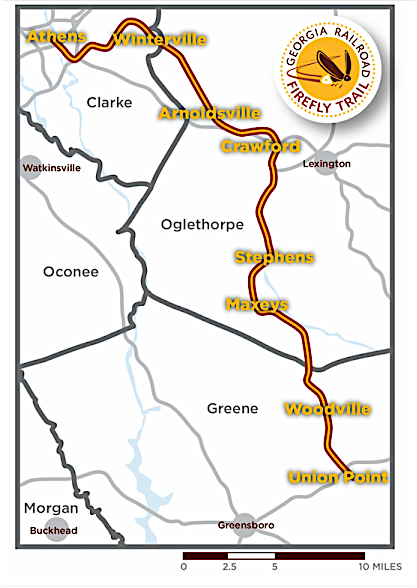
Source: Firefly Trail, Inc.

It would connect to Athens via the planned Firefly Trail in Athens-Clarke County.

PATH executive director Greta deMayo said the first step in the multi-decade plan is to get each jurisdiction to build a model project.

“You can’t build 211 miles as one project,” deMayo said. “So this is a long-term implementation that is segmented into phases and will be done with everybody starting their part.”

PATH has experience with this kind of approach.

It describes its Silver Comet Trail, beginning in Smyrna, northeast of Atlanta, as the current record-holder for the longest, continuous paved trail in the United States, at 94 miles when coupled with the 33-mile Chief Ladiga Trail in Alabama.

That project took 16 years from the time that an abandoned rail corridor was acquired for a non-motorized trail until the trail’s final completion in 2008.

Howard encourages cyclists interested in experiencing the potential of the HiLo Trail to sign up for an Athens-to-Savannah ride from Oct. 17 to Oct. 20, 2024.

This article comes to Now Habersham in partnership with GPB News

Michael Shannon and Jason Narducy lure all four members of R.E.M. on stage in Athens

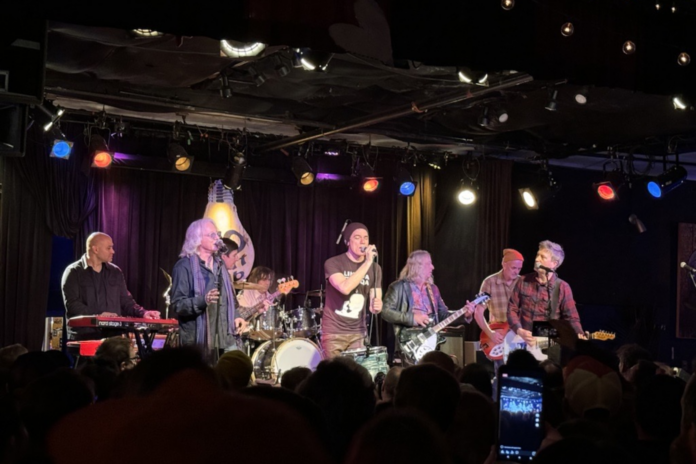
R.E.M.'s Mike Mills (second from left) and Peter Buck (center right, on guitar) are shown onstage with Michael Shannon (center) and Jason Narducy (far right) onstage at the 40 Watt Club in Athens, Ga., on Feb. 8, 2024. (Credit: Bertis Downs/R.E.M.)

It wasn’t a reunion — and they didn’t perform together. But the sight of all four members of R.E.M. on stage last night at the 40 Watt Club in Athens, Ga., has already rippled around the world.

The British music magazine NME was one of the first to report the moment, which saw singer Michael Stipe, guitarist Peter Buck, bassist Mike Mills, and drummer Bill Berry shoulder-to-shoulder at a tribute concert helmed by Oscar-nominated actor Michael Shannon and musician Jason Narducy.

The pair came to town to celebrate the 40th anniversary of R.E.M.’s 1983 debut, Murmur. Last summer at the Metro in Chicago, Shannon, Narducy, and friends performed the album in its entirety, along with some of their other favorite R.E.M. songs. That performance made such a splash that they decided to tour the country this month, landing at the 40 Watt Club, a historic musical home for heroes of the Athens music scene, including R.E.M., the B-52’s, Pylon, Vic Chesnutt, Five Eight and others.

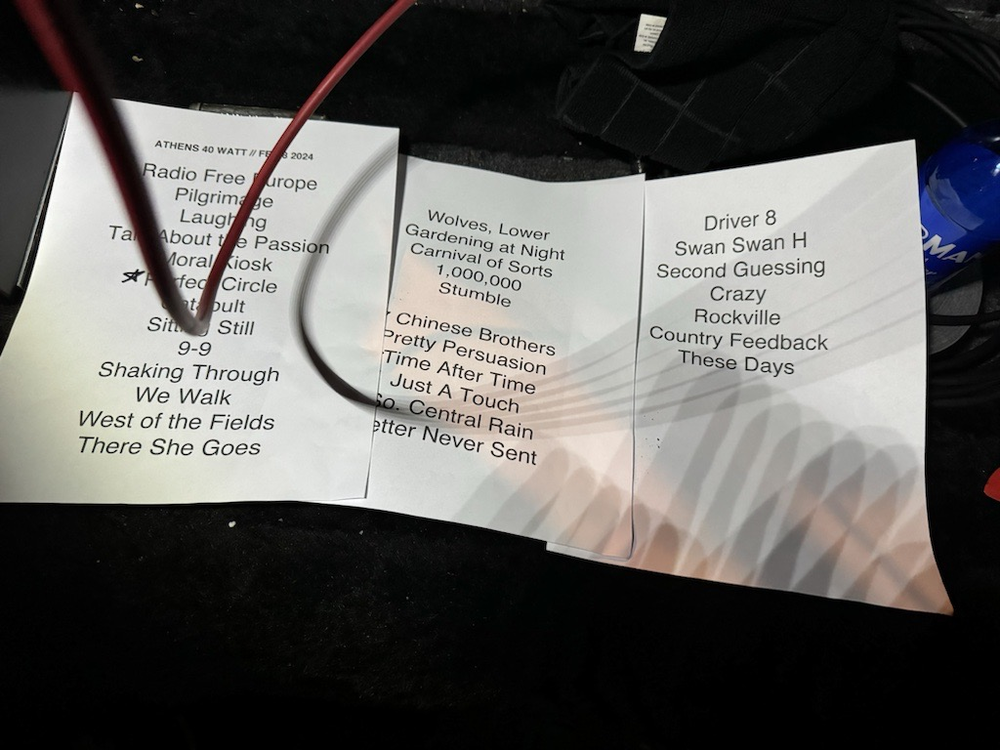
Mills joined Shannon and Narducy for that Chicago gig, and in Athens last night, he and Peter Buck contributed to the music after Michael Stipe took the microphone and announced how happy the members of the band were to be there. The Murmur tribute setlist included seminal “Radio Free Europe” and “Talk About the Passion” as well as fan favorites “Driver 8” and “(Don’t go back to) Rockville.”

The tour continues through Valentine’s Day with stops in Washington, D.C., and Brooklyn, N.Y.

The set list from the Murmur tribute concert performed by Michael Shannon and Jason Narducy and Friends at the 40 Watt in Athens, Ga. on Feb. 8, 2024. (Credit: Bertis Downs)

On the R.E.M. front, Michael Stipe has been unusually visible lately, popping up around the art world, talking with the New York Times about solo material and posing for a YSL campaign.

And here’s something to look forward to: All members of R.E.M. will be inducted into the Songwriters Hall of Fame during the 53rd Annual Induction and Awards Gala at the Marriott Marquis Hotel in New York City on June 13. The band was inducted into the Rock and Roll Hall of Fame in 2007 and introduced by Pearl Jam’s Eddie Vedder.

This article comes to Now Habersham in partnership with GPB News

Lock your love in Helen, GA

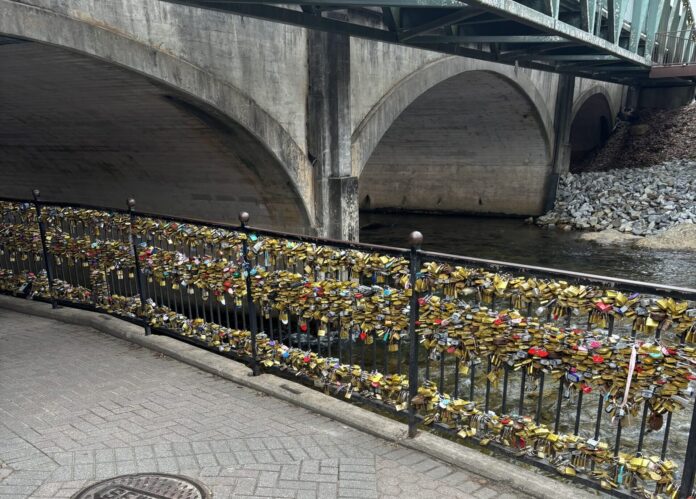
Bridge in Helen covered in locks (City of Helen)

It is a romantic legend dating back over 100 years to a woman in Hungary who lost her true love during World War I. In her grief, she placed locks on bridges at various places where she and the love of her life had spent time. It was a way of symbolizing that her love for him was unbreakable.

The legend continues

The tradition has continued on various bridges all over the world, including Helen, Georgia. Despite the romantic flare of sealing your love with a lock and tossing the key into the river, those who maintain and care for the safety of the bridges and those who cross them have grave concerns. Bridges in their development stages were not made to withstand the weight of the thousands of locks placed on them. And Helen is no exception.

“The locks add as much as 15,000 pounds to the bridge. When we cut them off after a weekend in Helen, we fill up several 5-gallon buckets weighing 150 to 200 pounds. Sometimes our employees are spending 15 to 20 hours during the week cutting them off only to have them return after the weekend,” explains Helen City Manager Darrell Westmoreland.

Problem-solving

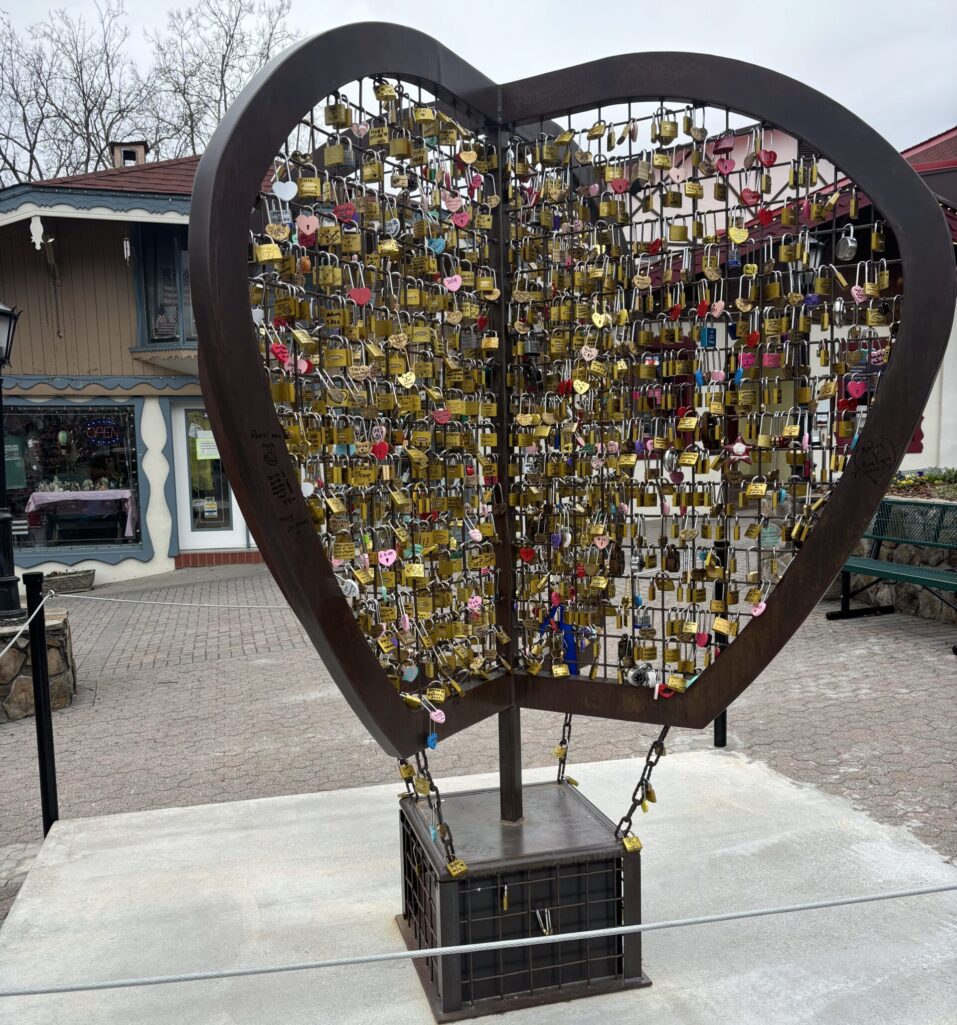
Balloon sculpture in Helen where people can place their locks and profess their undying love. (City of Helen)

The City of Helen contracted Owens Welding in Cleveland to create a balloon sculpture for couples to place their locks. The hot air balloon is a symbol for the city because of the Atlantic Balloon Race. You can find this work of art in MarketPlatz in the center of Helen.

The sculpture cost the city $12,500, but Westmoreland said, “It is money well spent when you compare the cost of removing the locks and keeping the bridges safe for pedestrians and vehicles to cross.”

“Around three years ago, placing locks on the bridge became a growing trend,” said Westmoreland. “Having the Balloon Sculpture since October for couples to place their locks has helped reduce the number of locks on the bridges.”

Placing a love lock in Helen

Locks can be purchased in various stores around Helen. There are regular locks and novelty locks, all to lock a couple’s love and throw away the key.

“We will be removing the guard rail fence under the bridge and replacing it with a wooden wall. It is currently covered with locks,” Westmoreland added.

It is a perfect time to visit Helen, with Valentine’s Day just around the corner. Stroll the streets, grab dinner at the many delicious eating spots, and profess your love with a lock and throw away the key- just don’t put it on the bridge. Use the balloon sculpture to be certain it will always remain.

Hoyt Street Bridge is gone forever

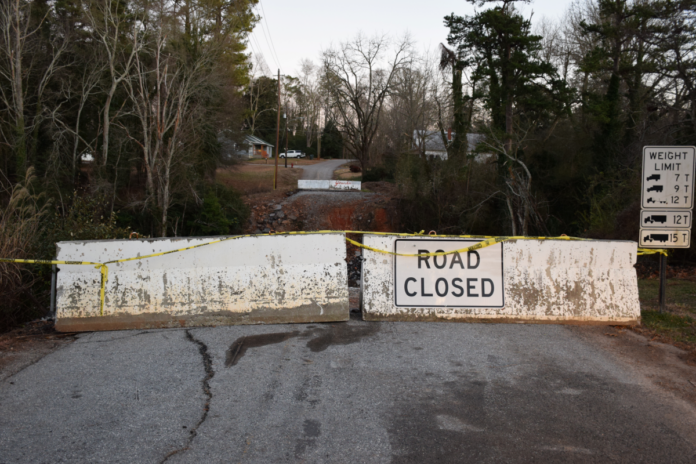
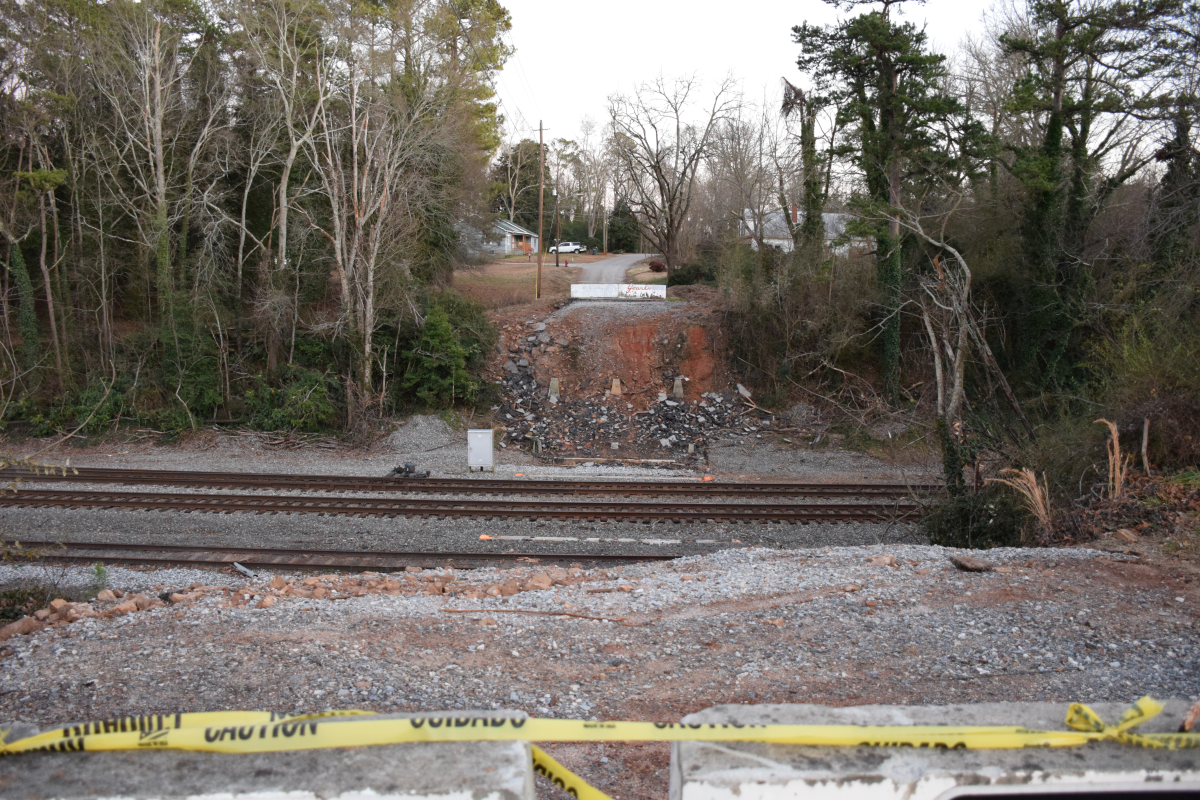
Concrete barricades block the road where Hoyt Street bridge once stood. (Jerry Neace/NowHabersham.com)

In November 2022, Cornelia City Commissioner Don Bagwell said, “Once the bridge is gone, it’s gone forever.” Well, that day has come. Hoyt Street Bridge is gone.

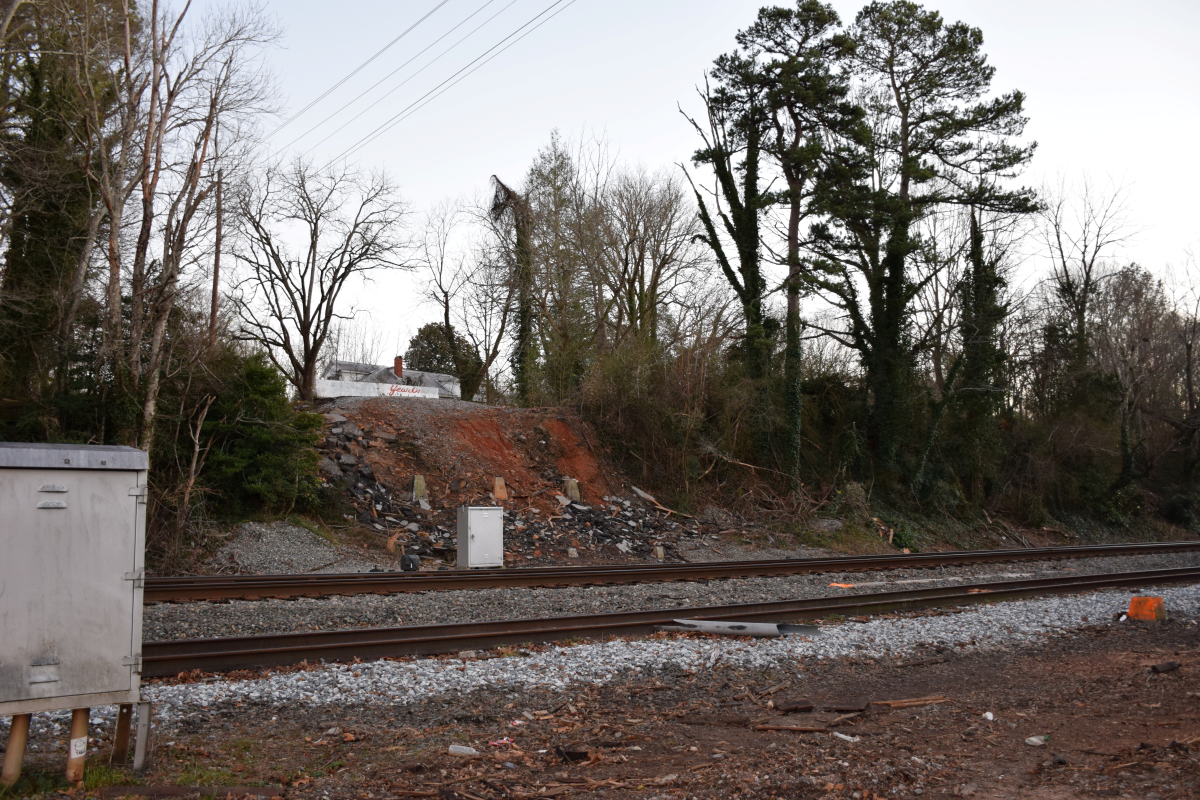
In December, Norfolk Southern Railroad removed the well-worn cut-through bridge that led from one side of town to the other. The railroad is now in the process of cleaning up the remaining debris. Norfolk Southern (NS)  is waiting for material to be delivered to permanently block off Hoyt Street and make it safe for residents and the traveling public. Right now, concrete barricades are blocking both ends of the roadway where the bridge once stood.

Failed negotiations

Norfolk Southern wanted the bridge removed, at least in part, so it would no longer have to maintain it. The railroad was in on-again, off-again negotiations with the city for nearly two years. About 18 months ago, it appeared the two sides had struck a deal. The railroad agreed to dismantle the bridge and clean up the area at no cost to the city. In addition, Norfolk Southern agreed to pay Cornelia $100,000.

At the same time that deal was unfolding, Cornelia was working to get an upgraded rubberized rail crossing at South Main Street downtown. The city secured funding for the $224,500 project, but Norfolk Southern refused to agree to it when the city did not immediately sign off on the deal to remove the Hoyt Street Bridge.

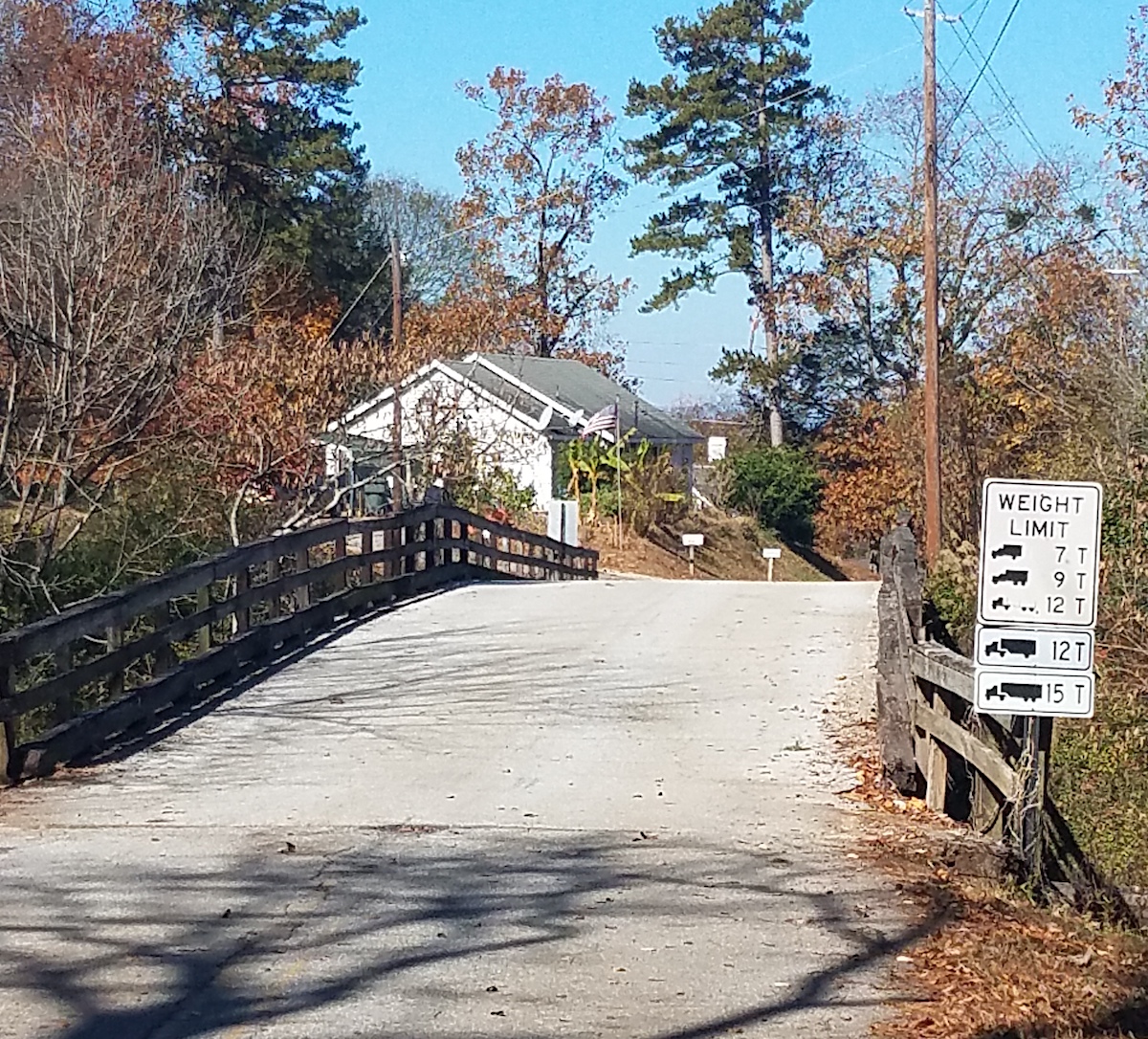
The bridge’s weight limit was repeatedly lowered to account for the bridge’s age and decay. (Jerry Neace/Now Habersham)

Eventually, the two sides reached an agreement after Cornelia conducted a traffic study and determined that only a handful of people were utilizing the bridge.

Bagwell says the city took its time in making the decision because it didn’t want to alienate residents who used the bridge to walk and drive across town. However, the bridge was in a state of steady decline. Bagwell says the weight limit for vehicles to safely cross the bridge had “decreased to the point that it had become dangerous.”

Finding common ground

The two sides resumed their talks and agreed to the original terms. Cornelia allowed the railroad to tear down the bridge at no cost to the city. Norfolk Southern has delivered its $100,000 check to Cornelia. City Manager Dee Anderson says the city will apply those funds to the cost of the rubberized rail crossing, which Norfolk Southern has now approved. The Georgia Department of Transportation will pick up the rest of the tab.

“In negotiating with the railroad, I think we were trying to both get to a happy place where the railroad achieved its goal, which was to remove the bridge so that trains could pass freely underneath it,” Bagwell tells Now Habersham.

He says that it just made sense to find some common ground with the railroad so they could remove the bridge, and the city was able to achieve that goal.

Cornelia’s Hoyt Street bridge is gone. All that can be seen from above is debris, foundation supports, and railroad tracks. (Jerry Neace/Nowhabersham.com)
Remnants of the old Hoyt Street bridge can still be seen below where it once stood. (Jerry Neace/NowHabersham.com)

“I think that was a really good thing, ultimately. The railroad agreed to help us out on improving where you cross the tracks downtown. That wound up being a win-win, I think, for both the railroad and the city,” says Bagwell.

While some residents expressed concerns about losing the bridge as a conduit to other parts of the city, Hoyt Street residents seem generally pleased with the decision to get rid of the bridge, according to Bagwell. He says that since the bridge has closed, residents have told him their neighborhood is much quieter, and it’s much safer now for their children to play outside.

North Carolina man arrested in Rabun County on drug trafficking charges

(NowHabersham.com)

A North Carolina man remains behind bars in Rabun County following his arrest earlier this week on drug trafficking charges.

Deputies arrested Alexander Farland, 30, of Sylva, on Tuesday, Feb. 6. He was pulled over for a traffic violation on US Highway 76 at the RaceTrac gas station.

During the traffic stop, deputies say they recovered approximately 29 grams of methamphetamine and around 16 grams of fentanyl. Authorities charged Farland with trafficking the drugs and on warrants out of Cobb County.

The sheriff’s office says the case has been turned over to the Appalachian Regional Drug Enforcement Office for further investigation.

Justice Department will not charge Biden in classified documents probe

President Joe Biden addresses the nation during a press conference at the White House after the release of a scathing U.S. Justice Department report saying he "willfully" retained classified documents and called his memory into question. (White House livestream)

WASHINGTON (States Newsroom) — The U.S. Justice Department released a lengthy report Thursday concluding that while President Joe Biden “willfully retained” classified materials following his time as vice president, he won’t be charged with a crime.

Special Counsel Robert K. Hur wrote in the 388-page report that prosecutors considered “that, at trial, Mr. Biden would likely present himself to a jury, as he did during our interview of him, as a sympathetic, well-meaning, elderly man with a poor memory.”

“Based on our direct interactions with and observations of him, he is someone for whom many jurors will want to identify reasonable doubt,” the report states. “It would be difficult to convince a jury that they should convict him — by then a former president well into his eighties — of a serious felony that requires a mental state of willfulness.”

“We conclude the evidence is not sufficient to convict, and we decline to recommend prosecution of Mr. Biden for his retention of the classified Afghanistan documents,” the report states.

Attorney General Merrick Garland wrote in a one-page letter to Congress that Biden “has decided not to assert executive privilege over any part of the report or its appendices.”  The doctrine of executive privilege allows the president to withhold certain documents or information from the judicial or legislative branches.

The Hur report seeks to differentiate between the Biden investigation and another of former President Donald Trump’s handling of documents, which did lead to charges, saying there are “several material distinctions.”

“Unlike the evidence involving Mr. Biden, the allegations set forth in the indictment of Mr. Trump, if proven, would present serious aggravating facts,” the report says. “Most notably, after being given multiple chances to return classified documents and avoid prosecution, Mr. Trump allegedly did the opposite.”

The report adds that Trump allegedly “obstructed justice by enlisting others to destroy evidence and then to lie about it.”

“In contrast, Mr. Biden turned in classified documents to the National Archives and the Department of Justice, consented to the search of multiple locations including his homes, sat for a voluntary interview. and in other ways cooperated with the investigation,” the report added.

The announcement quickly provoked a reaction from Trump, who, in a written statement released by his campaign, said the two cases are significantly different and that he “did nothing wrong.”

Trump alleged there is a “two-tiered system of Justice” and called for the special counsel in his case to drop it immediately, saying it represents “election interference.”

Biden says he ‘threw up no roadblocks’

Biden said in a written statement that he was “pleased to see they reached the conclusion I believed all along they would reach — that there would be no charges brought in this case and the matter is now closed.”

“This was an exhaustive investigation going back more than 40 years, even into the 1970s when I was a young Senator,” Biden said. “I cooperated completely, threw up no roadblocks, and sought no delays.”

Biden noted in his statement that he sat for five hours of interviews with the special counsel on Oct. 8 and 9, 2023, the two days following the terrorist attacks in Israel.

While he was “in the middle of handling an international crisis,” Biden said that he “believed that’s what I owed the American people so they could know no charges would be brought and the matter closed.”

Garland announced Hur as the special counsel in January 2023; Trump had appointed Hur to lead the prosecutor’s office in Maryland in 2018. He left in 2021 to join the Gibson, Dunn & Crutcher law firm.

The announcement of the special counsel came after classified documents were found at the Penn Biden Center in Washington, D.C., on Nov. 2, 2022, and then in the garage at Biden’s home in Wilmington, Delaware, on Dec. 20, 2022, and Jan. 11 and Jan. 12, 2023.

The White House defended its decisions to delay revealing that information publicly in mid-January 2023, shortly after the special counsel was publicly appointed.

Ian Sams, White House spokesman for oversight and investigations, said at the time the administration understood “that there’s a tension between the need to be cooperative with an ongoing DOJ investigation, and rightful demands for additional public information.”

“And so we’re trying to strike that balance and being as clear as we can,” Sams said.

‘Mistakes when packing documents’

Special Counsel to the President Richard Sauber said in a written statement released Thursday that Biden cooperated with investigators and that the report acknowledges “mistakes when packing documents at the end of an Administration or when Members of Congress leave office are unfortunately a common occurrence.”

“Now that this investigation has concluded, President Biden plans to take new, substantive action to help prevent such mistakes in the future and will announce it soon,” Sauber said.

Bob Bauer, personal counsel to Biden, said in a written statement that the special counsel’s decision “rested on evidence compiled using millions of taxpayer dollars over a 15-month inquiry involving 173 interviews of 147 witnesses and more than 7 million documents.”

“He specifically noted that he would have reached the same conclusion even if the President were a private citizen and not the sitting president,” Bauer said.

“The Special Counsel also noted the President’s complete cooperation, including the President’s unprecedented decision to open up every room of his family home and beach house to comprehensive FBI searches as well as a voluntary interview conducted over two days.”

Hall County seeks community feedback on Comprehensive Plan

The Hall County Planning and Development team is preparing the final version of the Comprehensive Plan, a document that will guide the county’s long-term land development over the next decade. The community has one last chance to provide feedback on the draft of the plan.

The Comprehensive Plan is a framework for how the county will achieve its goals of maintaining a healthy rural character, preserving greenspace, and addressing the need for new development to accommodate population growth. The plan also seeks to ensure that new development is compatible with the county’s infrastructure capacity.

“Our last major update to the plan was in 2017, and a lot has changed in Hall County since then. Citizen feedback is incredibly important to this process, as we want to ensure the Comprehensive Plan accurately reflects the values and visions of Hall County communities,” said Hall County Planning and Development Director Randi Doveton.

The county’s current population is growing faster than the infrastructure is designed to accommodate, leading to conflicts between the two. The comprehensive plan provides an opportunity for the county to guide development in a way that will preserve the rural character of the county while also meeting the needs of the growing population.

Doveton said the county plans to adopt the plan in June.

The public review period is the final opportunity for the community to provide feedback on the draft of the plan. The period is open from now until March 1, 2024. The county is committed to providing feedback from diverse sources of the community, including residents, businesses, and community organizations.

If you have any questions or feedback for Hall County’s Comprehensive Plan, you may submit your comments online at https://tsw.mysocialpinpoint.com/hall-county-forward.