WASHINGTON (States Newsroom) — U.S. House Republicans unveiled three bills Wednesday that would provide $95 billion overall in assistance to Ukraine, Israel, and Taiwan instead of voting on a similar bipartisan Senate-approved package that’s been waiting around for months.
The Ukraine bill would provide $60.84 billion, the Israel bill would appropriate $26.38 billion and the Indo-Pacific bill would approve $8.12 billion in assistance, according to a House GOP summary of the legislation.
President Joe Biden quickly threw his support behind the legislation, which could be voted on as early as Saturday, writing in a statement that Congress “must pass” the three bills as soon as possible.
“Israel is facing unprecedented attacks from Iran, and Ukraine is facing continued bombardment from Russia that has intensified dramatically in the last month,” he wrote.
Biden added that he would sign the bills “immediately to send a message to the world: We stand with our friends, and we won’t let Iran or Russia succeed.”
Votes are forecast on separate measures on a TikTok ban and border security policy, though details were not yet disclosed early Wednesday afternoon.
House Republican leaders hope to vote on funding for each nation or region separately Saturday as well as amendments, though numerous House Republicans have vowed to vote against the rule that sets up debate on the bills.
Both chambers of Congress are scheduled to be on recess next week, adding a time crunch to the debate within the House GOP Conference.
Democrats could bail out Republicans by voting to approve the rule, though that’s not typically how the House works. The majority party, currently the GOP, is expected to carry the rule vote on its own, regardless of whether the bill that follows is bipartisan.
The question of aid to Israel gained urgency in Congress following attacks by Iran on that nation last weekend and vows by Israel to retaliate, although it’s not yet clear how. Israel is also engaged in a war with Hamas in the Gaza Strip.
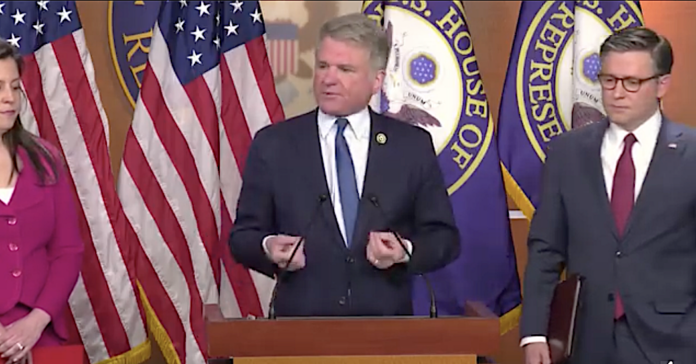
Speaker Mike Johnson, a Louisiana Republican, sent a message to members Wednesday morning announcing the three foreign assistance bills would be released and committing to some amendment votes.
“After significant Member feedback and discussion, the House Rules Committee will be posting soon today the text of three bills that will fund America’s national security interests and allies in Israel, the Indo-Pacific, and Ukraine, including a loan structure for aid, and enhanced strategy and accountability,” Johnson wrote.
The House plans to vote on the package Saturday evening, ensuring “time for a robust amendment process,” Johnson wrote.
TikTok, immigration and a motion to vacate
The House will also take votes on a border security bill as well as a separate package that includes a bill banning the social media site TikTok unless it’s sold by Chinese owner ByteDance, Johnson wrote.
The House approved the TikTok bill in mid-March, but it’s been held up in the Senate ever since as that chamber debates whether to take it up. That bill will now be rolled into a package with “sanctions and other measures to confront Russia, China, and Iran,” he wrote.
Johnson’s decision to move forward with aid to Ukraine, Israel and Taiwan comes amid increasing frustration from especially conservative members of the House Republican Conference, two of whom are calling for him to resign or face a vote that could remove him from the leadership post.
Rep. Marjorie Taylor Greene of Rome, Georgia, filed a so-called motion to vacate resolution in March that would oust Johnson from his post if approved. She struggled to find support among her colleagues until Tuesday when Kentucky Rep. Thomas Massie called for Johnson to resign in a closed-door meeting, then said he’d supported the resolution.
Other far-right members have expressed frustration with Johnson’s decision to advance the supplemental spending bills, including Pennsylvania’s Scott Perry, who has repeatedly criticized Johnson on social media for not pressing harder for a House GOP border security bill. Republicans have been sharply critical of the Biden administration’s immigration policy.
“While we always want to help our allies, what are we doing for the American Citizens?” Perry wrote in one of many posts.
House Appropriations Chairman Tom Cole, an Oklahoma Republican, wrote in a statement releasing the foreign aid bills that “if we don’t help our friends in time of need, soon enough, we won’t have any friends at all.”
“Equivocating is not an option, and each bill will be given distinct attention and consideration,” Cole wrote. “I look forward to supporting them and providing our allies and partners with the tools they need to defend themselves. America must stand firmly on the side of freedom.”
Top Democrat lends support
Connecticut Rep. Rosa DeLauro, the top Democrat on the spending committee, wrote in a statement that she will support the three assistance bills.
“We cannot retreat from the world stage under the guise of putting ‘America First,’” DeLauro wrote. “We put America first by demonstrating the power of American leadership — that we have the strength, resolve, and heart to fight for the most vulnerable people, protect their freedom, and preserve their dignity. I urge swift passage of these bills.”
The House GOP bills, she wrote, “mirror the Senate-passed package and include support for Ukraine against Russian aggression; Israel in its war against Iran and its proxies, like Hamas, Hezbollah, and the Houthis; and our Indo-Pacific partners against an adversarial China.”
How is the aid money divided up?
The Ukraine bill would appropriate nearly $48 billion to the U.S. Defense Department to provide Ukraine with training and equipment, to replenish U.S. stockpiles that have been shipped to Ukraine and to support U.S. armed forces in the region, according to a summary of the bill from House Democrats.
The U.S. State Department would receive $9.5 billion in “forgivable loans for vital economic and budgetary support for Ukraine’s energy sector and other infrastructure needs” and $2 billion in security assistance for Ukraine and other allies, according to the Democratic summary.
The U.S. Energy Department would receive nearly $250 million to address any potential nuclear or radiological incidents.
Funding for Israel would be split between the U.S. Departments of Defense, Homeland Security, and State.
Defense would get $13 billion for replenishing U.S. stockpiles sent to Israel, U.S. Central Command operations and for the Iron Dome, David’s Sling and Iron Beam defense systems, according to Democrats’ summary.
The State Department would receive $9.15 billion for humanitarian assistance in Gaza and other locations and $3.6 billion in security assistance for Israel as well as other Middle Eastern partners.
The Federal Emergency Management Agency, housed within DHS, would receive $400 million for the nonprofit security grant program.
That bill prohibits U.S. funding from going to the United Nations Relief and Works Agency, according to the GOP summary.
The third bill, with funding for the Indo-Pacific region, would provide the U.S. Defense Department with $5.6 billion for “integrated deterrence” and for the submarine industrial base, according to Democrats’ summary.
Another $281.9 million would go to the U.S. Navy for dry dock construction.
The State Department would receive $2 billion in foreign military financing for U.S. allies in the Indo-Pacific region.
Text of the 49-page Ukraine bill is here, the 25-page Israel bill is here and the 15-page Indo-Pacific bill is here.
Senate version of aid package
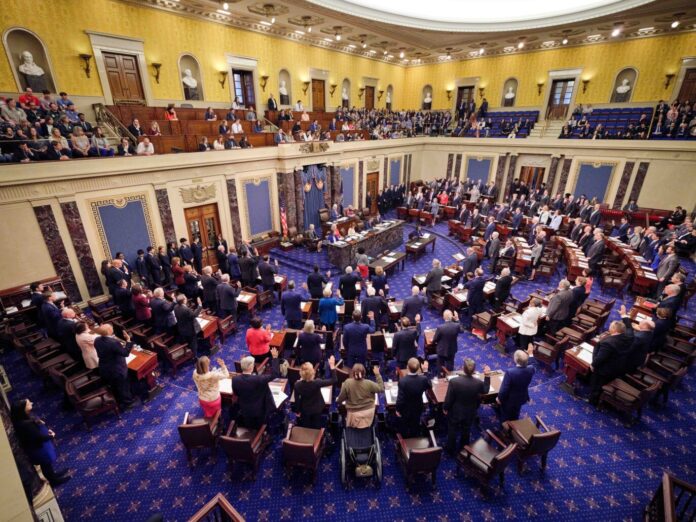
The Senate voted 70-29 in mid-February to approve a $95 billion emergency spending bill for Ukraine, Israel and Taiwan, with much of that funding going directly to the U.S. departments of Defense, Energy and State. The weapons or humanitarian assistance would then be distributed to the respective countries.
Much of that Senate package resembles the measures rolled out by Johnson on Wednesday.
Ukraine would have received about $60 billion, Israel $14 billion and the Indo-Pacific $4.8 billion. The package also included the bipartisan Fentanyl Eradication and Narcotics Deterrence, or the FEND Off Fentanyl Act.
Senate Majority Leader Chuck Schumer, a New York Democrat, and Minority Leader Mitch McConnell, a Kentucky Republican, have repeatedly called on House GOP leaders to put that package on the floor for a vote.
Johnson has spent the intervening two months taking the pulse of his lawmakers and plotting a path forward that began to take shape earlier this week.
‘The entire world is waiting’
Schumer said Wednesday morning from the Senate floor that he was waiting to see what exactly the House bills would propose in terms of funding and what makes it out of the House chamber before deciding what the Senate will do.
“The entire world is waiting to see what House Republicans will do about aid to Ukraine, aid to Israel, humanitarian assistance, and aid to the Indo-Pacific,” Schumer said.
“(Russian leader Vladimir) Putin is watching very closely to see if America will step up and show strength or slink away from a friend in need.”
Defense Secretary Lloyd Austin testified before the House Defense spending panel on Wednesday morning the delay approving aid for Ukraine, Israel, and Taiwan “sends a terrible signal to our allies and partners.”
Ukraine losing the war to Russia would have significant ramifications for NATO allies in Europe and for the United States, he said.
“We all know that Putin won’t stop in Ukraine. This will continue. And, you know, our allies on the Eastern Front there are very, very concerned about that,” Austin said. “It will also signal to other autocrats around the globe that the United States is not a reliable partner. And so all the alliances and partnerships that we’ve worked hard to develop over the years will be in question.”

















Bookman: Cynicism of Georgia GOP leaders robs poor of access to a doctor
Health care is not a luxury item, a commodity reserved for those who can afford it. It is a basic human right.
Health care eases pain. It reduces suffering. It extends life and enhances life. It helps the lame to walk, the sick to heal, the old to age gracefully. The joy that a newborn baby brings, the relief and comfort that hospice provides … from beginning to end, throughout our lifespans, health care is essential.
A society that is economically and medically capable of providing health care to its members, yet chooses not to do so, is inhumane. Unfortunately, our state of Georgia fits that description.
We have the second highest uninsured rate in the country, and even in the midst of an historic economic boom the number of fellow Georgians without health insurance is rising, not falling, by the hundreds of thousands.
Why? Because of conscious choices made by those elected to govern us, and because we continue to elect those who make such choices.
It’s certainly not a question of resources. Our state’s coffers are full to overbrimming, and the federal government is committed to paying most of the cost of expanding Medicaid to cover those unable to get insurance elsewhere. In fact, it currently costs the state of Georgia more money NOT to provide health care to its poor than we would spend in providing it. On top of all the human costs and the social costs of such a policy, the refusal to expand Medicaid costs our state hundreds of millions of dollars a year.
Think about that: Those who govern us are so callous, so stubborn about not providing health care to their fellow Georgians, that they’re willing to cost the state money to continue not doing so.
That’s perverse. Kentucky expanded Medicaid five years ago. Louisiana did it eight years ago. Arkansas implemented its version three years ago, as did Missouri. North Carolina finally did it in 2023. Even Mississippi seems closer to adoption than Georgia.
Again, why?
Normally, the place to look for an explanation of such obstinance would be politics, but you would look there in vain. In a poll taken in January by the University of Georgia, almost 70% of registered voters in Georgia said they support expanding Medicaid “to cover all the state’s uninsured poor.” Georgia Republicans supported Medicaid expansion by 47-39%. A majority of self-described Georgia conservatives backed it by a margin of 51-36%.
Nationwide, according to a poll by KFF, a health-policy research group, 60% of Americans now have a favorable view of the Affordable Care Act, with only 39% of Republicans saying they would still support repeal. The ACA, also known as Obamacare, is so popular now that even Donald Trump says he opposes its repeal, claiming instead to have a secret plan to make it “much better than it is right now and much less expensive for you.” (He doesn’t.)
And yet, here in Georgia, Medicaid expansion is still off the table.
Maybe – and I’m just guessing here — it’s a question of timing. The second and final term of Brian Kemp as governor ends in 2026, when he is expected to run for the U.S. Senate seat now held by Jon Ossoff. Maybe the plan is to delay expansion for another two years, so that Kemp can sign it into law just as he launches his bid for federal office. He’d be playing hero by solving a problem that he himself helped to create.
If it sounds cynical to suggest that politicians play with human lives like that, maybe it is. But I guarantee you cynicism plays a role in this somehow.