WASHINGTON (States Newsroom) — Congress has 12 days left to approve a short-term government funding bill before the shutdown deadline, though leaders in the Republican House and Democratic Senate haven’t felt the need to start negotiations just yet.
House GOP leaders, instead, attempted to pass a six-month continuing resolution Wednesday that carried with it a bill requiring proof of citizenship to register to vote, but were unsuccessful.
The 202-220 vote in the House, with two members voting present and 14 Republicans in opposition, came shortly after Republican presidential nominee Donald Trump called on lawmakers to force a government shutdown as leverage to enact the voter ID law.
“If Republicans don’t get the SAVE Act, and every ounce of it, they should not agree to a Continuing Resolution in any way, shape, or form,” Trump wrote on social media, doubling down on a shutdown statement he made last week.
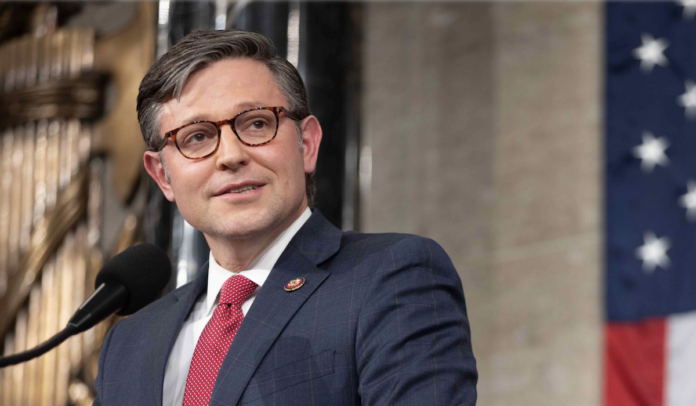
The unsuccessful House vote could provide space for Speaker Mike Johnson, a Louisiana Republican, to negotiate with the Senate.
But, with just one week left in the session before Congress departs for a six-week election break, there’s not much time for leaders to find consensus, draft a bill, hold votes in both chambers and secure President Joe Biden’s signature.
Johnson, asked repeatedly by reporters Wednesday about the possibility of a shutdown, didn’t entirely rule out a funding lapse beginning on Oct. 1.
“We’ll see what happens with the bill,” Johnson said before the vote. “We’re on the field in the middle of the game, the quarterback is calling the play, we’re going to run the play.”
Blaming the Senate
Johnson criticized the Senate for not being further along in the annual appropriations process, seeking to place the blame for a stopgap spending bill and a possible shutdown on that chamber.
The Senate Appropriations Committee approved 11 full-year government funding bills with broadly bipartisan votes this summer, but experienced challenges with the Homeland Security funding measure.
The House Appropriations Committee approved all dozen of its bills along party-line votes and was able to move five of those across the floor with GOP support, but not broad backing from Democrats.
House and Senate leaders haven’t allowed the two chambers to begin conferencing the bills that have either passed out of committee or off the floor, despite that being a regular occurrence in past years.
It’s highly unlikely leaders will bring any more of the full-year spending bills to the floor this fall, making the election results the biggest piece of the puzzle that will change between now and the end of the calendar year.
McConnell: Shutdown would be ‘politically, beyond stupid’
Senate Minority Leader Mitch McConnell, R-Ky., has repeatedly called on his colleagues to avoid a shutdown, though he hasn’t jumped in to negotiate a stopgap bill and doesn’t seem inclined to do so.
“I think we first have to wait and see what the House sends us,” McConnell said during a Tuesday press conference. “My only observation about this whole discussion is the one thing you cannot have is a government shutdown. It would be, politically, beyond stupid for us to do that right before the election because, certainly, we’d get the blame.”
McConnell then referenced the saying that there’s no “education in the second kick of a mule” and noted funding the government for a few more months will “ultimately end up being a discussion between” Senate Majority Leader Chuck Schumer and Johnson.
“I’m for whatever avoids a government shutdown,” McConnell added.
Election year drama
Leaning on a stopgap spending bill has been a regular part of Congress’ annual appropriations process for nearly three decades. During that time, lawmakers have consistently failed to approve all the full-year government funding bills before the Oct. 1 deadline.
The September struggle to approve a continuing resolution, which is intended to give lawmakers a bit more time to reach bicameral agreement on the full-year spending bills, has become increasingly dramatic with election-year politics ratcheting up the posturing this year.
In divided government, any legislation to fund the government must be bipartisan, or it all but guarantees a shutdown.
The House’s failed six-month continuing resolution also wasn’t supported by most Senate Republicans.
GOP senators argued it was too lengthy and could have hindered that chamber’s ability to confirm the next president’s Cabinet during the first few months of 2025.
Senate Republicans and defense hawks in the House also said that leaving the Department of Defense on autopilot for half of the next fiscal year was an abdication of Congress’ responsibility and a threat to national security.
December end date eyed
The final stopgap spending bill that Congress approves in the days ahead will likely last through Dec. 20, the final day this year that Congress is scheduled to be in session. It is also unlikely to include the voter registration ID component.
That final, bipartisan continuing resolution could also include a plus-up in spending for the Secret Service or a provision that allows the agency to spend its stopgap allocation at a faster rate to bolster Trump’s security following two apparent assassination attempts.
Florida Republican Rep. Mario Díaz-Balart, chairman of the State-Foreign Operations spending panel, said Wednesday that if he was a betting man, he’d expect Congress to pass a stopgap spending bill through mid-December.
“The first thing is, we can’t have a shutdown,” Díaz-Balart said. “I think most people here understand that that would be catastrophic, particularly when half the world is in flames.”
During a government shutdown, some federal workers continue reporting to the office without pay while the rest are furloughed until Congress approves a new funding bill. All federal employees impacted by a shutdown receive back pay.
A shutdown this October would affect all the departments and agencies funded within the annual process, including the departments of Agriculture, Defense, Health and Human Services, Homeland Security and State.
Idaho Republican Rep. Mike Simpson, chairman of the Interior-Environment appropriations subcommittee, said he was sure there would be no shutdown but didn’t detail how exactly Congress would broker a bipartisan agreement in the days ahead.
“I don’t think anybody wants to shut the government down,” Simpson said. “That’s not a viable option.”













 Robert James Sowers, age 75, of Clarkesville, passed away on Wednesday, September 18, 2024.
Bookman: For some GOP leaders, there’s no time like never to discuss gun safety policies
When nursing student Laken Riley was tragically murdered here in Georgia last February, allegedly at the hands of a Venezuelan immigrant, Gov. Brian Kemp and his fellow Republicans didn’t hesitate.
They knew immediately who was at fault, and knew exactly what steps needed to be taken.
Kemp, for example, used Fox News and social media to pin the murder on the Biden administration.
“Joe Biden’s failed policies have turned every state into a border state, and I’m demanding information from him so we can protect our people when the federal government won’t,” Kemp said on X, formerly Twitter.
U.S. Rep. Mike Collins, a Republican congressman who represents the Athens area where the Riley murder occurred, was equally quick to respond.
“The blood of Laken Riley is on the hands of Joe Biden, (Homeland Secretary) Alejandro Mayorkas, and the government of Athens-Clarke County,” Collins wrote on X.
However, when four innocent people – two students and two teachers – were murdered in Collins’ district this month, allegedly by a 14-year-old student armed with an assault rifle, Kemp, Collins and most of their fellow Republicans acted stupefied at who to blame or what public officials could possibly do to address it.
They didn’t even think the problem of school shootings worthy of discussion.
For example, when Kamala Harris responded by calling the shooting “senseless” and noting that “it does not have to be this way,” Collins acted offended.
“In my opinion, it’s not the right time to talk about what we see out there,” Collins said. “We’ve got to get back to God in this country, we have really gotten away from that from a moral standpoint. There’s a lot of issues out there, (Harris) is dead wrong to bring that up at this time. It’s just not the right time.”
Kemp has taken a similar head-in-the-sand approach.
“I’m very interested in making sure we learn all the facts, certainly before I try and weigh in on … policy issues,” the governor said more than a week after the shooting.
We will never know “all the facts,” and apparently the right time to debate such issues is never. But here’s a few facts we do know for sure:
It’s also worth noting that in a 2018 campaign ad, Kemp posed with a shotgun in his lap, surrounded by assault weapons and other firearms, as he queried a young boy about dating his daughter. Apparently, our governor deemed that an appropriate use of deadly firearms.
And in a 2022 campaign ad for Congress, Collins also posed with an assault weapon as he claimed that the 2020 election in Georgia had been stolen from Donald Trump and it was time to set things right.
“Georgians are sick and tired of weak-kneed, spineless politicians who won’t fight for Trump and get to the bottom of 2020 and fix our elections,” he says in the ad. “Well, if they won’t do it, Mike Collins will.”
He then wheels and fires at a target, which explodes on impact. Apparently, Collins has no qualms about modeling the use of firearms as an instrument of political change.
This is not a rational situation. This is a cultural sickness. Guns are being marketed by manufacturers and politicians alike as the solution to crime, to political disputes, to lack of self-esteem, and to doubts about gun owners’ masculinity. To many, guns have become a cult object, and if protecting that cult object means we have to act helpless in the face of mass shootings that kill dozens and school shootings that slaughter helpless children, well, those are sacrifices that the Gun God insists be paid, and too many are willing to do so.