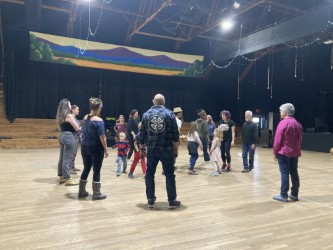
SOLfest Days of Play (2024) illustrate the kind of interaction folks might have as part of the Sautee Nacoochee Center's talent inventory. (Photo submitted by SNC)
The Sautee Nacoochee Center announces an open call for performers, designers, technicians, and artists of all ages and backgrounds to join in the June production of William Shakespeare’s A Midsummer Night’s Dream.
According to SNC’s Marketing and Development Coordinator, Jennie Inglis, talent inventories will be held this month to assess the interests and skills of those interested in participating.
The first session will be held on March 15 from 12 to 2 p.m. in the Center Theatre at 283 GA-255, Sautee Nacoochee, GA. The second talent inventory is from 2 to 4 p.m. on March 29 in the Sautee Nacoochee Center Community Hall.
A place for you
Whether you’re interested in performing on stage or assisting behind the scenes, Inglis says there’s a place for you in this production.
The talent inventories will offer a taste of the creative process, featuring activities such as games, movement, acting, singing, organizing, and even constructing sets and environments. Inglis says that everyone who is eager to participate and can commit their time will find a role that suits their talents and interests.
SOLfest will play out across several locations on the Sautee Nacoochee Center campus. (Photo submitted by SNC)
The June production of A Midsummer Night’s Dream will serve as the centerpiece of the inaugural SOLfest – Sautee Outdoors Live Festival, a groundbreaking celebration of performance, creativity, and intergenerational collaboration. This festival will invite community members from all walks of life to contribute to a one-of-a-kind theatrical experience that honors Sautee Nacoochee’s rich history of performance and creativity.
A unique production
This immersive, community-driven festival promises to be a unique production. The play will be staged in various locations across the Sautee Nacoochee Center campus, moving with each scene to create an engaging environment for both performers and the audience. Throughout the process, participants will be able to learn from internationally recognized artists, working alongside professionals in a space that fosters creativity and artistic growth.
The June performances of A Midsummer Night’s Dream will also mark a milestone for the Sautee Nacoochee Center, celebrating the 35th anniversary of its performing arts program. The festival will pay homage to the center’s first production in 1990, bringing a fresh reimagining of this classic play to life.
Rehearsals and production
Rehearsals will begin in late April and continue through June, with performances scheduled for June 20-22, 2025.
For more information, contact Jenna Scaramuzzo at [email protected] or call 706-878-3300 ext. 303.
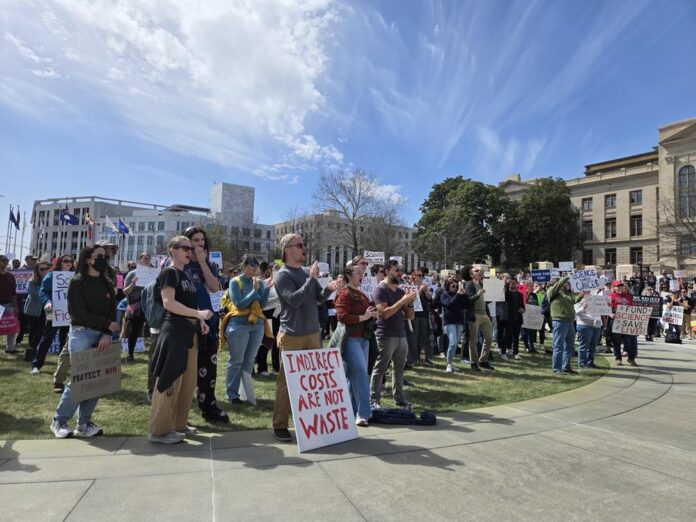
More than 100 scientists, researchers and their supporters showed up for a "stand up for science" rally outside the Georgia Capitol on March 7, 2025.
(Amanda Andrews/GPB News)
More than 100 scientists, researchers and their supporters showed up for the Stand Up for Science rally outside the state Capitol on Friday afternoon.
The protesters were there to speak up for the importance of science and against federal funding cuts made by the Trump administration and spearheaded by the Department of Government Efficiency (DOGE) led by Elon Musk. The event was part of a national day of action in more than 30 U.S. cities, including Washington D.C., New York, and Los Angeles.
“Who is science for? EVERYONE!” rallygoers shouted.
People at the Atlanta event spoke about the importance of vaccines, scientific research, and funding for organizations facing cuts, including the Atlanta-based Centers for Disease Control and Prevention and the National Oceanic and Atmospheric Administration.
Holly Williams worked at the CDC for 20 years. She said she’s hearing through her contacts that the chaos is affecting remaining researchers.
Protesters speak out on March 7, 2025, at the state Capitol against federal funding cuts affecting CDC workers and more as part of a national day of action. (Amanda Andrews/GPB News)
“People cannot do their work,” Williams said. “People get fired. They get rehired, other people get fired. Center directors do not even know how many people are fired because DOGE isn’t telling them.”
Protesters speak out against federal funding cuts affecting workers as part of a national day of action.
Meteorologist John Knox said funding cuts to NOAA will affect private industries, from agriculture to clothing to your favorite weather app.
“Without NOAA and the information that’s gathered and the model output, those private sector firms are going to have to go to the groundhog to ask for forecasts,” Knox said.
Speakers at the rally also included state Reps. Jasmine Clark and Jason Esteves along with college faculty members from Georgia Tech and Emory University.
This article comes to Now Habersham in partnership with GPB News
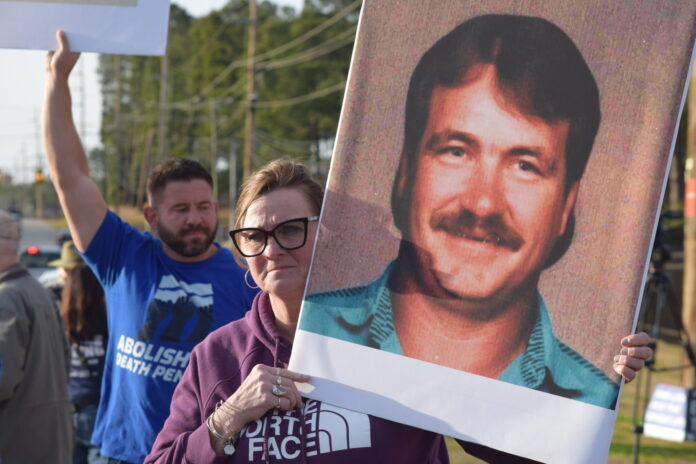
Death penalty protesters outside Columbia’s prison complex hold signs of a young Brad Sigmon, who was executed Friday, March 7, 2025. (Photo by Jessica Holdman/SC Daily Gazette)
“South Carolina has ended the life of a man who has devoted himself to his faith, and to ministry and service to all around him,” read a statement issued by Gerald “Bo” King of the federal public defender’s office on behalf of Sigmon’s legal team.
“Brad admitted his guilt at trial and shared his deep grief for his crimes with his jury and, in the years since, with everyone who knew him,” it read.
Sigmon was convicted in 2002 of killing David and Gladys Larke in their Greenville home, then kidnapping their daughter — his ex-girlfriend, Rebecca Barbare — who managed to escape.
South Carolina justices turned down his final appeal in state court Tuesday. The U.S. Supreme Court issued a denial to intervene less than two hours before his scheduled execution. Gov. Henry McMaster then declined to grant clemency.
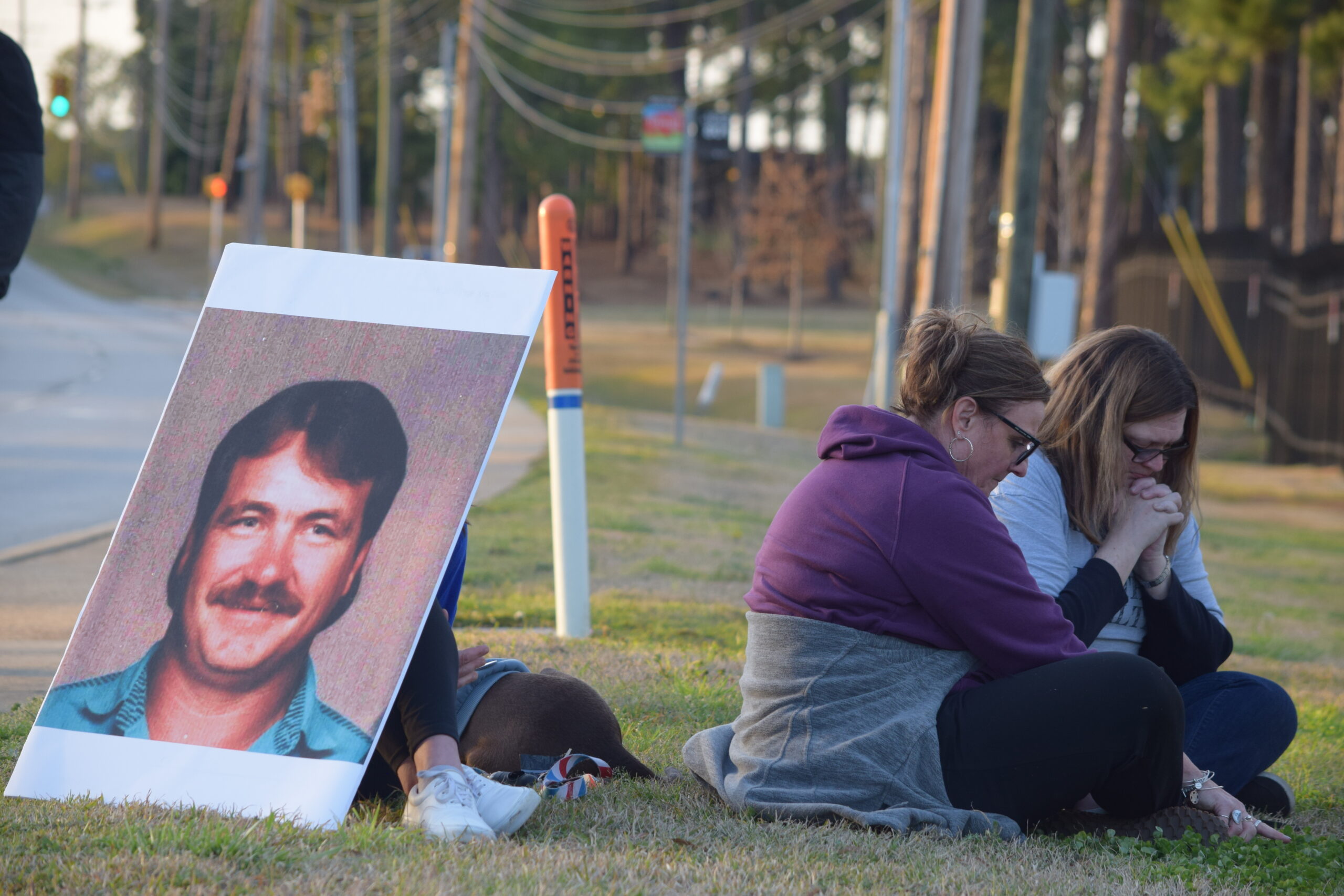
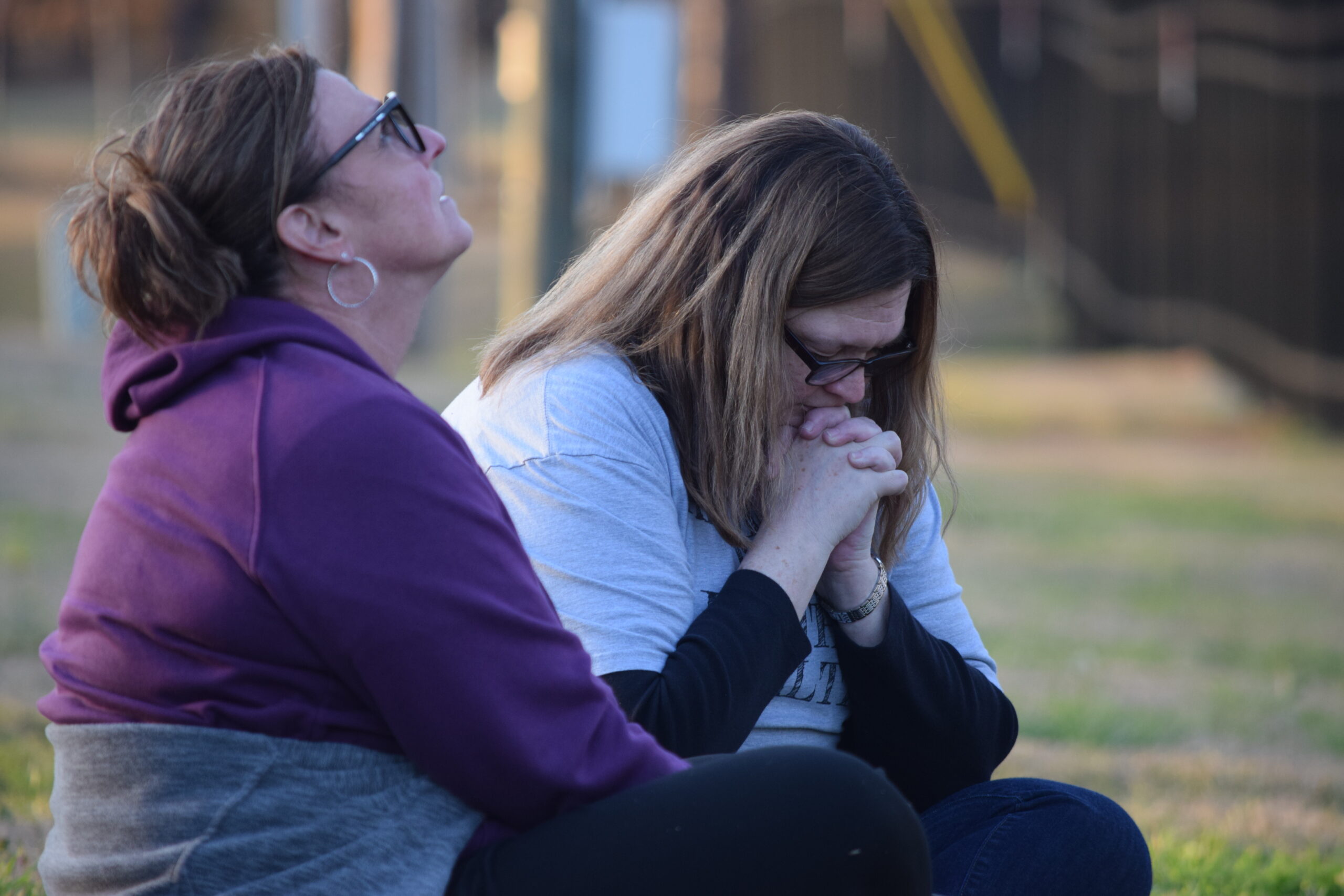
Death penalty opponents pray outside the Columbia prisons complex as Brad Sigmon is executed Friday, March 7, 2025. (Jessica Holdman/SC Daily Gazette)
At 67, Sigmon was the oldest person ever executed in South Carolina. He was also the first person put to death by firing squad in the United States since 2010, when Ronnie Lee Gardner chose the method in Utah.
Three other inmates have been put to death in South Carolina since executions resumed in September following an unintentional 13-year hiatus. All three chose to die by lethal injection.
The execution
The prison agency’s protocol for the firing squad called for Sigmon to be strapped to a chair in the state’s death chamber, facing a rectangular hole in the wall 15 feet away.
His head, chest, arms and ankles were already strapped when the curtain separating witnesses from the death chamber opened at 6:01 p.m., media witnesses said after the execution.
A gaiter mask obscured his mouth. A white target with a red bullseye printed on it covered his heart.
Sigmon looked toward his attorney and appeared to mouth a few words that witnesses couldn’t make out. He and his spiritual advisor, who sat in the front row, nodded toward each other, witnesses reported.
In his last statement (printed in full below), Sigmon reaffirmed the Christian faith to which he committed himself in prison and called for an end to the death penalty.
“An eye for an eye was used as justification to the jury for seeking the death penalty,” Sigmon wrote in the statement read by King. “At that time, I was too ignorant to know how wrong that was. Why? Because we no longer live under the Old Testament law but now live under the New Testament.”
Along with the spiritual advisor and attorney, three unidentified members of the Larke family and representatives from the solicitor’s office and Greenville County Sheriff’s Office watched.
A prison employee placed a black hood over Sigmon’s head that came down to his shoulders, then opened a black shade that had covered a hole in the brick wall.
Sigmon appeared to take several deep breaths.
According to protocol, the firing squad consisted of three volunteer corrections officers, all using live ammunition, aiming for the target over Sigmon’s heart.
At 6:05 p.m., the gunmen shot through the opening. Sigmon’s arm tensed. His chest moved two or three times. The bullets seemed to enter his chest right over his heart, witnesses said.
A doctor entered the room and examined Sigmon for about 90 seconds before declaring his time of death. No blood could be seen beyond a small patch over his heart where the bullets hit, witnesses said.
The execution went faster than previous ones by lethal injection, according to a witness who has seen all four since September.
According to what officials previously told the state Supreme Court, the gunmen used .308 Winchester bullets, which expand and fragment on impact, causing a more “instantaneous” death.
Sigmon’s last meal, which he had Wednesday, was four pieces of fried chicken, green beans, mashed potatoes and gravy, biscuits, cheesecake and sweet tea, said prison spokeswoman Chrysti Shain.
According to his legal team’s statement, Sigmon asked for three buckets of Original Recipe KFC “so he could feed the men locked up with him. That request was denied.”
Protocol requires that all food must come from the prison’s kitchen.
How it became an option
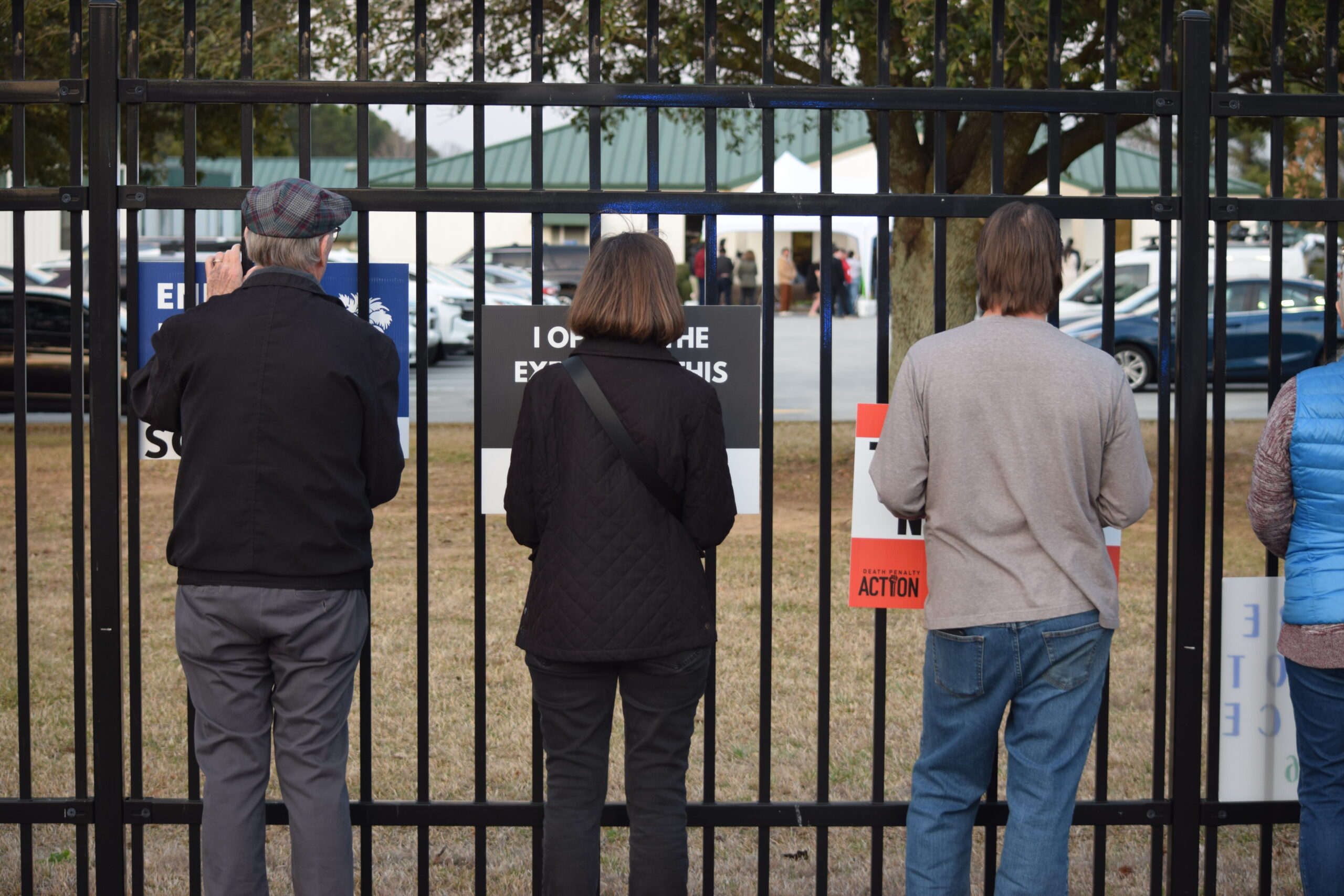
Death penalty protesters press against the fence outside Columbia’s prison complex ahead of the execution of Brad Sigmon on Friday, March 7, 2025. (Jessica Holdman/SC Daily Gazette)
Legislators added the firing squad as an option in 2021, amid struggles to get the drugs needed for lethal injection. The same law changed the default method of execution from lethal injection back to electrocution.
Some, including legislators and attorneys for the state, have argued firing squad is a quicker and less painful death than lethal injection and electrocution. The state Supreme Court ruled in July that firing squad and electrocution were constitutional methods.
Firing squad “comes as close to a ‘painless death’ — not guaranteed by the constitution — as any method of execution is likely to come,” Justice John Few wrote in the majority opinion.
A U.S. Supreme Court justice seemed to agree in a 2017 opinion. Justice Sonia Sotomayor, who’s considered a liberal justice, believed the nation’s high court should halt the lethal injection execution of an Alabama inmate and allow him to die by his preferred method, the firing squad, despite state law not allowing it.
“In addition to being near instant, death by shooting may also be comparatively painless,” Sotomayor wrote in her dissent. “And historically, the firing squad has yielded significantly fewer botched executions.”
Sigmon was the fourth person executed by firing squad since the U.S. Supreme Court allowed executions to resume nationally in 1976. While five states — Idaho, Utah, South Carolina, Oklahoma and Mississippi — allow the method, only Utah has used it in that timeframe, according to the Death Penalty Information Center.
Sigmon’s crime
The evening of April 26, 2001, while drinking and smoking crack cocaine with a friend, Sigmon said he planned to go to the Larkes’ house the next morning to kidnap Barbare and disappear with her after tying up her parents so they couldn’t call the police, the friend later testified.
Barbare had recently broken up with Sigmon, who continued to live in the trailer they had shared on the Larkes’ property. Obsessed with the idea of her dating another man, he had been stalking her, according to court documents.
“Was I obsessed with her? Yes,” Sigmon later testified. “Did I love her? I loved her more than anything in this world. And I didn’t want to lose her.”
Sigmon went to the Larkes’ house the next morning and attacked 62-year-old David and 59-year-old Gladys with a baseball bat. He went back and forth between where they lay in the kitchen and the living room, hitting them in the head repeatedly until both were dead. Each was struck nine times, according to court records.
When Barbare returned home, Sigmon forced her back into her car at gunpoint — using her father’s gun. She opened the door as the car was moving, jumped out and ran. Sigmon shot at her, hitting her once in the foot. After Barbare escaped, Sigmon fled, prompting a manhunt.
Authorities found Sigmon at a campground in Gatlinburg, Tennessee, after using a wire tap on his mother’s phone, which he called while on the lam. He later told police he had planned to kill himself and Barbare, officers later testified.
“I hate what I did,” Sigmon testified. “My family raised me to be better than that. They raised me to do right. And it ain’t the drugs. It ain’t the alcohol. It ain’t (Barbare). It was me.”
Sigmon never denied what he did, even telling the jury during his trial, “I am guilty.” His attorneys gave no evidence to the contrary, but Sigmon decided not to enter a guilty plea because he wanted a jury to decide his fate, according to court records.
“Do I deserve to die?” Sigmon testified during his trial. “I probably do. I probably do.”
“I don’t want to die,” he continued. “It would kill my mom, my brothers and my sisters.”
Final appeals
Sigmon’s attorneys claimed in last-ditch appeals that a jury never heard evidence about his bipolar disorder, brain damage and childhood trauma.
Sigmon’s then-undiagnosed mental illness and trauma caused him to have “a manic and irrational episode akin to a psychotic break,” which led to him killing the Larkes, his attorneys claimed in court filings last month.
But Sigmon’s attorneys did call witnesses to testify about Sigmon’s mental illness, brain damage and trauma during his sentencing, the court wrote Tuesday in denying their request. Even if they hadn’t, that likely wouldn’t have been enough to convince jurors to change their minds, justices wrote.
Sigmon also asked the court to pause his execution long enough to hear arguments as to whether the lethal injection the state used in its past three executions since September is as safe as officials say.
Sigmon didn’t have enough time or information to decide whether lethal injection would be preferable to the other available methods, his attorneys argued. If he knew more about the state’s process, he might have chosen differently, they wrote in petitions to state and federal courts.
Under a 2023 law meant to make it possible for the state to acquire drugs used in lethal injections, nearly everything about the drugs and the protocol is kept secret. Officials have maintained the state has followed that protocol in all three executions performed since September.
Autopsies of Richard Moore and Marion Bowman showed the drug, administered in two doses each time, made the men’s lungs swell with blood and fluid and “causes the sensation of drowning,” the attorneys wrote in their petition Wednesday to the U.S. Supreme Court.
Freddie Moore, before he was put to death by lethal injection in September, opted out of an autopsy for religious reasons.
That swelling, known as pulmonary edema, is common in deaths caused by lethal injection, state Attorney General Alan Wilson wrote in response. Doctors have presented evidence in some cases that the fluid rushing to inmates’ lungs doesn’t occur until after the inmate is already dead, his response continued.
Besides, Sigmon didn’t choose that method, so how it affected other inmates shouldn’t matter to him, Wilson wrote.
David and Gladys Larke
David and Gladys Larke’s children were still counting on them when they died, their children testified during Sigmon’s 2002 trial.
David was helping his son, Darrell Larke, build a house to live in. Gladys was supposed to go to an ultrasound appointment with her pregnant daughter, Renee Smith, two weeks after her death.
Gladys “was counting the days down to find out if it was going to be a boy or girl,” Smith said at the time.
The two were “the center of everything that we did,” Darrell Larke testified.
“Every morning when I wake up, I see his marks at my house, knowing that he will never see that house that he built with me,” Darrell Larke said about his father.
The Larkes had three daughters and two sons. They were both retired, Gladys from clothing factory Stone Manufacturing and David from Renfrew-Kerr Finishing Company, according to their obituaries.
Smith lived next door to her parents and went over every night for dinner. Her dad would always sit in his chair in the living room or on the front porch while her mother cooked, she said.
The family would gather for every holiday. But after David and Gladys died, they stopped, Smith said.
Outside the gates of South Carolina’s Broad River Correction Institution on Friday, March 7, 2025, anti-death penalty activist Hillary Taylor read a yellow highlighted passage from a well-worn Bible given to her by Brad Sigmon ahead of his execution by firing squad. (Jessica Holdman/SC Daily Gazette)
“It just seems like I’m living somebody else’s life, because we used to be a family and it’s just like that part of it is gone,” Smith said.
In a recent interview with USA Today, her first since the crime, Barbare said she didn’t believe in the death penalty but believed Sigmon needed to answer for what he had done.
“The Bible tells you, I know it says ‘an eye for an eye’ and ‘a tooth for a tooth’ but if you read on down in there it says, ‘Revenge is not mine, says the Lord, revenge is God’s,” Barbare, whose last name is now Armstrong, told USA Today. “I don’t think somebody being put to death is gonna bring me closure … It bothers me and gives me anxiety about him being put to death, and especially him picking the firing squad.”
Brad Sigmon
On death row, Sigmon has become known as an “informal chaplain” who mentors other inmates, said Rev. Hillary Taylor, director of South Carolinians for Alternatives to the Death Penalty. He has been known to use his commissary funds to help other inmates who have less than him, said Taylor, who has been Sigmon’s spiritual advisor for the past four years.
Sigmon has long been devout. While he hid out in Tennessee, he brought with him a Bible that he read from, he testified during his trial. He recommitted himself to his faith after his arrest, he told the court.
“That’s all I got left,” Sigmon testified about his religion. “I got nothing else. That’s all I have.”
Once, after completing a course with a church that does services for inmates, he requested that the Bible he was meant to receive go to his 10-year-old grandson instead, according to a letter provided by his attorneys.
“What book is more important then (sic) God’s word,” Sigmon wrote. “I so want him to learn about Jesus while he is still young.”
Sigmon has multiple penpals, some of whom he has been exchanging letters with for over a decade, Taylor said. He has asked some of those penpals to send him books of jokes that he can use to make other inmates laugh, she said.
Sigmon was close with his son, Robbie Sigmon, the son testified during Sigmon’s trial. One year for Robbie’s birthday, Sigmon skipped paying his insurance bill so he could buy a dirt bike, his son testified.
“We used to play all the time,” Robbie Sigmon said. “He’d come home from work, and he’d play outside with us. Me and my daddy had a good relationship.”
As the oldest of five siblings, Sigmon learned to care for his family from a young age, Taylor said. He began working in a factory as a teenager to help pay for food. When a younger brother was injured and struggled to walk, 13-year-old Sigmon would carry him on his back, Taylor said.
“He was always the peacemaker,” Sigmon’s father, Ronnie Sigmon, testified during his trial. “That’s what’s so shocking about all this. He’s the one that stopped the fights.”
The statement issued by Sigmon’s attorneys after he was executed noted that he was never violent in his 23 years on death row.
“Brad devoted himself every day to prayer and repentance,” it read. ” In these last days of his 23 years on death row, Brad spent hours kneeling on the floor of his cell so he could write letters to the family and friends for whom he has been a wellspring of love and support.”
Death penalty opponents pray outside the Columbia prisons complex as Brad Sigmon is executed Friday, March 7, 2025. (Jessica Holdman/SC Daily Gazette)
Sigmon’s last words
“I want my closing statement to be one of love and a calling to my fellow Christians to help us end the death penalty.
An eye for an eye was used as justification to the jury for seeking the death penalty.
At that time, I was too ignorant to know how wrong that was. Why? Because we no longer live under the Old Testament law but now live under the New Testament.
Matthew 5:38-39 says “You have heard that it has been said, ‘An eye for an eye and a tooth for a tooth’ but I say unto you that you do not resist an evil person. Whosoever shall smite me on the right cheek, turn to him the other one as well.”
Romans 6:14, “For sin shall not have dominion over you, for you are no longer under the law but under grace.”
Nowhere does God in the New Testament give man the authority to kill another man.
That is why the Bible is divided into the Old Testament and the New Testament.
Remember the words of Jesus, John 7:19, “Did not Moses give you the law? Yet none of you keep with the law.
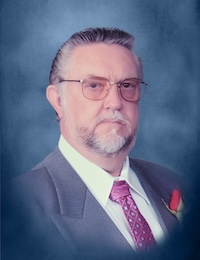
Autumn Elizabeth Shiffer Brannon, age 46, of Toccoa, passed away Friday, February 28, 2025.
Born September 22, 1978, in Toccoa, she was a daughter of Paul and Dianne Turner Shiffer.
Autumn was a member of Tates Creek Baptist Church and was employed with 1st Franklin Financial. She was a graduate of Stephens County High School and Toccoa Falls College. She enjoyed crocheting and many people have been blessed by her handiwork. But her most valued treasure was her personal relationship and faithful service to Jesus Christ and her family, especially her sweet boys. Her kind spirit radiated to all those around her. To know her was to love her.
Family members include her husband, Dustin “Dusty” Brannon; two sons, Nathan Brannon and Ethan Brannon; her parents, Paul and Dianne Shiffer; her siblings, Marie Wilson, April Veronica Stowe (Gregory), and Andrew Shiffer (Alexa); She was loved by her nieces, Lauren Stowe and Rowan Robinson; her nephews, Dylan Hendrix, Cooper Garrett, Eian Vawter; and many uncles, aunts, and cousins.
The family will receive friends at the mortuary from 2—4 p.m. and 5—8 p.m. on Friday, March 7, 2025, and from 12—1:15 p.m. on Saturday, March 8, 2025.
Funeral services will be held at two o’clock on Saturday, March 8, 2025, at Tates Creek Baptist Church, with the Rev. Jerrell Beatty officiating.
Burial will be in the church cemetery, and Rev. Brandon Crunkleton will officiate at the graveside.
In lieu of flowers, a Venmo account has been set up to help Autumn’s boys, Nathan and Ethan. Venmo@Dustin-Brannon-4.
Please keep the family in your thoughts and prayers and sign the online guestbook at www.whitlockmortuary.net.
Whitlock Mortuary, Funerals and Cremations is honored to be serving the family of Autumn Elizabeth Shiffer Brannon.
Brannon Chitwood, a devoted husband, father, grandfather, and great-grandfather, went home to be with the Lord on Thursday, March 6, 2025, at the age of 78. Born on October 10, 1946, in Demorest, Georgia, Brannon made a profound impact on the lives of those around him throughout his remarkable journey.
Brannon was known for his steadfast dedication to his family and community. He spent his professional career with Habersham Mills and Russell Corporation before transitioning to Chambers Realty, where he continued to build lasting relationships founded on respect and integrity. His commitment to his work was paralleled only by his loyalty to his loved ones.
A member of Cool Springs Church, Brannon’s faith was the cornerstone of his life. He cherished his time spent in prayer and fellowship, continually offering support and encouragement to those in need.
Brannon had many interests, including a love for flea markets and fishing. However, nothing brought him more joy than spending quality time with his family, creating memories that will be cherished forever. He leaves behind his beloved wife, Brenda Ausburn Chitwood, with whom he shared 58 wonderful years of marriage. His legacy continues through his daughter, Belinda Chitwood Loudermilk, and his son, Shannon Chitwood, along with his daughter-in-law, Linda Chitwood. Brannon took immense pride in his grandchildren, Breana Meister and her spouse Nic, Shelby Fowler and her spouse Daniel, Danielle Owenby and her spouse Ricky, Dawson Chitwood and his spouse Chelsea, and was delighted by his great-grandchildren, Kimber, Kash, and Kora Meister, as well as Brannon Chitwood and Olivia Owenby.
Brannon is also survived by his siblings, including brothers Ben Chitwood and his wife Judy, Clint Chitwood and his wife Debra, Kelvin Chitwood and his wife Suzanne, and sisters Beatrice York and her husband Bobby, Phyllis Trotter and her husband Barry, Carolyn Wilkes and her husband Charles, along with sister Lesia Long. He is cherished by numerous nieces, nephews, and other relatives and friends, all of whom will miss his warmth and generosity.
Brannon was preceded in death by his parents, Philip Chitwood and Ossie Mae Coker Chitwood, whose love and guidance shaped the man he became.
Visitation for Brannon will be held on Saturday, March 8, 2025, from 6:00 PM to 8:00 PM at McGahee-Griffin & McEntire Funeral Home in Cornelia. A graveside service will take place on Sunday, March 9, 2025, at 2:00 PM at Cool Springs Church Cemetery in Clarkesville.
As we remember Brannon, we celebrate a life richly lived, filled with love, laughter, and an unwavering commitment to family and faith. His spirit will forever be a guiding light for those who knew him.
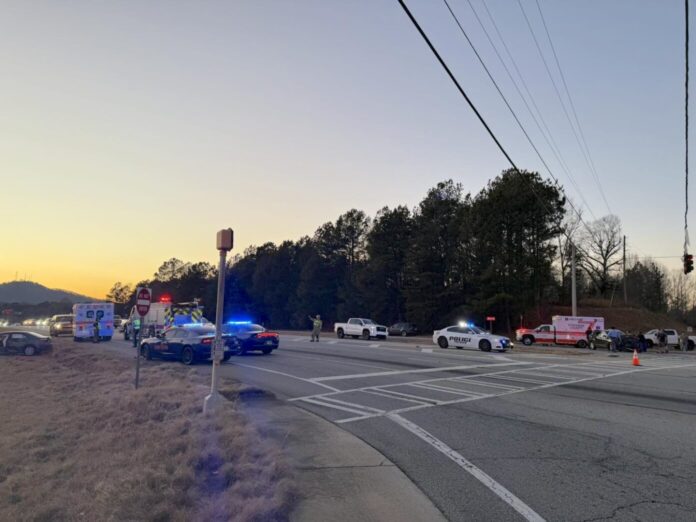
Toccoa Bypass and Highway 106 intersection after a wreck that killed the daughter of a retired Stephens County Sheriff's Office deputy on Friday, Feb. 28 (Stephens County Sheriff's Office/Facebook)
Funeral services will be held this weekend for the daughter of a longtime – now retired – Stephens County deputy who was killed last week in a wreck on the Toccoa Bypass.
The two-vehicle collision that killed Autumn Brannon happened Friday evening, Feb. 28, at the intersection of GA 17 North and GA 106/Mize Road.
According to authorities, 19-year-old MacKenzie Howell of Toccoa was westbound on Highway 17 in a Jeep Cherokee. State troopers say Howell ran the red light at the intersection, and the Jeep struck the side of a Toyota Corolla driven by Brannon, also of Toccoa.
The 46-year-old Brannon died as a result of the crash. Her father, Paul Shiffer, served over 40 years in law enforcement – much of that time was spent at the Stephens County Sheriff’s Office.
Sheriff Rusty Fulbright shared the sad news of Brannon’s passing on social media and extended his condolences “to all parties involved in this tragic incident.”
“Prior to his retirement, Paul faithfully served the citizens of Stephens County with our Patrol and Civil Divisions. Their family’s loss is felt by many, including Paul’s law enforcement brothers and sisters here in Stephens County,” Sheriff Fulbright said. “Please join us in keeping these families in your prayers.”
According to her obituary, Brannon was employed at 1st Franklin Financial. She is warmly remembered as someone whose “kind spirit radiated to all those around her. To know her was to love her,” her family said.
Brannon leaves behind her husband, Dustin, and two sons. Her funeral is scheduled for 2 p.m. on Saturday, March 8, at Tate’s Creek Baptist Church.
The Georgia State Patrol is still investigating the fatal crash.
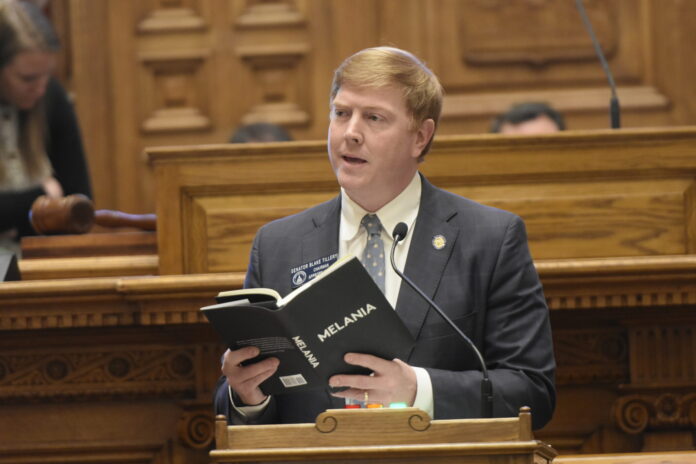
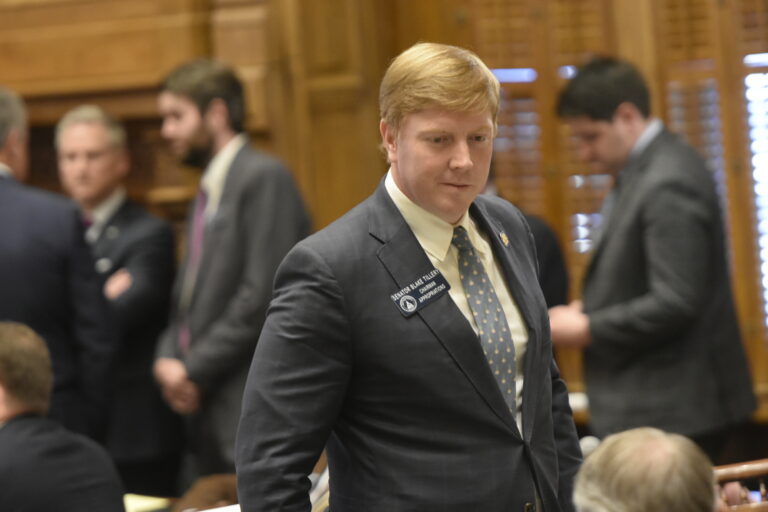
Sen. Blake Tillery. Reads from First Lady Melania Trump’s book, in which she said she was debanked. Tillery’s debanking bill failed in the Senate by a wide margin. (Ross Williams/Georgia Recorder)
(Georgia Recorder) — Georgia lawmakers passed a heap of bills by a key legislative deadline Thursday, signing off – again – on an accelerated income tax rate cut and a plan to slightly expand the state’s medical cannabis program while attempting to ban THC-infused drinks.
But by the end of the day, many high-profile proposals were left on the cutting room floor, for now.
A late push in the House to legalize and regulate online sports betting never made it to the floor for a vote Thursday.
And a proposal to overhaul how the state compensates those who are wrongfully convicted in Georgia showed new signs of momentum this year but ultimately did not get a vote Thursday.
Rep. Scott Holcomb. (Ross Williams/Georgia Recorder)
“I’m definitely very disappointed. I think it’s a missed opportunity to improve the system,” said Rep. Scott Holcomb, an Atlanta Democrat and co-sponsor.
House lawmakers did, however, overwhelmingly pass a measure that included individual compensation resolutions for five people who served time in prison after being wrongfully convicted. That measure, House Resolution 128, passed with a 151-12 vote and now moves to the Senate.
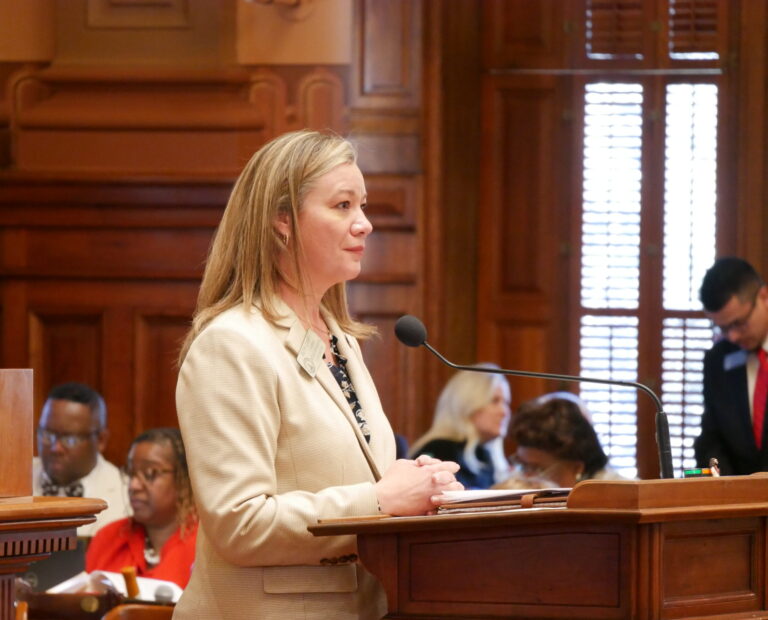
“Each of these men were denied their opportunity to an education, to build a career, relationships and family time, to seek a financial future for themselves and their loved ones,” said the bill’s lead sponsor, Rome Republican Rep. Katie Dempsey.
“Compensation will not buy back those opportunities or those years, but it will help them move forward, and it is the least we can do,” she said.
Dempsey said afterwards that she is still hopeful that the bill overhauling the process can pass this year through legislative maneuvering.
“It’s not over until day 40,” she said, referring to the final day of the legislative session on April 4.
DEI ban dies
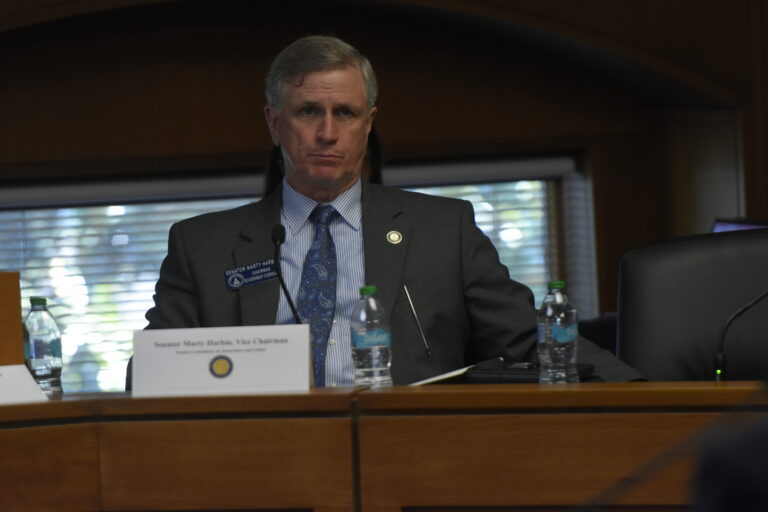
Sen. Marty Harbin. (Ross Williams/Georgia Recorder)
Another crossover dud was Tyrone Republican Sen. Marty Harbin’s Senate Bill 120, which seeks to ban K-12 schools and colleges from promoting, supporting or maintaining “any programs or activities that advocate for diversity, equity, and inclusion.”
The controversial bill was on the calendar of bills to be voted on Thursday, but when Lt. Gov. Burt Jones banged his gavel to signal it was time to go home, the DEI bill had still not been voted on.
Harbin said there were some changes that needed to be made but declined to say what they were. He implied that the bill could come back in 2026, which is the second in this two-year legislative cycle.
“We got down tonight, and we had our last proofing of the reading, and we said there’s some things we need to make right. This is a biennial. We’d rather do it right than do it halfway,” he said.
Harbin also declined to say that the bill would not be grafted onto other legislation later this year.
While Crossover Day is mostly do or die, dead bills can sometimes be revived before the end of the session by attaching language from the deceased legislation onto a related bill. That could happen any time before April 4, the last day of the session, also known as sine die.
That’s what Grayson Democratic Sen. Nikki Merritt said she fears will happen.
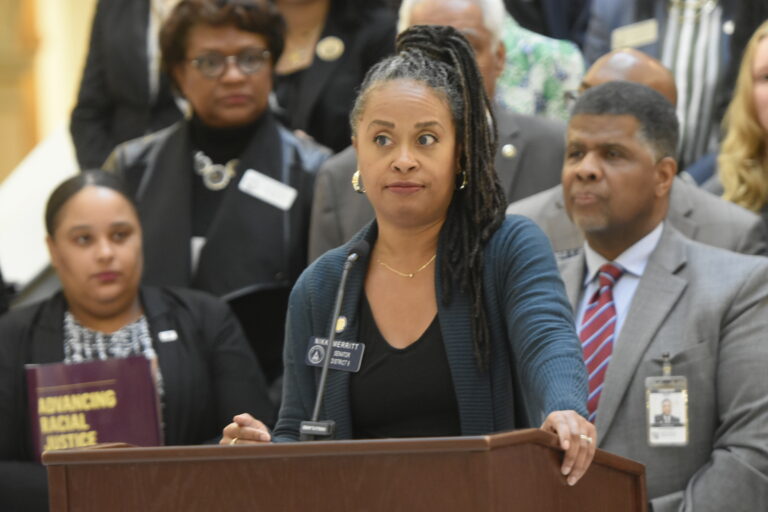
Sen. Nikki Merritt. (Ross Williams/Georgia Recorder)
“Yeah, it could get zombie’d again,” she said. “So I’m going to tell you, we’re going to stay vigilant. I’m going to keep my eye out and we’re going to continue to tell our educators and the public, we’re going to continue to call to action, it’s not over until we sine die, and really it’s not over until next year because it can come back, if it stays alive or gets attached to something, it’s still in play until we’re done for the biennium.”
Still, Merritt said she would be smiling on her drive home from the Capitol Thursday night.
“As a minority party, we don’t get a lot of wins, and it’s really hard for us to push back once it comes out of (the rules committee) or it gets to the floor, we kind of never know,” she said. “So I do feel like this is a win for now, and it’s the power of getting the public engaged.”
Gutting local gun ordinances
Georgia cities and counties that attempt to institute gun safety measures could be subject to steep fines under a bill that passed the Senate Thursday.
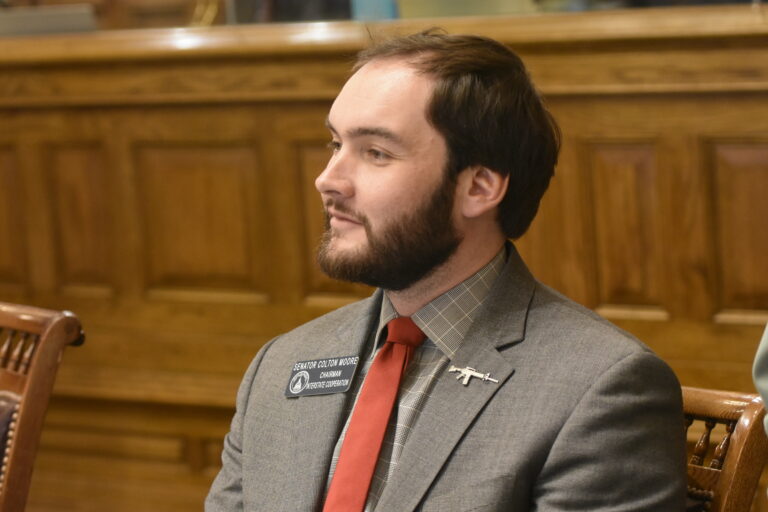
Northwest Georgia Republican Sen. Colton Moore’s Senate Bill 163 would allow people aggrieved by local gun regulations to recoup actual damages or up to $50,000, whichever is greater. That’s up from $100 under current law.
Sen. Colton Moore. (Ross Williams/Georgia Recorder)
Moore indicated his bill was a response to a Savannah ordinance requiring people traveling with guns to keep them locked up and out of sight when the vehicle is parked.
“When citizens in northwest Georgia go to a place like Savannah, and there is a mayor there who has put in ordinances that violate their Second Amendment rights, my piece of legislation simply says that those citizens, just like your citizens, have a right of tort to sue those governments for violating those rights,” Moore said.
Democratic Sen. Derek Mallow, who represents Savannah, said the ordinance was a reaction to more than 200 guns being stolen from unlocked cars in 2024.
“Dr. King said you cannot legislate morality, you can only legislate behavior, and so what the city of Savannah did was to try to create some recourse to have folks just lock their vehicles if they’re going to leave a loaded firearm in their vehicle,” he said.
The bill passed 33-23 along party lines. Senators rejected a Democrat-sponsored amendment to require guns to be locked up in places where minors may be present.
Debanking debunked after lengthy debate
After more than an hour of debate, a bill authored by the powerful Senate Appropriations Committee Chair Blake Tillery failed 43-13.
Tillery’s Senate Bill 57 seeks to outlaw ideological debanking or banks shutting down accounts of people based on their ideology.
The bill would also prevent providers of essential services like water and power from cutting off services to people for ideological reasons.
Sen. Blake Tillery. (Ross Williams/Georgia Recorder)
Some prominent conservatives and tech founders, including first lady Melania Trump, have claimed they were debanked under the Biden administration, but it’s not clear whether the alleged debanking was for ideological reasons or because the banks had issues with their investments or some other problem.
Many of Tillery’s fellow Republicans had problems with trying to meddle with banks.
“This is a bill that has some good ideas, but it’s looking for a place to land and it does so in a really, really bad way,” said Senate President Pro Tem John Kennedy. “One of the problems is, passage of this bill puts banks in a horrible position because, as the bankers have said, nine times out of ten when they choose to either not bank somebody or sever a relationship with a client, they can’t talk about under federal regulations why they made the decision that they made. So this puts them in a horrible position of not being able to explain the decision that was made but yet leaves them fully exposed to being sued about it.”
House backs bill banning pop-up sales of dogs, cats and rabbits
A proposal to crack down on unscrupulous breeders sailed through the House.
The bill, sponsored by Concord Republican Rep. Beth Camp, would ban the practice of selling dogs, cats and rabbits along the roadside, in parking lots, on sidewalks, seasonal flea markets and other areas that tend to be hotspots for unlicensed breeders who prioritize profit over the wellbeing of the animals in their care.
Rep. Beth Camp, a Concord Republican, is sponsoring a bill that would ban the practice of selling dogs, cats, and rabbits from roadsides, parking lots, and other locations. (Jill Nolin/Georgia Recorder)
Breeders would still be able to sell dogs, cats and rabbits from their home, business, a veterinarian’s office or other designated locations, like outside a police department.
Camp described the measure as a “consumer and animal protection bill” that creates a legal pathway for legitimate breeders and makes it harder for puppy mills to sell in Georgia.
And she argued her bill might help ease the strain on Georgia’s public animal shelters.
“Often animals that are purchased on impulse in parking lots and later found to have poor health end up in animal shelters, which cost every single one of us tax wise,” Camp said.
The bill passed 161-13 Thursday and now heads to the Senate.
Senate advances ‘doxxing’ bill
The Senate backed a bill Thursday that would make it a criminal offense for so-called doxxing, the act of recklessly posting someone’s personal information that places them at risk of being stalked or injured.
Roswell Republican Sen. John Albers presented Senate Bill 27, which he said would provide some teeth for fighting a chilling crime that can put unsuspecting people in dangerous situations. He said the intent is not to infringe on an individual’s freedom of speech.
Sen. John Albers. (Ross Williams/Georgia Recorder)
“Doxxing is a contemporary and pernicious form of harassment involving publicizing private information of individuals on the internet, usually with malicious intent,” Albers said. “It’s a gross violation of your privacy, resulting in emotional distress, reputational damage, and, in many cases, physical harm.
“This bill takes a step in the right direction towards securing the digital safety of all Georgia citizens and sends a clear message that Georgia will not tolerate online harassment,” Albers said.
If the doxxing bill becomes law, the first conviction would result in a misdemeanor. However, the penalties could increase to an aggravated felony if there is significant harm caused to the victims or with subsequent violations. A person convicted of aggravated doxxing will be sentenced to one to three years in prison and up to a $10,000 fine.
Sen. Sonya Halpern, an Atlanta Democrat, said she supports SB 27 because neither a public official or private citizen should be fearful of having their personal information weaponized against them. She said the legislation strikes a “delicate balance of safeguarding freedom of speech while acknowledging the seriousness of the crime.”
Georgia Recorder freelancer Maya Homan contributed to this report.
A collaborative effort between the Stephens County Sheriff’s Office Crime Suppression Unit and the Appalachian Regional Drug Enforcement Office (ARDEO) Drug Task Force led to a significant drug bust on Celtic Drive in Eastanollee on Thursday, March 6, according to authorities.
The investigation, sparked by a tip from a concerned citizen, focused on 65-year-old Gary Marvin English, of Eastanollee, who police say was suspected of selling illegal narcotics.
At 9:55 a.m. Thursday, law enforcement officials from the Crime Suppression Unit, ARDEO Drug Task Force, Toccoa Police Department detectives and state probation officers executed a search warrant at English’s residence.
Upon making contact with English, investigators allegedly discovered a substantial amount of suspected methamphetamine in his pocket, prompting a more extensive search of the property.
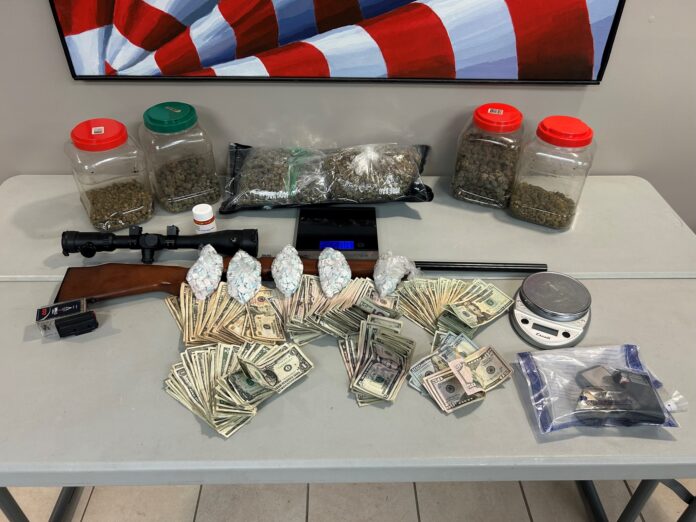
During the search, authorities allegedly seized around 240 grams of suspected methamphetamine, $4,572 in cash, 21 firearms and a significant quantity of ammunition.
English was arrested and charged with multiple offenses, including possession of methamphetamine with intent to distribute, trafficking methamphetamine, three counts of possession of a firearm during the commission of a crime, and five counts of possession of a firearm by a convicted felon.
A 65-year-old female, identified as Sandra Ostiguy of Toccoa, was also arrested during the operation. She faces charges of possession of methamphetamine with intent to distribute, trafficking methamphetamine and possession of a firearm during the commission of a crime.
Both suspects were transported to the Stephens County Jail following their arrests.
A Hartwell man was arrested after a raid that allegedly led to the seizure of a large amount of drugs, according to the Hart County Sheriff’s Office.
The Hart County Sheriff’s Office executed the search warrant at 560 Slaton Avenue in Hartwell on Friday, March 7, according to police.
During the operation, authorities allegedly seized a significant amount of illegal substances and a firearm.
The search allegedly led to the discovery of 953 Ecstasy pills as well as approximately 2.8 pounds of marijuana. A firearm also was allegedly found on the premises.
After the raid, Johnny LaQuintin Carter, 45, of Hartwell, was arrested and faces multiple charges, including: trafficking ecstasy, possession of marijuana with intent to distribute, possession of a firearm during the commission of a crime and possession of a firearm by a convicted felon.
Police say additional charges are expected as the investigation continues.
The investigation is ongoing, and further details could be provided as they become available.
Clarkesville Police Department is asking for the public's help in identifying this man. (Clarkesville Police Department Facebook)
The Clarkesville Police Department is asking for the public’s assistance in identifying a man wanted in connection with identity theft, according to Clarkesville Assistant Police Chief Ryan Ledford.
Ledford provided what details were available about the case. The suspect allegedly withdrew $4,900 from an account at one of the banks in Clarkesville. The suspect had all of the necessary information required to fraudulently withdraw the money. “He had a lot of information on the victim,” Ledford said. “It obviously appears to not be his first time doing something like this.”
After the incident occurred, the bank notified area banks of the suspect. According to Ledford, the suspect attempted to do the same thing at a bank in the Dahlonega area. By that time, the account was blocked and the suspect fled the bank, leaving the fraudulent identification.
The Clarkesville Police Department asks that if you have any information on the identity of this subject or know his whereabouts, please contact the Clarkesville Police Department at 706-754-5390.
The city of Baldwin has lifted the boil water advisory that had been in effect since Monday afternoon, March 3.
According to city officials, bacteriological samplings collected from several sites in the area tested negative for the presence of harmful bacteria.
The city issued the boil water advisory for part of its water system due to a water main break in the 6000 block of Old Highway 441 which caused water supply issues or caused low water pressure in parts of the water system.
The advisory was issued out of an abundance of caution due to the potential a health hazard may exist due to microbial contamination in these areas without positive pressure.
The affected areas were in Banks County and for Baldwin water customers on the following roads: Old 441 from the 6000 block to Rock Springs Road, GA 105, Otis Brown Road, Harmony Church Road, Soapstone Road, Simmons Road, Wynn Lake Road, Trotters Glen, and Cotton Tail.
Those in the affected areas were advised to bring water to a rolling boil for two minutes before brushing their teeth, drinking, cooking, or preparing baby food with it.
The Georgia Senate approved a bill on Thursday that would significantly enhance criminal penalties for students who make threats against their schools. Senate Bill 61, introduced by Republican lawmakers, passed in a 33-22 vote.
The bill, sponsored by Sen. Greg Dolezal, R-Cumming, and other leading Republicans, will now go to Georgia’s House of Representatives.
The bill comes in the wake of the Apalachee High School shooting in early September that left four dead and nine injured.
The legislation targets students aged 13 to 17 and would enable them to be tried as adults for charges of terroristic threatening. It also would allow young offenders to face superior court if they attempt to commit or conspire to commit terroristic threatening.
Under the new law, crimes such as aggravated assault with a firearm and armed robbery could be prosecuted in a higher court, carrying more severe consequences for offenders.
Superior courts also would gain exclusive original jurisdiction over cases involving terroristic threats or acts targeting public and private schools, as well as attempts or criminal conspiracies to commit specific offenses. These cases would be subject to the Class A designated felony provisions under the bill, if approved.