ORLANDO, FL – Piedmont women’s tennis concluded its Orlando Spring Break trip with another win, besting Loras College 6-1 on Thursday afternoon into the evening.
The Lions bounced back after dropping the doubles point with a few dominant singles wins from the bottom of the lineup, taking all six lines overall to remain just once beaten on the season.
The Duhawks jumped on the Lions to start, however, winning at No. 1 doubles (6-2) and No. 2 doubles (6-4) to take the opening point. Piedmont did win a hard-fought battle at No. 3 doubles as Caroline Morrison and Abby Gayle Moody prevailed 7-5.
Singles action saw Piedmont flip the script, led by the freshman Morrison, who blanked her opponent 6-0, 6-0 at No. 3 singles to even the match at 1-1.
Then, it was the senior Bri Laidman’s turn, as she dispatched her opponent 6-2, 6-3 at No. 2 to make it 2-1 Lions. Jordan Ballard was next, with a 6-2, 6-1 victory at No. 4 to put Piedmont a point away from clinching the match.
That clinch came from sophomore Olivia Carpenter, who delivered a clinical 6-2, 6-2 win to put another win in the books for Piedmont.
Closing things out, freshman Sarah Sanabia won 6-2, 6-2 at No. 6 before Alyssa McSpadden won a lengthy match at No. 1, 7-5, 4-6, 1-0 (6).
Up next, the Lions will have over a week off from competition before returning to the home courts to host Maryville on Saturday, March 22 for Senior Day.
Standout performances:
Morrison’s 6-0, 6-0 win keeps her perfect dual singles season alive. She has also lost a total of three games over her last three matches.
After recently setting the Piedmont record for career singles wins and career total wins, McSpadden won again on Thursday, improving to 8-1 at No. 1 singles.
The TFS Indians stormed back with a 7-run sixth inning in what ended as a 14-11 game that went in favor of visiting Bethlehem Christian on Thursday night.
The visitors put up three in the second before TFS matched that in the home half. BJ Carver had an RBI single and Ashton Roache a sac fly to even the game.
Bethlehem went for two in the third, one in the fourth, two in the fifth, and six in the sixth inning to take a commanding 14-3 lead. Tallulah Falls battled back with seven runs in the home half, highlighted by a 2-run single from Diego Gonzalez and an Andrew Skvarka RBI hit. Cash Unruh singled in a run in the last at-bat as well.
Carver and Gonzalez each had two hits and two RBI, while Roache had two RBI and a pair of runs scored. The Indians had seven batters reach base via hit by pitch. Chase Pollock took the tough loss on the bump, while Drew Barron pitched the final two innings.
The Indians moved to 2-5 overall and 0-2 in district play.
Georgia House Education Committee Chair Rep. Chris Erwin (R-Homer) supports weighting school funding to account for poverty. A former educator, he served as superintendent of Banks County Schools before being elected to state office. (Ross Williams/Georgia Recorder)
ATLANTA (Georgia Recorder) — For a long time, education advocates under the Gold Dome have lamented that Georgia is one of only six states that does not allocate specific state funds to help educate students living in poverty. That could soon be changing – kind of.
What those advocates want is a change to the Quality Basic Education formula that determines the state share of education funding distributed to local schools. The QBE formula provides weighted amounts of money per student based on things like their grade level and whether they qualify for programs like special education or gifted services.
Sending more dollars to children whose families are struggling with poverty, also known as a poverty weight, could help them chart a path toward a better life and help districts focus on teaching.
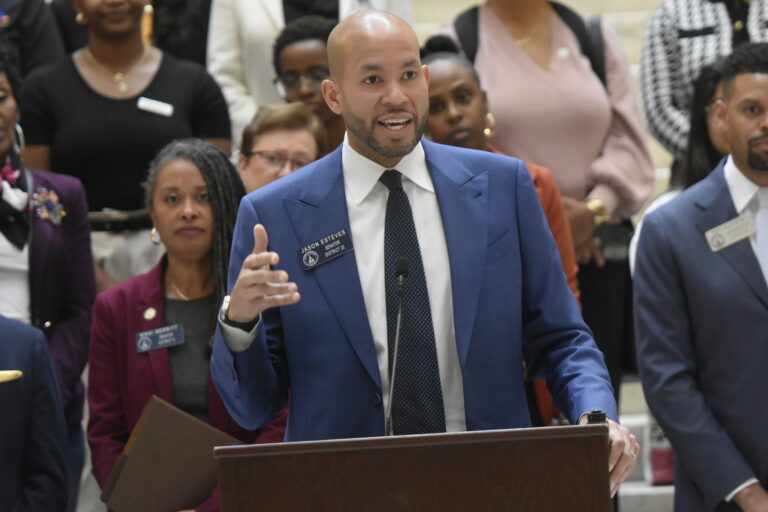
Sen. Jason Esteves (Ross Williams/Georgia Recorder)
“What school districts have had to do is they’ve had to create new schedules, they’ve had to literally have health clinics in schools to provide health care. They’ve had to host job fairs for parents” said Sen. Jason Esteves, an Atlanta Democrat who previously served on the Atlanta Board of Education. “They’ve had to do all of these things to try to play catch up for some of the issues that these parents and these families are experiencing in the community, and if we want our school systems to focus on the number one thing they should be focused on, which is educating students, then we have to do what we can to remove these barriers that poverty introduces.”
Speaking before a Senate committee Thursday, Georgia Department of Education Chief Financial Officer Rusk Roam said the department estimated a poverty weight would come with a price of about $300 million.
The $37.7 billion budget that passed the House Tuesday includes $28 million in grants designated for school systems for “targeted support to economically disadvantaged students,” according to a document released by the House Budget and Research Office.
House Education Committee Chair Chris Erwin, a Homer Republican, said he hopes the $28 million will open the door to a full poverty weight in the education formula.
“Currently this is a one-time grant, but I see we’re moving towards – we’re one of six states that do not have some type of poverty weight within their formula, and this is our opportunity to look at the impact that that could have, so I would hope that we would continue to go down the road of understanding the importance of providing this to students that come in from a low wealth area,” he said.
“This is something I wish we did 15 years ago, but we are beginning that process with this, and I think it’s going to end up to be very impactful for those students and for their lives going forward,” he added.
Esteves struck a similar tone. He said he thinks the 40-year-old QBE is in serious need of an update, but he’s glad that the Legislature could be taking action to support kids living in poverty.
“The fact that we are now including a little bit of money as a poverty weight is a big deal. It’s a good first step, but there’s a long way to go to actually meet the need that we have,” he said.
Experts say meeting that need will require a great deal of work – taking into account issues like differing levels of poverty, differences between rural and urban school districts and what kind of reporting requirements there ought to be.
Ashley Young, senior education analyst for the Georgia Budget and Policy Institute, said she’s grateful for the prospective new funds.
“$28 million is certainly going to be useful to help students who are low-income. I do think that it could have major changes for students who do not have their basic needs met and are coming to school in these circumstances,” she said. “And so having that additional money could be helpful. This is what we feel like is a good start, but a start nonetheless. And there does need to be a more comprehensive focus in our QBE funding to address this so that it is recurring, so that it has a specific line item or a specific weight that is present within the formula to ensure that students have what they need.”
The budget is now in the Senate’s hands, where it could undergo revisions. The chambers will need to agree on a final version before the legislative session ends April 4.
The Sharing and Caring Thrift Store in Clarkesville is located at 110 Camelot Way. (Joy Purcell/NowHabersham.com)
The Savvy Picker travels around the Southeast looking for vintage merchandise to stock in her brick-and-mortar and online shops. Last year, which included a new addition to her family, ended up being her busiest year yet, so she didn’t have as much time as usual to write about her thrifting adventures but is happy to return to Now Habersham to share the great deals she found at The Sharing & Caring Thrift Store in Clarkesville, Georgia.
Keep reading to check out her hauls and pick up a few tricks of the trade.
Worth the wait!
I stumbled across the Sharing & Caring Thrift Store in Clarkesville after pulling out of the Habitat Re-Store parking lot. After all, it was directly in my path. I couldn’t miss it, especially with the big banner near the door announcing their 40th year of being open. It was 9:51 a.m. when I parked my car alongside several others already parked in the lot and strode up to the door—only to discover the store didn’t open until 10:00! Thus, I commenced peeking in the windows to see if the store was worth the nine-minute wait.
Unfortunately, the large windows were all lined with some type of shiny mirroring stuff, so all I could see was myself peeking back at me, and since I already know I’m no bargain, I headed back to my car to wait it out.
I do believe these mirrored windows are clear enough to tweeze your eyebrows from, but I was careful to stay out of them for the photo! (TheSavvyPicker.com)
Thirty seconds later, the folks in the car next to me headed to the door and started forming a line that included several others who had exited their vehicles in the half-minute I’d been sitting back in mine! (Alas! I could have been first!) But since, in my experience, if there’s a line at a thrift store, it usually pays to get in it, I hopped out of the car again and took my place behind the last person.
I’ve never been great at waiting, so I made small talk with the folks in line, asking what kind of items the store carried. Once the crowd confirmed that the store had housewares in addition to clothes and furniture, I kept my place and was among the first dozen customers to enter when the store opened at 10 a.m. Homing in on a shelf full of housewares to the right, I headed in that direction.
These shelves in the foreground led the way to a room full of items, which you can see in the background. (TheSavvyPicker.com)
It pays to keep notes
I found a couple of cool things on the first shelf I passed, including the large cloisonne bell you can see nestled among other bells in the photo above and the tall, narrow woman vase a little further down, as I made my way to the larger room stocked with loot. There, I picked up an adorable retro suitcase for $5 that lasted less than a weekend priced at $25 in my shop, and a retro typewriter for only $5 that I sold for $35 to a loyal customer back home entered in my phone as “Typewriter Guy.”
A note about loyal customers here. It pays to keep notes on what people are looking for. When our customers at the shop show interest in something or say they are looking for something in particular, we ask if they want us to take their names and numbers.
In the year and a half or so since Typewriter Guy left his name, I’ve probably sold him 10 typewriters for varying prices. He repairs them himself and is interested in every machine, as he calls them. (Typewriter Guy, if you are reading this, I’m sorry I don’t know your name, but please remember the vintage typewriter Christmas ornament I gifted you and your wife this year and try to forgive me!)
Anyway, once I grabbed that sure-to-sell typewriter, I realized I needed one of those shopping buggies I’d blown past when hurrying through the doors. I went back to get one, but they were already all gone. Darn it! Luckily, the nice lady at the register had pity on me as she watched me struggling to carry the suitcase, the typewriter, two large retro banks, the narrow lady vase, and the bell! She offered to let me make a pile on the floor next to her while I continued shopping. I took her up on the offer.
This Snoopy bank and a large Pikachu bank I found at Sharing and Caring sold quickly for $20 each in my shop. (TheSavvyPicker.com)
Hands free, I went back to shopping and picked up a brass pineapple lamp and a gorgeous hand-thrown pottery pitcher.
Another great find at Sharing and Caring in Clarkesville, Georgia. (TheSavvyPicker.com)
The nice people working that day helped me box up my treasures, which took me more than one trip to load into the car, making Sharing & Caring one of my favorite stops!
Sharing & Caring has thrift stores in Clarkesville and Cornelia. The money raised from selling donated items goes to local families and individuals who need assistance with food, utility payments, and other basic necessities. Another bonus for thrifters: it is so close to the Habitat Re-Store, you can visit both places in one stop.
TSP Takeaway
The Sharing & Caring Thrift Store is located at 110 Camelot Way, off Highway 17, across from the Habersham County Recreation Department in Clarkesville.
Who should visit: This is one of those DON’T MISS stops if you want a BARGAIN! Score of the day: Character Banks Profit on banks: $30 Re-seller takeaway: Grab a buggy when you walk in the door, even if you think you won’t need one.
For more great Savvy Picker reads and finds, click here.
French wine on Washington, D.C., store shelves on Thursday, March 13, 2025. (Ashley Murray/States Newsroom)
WASHINGTON (States Newsroom) — Wine and spirits are front and center in President Donald Trump’s escalating trade war with European allies.
Just after sunrise Thursday, Trump threatened in a social media post to slap a 200% tariff on all wine, Champagne and other alcohol products from France and other European Union countries.
“This will be great for the Wine and Champagne businesses in the U.S.,” Trump wrote on his platform Truth Social.
French Foreign Trade Minister Laurent Saint-Martin responded on X by saying Trump “is escalating the trade war he chose to unleash” and that France “will not give into threats,” according to a translation.
Alcoholic beverages ranked 11th on the list of top European products exported to the United States in 2024, according to the European Commission.
U.S. imports of European wine, vermouth, spirits and beer approached $13 billion last year, according to International Trade Centre data.
U.S. bourbon and whiskey
Trump said the U.S. would be imposing the tax “shortly” if the EU does not immediately drop its plans to impose levies next month on hundreds of American products, including a 50% tariff on the country’s iconic Kentucky bourbon and Tennessee whiskey.
The EU announced Wednesday forthcoming taxes on a lengthy list of American goods, also including beer, clothes, makeup and motorcycles, in response to Trump’s 25% tariffs on steel and aluminum that took effect the same day.
The latest round of tit-for-tat tariffs is not the first time American alcohol producers have been impacted by a trade war.
A new analysis by the center-right Tax Foundation shows American distillers lost hundreds of millions after tariffs imposed during Trump’s first presidency sparked 25% retaliatory levies from the EU and the United Kingdom.
American whiskey imports to the EU and UK fell 27% from 2018 to 2019 and another 15% from 2019 to 2020, according to the analysis published Thursday. The foundation calculated that domestic distillers lost about $649 million in exports, assuming the imports would have remained flat at previous levels. The industry did not rebound until 2023.
Rebuilding spirits exports
Chris Swonger, CEO and president of the Distilled Spirits Council of the United States, said Wednesday the return of EU tariffs “will severely undercut the successful efforts to rebuild U.S. spirits exports in EU countries.”
“Many spirits products are recognized as ‘distinctive products’ by the U.S. and EU and can only be made in their designated countries. As a result, the production of these spirits products, including Bourbon, Tennessee Whiskey, Cognac, and Irish Whiskey, cannot simply be moved to another country or region,” Swonger said in a statement.
“Reimposing these debilitating tariffs at a time when the spirits industry continues to face a slowdown in U.S. marketplace will further curtail growth and negatively impact distillers and farmers in states across the country,” Swonger continued.
The transatlantic spirits trade increased by nearly 450% from 1997 to 2018 when the U.S. and EU agreed to reciprocal zero-to-zero tariffs on alcohol beverages trade, according to the council.
Former Habersham County School System Superintendent Matthew Cooper sorts through items as he packs up his office Tuesday, March 11 (Brian Wellmeier/Now Habersham
After three decades in education, including 13 years as the leader of the Habersham County School System, Superintendent Matthew Cooper’s retirement will mark the end of an era.
On Thursday, March 13, for the first time in 137 years, Cooper retired as the longest-serving superintendent in the history of Habersham schools, surpassing James J. Kimsey – who held the office from 1876-1888.
The runners-up, tied for third (all of whom served 11 years), are C.W. Grant (1900-1911), Nell Hallford (1957-1968), and Lonnie Burns (1982-1993).
Now in his 13th year as Habersham’s superintendent, Cooper’s impact on the school system will likely be felt for generations.
The beginning
Cooper’s story begins over 300 miles away in southern Ohio, nestled on the Kentucky-West Virginia border in Appalachia. Raised on a 20-acre farm in a remote valley, Cooper grew up with his four younger siblings and mother while his father worked as a federal prison officer.
In his youth, Cooper lived alongside neighbors with outhouses and no running water. Winter nights would often find the family trekking to a nearby creek with buckets to retrieve water when the well froze.
Former Superintendent Matthew Cooper speaks for a final time at a Habersham Board of Education meeting on Monday, March 10 (Brian Wellmeier/Now Habersham)
Cooper’s father, a lifelong hero to him, played a key role in his decision to pursue a career in education.
“My father used to tell me – when I was growing up – that if he could’ve made decisions over, he would’ve become a teacher,” Cooper said. “He always admired the teachers he had, and he always thought it was meaningful work.”
Heading South
Cooper had always been intrigued by the South, and South he would go.
He moved to Augusta in the 1990s and enrolled at Augusta State University, staying with a family friend who owned a farm, where he worked the land in exchange for room and board.
A passionate history enthusiast, Cooper pursued a degree in history with a minor in education. His choice of history was influenced by his family’s connection to World War II. Both of his grandfathers served during the war—his paternal grandfather in the Battle of the Bulge against Nazi Germany and his maternal grandfather in Africa and Italy.
“It’s still fascinating to me – how the United States literally saved the world, and my two grandfathers were part of that,” Cooper said. “Having real-life history in our family, I believe, helped spark that interest.”
After graduating in 1995, Cooper embarked on his career in education.
And down the road, in Habersham, Cooper would go on to make history in multiple ways himself.
With a wave of his hand, Matthew Cooper acknowledges the crowd and his departure from the job he has held for 13 years. School board members, administrators and staff applauded him during his last board of education meeting on Monday, March 10, 2025. (Brian Wellmeier/Now Habersham)
Career in education begins
Cooper’s first teaching position took him to Fitzgerald, Georgia, where he taught history and coached multiple sports, including basketball, football and soccer.
Standing 6’5”, and as a former basketball player in high school himself, Cooper had dreams of becoming the head coach for the basketball team. But with that title already occupied by someone long-entrenched in the position, he shifted gears toward administration.
In 2002, after earning his master’s degree in leadership from Albany State University, Cooper applied for an assistant principal position at Banks County Middle School.
Technology was still in its infancy at the time. Cooper recalled accessing the only computer in the school, wading through the unbearably slow dial-up process before scanning a website called Teach Georgia.
That’s where he spotted the Banks County position. He applied and then received a call that same day.
He interviewed with the principal over the phone and was offered the job.
Just three years later, he was promoted to principal of Banks County Middle School.
In 2012, Cooper saw an opening for the superintendent position in Habersham County. Initially unsure of his qualifications and youth, he hesitated to apply. But when the position reopened, he felt it could be meant to happen.
“I thought, ‘OK, this is a sign. I’m going to apply this time,” Cooper said.
He was in his early 40s at the time. And the rest is history.
During his tenure as school superintendent, Cooper says his favorite moments were those spent with students
Transforming Habersham schools
As superintendent, Cooper introduced a new mission: “Success for All Students” upon his arrival.
When he began in 2012, the system served around 6,450 students and had a graduation rate of 68%. Today, the district serves nearly 7,200 students, and Habersham Central boasts a graduation rate of 98%, the highest in the region.
Cooper’s leadership also helped elevate academic success, including the district’s top SAT scores and highest student attendance rates in the area. Under his guidance, school safety was significantly improved, with the number of resource officers growing from just two to 14, and new security measures, such as cameras and secure visitor protocols, implemented across schools.
Perhaps one of Cooper’s proudest accomplishments is the creation of the Habersham Success Academy, designed to help at-risk students. The academy started as a vision during Cooper’s tenure as principal at Banks County, where he recognized that traditional schooling didn’t work for every student. In what started as just one classroom and 20 students in the first cohort, the Success Academy now serves over 100 students a year, many of whom would have otherwise dropped out.
The Habersham Success Academy is housed inside the Habersham Ninth Grade Academy building in Mt. Airy, GA. (NowHabersham.com)
“I noticed that traditional school was not working for some students,” Cooper said. “Those students usually have poor attendance, sometimes behavior issues, and sometimes they’re not doing well academically … I thought: ‘What if we had an alternative school that was not punitive? That it was not for students who were necessarily getting in trouble – but (students) who were struggling because regular school isn’t working for them? What if we could give them a different model?’”
“I’m very proud of it,” Cooper added. “It has to be in the top two or three things I’m most proud of as superintendent. It’s also helped improve our system’s graduation rate. It’s a reason of how we got to 98%.”
Looking ahead
Cooper, now married with three adult children—all graduates of Habersham Central—plans to take a year off in retirement to focus on his passions: fishing and trips to Montana.
Incoming Superintendent Patrick Franklin, right, introduces David Leenman who has been selected to become Habersham School System’s next assistant superintendent (Brian Wellmeier/Now Habersham)
As for the future of Habersham schools, Cooper has named assistant superintendent Patrick Franklin as his successor. Franklin’s first day was Thursday, March 13.
On Tuesday, March 11, when asked about his advice to Franklin, the longtime superintendent offered these words:
“Mr. Franklin needs to trust his judgment, trust his discernment and trust his instincts,” Cooper said. “Mr. Franklin has a servant’s heart. I would say to Mr. Franklin, ‘Don’t change’ – be who you have been as an assistant superintendent…he needs to continue to show wisdom like he has, continue serving others and continue listening to his heart.”
And as a school system with more than 900 employees, Cooper emphasized the importance of collective decision-making as one body.
“Don’t make decisions on your own,” Cooper said as advice to Franklin. “Make decisions as a team. Make sure to seek advice from those around you. It’s not good to make decisions alone.”
After delivering his final report, waves of applause erupted from a room full of people before Cooper was again praised for his legacy.
“You are indeed the example of how to live the American dream,” Habersham County Board of Education Chairman Russ Nelson said. “I’ve seen it, and I see you’re at the top of the mountain. You are the example. It can be done.”
Former Superintendent Matthew Cooper receives waves of applause following his final report to board members Monday, March 10 (Brian Wellmeier/Now Habersham)
In January, following Cooper’s announcement to retire, Doug Westmoreland, a board of education member, noted the institution of the Success Academy – which he described as an educational foundation for all students and their success over the years.
“You and I, together, campaigned that Success Academy, and I look over the years (since) that has been implement and I look at how many students we’ve saved with a diploma that would not have graduated,” Westmoreland said.
For Cooper, the most memorable moments throughout his career involve the students, namely the ones he’s had the opportunity to help throughout his career. Even as the longest-serving superintendent in Habersham’s history, Cooper said “the best job I’ve ever had” was being a principal – for its closer, more direct connection to students.
“I’ve devoted my entire life to students,” Cooper said. “I’ve fought for the underdog during that time. I’ve always fought for the underdog. I’ve been a champion of public education. I’ve been fortunate enough to do a lot of good work. It’s been meaningful work. Now I’m ready to take a little break, and we’ll see what the future holds after that.”
Senate Majority Leader Chuck Schumer talks to reporters at the U.S. Capitol on Feb. 7, 2024. (Jennifer Shutt/States Newsroom)
WASHINGTON (States Newsroom) — Senate Minority Leader Chuck Schumer announced during a floor speech Thursday evening that he will vote to advance the stopgap spending bill that must become law before Friday at midnight to avoid a partial government shutdown.
“While the CR bill is very bad, the potential for a shutdown has consequences for America that are much, much worse,” Schumer said, referring to the stopgap bill, formally known as a continuing resolution.
“For sure, the Republican bill is a terrible option. It is not a clean CR. It is deeply partisan. It doesn’t address far too many of this country’s needs,” he added. “But I believe allowing Donald Trump to take even much more power via a government shutdown is a far worse option.”
The Senate is scheduled to take its first procedural vote on the bill Friday, but both parties will need to reach a time agreement to hold a final passage vote before the deadline.
Schumer’s comments came just one day after he declared that Republicans didn’t have the 60 votes needed to move beyond procedural votes and onto final passage, setting the stage for a funding lapse that would affect nearly every corner of the federal government.
The reversal by the party’s leader indicates that enough Democrats likely will vote with Republicans to cut off debate on the House-passed bill and send it to President Donald Trump, despite intense objections from some in the Democratic Party who want to protest Trump’s actions and obtain commitments that Trump will spend the money Congress appropriates.
No pay during shutdown
During a partial government shutdown, federal departments and agencies have broad authority to determine which federal employees keep working and which are sent home. Neither group would get paid until after Congress and Trump reach agreement on a way to fund the government.
Schumer argued that entering a partial government shutdown would give Trump and members of his administration even more authority than they have now to limit federal operations.
“The decision on what is essential would be solely left to the executive branch, with nobody left at the agencies to check them,” Schumer said. “In short, a shutdown would give Donald Trump, Elon Musk and DOGE and (Office of Management and Budget Director Russ) Vought the keys to the city, state and country.”
Democrats, he said, also want to ensure that any negative repercussions from firing federal workers en masse are solely the responsibility of the Trump administration.
“Right now, Donald Trump owns the chaos in the government. He owns the chaos in the stock market. He owns the damage happening to our economy from one end of the country to the other,” Schumer said. “Donald Trump is hoping for a shutdown, because it will distract from his true agenda — delivering massive cuts to the rich, paid for on the backs of American families.”
Democratic votes needed
Republicans hold 53 seats in the Senate, but Kentucky Sen. Rand Paul has said he’ll vote against advancing the continuing resolution, meaning at least eight Democrats must vote with the GOP for the resolution to move forward.
Schumer and Pennsylvania Democratic Sen. John Fetterman, who previously announced support for the stopgap spending bill, will need at least six of their colleagues to vote with them on Friday.
It wasn’t immediately clear Thursday which Democratic senators would cast those votes.
The House voted mostly along party lines Tuesday to send the stopgap spending bill to the Senate.
Congress was supposed to complete work on the dozen annual government funding bills before Oct. 1, but has instead used continuing resolutions to fund the government through Friday.
Appropriators from both political parties and both chambers had spent weeks trying to reach agreement on how much to spend on the bills during the current fiscal year, but were unable to in time.
To avoid a funding lapse, Speaker Mike Johnson, R-La., released a continuing resolution over the weekend that would fund the government through September, essentially cutting off efforts to get agreement on the full-year bills nearly six months into the fiscal year.
The continuing resolution will free up time and energy for Republicans, who won unified control of government during the November elections, to negotiate a deal among themselves on extending the 2017 tax law, and finding ways to pay for the deficit increase that is expected to cause.
The U.S. Supreme Court on Oct. 9, 2024. (Jane Norman/States Newsroom)
WASHINGTON (States Newsroom) — The Trump administration Thursday called on the U.S. Supreme Court to limit the scope of three nationwide injunctions from lower courts against the president’s executive order ending the constitutional right to birthright citizenship.
It’s the first time the administration has asked the high court to intervene in cases challenging President Donald Trump’s executive order that aims to redefine birthright citizenship, under which children born in the United States are legal citizens.
Acting Solicitor General Sarah Harris is asking the Supreme Court to scale back the nationwide injunctions to apply to only the individual plaintiffs in the cases brought before federal courts in Maryland and Washington, or 18 people.
The Trump administration is asking for a full stay of a third suit filed by Democratic attorneys general in Massachusetts.
Harris argued “universal injunctions compromise the Executive Branch’s ability to carry out its functions….”
“These cases — which involve challenges to the President’s January 20, 2025 Executive Order concerning birthright citizenship — raise important constitutional questions with major ramifications for securing the border,” she wrote in her emergency request. “At a minimum, this Court should stay all three preliminary injunctions to the extent they prohibit executive agencies from developing and issuing guidance explaining how they would implement the Citizenship Order in the event that it takes effect.”
Appeals underway
The Trump administration has appealed to the 4th Circuit of Appeals the case from Maryland, brought by two nonprofits — Asylum Seeker Advocacy Project and CASA — that represent five women who are currently pregnant and do not have legal status. Other individual plaintiffs belong to the two organizations.
The third case is in Washington state and the Trump administration has appealed to the 9th Circuit. It was filed by attorneys general from Arizona, Illinois, Oregon and Washington state and includes two individual plaintiffs.
The executive order that brought a flurry of legal challenges says that the federal government will not recognize or issue citizenship documentation to any child born after Feb. 19 to parents who are in the country without proper authorization, or if the parent is in the United States on a temporary visa and the other parent is a noncitizen or green card holder.
14th Amendment
The Supreme Court in 1898 upheld the 14th Amendment, in United States v. Wong Kim Ark, extending birthright citizenship.
In that case, Ark was born in San Francisco, California, to parents who were citizens of the Republic of China, but had legal authority to be in the country. Ark’s citizenship was not recognized when he left the United States and he was denied reentry due to the Chinese Exclusion Act— a racist law designed to restrict and limit nearly all immigration of Chinese nationals.
The high court ruled that children born in the United States to parents who were not citizens automatically become citizens at birth.
Attorneys on behalf of the Trump administration have argued that the case was misinterpreted.
The Trump administration contends that the phrase in the 14th Amendment means that birthright citizenship only applies to children born to parents who are “subject to the jurisdiction” of the United States. That would mean, under their view, people in the U.S. without legal status or temporary legal status are “subject to the jurisdiction” of their country of origin.
Demonstrators outside the U.S. Senate buildings on Capitol Hill protest billionaire Elon Musk's dismantling of the U.S. Agency for International Development on Feb. 5, 2025. (Ashley Murray/States Newsroom)
WASHINGTON (States Newsroom) — A federal judge in California ordered the Trump administration to immediately reinstate thousands of jobs for probationary federal workers fired as part of billionaire Elon Musk’s campaign to slash the federal workforce.
Judge William Alsup ruled Thursday morning that tens of thousands of workers must be rehired across numerous federal agencies, including the departments of Agriculture, Defense, Energy, Interior, Treasury and Veterans Affairs, extending his previous temporary emergency order issued Feb. 28.
Alsup, appointed in 1999 by former President Bill Clinton to the Northern District of California, ruled in favor of numerous plaintiffs that brought the suit against the Trump administration’s Office of Personnel Management.
Alsup’s order also prohibits OPM from advising any federal agency on which employees to fire. Additionally, Alsup is requiring the agencies to provide documentation of compliance to the court, according to the plaintiffs who were present in the courtroom.
Unions bring suit
The plaintiffs, which include the American Federation of Government Employees, AFL-CIO and other unions representing thousands of federal workers, sued in February over OPM’s “illegal program” terminating employees who are within the first year of their positions or recently promoted to new ones.
Everett Kelley, AFGE’s national president, said in a statement Thursday that the union is “pleased with Judge Alsup’s order to immediately reinstate tens of thousands of probationary federal employees who were illegally fired from their jobs by an administration hellbent on crippling federal agencies and their work on behalf of the American public.”
“We are grateful for these employees and the critical work they do, and AFGE will keep fighting until all federal employees who were unjustly and illegally fired are given their jobs back,” Everett said.
The AFGE was among more than a dozen organizations that sued the government. The plaintiffs were represented by the legal advocacy group State Democracy Defenders Fund and the San Francisco-based law firm Altshuler Berzon LLP. Washington state also joined the case and was represented by state Attorney General Nick Brown.
Trump administration ‘will immediately fight’
The White House said it will contest the ruling and that “a single judge is attempting to unconstitutionally seize the power of hiring and firing from the Executive Branch.”
“The President has the authority to exercise the power of the entire executive branch – singular district court judges cannot abuse the power of the entire judiciary to thwart the President’s agenda. If a federal district court judge would like executive powers, they can try and run for President themselves. The Trump Administration will immediately fight back against this absurd and unconstitutional order,” White House press secretary Karoline Leavitt said in a statement.
The unions argued in a Feb. 19 complaint that Congress “controls and authorizes” federal employment and spending, and that lawmakers have empowered federal agencies, not OPM, to manage their own employees.
OPM, which administers employee benefits and essentially serves as the government’s human resources arm, “lacks the constitutional, statutory, or regulatory authority to order federal agencies to terminate employees in this fashion that Congress has authorized those agencies to hire and manage,” according to the complaint.
“[A]nd OPM certainly has no authority to require agencies to perpetrate a massive fraud on the federal workforce by lying about federal workers’ ‘performance,’ to detriment of those workers, their families, and all those in the public and private sectors who rely upon those workers for important services,” the complaint continues.
Musk role
Musk, a Trump special adviser, has publicly and repeatedly touted the terminations as a means to cut federal spending.
Mass firings began in early to mid-February and continued as recently as Tuesday when the Department of Education announced it would cut about 50% of its workforce.
The terminations sparked numerous lawsuits and public outcry.
Musk, who the White House claims has no decision-making authority, has posted on his social media platform X about emails sent to federal workers offering buyouts and demanding they justify their jobs.
Musk has also published dozens of posts attacking federal judges who’ve ruled against his workforce downsizing as “evil” and “corrupt.”
Anthony Kim Martin, born on January 6, 1963, in Atlanta, Georgia, passed away on March 12, 2025, in Gainesville, Georgia. He was a beloved figure to many, known for his craftsmanship and unwavering willingness to assist others. A talented handyman, Kim had an exceptional ability to fix anything, which he turned into a lifelong career that left a positive impact on those around him.
Kim proudly served in the Army, a testament to his character and dedication to his country. His commitment extended beyond his military service; those who knew him well understood him to be a willing worker, always ready to lend a hand whenever and wherever it was needed. He was not just relied upon for his skills but also cherished for his warm presence and genuine spirit.
He is survived by his loving companion of 16 years, Donna Sosebee. Together, they shared countless memories and experiences that enriched each other’s lives. He is also remembered fondly by his aunt and uncle, Anne and Jack Fisher, and his stepchildren, Heather McDaniel and Crystal Caudell (Tyler). Kim found immense joy in his role as a grandfather to Lane and Kaylee Caudell, Jeshua, Anayah, and Maverick McDaniel, with whom he shared many loving moments.
Kim was preceded in death by his father, Larry Martin, and his mother, Sandra Elrod Martin, as well as his grandparents, Jake and Ann Holland Martin, and Leroy and Grace Webb Elrod. Their memories remain deeply cherished by all who knew them.
Visitation for Anthony Kim Martin will be held on March 17, 2025, from 12:00 PM to 1:00 PM at McGahee-Griffin & McEntire Funeral Home in Cornelia, Georgia. This will be followed by a graveside service at Westview Cemetery in Lula, Georgia, commencing at 2:00 PM.
With deep appreciation for the life he lived and the warmth he brought to those around him, Kim will be remembered lovingly by family and friends alike. His spirit and legacy will continue to resonate through the stories shared and the memories preserved.
A closer view of the bridge construction that has been ongoing in Demorest over the last several months. The old Johnny Mize Bridge is on the left. (Jerry Neace/NowHabersham.com)
The bridge construction in Demorest is making progress despite months of delays due to weather and utility relocations. Sources close to the project said that the project is about 20%-25% complete.
Currently, the contractor is constructing a new bridge over Hazel Creek to divert traffic so that the old Johnny Mize Bridge can be removed and replaced. However, the new bridge will remain in addition to the old bridge replacement, according to Demorest City Manager Mark Musselwhite.
It was originally discussed that the bridge currently under construction would only be temporary and removed after the new replacement bridge was in place.
The view motorists see as they drive through the construction zone in Demorest. (Jerry Neace/NowHabersham.com)
The bridge that is currently being constructed is expected to be completed in about three months. At which time, the bridge will be opened and a traffic shift will occur so the contractor can begin removing and replacing the former bridge.
Vertical Earth of Cumming was awarded the project in April 2023. The project cost is estimated at $6.8 million. The project completion is not expected until Spring 2026.

























 Anthony Kim Martin, born on January 6, 1963, in Atlanta, Georgia, passed away on March 12, 2025, in Gainesville, Georgia. He was a beloved figure to many, known for his craftsmanship and unwavering willingness to assist others. A talented handyman, Kim had an exceptional ability to fix anything, which he turned into a lifelong career that left a positive impact on those around him.