Home Blog Page 543

Students learn Latin American impact at Harvard LEAD conference

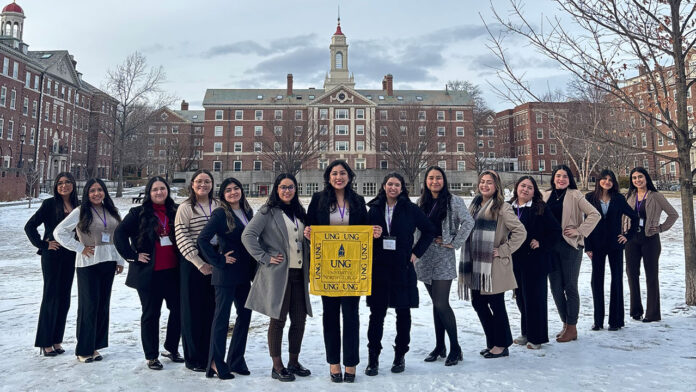
Fourteen UNG students took part in the Harvard Undergraduate Latina Empowerment & Development Conference, held Feb. 7-8 (UNG)

More than a dozen students from the University of North Georgia (UNG) recently participated in the renowned Harvard Undergraduate Latina Empowerment & Development (LEAD) Conference, held February 7-8 in Cambridge, Massachusetts.

Among the attendees was Fatima Santillan, a senior from Gainesville studying political science with a minor in public administration and public service. Santillan, who served as an ambassador at this year’s conference, was returning for a second time.

She is also president of UNG’s Latino Student Association (LSA). Santillan expressed her gratitude for the opportunity to attend alongside so many other UNG students, especially following a smaller UNG contingent at the event in 2024.

“We have moved forward in society, and we have also acknowledged there’s still a lot of work to do,” Santillan said. “It’s about being exposed to those environments and finally seeing yourself at that level. That’s how you continue to grow and inspire others.”

For many of the attendees, the conference marked a first-time flight experience, and they bonded further as they stayed together in an Airbnb during the event.

The LEAD Conference aims to provide a platform for Latinas to recognize their impact in the professional world and beyond. According to the event’s website, it was created to “celebrate Latina innovation, diversity, and strength” while affirming their leadership potential.

Guadalupe Jimenez, a senior from Clarkesville, Georgia, pursuing a degree in communication with a public relations concentration, is vice president of LSA. She reflected on the empowering experience of attending the conference with fellow Latinas from UNG.

“It was a really nice and empowering experience,” Jimenez said. “We heard amazing stories from other Latinas who have succeeded in their career fields.”

Gloria Silva, a senior from Cumming double majoring in accounting and finance, highlighted the networking opportunities provided by the conference. Silva, who also serves as vice president of the Gainesville Campus chapter of Beta Alpha Psi, an accounting honor society, was inspired by the resilience stories shared by Latina professionals.

“It was inspiring to hear from Latinas who faced similar barriers and have not only persevered, but excelled,” Silva said. “The theme I heard a lot was resilience. It encouraged me to keep pushing for my academic and career goals.”

Cake Bake Event and more for literacy in White County

Dolly Parton's Imaginary Library works with organizations like Foundational Literacy, Inc. to supply children with books. (submitted)

Vicky and John Aiken of Cleveland, Georgia, are deeply committed to helping children read and access the books they need to thrive. As educators and passionate advocates for literacy, they founded Foundational Literacy, Inc., a 501c3 nonprofit dedicated to fostering a lifelong love of reading in White County, Georgia.

“Twelve books can make all the difference in promoting reading, whether the child can read them or not,” says Vicky, a former educator who knows firsthand the impact books can have on a child’s future. Through Foundational Literacy, Vicky and John’s mission is to ensure that every child in White County has access to books—sent directly to their homes, free of charge, through Dolly Parton’s Imagination Library.

The Chick-fil-A Cow loves literacy and participating in the Cake Bake Event. (submitted)

“We view it as a kind of book ministry,” Vicky shares. “Our goal is to provide the tools, encouragement, and opportunities for students in White County to develop a lifelong love and excitement for reading.”

Since launching the program in September 2022, Vicky and John have already made a significant impact. Over 700 young readers have enrolled, and over 6,500 books have been distributed.

“Our goal is to enroll at least 1,300 children aged 0 to 5,” Vicky explains. “The earlier they start reading—especially before third grade—the greater the benefits, both in the classroom and beyond.”

Foundational Literacy partners with local businesses and organizations to fundraise and raise awareness. Parents can sign their children up online for one free, age-appropriate book each month, with no child being turned away. “So far, we’ve relied on word of mouth,” Vicky adds. “The kids get so excited, they tell their friends, and reading becomes something fun to them.”

Cake event for a great cause

One of the cake entries from the Cake Event 2024. (submitted)

On Saturday, March 15, Foundational Literacy is hosting a fun-filled day to support the Imagination Library in White County.

The event will occur from 12 p.m. to 4 p.m. at the Historic Gym at the Sautee Nacoochee Center (283 GA-255, Sautee Nacoochee, GA). All proceeds will benefit the program, helping to provide more books for local children.

For book lovers and baking enthusiasts alike, there will be an exciting Edible Book Cake Competition. Participants can show off their creativity by crafting cakes inspired by their favorite books. Whether it’s a beloved children’s classic or an adult novel, this event is the perfect opportunity to combine your love of reading with your love of baking!

Here are the rules for the cake competition:

Get Inspired! Your cake should bring a book to life—be it a character, scene, or theme.
Keep It PG! Cakes should be family-friendly and suitable for all ages.
Room-Temperature Ready. Cakes should be able to sit out on display without needing refrigeration.
Homemade Magic! No store-bought cakes—this competition is about your kitchen creativity!

The 2024 Cake Bake Event entries. (submitted)

Prizes for the Amateur Competition:

First Place: $100
Second Place: $50
Third Place: $25

There will also be a Children’s Category for kids 10 and under, allowing younger bakers to showcase their talents!

Other Event Highlights:

Marvel at Beautiful Cakes: Come see the stunning edible book-themed cakes created by talented local bakers.
Grab Lunch: Yonah Lodge 382 will sell delicious hamburgers and hotdogs fresh off the grill.
Sweet Treats: Don’t miss the cake and bake sale, offering a variety of tasty goodies.
Play and Win: Try your luck at games for all ages. Game tickets are just $1 each (some games may require more than one ticket).
Meet Amazing Authors: Chat with local children’s authors and get your books signed.
Entertainment: Enjoy live performances and fun activities for the whole family.

Vicky and John Aiken are dedicated to ensuring that every child in White County has the opportunity to develop a love for reading. By participating in events like this, you can help support their mission and make a lasting impact on the lives of local children. So gather your family and friends and join them for a day of fun, food, and books—all for a great cause! Admission is free.

North Georgians protest closure of Gainesville Social Security Office

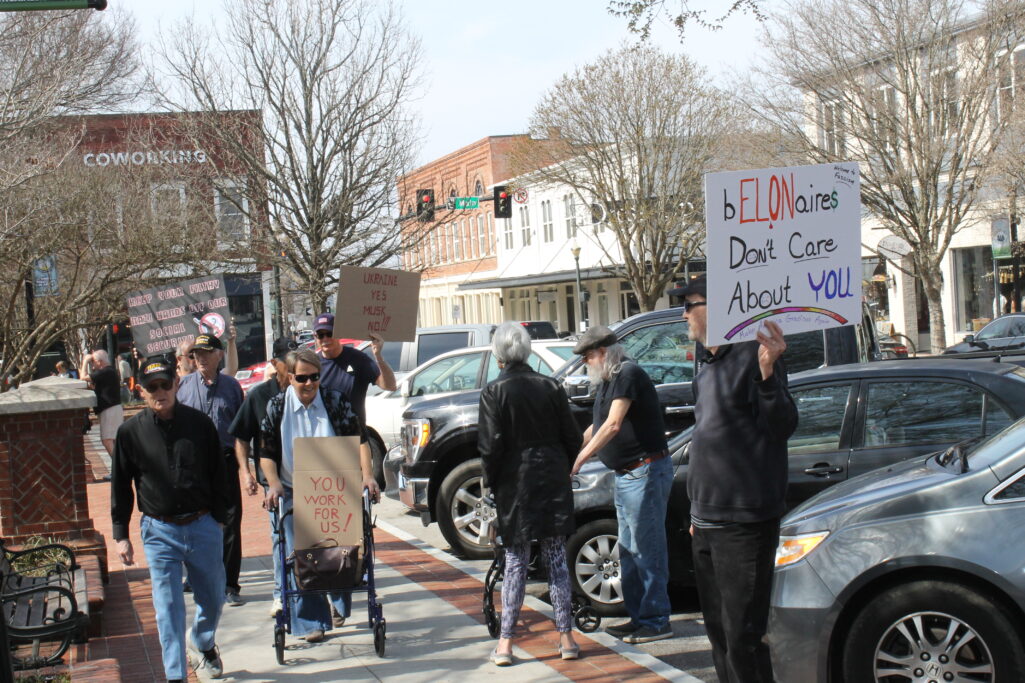
North Georgia residents protest the pending closure of the Social Security Office in Gainesville. Some directed their anger at Ninth District Congressman Andrew Clyde (R-Athens) who was in Gainesville when the protest occurred but did not meet with the group directly. (Brian Wellmeier/NowHabersham.com)

Less than a mile from the office of U.S. Rep. Andrew Clyde, R-Athens, over 50 people from counties across North Georgia took to the square in downtown Gainesville to protest federal budget cuts under President Donald J. Trump’s administration and the Department of Government Efficiency (DOGE), led by Elon Musk.

In early March, in conjunction with the cuts, DOGE announced the termination of at least five of Georgia’s 34 regional Social Security offices. Those locations include Brunswick, Columbus, Vidalia, Thomasville, and Gainesville. 

(Brian Wellmeier/Now Habersham)

During the demonstration, sparked by the future closure of the Gainesville office, multiple people reported seeing Clyde at a restaurant just across the street from the site of the protest, telling Now Habersham the congressman left through the back without hearing their concerns.

In recent weeks, opponents of the cuts have accused Clyde of failing to take action to prevent the closure. 

When reached by phone, a representative at Clyde’s Gainesville office referred Now Habersham to spokesperson Madeline Huffman, who provided a statement via email Friday afternoon. 

“Congressman Clyde is in Gainesville today meeting with constituents,” Huffman said. “A few protesters approached Congressman Clyde to ask about the (Social Security) Office in Gainesville. Rep. Clyde confirmed that the SSA Office in Gainesville is open and operating.”

Closure of the Gainesville office could leave North Georgians with few options for in-person services. The nearest alternative Social Security facility is in Toccoa, potentially forcing seniors who experience existing issues of transportation to travel farther to access those services.

RELATED Georgia to lose 5 Social Security offices

Protest

(Brian Wellmeier/Now Habersham)

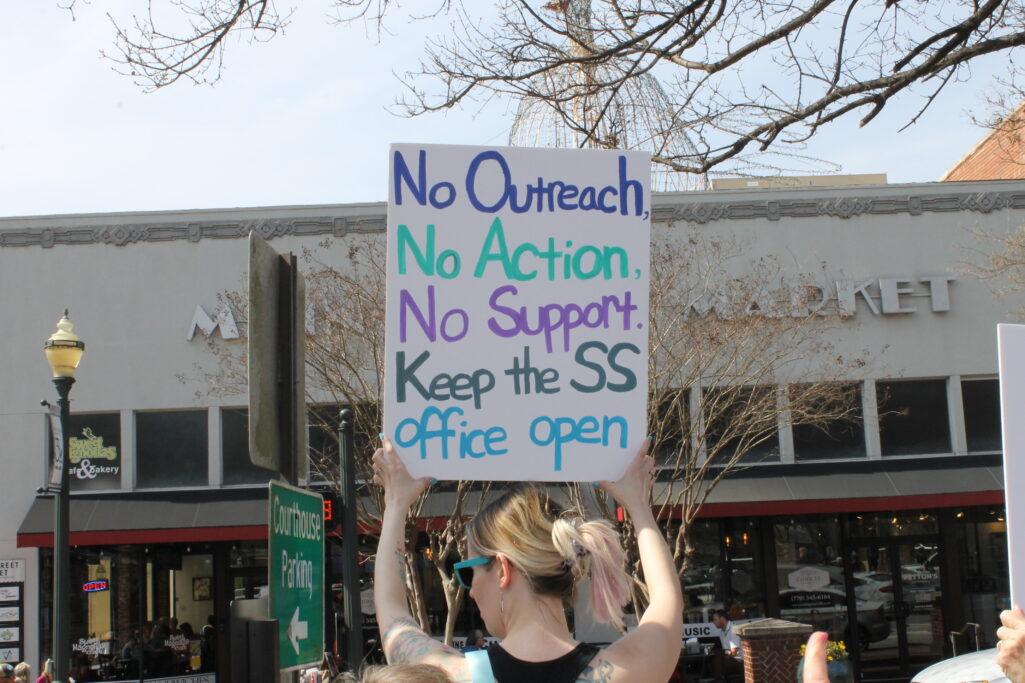
By noon, protesters – ranging from seniors to younger supporters – marched around Gainesville’s downtown square. Chants of “Andrew Clyde, why do you hide?” filled the air as participants held up posters with slogans like: “Protect Social Security – Stop Donnie and Clyde Stealing From Citizens,” “Clyde Cares More About D.C. Street Mural Than About Seniors of the 9th C.D.,” “Andrew Clyde Must Hate Old People,” “No Outreach, No Action, No Support, Keep SS Office Open,” “Clyde, Save Our Social Security Office,” “Bad DOGE” and “Send Musk To Mars.” 

North Georgians protest federal cuts on the square in Gainesville Friday, March 14 (Brian Wellmeier/Now Habersham)

“We’re an over 55 community,” Hall County resident Sandy Barnak said Friday. “Many of the people here are over 65. They should care that this office is getting closed. This is just another one of the haphazard cuts they’re doing.”

While Barnack is adept using the internet, she noted other people her age are not. And without a Social Security office to visit in-person, Barnack said she fears a potential rise in scams targeting senior citizens over the phone. 

“It’s so much easier to speak to someone in person,” she said. 

(Brian Wellmeier/Now Habersham)

White County resident and former chair of White County’s Democratic Party Marilyn Langford, an organizer of Friday’s protest, said she believes shuttering Social Security offices is just the first step in a long-term plan to gut assistance to seniors.

The Trump administration has not announced plans to cut Social Security. 

“First, they come for your Social Security office, then they come for your Social Security, then they come for you,” said Langford, a former federal employee with the NSA, where she worked for 12 years in the late-80s and 1990s. “We need to do something.”

Susan Demora traveled from Fannin County to Gainesville to participate in the protest. Demora said that while there is an office near Blue Ridge, it has limited resources and she’s often sent to the location in Gainesville. 

“The closest (Social Security office) to us would be in Dalton,” she said of potential closure of the Gainesville office. “We’re wanting to put pressure on Andrew Clyde to be accountable for what’s going on, and for his support of Donald Trump. We’re very, very angry at Donald Trump and Elon Musk for the (cuts).”

(Brian Wellmeier/Now Habersham)

Dean Erickson, a Hall County resident, agreed with his fellow seniors who marched around the square Friday. He said both he and his wife rely on Gainesville’s Social Security office for needed in-person services.

“Seniors voted overwhelmingly Republican,” he said. “… If we have an issue, what do we do? Call them on the phone? You’ll never get an answer.”

(Brian Wellmeier/Now Habersham)

Like Demora, Erickson believes greater barriers could arise for seniors throughout the region if the Gainesville office is closed down. 

“It’s hard for some of these people to deal with the internet,” he said. “It’s going to be even harder for them to deal with phone calls. Not everybody knows you’re never going to get an income phone call (from Social Security). You’re never going to get an incoming email (from Social Security). They’ll send it to you in a letter.”

A handful of millennials also marched alongside seniors during the demonstration. Two of them explained the root of their opposition, which they said stems from the notion they also will one day be senior citizens and rely on Social Security. 

(Brian Wellmeier/Now Habersham)

“The only way you enact real change is by standing up and showing out even when it doesn’t actually affect you,” said Alexa Elliott, a protester in her 30s from Sugar Hill. “It’s basic human empathy. I will support anybody who’s being marginalized.”

Lindsay Day, in her 40s also from Sugar Hill, then echoed Elliott’s remarks.

“Someday, we might need Social Security,” she said. “We don’t need it now, but we know people that do. We have grandparents. It’s our right. We’re paying for it. We need the services.”

Clyde responds

Just before 12:30 p.m., pockets of demonstrators holding signs stood facing Sweet Magnolia’s Café and Bakery on the corner of Main Street, where they believed Clyde was inside as they demanded he come out to speak to constituents. 

At least one protester, Nancy Lawrence, went inside to confront the congressman. She said Clyde denied the office would soon close before he picked up a to-go order and left out the back of the building.

Barnack said she also approached Clyde as he was leaving his Gainesville office toward Magnolia’s, asking him to visit the square to speak to voters. She told Now Habersham Clyde avoided her and continued down the street. 

FILE PHOTO – Rep. Andrew Clyde (R-Athens) (Hadley Cottingham/Now Habersham)

Clyde issued a statement through Huffman on Friday.

“I’m honored to represent the Ninth’s voice and fight for our shared values in Congress,” Clyde said. “I encourage folks to contact my office to share any comments, questions or concerns they may have about my work on their behalf.”

Asked about a potential timeline for closure or whether the office could be relocated, Huffman referred Now Habersham to a previous statement issued by the U.S. Social Security Administration last month.

“The Social Security Administration will soon implement agency-wide organizational restructuring that will include significant workforce reductions,” the agency released in late February. “Through these massive reorganizations, offices that perform functions not mandated by statute may be prioritized for reduction-in-force actions that could include abolishment of organizations and positions, directed reassignments, and reductions in staffing. The agency may reassign employees from non-mission critical positions to mission critical direct service positions (e.g., field offices, teleservice centers, processing centers). Reassignments may be involuntary and may require retraining for new workloads.”

Clyde went on to issue another statement just before 5 p.m. 

“My team in Gainesville is equipped with phenomenal case workers who are always ready to help folks with federal agencies, such as receiving fair treatment from the IRS, navigating Social Security claims, or obtaining VA benefits,” he said. “I encourage the Ninth to contact my office if they ever need assistance with a federal agency, and I remain committed to ensuring Northeast Georgians receive the federal services they deserve.” 

When severe weather approaches, preparation is key

Planning is the key in preparing for the worst weather can bring. With the official arrival of spring, severe weather potential increases.

SEE RELATED: Damaging winds, tornadoes possible Saturday night

Being informed

According to White County Assistant Public Safety Director Don Strength, being weather aware is the first step in being prepared for severe weather. “Remain weather aware, I can’t stress that enough,” he said. He advises people to know where your county is on the map and know where your house is located within the county so you can keep track of storms as they approach.

Strength said that the base line defense for being prepared for severe weather is having a NOAA weather radio. He explains that you can set the radio to receive weather alerts from the nearest National Weather Service (NWS) office to your location. For Northeast Georgia, that is the NWS office out of Greenville-Spartanburg, SC. He cautions to be prepared. “That thing will wake the dead at 2 a.m. in the morning,” he said.

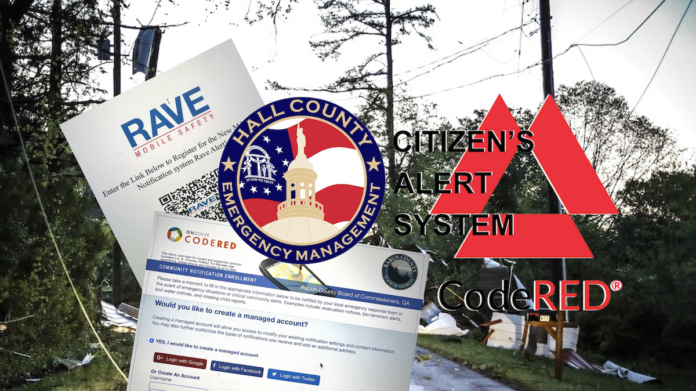
The second thing that an individual should do is sign up for your local county’s and/or city’s mass information notification system. White and Habersham counties both utilize the CodeRed notification system.

The third thing he recommends is for an individual to download a good weather app on their phone. Strength said that most news broadcast television stations have an app that can be downloaded and send out weather alerts to keep people informed.

He reiterated the importance of people needing to be weather aware. “Most people who are injured and lose their life in severe weather, had no concept of what was happening around them,” Strength said.

Remaining safe

In his experience, he cautions those that live in a mobile home during severe weather events. “Most fatalities are in mobile homes during high wind and tornado events,” he said. ”It’s always a good idea to find a more substantial structure to be in during severe weather versus a mobile home.”

Over the course of his life, he has lived in a mobile home. However, they are not as structurally sound as a “brick and mortar” structure during high winds or tornadoes.

He explained that the safest place to be is on the lowest floor. “Being in the center of the lowest floor of your home or workplace when a warning is issued.”

Strength advises people to know the difference between a watch and a warning. According to him, a watch means “look out, it is possible.” A warning means “it’s happening.”

He also cautions people to never rely on outdoor sirens as a means of notification. “Never, ever, ever, ever rely on outdoor warning sirens for your only means of notification when a warning is issued.”

Strength explained that they are designed to warn people that are outdoors such as in their yard or on a ballfield. They are not designed to wake you in the middle of the night inside your home when pouring rain is hitting your roof.

He said that outdoor sirens serve their purpose but “it is not intended in any shape, form, or fashion for indoor warning.”

Have a plan

Strength recommends that families need to develop a plan of what to do during a severe weather event. Discuss with family members where the safe place is in the home, which is in the center of the lowest level, preferably a basement.

Once in the safe place, have available items that can protect you from debris. Having a helmet of some type is ideal to protect your head but it is not something that everyone has. Strength recommends having blankets, pillows, and cushions available in the safe place for protection.

He recommends that when you evacuate to the safe place to be fully clothed and wear hard sole shoes.

Strength also recommends having a whistle or marine air horn in your safe place. In the event your home is hit with high winds or by a tornado, you can alert first responders to your location.

Again, he stresses the importance of being weather aware as severe storms are forecasted for your area and have a plan that is shared with family members.

White County firefighters battle brush fire

FILE PHOTO (White County Fire Services)

Firefighters battled a brush fire in White County that burned two outbuildings and threatened a nearby home. According to White County Public Information Officer Bryce Barrett, the fire was reported to 911 at 4:32 p.m. on March 14.

Multiple county units responded to the area of Rattlesnake Hill off Town Creek Road, along with mutual aid from Cleveland and Lumpkin County firefighters.

“Upon arrival, units found one outbuilding fully involved with fire and a second outbuilding partially involved,” says Barrett. “The brush fire had begun to extend toward a nearby wooded area, and Georgia Forestry was requested to assist with containment.”

Lumpkin County provided an additional tanker to shuttle water to the scene.

Barrett says a nearby residence was damaged by the fire.

Cleveland residents displaced by fire

(NowHabersham.com)

Firefighters helped three people out of a burning home in Cleveland Friday evening.

The fire broke out around 6:28 p.m. at a residence in the 300 block of West Underwood Street. When the first fire units arrived on the scene, the house was already 25 percent involved with fire, White County Fire Services said.

The Cleveland Fire Department, White County Fire Services, White County EMS, and the Cleveland Police Department responded to the scene. West Underwood and West Kytle Streets were blocked for two hours while firefighters fought the fire.

White County Emergency Management deployed its drone for on-scene overwatch and sent its Rehabilitation Unit to aid firefighters.

The American Red Cross was contacted to assist the displaced occupants.

How to sign up for CodeRED and other severe weather alerts

(NowHabersham.com)

With severe weather expected overnight, officials from the governor on down are urging Georgians to remain weather-aware.

Northeast Georgia counties issue public alerts through CodeRED and other notification systems. These free email and text alerts will notify you when a weather watch or warning is issued for your area.

Below is a list of links to some Northeast Georgia area alert system sign-up pages. Check with your county Emergency Management Agency or public safety department if your county is not listed.

You can download alert apps for Android and iPhone devices, but make sure to register when you do. Downloading the app does not automatically enroll you in the system.

Child airlifted to hospital after golf cart accident

(Photo by White County Fire Services)

A child was airlifted to Children’s Healthcare of Atlanta Friday afternoon following a golf cart accident, White County authorities say.

The accident happened around 2:30 p.m. on March 14 in an area off Dyer Farm Road southwest of Cleveland. White County Fire Services, White County EMS, and the White County Sheriff’s Office responded to the scene. The child was the only patient reported.

AirLife Georgia was requested for transport, and a landing zone was set up at Webster Lake Road in front of White Creek Baptist Church, closing the area for approximately 30 minutes.

The child was transported to Arthur M. Blank Hospital at Children’s Healthcare of Atlanta.

Trump signs stopgap spending bill into law, following U.S. Senate passage

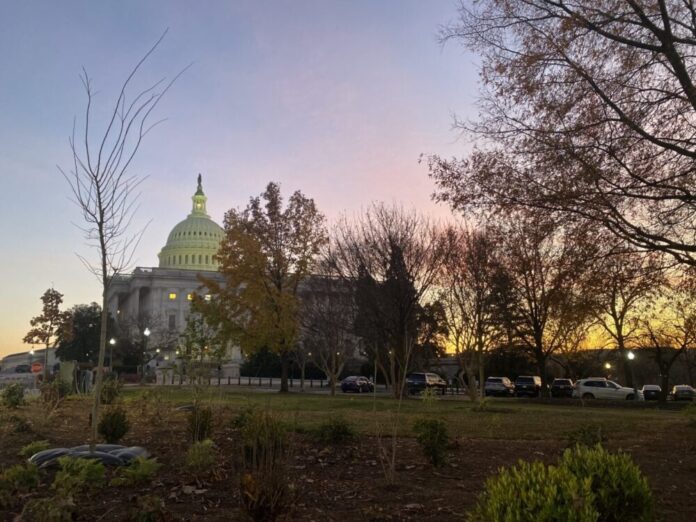
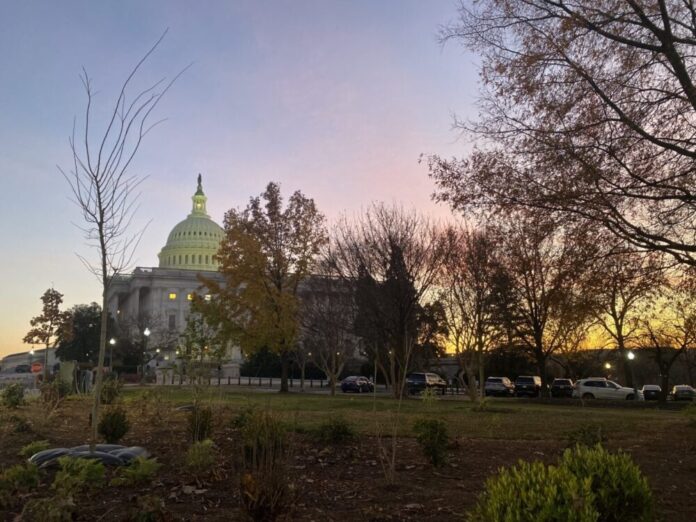
U.S. Capitol at sunset on March 8, 2024. (Jennifer Shutt/States Newsroom)

WASHINGTON (States Newsroom) — The U.S. Senate cleared a stopgap spending bill Friday that will fund the government through the end of September, sending the legislation to President Donald Trump.

The White House said on Saturday afternoon that Trump had signed the measure, avoiding a partial government shutdown.

Trump’s signature, a day after the 54-46 Senate vote, will keep the federal government mostly running on autopilot under spending levels and policy similar to what Congress approved about a year ago when lawmakers passed the full-year appropriations bills for the last fiscal year. But the stopgap bill does slightly boost defense spending while reducing domestic funding authority.

Kentucky Sen. Rand Paul was the only Republican to vote against passage. Maine independent Sen. Angus King and New Hampshire Democratic Sen. Jeanne Shaheen voted to approve the bill, the only ones backing it besides Republicans.

Senate approval followed days of debate among Democrats over whether to support moving forward with the GOP-authored bill or see a shutdown begin that Minority Leader Chuck Schumer said would allow Trump to take even more power over the government.

Debate on the House-passed stopgap spending bill was more complex than usual. A majority of Senate Democrats believe the continuing resolution shortchanges important federal programs and doesn’t do enough to reinforce Congress’ constitutional authority over spending in light of Trump’s efforts to remake the size and scope of the federal government.

Many of those actions are on hold as dozens of lawsuits move through the federal court system. But Democrats who opposed the bill felt that lawmakers must make their voices heard as well.

Other Democrats argued a partial government shutdown would give Trump more leeway to make funding decisions and further harm federal workers.

Republicans largely supported the stopgap spending bill. However, many lamented that the House and Senate didn’t do more to reach agreement on the dozen full-year government funding bills.

‘Inherently a failure

Senate Appropriations Chairwoman Susan Collins, R-Maine, said the stopgap spending bill wasn’t her first choice for funding the government, but that it was the only option on the table to prevent a funding lapse.

“Government shutdowns are inherently a failure to govern effectively and have negative consequences all across government,” Collins said. “They inevitably require certain government employees — such as Border Patrol agents, members of our military and Coast Guard, TSA screeners and air traffic controllers — to report to work with no certainty at all on when they will receive their next paycheck.”

Washington state Democratic Sen. Patty Murray, ranking member on the Appropriations panel, rebuked House Republican leaders for drafting the stopgap spending bill on their own and then expecting Democratic votes.

“Let me be clear, in my time in Congress, never, ever has one party written partisan full-year appropriations bills for all of government and expected the other party to go along without any input,” Murray said.

The stopgap spending bill, she said, cuts overall spending on domestic programs, a choice Democrats never would have agreed to had GOP leaders tried to negotiate with them.

“We are talking about a nearly 50% cut to life-saving medical research into conditions affecting our service members,” Murray said. “It is a giant shortfall in funding for NIH. It is a massive cut in funding for Army Corps projects and $15 billion less for our domestic priorities.”

“This bill will force Social Security to cut staff and close offices and make it harder for our seniors to get the benefits they spent their careers paying into the system to earn,” Murray added. “It creates a devastating shortfall that risks tens of thousands of Americans losing their housing. So this bill causes real pain for communities across the country.”

Murray also criticized House Republicans for releasing their stopgap spending bill just days before the deadline and then leaving for a recess right after voting to send the measure to the Senate. The move prevented the Senate from amending the CR in any way if Congress wanted to avoid a shutdown.

The Senate voted to reject amendments from Oregon Democratic Sen. Jeff Merkley, Illinois Democratic Sen. Tammy Duckworth, Maryland Democratic Sen. Chris Van Hollen and Paul before approving the bill.

Schumer’s decision

Schumer said he voted to limit debate to avoid giving Trump, Elon Musk and U.S. DOGE Service the authority to determine which federal employees would have been exempt from the effects of a shutdown and which would have essentially been furloughed. Under federal law, both categories of federal workers receive back pay once the shutdown ends.

“In a shutdown, Donald Trump and DOGE will have the power to determine what is considered essential and what is not — and their views on what is not essential would be mean and vicious and would decimate vital services and cause unimaginable harm to the American people,” Schumer said.

The Democrats who voted to advance the stopgap spending bill, Schumer said, wanted to keep attention on Trump’s actions as president and not divert focus to the wide-reaching repercussions of shutting down the government.

“A shutdown will be a costly distraction from this all important fight,” Schumer said.

The stopgap spending bill, he noted, doesn’t change the Constitution or the laws that say Congress controls spending and that the president must implement those laws.

“The CR does not change the underlying law, making the Trump administration’s impoundments and mass firings illegal,” Schumer said. “Nothing in the CR changes the Impoundment Control Act, the foundation of Congress’ appropriations authority. And the authorization laws that require USAID and other agencies to exist and to operate the programs Congress has assigned to them. Nothing changes Title 5, governing the civil service, the Administrative Procedures Act and so on.”

Senate rules require at least 60 lawmakers vote to cut off debate on a bill. The GOP holds 53 seats at the moment and needed Democratic buy-in to proceed with regular bills. That procedural vote was 62-38.

Democratic Sens. Catherine Cortez Masto of Nevada, Dick Durbin of Illinois, John Fetterman of Pennsylvania, Kirsten Gillibrand of New York, Maggie Hassan of New Hampshire, Gary Peters of Michigan, Brian Schatz of Hawaii, King, Schumer and Shaheen voted to limit debate.

Delays on spending bills

Congress was supposed to draft, debate and approve the dozen annual appropriations bills by the start of this fiscal year on Oct. 1, nearly six months ago.

The bills fund the departments of Agriculture, Commerce, Defense, Education, Energy, Health and Human Services, Homeland Security, Housing and Urban Development, Interior, Justice, Labor, State, Transportation, Treasury and Veterans’ Affairs.

They also provide funding for Congress, the Supreme Court and numerous smaller agencies, like NASA and the National Science Foundation.

The House Appropriations Committee approved all 12 of its bills on party-line votes and the House was able to pass five of those across the floor last summer without broad Democratic support.

The Senate panel approved 11 of the bills in July and August with broadly bipartisan votes, but none of the measures came up on the floor for debate.

The House and Senate have regularly negotiated final versions of the spending bills, even if they didn’t receive floor approval, and could have begun that conference process in September, or even during their August recess.

But congressional leaders opted to focus their attention on the November elections and used a stopgap spending bill to keep the government running through mid-December, an expected and rather predictable move.

After Republicans won unified control of government, Congress used a second continuing resolution to keep the government funded through March 14. GOP leaders and Trump wanted to hold over negotiations on the full-year bills until they were in office.

The leaders of the Appropriations committees spent the last couple months trying to get bipartisan, bicameral agreement on the total spending level for the current fiscal year. But that ended this weekend when House Republicans released a stopgap spending bill to fund the government through September.

The House voted 217-213 on Tuesday to send the continuing resolution to the Senate. Kentucky Rep. Thomas Massie was the only GOP lawmaker to vote against it and Maine Rep. Jared Golden was the only Democratic member to support the bill in that chamber.

‘Congratulations to Chuck Schumer’

Trump had said he would sign the stopgap spending bill, according to a Statement of Administration Policy issued Tuesday.

“H.R. 1968 includes a focused set of critical funding anomalies to ensure the Administration can carry out important programs and fulfill its obligations, including veterans’ healthcare and benefits, pay raises for junior enlisted servicemembers, operations of our air traffic control system, along with nutrition and housing programs,” the SAP states.

“The bill also provides the Department of Defense with the resources and flexibility necessary to align funding to current priorities in consultation with the Congress and responds to emerging threats by allowing for ‘new starts,’ including other key provisions.”

Trump took to social media ahead of the procedural vote to thank Schumer for announcing he’d vote to limit debate.

“Congratulations to Chuck Schumer for doing the right thing — Took ‘guts’ and courage! The big Tax Cuts, L.A. fire fix, Debt Ceiling Bill, and so much more, is coming. We should all work together on that very dangerous situation,” Trump wrote. “A non pass would be a Country destroyer, approval will lead us to new heights. Again, really good and smart move by Senator Schumer. This could lead to something big for the USA, a whole new direction and beginning! DJT”

‘Drive sober’: Habersham Sheriff’s Office warns of weekend checkpoints

(Habersham County Sheriff's Office/Facebook)

For motorists who plan to consume alcohol on St. Patrick’s Day weekend, make plans ahead of time. 

Deputies will be stationed at designated checkpoints while the H.E.A.T. unit conducts concentrated patrols on roads throughout the county in an effort to arrest impaired drivers, the Habersham County Sheriff’s Office announced via Facebook Friday, March 14.

Authorities did not disclose the locations of the checkpoints or where heightened patrols might be.

“Drive sober or get pulled over,” the sheriff’s office posted Friday evening.

In 2020, over 11,000 lives were lost in drunk-driving crashes, many of which could have been avoided with a sober designated driver.

Tow to Go

In Georgia, AAA is once again activating its Tow to Go program to help ensure the public’s safety and prevent impaired driving in select areas throughout the state.

The service offers a free, confidential ride for impaired drivers and towing for their vehicles, providing transportation to a safe location within a 10-mile radius.

Tow to Go is free and available to both AAA members and non-members, but AAA encourages using the service as a last resort.

To request a Tow to Go ride, drivers should call (855) 2-TOW-2-GO or (855) 286-9246. The program is confidential, but it’s important to note that it’s not intended for pre-scheduled rides. Tow to Go is designed to serve those who didn’t plan ahead and need a safe option to avoid impaired driving.

While the service is available in many areas, it may not be operational in rural regions or during severe weather conditions.

Protesters rally against sweeping cuts to U.S. Education Department

Keri Rodrigues, president of the National Parents Union, speaks at a rally on Friday, March 14, 2025, in Washington, D.C, protesting the U.S. Education Department’s mass layoffs and President Donald Trump’s plans to dismantle the agency. (Shauneen Miranda/States Newsroom)

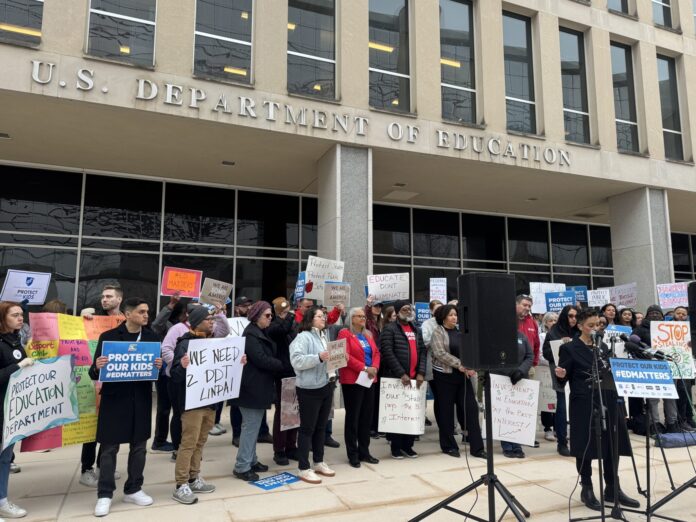
WASHINGTON (States Newsroom) — Dozens gathered Friday outside the U.S. Department of Education to protest the ousting of more than 1,300 employees and President Donald Trump’s plans to dismantle the agency.

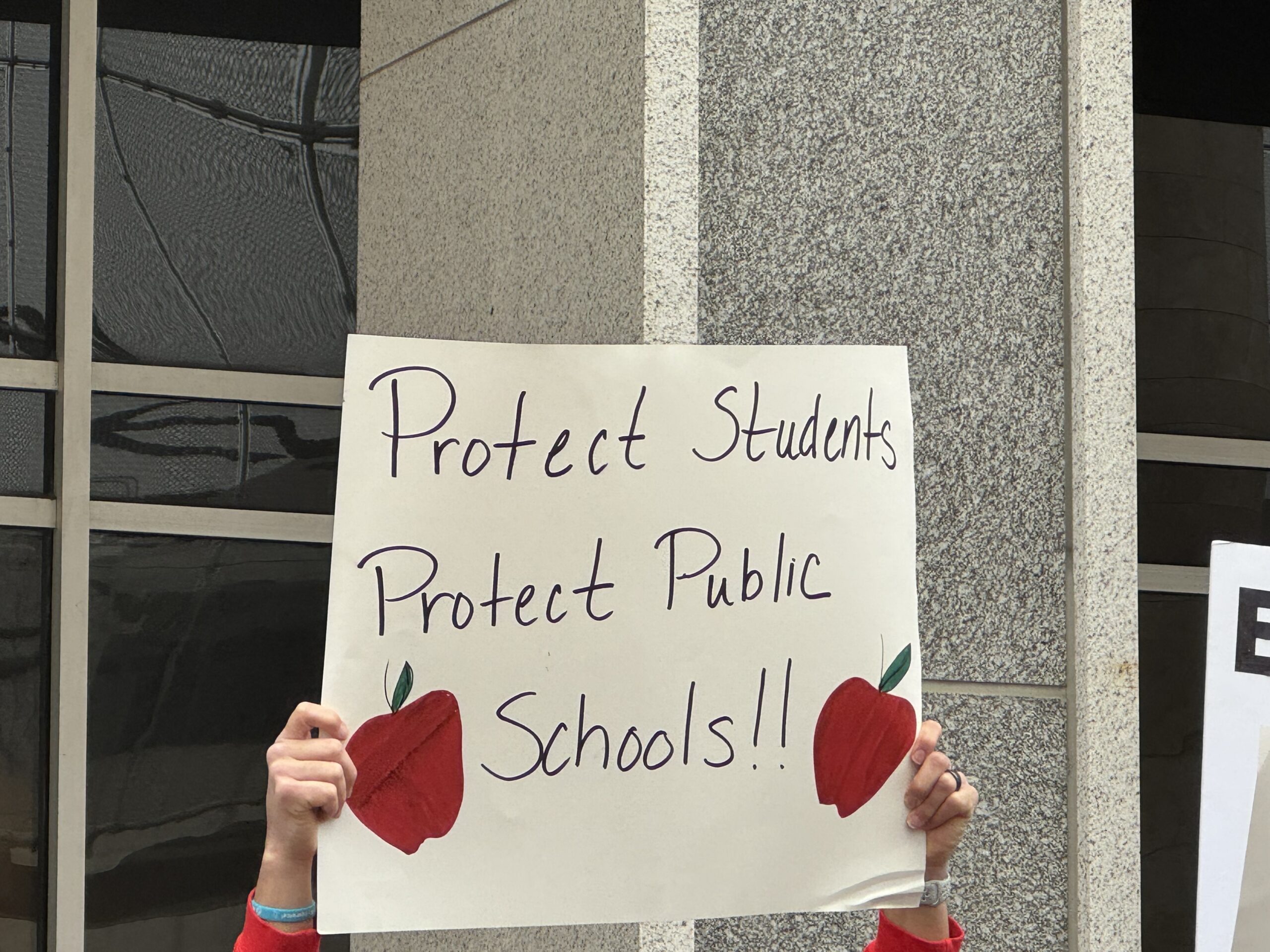
As the fate of the 45-year-old department hangs in the balance following the cuts this week, demonstrators held signs at a rally outside of the Education Department headquarters with slogans including “Educate Don’t Eliminate” and “WWE: We Want Education,” a reference to Education Secretary Linda McMahon’s World Wrestling Entertainment background.

“These cuts — this isn’t just about a department and a building — this is about federal streams of money that help students live (up to) their full potential,” said Kim Anderson, executive director of the National Education Association, the country’s largest labor union.

Antoinette Flores, who worked for the U.S. Department of Education during the Biden administration, protests the agency’s mass layoffs during Friday’s “honk-a-thon” and rally. (Shauneen Miranda/States Newsroom)

“This agenda is about cutting funding and shipping it to private schools; it is about vouchers, make no mistake about it,” Anderson said. “It is about dismantling public education so that children cannot get what they deserve.”

Trump has repeatedly pledged to shutter the agency, and McMahon confirmed this week that the sweeping cuts marked the first step in that process.

The president alone does not have the authority to close the department, and such an effort would need congressional approval.

‘Fight back’

Following a “honk-a-thon” on Independence Avenue, Sen. Mazie Hirono told the crowd that Trump and billionaire White House adviser Elon Musk “think that they can take a chain saw to government agencies, and they’ve been slashing and burning and firing thousands of people for no cause, and just recently, of course, they got to the Department of Education.”

Trump and Musk have taken significant steps to reduce federal government spending and go after what they see as waste, with the Education Department marking a major target of those efforts.

“But we are all here to fight back because this is no time to be sitting back thinking that other people are going to fight the battles for us,” the Hawaii Democrat said. “No, we are in it together.”

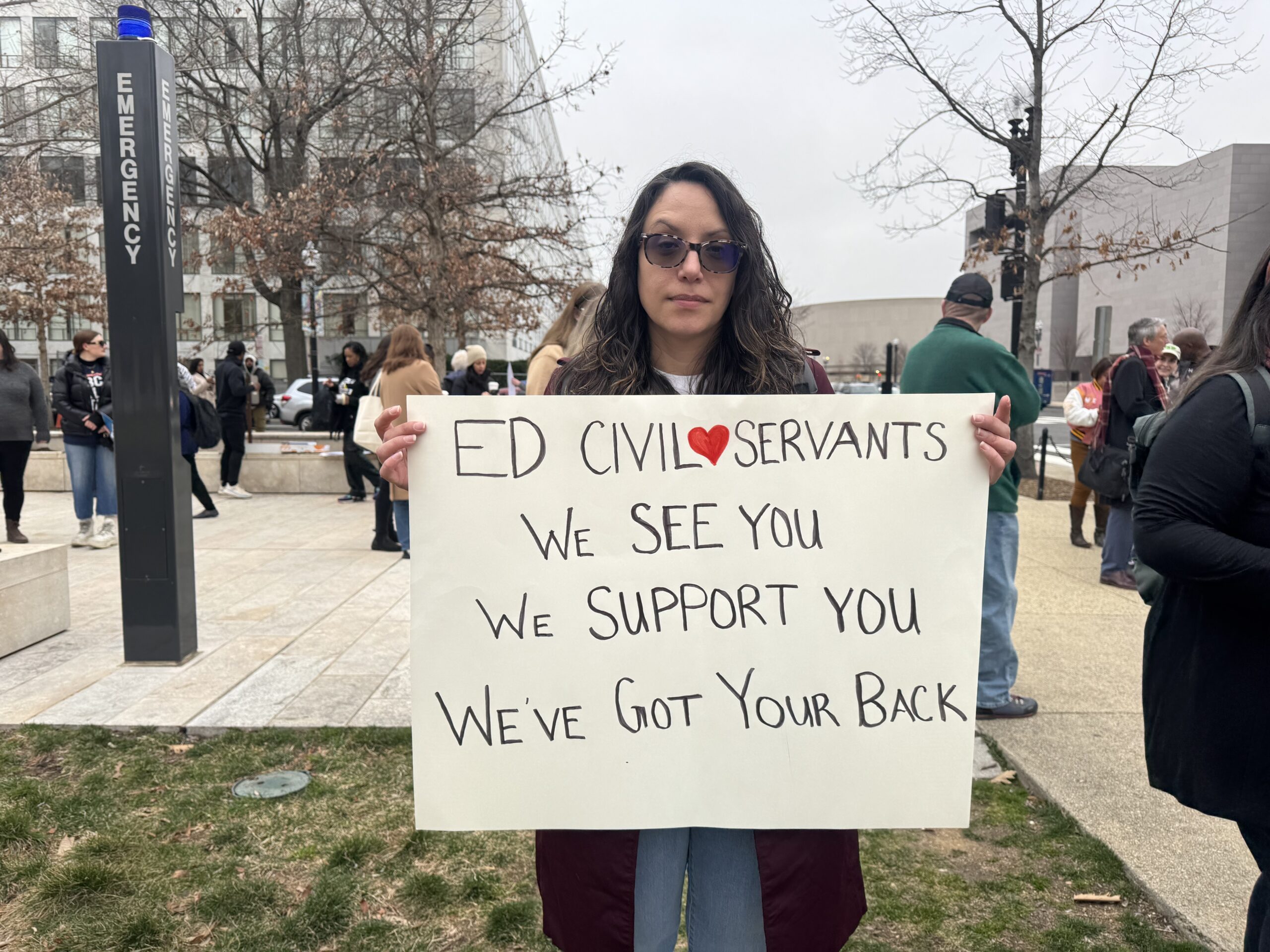
A demonstrator stands outside the U.S. Education Department in Washington, D.C. (Shauneen Miranda/States Newsroom)

The rally came as department leaders announced this week that they would be cutting a substantial number of the agency’s staff, prompting concerns over how the department could carry out its responsibilities when roughly halving its workforce.

The layoffs make huge cuts to the Office for Civil Rights, Office of Federal Student Aid and Institute of Education Sciences, among other units, according to the nonprofit Education Reform Now, which advocates for more resources for education.

Fulfilling responsibilities

Some of the department’s many responsibilities include administering federal student aid, enforcing civil rights cases, providing Title I funding for low-income school districts and guaranteeing a free public education for children with disabilities via the Individuals with Disabilities Education Act, or IDEA.

Through a spokesperson, the department said Thursday its core responsibilities would not be impacted by the cuts.

But protesters Friday worried about the path to dismantling the department.

Molly Cronin, a special education teacher in Virginia, told States Newsroom that “if IDEA is not protected, if Title I is not protected, if Head Start is not funded, our most vulnerable children are going to be failed by the system, and we have a duty as educators to protect all students.”

Cronin, a member of the National Education Association who serves on the board of her local union, said one of the biggest misunderstandings about the agency “is that people think that the federal department is in control of the states and states’ curriculum and programs and all of that, when, in fact, that’s not true.”

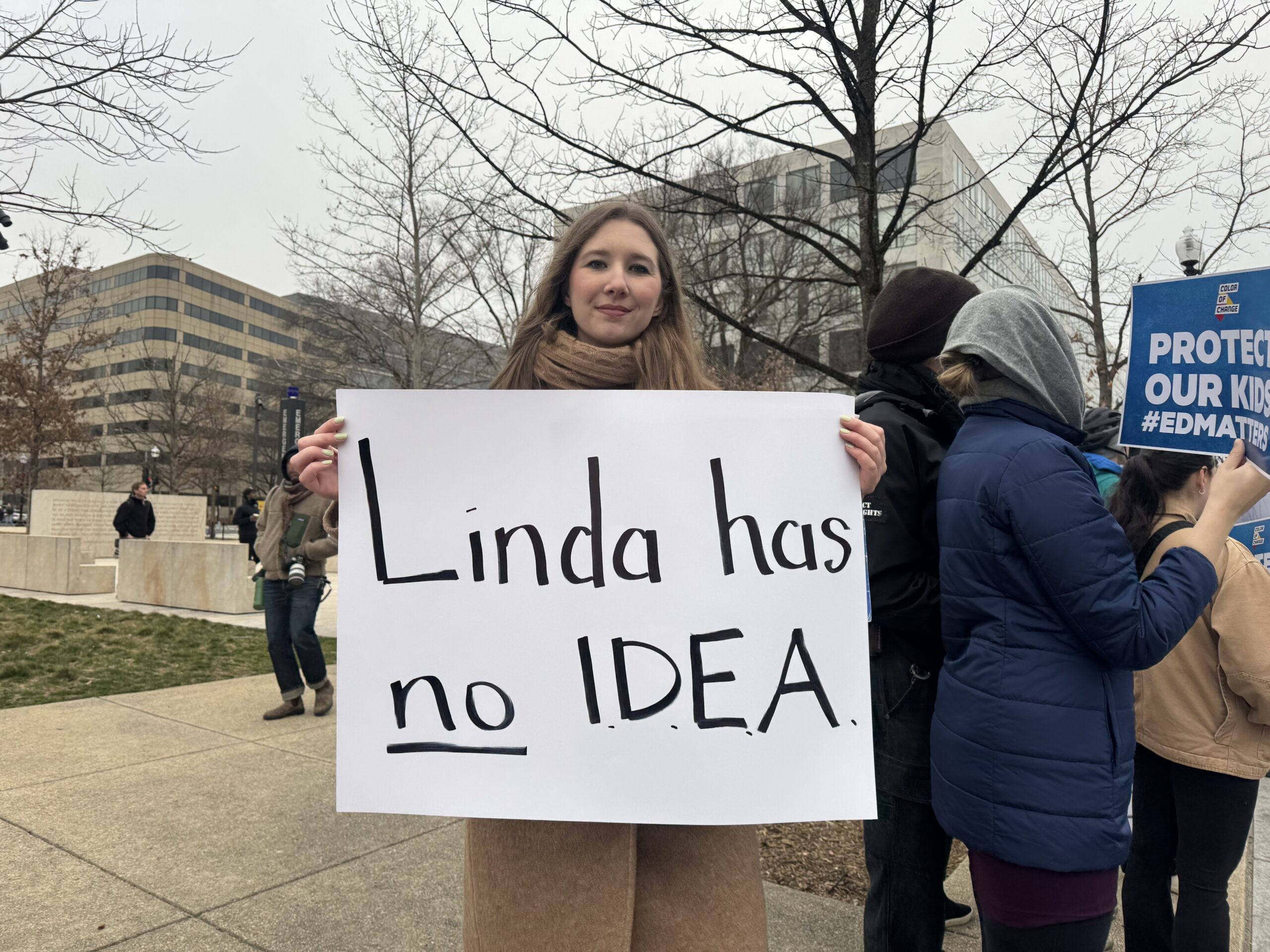
Molly Cronin, a special education teacher in Virginia, holds a sign that reads: “Linda has no I.D.E.A.” — referencing the Individuals with Disabilities Education Act, or IDEA. During a recent interview on Fox News, U.S. Education Secretary Linda McMahon could not answer what the acronym stood for when asked. (Shauneen Miranda/States Newsroom)

Trump has vowed to shut down the department in his quest to move education “back to the states,” despite much of the funding and oversight of schools already occurring at the state and local levels. Legally, the federal government cannot control the curriculum of schools.

Legal challenges to the sweeping cuts are already taking shape, after 21 Democratic attorneys general sued the Trump administration Thursday over the efforts.

Prior to the mass layoffs, the department already witnessed dramatic downsizing in the weeks since Trump took office, with major contract cuts and staff buyouts.

Cuts make mission harder

Antoinette Flores, who worked for the Education Department during the Biden administration, said she knows many of the people harmed by the layoffs.

“These are colleagues, these are friends, these are dedicated public servants that help students, and it’s devastating to see what’s happening.”

Flores, who focuses on higher education, told States Newsroom the massive cuts are “going to make it much more challenging for students to receive grants and loans that they’re entitled to.”

Rather than go after inefficiencies in the federal government, as Trump and Musk have said is their goal, Flores said a smaller federal workforce would actually “increase fraud, waste and abuse.”

Hours away from shutdown, U.S. Senate clears spending bill for Trump’s signature

U.S. Capitol at sunset on March 8, 2024. (Jennifer Shutt/States Newsroom)

WASHINGTON (States Newsroom) — The U.S. Senate cleared a stopgap spending bill Friday that will fund the government through the end of September, sending the legislation to President Donald Trump, who is expected to sign it, avoiding a partial government shutdown.

The 54-46 vote will keep the federal government mostly running on autopilot under spending levels and policy similar to what Congress approved about a year ago when lawmakers passed the full-year appropriations bills for the last fiscal year. But the stopgap bill does slightly boost defense spending while reducing domestic funding authority.

Kentucky Sen. Rand Paul was the only Republican to vote against passage. Maine independent Sen. Angus King and New Hampshire Democratic Sen. Jeanne Shaheen voted to approve the bill, the only ones backing it besides Republicans.

Senate approval followed days of debate among Democrats over whether to support moving forward with the GOP-authored bill or see a shutdown begin that Minority Leader Chuck Schumer said would allow Trump to take even more power over the government.

Debate on the House-passed stopgap spending bill was more complex than usual. A majority of Senate Democrats believe the continuing resolution shortchanges important federal programs and doesn’t do enough to reinforce Congress’ constitutional authority over spending in light of Trump’s efforts to remake the size and scope of the federal government.

Many of those actions are on hold as dozens of lawsuits move through the federal court system. But Democrats who opposed the bill felt that lawmakers must make their voices heard as well.

Other Democrats argued a partial government shutdown would give Trump more leeway to make funding decisions and further harm federal workers.

Republicans largely supported the stopgap spending bill. However, many lamented that the House and Senate didn’t do more to reach agreement on the dozen full-year government funding bills.

‘Inherently a failure

Senate Appropriations Chairwoman Susan Collins, R-Maine, said the stopgap spending bill wasn’t her first choice for funding the government but that it was the only option on the table to prevent a funding lapse.

“Government shutdowns are inherently a failure to govern effectively and have negative consequences all across government,” Collins said. “They inevitably require certain government employees — such as Border Patrol agents, members of our military and Coast Guard, TSA screeners and air traffic controllers — to report to work with no certainty at all on when they will receive their next paycheck.”

Washington state Democratic Sen. Patty Murray, ranking member on the Appropriations panel, rebuked House Republican leaders for drafting the stopgap spending bill on their own and then expecting Democratic votes.

“Let me be clear, in my time in Congress, never, ever has one party written partisan full-year appropriations bills for all of government and expected the other party to go along without any input,” Murray said.

The stopgap spending bill, she said, cuts overall spending on domestic programs, a choice Democrats never would have agreed to had GOP leaders tried to negotiate with them.

“We are talking about a nearly 50% cut to life-saving medical research into conditions affecting our service members,” Murray said. “It is a giant shortfall in funding for NIH. It is a massive cut in funding for Army Corps projects and $15 billion less for our domestic priorities.”

“This bill will force Social Security to cut staff and close offices and make it harder for our seniors to get the benefits they spent their careers paying into the system to earn,” Murray added. “It creates a devastating shortfall that risks tens of thousands of Americans losing their housing. So this bill causes real pain for communities across the country.”

Murray also criticized House Republicans for releasing their stopgap spending bill just days before the deadline and then leaving for a recess right after voting to send the measure to the Senate. The move prevented the Senate from amending the CR in any way if Congress wanted to avoid a shutdown.

The Senate voted to reject amendments from Oregon Democratic Sen. Jeff Merkley, Illinois Democratic Sen. Tammy Duckworth, Maryland Democratic Sen. Chris Van Hollen and Paul before approving the bill.

Schumer’s decision

Schumer said he voted to limit debate to avoid giving Trump, Elon Musk, and U.S. DOGE Service the authority to determine which federal employees would have been exempt from the effects of a shutdown and which would have essentially been furloughed. Under federal law, both categories of federal workers receive back pay once the shutdown ends.

“In a shutdown, Donald Trump and DOGE will have the power to determine what is considered essential and what is not — and their views on what is not essential would be mean and vicious and would decimate vital services and cause unimaginable harm to the American people,” Schumer said.

Schumer said that the Democrats who voted to advance the stopgap spending bill wanted to keep attention on Trump’s actions as president and not divert focus to the wide-reaching repercussions of shutting down the government.

“A shutdown will be a costly distraction from this all important fight,” Schumer said.

The stopgap spending bill, he noted, doesn’t change the Constitution or the laws that say Congress controls spending and that the president must implement those laws.

“The CR does not change the underlying law, making the Trump administration’s impoundments and mass firings illegal,” Schumer said. “Nothing in the CR changes the Impoundment Control Act, the foundation of Congress’ appropriations authority. And the authorization laws that require USAID and other agencies to exist and to operate the programs Congress has assigned to them. Nothing changes Title 5, governing the civil service, the Administrative Procedures Act, and so on.”

Senate rules require at least 60 lawmakers vote to cut off debate on a bill. The GOP holds 53 seats at the moment and needed Democratic buy-in to proceed with regular bills. That procedural vote was 62-38.

Democratic Sens. Catherine Cortez Masto of Nevada, Dick Durbin of Illinois, John Fetterman of Pennsylvania, Kirsten Gillibrand of New York, Maggie Hassan of New Hampshire, Gary Peters of Michigan, Brian Schatz of Hawaii, King, Schumer and Shaheen voted to limit debate.

Delays on spending bills

Congress was supposed to draft, debate and approve the dozen annual appropriations bills by the start of this fiscal year on Oct. 1, nearly six months ago.

The bills fund the departments of Agriculture, Commerce, Defense, Education, Energy, Health and Human Services, Homeland Security, Housing and Urban Development, Interior, Justice, Labor, State, Transportation, Treasury and Veterans’ Affairs.

They also provide funding for Congress, the Supreme Court and numerous smaller agencies, like NASA and the National Science Foundation.

The House Appropriations Committee approved all 12 of its bills on party-line votes and the House was able to pass five of those across the floor last summer without broad Democratic support.

The Senate panel approved 11 of the bills in July and August with broadly bipartisan votes, but none of the measures came up on the floor for debate.

The House and Senate have regularly negotiated final versions of the spending bills, even if they didn’t receive floor approval, and could have begun that conference process in September, or even during their August recess.

But congressional leaders opted to focus their attention on the November elections and used a stopgap spending bill to keep the government running through mid-December, an expected and rather predictable move.

After Republicans won unified control of government, Congress used a second continuing resolution to keep the government funded through March 14. GOP leaders and Trump wanted to hold over negotiations on the full-year bills until they were in office.

The leaders of the Appropriations committees spent the last couple months trying to get bipartisan, bicameral agreement on the total spending level for the current fiscal year. But that ended this weekend when House Republicans released a stopgap spending bill to fund the government through September.

The House voted 217-213 on Tuesday to send the continuing resolution to the Senate. Kentucky Rep. Thomas Massie was the only GOP lawmaker to vote against it and Maine Rep. Jared Golden was the only Democratic member to support the bill in that chamber.

‘Congratulations to Chuck Schumer’

Trump is expected to sign the stopgap spending bill, according to a Statement of Administration Policy.

“H.R. 1968 includes a focused set of critical funding anomalies to ensure the Administration can carry out important programs and fulfill its obligations, including veterans’ healthcare and benefits, pay raises for junior enlisted servicemembers, operations of our air traffic control system, along with nutrition and housing programs,” the SAP states.

“The bill also provides the Department of Defense with the resources and flexibility necessary to align funding to current priorities in consultation with the Congress and responds to emerging threats by allowing for ‘new starts,’ including other key provisions.”

Trump took to social media ahead of the procedural vote to thank Schumer for announcing he’d vote to limit debate.

“Congratulations to Chuck Schumer for doing the right thing — Took ‘guts’ and courage! The big Tax Cuts, L.A. fire fix, Debt Ceiling Bill, and so much more, is coming. We should all work together on that very dangerous situation,” Trump wrote. “A non pass would be a Country destroyer, approval will lead us to new heights. Again, really good and smart move by Senator Schumer. This could lead to something big for the USA, a whole new direction and beginning! DJT”