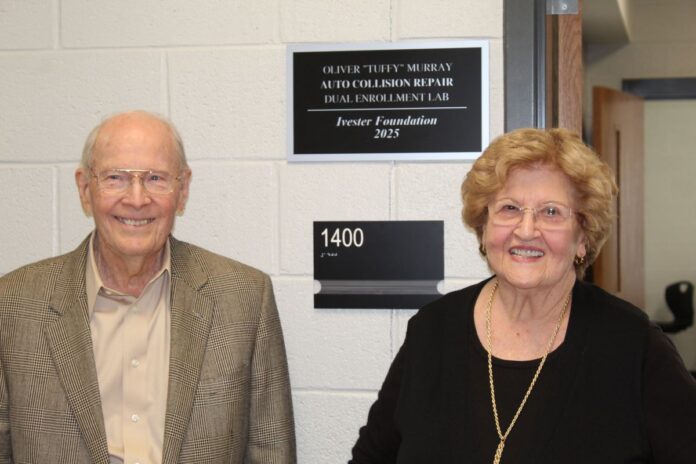
Oliver Tuffy Murray and Mary Jane Murray (submitted)
The Hall County School District announced the completion of the newly upgraded learning commons at Flowery Branch High School, West Hall High School, and Wauka Mountain Elementary School. Construction on the new learning commons at Johnson High School will begin this spring, with the space set to open in the fall of 2025.
These state-of-the-art learning spaces were made possible through a generous $100,000 donation from the Melvin Douglas and Victoria Kay Ivester Foundation. Designed to promote creativity, collaboration, and student-focused learning, each school received $25,000 to modernize its learning commons, creating dynamic environments that inspire innovation.
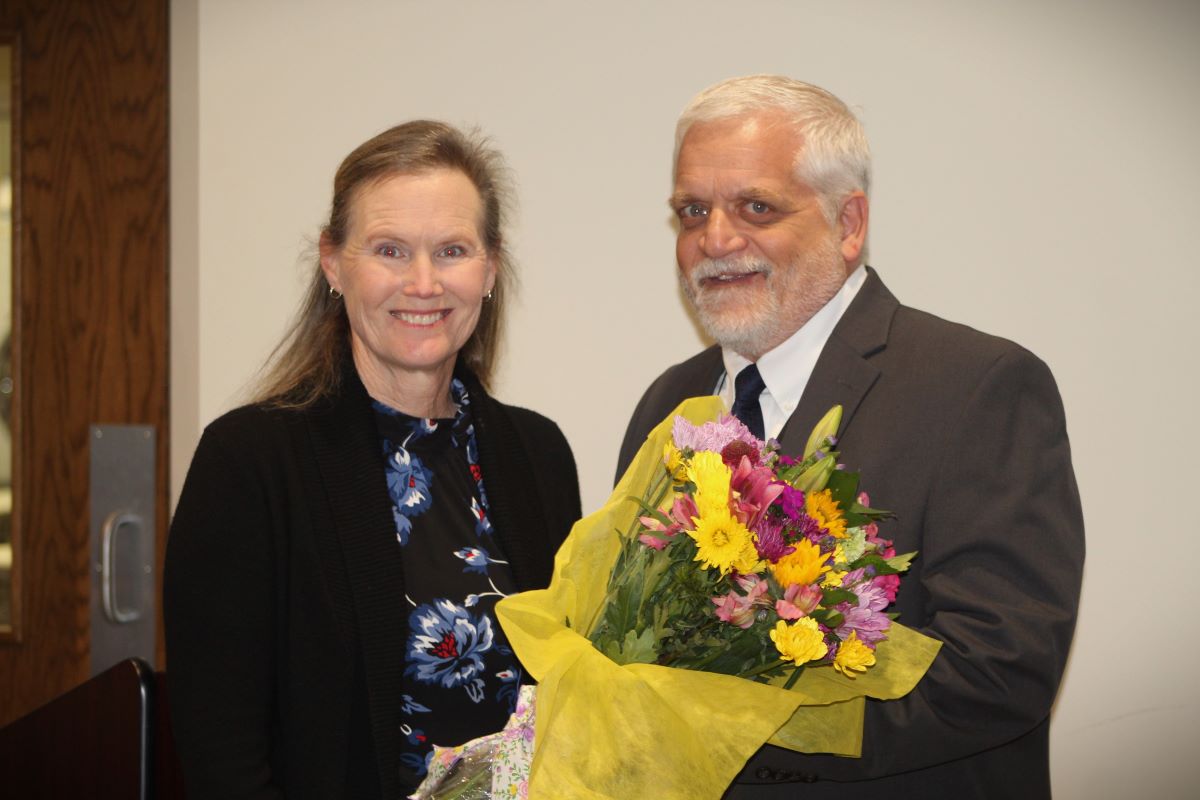
Dr. Ley Hatcock thanked Amanda Griffith at the Hall County School District celebration. (submitted)
Recognition of individuals
In recognition of individuals who have made a significant impact on the community, each learning commons has been named in their honor:
Flowery Branch High School: The Diane Darby Learning Commons
West Hall High School: The Amanda Griffith Learning Commons
Johnson High School: The Mary Jane Murray Learning Commons
Wauka Mountain Elementary School: The Alana Rochester Learning Commons
The Ivester Foundation has also contributed $1.5 million to enhance three Dual Enrollment Career Ready labs at Lanier College & Career Academy. These labs will equip students with practical, real-world skills and hands-on learning experiences. The labs have been named in honor of key contributors to the foundation’s ongoing support of education in the Gainesville-Hall County area:
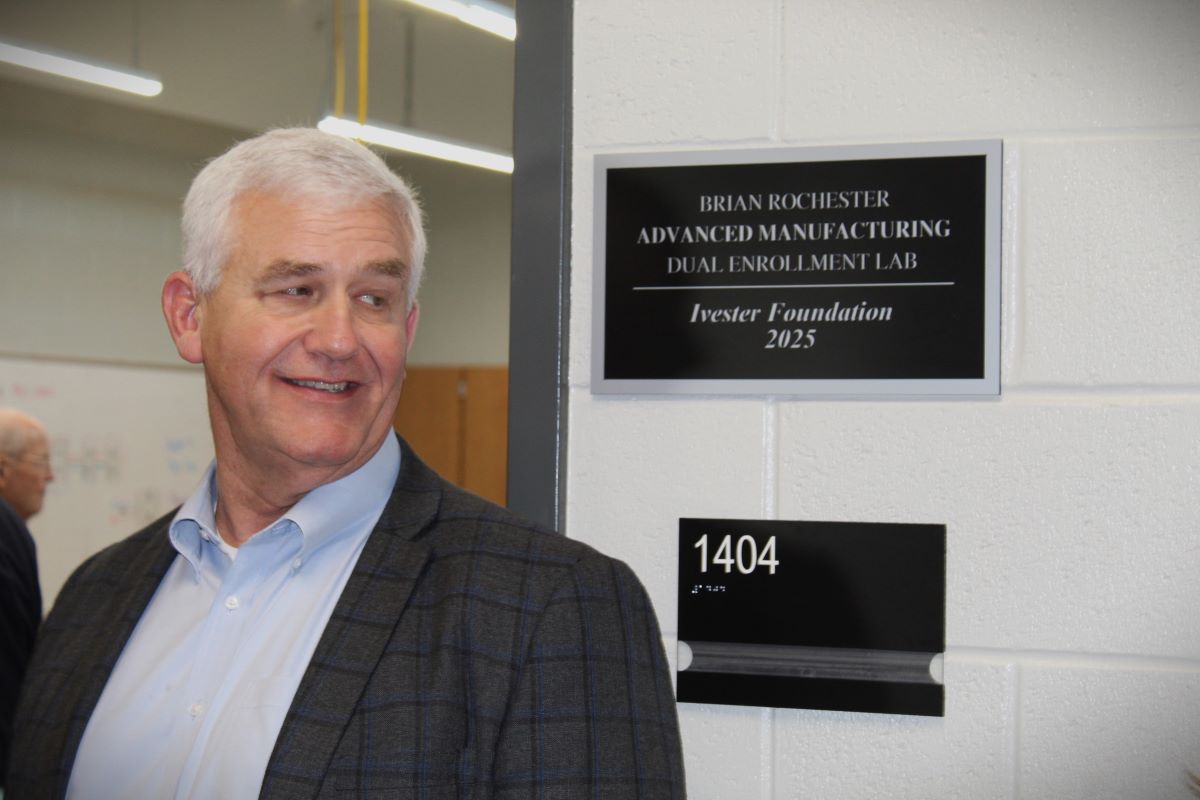
Dual Enrollment Career Ready labs at Lanier College & Career Academy received funding from the Ivester Foundation. The Advanced Manufacturing Lab was named In honor of Brian Rochester, President of Rochester DCCM. (submitted)
Advanced Manufacturing Lab: In honor of Brian Rochester
Auto Collision Repair Lab: In honor of Oliver “Tuffy” Murray
Design and Media Lab: In honor of Swinton A. Griffith III
Gratitude
A celebration to recognize the opportunities these spaces will provide for students—and to honor the individuals for whom they are named—took place Tuesday, March 18, at the Bistro at The Oaks on the Lanier College and Career Academy campus.
Principals from the benefiting schools attended the event, sharing their appreciation for these enhancements.
Superintendent Will Schofield expressed gratitude for the Ivester Foundation’s ongoing commitment to Hall County students. “We are deeply thankful to the Ivester Foundation for investing in world-class learning environments for our young people. These new learning commons and Career Ready labs will have a lasting impact, equipping students with the resources and experiences they need to thrive in an ever-evolving world.”
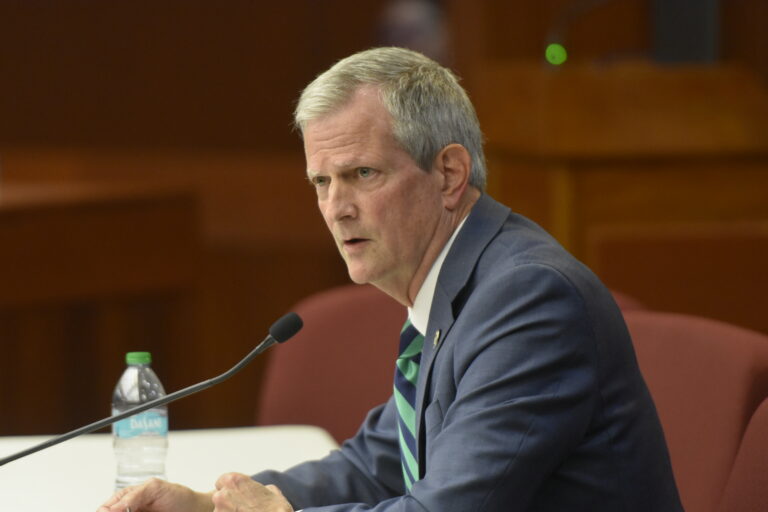
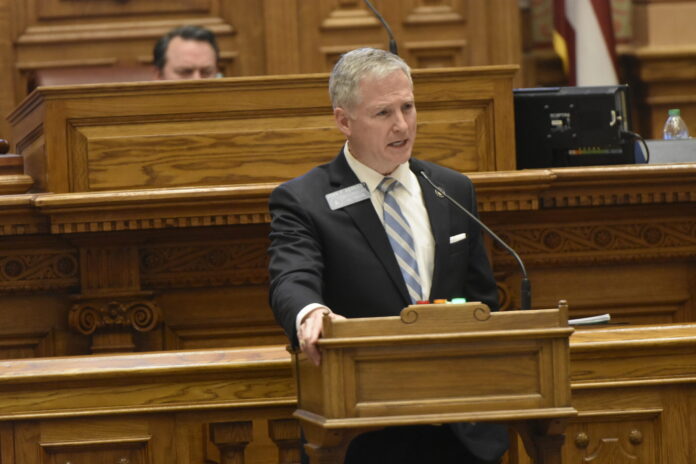
The bill to ban puberty blockers faced skepticism from Democrats on the committee as well as Committee Chair Sharon Cooper, a Marietta Republican. (Ross Williams/Georgia Recorder)
ATLANTA (Georgia Recorder) — The fate of a Senate bill banning puberty-blocking medications for minors with gender dysphoria is unclear after a rocky House Committee hearing Tuesday.
Savannah Republican Sen. Ben Watson’s Senate Bill 30 was not scheduled to get a vote in the House Public and Community Health Committee but the meeting ended early after the bill faced skepticism from Democrats on the committee as well as Committee Chair Sharon Cooper, a Marietta Republican.
Sen. Ben Watson (Ross Williams/Georgia Recorder)
The bill would bar doctors from prescribing puberty blockers to children with gender dysphoria, a feeling of distress that comes from one’s gender identity not matching one’s body.
Dr. Michelle Zeanah, a Statesboro-based pediatrician, joined the committee by Zoom to speak in favor of the bill.
“In Georgia, adolescents under the age of 16 are not able to consent to sexual activity,” she said. “Adolescents under the age of 18 are not able to consent to a tattoo or genital piercing. And most OBGYNs think that young mothers under the age of 25 cannot really give informed consent to having their tubes tied to prevent additional pregnancies. So I really don’t think that we should be allowing children and adolescents the opportunity to make a life-altering decision that affects them forever because they don’t really understand how to give consent, and they don’t understand the decisions that they’re making.”
Children are not allowed to seek treatment for gender dysphoria without parental permission.
Zeanah specializes in treating children with autism, which she said is relevant because children with autism are more likely to be transgender.
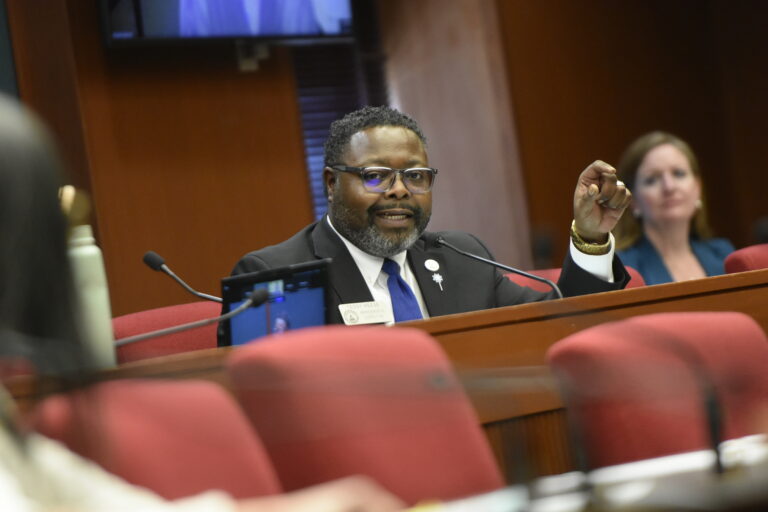
But the doctor’s testimony was met with skepticism from Democrats on the committee, including Columbus Rep. Tremaine “Teddy” Reese.
“You feel strongly enough that the parents should lose their rights, per state law, with the child they have raised from birth, waking up in the morning when they were two or three months old to give them milk and change their diapers, the person who knows them better than anybody on this committee, anybody in this state, that they should have the right taken away from them to determine how they decide to proceed with their child’s life,” Reese said.
“I think that children should be protected from making life-altering decisions that could be very harmful,” answered Zeanah.
“Children should be protected from their parents, that’s what you’re saying, by strangers that know nothing about what’s going on in the household,” Reese said.
Watson, who is also a physician, said the bill cleans up another law passed two years ago that outlawed hormone therapy but specifically kept puberty blockers legal. He said new information has come to light indicating that puberty blockers are harmful, and he said parents have confided in him that they wish their children had never been allowed to start them.
“Because though their children suffered from gender dysphoria, the evidence-based treatment is such that they should receive counseling for quite some time, that unfortunately has not been the case, and that puberty blockers were initiated and transitioning was happening,” he said. “If puberty blockers had not been initiated, or are not initiated, then you allow a natural process called puberty that we’ve all been through. And that is a lot of fluctuation of hormones, I think that we all can testify.”
Watson added that his bill would still allow puberty blockers for treatments other than gender dysphoria.
”This does not keep puberty blockers from being used when little girls are starting their menstrual cycle at age 6 or 8 years old,” he said. “That does happen, and puberty blockers are used. It is also used in other situations, in mental health situations, when you’re blocking the estrogen or testosterone, the psychiatrists do that. It doesn’t prevent that, but it does prevent it in a mental health issue with gender dysphoria or gender confusion. And that’s what this does.”
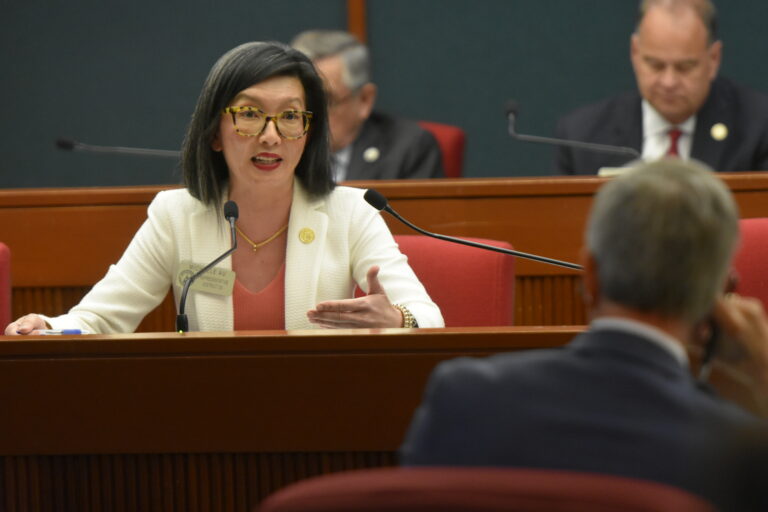
Johns Creek Democratic Rep. Michelle Au, who is also a physician, said the bill limits doctors’ discretion and could bar them from prescribing puberty-blocking medications even for cisgender patients.
Watson pointed to lines in the bill that carve out people “born with a medically verifiable disorder of sex development” as still being eligible for treatment.
Rep. Michelle Au speaking with Sen. Ben Watson. (Ross Williams/Georgia Recorder)
Au said there are conditions that do not fall under that category which are commonly treated with medications that could be deemed hormone-blocking drugs. She gave examples including galactorrhea – lactation not associated with pregnancy or breastfeeding – which can afflict men, women and children, and can be caused by a brain tumor.
Au said she fears the bill could cause doctors to risk running afoul of the law simply by offering standard treatments.
“I generally have a problem with legislation that legislates the practice of medicine, as you sometimes do too, like we’ve worked together, right? You get this, but that’s the situation you’re putting doctors in when they’re trying to do their job. It makes it hard for us to do our job.”
Cooper called the meeting short because she and other members of the panel were required to attend a House Rules Committee to vote on lawsuit damage award limit legislation, but before leaving, she told Watson she had problems with his bill, including that it would go back on the state’s protection of puberty blockers from the bill banning hormone therapy two years ago.
“I have a real problem with anything going retroactive,” she said.” Whether it’s changing the tax code, going back and penalizing people like they did in the U.S. Senate years ago, or taking away something, as a state, we said was okay, and let families and children, parents, come together and make a decision. And then we’re saying we should take that away when people are in transition.”
Cooper also said she doesn’t want the bill to specify that parents who feel their children have been improperly treated could seek a civil or criminal trial against doctors.
Cooper said the unintentional fallout could be comparable to that from the state’s abortion law.
“We’re having trouble recruiting OBGYNs because of the criminal part of the law,” she said. “Just regular OBGYNs who just want to deliver healthy babies. Well, when you put something like that in the end that says nothing is to prohibit them being sued criminally or civilly then it scares all of them. And then, will they be too scared to (treat) a child with an early period? Are they going to be scared to use the blockers that they’re going to need?”
Cooper suggested Watson appeared peeved at the questioning.
“I get the feeling you’re a little upset with us for even questioning, I hope that’s not the way it is, it’s just that, it’s different, we haven’t had, and I’ve been listening to my committee members talk to me about this and what was going to happen, and I’m just trying to give them an opportunity to express how they feel about it, to ask the questions they need to ask, and I hope you’ll bear with us, it means some extra time, and perhaps changes that will make the bill better or take care of some of the concerns, or maybe not.”
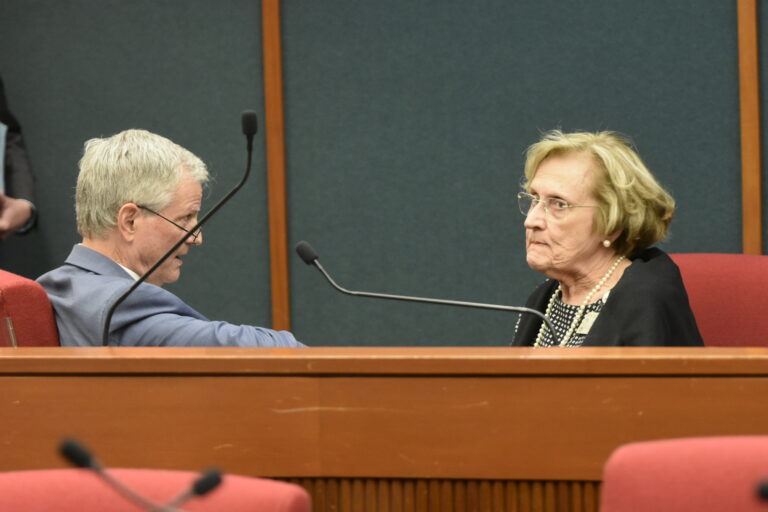
Sen. Ben Watson and Rep. Sharon Cooper in an off mic discussion. (Ross Williams/Georgia Recorder)
Before she left the committee, Cooper and Watson could be seen having an animated discussion behind the dais.
Cooper originally said she would reconvene the meeting after the vote on lawsuit reform and allow people to testify. About a dozen people signed up to speak before the meeting.
But when the Rules meeting went late, Cooper returned and officially adjourned the meeting.
“We are not in charge of all the committees that are meeting, and right now Rules rules the roost, and so I think it would just be better if we reconvened at another time,” she said. “I have no idea when that will be because, as I say, we’re at the end of session, and the time is of the essence, and we need to move. But I will be back, thank you very much for coming. I apologize for your travels, and I do intend, and we will have a fair hearing.”
If the bill gets another hearing, it will then need to get a vote and pass the committee. If the committee passes it without changes, it can head to the House for a final vote. If they make modifications, it will need to go back to the Senate in addition to the House. The deadline for either path is April 4.
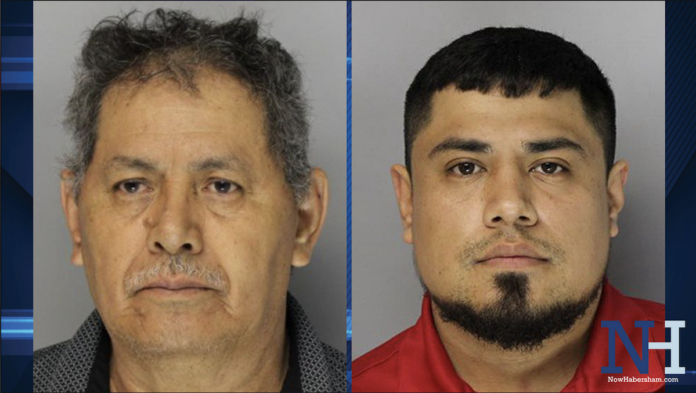
Following their arrests this week, a Gainesville man and his son remain in the Hall County Jail with no bond on charges related to the sexual assault of a young girl.
Reymundo Castillo, 60, was taken into custody on Monday, March 17, 2025, and Edgar Jovanny Razo, 30, was arrested Tuesday, March 18, the Hall County Sheriff’s Office says.
Castillo is charged with one felony count of child molestation. Razo is charged with two counts of child molestation and three counts of sexual battery on a child under the age of 16, all felony crimes.
Investigators say the suspects and the victim were known to one another.
According to the investigation to date, the sexual abuse occurred over a period of several years, starting in 2014. The sheriff’s office says there is no evidence at this time the two suspects committed the crimes together. The victim revealed the abuse to a teacher at her school and the teacher made a report to law enforcement.
A favorite at Hardman Farm - the annual plant swap. (Hardman Farm)
Spring is here, and there’s no better way to celebrate than at the Hardman Farm Annual Community Plant Swap! If you missed out last year, now’s your chance to join in on the fun.
The 2nd Annual Community Plant Swap is happening on Saturday, March 29th from 10 a.m. to 2 p.m.
“We’re excited to bring the community together for a fun day of plant swapping, sharing seeds, bulbs, cuttings, and gardening tips,” said Sarah Summers, Assistant Manager of Hardman Farm. “This time of year, many people are cleaning out their flower beds and have plants, bulbs, or extra seeds from last season that could use a new home—what better way to make use of all that excess than through a plant swap?”
A great way to learn and share plants at Hardman Farm. (Hardman Farm)
You can drop off your plants, seeds, seedlings, bulbs, and even small garden tools, trellises, or gardening books at the Hardman Farm Visitors Center from 10 a.m. to 4 p.m. Tuesday, March 22nd to Friday, March 28th, or bring them directly to the swap on Saturday, March 29th.
All plants, seeds, and bulbs should be healthy, pest-free, and labeled. Make sure they are non-invasive—check Georgia’s invasive species list here.
During the swap on March 29th, you can select a few “new” plants, seeds, or bulbs to take home. “We’ve been growing many plants at Hardman Farm for the swap, and some of our Friends of Hardman Farm volunteers have generously donated plants too,” said Summers. “We’re excited to see what the community brings to share. Even if you have nothing to contribute or are new to gardening, we encourage you to come. We’ll have plenty, and gardeners love to share. Our goal is to help build connections between local plant enthusiasts.”
A free event at Hardman Farm Saturday, March 29, 10 a.m. to 2 p.m.
A Master Gardener from Hardman Farm will also be available to answer questions and provide gardening advice. She’ll host a houseplant workshop at 11 a.m. during the swap.
Anyone interested is encouraged to bring a houseplant they’re struggling with or one they’re particularly proud of for advice.
The plant swap is free to attend. Hardman Farm mansion tours will be available throughout the day for regular admission: $13 for adults, $9.75 for seniors, $8 for youth (ages 6-17), and free for children 5 and under.
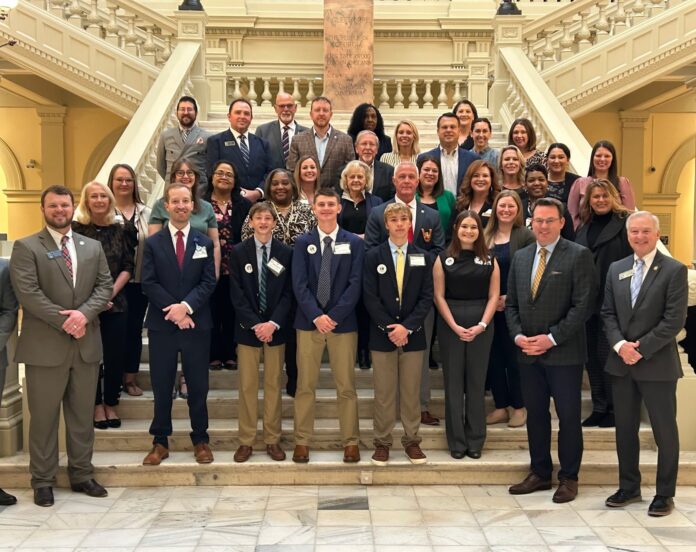
Stephens County Sheriff Rusty Fulbright recently traveled to the State Capitol alongside other county officials, engaging in key legislative discussions with state representatives.
On Thursday, March 13, Fulbright joined representatives from the Toccoa-Stephens County Chamber of Commerce, the Stephens County Development Authority, the Stephens County School System and Toccoa Police Chief Bruce Carlisle for the visit.
The delegation met with Georgia Sen. Bo Hatchett, R-Cornelia and Rep. Chris Erwin, R-Homer, to gain insight into legislative priorities and pending bills that could impact the local community.
Among the legislation under discussion were House Bills 430, 577 and 225, as well as Senate Bill 254. The bills focus on tightening regulations regarding sex offenders, vaping products, school zone speed cameras and hemp, – issues that could significantly affect families and youth in Stephens County.
Fulbright emphasized the importance of these measures, particularly in safeguarding children.
“I wanted to learn where our state senator and state representative stand on these bills which all affect the children in Stephens County and their accessibility to these products,” Fulbright said. “It’s important that they pass because these issues usually impact our youth, our school-aged children.”
Fulbright’s office said the visit provided local leaders with a clearer understanding of legislative efforts and reinforced their commitment to advocating for policies that benefit the Stephens County community.
If you are a business owner, employee, or resident of Clarkesville, Georgia, you will want to attend Coffee & Connections. On the 4th Tuesday of each month at 8:30 a.m. at Clarkesville City Hall, the Clarkesville Main Street hosts this event to share the calendar and upcoming events.
This event gives you a chance to meet your neighbors and local business owners.
Coffee is provided or you can bring your own. This month it will be held from March 25 at 8:30 a.m. at the Clarkesville City Hall.
FILE - Senate President Pro Tem John F. Kennedy, a Macon Republican who sponsored the bill, reiterated his claim that the legislation is aimed at restoring balance between plaintiffs and defendants in Georgia’s civil courtrooms. (Ross Williams/Georgia Recorder)
(Georgia Recorder) — Georgia Gov. Brian Kemp’s top priority in the 2025 Legislature got a little closer to the finish line Tuesday after a state House panel signed off on a bill intended to limit lawsuit damage awards.
The House Subcommittee of Rules on Lawsuit Reform passed Senate Bill 68 in a contentious vote Tuesday afternoon, clearing a path for the omnibus bill dedicated to overhauling Georgia’s civil litigation landscape to advance to the House after weeks of debate over the Kemp-backed legislation.
The tort legislation is now moving quickly, with a full state House vote on track as soon as Thursday. The 2025 legislative session ends April 4.
Senate President Pro Tem John F. Kennedy, a Macon Republican who is sponsoring the bill, reiterated his claim that the legislation is aimed at restoring balance between plaintiffs and defendants in Georgia’s civil courtrooms during the committee’s fifth and final planned hearing on the bill.
Though Kennedy repeatedly resisted proposed amendments to the bill as it passed through the Senate committee, the version that passed the House Rules Committee did contain a few minor changes, including one that marginally increased protections for sex trafficking survivors.
“I believe that the bill you have before you is a carefully crafted compromise,” he said.
Survivors of human trafficking have been some of the most prominent voices against Kemp’s civil litigation overhaul, holding multiple protests at the capitol to sound the alarm about aspects of the bill they say could shield businesses from accountability and prevent nearly all victims from receiving justice through the courts.
Kennedy tried to assuage some of the concerns that the damage limits will hold businesses like extended-stay hotels less accountable if a jury finds property managers and owners enabled human trafficking, claiming that “the intention of SB 68 is not to harbor, enable or turn a blind eye in any regard to such grotesque activity and conduct.”
Another amendment to the bill speeds up the timeline for trials split to consider culpability separately from monetary damages. The aim is to ensure that separate phases of a trial can happen “immediately” using the same judge and jury, rather than being spread out over weeks or months. It also exempts survivors of sexual violence and plaintiffs in lawsuits that are less than $150,000 from having to testify multiple times.
“What we have done is an attempt to codify a body of law and introduce a workable framework to provide stability to businesses and consumers while ensuring fair compensation to those that have been wronged,” Kennedy said.
However, the amendments fell short of the sweeping exemptions for all children, elderly victims, and survivors of sexual assault that trial lawyers and victims’ advocates had requested, and an omnibus amendment offered by Atlanta Democratic Rep. Stacey Evans, which would have extended the bill’s protections beyond human trafficking survivors was voted down.
Before the panel amended the bill, it failed to make allowances for victims who want to bring property liability claims that go beyond just the physical condition of a property and also pertain to issues like negligent behavior by employees or management. Under the amended version of the bill, plaintiffs who were injured at a business would have to prove that someone had exploited the physical condition of the property to harm them, even if the business owner had knowledge of similar wrongful conduct occurring in the past and failed to act to keep customers safe.
“We’re trying to put additional parameters and guardrails on when someone is responsible or legally liable for negligent security,” Kennedy said. “And if it’s foreseeability alone, that’s not enough. It requires these additional provisions.”
Trial lawyers, who warn about the unintended consequences SB 68 could create for Georgians seeking justice through the civil court system, condemned the bill’s passage out of committee. Andy Rogers, a personal injury lawyer at the Atlanta firm Deitch & Rogers who has been following the bill, said he wasn’t surprised that SB 68 passed the committee, but added that he was “frustrated with the lack of intellectual honesty” in discussions lawmakers were having about the bill’s impact.
“The fact that there’s a carve-out for sex trafficking victims is great and makes perfect sense, but that’s only been done because of the recognition by the drafters that sex trafficking victims would be harmed by the current language in SB 68,” he said. “Which, by necessity, means that all of the other potential plaintiffs are going to be harmed by SB 68. There’s just no other way to think about it.”
If this bill becomes law, Rogers added, he will most likely be having two types of conversations with clients who come to his office.
“If they were victimized by crime other than sex trafficking, it’s going to be very, very difficult to prove their case,” Rogers said. “And if their attack was the result of something unrelated to the physical condition on the property, they probably have no case.”
Meanwhile, House Republicans applauded the committee’s passage of SB 68, with Speaker Jon Burns, a Newington Republican, reiterating his support for Kemp’s legislation.
“Each provision included in Senate Bill 68 has been meticulously crafted to ensure fairness for Georgia’s businesses and citizens alike,” Burns said in a statement shortly after the bill passed through the committee. “We’re looking forward to its passage out of the House later this week.”
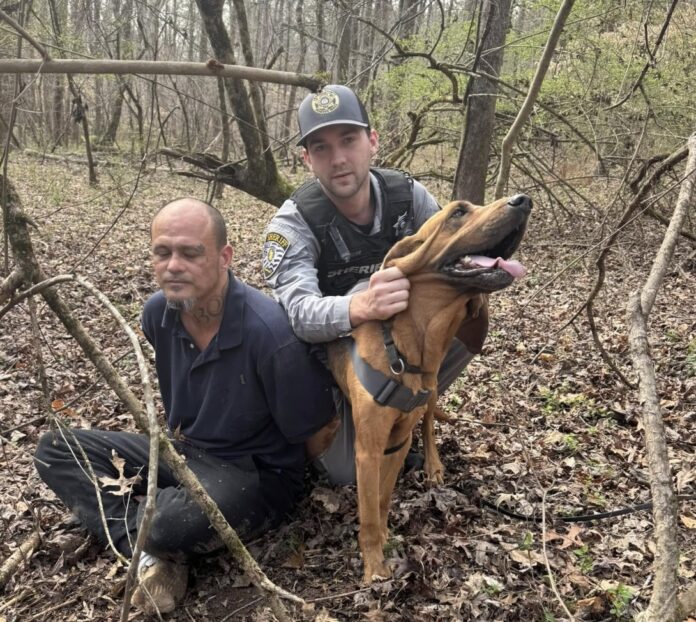
Pruitt is pictured with Peggy Sue and her Handler Deputy Cochran (Maysville Police Department)
A man with outstanding warrants was taken into custody after attempting to evade law enforcement by fleeing into the woods near Maysville Sunday evening, according to authorities.
According to the Maysville Police Department, authorities received a call regarding a suspicious individual knocking on multiple doors near West Freeman Street on Sunday, March 16.
Officers responded to the area and located the suspect, identified as Joshua Pruitt, on Deadwyler Road. Police say a routine warrant check revealed that Pruitt had outstanding warrants, including a felony probation violation for aggravated assault from Barrow County.
As officers attempted to place him in handcuffs, Pruitt managed to escape and fled into a wooded area. Backup was requested, and officers from the Commerce Police Department and the Jackson County Sheriff’s Office established a perimeter with assistance from Jackson County dispatchers.
A K9 unit from Franklin County was deployed to track the suspect. After a half-mile pursuit through dense woods, authorities say Pruitt was located near a creek. He surrendered without further resistance and was taken into custody.
The man accused of abducting and assaulting a 12-year-old Hall County girl will spend at least the next 15 years in prison.
Antonio Agustin-Ailon appeared in court in Ohio last week. According to the Tuscarawas County District Attorney’s Office, he accepted a negotiated plea and admitted to two counts of statutory rape, two counts of pandering involving a minor, and one count of gross sexual imposition.
Accepting the recommended sentence from prosecutors and the defense, the judge sentenced Agustin-Ailon to life in prison without the possibility of parole for 15 years. He will serve his sentence in the Ohio prison system.
Maria Gomez disappearance
The Hall County Sheriff’s Office said Gomez-Perez met Agustin-Ailon online and began chatting with him and other adult men through Facebook Messenger. She told them she was unhappy and wanted to leave home.
On May 29, Agustin-Ailon, a Guatemalan native, drove from Ohio to Gainesville, picked up Gomez-Perez, and took her back to northeast Ohio. She remained there with him until his arrest in late July.
While this guilty plea addresses the crimes committed in Ohio, it does not impact the charges Agustin-Ailon faces in Hall County, including kidnapping.
Hall County District Attorney Lee Darragh told WSB-TV he intends to discuss with the Gomez-Perez family whether and when to pursue these charges. Darragh expressed gratitude for the “significant sentence” Agustin-Ailon received in Ohio.
Firefighters responded to a residential fire in Baldwin Tuesday, March 18. (Jerry Neace/NowHabersham.com)
A family escaped from their burning apartment Tuesday evening in Baldwin. The fire broke out at a residence at 108 King Street shortly before 6:30 p.m. on March 18.
According to Baldwin Fire Chief Joe Roy, the three occupants of the apartment and the family pets escaped the fire. He said that there were no injuries reported at the scene.
Firefighters from Cornelia, Habersham Emergency Services, and Lee Arrendale State Prison also responded to the fire to assist Baldwin.
Emergency vehicles block the southbound lane of Willingham Avenue while fire crews battle a residential fire in Baldwin. (Jerry Neace/NowHabersham.com)
Roy said that the fire started outside at the back of the house from a stump being burned. Assistant Fire Chief Shawn Benfield added that the fire spread by catching outdoor furniture and other items at the rear of the structure on fire that accelerated the spread to the house.
According to Benfield, the affected unit is a total loss. Fortunately, the brick wall that divided the duplex stopped the fire from spreading to the second unit.
The Red Cross has been contacted to assist the residents affected by the fire.
Benfield said that the fire is under investigation and that the State Fire Marshal was en route to assist in the investigation. He added that a fire crew will remain on scene late into the evening to assist the Fire Marshal if needed.
Democratic U.S. Rep. Glenn Ivey of Maryland speaks at a rally in support of federal workers outside the U.S. Department of Health and Human Services in Washington, D.C., on Wednesday, Feb. 19, 2025. (Ashley Murray/States Newsroom)
WASHINGTON (States Newsroom) — The Trump administration has begun the process of reinstating tens of thousands of fired federal workers, though most are just being placed on administrative leave as the government cites the “burdens” of rehiring, court filings reviewed by States Newsroom show.
The documents also show agency by agency, the wide swath of firings that swept across the federal government in February and early March.
Last week, a federal judge in Maryland ruled that the recent terminations of probationary employees were illegal and ordered the administration to reinstate the workers across 18 federal agencies by 1 p.m. Eastern Monday. Nineteen Democratic attorneys general and the District of Columbia sued the administration over the firings.
The mass firings began in early February as part of President Donald Trump’s U.S. DOGE Service cost-cutting agenda. Elon Musk, a White House adviser and top donor to Trump’s reelection is the face of the temporary DOGE project, though the administration maintains he has no decision-making power.
According to the courtfilings late Monday, the agencies have returned almost 19,000 employees to administrative leave out of the 24,418 fired. The filings provided the most comprehensive list to date of the federal workforce downsizing that spanned February into March.
Judge James Bredar of the U.S. District Court for the District of Maryland ordered the agencies on Tuesday to provide a progress update by early next week. Bredar was appointed by former President Barack Obama in 2010 and confirmed by a Senate voice vote.
The lawsuit was filed March 6 by Democratic attorneys general in Arizona, California, Colorado, Connecticut, Delaware, District of Columbia, Hawaii, Illinois, Maryland, Massachusetts, Michigan, Minnesota, Nevada, New Jersey, New Mexico, New York, Oregon, Rhode Island, Vermont and Wisconsin.
Workers on leave, some ‘until further notice’
Some agencies, like the Departments of Commerce and Transportation, indicated that employees would only be on paid administrative leave temporarily until paperwork and other procedures were finished.
Others, including the U.S. Agency for International Development, have given employees paid administrative leave status “until further notice.”
The government argued that reinstating the terminated employees to full duty status “would impose substantial burdens” on the agencies and cause “turmoil for the terminated employees.”
“[T]hey would have to be onboarded again, including going through any applicable training, filling out human resources paperwork, obtaining new security badges, reinstituting applicable security clearance actions, receiving government furnished equipment, and other requisite administrative actions,” according to the filings from several department representatives.
But “nonetheless,” the agency representatives said they began complying with Bredar’s order even as the cancellation of terminations was a “very time and labor-intensive process,” wrote Mark D. Green, deputy assistant secretary for human capital, learning and safety at the Department of the Interior.
“The tremendous uncertainty associated with this confusion and these administrative burdens impede supervisors from appropriately managing their workforce. Work schedules and assignments are effectively being tied to hearing and briefing schedules set by the courts. It will be extremely difficult to assign new work to reinstated individuals in light of the uncertainty over their future status,” Green continued in his legal declaration required by Judge Bredar.
The agency representatives also wrote, “employees could be subjected to multiple changes in their employment status in a matter of weeks” if an appellate ruling reverses the lower court order.
The Trump administration appealed the district court ruling Friday to the 4th Circuit Court of Appeals.
California judge issues warning
The March 13 temporary restraining order out of Maryland was the second on that date mandating agencies rehire terminated workers. A federal judge in California separately ordered the government to reinstate thousands of employees at six federal agencies.
District Judge William Alsup in the Northern District of California warned in a court filing late Monday that the agencies must comply by fully returning employees to their jobs.
“The Court has read news reports that, in at least one agency, probationary employees are being rehired but then placed on administrative leave en masse. This is not allowed by the preliminary injunction, for it would not restore the services the preliminary injunction intends to restore,” Alsup wrote, requesting a status report Tuesday. Alsup was appointed by former President Bill Clinton in 1999 and confirmed by a Senate voice vote.
The Trump administration quickly appealed the California ruling last week to the U.S. Appeals Court for the 9th Circuit.
A three-panel judge for the 9th Circuit Monday ruled 2-1 to deny the Trump administration’s emergency request to block the workers’ reinstatement.
Employees new on the job
Probationary employees were targeted by the Office of Personnel Management on the first day of Trump’s second presidency, according to court documents.
The employees, who are within one or two years of being hired or beginning a new position, have “extremely limited protections against termination,” agency representatives wrote.
The Office of Personnel and Management sent emails Jan. 20 to department heads stating that “agencies should identify all employees on probationary periods” and “should promptly determine whether those employees should be retained at the agency,” according to the court filing.
Agency by agency list
Department and agency representatives detailed the following termination numbers in the Monday filings (not all agencies provided total numbers of probationary employees):
Health and Human Services: 3,248 of its 8,466 probationary workers were placed on administrative leave between Feb. 15 and March 13 (and remain on extended leave); 88 were subsequently fired and placed back on leave as of Monday.
Environmental Protection Agency: 419 probationary employees were terminated between Feb. 14 and Feb. 21. “Most” were returned to paid administrative leave Monday. Some who were in “unpaid leave status” were returned to that status.
Energy: 555 were terminated “on or around” Feb. 13 and Feb 14. All 555 were returned Monday to retroactive administrative leave status “that will continue until their badging and IT access are restored, at which time they will be converted to an Active Duty status.”
Commerce: 791 of the agency’s roughly 9,000 probationary employees were terminated up until March 3. Twenty-seven were reinstated soon after, and 764 were placed back on paid administrative leave Monday. The agency plans to move them to full duty status within a week, according to the filing.
Homeland Security: 313 employees were terminated through March 14. With a few exceptions of employees who resigned or declined to return, DHS placed 310 back on paid administrative leave.
Transportation: 788 employees were terminated between Feb. 14 and Feb. 24. DOT informed 775 that they’ve been placed on paid administrative leave until Wednesday. “The Department of Transportation will coordinate the specifics of their return, including the restoration of their government equipment and Personal Identity Verification (PIV) card,” according to the filing.
Education: Without providing specific dates, the department terminated 65 of its 108 probationary employees before Judge Bredar’s March 13 order. All have now been placed on paid administrative leave.
Housing and Urban Development: The agency terminated 312 of its 549 probationary employees on Feb. 14. About 299 are being brought back “temporarily” on administrative leave.
Interior: As of Monday night, Interior had reinstated roughly 1,540 of the 1,710 workers fired on Feb. 14.
Labor: 170 were terminated but reinstated before March 7.
Consumer Financial Protection Bureau: 117 employees were terminated between Feb. 11 and Feb. 13. All were notified Sunday that they “will be immediately placed on administrative leave status while the CFPB continues to act to comply with the TRO and/or employees are to be assigned work by management/supervisors,” according to the filing.
Small Business Administration: 304 of the SBA’s 700 probationary employees were terminated between Feb. 11 and Feb. 25. The agency was unable to notify seven employees about reinstatement. Roughly 164 were returned to non-pay intermittent status, while the rest were returned to paid administrative leave.
Federal Deposit Insurance Corporation: 156 of its 261 probationary employees were terminated between Feb. 18 and 19; 151 were placed on paid administrative leave as of Monday.
USAID: 270 of the agency’s 295 probationary employees were fired March 7. All have been reinstated to paid administrative leave.
General Services Administration: 366 of its 812 probationary employees were terminated between Feb. 13 and March 7. While two declined reinstatement, 364 were placed Monday on paid administrative leave.
Treasury: 7,605 of Treasury’s 16,663 probationary employees were fired between Feb. 19 and March 7. All have been reinstated to paid administrative leave status.
Agriculture: 5,714 probationary employees were terminated between Feb. 13 and 17. The department is “working diligently” to restore employees to active duty status, according to the filing. The employees have been returned to paid or unpaid leave as of March 12.
Veterans Affairs: 1,683 of the VA’s roughly 46,000 probationary employees were terminated between Feb. 13 to 24. All were placed on paid administrative leave.
USAID ruling
In a separate case against Trump and DOGE’s workforce-slashing agenda, a federal judge in Maryland on Tuesday ruled Musk likely violated the Constitution when orchestrating the shutdown of the U.S. Agency for International Development, or USAID.
Judge Theodore David Chuang for the U.S. District Court in the District of Maryland demanded Musk and any personnel working for DOGE refrain from any further action related to dismantling USAID.
Chuang also ordered Musk and DOGE to reinstate computer and email access for all current USAID employees and contractors within seven days. Additionally, he ordered Musk and DOGE to strike an agreement within 14 days that would reopen the former USAID headquarters in Washington, D.C.
Musk’s DOGE personnel forced their way into the humanitarian agency’s headquarters in early February ahead of the mass firings.
The shuttering of U.S. humanitarian missions around the world sparked protests in the nation’s capital.
Chuang, an Obama appointee, was approved by the Senate in 2014 in a 53-42 vote.
The White House slammed the court order Tuesday, alleging that “rogue judges are subverting the will of the American people in their attempts to stop President Trump from carrying out his agenda.”
“If these Judges want to force their partisan ideologies across the government, they should run for office themselves. The Trump Administration will appeal this miscarriage of justice and fight back against all activist judges intruding on the separation of powers,” said White House spokesperson Anna Kelly in an emailed statement.
Earlier Tuesday, U.S. Supreme Court Chief Justice John Roberts issued a rare statement following Trump’s morning social media attack on federal judges, calling for their impeachment.
“For more than two centuries, it has been established that impeachment is not an appropriate response to disagreement concerning a judicial decision,” Roberts said. “The normal appellate review process exists for that purpose.”
The Habersham County Airport Business Park (Daniel Purcell/Now Habersham)
A developer who purchased two lots in the Airport Business Park has responded to the Habersham County Development Authority after the board gave the company a month to begin the first phases of construction of a spec building or face a potential buyback of the land.
The parcels, located in a prime section of the park, have remained undeveloped for over two years despite initial development plans.
The Hutchinson organization acquired lots five and seven for $45,000 per usable acre – totaling 12 acres. Now, after more than 28 months without visible progress, the development authority is considering reclaiming the land. If the board proceeds with the buyback, it could repurchase the property for $500,000 – an outcome board members hope to avoid.
Grant Schmeelk, a representative of the Hutchinson organization, attributed the delay to ongoing market stagnation.
“We’ve been advocates for that (business) park since inception,” Schmeelk said. “We’ve worked with multiple folks. We’ve had a full set of plans, but it didn’t work out at the last minute. There’s been movement, but the market is stagnant. We’re definitely advocates of the area and looking forward to the partnership.”
Habersham County Development Authority Chairman Jim Butterworth said during a meeting on Thursday, March 13, that he’d heard the developer had possibly offered the properties for a higher price to a potential buyer – a likely violation of the agreement made with the authority in the covenants.
Schmeelk claimed he wasn’t aware of any such offer.
According to county documents, the covenants between the authority and the Hutchinson organization required construction of a spec building to begin within a year of purchase.
With two years now passed, the authority has the right to reclaim the land unless the developer requests an extension or moves to begin construction.
Schmeelk said his organization remains committed to economic development in Habersham’s Airport Business Park.
“We’ve got building plans,” he said. “It’s not like we haven’t done anything…that’s the market. The market is what it is. We’re doing the best we can. If they’ve got an issue, they can call us.”
While officials say a letter had been sent to the developer as notification of the potential buyback, Schmeelk claimed the organization hasn’t heard from the authority.
“We’re definitely big fans of the area,” Schmeelk said. “We’d love to have more activity out of the development authority. That was the intent. We’d love to build them some buildings, but we just haven’t had the activity.”