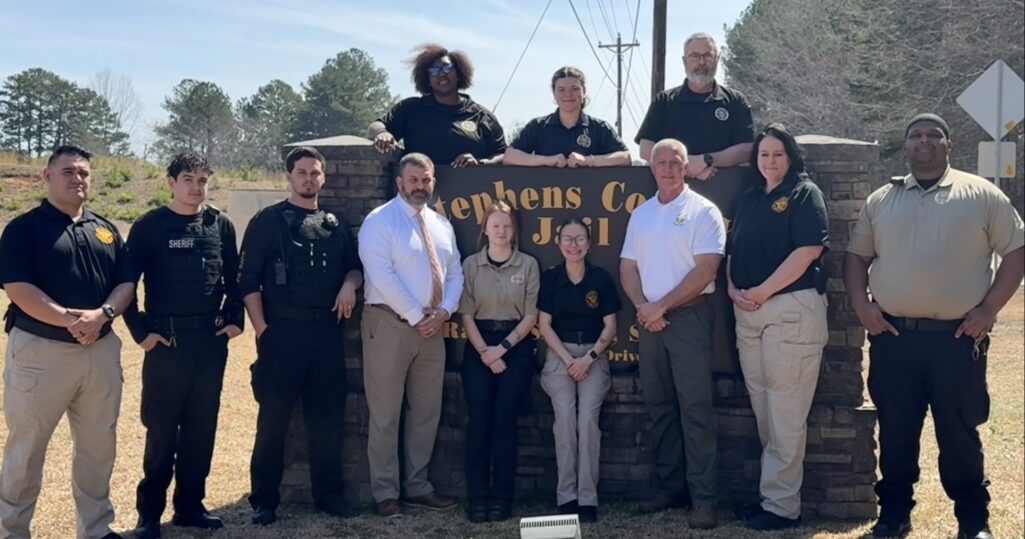
Jail officers receive certification training at the Stephens County Sheriff's Office earlier this month (Stephens County Sheriff's Office/Facebook)
The Stephens County Sheriff’s Office Training Division has started up its inaugural Basic Jail Officer Certification Program, which aims to provide training for local jail employees.
The program, which took place from March 3-14, was held in partnership with the Georgia Peace Officer Standards and Training (P.O.S.T.) Council and the University of North Georgia (UNG) Public Safety Academy.
Under Georgia state law, all jail and prison employees who oversee inmates must complete an 80-hour training program to become certified jail officers. In response to this requirement, the sheriff’s office organized its inaugural training course, welcoming eight participants from Stephens, Franklin, and Habersham counties.
(Stephens County Sheriff’s Office/Facebook)
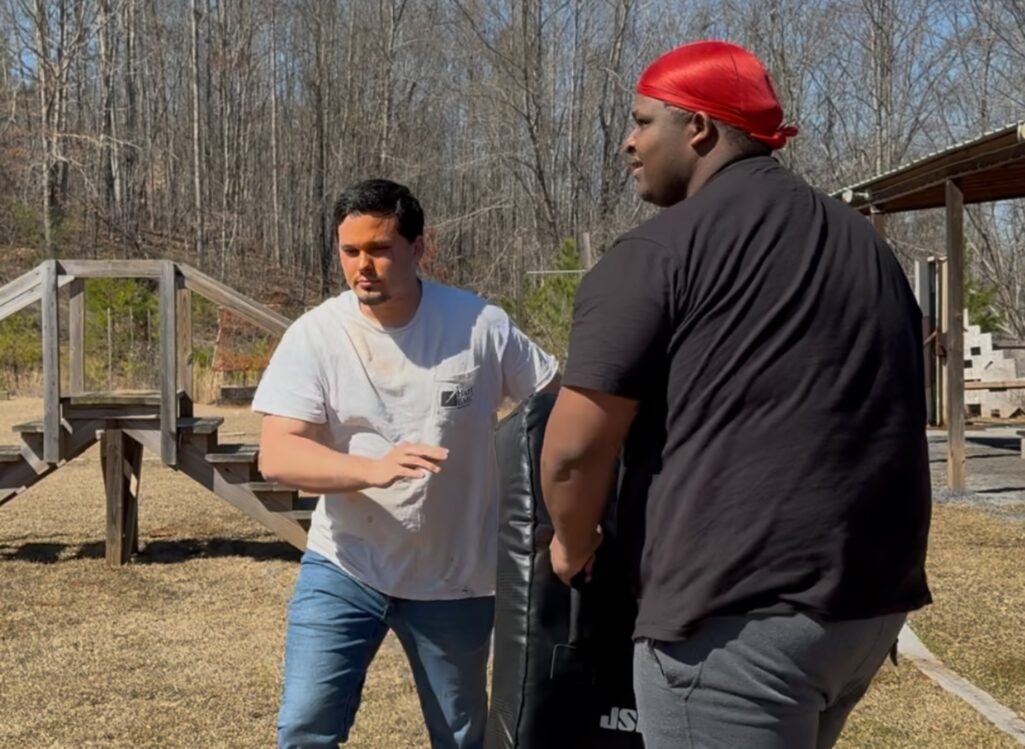
Throughout the two-week program, trainees received instruction in critical areas such as emergency procedures, inmate rights and discipline, fingerprinting, self-defense, and inmate supervision. Participants also completed hands-on training in cell searches, report writing, and proper handcuffing techniques. Additionally, they were certified in the use of less-lethal weapons, including the Taser 7 and OC spray.
Stephens County Sheriff Rusty Fulbright emphasized the benefits of hosting the certification program locally, stating that newly hired jailers will no longer need to travel outside the county for required training. This initiative reduces travel expenses and ensures that officers are trained according to SCSO policies from the start.
“When a person is hired as a jailer, they have six months to get to jailer school,” Fulbright said. “When agencies are close to that six-month mark, they won’t have to wait on classes to become available at places like the Georgia Public Safety Training Center in Forsyth. Instead, they can take advantage of coming to classes in neighboring counties like ours.”
(Stephens County Sheriff’s Office/Facebook)
The program also included a 45-hour lecture portion for officers pursuing Senior Deputy certification through the Georgia Sheriff’s Association. One individual successfully completed this advanced training.
The sheriff’s office expressed gratitude to Dr. Butch Newkirk of the UNG Public Safety Academy for providing training materials, as well as Captain Stephen Stewart and officials from the Franklin and Habersham County Sheriff’s Offices for their contributions.
Future training sessions will be announced as they become available. Outside agencies interested in enrolling can visit the SCSO website or contact the Training Division at (706) 898-5853.
This article has been corrected to reflect the accurate spelling of Stephens County Sheriff Rusty Fulbright
Dr. Phillip M. Lawrence, Chiropractor, age 75, of Toccoa, Georgia, went home to be with his Lord and Savior, Jesus Christ, on Tuesday, March 18, 2025.
Phillip was born on December 28, 1949, in Spartanburg, South Carolina, to the late Hugh D. and Thelma McGraw Lawrence of Lyman, South Carolina. He attended the University of South Carolina in Spartanburg and Columbia, South Carolina, before entering the U.S. Navy in 1971, serving for two years during the Vietnam War.
Phillip originally wanted to be a pharmacist but changed his mind after speaking with the President of the newly formed Sherman College of Straight Chiropractic in Spartanburg, South Carolina, where he was in the second graduating class in 1979. He started his Chiropractic Practice in Toccoa in January 1981 and faithfully served his patients for 45 years. He loved being a chiropractor and relieving suffering on a daily basis.
He played the tuba for 40 years, 25 of which he played in the Toccoa Symphony. He loved any project that involved rocks, singing southern gospel music with his beautiful bass voice, loved muscle cars and loved his family—but most of all was a dedicated servant of God who shared the Gospel with and prayed for many, many people. He was a faithful member of Hill Street Baptist Church in Toccoa. He was preceded in death by his parents.
Survivors include his wife, Dr. Jean Jackson Lawrence; two daughters and son-in-law, Kristen and Corey Landis of Holly Ridge, North Carolina and Amy Lawrence of Oakwood, Georgia; two sons, Justin Lawrence of Camarillo, California and Jordan Guzman of Minneapolis, Minnesota; grandchildren, Rhett Lawrence, Alexa Addison, Brycen Addison and Dallas Landis; two sisters, Teresa Wilbanks of Lyman, South Carolina and Melinda Ingle of Rock Hill, South Carolina.
A Celebration of Life will be held Saturday, March 29, 2025, 2 p.m. at Hill Street Baptist Church with The Reverend Paul Garrison and The Reverend Butch Franklin officiating. The following gentlemen will serve as pallbearers: Logan Young, Jerome Stratton, Jerome Stratton, Jr., Travis Stratton, Sam Stratton, and John Murray.
The family will receive friends at the Acree-Davis Funeral Home on Friday, March 28, 2025, from 6 p.m. until 8 p.m. and on Saturday from 12:30 p.m. until 1:30 pm. Online condolences may be left for the family at www.acree-davisfh.com.
In lieu of flowers, memorials may be made to World Challenge Ministry, P.O. Box 8930, Pueblo, Colorado 81008, in memory of Dr. Phillip M. Lawrence.
Interment will follow in the Toccoa City Cemetery with Military Honors by the U.S. Navy Honor Guard.
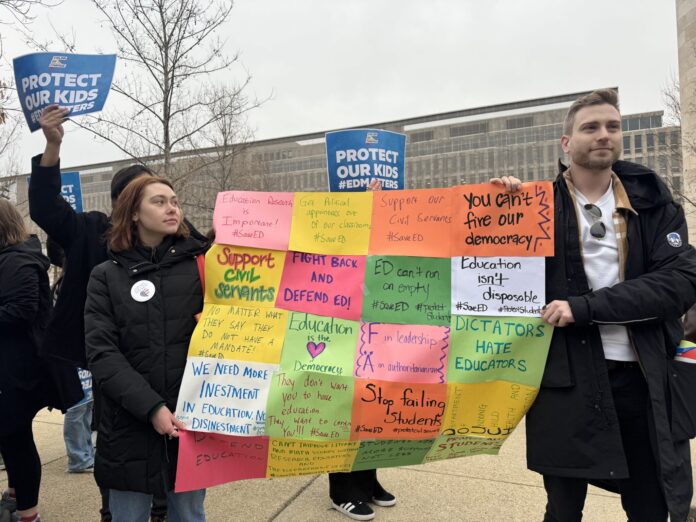
From left, Olivia Sawyer and Jeremy Bauer-Wolf protest the U.S. Education Department’s mass layoffs during a “honk-a-thon” and rally March 14, 2025, in Washington, D.C. (Shauneen Miranda/States Newsroom)
WASHINGTON (States Newsroom) — A coalition of advocacy and labor groups says it plans to file suit against the Trump administration Monday over its sweeping efforts to dismantle the U.S. Department of Education.
The National Education Association, NAACP, the American Federation of State, County and Municipal Employees Maryland Council 3 and public school parents are set to file a lawsuit asking a court to “immediately halt” the administration’s attempts to shutter the agency, the coalition members said in a statement.
Meanwhile, the American Federation of Teachers, its Massachusetts chapter, AFSCME Council 93, the American Association of University Professors, the Service Employees International Union and two school districts in Massachusetts sued the administration in U.S. District Court for the District of Massachusetts on Monday over the executive order and recent mass layoffs at the department.
Trump direction to McMahon
President Donald Trump last week directed Education Secretary Linda McMahon to “take all necessary steps to facilitate the closure” of the department to the maximum extent that is legally permissible.
Only Congress, which established the 45-year-old department, has the power to abolish it.
The following day, Trump announced that some of the department’s key responsibilities — including its handling of the massive student loan portfolio and special education services — would be housed in the Small Business Administration and the Department of Health and Human Services, respectively.
The president also said HHS would handle “nutrition programs,” though it was unclear what he was referring to as the Department of Agriculture manages school meal and other major nutrition programs.
In a Monday statement, NEA’s president Becky Pringle said “gutting the Department of Education will hurt all students by sending class sizes soaring, cutting job training programs, making higher education more out of reach, taking away special education services for students with disabilities, and gutting student civil rights protections.”
“Parents, educators, and community leaders know this will widen the gaps in education, which is why we will do everything in our power to protect our students and their futures,” Pringle said.
Layoffs, cuts
Prior to the executive order, the agency already saw significant changes in the weeks since Trump took office, including mass layoffs, contract cuts, staff buyouts and major policy changes.
The department also announced earlier this month that more than 1,300 employees would be cut through a “reduction in force” process, calling into question how those mass layoffs would affect the agency’s abilities to carry out its main responsibilities.
The cuts prompted a lawsuit from a coalition of 21 Democratic attorneys general — who are trying to block the department from implementing the “reduction in force” action and Trump’s “directive to dismantle the Department of Education.”
“The NEA and NAACP have done nothing to advance the educational outcomes of America’s students and the latest NAEP scores prove that,” Harrison Fields, White House principal deputy press secretary, said in a statement shared with States Newsroom.
“Instead of playing politics with baseless lawsuits, these groups should ditch the courtroom and work with the Trump administration and states on improving the classroom,” Fields said.
The Education Department did not immediately respond to a request for comment Monday.
The Spring Soiree raises money to support the Soque River Watershed Association, a nonprofit devoted to the care and preservation of one of Habersham County's greatest natural resources. (Margie Williamson/NowHabersham.com)
Tickets are still available for the Soque River Watershed Association’s highly anticipated Spring Soiree fundraiser, which serves as a vital source of financial support for the association’s crucial conservation efforts.
Brad Coppedge, SRWA Board President, emphasizes the significance of the event, stating, “The Spring Soiree is our biggest fundraiser of the year, and it generates about 20% of our annual revenue. This year promises to be the best event yet!”
Event Details
The Spring Soiree will take place on Saturday, April 12, from 5:30 p.m. to 8:30 p.m. at the North Georgia Technical College Industrial Technology Event Center, located at 1500 GA-197 North in Clarkesville. Guests will be greeted with an open cash bar and a variety of appetizers to kick off the evening. Attendees will then enjoy an elegant dining experience, followed by a delectable dessert and a guest presentation by Mike Watts, a best-selling author of Fly-Fishing books.
The evening will culminate with a grand live auction, featuring $12,000 in exciting raffle prizes, making it an event to remember.
The Importance of the SRWA’s Work
Since its inception, the SRWA has been steadfast in its mission to preserve the Soque River’s health, quality, and biodiversity. As Georgia’s population grows and the demands on natural resources intensify, the SRWA’s work has never been more essential. From advocating for clean water and habitat protection to offering environmental education programs and stream monitoring initiatives, the SRWA is dedicated to ensuring that the river remains a sustainable resource for generations to come.
“We originated in 1998, which puts us going on our 27th year of existence,” Coppedge shared. “I’m very proud of this organization’s survival success.”
Support Conservation and Enjoy a Memorable Evening
By attending the Spring Soiree, guests not only get to enjoy a night of fine dining and entertainment but also contribute to the SRWA’s vital conservation efforts. Funds raised from the event will directly support projects such as stream restoration, habitat conservation, and educational outreach—ensuring the continued health of the Soque River and its surrounding watershed.
Tickets for this year’s Spring Soiree are available for $75.00 per person. To reserve your spot and show your support for this important cause, visit www.soque.org.
Don’t miss this opportunity to make a difference in preserving one of Georgia’s most treasured rivers, all while enjoying an unforgettable evening with fellow community members and conservation enthusiasts!
Georgia drivers are seeing higher prices at the pump compared to last week, with the state’s average cost for a gallon of regular unleaded gasoline rising to $2.94—an increase of 5 cents in just seven days.
While prices are up from last week, they remain 5 cents lower than last month and 41 cents cheaper than a year ago.
At this rate, filling a standard 15-gallon tank now costs drivers around $44.10, which is nearly $7 less than this time last year.
“Typically, gas prices drop if demand is low and crude oil is cheaper. Unfortunately, not this time,” AAA- The Auto Club Group spokeswoman Montrae Waiters said. “Some refineries are switching to summer blend gasoline, which works better in the heat and costs more to make. However, there is still good news. Georgia drivers are paying 18 cents less than the national average of $3.12.”
Despite the increase, Georgia drivers are still paying 18 cents less per gallon than the national average of $3.12.
National trends: Gas prices tick upward
Nationally, gas prices have risen 5 cents since last Monday, bringing the U.S. average to $3.12 per gallon. This increase comes despite a drop in demand, according to the latest Energy Information Administration (EIA) data. Gasoline consumption declined from 9.18 million barrels per day to 8.81 million, while domestic gasoline stockpiles dipped slightly from 241.1 million barrels to 240.6 million.
Meanwhile, crude oil prices remain volatile. Last Wednesday, West Texas Intermediate (WTI) crude settled at $67.16 per barrel, marking a 26-cent increase from the previous session. U.S. crude inventories rose by 1.7 million barrels, bringing total stockpiles to 437 million barrels—about 5% below the five-year average for this season.
As summer approaches, fuel costs may continue to fluctuate, especially with seasonal refinery shifts and ongoing global oil market trends.
Drugs, guns, and cash the Stephens County Sheriff's Office says were seized during a joint law enforcement operation in Stephens County on March 18, 2025. (Stephens County Sheriff's Office)
Authorities arrested five people and seized a large quantity of illegal drugs during a joint operation by the GBI and Stephens County Sheriff’s Office.
The drug investigation, which began in January 2025, targeted a drug trafficking ring authorities say was transporting large quantities of illegal contraband from Metro Atlanta into Stephens County.
The searches, conducted at multiple locations in Stephens County on March 18, resulted in the arrest of Jimmy Dale Turpin, age 46, of Toccoa. He allegedly had in his possession 282.2 grams of suspected crystal methamphetamine, a firearm, and $1,893 in cash. Officials charged Turpin with trafficking illegal drugs, possession of a firearm during the commission of a crime, possession of a firearm by a convicted felon, and a parole violation.
Authorities also arrested Jonathon Purcell, age 39, of Toccoa, on an outstanding felony warrant out of Gwinnett County and Westley Woody, 43, of Martin, on an outstanding felony probation warrant out of Stephens County.
(Stephens County Sheriff’s Office)
At another location, authorities arrested Robert “Bobby” Thompson, 47, of Eastanollee, and Candice P. Martin (Stanford), 33, of Martin. They allegedly possessed 78 grams of suspected crystal methamphetamine, 23 grams of suspected marijuana, 10 grams of suspected psilocybin mushrooms, various prescription medications, and $4,393 in cash. Authorities charged both with trafficking illegal drugs and possession of Schedule II and IV controlled substances with intent to distribute. They also charged Thompson with a felony probation violation, and Martin with a felony parole violation.
The investigation into the drug trafficking operation continues. Authorities ask anyone with information to contact the SCSO tip line at (706) 886-7048 or the GBI tip line at (706) 348-7410. Anonymous tips may be submitted through the SCSO mobile app or the GBI website at gbi.georgia.gov/submit-tips-online.
The TFS Indians swept past George Walton, taking game two of their Friday double-header with a 15-0 run-rule win on Friday, March 21.
A 9-run third did most of the damage. TFS piled on 11 hits, including a double by Chase Pollock and triple from Ashton Roache. The former had two hits, two runs, and three RBI. Roache had two hits, two runs, and two RBI.
Wyatt Franks had two RBI, while Justin Smith, Drew Barron, Cole Bonitatibus, and Wyatt Dorsey all had RBI hits. Diego Gonzalez earned with win by going 3.1 innings and striking out two. Andrew Skvarka got the last two outs.
The Indians are now 5-6 overall and 3-3 in region play.
A coaltion of Georgia housing rights organizations descended outside the state capitol on the March 5 eve of a critical deadline to advance legislation. Habitat for Humanity volunteers would build a makeshift home to promote a tax credit bill that would save money for home construction expenses for nonprofits. (Ross Williams/Georgia Recorder)
ATLANTA (Georgia Recorder) — A coalition of housing rights advocates is feeling disappointed heading into the home stretch of the 2025 legislative session after seeing little progress on bipartisan bills aimed at protecting Georgians from higher rents, problematic landlords, and increasing threats of eviction.
Habitat for Humanity Northeast Metro Atlanta and House ATL are among the three dozen housing non-profits, civil rights groups, and faith-based organizations that have spent the session pushing for legislation regulating corporate-owned single-family homes and calling for the state to keep alive a federal emergency rental assistance program that runs out later this year.
Despite backing multiple bipartisan bills this year, a leading voice in Georgia’s housing advocacy coalition says she sees a bleak outlook for the rest of the session.
“It’s grim especially given how much recognition is now of the importance of housing people as a foundation for strong communities, strong families,” said Elizabeth Appley, an attorney and public policy advocate for housing rights in Georgia. “There’s really no way for people to succeed without decent, safe, and affordable places to live.”
A key housing bill that failed to meet the March 6 deadline to advance through one chamber was House Bill 689. The bill was sponsored by Dalton Republican Rep. Kasey Carpenter and would include $25 million in the state budget to continue the Georgia Rental Assistance Program, which was launched in March 2021 with $1 billion in federal emergency rental assistance money.
The measure calls for the creation of a homeless prevention program that would provide resources such as legal support to unhoused and low-income individuals.
The proposed 2026 budget includes $4 million for the State Housing Trust Fund or homeless intervention.
Appley said that the Georgia Housing Voucher Program remains underfunded and has only been able to provide housing to about 20 people since April 1.
“We’re hoping that could be used for these flexible local grants for emergency rental assistance, but it would need to be substantially increased in order to continue what the department is doing now with the federal funds that will expire in September,” Appley said.
A $1.7 million increase is included in next year’s proposed budget to support adult mental health services through a housing voucher program administered by the Georgia Department of Behavioral Health and Developmental Disabilities.
The Georgia Housing Coalition is advocating for a $20 million state grant for a program that provides supportive housing and wraparound services to chronically unhoused individuals with persistent mental illnesses.
Housing rights groups are hoping for the passage of Stone Mountain Democratic Sen. Kim Jackson’s Senate Bill 170, which would create an Interagency Council on Homelessness. A vote on the bipartisan bill could take place in the House Governmental Affairs Committee in the next week.
Housing rights groups have also seen some traction gained with measures they oppose.
The Senate Public Safety Committee could take up as early as Monday a substitute of House Bill 61. A measure about issuing license plates for ambulances and hearses now includes language that critics say would violate the rights of people accused of illegally staying in a home without permission.
There has been some success for a housing coalition-backed bill targeting the proliferation of investor-owned homes, primarily around metro Atlanta.
The House passed a bipartisan bill by a 163-4 vote that supporters say would hold out-of-state landlords accountable for managing single-family homes in Georgia.
House Bill 399 would require landlords owning 25 or more single-family homes to employ local brokers or real estate agents and have in-state staff to handle tenant complaints.
“If you are a single family, young family, looking to purchase a home, these investors are taking assets out of Georgia,” said bill sponsor Decatur Democratic Rep. Mary Margaret Oliver during debate on March 3. “They’re making a profit on the rent that’s charged. They’re making profit on the acceleration of home values and that profit is not being enjoyed by young Georgia families looking to purchase a home.”
Another bipartisan bill that has stalled this session is House Bill 555, which would prohibit investors from owning an interest in more than 2,000 single-family residential properties or 10 multifamily residential properties. The Georgians First Residential Property Protection Act, sponsored by Rep. Derrick McCollum, a Chestnut Mountain Republican, would also enforce penalties such as forcing the residential property owners to return rental payments when a lease is found to be unlawful.
The bill also targets the rise in investor-owned housing, which has lowered the affordability of homes in metro Atlanta neighborhoods. An Atlanta Regional Commission report in November found that seven corporations own more than 51,000 single-family rental homes across 21 counties around the area.
Housing rights groups also criticized Georgia lawmakers’ failure so far in passing legislation that would provide people living long-term in extended stay housing with the same legal tenant rights as people renting an apartment.
Appley said she recently received an email from a family that had been paying daily for several months for a room at an extended stay hotel who had their possessions left outside the hotel because the family missed an 11 a.m. checkout time once.
Warnock introduces federal housing bills
U.S. Sen. Raphael Warnock, who is a Democrat, is attempting to drive down the high cost of living in Georgia by recently introducing a package of bills including the Downpayment Toward Equity Act, the Rent Relief Act, the Stop Preparatory Investing Act and the American Housing and Economic Mobility Act.
Warnock emphasized the need for bipartisan support to tackle the housing crisis, which disproportionately affects young people and renters. He also criticized private equity firms for buying up housing stock, especially in the Atlanta area, resulting in soaring rental costs and the need for policies that increase housing supply to mitigate the crisis and support generational wealth.
“We need to listen to the people and people all across Georgia — Democrats, Republicans, independents — all agree that we have a severe housing issue that is crushing young people,” Warnock said during a press conference last week. “Housing is not a partisan issue.
“I say to those that support the free market, and certainly I do that, you ought to look at what this housing crisis is doing to the American market,” Warnock said. “We are seeing generational wealth shift, literally from the young to the old, and that doesn’t bode well for the future of our economy.”
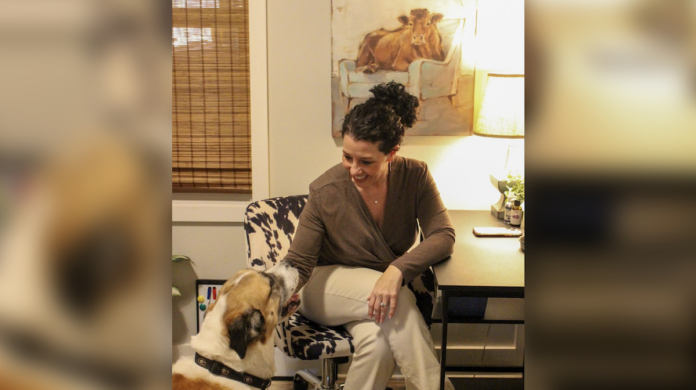
Audra Hawkins and her dog, Lugnut, better known as "Lugz," in her office at the Hawk's Nest Counseling therapy farm in Lula. Here, counselors incorporate animals into their treatment plans to help reduce clients' anxiety, depression, pain, and other physical and emotional challenges. (Photo by Oliva Hulsey)
“Brian” (a pseudonym used to protect his privacy) was a successful professional in a high-intensity career and seemed to have everything. Yet he felt trapped and overwhelmed by the demands of his prestigious job. His persistent feelings of being stuck occasionally led him to thoughts of suicide. When he was most desperate, he turned to Hawk’s Nest Counseling, an innovative counseling and therapy center in Lula, for some badly needed help.
Brian found his way back to stability and a better sense of belonging in his career with a therapist and an unusual duo of sidekicks—Buck and Lula Mae, who are the farm’s rambunctious, playful goats. He ultimately decided to remain in his profession, but with stronger clarity that it was a choice, not fate or an obligation, that put him there.
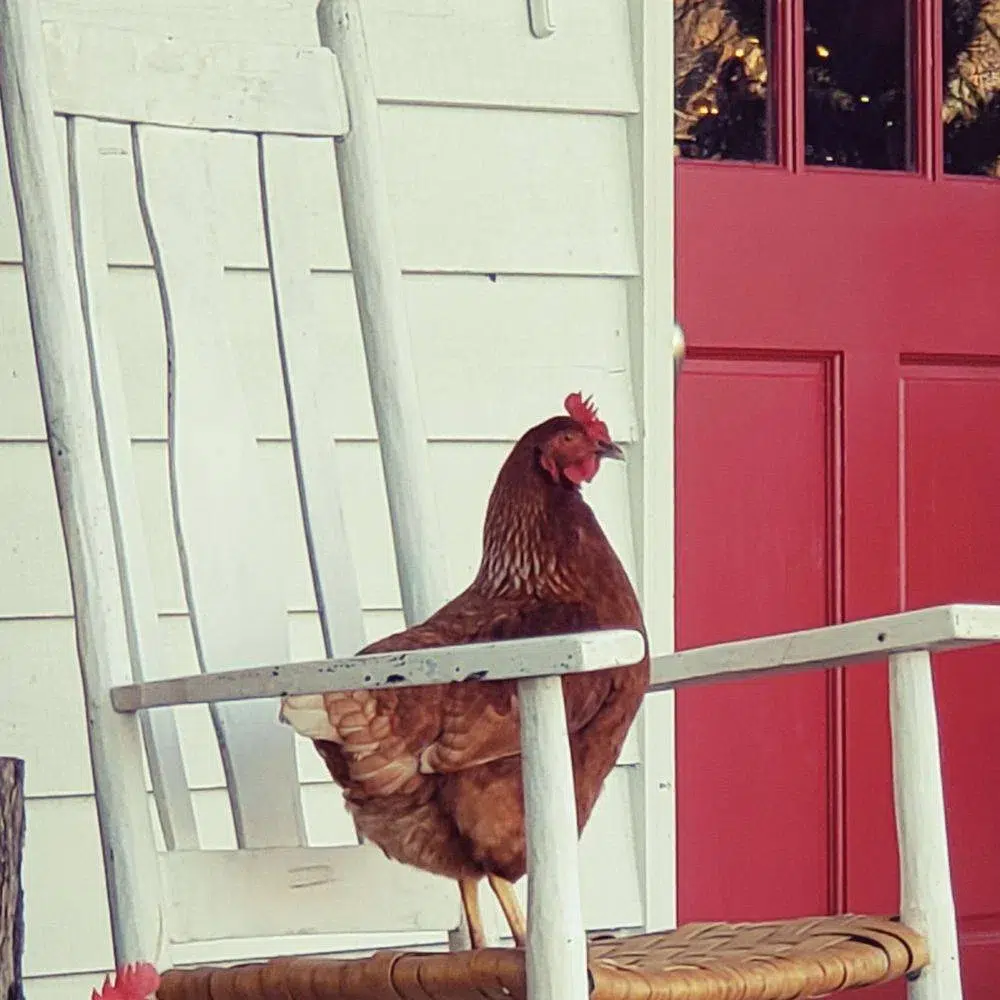
A photo montage of animals that live on the farm at Hawk’s Nest Counseling in Lula, Georgia. Children and adults interact with the animals during therapy, easing their anxiety, depression and pain and other physical and emotional challenges. (Hawk’sNestCounseling.com)
Animal-based therapy
Audra Hawkins founded Hawk’s Nest Counseling in 2019, after years as a therapist in other settings, and while continuing her work as a counselor at Wilbanks Middle School in Demorest. She and her husband bought an undeveloped farm in this rolling, rural stretch of Banks County, and she decided from the outset that bringing a veritable menagerie of farm animals—goats, cows, chickens, rabbits, donkeys, cats, dogs, and soon, piglets—would supply a crucial part of the therapeutic process.
“For many people,” says Hawkins, “talking is hard; feeling is hard. Relating to an animal is comparatively easy.”
(Hawk’sNestCounseling.com)
She speaks fondly of an adolescent patient who willingly talks about her home, school, and life struggles—but only when she’s happily chasing chickens around the farm’s henhouse or petting them once she catches them.
The Hawk’s Nest model of animal-based therapy exists elsewhere in the country but appears unique in Northeast Georgia. The underlying idea is that many people feel at ease in an outdoor setting, stroking a soft rabbit or nuzzling a friendly dog, when they might feel less open about their emotions in a confined office space.
Nature heals
Another crucial part of Hawk’s Nest therapy, quite simply, is its locale. The farm and neighboring woods, with a designated nature-walk path, a firepit, and just the ability to breathe country air and be among the trees, is healing, Hawkins asserts.
“We like our clients to literally ‘touch some grass,’” she says. “There is a lot of research to support healing through nature.”
Patients come in for all the same reasons people go to any other kind of therapy: conflicts with family, co-workers, or partners; parent/kid dynamics; depression; and questions about sexual identity. But Hawkins started to notice, many years ago, that the right animal, combined with the right therapist, could effectively boost people’s ability to respond and deal calmly with whatever challenges they are facing.
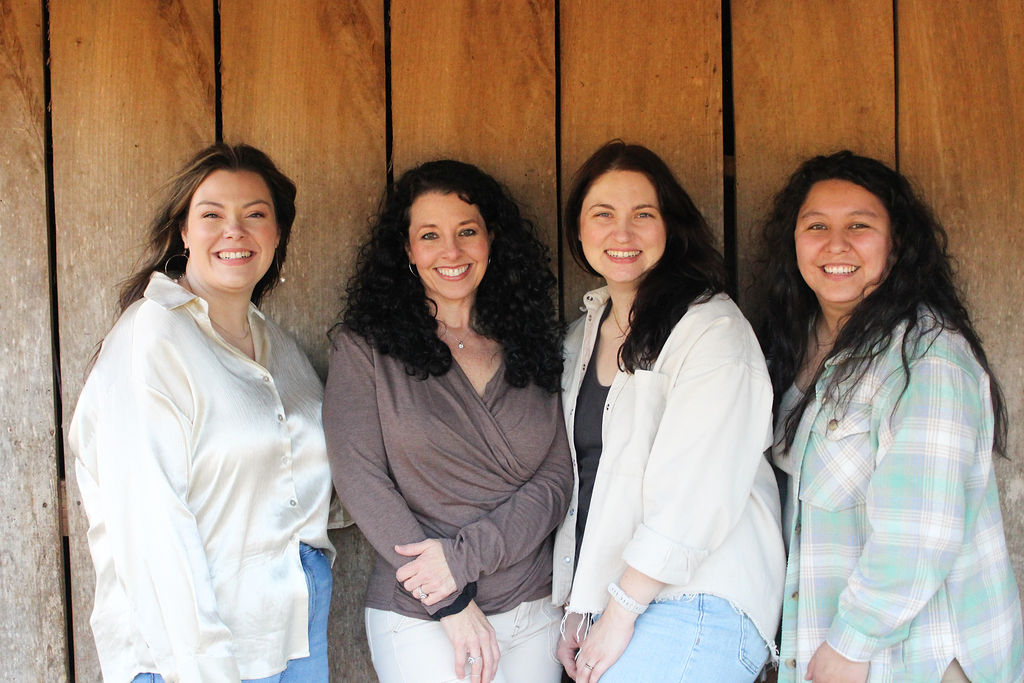
Audra Hawkins and her team of therapists at Hawk’s Nest Counseling in Lula. Pictured from left to right are Brianna Leweallen, Hawkins, Erica Henderson, and Gennesis Popovici. Not pictured, Jeremy Noles. (Photo by Oliva Hulsey)
The therapeutic staff of five is well-credentialed, but none more than Hawkins: She has a bachelor’s degree in Psychology from North Carolina State University, a Master’s degree in School Counseling from Florida Gulf Coast University, and a Specialist’s degree in Counseling from the University of West Alabama. She’s also a licensed professional counselor (LPC) in Georgia and a Nationally Certified Counselor and Certified Professional Counseling Supervisor (CPCS.)
Hawkins’ prize dog, Lugnut, who goes by the nickname “Lugz,” offers a prime example of the almost magical, soothing powers an animal can have.
Lugz, who is officially certified as a therapy dog, joins Hawkins both on the farm and at her “day job” at Wilbanks.
Loveable Lugz
Hawkins recounts the day a young student was called into her office at school after what the therapist delicately referred to as “making some poor decisions with her phone.” Hawkins asked the student how her father would react when he was called into school to discuss it; she accurately predicted he’d be furious.
Lugz is a Hall County rescue dog, possibly a Mini Saint (Saint Bernard and Lab mix). The Hawk’s Nest Counseling website describes him as “110 pounds of pure sweetness!” (HawksNestCounseling.com)
As Hawkins tells it, the girl’s father arrived, and Lugz, who weighs 110 pounds, seemingly sensed the tension between the two and physically came between them, climbing up onto the couch between father and daughter. When the father began petting the dog, the anger and tension in the room began to deflate, and even more so when Lugz started licking the no-longer-angry man’s hand.
Hawkins is sure the session — and resolution — went much more smoothly because of the canine intervention.
“It was astonishing how much it calmed the whole situation down,” Hawkins remembers. The father “didn’t really know why he was calming down. But he did.”
Drawing the family
Hawkins and the other therapists also use more standard techniques when appropriate. Three little cottages on the farm hold comfortable, intimate offices where the therapists do indoor work. Hawkins says she often uses a typical therapeutic tactic with her youngest patients: asking them to draw their families. Through the artistic choices they make, she can learn a lot about how a child is feeling about their home circumstances.
Hawkins remembers an eight-year-old, whom we’ll refer to as “Maisy,” struggling with her parents’ divorce. The parents were worried, even alarmed, about their daughter’s adjustment. When Hawkins had Maisy draw her family, the result opened up a line of questions about the girl’s feelings and how she was psychologically managing the split.
“Ironically, I learned that at some level, Maisy’s perspective was changing; she came to think it was ‘a really neat idea’ that she would have a room of her own in each home and—maybe better—individual time with her mother and her father,” Hawkins said.
Therapist Erica Henderson holds the farm bunny, Jelly Bean. (Photo by Oliva Hulsey)
One of the farm’s adult patients, “Diana” (also a pseudonym), wrote movingly about her therapeutic experience. She said, “Animals have always been a source of safety and emotional security for me. They are kind, compassionate, nonjudgmental beings that have always brought comfort to my life.”
Diana added that her therapist’s specialties matched her needs perfectly.
“I found my way to Hawk’s Nest as they were the only ones I could find that had a therapist specializing in areas that I was struggling with–sexual trauma and law-enforcement related trauma.”
Diana’s therapist’s “day job” is working at a sexual assault trauma center. Thus, she draws on her background and the farm’s unique resources to offer targeted help on those difficult issues.
Regarding payment
Hawkins decided long ago that involvement with health insurance companies does not help her get where she wants, which is “moving each patient along as quickly and economically as possible.” She takes payment from patients or parents only directly, for a standard fee of $115 per hour for individuals of any age and $140 for couples or families. That’s less than big-city therapy fees, of course, and many people, regardless of income, seem to find it worthwhile; her patient roster is nearly full, and she has steadily grown her staff to meet the demand.
She says one of her adult patients drives three hours one way to the farm once a week. The youngest patient is four, and the oldest is 76.
Newest staffer
Therapist Gennesis Popovici (Photo by Oliva Hulsey)
Gennesis Popovici is the latest therapist to join the Hawk’s Nest staff; she had been working at a clinic in Gainesville and may continue to do so, but as she said upon arriving on a February afternoon for her orientation with Hawkins, “I can’t wait to get to work here!” Hawkins said there’s a list of people waiting to see her. Popovici boasts a particular fondness for working with adolescents, who, as she notes, “have so many issues to deal with.”
Asked what crucial issues she thinks people most often overlook or brush aside, Hawkins said it was an easy choice: “Good communication.” People can be really bad at listening, and at expressing themselves, and therapy can help them do both.
“I had one married couple in here, and the woman made one comment about her husband that didn’t go well. We spent three weeks on ‘reflective listening,’ where one partner is asked to reflect back what their partner says, in chunks, to make sure the speaker is genuinely being heard. We spent three hours learning that technique,” Hawkins says, adding that it was necessary.
Popovici chimed in with a second, almost universal issue: “Boundaries,” both therapists agreed. “People just aren’t very good at maintaining them or about avoiding stepping across other people’s.”
Beating the bottle
Hawkins implored one of her earliest farm patients to allow her story to be told, and it is perhaps her most moving:
The farm’s tranquil rural setting contributes to the healing that takes place here. (HawksNestCounseling.com)
Early in the farm’s history, the patient, then in her twenties, came for treatment. She was initially dealing with work problems, sleeplessness, and the grief of recently losing her father.
“As we dug deeper and built rapport,” Hawkins remembers, “she shared that she drank a lot and came from a family who had all struggled with alcoholism and addiction.”
The woman gradually arrived at a personal goal to cut back on her own drinking, and that evolved into working for a few years on those issues along with her more general problems.
“She lost loved ones–some to addiction–watched siblings reach rock bottom due to drugs and alcohol, lost romantic partners…and suffered through all the turmoil that can bring.”
She surmounted it all, Hawkins says. “Even when she faltered, she kept at it.”
That woman is now married, a mother, an entrepreneur, a churchgoer, and has achieved sobriety with the steady support of Alcoholics Anonymous, on top of her regular therapy on the farm.
“She’s proud of the fact she did all the work to be where she is today, clean and sober for almost two years,” Hawkins says.
Hawk’s Nest does not offer addiction counseling services, but therapy on the farm works hand-in-hand with the “Twelve Steps” treatment—in this particular patient’s case, to the point of genuine triumph.
Blue
Blue, right, and his little buddy (Hawk’s Nest Counseling/Facebook)
For patient Diana, the lure of therapy on the farm is partly due to the huge dog that keeps her company during all her therapy sessions.
“Of course, there is Blue, the Great Dane, who sometimes forgets her size and likes to lie or sit on my lap,” she says. “It can bring laughter to some hard topics. And I am also convinced that she has the softest ears of any dog I know.”
As the sun sets on that February afternoon, Hawkins and Popovici chat with a visitor. A sinewy cat, bedecked with straw matting her fur, which she’s just picked up strolling around the farm, winds in and out of the legs of the folks in the room. She zeroes in on the one person in the room who professes not to be particularly fond of cats, and she insists on being petted.
“They’ll do that,” Hawkins chuckles. “That’s a cat thing.”
John DeGarmo speaks outside the state Capitol. (Ross Williams/Georgia Recorder)
ATLANTA (Georgia Recorder) — Georgia is set to hand over control of Medicaid services for foster children to UnitedHealthcare, leading some foster parents and advocates to express concerns.
John DeGarmo, foster parent to more than 60 children and founder of the Foster Care Institute advocacy group, said one of his major concerns is with mental health treatment.
“There’s a 70% increase in teenage suicide since the lockdowns. Children are facing more and more depression issues, anxiety issues, all this surrounding mental health,” he said. “It’s so important they get the support services they need, and they may not if they have that switch. And that, to me, is very alarming because we will lose foster parents as a result. And that is so important. Right now we are struggling. Agencies in Georgia and throughout the country are struggling to recruit foster parents and retain foster parents, and if they don’t get the support services they need, we’re going to have a hard time retaining the ones we have.”
The Georgia Department of Community Health announced United as a provisional winner in December, the same month ProPublica released a report that found the company has a policy to cut costs by denying effective and necessary treatments for children with autism.
December was also the month United CEO Brian Thompson was fatally shot in New York. The slaying launched a national conversation on the morality of insurance companies’ profit motive to deny claims.
UnitedHealthcare did not respond to emailed requests for comment. The Department of Community Health declined to comment, saying the contract is still under a period of protest.
The change is set to kick in by next July unless changes are made during the appeal period.
Former foster parent Veda Brooks said children in foster care often need mental health care more than their peers but often have the most trouble getting it.
“They don’t go to foster care because they’ve done something wrong; they go to foster care because they’ve had to live through situations that most adults won’t even fathom they could have gone through at that age,” she said. “And so that mental health care is just like dental and physical health, it’s that important, especially since the goal of foster care is to produce functional humans when they age out. And when you look at a system that declares someone an adult at 18 based on that number, we need to give them the best foundation we can, mentally, otherwise we’re going to continue to see the increase in our foster kids becoming trafficked, homeless, uneducated.”
National Leadership Challenge, set for April 4-6, provides high school students a chance to consider their potential future in UNG's Corps of Cadets (UNG)
For high school students considering a future with the University of North Georgia’s (UNG) Corps of Cadets, the National Leadership Challenge (NLC) offers a firsthand look at life in the program.
Held each spring and fall, the weekend-long event provides students with an immersive experience, helping them decide between the commissioning track or the National Service Leadership Track within the Corps. This semester’s NLC will take place April 4-6 at UNG’s Dahlonega campus.
Freshman Jay Tysinger, who attended the event last year, called it an invaluable experience.
“The National Leadership Challenge was a fantastic experience. It gave me a hands-on introduction to the Corps of Cadets, helping me better understand their customs, history and values,” Tysinger said. “I gained a new appreciation for the leadership structure and the responsibilities that come with being a part of it.”
The program is designed to be both informative and transformational, giving prospective cadets direct access to current students.
“The weekend gave me a strong sense of the leadership roles and chain of command. I feel like it accurately portrayed how structured and disciplined cadet life is. It really helped me understand the expectations and responsibilities,” he said.
Tysinger, a strategic and security studies major from Statesboro, Georgia, said the weekend provided a realistic preview of cadet life, from its leadership structure to daily responsibilities.
Beyond the training and leadership exercises, Tysinger found an unexpected benefit—building connections with fellow cadets and cadre.
“NLC also gave me a chance to meet some of the cadets and staff, which really helped me understand the camaraderie and the sense of community within the Corps,” he said.
Students interested in attending NLC can register on the event’s webpage. For additional information, contact Jordan Mund at [email protected].




 Dr. Phillip M. Lawrence, Chiropractor, age 75, of Toccoa, Georgia, went home to be with his Lord and Savior, Jesus Christ, on Tuesday, March 18, 2025.