Home Blog Page 464

Clarkesville Boil Water Advisory lifted

(NowGeorgia.com)

A Boil Water Advisory that had been in effect for portions of Clarkesville following a large structure fire Saturday night has been lifted.

The advisory impacted city water customers in the area of Hwy. 115 between Beaver Dam Road and Singing Hills Drive.

Residents in the affected areas may now resume normal water use.

Drop in pressure

The advisory was issued as a precaution after firefighting operations caused a significant drop in water pressure in the area over the weekend.

Firefighters returned to the scene of the fire on Monday, July 21, 2025, to put out hotspots and make sure the fire did not reignite. (Daniel Purcell/NowHabersham.com)

“To accommodate the additional water usage, the interconnect with Demorest was utilized while the fire was being suppressed. Unfortunately, it takes time to get the system back to full pressure. It also stirs up color in the system due to the amount of velocity in the line, so we’ve been flushing, which may cause low pressures as well,” said Clarkesville Public Works Director Joe Deputy.

On Monday, July 21, firefighters revisited the scene to extinguish hotspots, which again caused a drop in water pressure, potentially allowing contamination.

“So while there was no main break exposing the system, we issued a boil water order out of caution,” explained Deputy.

RELATED 

‘We are heartbroken’: Family loses heirlooms, cherished history in old Eddy West building fire

US House spending panel votes to rename Kennedy Center Opera House for Melania Trump

The John F. Kennedy Center for the Performing Arts in Washington, D.C. (Photo courtesy of the Kennedy Center)

(States Newsroom) — Republicans on the U.S. House Appropriations Committee voted Tuesday to rename the Opera House at the Kennedy Center in Washington, D.C., for first lady Melania Trump.

The panel adopted, 33-25, a package of amendments to the bill funding the Interior Department, Environmental Protection Agency and related agencies for fiscal 2026 that included a provision to designate the First Lady Melania Trump Opera House at the John F. Kennedy Center for the Performing Arts.

The vote was mostly party line, with Democrat Marie Gluesenkamp Perez of Washington joining all Republicans present in voting in favor.

The ranking Democrat on the Interior-Environment Appropriations Subcommittee, Chellie Pingree of Maine, said she was “surprised” by the provision.

“Republicans snuck in something that I think is slightly divisive, which is renaming one section of the Kennedy Center after a family member of this administration,” Pingree said during the full committee markup, a meeting when a bill is debated, amended and voted on.

Subcommittee Chairman Mike Simpson, an Idaho Republican, responded that the name change was “an excellent way to recognize (the first lady’s) support and commitment to promoting the arts.”

“Yes, we renamed the Opera House at the Kennedy Center for the first lady, who is the honorary chairman of the board of trustees of the Kennedy Center,” Simpson said.

The Kennedy Center is considered one of the nation’s premier performing arts venues.

President Donald Trump removed several members of the Kennedy Center board in February, replacing them with loyalists who elected him board chair. He also fired the cultural center’s president, Deborah Rutter, and replaced her on an interim basis with Richard Grenell, who has held several roles over Trump’s two presidencies.

Interior-Environment bill

The House Interior-Environment spending bill proposes nearly $38 billion for departments and agencies covered by the measure, an overall spending cut of 6% compared to current levels that mainly comes from chopping 23% of the EPA’s budget.

The Interior Department would see a cut of less than one-half of 1% of its current funding, according to a summary provided by committee Republicans.

Arts and culture funding would also see major cuts in the bill.

The National Endowment for the Arts and the National Endowment for the Humanities would each see 35% cuts, bringing each agency’s funding to $135 million. The Smithsonian Institution would receive $961.3 million, representing a 12% cut. And the Kennedy Center itself would see a 17.2% cut, to $37.2 million.

The full House Appropriations Committee approved the bill, with the amendment, 33-28.

Appropriations bills must win 60 votes in the Senate to become law, which generally makes it difficult for overly partisan provisions to be included in the final text.

The corresponding Senate subcommittee has not released its version of the bill, but is scheduled to consider it Thursday.

Ozzy Osbourne, godfather of heavy metal who led Black Sabbath, dies at 76

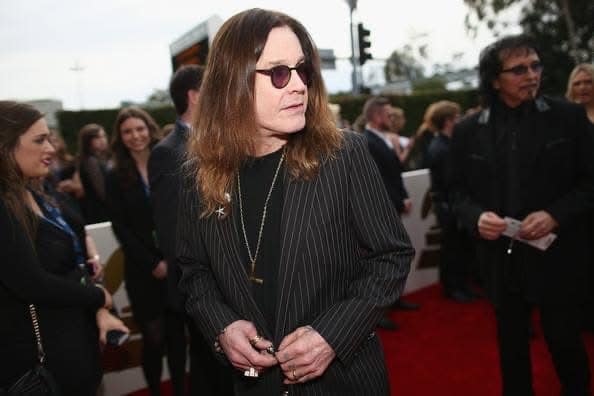
Ozzy Osbourne arriving at the Grammys in 2014. (Ozzy Osbourne/Facebook)

Ozzy Osbourne, the lead singer of the pioneering band Black Sabbath who became the throaty, growling voice of heavy metal, died Tuesday, just weeks after his farewell show. He was 76.

“It is with more sadness than mere words can convey that we have to report that our beloved Ozzy Osbourne has passed away this morning. He was with his family and surrounded by love. We ask everyone to respect our family privacy at this time,” a family statement from Birmingham, England, said. In 2020, he revealed he had Parkinson’s disease after suffering a fall.

Either clad in black or bare-chested, the singer was often the target of parents’ groups for his imagery and once caused an uproar for biting the head off a bat. Later, he would reveal himself to be a doddering and sweet father on the reality TV show “The Osbournes.”

The Big Bang of heavy metal

Black Sabbath’s 1969 self-titled debut LP has been likened to the Big Bang of heavy metal. It came during the height of the Vietnam War and crashed the hippie party, dripping menace and foreboding. The cover of the record was of a spooky figure against a stark landscape. The music was loud, dense and angry, and marked a shift in rock ’n’ roll.

The band’s second album, “Paranoid,” included such classic metal tunes as “War Pigs,” “Iron Man” and “Fairies Wear Boots.” The song “Paranoid” only reached No. 61 on the Billboard Hot 100 but became in many ways the band’s signature song. Both albums were voted among the top 10 greatest heavy metal albums of all time by readers of Rolling Stone magazine.

“Black Sabbath are the Beatles of heavy metal. Anybody who’s serious about metal will tell you it all comes down to Sabbath,” Dave Navarro of the band Jane’s Addiction wrote in a 2010 tribute in Rolling Stone. “There’s a direct line you can draw back from today’s metal, through Eighties bands like Iron Maiden, back to Sabbath.”

Sabbath fired Osbourne in 1979 for his legendary excesses, like showing up late for rehearsals and missing gigs. “We knew we didn’t really have a choice but to sack him because he was just so out of control. But we were all very down about the situation,” wrote bassist Terry “Geezer” Butler in his memoir, “Into the Void.”

Osbourne reemerged the next year as a solo artist with “Blizzard of Ozz” and the following year’s “Diary of a Madman,” both hard rock classics that went multiplatinum and spawned enduring favorites such as “Crazy Train,” “Goodbye to Romance,” “Flying High Again” and “You Can’t Kill Rock and Roll.” Osbourne was twice inducted to the Rock & Roll Hall of Fame — once with Sabbath in 2006 and again in 2024 as a solo artist.

The original Sabbath lineup reunited for the first time in 20 years in July for what Osbourne said would be his final concert. “Let the madness begin!” he told 42,000 fans in Birmingham.

Metallica, Guns N Roses, Slayer, Tool, Pantera, Gojira, Alice in Chains, Lamb of God, Halestorm, Anthrax, Rival Sons and Mastodon all did sets. Tom Morello, Aerosmith’s Steven Tyler, Billy Corgan, Ronnie Wood, Travis Barker, Sammy Hagar and more made appearances. Actor Jason Momoa was the host for the festivities.

“Black Sabbath: we’d all be different people without them, that’s the truth,” said Pantera singer Phil Anselmo. “I know I wouldn’t be up here with a microphone in my hand without Black Sabbath.”

Outlandish exploits and a classic look

Osbourne embodied the excesses of metal. His outlandish exploits included relieving himself on the Alamo, snorting a line of ants off a sidewalk and, most memorably, biting the head off the live bat that a fan threw onstage during a 1981 concert. (He said he thought it was rubber.)

Osbourne was sued in 1987 by parents of a 19-year-old teen who died by suicide while listening to his song “Suicide Solution.” The lawsuit was dismissed. Osbourne said the song was really about the dangers of alcohol, which caused the death of his friend Bon Scott, lead singer of AC/DC.

Then-Cardinal John J. O’Connor of New York claimed in 1990 that Osbourne’s songs led to demonic possession and even suicide. “You are ignorant about the true meaning of my songs,” the singer wrote back. “You have also insulted the intelligence of rock fans all over the world.”

Audiences at Osbourne shows could be mooned or spit on by the singer. They would often be hectored to scream along with the song, but the Satan-invoking Osbourne would usually send the crowds home with their ears ringing and a hearty “God bless!”

He started an annual tour — Ozzfest — in 1996 after he was rejected from the lineup of what was then the top touring music festival, Lollapalooza. Ozzfest has gone on to host such bands as Slipknot, Tool, Megadeth, Rob Zombie, System of a Down, Limp Bizkit and Linkin Park.

Osbourne’s look changed little over his life. He wore his long hair flat, heavy black eye makeup and round glasses, often wearing a cross around his neck. In 2013, he reunited with Black Sabbath for the dour, raw “13,” which reached No. 1 on the U.K. Albums Chart and peaked at No. 86 on the U.S. Billboard 200. In 2019, he had a Top 10 hit when featured on Post Malone’s “Take What You Want,” Osbourne’s first song in the Top 10 since 1989.

In 2020, he released the album “Ordinary Man,” which had as its title song a duet with Elton John. “I’ve been a bad guy, been higher than the blue sky/And the truth is I don’t wanna die an ordinary man,” he sang. In 2022, he landed his first career back-to-back No. 1 rock radio singles from his album “Patient Number 9,” which featured collaborations with Jeff Beck,Eric Clapton, Mike McCready, Chad Smith, Robert Trujillo and Duff McKagan. It earned four Grammy nominations, winning two. (Osbourne won five Grammys over his lifetime.)

At the Rock & Roll Hall of Fame induction ceremony in 2024, Jack Black called him “greatest frontman in the history of rock ‘n’ roll” and “the Jack Nicholson of rock.” Osbourne thanked his fans, his guitarist Randy Rhoads and his longtime wife, Sharon.

The beginnings of Black Sabbath

John Michael Osbourne was raised in the gritty city of Birmingham. Kids in school nicknamed him Ozzy, short for his surname. As a boy, he loved the Four Seasons, Chuck Berry and Little Richard. The Beatles made a huge impression.

“They came from Liverpool, which was approximately 60 miles north of where I come from,” he told Billboard. “So all of a sudden it was in my grasp, but I never thought it would be as successful as it became.”

In the late 1960s, Osbourne had teamed up with Butler, guitarist Tony Iommi and drummer Bill Ward as the Polka Tulk Blues Band. They decided to rename the band Earth, but found to their dismay there was another band with that name. So they changed the name to the American title of the classic Italian horror movie “I Tre Volti Della Paura,” starring Boris Karloff: Black Sabbath.

Once they found their sludgy, ominous groove, the band was productive, putting out their self-titled debut and “Paranoid” in 1970, “Master of Reality” in 1971, “Vol. 4” in 1972 and “Sabbath Bloody Sabbath” in 1973.

The music was all about industrial guitar riffs and disorienting changes in time signatures, along with lyrics that spoke of alienation and doom. “People think I’m insane because I am frowning all the time,” Osbourne sang in one song. “All day long I think of things but nothing seems to satisfy/Think I’ll lose my mind if I don’t find something to pacify.”

The Guardian newspaper in 2009 said the band “introduced working-class anger, stoner sludge grooves and witchy horror-rock to flower power. Black Sabbath confronted the empty platitudes of the 1960s and, along with Altamont and Charles Manson, almost certainly helped kill off the hippy counterculture.”

After Sabbath, Osbourne had an uncanny knack for calling some of the most creative young guitarists to his side. When he went solo, he hired the brilliant innovator Rhoads, who played on two of Osbourne’s finest solo albums, “Blizzard of Ozz” and “Diary of a Madman.” Rhoads was killed in a freak plane accident in 1982; Osbourne released the live album “Tribute” in 1987 in his memory.

Osbourne then signed Jake E. Lee, who lent his talents to the platinum albums “Bark at the Moon” and “The Ultimate Sin.” Hotshot Zakk Wylde joined Osbourne’s band for “No Rest for the Wicked” and the multiplatinum “No More Tears.”

“They come along, they sprout wings, they blossom, and they fly off,” Osbourne said of his players in 1995 to The Associated Press. “But I have to move on. To get a new player now and again boosts me on.”

Courting controversy — and wholesomeness

Whomever he was playing with, Osbourne wasn’t likely to back down from controversy. He had the last laugh when the TV evangelist the Rev. Jimmy Swaggart in 1986 lambasted various rock groups and rock magazines as “the new pornography,” prompting some retailers to pull Osbourne’s album.

When Swaggart later was caught with a sex worker in 1988, Osbourne put out the song “Miracle Man” about his foe: “Miracle man got busted/miracle man got busted,” he sang. “Today I saw a Miracle Man, on TV cryin’/Such a hypocritical man, born again, dying.”

Much later, a whole new Osbourne would be revealed when “The Osbournes,” which ran on MTV from 2002-2005, showed this one-time self-proclaimed madman drinking Diet Cokes as he struggled to find the History Channel on his new satellite television or warning his kids not to smoke or drink before they embarked on a night on the town.

Later, he and his son Jack toured America on the travel show “Ozzy & Jack’s World Detour,” where the pair visited such places as Mount Rushmore and the Space Center Houston. Osbourne was honored in 2014 with the naming of a bat frog found in the Amazon that makes high-pitched, batlike calls. It was dubbed Dendropsophus ozzyi.

He also met Queen Elizabeth II during her Golden Jubilee weekend. He was standing next to singer-actor Cliff Richard. “She took one look at the two of us, said ‘Oh, so this is what they call variety, is it?’ then cracked up laughing. I honestly thought that Sharon had slipped some acid into my cornflakes that morning,” he wrote in “I Am Ozzy.”

Thelma Riley and Osbourne married in 1971; Osbourne adopted her son Elliot Kingsley, and they had two more children, Jessica and Louis. Osbourne later met Sharon, who became her own celebrity persona, when she was running her father’s Los Angeles office. Her father was Don Arden, a top concert promoter and artist manager. She went to Osbourne’s hotel in Los Angeles to collect money, which Osbourne had spent on drugs.

“She says she’ll come back in three days and I’d better have it. I’d always fancied her and I thought, ‘Ah, she’s coming back! Maybe I have a chance.’ I had pizza hanging from my hair, cigarette ashes on my shirt,” he told the Los Angeles Times in 2000. They married in 1982, had three children — Kelly, Aimee and Jack — and endured periodic separations and reconciliations.

He is survived by Sharon, and his children.

Happy Tails Way: New shelter road named as construction nears

Habersham Animal Care and Control Center Director Madi Nix and 'Little Pupppy' at the groundbreaking for the new Habersham County Animal Shelter on April 17, 2025. (Jerry Neace/NowHabersham.com)

The new animal shelter is not yet built, but at least Habersham Countians know the name of the road that will lead to it.

On Monday, the county announced ‘Happy Tails Way’ as the winning entry in an online poll that spanned more than a month and considered over 600 entries. The name overwhelmingly won out over the other finalists, claiming 72% of the final vote. The runner-up was Pawsitive Drive (8.8%), followed by Wagging Tail Way (7.2%) and Wagmore Way (11.3%).

Shelter delays

Naming the road has been the fastest part of Habersham’s years-long effort to build a new animal shelter for Habersham County Animal Care and Control (HCACC).

In 2020, voters approved $1.75 million in SPLOST funding for a new facility. However, construction costs spiked after the pandemic, contributing to a series of delays.

FILE PHOTO – Habersham County Animal Care and Control Director Madi Nix and Animal Control Officer Chris Broadway survey the old landfill where, in 2022, the county had planned to build a new animal shelter. (Hadley Cottingham/Now Habersham)

As hopes grew in 2022 that construction was near, they were dashed again when the old landfill property the county planned to build on was deemed unusable, largely due to the million-dollar price tag to grade it. The county searched for other properties and eventually selected a county-owned property behind South Habersham Middle School off Old Athens Highway. However, the project remained on hold for another three years as construction costs continued to soar.

To rein in costs, the county relied on value engineering to redesign and reimagine the space. That brought with it its own set of delays.

“The value engineering process between our contractor and the architect has slowed things a bit as some of the items that have been suggested to be changed, the architect has issues with,” explains County Manager Tim Sims.

At the beginning of the year, Habersham County secured a guaranteed estimate from the contractor, moving the project forward.

Construction could begin by end of July

In April, county officials broke ground for the new animal shelter, but cost concerns remain.

HCACC Director Madi Nix, in a pink construction hat, leads county officials in breaking ground for the new animal shelter in Cornelia. The shelter, to be built in tandem with a new recreational park near South Habersham Middle School off Old Athens Highway, is expected to be completed in 2026. (Jerry Neace/NowHabersham.com)

“There have been some issues with the cost of material due to the volatility of construction products,” Sims tells Now Habersham. “Many suppliers have increased costs due to speculating higher costs from mostly steel.”

Sims says the county’s contractor has “been negotiating with their subs (subcontractors) to stay within the guaranteed estimate of $7.8 million.” He adds that the county’s main goal is to keep the cost at the guaranteed minimum since commissioners have already approved those funds.

Confident they now have things “figured out,” Sims says he expects grading and construction to begin by the end of the month. That will be a welcome relief not only for the HCACC employees still working in overcrowded, outdated quarters, but also for county officials like Sims, who have worked to ensure that the project voters approved five years ago finally gets built.

Says Sims, “It’s all been a process for sure.”

Cleveland Fire Chief Ricky Pruitt resigns after 42 years of service

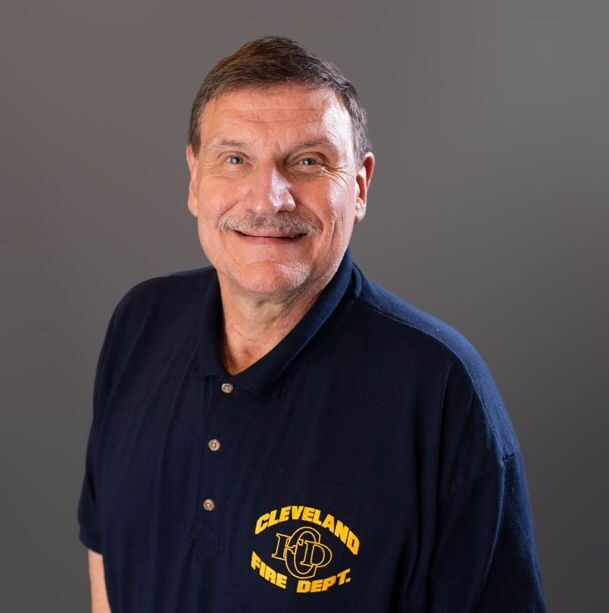
Outgoing Cleveland Fire Chief Ricky Pruitt (Photo via WRWH.com)

After more than four decades of service to the City of Cleveland, longtime Fire Chief Ricky Pruitt is stepping down.

Cleveland Mayor Josh Turner announced Pruitt’s resignation during the city council meeting Monday night, following an executive session. Acting on a motion by Councilman Jeremy McClure, the council voted to accept Pruitt’s resignation and honor him with the title of Fire Chief Emeritus.

End of an era

Pruitt’s resignation marks the end of an era for the Cleveland Fire Department. He began serving as fire chief in 1992 and has spent a total of 42 and a half years leading and protecting the community.

Before taking the department’s top job, he served as Assistant Chief for 10 years.

His leadership has shaped generations of firefighters in Cleveland and set a standard of that will resonate for years to come.

“Chief Pruitt will always be remembered not just for the length of his service, but for the profound impact he has made on our department and our community,” said Mayor Turner, reading from a prepared statement.

Known for his steady leadership and unwavering commitment to public safety, Pruitt leaves behind a legacy of professionalism, mentorship, and innovation, said Turner. Under Chief Pruitt’s direction, the Cleveland Fire Department expanded its full-time staff, added a new ladder truck, and is nearing completion of a new four-bay fire station.

“The firefighters under his command hold him in the highest regard, not just for his decades of tireless service, but for the way he has always led with compassion, humility, and an unwavering commitment to others,” the mayor said. “There is no exaggeration to say that he is beloved by those who have had the honor of serving alongside him.”

The city expressed its “deepest gratitude” to Chief Pruitt and extended best wishes to him and his family.

“His leadership has shaped generations of firefighters in Cleveland and set a standard that will resonate for years to come,” Turner said.

Chief Pruitt’s resignation is effective July 31.

Habersham becomes Purple Heart County, pledges to honor local heroes

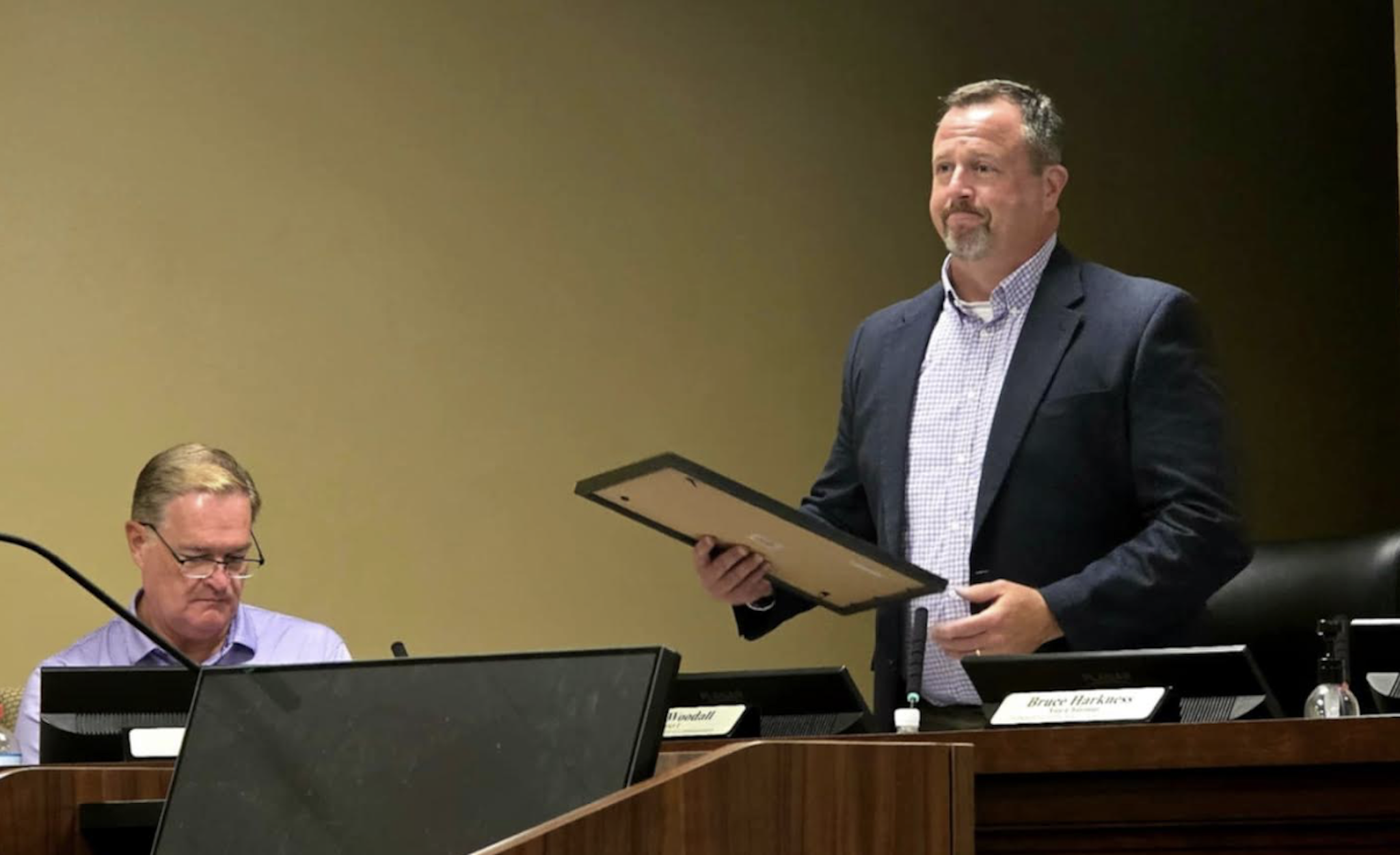
American Legion Post 84 Commander Jim Morgan (far left) and VFW Post 7720 Commander Barry Church (holding plaque) stand with Habersham County commissioners as they accept the commemorative plaque. Also pictured are commissioners Kelly Woodall, Bruce Harkness, Dustin Mealor, Jimmy Tench, and Ty Akins. (Carly McCurry / Now Habersham)

Habersham County officially became a Purple Heart County during a special ceremony on July 21, honoring veterans who were wounded or killed in combat. A crowd of veterans, family members, and local officials—many dressed in purple—filled the commission meeting room for the recognition.

Commissioner Kelly Woodall presented a commemorative plaque to Barry Church, commander of Grant Reeves VFW Post 7720 in Cornelia. The plaque signifies the county’s commitment to supporting and honoring Purple Heart recipients and their families.

Nationwide network

By becoming a Purple Heart County, Habersham joins a nationwide network of communities dedicated to honoring combat-wounded veterans. The designation also establishes August 7 as Purple Heart Day—an annual reminder of the sacrifices made by those who have borne the scars of war.

“For so many years, our wounded veterans have not received the credit they deserve,” said Barry Church, VFW Post 7720 Commander. “A Purple Heart shows that these folks have given their actual life’s blood to defend their country. We in the county wanted to honor them and bring people’s attention to Purple Heart Day. We have quite a few Purple Heart recipients in Habersham County, so it’s a privilege for me to be part of this.”

Jim Morgan, commander of American Legion Post 84, also praised the designation.

“It’s an incredible honor for those who have been awarded a Purple Heart—not only for them but for all veterans,” he said. “We are very grateful to the county for doing this.”

Oldest military decoration

Created by George Washington in 1782 and revived in 1932, the Purple Heart is the nation’s oldest military decoration. It is awarded to members of the U.S. Armed Forces who are wounded or killed in action against an enemy of the United States.

Commissioner Kelly Woodall presents the plaque to Barry Church, commander of VFW Post 7720, as he offers heartfelt gratitude to all who have received the Purple Heart (Carly McCurry/Now Habersham).

Applause broke out as officials read the proclamation naming Habersham a Purple Heart County.

It reads, in part: “Habersham County seeks to recognize and honor all local veterans who have received the Purple Heart and to pledge support and appreciation for their bravery and service to our nation.”

The plaque, which features the county seal, will serve as a permanent tribute to the community’s commitment to its veterans.

Purple Heart Day August 7

To celebrate the new designation, Habersham County and VFW Post 7720 will host a Purple Heart Day ceremony and community reception on Thursday, August 7. The event begins at 2 p.m. at the Fairfield Inn & Suites, 160 Market Corners Drive in Cornelia.

The public is invited to attend.

If you or someone you know with ties to Habersham has received a Purple Heart, contact County Clerk Brandy Carnes at [email protected] or call 706-839-0215 so they may be recognized.


The Camp Crafter: At Home Shrinky Dinks

Shrinky Dinks are one of my favorite crafts! I love them because you can turn your own drawings into keychains or jewelry. There is a way to create these things out of plastic from your recycling bin. So, after using your plastic water bottle to stay hydrated in the summer heat, it is time to repurpose it into something fun. You can use lots of other leftover plastics as well. This is such a great way to recycle!

Supplies needed

*NOTE: Adult supervision is required for this craft
one-time use plastic (look for the recycling label with #1 or #6)
– scissors
– hole punch
– permanent markers
– tin foil
– baking tray
– oven/toaster oven
– spatula (the flat kind that can withstand heat) string/ribbon

Steps

  1. Cut your plastic into different shapes.

a. Keep in mind that the plastic is going to shrink super small, so do not cut shapes any smaller than a quarter.

b. You can use all parts of the plastic to make unique pieces, for example, the bottom of a plastic bottle can resemble a flower.

2. Use permanent markers like Sharpies to draw on the plastic.

3. If you want to make your art functional to wear as a necklace or put on a keychain, be sure to use the hole puncher BEFORE shrinking. If you do not have a hole puncher, you can use scissors to cut a hole.

4. Preheat the oven to 350° – NOTE: Melting plastic can create fumes, so make sure you do this in a well-ventilated area. You can wear a mask for extra protection.

5. Cover the baking tray with tinfoil.

6. Place your creations on the tray, making sure they do not touch.

(The Camp Crafter/NowHabersham.com)

7. Watch as your creations shrink. Baking time may vary depending on the thickness of the plastic (approximately 2 minutes).

(The Camp Crafter/NowHabersham.com)

8. Once the pieces stop shrinking, use a pot holder to remove the pan from the oven.

a. Use the spatula to flatten the plastic if it curled while baking.

b. Use the spatula to take the art off the tray to avoid getting burned.

9. Once the plastic is cool, use string to turn your creation into a necklace or a keychain.

Enjoy your at-home take on shrinky dinks! I hope you were able to make some cute jewelry or trinkets.

Maybe you will be able to wrap up your day with a snack like we do at camp. A favorite of all the campers is s’mores, and there is an at-home version that doesn’t require a campfire.

In order to make these at-home s’mores, you will need graham crackers, marshmallows, and some type of chocolate spread, like Nutella. When my family doesn’t have these ingredients, we sometimes put peanut butter on saltines and top with a marshmallow.

Bake them the same way for a salty and sweet treat.

Use a knife to spread the chocolate spread on a graham cracker. Place a regular-sized marshmallow on top of the chocolate. Place finished s’mores on a baking sheet. I like to cook mine in a toaster oven. Set the toaster oven to the toast setting. Cook your s’mores until the marshmallows become brown on top, about 5 minutes. Wait a minute before enjoying, they will be quite hot.

A look to next week:

Find different types of paper, such as construction paper, printer paper, or even old magazines. You will also need a glue stick.

Partially decomposed body found in car outside Hall County strip mall

A man's body was found in the backseat of a car parked outside this strip shopping mall on Brown's Bridge Road in Hall County. (Source: Google Maps)

Authorities are investigating after a body was discovered inside a parked car on Brown’s Bridge Road in Hall County.

Around 11 a.m. Sunday, July 20, Hall County sheriff’s deputies responded to a 911 call about a suspicious vehicle at the Exxon Food Mart shopping center, located at 5201 Browns Bridge Road. When deputies arrived, they found a 2015 Mercedes-Benz C300 parked outside a barbershop in the shopping area.

Upon opening the vehicle’s rear door, deputies discovered the partially decomposed body of an adult male in the back seat.

Criminal investigators were called to the scene. According to the sheriff’s office, there are no immediate signs of foul play. The body has been sent to the Dekalb County Medical Examiner’s Office for autopsy and identification.

Athens library to host celebration for ADA’s 35th anniversary

The Americans with Disabilities Act will mark its 35th anniversary this week. President George H. W. Bush signed the measure into law on July 26, 1990. It is designed to promote equal opportunity for people with disabilities.

Multiple Choices Center for Independent Living is holding a celebration of the legislation at the Athens Regional Library on Tuesday, July 22, from 1:30 to 4:30 pm.

Stephanie Bergamo is special events coordinator with the organization.

“Talking about independent living, talking about equal opportunity, talking about economic self-sufficiency,” Bergamo said. “It’s not that simple sometimes, so it gets complicated.”

Program manager Jerrie Toney says members of the community are invited to attend the event.

“There’s a lot of different services and a lot of different resources out there that people just do not know about and how better for them to learn about what the ADA is, and who it serves because at some time or another, everybody is going to need the ADA in their life.”

Several organizations are taking part and Athens-Clarke County Mayor Kelly Girtz is one of the speakers. Julie Range is a volunteer.

“There will be games, cotton candy, and chair yoga” Range said. “It’s going to be full of information, very informed”

Eighteen different agencies and organizations will participate, including the Athens-Clarke County Board of Elections, which will have two voting booths available for practice.

Georgia conservationists push to ‘finish the job’ of protecting Okefenokee from mining

A recently announced land deal marks the second time a mining proposal near the Okefenokee National Wildlife Refuge was thwarted due to public outcry. (Joe Cook/Georgia Rivers)

(Georgia Recorder) — Georgia environmentalists are still celebrating a conservation group’s announcement last month that it plans to purchase thousands of acres of land targeted for mining near the Okefenokee National Wildlife Refuge.

But they read the win, they say, not as a moment to pop the champagne, but a call to action.

Mining interests are still eyeing property near the refuge, they say, and to preserve additional acreage, they need to build on their advocacy efforts, including persuading environmental groups to buy mineral rights in other areas attractive to mining businesses and highlighting easements for purchase along mineral-rich Trail Ridge.

And they say they need to continue to press Georgia leaders to enact the legal protections for the Okefenokee that have eluded them for years at the state Capitol. Lawmakers will return to Atlanta for a new legislative session in January.

“We can’t rest on our laurels,” said Brian Foster, a spokesman for Georgia Conservancy, one of the environmental groups leading the charge. “There is still a lot of work to be done.”

There’s a reason for their urgency, Georgia environmentalists said.

In the late 1990s, the environmental community thought the Okefenokee was safe from mining after chemical giant DuPont was persuaded to donate thousands of acres to The Conservation Fund because of public opposition to DuPont’s mining plans.

Three decades later, Alabama-based Twin Pines Minerals, which has owned land along Trial Ridge since 2019, appeared close this year to realizing its plans to mine the area for titanium dioxide, a whitening agent in toothpaste, paint, sunscreen and other products.

But The Conservation Fund, a nonprofit based in Arlington, Virginia, stepped in again, announcing late last month that it would spend almost $60 million to purchase close to 8,000 acres owned by Twin Pines.

Environmentalists were elated, but quickly turned their attention to protecting land that could still be purchased for mining.

“If there is one thing that is abundantly clear to us is that the past is prologue when it comes to the Okefenokee,” said Christian Hunt, chairman of the Okefenokee Protection Alliance.

“Roughly 25 years ago we were pretty much in the same position we’re in today,” said Hunt, who also is director of national wildlife refuges and parks program for Defenders of Wildlife. “It’s very clear to everybody involved at this stage that goodwill alone is not going to save the swamp and we need to secure durable protections.”

Environment Georgia launched a campaign to collect 10,000 signatures calling on Gov. Brian Kemp to pursue permanent protections for the Okefenokee just days after The Conservation Fund’s announcement. The organization hopes to meet its goal by the end of the summer.

“We know that there are mineral rights that are still in the hands of people who could and would like to use them, so we would like to make sure that we find a permanent protection that ensures that there is not another mine proposed,” Environment Georgia Director Jennette Gayer said.

“Our hope is that we do not find ourselves in the same position a couple of decades from now,” she said.

Kim Bednarek, executive director of Okefenokee Swamp Park and Adventures, said environmentalists are not the only ones concerned about the refuge. It has a direct impact on the economies of Charlton, Ware and Clinch counties, which are home to the majority of the Okefenokee’s shallow, 438,000-acre, peat-filled wetland along the Georgia-Florida border.

A healthy Okefenokee promotes agritourism in the three small south Georgia counties, which have a combined population of about 54,000 people, as well creating jobs and encouraging workforce development, she said.

In addition, the Okefenokee National Wildlife Refuge has been nominated to be a UNESCO World Heritage Site, which could further boost its visitation numbers, Bednarek said. A decision on the nomination is expected next year.

More than 800,000 people visit the Okefenokee annually, according to Okefenokee Swamp Park and Adventures. Visitors spend about $91.5 million in Ware, Charlton, and Clinch counties.

“It’s really a huge opportunity for the region and the gateway communities around the Okefenokee to benefit from increased tourism and educational and research activities,” Bednarek said. “We want to see more sustained attention and investment in the communities and the people around the Okefenokee. If the people are benefitting from a conserved landscape, then they’ll want to make sure the landscape stays preserved.”

Megan Huynh, senior attorney and wetlands and coasts program leader for the Southern Environmental Law Center, echoed Bednarek.

“Now that the mine is gone, there’s a responsibility to support opportunities for those communities that aren’t at odds with the health of the Okefenokee,” she said.

Mike Worley, president and CEO of the Georgia Wildlife Federation, said the goal is to use every available tool to ensure the future of the Okefenokee.

“The main thing right now is to celebrate the victory that we’ve had and be prepared to finish the job,” he said.

The hills are alive with the sound of Rodgers and Hammerstein

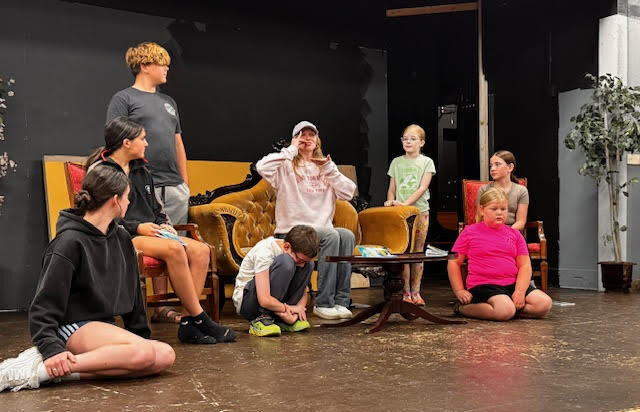
Rehearsals are underway for the North Georgia Community Players' production of "The Sound of Music." The classic musical by Rodgers and Hammerstein opens at the NGCP theater on August 8, 2025. (Photo by Rebecca Bilbrey)

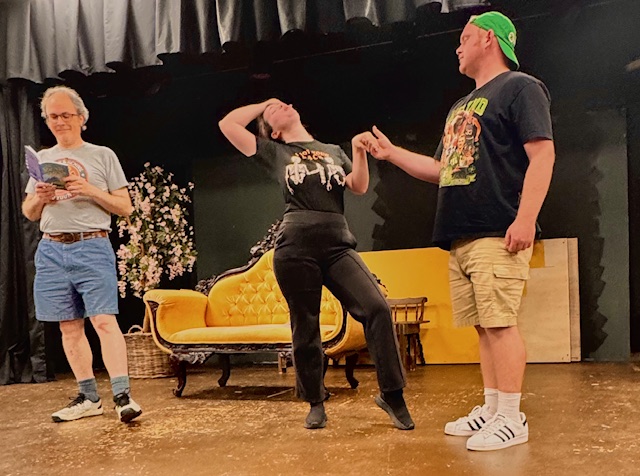
The hills are alive with the sound of singing children. At a late June rehearsal of North Georgia Community Players’ production of The Sound of Music, the von Trapp kids are singing their lungs out as they yodel their way through “The Lonely Goatherd,” one of many memorable songs in Richard Rodgers and Oscar Hammerstein’s immortal musical.

The show, which will run for nine performances in Dillard over three weekends from August 8th through the 24th, features familiar young faces from previous NGCP shows, as well as the indefatigable director of all the company’s recent musicals, Rebecca Bilbrey.

A timeless tale of music, love, and resistance

Based on the true story of an Austrian near-nun, Maria; the Austrian admiral who becomes her husband, Baron Georg von Trapp; and his seven children from his first marriage, the musical tells the story of the now-famous family that escaped the Nazi “Anschluss”—the 1938 German annexation of neighboring Austria that was the first Nazi cross-border aggression leading to World War II. The beloved musical, as a film, is one of the top-grossing shows of all time and is Rodgers and Oscar Hammerstein’s most successful collaboration.

Some of its many songs, “My Favorite Things,” “Do-Re-Mi,” “Sixteen Going on Seventeen,” and the heart-rending “Edelweiss”—the last song the duo ever wrote together—are considered classics of musical theater, and have been recorded by dozens of other artists, in many different styles, from operatic to jazz.

The story, for the 11 readers who may be unfamiliar with it: Maria, a postulant—prospective nun—near Salzburg, Austria, is initially sent out of her abbey for a bit of real-world experience, as her mother abbess is not sure the restless young woman is suited for a nun’s life. She is assigned to help the stern, hyper-disciplinarian and widower von Trapp raise his seven children. The captain, a celebrated German naval officer in World War I, is being pressured to resume his military career—this time under the authority of the party led by one Adolf Hitler.

Spoiler alert

The captain has an equally distinguished girlfriend—the Baroness Elsa Schraeder—who is initially suspicious of Maria, but is comforted by learning she will soon be returning to the abbey. Maria does leave, but doesn’t stay away for long (cue romantic music). The former future nun instantly bonds with the von Trapp children, dressing them colorfully and teaching them the rudiments of music, which became the family’s lifelong passion.

The nuns in the abbey are a big part of the story, as they ponder (among other big questions, “How Do You Solve a Problem Like Maria?”

Ultimately, the plot turns on the pressure the Nazis are applying to force von Trapp to resume his military duties. His original fiancée and his friend, Max, both consider the Germans’ triumph inevitable and beg him to submit. But Georg and his new bride endeavor to evade the Nazi menace and save their children from the Nazi domination of Austria and Europe (spoiler alert: the good guys win).

Double-casting the von Trapp kids

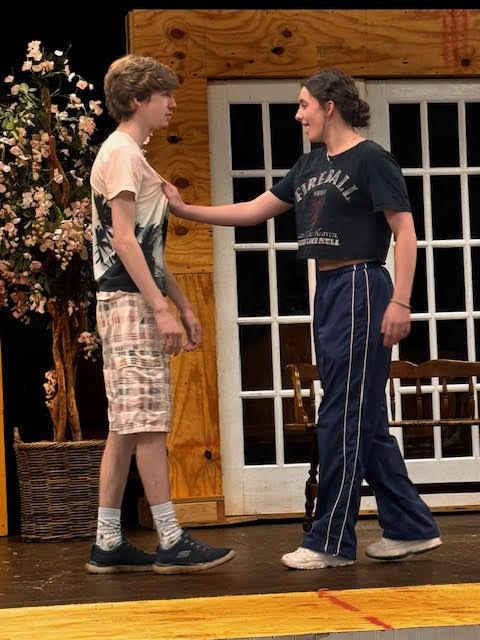
Rehearsing a pivotal dance in the musical are Sam Warren as “Rolf Gruber” and Rilyn Bilbrey as “Liesl von Trapp” (Photo by Rebecca Bilbrey)

Director Rebecca Bilbrey was overwhelmed by local actors’ response to the auditions in May; more than 40 people of all ages turned out, including many family groups. She decided to double-cast all the kids’ roles, which included older teens down to a six-year-old as the youngest von Trapp.

“I chose the show because I wanted to give the younger talent in the community a chance to shine,” Bilbrey said, taking a breath this week between rehearsals. “I’m thrilled with how I was able to fill the cast; the kids are so gifted, and everyone is working so hard.”

Among the younger characters are Captain’s oldest girl, Liesl, and a local messenger boy, Rolf, whose romance serves as a subplot and generates the charming duet, “You Are Sixteen, Going on Seventeen.”

Stage veterans bring depth to iconic characters

Lucy Barry is all of 22, and playing Maria is her first time in a full-on romantic lead. She’s played the title role in “Annie,” Elle Woods in “Legally Blonde,” and most recently the high-energy Rosie in the NGCP “Bye Bye Birdie” in 2023.

“I love this show,” Barry says. “I watched it incessantly while I was growing up.”  Interestingly, Barry has a little bit of exposure to the lifestyle Maria surrenders: “My aunt, Christine, is the only cloistered nun I’ve ever known.” In “real life,” Barry is a zip line guide and dog groomer, but she has always loved the stage.

Lucy’s “stage husband” is Anthony Schandel, 23, who’s been very busy on stage lately, including a big role in “9 to 5” in Dillard, and “Pirates of Penzance” and “To Kill a Mockingbird” at Habersham Community Theatre, among others. But he called playing the Captain his biggest stage challenge to date.

“It’s quite an evolution he goes through,” Schandel says. “He’s so emotionally closed off at first, “but he gradually opens up more in each scene. It’s very tricky to reveal that slowly.”

Schandel particularly likes the moment when his firm, military reserve cracks as he dances with Maria for the first time, to illustrate to his children how it’s properly done. The lesson generates a bit more heat between the incipient couple than they intended.

Anthony Schandel, right, is an auto parts salesman by day who dances and sings on stage at night as Captain von Trapp in NGCP’s production of “The Sound of Music.” (Photo by Rebecca Bilbrey)

In the rest of his life, Schandel manages a career every bit as hands-on as the captain’s; he sells automotive parts at Jefferson Ford in Jackson County.

Bilbrey brings families and talent together

Schandel and Barry both said their favorite element of the show is the joyful kids—two septets full—who are not only key to the plot but will win over the audience’s hearts. The kids are featured in several of the show’s best-known songs, including the charming “Goatherd” song, and, of course, “Do-Re-Mi.”

Director Bilbrey has become an NGCP institution; she’s directed every one of the company’s musicals since performances resumed after the Covid shutdown.  These have included such audience favorites as “Little Shop of Horrors,” “9 to 5,” “I Love You, You’re Perfect, Now Change,” “Bye Bye Birdie,” “Joseph and the Amazing Technicolor Dreamcoat,” and the song and dance numbers at the theater’s recent spring gala fundraiser.

Said Bilbrey, “I think it’s everybody’s favorite, and for me, I’m delighted that I’ve been able to cast whole family groups—moms, dads, and kids together.”

Some of the other familiar names and faces in the cast: Cecilia Barry (Lucy’s sister), and Makenna Bilbrey (the director’s niece), who share duties as Liesl von Trapp; Amy Smith, who is both music director and Sister Berthe, one of the nuns; Sam Warren and Mont Wood, who share the role of Liesl’s love interest, Rolf; Dannyale Williams as Baroness Elsa Schrader; Peyton Wood as Admiral von Schreiber and Baron Elberfeld; Rilyn Bilbrey—the director’s daughter—as Louisa von Trapp, and Lauryn Baltimore as Frau Zeller.

(Photo by Rebecca Bilbrey)

Tickets now on sale

The North Georgia Community Players (NGCP) production of The Sound of Music opens Friday, August 8, and runs through August 24. Friday and Saturday performances are at 7 p.m., and Sunday matinees are at 3 p.m.

Tickets are available online through the NGCP website or by calling (706) 212-2500.

The NGCP theater is in the Old Dillard Schoolhouse, which also houses Dillard City Hall, at 892 Franklin Street in Dillard, Georgia.

Trump tax law runs up deficit by $3.4T, throws 10 million off health insurance, CBO says

President Donald Trump holds up the “One Big Beautiful Bill Act” that was signed into law during an Independence Day military family picnic on the South Lawn of the White House on July 4, 2025 in Washington, D.C. (Photo by Alex Brandon – Pool/Getty Images)

WASHINGTON (States Newsroom) — Republicans’ “big, beautiful” law will add $3.394 trillion to deficits during the next decade and lead 10 million people to lose access to health insurance, according to an analysis released Monday by the nonpartisan Congressional Budget Office.

The updated assessment of the sweeping tax and spending cuts law came weeks after nearly every GOP lawmaker voted to approve the legislation ahead of a self-imposed Fourth of July deadline. The law made permanent the 2017 tax cuts from President Donald Trump’s first term and provided billions to carry out his plans of mass deportations, an immigration crackdown and increased defense spending.

Maya MacGuineas, president of the Committee for a Responsible Federal Budget, wrote in a statement that it is “still hard to believe that policymakers just added $4 trillion to” deficits after Republican lawmakers “have spent months or years appropriately fuming about our unsustainable fiscal situation.”

“This is a dangerous game we are playing,” MacGuineas wrote. “It has been going on for years, and it was brought to new levels with this bill. And it is time to stop.”

CBO released numerous reports throughout the months-long process showing how various parts of the bill would affect federal spending and health care access, but the scorekeeper needed additional time to evaluate changes Republicans made during the last few days of debate.

The latest figures are similar to a preliminary report CBO released earlier this month projecting the final version of the package, which underwent considerable changes in the Senate, would likely lead to a $3.4 trillion increase in deficits between 2025 and 2034.

That total was significantly higher than the $2.4 trillion increase in deficits CBO expected the original House version of the bill would have had during the next decade.

Health spending to fall by more than $1 trillion

Republicans’ numerous changes to health programs, predominantly Medicaid, will reduce federal spending during the next decade by $1.058 trillion.

The law made more than a dozen changes to the state-federal health program for lower income individuals and certain people with disabilities, though some of those have larger budget impacts than others.

Language barring Medicaid spending from going to Planned Parenthood for one year would actually increase federal deficits during the 10-year window by $53 million.

The CBO score shows that policy change would decrease federal spending by $44 million this fiscal year and another $31 million during the next fiscal year, before increasing deficits by $91 million during fiscal year 2027 and continuing.

That section of the law is on hold for the moment after a federal judge issued a temporary restraining order earlier this month that required the Trump administration to continue paying Planned Parenthood for routine health care coverage for Medicaid enrollees.

Federal law for decades has barred the federal government from spending taxpayer dollars for abortion services with limited exceptions, so the one-year prohibition on Medicaid funding to Planned Parenthood would have blocked patients enrolled in the program from going to their clinics for routine health appointments, like annual physicals and cancer screenings.

The CBO report didn’t include a state-by-state breakdown of the effects of the health care changes in the law, but the agency is expected to release more detailed analysis of the health impacts in the coming weeks.

Nutrition assistance cuts

Apart from Medicaid, two large projected deficit reductions in the law come in the agriculture title’s sections on the Supplemental Nutrition Assistance Program, or SNAP.

A provision requiring states to pay for some portion of SNAP benefits starting in fiscal 2028 would save the federal government between $5.7 billion and $6 billion per year, totalling just less than $41 billion for the first seven years it will be in effect.

And new work requirements for SNAP would result in $68.6 billion less in federal spending over the 10 years starting in fiscal 2026, the CBO projected.

Federal student loan program

Republicans’ streamlining of the federal student loan program is projected to reduce federal spending in the next decade by $270.5 billion.

As part of a sweeping overhaul of higher education, the law limits repayment options for borrowers with any loans made on or after July 1, 2026, to either a standard repayment plan or an income-based repayment plan.

Extension and expansion of tax cuts

The extension of Trump’s 2017 tax law, plus new tax breaks, will cost $4.472 trillion over the next decade, according to the latest CBO score.

The United States collects the majority of its revenue from individual taxpayers, and the continuation of lowered income tax brackets, plus an increased standard deduction, will comprise the bulk of lost revenue over 10 years, adding up to $3.497 trillion.

Trump also campaigned on several other tax cut promises, including no tax on tips and overtime, as well as no tax on car loan interest. The temporary provisions come with stipulations and will end in 2029. Together they will cost $151.868 billion.

The child tax credit increases under the new law to $2,200, up from $2,000, though lawmakers did not increase the amount lower income families can receive as a tax refund. The CBO estimates the bumped-up tax credit will cost $626.345 billion over the next decade.

Lawmakers offset some costs of the bill by repealing clean energy tax credits, including ending tax credits for personal and commercial electric vehicles, nixing energy efficiency improvement credits for homeowners, and terminating clean electricity production credits. In all, Republicans saved $487.909 billion from axing the measures meant to address the effects of climate change.

Jacob Fischler, Shauneen Miranda and Ashley Murray contributed to this report.