Home Blog Page 398

Calm before the storm

Rick Austin captured this lightning strike in the clouds at sunset over Demorest on Wednesday, June 25, 2025. (Photo by Rick Austin)

Before severe weather rained down late Wednesday, Northeast Georgians were treated to a beautiful sunset.

Two Habersham Countians captured the calm before the storm.

Demorest resident Rick Austin photographed an amazing shot of lightning in the clouds as the sunset painted the sky purple.

(Photo by Rick Austin)

Sherri Purcell captured a gorgeous photo in Clarkesville as the sun set lower in the sky drawing the day to a close.

(Photo by Sherri Purcell)

Alison Cathey captioned this purple skyscape, “The beauty before the storm in Alto.”

(Photo by Alison Cathey)

Sheila McCutcheon shared another image of a sunset before the storm.

(By Sheila McCutcheon)

Share your sunset and storm photos with us on Facebook at #NowWeather.


Soto hits 2 homers and Mets beat Braves 7-3 for 2nd victory in 12 games

A fan fields Drake Baldwin's solo shot to centerfield. (livestream image Atlanta Braves/Facebook)

NEW YORK (AP) — Juan Soto homered twice and the New York Mets finally got some production from the bottom of the lineup, beating the Atlanta Braves 7-3 on Wednesday night for their first victory over their NL East rivals in six meetings this season.

No. 8 batter Ronny Mauricio also went deep and finished with three hits as New York won for only the second time in 12 games. Center fielder Jeff McNeil robbed Marcell Ozuna of a two-run homer in the first inning.

Clay Holmes (8-4) pitched around four walks in five innings after issuing a career-high six free passes during a loss at Atlanta last week. The converted reliever allowed only a solo homer by rookie Drake Baldwin in the fourth.

One night after blowing a 3-0 lead, the Mets’ bullpen followed Holmes with three scoreless innings. Jonathan Pintaro, making his major league debut, gave up a two-run single to Ronald Acuña Jr. in the ninth before Edwin Díaz retired Ozuna with two on for his 16th save in 17 opportunities.

With the score tied 1-all, Soto sparked a five-run fourth when he homered to right-center on the first pitch of the inning from Didier Fuentes (0-2), who was making his second big league start.

Brett Baty and Brandon Nimmo each singled home a run during the rally. Starling Marte and Francisco Lindor both had a sacrifice fly.

Pitching eight days after his 20th birthday, Fuentes was charged with six runs and eight hits in 3 1/3 innings.

Soto connected again leading off the seventh against Austin Cox to make it 7-1. It was the 27th career multihomer game and fourth this season for Soto, who has 10 home runs in 23 games this month.

Braves center fielder Michael Harris II robbed Lindor of a two-run homer with a spectacular leaping catch in the eighth.

Key moment

With two on in the fifth, Holmes retired Ozuna and Austin Riley to end the inning.

Key stats

Soto broke a tie with Hall of Fame slugger Jimmie Foxx for the most multihomer games by a player 26 or younger. … Atlanta first baseman Matt Olson extended his on-base streak to a career-best 26 games — the longest active run in the majors.

Up next

Braves RHP Grant Holmes (3-6, 3.97 ERA) starts Thursday night against RHP Griffin Canning (7-3, 3.91) in the finale of the four-game series.

$1,000 ‘Trump Accounts’ for babies skewed toward the wealthy, critics say

WASHINGTON — Tucked in the “one big beautiful bill” is a proposal for tax-advantaged “Trump Accounts,” each seeded with $1,000 from the government for certain babies born in the United States over the next few years.

But financial experts and advocates for low-income children are not overly impressed.

The idea is not new and has been likened to other “baby bonds” programs aimed at reducing the growing wealth gap, like state-run trust funds in California and Connecticut. Democrats in Congress have introduced a bill to create a similar federal program.

The White House has touted the proposal in the tax and spending cut measure as “pro-family” and one that “will afford a generation of children the chance to experience the miracle of compounded growth.”

At a June 9 event to promote the “Trump Accounts” featuring CEOs of top American companies, President Donald Trump promised the pilot program will make it possible for “countless American children to have a strong start in life at no cost to the American taxpayer.”

Speaking at the same event, top House Republican tax writer Rep. Jason Smith of Missouri said “every child born under this policy will have a better shot at a future. It does not matter if they live on a city block or on a county road, this will make a significant difference to their lives.”

Critics say the accounts, as proposed, would mostly benefit children born to wealthier families.

They also say the restricted-access accounts, and the one-time government contribution of $1,000, will not help in the face of cuts to food and health programs for low-income people written into the massive budget reconciliation bill, titled the “One Big Beautiful Bill Act.”

How ‘Trump Accounts’ would work

The investment savings accounts would be available to U.S. citizens born between 2025 and 2028, and whose parent, or parents, if legally married, already have Social Security numbers.

Each year, from a child’s birth to age 18, family and friends, parents’ employers, churches and other private foundations, could contribute up to a combined $5,000 annually to the investment account that will track a stock index and gain interest accordingly.

Deposits into the account are taxed. Later on, withdrawals would be subject to the long-term capital gains tax — a tax on the profit made from selling an asset, or investment, that a person has held for longer than a year.

After reaching 18, the account beneficiary could access half the account’s value only for qualified expenses that include higher education, vocational training, the purchase of a first home, and costs associated with an enterprise for which the beneficiary has received a small business loan or small farm loan.

The beneficiary could access the remaining half of the account after age 25. At age 31, the account loses its status as a “Trump Account” and any remaining balance is taxed as income.

Drawbacks seen

The Urban Institute warns that the proposed structure of the account will mostly benefit wealthy families who already have the resources to grow the funds.

The bottom 80% of households, by income, only hold half as much cash on hand as the top 20% of households, according to the left-leaning think tank’s nationwide financial health data.

Additionally, because of penalties for early withdrawals, lower-income families would be incentivized to save in less restrictive accounts, according to the think tank’s May 27 analysis.

The institute recommends the government provide more contributions based on income level, beyond just the one-time $1,000, and lessen the penalties for accessing cash for catastrophic events.

A 2023 Democratic legislative proposal put forth by Sen. Cory Booker of New Jersey and Rep. Ayana Pressley of Massachusetts aimed to create an account that would target the benefit to children from lower-income households.

Their plan suggests accounts be initially seeded with $1,000, and then children would receive up to an additional $2,000 annually based on their family’s income level.

According to Booker’s and Pressley’s plan, a child from a family of four that brings in less than $25,100 in annual income would have an estimated $46,200 in investment savings by the time they turn 18.

Under the Trump Account proposal, a child’s one-time $1,000 deposit from the government would grow to roughly $5,000 by age 18 if no other contributions were ever made, according to the Urban Institute.

Child tax credits

Brendan Duke, senior director for federal fiscal policy at the left-leaning Center on Budget and Policy Priorities, said the GOP proposal “wasn’t particularly well thought through.”

“It’s this question of whether it makes more sense to give every family $1,000 that they can’t access in those really important years, or whether you should have expanded the child tax credit,” Duke said.

Duke criticized lawmakers’ proposals that do not expand the child tax credit to the lowest-income families in the massive GOP budget reconciliation package.

While the House version temporarily expands the credit to $2,500 per child, up from $2,000, and the Senate version permanently expands the credit by a more modest amount of $2,200, neither version expands income or refundability parameters that would benefit the poorest families.

The CBPP estimates that 17 million children are left out of the credit because of the restrictions.

Existing savings vehicles

Another criticism of the Trump Accounts is that they provide a redundant option among the several existing tax-preferred savings vehicles for Americans, including 529 education investment savings accounts, Roth and Traditional IRAs and Health Savings Accounts.

The Tax Foundation’s Alex Muresianu said the account is “a move toward complexity rather than simplification.”

“We already have plenty of savings accounts with specific purposes, and a lot of different strings attached,” said Muresianu, senior policy analyst with the right-leaning foundation.

“We don’t really need another targeted account for a specific purpose, rather than a more easily accessible account with fewer conditions.”

White County residents pack Joint Comprehensive Plan meeting

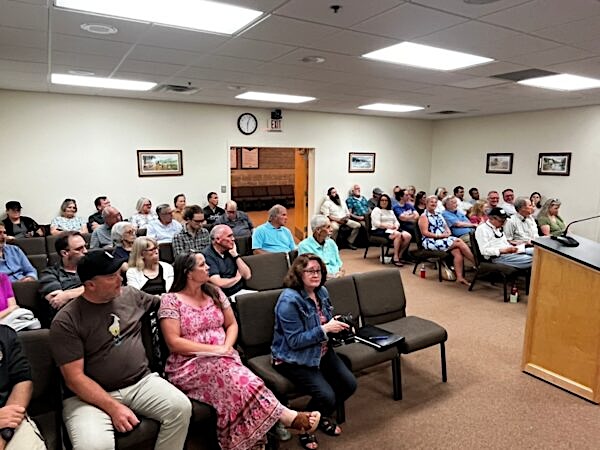
White County residents fill the Commission Board meeting room to learn more about the county's Joint Comprehensive Plan. (Dean Dyer/WRWH Radio)

White County citizens packed the board meeting room of the White County Administration Building Tuesday evening to hear more about the development of a new White County Joint Comprehensive Plan for the county and cities of Cleveland and Helen.

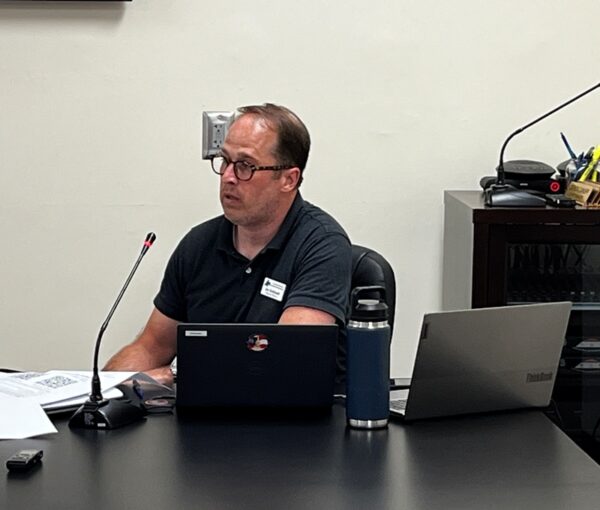
The group received a detailed overview of what a comprehensive plan is from Joe Rothwell, Regional Planner with the Georgia Mountains Regional Commission. Rothwell also shared information about past plans, including how they were developed and implemented. He said so far they have received over 520 citizen comments, which is more than all of the comments received in the 2021 comprehensive plan.

Georgia Mountains Regional Commission Planner Joe Rothwell shares information during the Joint Comprehensive Plan meeting in White County on June 24, 2025. (Dean Dyer/WRWH Radio)

Rothwell said comprehensive planning helps communities grow better by wise management of resources along with smart investments in utilities, facilities, and services.

During the citizen comment time, around a half dozen people shared their views and asked questions on a variety of topics.

More of the citizens were there to find out more about the plan and how it would be developed than those making comments or suggestions. Most of those at the Tuesday meeting had already shared their views via a survey form.

Sell: Community input ‘will help us plan’

White County Community and Economic Development Director John Sell, after the meeting, expressed his pleasure at how the community has responded,

“We’re very excited that we had a packed house here. That shows the commitment from the citizens to be involved with this process, which will help us to plan,” he said. “We’re excited to get their opinions to know what they want us to do, what they don’t want us to do.”



Sell said there are “a lot of great comments” in the 520 surveys that have already been submitted.

Officials will continue collecting online surveys through the end of this year and hold another public meeting in the fall.

Citizens may share their views in the online survey by clicking here, scanning the QR code above, or by visiting www.surveymonkey.com/r/WhiteCounty2025.

US default could hit during Congress’ summer recess, think tank predicts

The U.S. Capitol in Washington, D.C., is pictured on Monday, April 15, 2024. (Jennifer Shutt/States Newsroom)

(Georgia Recorder) — The United States could default between Aug. 15 and Oct. 3 if Congress doesn’t act to raise or suspend the debt limit before then, according to a projection the Bipartisan Policy Center published Wednesday.

The new estimate from the centrist Washington, D.C., think tank would give Congress slightly more time to address the issue than the center’s last analysis that projected the so-called X-date could hit as early as July.

Quarterly taxes received in April were higher than expected, while the economy has remained stable, which combined to help push the date later, the center said in a Wednesday news release.

The projection aligns with the nonpartisan Congressional Budget Office estimate this month that the X-date would come between mid-August and the end of September.

The Bipartisan Policy Center analysis does not change the recommendation from the center, Treasury Secretary Scott Bessent and others that Congress deal with the debt limit sooner rather than later.

“Congress must address the debt limit ahead of the August recess,” Margaret Spellings, president and CEO of the center, said in the Wednesday release. “Congress can’t afford to inject any additional uncertainty into the mix. They need to act soon to prioritize our nation’s financial stability and reassure global markets that we take this responsibility seriously.”

Both the House and Senate are scheduled to be in recess Aug. 4 through Sept. 2.

Global crisis looms

If Congress does not act, the U.S. would default on its debt for the first time, likely leading to a global financial crisis.

As of June 18, the federal treasury had $384 billion in cash on hand and could save another $89 billion through “extraordinary measures,” the term for accounting tricks the government can use to save cash in an emergency.

The exact date will depend on how much the government spends in July and August — months that typically see large deficits, according to the Bipartisan Policy Center.

If the government can avoid the debt limit until quarterly taxes are due on Sept. 15, those receipts would likely give more breathing room until early October, the center said.

Other factors that could influence the X-date include fluctuating tariff revenue and the potential for costly hurricanes this summer.

Big beautiful debt limit increase

The reconciliation package Republicans in Congress are racing to send to President Donald Trump’s desk by July Fourth includes a raise in the debt limit. The version that passed the House would raise the debt ceiling by $4 trillion, while the Senate version would increase it by $5 trillion.

Republican senators are scrambling this week to revamp several pieces of the legislative package as the chamber’s parliamentarian rules that some do not meet the strict rules for what can be considered under the fast-track procedure known as budget reconciliation.

The process allows the Senate to pass the bill with a simple majority, meaning Republicans could pass it without Democratic votes. But Republicans are still haggling among themselves over provisions to aid rural hospitals amid changes to Medicaid, sell off public lands and others.

Once passed in the Senate, either the House would have to approve that version or both chambers would have to vote on some kind of compromise language before Trump could sign the bill.

Two injured in White County crash at busy intersection

Two people were injured in a crash on Hwy. 254 in White County on Wednesday, June 25. 2025. (Bryce Barrett/White County)

WHITE COUNTY, Ga. – Two people were hospitalized Wednesday afternoon following a two-vehicle crash at the intersection of Highway 254, Post Road, and Webster Lake Road.

White County 911 received the call at approximately 1:22 p.m. on June 25. Emergency crews from White County Fire Services, White County EMS, the White County Sheriff’s Office, and Georgia State Patrol were quickly dispatched to the scene.

Upon arrival, responders found that one of the vehicles had left the roadway, and one of the individuals involved was trapped inside. Firefighters and EMS personnel began immediate medical care and extrication, successfully freeing the individual from the vehicle.

Both people involved in the crash were transported by ambulance to Northeast Georgia Medical Center in Gainesville for treatment.

The intersection was closed to traffic for more than 40 minutes while emergency crews worked to clear the scene. The road reopened around 2:05 p.m.

The cause of the crash has not been released. The Georgia State Patrol is investigating. Now Habersham reached out to the State Patrol for more information, but they have not responded to our request.

Bert Samuel “Sam” Cooper

Bert Samuel “Sam” Cooper, age 85, of Mount Airy, passed away on Sunday, June 22, 2025.

Born on October 17, 1939, in Madison, South Carolina, he was a son of the late Charlie and Lillie Mae Wilson Cooper. Sam was retired from Chrysler Corporation, with 30 years of service. He was a member of Chopped Oak Baptist Church, who enjoyed restoring old cars, trucks and tractors in his spare time.

In addition to his parents, he was preceded in death by a grandson, Jeremy Cooper, and siblings, Charlene Isaacs, Frances Stancil, Ola Mae Qualls, Frankie Blackwell, Wayne Cooper, and Sandra Cooper.

Survivors include his wife of 64 years, Charlene Franklin Cooper; sons and daughter-in-law, Wendell Cooper (Sandra), Wesley Cooper, Mitchell Cooper, and Michael Cooper; grandchildren, Wesley Cooper, Jr., Kyle Dorsey, Chad Cooper (Brittany), Cassie Cooper, Tyler Cooper (Stephanie Thigpen), Clara Cooper, Brittany Cooper, and Daniel Cooper; great grandchildren, Kingston Cooper, Eli Cooper, Cohen Cooper, Cameron Dorsey, Chloe Dorsey, and Hannah, Emma, & Marlee Johnson; brother, Fred Cooper; sister, Jean McClamma; several nieces, nephews, other relatives and friends.

Funeral services are 3 pm on Friday, June 27, 2025, in the Chapel of McGahee-Griffin & McEntire, with Rev. Scott Slaton officiating. Interment will follow the service in Antioch Baptist Church Cemetery.

The family will receive friends from 1 pm until the service hour on Friday, at the funeral home.

In lieu of flowers, the family requests that donations be made, in memory of Sam, to Chopped Oak Baptist Church, P.O. Box 1445, Clarkesville, GA 30523.

An online guest register is available and may be viewed at www.mcgaheegriffinandmcentire.com.

McGahee-Griffin & McEntire Funeral Home of Cornelia, Georgia (706/778-8668) is in charge of arrangements.

Seven Georgians indicted in Athens for massive meth/fentanyl operation on the dark web

FILE PHOTO - fentanyl pills (Courtesy WUGA News)

Seven Georgians have been indicted in federal court in Athens for allegedly conspiring to ship thousands of parcels containing fentanyl and methamphetamine across the country using a dark web vendor account.

While the indictment was returned by a federal grand jury more than a month ago, two of the defendants weren’t arraigned until last week.

Search warrants executed on May 19 at various locations in metro Atlanta turned up about 5 kilograms of fentanyl-based powder, about 1 kilo of cocaine, several pounds of marijuana, about 200 pills, six firearms, and vehicles. The indictment alleges that a dark web vendor controlled by Stephen Oboite and Eric Bechet, called WallStreetBets, began distributing large quantities of fentanyl, methamphetamine, and other controlled substances.

They allegedly shipped parcels of the illegal drugs from Georgia to many locations within the United States, reporting 2,777 sales on the “Previous Vendor Feedback” section of a dark web market.

The packages shared common characteristics like padded or bubble-wrap-lined mailing envelopes and prepaid shipping labels generated by a third-party postage provider that accepted cryptocurrency as payment.

This article comes to Now Habersham in partnership with WUGA News

Busy Cornelia intersection reopens after gas leak contained

(Photo by Cornelia PD)

A busy intersection along one of Cornelia’s major thoroughfares was shut down for nearly two hours this morning due to a gas leak.

Authorities closed the intersection of Level Grove Road and the US 441 Bypass shortly after 10 a.m. after a construction worker struck a gas line. The contractor was laying a new water line when the incident occurred.

Cornelia Police Chief Jonathan Roberts tells Now Habersham, “Atlanta Gas Light was here really quick and have it contained.”

As crews repaired the leak, traffic had to be rerouted around the affected area.

Police reopened the intersection shortly before noon. Roberts says none of the businesses in the area were closed.

Kennedy’s new vaccine advisers meet for first time

(James Gathany/Centers for Disease Control and Prevention)

ATLANTA (AP) — U.S. Health Secretary Robert F. Kennedy Jr.’s new vaccine advisers began their first meeting Wednesday under intense scrutiny from medical experts worried about Americans’ access to lifesaving shots.

First on the agenda is an awkward scenario: Kennedy already announced COVID-19 vaccines will no longer be recommended for healthy children or pregnant women, and his new advisers aren’t scheduled to vote on whether they agree. Yet government scientists prepared meeting materials calling vaccination “the best protection” during pregnancy — and said most children hospitalized for COVID-19 over the past year were unvaccinated.

COVID-19 remains a public health threat, resulting in 32,000 to 51,000 U.S. deaths and more than 250,000 hospitalizations since last fall, according to the Centers for Disease Control and Prevention. Most at risk for hospitalization are seniors and children under 2 — especially infants under 6 months who could have some protection if their mom got vaccinated during pregnancy, according to the CDC’s presentation.

It’s one signal that this week’s two-day meeting of the Advisory Committee on Immunization Practices isn’t business as usual.

Another sign: Shortly before the meeting, a Virginia-based obstetrician and gynecologist stepped down from the committee, bringing the panel’s number to just seven. The Trump administration said Dr. Michael Ross withdrew during a customary review of members’ financial holdings.

The meeting opened as the American Academy of Pediatrics announced that it will continue publishing its own vaccine schedule for children but now will do so independently of the ACIP, calling it “no longer a credible process.”

The panel, created more than 60 years ago, helps the CDC determine who should be vaccinated against a long list of diseases, and when. Those recommendations have a big impact on whether insurance covers vaccinations and where they’re available, such as at pharmacies.

Earlier this month, Kennedy abruptly dismissed the existing 17-member expert panel and handpicked eight replacements, including several anti-vaccine voices. And a number of the CDC’s top vaccine scientists — including some who lead the reporting of data and the vetting of presentations at ACIP meetings — have resigned or been moved out of previous positions.

The highly unusual moves prompted a last-minute plea from a prominent Republican senator to delay this week’s meeting. Sen. Bill Cassidy of Louisiana, a physician who chairs the chamber’s health committee, said Monday that many of Kennedy’s chosen panelists lack the required expertise and “may even have a preconceived bias” against new vaccine technologies.

In a House hearing Tuesday, Kennedy defended his purge, saying the old panel had been “a template for medical malpractice.”

Rep. Kim Schrier, a pediatrician and Democrat from Washington state, told Kennedy: “I will lay all responsibility for every death from a vaccine-preventable illness at your feet.”

Committee will vote on RSV protections

The two-day meeting’s agenda on was abruptly changed last week.

Discussion of COVID-19 shots will open the session on Wednesday. Later in the day, the committee will take up RSV, with votes expected. On Thursday, the committee will vote on fall flu vaccinations and on the use of a preservative in certain flu shots.

RSV, or respiratory syncytial virus, is a common cause of cold-like symptoms that can be dangerous for infants.

In 2023, U.S. health officials began recommending two new measures to protect infants — a lab-made antibody for newborns and a vaccine for pregnant women — that experts say likely drove an improvement in infant mortality.

The committee will discuss another company’s newly approved antibody shot, but the exact language for the vote was not released prior to the meeting.

“I think there may be a theme of soft-pedaling or withdrawing recommendations for healthy pregnant women and healthy children,” even though they are at risk from vaccine-preventable diseases, said Lawrence Gostin, a public health law expert at Georgetown University who co-authored a recent medical journal commentary criticizing the COVID-19 vaccination decision.

Flu shot recommendations to be debated

At its June meetings, the committee usually refreshes guidance for Americans 6 month and older to get a flu shot, and helps greenlight the annual fall vaccination campaign.

But given the recent changes to the committee and federal public health leadership, it’s unclear how routine topics will be treated, said Jason Schwartz, a Yale University health policy researcher who has studied the committee.

Thursday also promises controversy. The advisory panel is set to consider a preservative in a subset of flu shots that Kennedy and some antivaccine groups have falsely contended is tied to autism. In preparation, the CDC posted a new report confirming that research shows no link between the preservative, thimerosal, and autism or any other neurodevelopmental disorders.

Gostin said the agenda appears to be “a combination of what we would normally expect ACIP to cover along with a mixture of potential conspiracy theories,” he said. “We clearly are in a new normal that’s highly skeptical of vaccine science.”

The committee’s recommendations traditionally go to the Centers for Disease Control and Prevention director. Historically, nearly all are accepted and then used by insurance companies in deciding what vaccines to cover.

But the CDC currently has no director, so the committee’s recommendations have been going to Kennedy, and he has yet to act on a couple recommendations ACIP made in April.

The CDC director nominee, Susan Monarez, is slated to go before a Senate committee on Wednesday.

John Carroll Ruis

John Carroll Ruis, age 81, of Lula, Georgia went to be with the Lord on Saturday, June 21, 2025.

Mr. Ruis was born on July 3, 1943, in Coffee County (Douglas), Georgia to the late Joe C. and Meniza Grantham Ruis. In addition to his parents, he was preceded in death by his wife, Geraldine Elizabeth Hooper Ruis, brothers, brothers-in-law, and sisters-in-law, Jurell and Joyce Ruis, Don Kinzer, and Ray Burnette, Buddy and Dale Ruis, Doug Carter.

Mr. Ruis and his wife founded United Enterprises Inc. He was a man whose strong work ethic and hands were forever tied to the tile and terrazzo business. More than just a profession, it was his passion, his pride, and the legacy he poured himself into every single day. From the moment he first stepped onto a job site, he found purpose in the precision, the artistry, and the durability of his craft, where in their journey, they built a legacy that continues to thrive, now guided by their son and daughter-in-law.

With a strong faith in his Lord and Savior Jesus Christ, he also held a strong passion for helping his wife tend the garden on his tractors, fishing when he could and watching countless hours of westerns most importantly Gunsmoke.

Survivors include son and daughter-in-law, Derek and Bridget Skalon Ruis; grandsons, Logan Johnson, and his wife Savanna; Nolan Johnson and his wife Abbey, Jacob Ruis; brothers and sisters, Marie Kinzer, Truman “Doc” Ruis, Minniola Burnette, Charlotte Carter, Marvin Ruis and his wife Robbie, great-grandchildren, Everett Johnson and Amelia Johnson; numerous nieces and nephews.

Funeral Services will be held at 12:00 p.m., Saturday, June 28, 2025, at the Whitfield Funeral Home, North Chapel with Pastor Bobby Griffin officiating. Interment will follow in the Yonah Memorial Gardens.

The family will receive friends from 10:00 a.m. to 11:45 a.m., Saturday at the funeral home prior to the service.

Arrangements have been entrusted to the Whitfield Funeral Home, North Chapel at 245 Central Avenue, Demorest, Georgia 30535. Telephone: 706-778-1700.

NATO leaders agree to hike military spending and restate ‘ironclad commitment’ to collective defense

Donald Trump (President, United States) and NATO Secretary General Mark Rutte. (NATO photo)

THE HAGUE, Netherlands (AP) — NATO leaders agreed on a massive hike in defense spending Wednesday after pressure from U.S. President Donald Trump, and expressed their “ironclad commitment” to come to each other’s aid if attacked.

The 32 leaders endorsed a final summit statement saying: “Allies commit to invest 5% of GDP annually on core defense requirements as well as defense- and security-related spending by 2035 to ensure our individual and collective obligations.”

The show of unity vindicated NATO Secretary-General Mark Rutte’s billing of the summit as “transformational,” even though it papered over divisions.

Trump called the spending boost “something that no one really thought possible. And they said, ‘You did it, sir. You did it.’ Well, I don’t know if I did it, but I think I did.”

Spain had already officially announced that it cannot meet the target, and others have voiced reservations, but the investment pledge includes a review of spending in 2029 — after the next U.S. presidential elections — to monitor progress and reassess the security threat posed by Russia.

The leaders also underlined their “ironclad commitment” to NATO’s collective security guarantee – “that an attack on one is an attack on all.” Ahead of the summit, Trump had again raised doubts over whether the United States would defend its allies.

“Together, allies have laid the foundations for a stronger, fairer and more lethal NATO,” Rutte told reporters after chairing the meeting in The Hague. “This will fuel a quantum leap in our collective defense.”

The spending hike requires each countries to spend billions of dollars. It comes as the United States — NATO’s biggest-spending member — shifts its attention away from Europe to focus on security priorities elsewhere, notably in the Middle East and Indo-Pacific.

Spain had called the new spending target and 2035 deadline “unreasonable.” Belgium signaled that it would not get there either, and Slovakia said it reserves the right to decide its own defense spending.

Prime Minister Pedro Sánchez stood conspicuously aside from other leaders in the summit family photo. After the meeting, he said that Spain can execute NATO’s defense plans by spending only 2% of gross domestic product on defense.

“In today’s summit, NATO wins and Spain wins something very important for our society, which is security and the welfare state,” Sánchez said.

Trump lashed out at Spain after the meeting.

“They want to stay at 2%. I think it’s terrible,” he said. “You know, what we’re going to do? We’re negotiating with Spain on a trade deal. We’re going to make them pay twice as much.”

Along with Spain, many other European countries face major economic challenges, and Trump’s global tariff war could make it even harder for America’s allies to reach their targets. Some countries are already squeezing welfare and foreign aid spending to channel extra funds into their military budgets.

On Tuesday, Trump complained that “there’s a problem with Spain. Spain is not agreeing, which is very unfair to the rest of them, frankly.” He has also criticized Canada as “a low payer.” In 2018, a NATO summit during Trump’s first term unraveled due to a dispute over defense spending.

Russia’s neighbors lead the pack in boosting spending

Other countries closer to the borders of Russia and Ukraine — Poland, the three Baltic states and Nordic countries — have committed to the 5% goal, as have NATO’s European heavyweights Britain, France, Germany and the Netherlands.

In their statement, the leaders said they were united “in the face of profound security threats and challenges, in particular the long-term threat posed by Russia.” It had been feared that Trump would object to that assessment, which European governments need to justify higher spending.

Trump has been reluctant to support Ukraine in its war against Russia’s full-scale invasion.

“We stand by Ukraine in its pursuit of peace and will continue to support Ukraine on its irreversible path to NATO membership,” Rutte said. The Trump administration has vetoed Ukraine’s bid to join NATO for the foreseeable future.

Finnish President Alexander Stubb said the agreement “is a big win, I think, for both President Trump and I think it’s also a big win for Europe.” He told reporters that “we’re witnessing the birth of a new NATO, which means a more balanced NATO.”

He said it would take nations “back to the defense expenditure levels of the Cold War.” NATO countries started to cut their military budgets in safer times after the Berlin Wall collapsed in 1989.

U.K. Prime Minister Keir Starmer threw his weight behind the hike, declaring, ““This is the moment to unite, for Europe to make a fundamental shift in its posture and for NATO to meet this challenge head-on.”

In a fresh take on Trump’s MAGA movement, Lithuanian President Gitanas Nausėda said: “We should choose a motto, ‘make NATO great again.’”

After Russia’s full-scale invasion of Ukraine in 2022, the NATO allies agreed to make 2% of GDP the minimum spending level. Last year, 22 countries were expected to hit that target, up from just three a decade ago.

In The Hague, the allies endorsed a major revamp of their spending targets. They upped the ante for what NATO calls “core defense spending” to 3.5%, while changing how it’s counted to include providing military support to Ukraine.

To hit Trump’s 5% demand, the deal set a second target of 1.5% of GDP for a broader range of defense-related spending, such as improving roads, bridges, ports and airfields so that armies can deploy more quickly, countering cyber and hybrid attack measures, or preparing societies to deal with future conflicts.

“This declaration is historic. We are 32 allies supporting that ambition, which is huge,” said Norwegian Prime Minister Jonas Gahr Støre. “We have been struggling to get above 2% and now we said 3.5%, which is necessary in order to reach our capabilities.”

US decision on forces in Europe expected in coming months

Extra funds will also be needed should the Trump administration announce a draw-down of forces in Europe, where around 84,000 U.S. troops are based, leaving European allies to plug any security gaps. The Pentagon is expected to announce its intentions in coming months.

Asked why Trump has suggested that the new spending target should not apply to the United States, Rutte said: “The U.S. is more or less there,” in terms of the 5% benchmark.

Beyond Trump’s demands, European allies and Canada have steeply ramped up defense spending out of concern about the threated posed by Russia. Several countries are concerned that Russia could carry out an attack on NATO territory by the end of the decade. Hungary is not one of them, though.

“I think Russia is not strong enough to represent a real threat to us. We are far stronger,” said Hungarian Prime Minister Viktor Orbán, fielding questions from reporters, leaning back with his hands thrust into his pockets. Orbán is considered Russian President Vladimir Putin’s closest ally in Europe.

_______


By Mike Corder, Sylvie Corbet, Molly Quell and Lorne Cook. Associated Press writer Jill Lawless in London contributed to this report.