Home Blog Page 397

College Spotlight: Swartz leaves Piedmont as one of the all-time greats

Zeke Swartz (Photo BlitzSportsGa.com)

The dust has settled, the numbers are finalized, and it’s official – Zeke Swartz is among the top pitchers in Piedmont Lions’ history.

Consider the stats: 19-5 overall record as a starter, appearing in 43 games (41 starts). The southpaw’s win total has him tied at third in program history, and same for the starting nods. His 3.38 ERA is fantastic, and his 260 strikeouts also sits third all-time at Piedmont. He’s ninth in innings pitched at 231.2, and first all-time in batting average against – .216.

“It’s what I set out to do from the very beginning,” says Zeke. “I wanted to be the best player I could possibly be for the four years I was at Piedmont. I wanted to leave everything out on the field and know when it was all said and done, I gave it everything I had.”

This past season was his best yet, as he naturally progressed each season since arriving from Union County. See the year-by-year marks below. He really took his game to a new level as a junior in 2024 with a 2.76 ERA and 5-2 record with 89 strikeouts. He followed that with a senior year of 6-1 with a 1.96 ERA and 84 K, earning All-American honors by D3 Baseball and ABCA/Rawlings. He was also named Collegiate Conference of the South Pitcher of the Year after leading the Lions to a 27-15 record.

“Honestly, I didn’t think I had put up the amount of innings and numbers for the All-American Honors,” Zeke admits. “I was extremely surprised, but also grateful. All that hard work put in on and off the field was recognized.”

YEAR W-L ERA K IP APP
2025 6-1 1.96 84 69.0 11-11
2024 5-2 2.76 89 75.0 13.13
2023 6-1 4.84 68 70.2 14-13
2022 2-1 5.82 19 17.0 5-4
19-5 3.38 260 231.2 43-41

While the numbers are eye-popping, you can’t put a number on the memories, relationships, and experiences for Zeke at Piedmont. His top moment came in a game that was not even official, but speaks to the importance of making memories with teammates.

“My favorite moment as a Lion to this day happened in the fall of my sophomore year during an inter-squad,” he recalls. “We were in the last inning and we had a rule where each team could select a pitcher to hit if they needed it. I was in the press box keeping score of the game and was called out to hit, walked down, hit a 3-run homerun and then proceeded to head right back up to the press box!”

The Business Marketing major just graduated in May, and has a world of possibilities ahead of him.

“As for my future plans, I plan on continuing my landscaping company with one of my hometown friends,” states Swartz. “Baseball will always hold a special place in my heart.”

Swartz shined at Union County as a 2021 grad for the Panthers. He was 6-6 with a 2.71 ERA and 109 K as a senior, also batting .402 with a homer and 33 RBI. He went 2-0 with a save and a 1.00 ERA as a junior with 16 K in the COVID-shortened season. In his sophomore season, we hit .360 with 16 RBI, and went 5-1 with a 0.75 ERA and 71 K across 56 innings. Those totals gave him a 13-7 W-L mark with a save and a miniscule 1.45 ERA, striking out 196 batters while batting around .375 with a homer and 49 RBI.

Southeast Division recap: Hornets add winning college players in NBA draft after a 63-loss season

File photo (AP Photo/Jessica Hill, File)

The Charlotte Hornets lost 63 games last year.

The four players they took in this year’s draft — combined — lost fewer than half that last season in college.

Charlotte drafted two players from Duke, one from UConn and one from Creighton this year. That’s after the Hornets took Duke’s Sion James and Creighton’s Ryan Kalkbrenner in the second round Thursday night. If nothing else, Charlotte can move forward with several young additions from winning college programs.

The Hornets and Washington Wizards were the two worst teams in the Southeast Division last year, and they had two first-round picks each, with Washington selecting Tre Johnson at No. 6 and Will Riley at No. 21, and Charlotte taking Kon Knueppel of Duke fourth and Liam McNeeley of UConn 29th.

The Hornets also finally got 7-footer Mark Williams traded this week after a deal with the Los Angeles Lakers fell through last season. Charlotte sent him to Phoenix and got the 29th pick in return.

Also active on the trade market were the Hawks, who dealt away the 13th pick and received the 23rd selection. That was after they’d already traded No. 22 in a deal bringing Kristaps Porzingis to Atlanta.

Rounding out the division, it was a quieter draft for Miami and Orlando, which made one pick each in the first round — both picking in the latter half.

Charlotte Hornets

Needs: You name it, the Hornets need it. Most notably, Charlotte had to stabilize the center position after trading Williams to the Phoenix Suns (and dealing away backup Nick Richards last year). After winning only 19 games, improving 3-point shooting, rebounding and defense were also priorities and the team addressed some of those.

Who they drafted: Knueppel, McNeeley, James and the 7-foot-1 Kalkbrenner.

NBA comparisons: Knueppel draws comparisons to Cam Johnson and Bojan Bogdanović for his shooting ability, savvy play and basketball IQ. McNeeley has been compared to Corey Kispert.

Washington Wizards

Needs: After winning 33 games over the past two seasons, the Wizards still need whatever young talent they can find, and after drafting center Alex Sarr last year, it made sense that they would look to the perimeter. They could use a pure scorer since their recent draft picks — who have shown promise in general — have not been all that efficient in that department.

Who they drafted: Johnson of Texas and Riley of Illinois in the first round, then Jamir Watkins of Florida State in the second.

NBA comparison: Johnson has been compared to Tyler Herro, who is also 6-foot-5. That was an offense-oriented pick.

Miami Heat

Needs: The Heat clearly needed a boost on offense.

Who they drafted: Lithuanian guard Kasparas Jakucionis from Illinois. He’s a good shooter, good slasher and excellent in the pick-and-roll. A strong finisher as well, and some of the passes he tried at the college level showed he was NBA-ready.

NBA comparison: For a Miami standpoint, try Goran Dragic — another smart European who wasn’t afraid to go into the lane, draw contact and use his body against bigger defenders.

Atlanta Hawks

Needs: New general manager Onsi Saleh addressed a need at center with a trade for Porzingis the day before the draft. Saleh then scored a potential draft-day steal by trading the No. 13 pick to New Orleans and landing the No. 23 pick and an unprotected 2026 first-round pick that will be the most favorable of picks held by Milwaukee and New Orleans. That could prove to be a lottery pick.

Who they drafted: Power forward Asa Newell of Georgia may have been Atlanta’s pick at No. 13, so it was a bonus when Newell was still available 10 picks later following the trade.

NBA comparison: Newell has been compared with former NBA forward Paul Millsap, who played four seasons in Atlanta.

Orlando Magic

Needs: The Magic acquired Desmond Bane from Memphis in a recent trade, a move they hope can improve their shooting. Four first-round picks went to the Grizzlies in the deal, so it’s clear Orlando is in win-now mode. Picking 25th, the Magic tried to find a sleeper late in the first round.

Who they drafted: Michigan State’s Jase Richardson, whose father Jason also played for the Magic. Orlando also acquired Noah Penda of France in the second round.

NBA comparison: Richardson isn’t big enough to be compared to his father, but if he can show similarity to Philadelphia’s Jared McCain, the Magic would probably be pretty happy.

Trump urges voters to press for US Senate GOP mega-bill after setback on Medicaid cuts

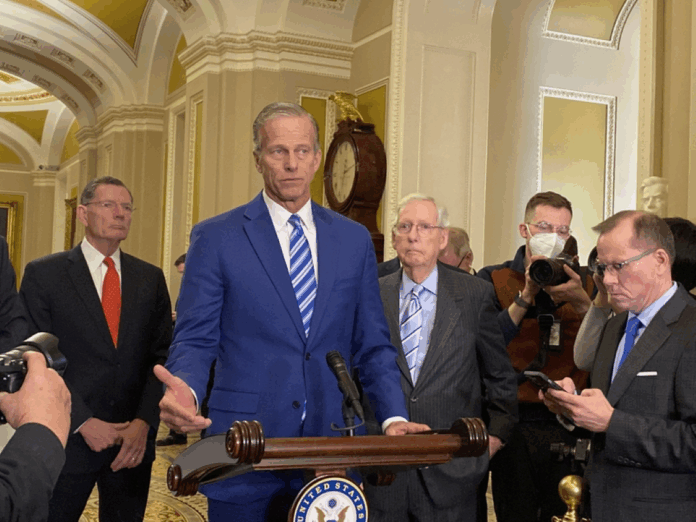
FILE PHOTO - U.S. Senate Majority Leader John Thune, R-S.D. (Jennifer Shutt/States Newsroom)

WASHINGTON (States Newsroom) — President Donald Trump on Thursday told his supporters to call members of Congress and lobby them to support the “big, beautiful bill,” a crucial push with just days to go before a self-imposed Fourth of July deadline.

Trump’s plea follows several tumultuous days on Capitol Hill as GOP leaders struggled to find consensus on multiple policy disagreements, especially after the parliamentarian ruled core elements of the package don’t meet the complex rules for moving a budget reconciliation bill.

Trump during an event in the White House’s East Room that was attended by several GOP lawmakers also cautioned Republicans against voting down the tax and spending cut package.

“We don’t want to have grandstanders,” Trump said. “Not good people. They know who I’m talking about. I call them out. But we don’t need grandstanders. We have to get our country back and bring it back strong.”

Some Republican senators remain optimistic they can work through the weekend and that the House votes will come together next week, despite growing opposition from members in that chamber.

Sen. Eric Schmitt said he doesn’t think the parliamentarian’s rulings will delay the votes “outside the weekend window, which has been the goal all the time.”

“We’re probably voting into the weekend, though. That’s probably my guess — Saturday and I suppose even Sunday — but, that’s the goal, I don’t think that materially changes too much,” the Missouri Republican said.

Senate Majority Leader John Thune, R-S.D., however, appeared a bit less definite, telling reporters in the afternoon that he didn’t know when the chamber would take the procedural vote that kicks off floor consideration.

“I’ll get back to you on that,” he said.

Medicaid provisions tossed

Earlier Thursday, Senate Republicans suffered a significant setback when the parliamentarian ruled several changes to Medicaid in the bill don’t comply with the rules, which means billions of dollars in savings are no longer available for the GOP to offset the cost of tax cuts.

Finance Committee Chairman Mike Crapo. R-Idaho, must rework or completely eliminate nine changes the committee proposed to the health care programs, though more of the panel’s proposals are still under review.

Republicans can no longer reduce the amount of federal matching funds for state governments that use their own tax dollars to provide Medicaid coverage for immigrants in the country without proper documentation.

The GOP bill cannot bar gender-affirming care for Medicaid patients.

And Republicans need to change or scrap a proposal to reduce states’ Medicaid provider tax credits, an issue that is relatively in the weeds of health care policy but has sharply divided the GOP and drawn fierce opposition from states.

The changes or eliminations will have a major impact on how much in savings the GOP tax and spending cut bill will generate during the next decade and will likely make the overall package’s deficit impact higher than before. The legislation is intended to extend the 2017 tax cuts and make spending reductions.

The ruling might make it more difficult for Trump and GOP leaders in Congress to get the votes needed to pass the bill at all, let alone before their self-imposed Fourth of July timeline. Senate GOP leaders had said they wanted to begin procedural votes as soon as Friday.

The measure already had been stuck on Wednesday amid growing disputes over how Medicaid changes will impact rural hospitals and far more.

Democrats to continue scrutinizing bill

Senate Budget Committee ranking member Jeff Merkley, D-Ore., who released the parliamentarian’s rulings, wrote in a statement that Democrats will continue to advocate for removing dozens of proposals from the bill that they believe don’t meet reconciliation rules.

“Republicans are scrambling to rewrite parts of this bill to continue advancing their families lose, and billionaires win agenda, but Democrats stand ready to fully scrutinize any changes and ensure the Byrd Rule is enforced,” Merkley wrote.

A staffer, who was granted anonymity to discuss the chairman’s plans, said the Finance Committee will “rework certain provisions to address the Byrd guidance and be compliant with reconciliation.”

The Byrd rule, named for former West Virginia Sen. Robert Byrd, includes several guardrails for reconciliation bills.

Finance Committee ranking member Ron Wyden, D-Ore., wrote in a statement that the parliamentarian’s ruling will lead to “more than $250 billion in health care cuts removed from the Republicans’ big bad bill.

“Democrats fought and won, striking health care cuts from this bill that would hurt Americans’ walking on an economic tightrope. This bill is rotten to its core, and I’ll keep fighting the cuts in this morally bankrupt bill until the end.”

The parliamentarian is still deciding whether several health provisions meet reconciliation rules, including language that would block all Medicaid funding from going to Planned Parenthood, effectively blocking Medicaid patients from visiting the organization for routine health services.

Federal law already bars funding for abortions with exceptions for rape, incest, or the life of the pregnant patient.

The parliamentarian will also decide later whether Republicans’ bill can block the Department of Health and Human Services from implementing a Biden-era rule that would require nursing homes to have a nurse working 24 hours a day, seven days a week.

Higher ed provisions axed

The parliamentarian also struck down several attempts from congressional Republicans to overhaul the higher education system.

GOP lawmakers cannot streamline student loan repayment options for current borrowers to just a standard repayment plan or an income-driven repayment plan, making such restrictions apply to only new borrowers.

Republicans have to nix a proposal that opened up the Pell Grant — a government subsidy that helps low-income students pay for college — to institutions that are for-profit and not accredited.

The parliamentarian scrapped a proposal that would have barred payments made by students enrolled in a medical or dental internship or residency program from counting toward Public Service Loan Forgiveness.

The federal program eliminates remaining debt for borrowers when meeting certain requirements, including working for a qualified employer within the government or nonprofit sector.

The parliamentarian rejected GOP lawmakers’ proposal to end federal student aid eligibility for certain immigrants who are not U.S. citizens.

‘Too many Medicaid cuts’

Missouri Republican Sen. Josh Hawley said the parliamentarian’s ruling on the Medicaid provider tax rate will give lawmakers “a chance to get it right.”

“This is a chance for the Senate to fix a problem that they created and not defund rural hospitals,” Hawley said, later adding he supports the House language that would freeze the rate at 6% instead of decreasing it to 3.5% over several years.

Hawley said hours before Trump’s event that he expects the president to get more involved in negotiations now that he’s back from a NATO conference in Europe and said Trump was in a “terrific mood” during a recent phone call.

“I think he wants this done. But he wants it done well. And he does not want this to be a Medicaid cuts bill,” Hawley said. “He made that very clear to me. He said this is a tax cut bill, it’s not a Medicaid cuts bill. I think he’s tired of hearing about all these Medicaid cuts, you know. As am I. It’s because there are too many Medicaid cuts.”

Louisiana Republican Sen. Bill Cassidy early Thursday night called on leaders to put the House’s language regarding Medicaid back into the bill, wiping out changes made by the Finance Committee.

“My position is that cuts, and especially drastic cuts, to Medicaid have to be avoided. The Senate bill cuts Medicaid too much,” the influential chairman of the Health, Education, Labor and Pensions Committee wrote in a social media post. “I agree with President Trump, the House version is better.”

SNAP cuts

The Agriculture Committee also is reworking parts of its bill, some being closely watched by states, to meet the rules that govern reconciliation.

Committee Chairman John Boozman, R-Ark., said he expects to hear from the parliamentarian before the end of Thursday about whether a revised state cost share provision for the Supplemental Nutrition Assistance Program that’s based on error rate payments will be in the final bill.

“It was thrown out the first time, so we actually gave her revised text. If she rules the revised text is fine, then we’ll release it,” Boozman said.

The committee released a statement later in the day announcing the parliamentarian had cleared the revised state cost share for SNAP that’s based on a state’s error payment rate.

States that have SNAP error payment rates higher than 6% will have to contribute some of the cost of the program. The updated proposal will give states the option of choosing between fiscal 2025 and fiscal 2026 to determine their match, which will begin during fiscal 2028. After that, a state’s match will be determined by its error payment rate for the last three fiscal years.

State and local tax, ‘revenge tax’

Senate Republicans also remained stuck on finding a deduction level for state and local tax, or SALT, that passes muster with House Republicans who represent high-tax blue states.

The House version would allow taxpayers making under $500,000 to deduct up to $40,000 in SALT from their federal tax bill. Both the $40,000 cap and the $500,000 income threshold will increase annually at 1% until hitting a ceiling of $44,000 and $552,000. The deduction cap phases down for higher earners.

Senate Republicans and the White House sought to lower the income threshold but were shot down Thursday by House Republicans, according to multiple reports.

Sen. Markwayne Mullin of Oklahoma, the lead negotiator on SALT for Senate Republicans, said he remained optimistic.

“We’re gonna be in a good spot. We’re gonna find a landing spot,” Mullin said.

A Senate Finance Committee spokesperson declined to comment on current negotiations, including any proposed income level changes.

Treasury Secretary Scott Bessent also weighed in on another tax provision: the so-called “revenge tax” on investments from countries whose trade policies the president views as unfair to U.S. businesses.

Bessent asked lawmakers to remove the up to 20% tax from the mega-bill following an agreement made with G7 partners, he wrote on social media.

“This understanding with our G7 partners provides greater certainty and stability for the global economy and will enhance growth and investment in the United States and beyond,” Bessent said.

The retaliation tax would have raised roughly $116 billion over 10 years, according to the Committee for a Responsible Federal Budget.

Timing on votes

Republican lawmakers don’t have much time left to rework all of the ineligible provisions, clear them with the parliamentarian, read through final bill text, slog through a marathon amendment voting session in the Senate and then move the bill through the House before their self-imposed deadline.

White House press secretary Karoline Leavitt said during a briefing before Trump’s event that the president is “adamant” Congress must pass the “big, beautiful bill” within the next week, despite the latest ruling.

“We expect that bill to be on the president’s desk for signature by July Fourth. I know there was a ruling by the Senate parliamentarian this morning,” Leavitt said. “Look, this is part of the process, this is part of the inner workings of the United States Senate. But the president is adamant about seeing this bill on his desk here at the White House by Independence Day.”

Morning fire displaces three in Hall County; cause under investigation

Fire broke out above the garage in this house on Saddlehorse Drive in Hall County on June 26, 2025. (Hall County Fire Rescue)

A fire broke out early Saturday morning at a home on Saddlehorse Drive, displacing three people and prompting a swift response from Hall County Fire Rescue (HCFR).

Emergency units were dispatched to the 6200 block of Saddlehorse Drive around 7:30 a.m. on June 26 after receiving reports of a residential fire. When crews arrived, they found a two-story home with a basement actively burning on the second floor above the garage, said HCFR spokesperson Kimberlie Ledsinger.

Ledsinger said firefighters launched an aggressive interior attack and were able to bring the blaze under control quickly. Crews conducted both primary and secondary searches of the home and confirmed that no one was left inside.

One resident was home at the time but managed to escape before firefighters arrived. The American Red Cross is assisting the three displaced occupants.

The cause of the fire remains unknown and is under investigation by the Hall County Fire Marshal’s Office.

Athens to celebrate Independence Day early with Star Spangled Classic June 28

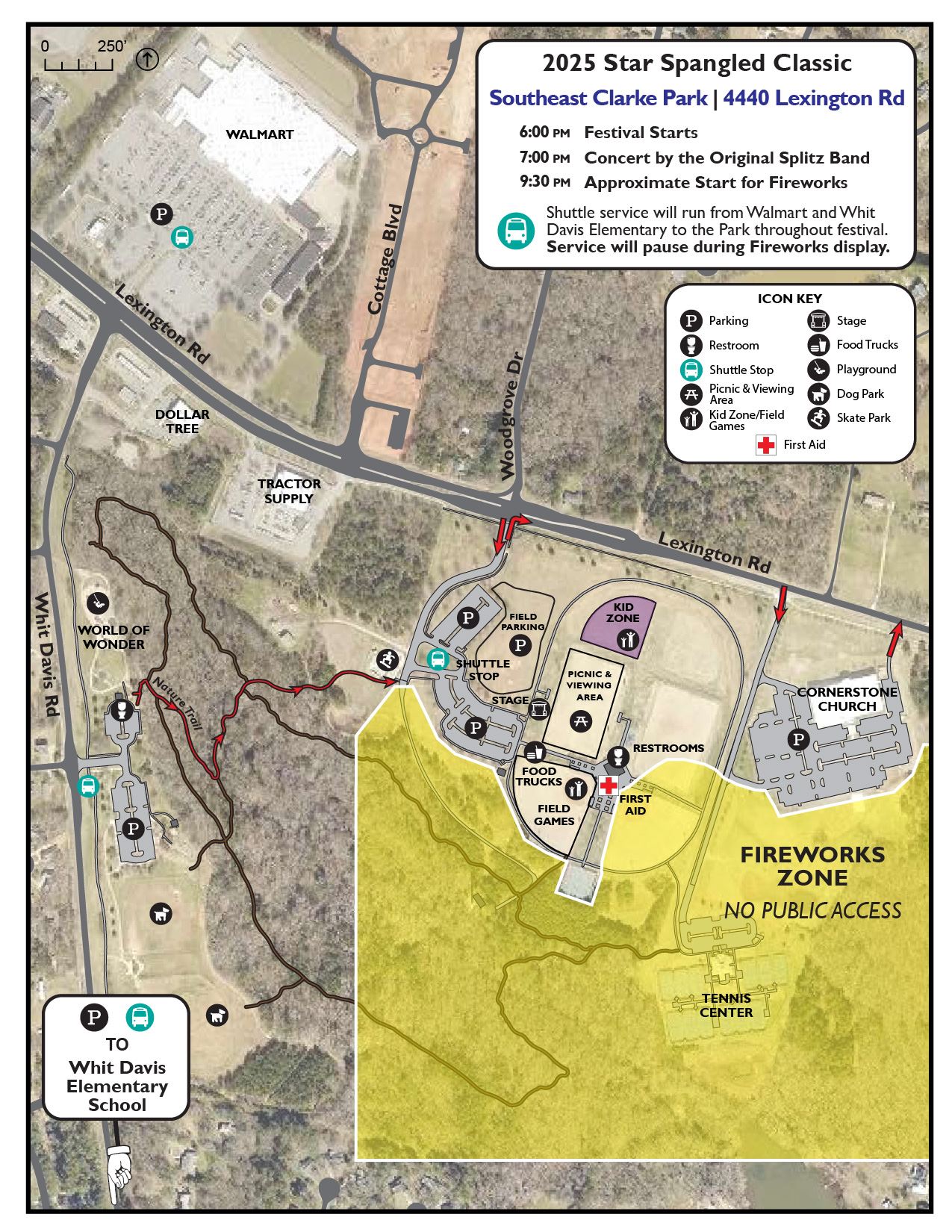
Athens-Clarke County will host an evening of free family-friendly activities, a concert and fireworks at Southeast Clarke Park on Saturday, June 28, 2025. (Athens-Clarke County Leisure Services/Facebook)

Athens is gearing up to celebrate America’s 249th Independence Day a few days early with its annual Star Spangled Classic on Saturday, June 28. The celebration will take place at Southeast Clarke Park. The evening will feature family-friendly activities, food, live music, and a large fireworks display.

Festivities begin at 6 p.m. on the Lexington Road fields. Children and families can enjoy free attractions, including carnival rides, inflatables, face painting, a photo booth, and more. Food trucks will be on site throughout the evening.

(Athens-Clarke County Leisure Services/Facebook)


The Funk Brotherhood will perform from 7 to 8:30 p.m., leading into the fireworks show. Fireworks will be launched from the Athens-Clarke County Tennis Center at approximately 9:30 p.m. and can be viewed from designated areas throughout the park.

Click to enlarge (Source: Athens-Clarke County Unified Government)

Shuttle service available

To accommodate parking, free shuttles will regularly circulate from the Wal-Mart off Lexington Road, Whit Davis Elementary School, and the World-of-Wonder Playground parking lot. The shuttle and parking locations will open at 5:30 p.m.

The Athens-Clarke County Unified Government is hosting the event. The city states that it will enforce park rules, including a ban on alcohol, personal fireworks, grills, and smoking. No pets allowed.

Southeast Clarke Park is located at 4440 Lexington Road, Athens.

If severe weather is forecasted for Saturday, the Star Spangled Classic will be moved to Friday, June 27. All event times will remain the same.

GOP mega-bill stuck in US Senate as disputes grow over hospitals and more

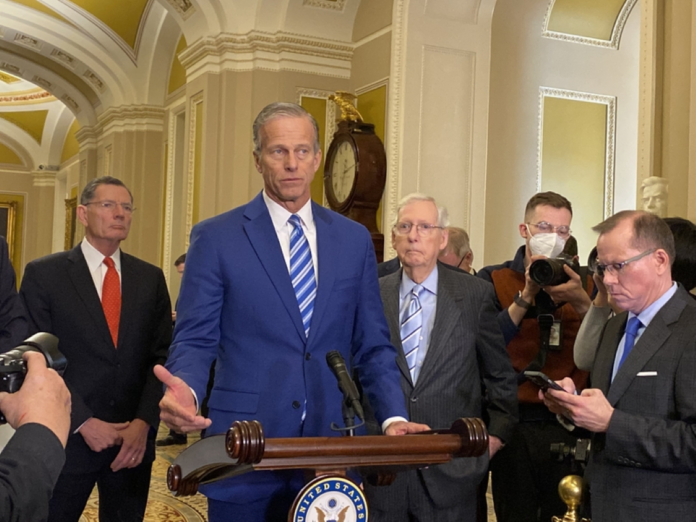
Sen. John Thune, Republican of South Dakota, speaks during a press conference inside the U.S. Capitol on March 20, 2024. Thune, a Republican, officially became majority leader Friday. (Photo by Jennifer Shutt/States Newsroom)

WASHINGTON (States Newsroom) — U.S. Senate Republicans appeared deeply divided Wednesday over how to establish a fund for rural hospitals to offset the budget impacts of Medicaid cuts in the “big, beautiful bill.”

The hospitals, which are generally already hurting financially, rely heavily on Medicaid, a state-federal partnership that provides health insurance for low-income households and for some people with disabilities.

GOP senators haven’t yet reached agreement on how to structure the fund, or on dozens of other unresolved provisions in the sweeping package, even though leaders hope to begin voting as soon as Friday. Still up in the air were agreements on major provisions of the measure involving the U.S. Department of Agriculture’s food aid program for low-income people and a proposed selloff of certain public lands.

Republican leaders continued to project optimism. “We’re well on our way to getting this bill passed this week,” Senate Majority Leader John Thune, R-S.D., said during a floor speech, continuing to press ahead toward a self-imposed Fourth of July deadline.

Others saw it differently. Wisconsin Republican Sen. Ron Johnson cast doubt on the short timeframe leaders have set to reach final agreement and move the bill through both chambers.

“We’re still discussing some pretty fundamental issues,” Johnson said. “I’m just laying out the reality of the situation. We’ve got a lot of work to do.”

‘The only person up here that’s ever ran a rural hospital’

Dueling plans to establish the rural hospital fund to ease the threat of Medicaid cuts circulated among senators working to finalize the massive tax and spending cut measure, but an agreement had not surfaced by late afternoon.

Unofficial details showed Senate Republicans eyeing the inclusion of a $15 billion fund — $3 billion a year between fiscal 2027 and fiscal 2031 — to help rural hospitals, according to multiple reports.

But Sen. Roger Marshall, who sits on the Senate Committee on Finance, said he wants to increase that fund to $5 billion annually, with “half of that going to rural hospitals, and half of it going to primary care and prescription drugs and throw in physical therapy and occupational therapy, all the others as well.”

The Kansas Republican and physician said “we should probably only do it for four or five years and then regroup and see where we are.”

“I’m the only person up here that’s ever ran a rural hospital — I actually know something about them,” he added.

While Marshall said he loves “90%” of the broader bill, he said not nearly enough is being cut.

“But I can’t get the votes to do that, so it’d still be the largest cut in spending in my lifetime anyway,” he said, noting that “it’s going to be hard for the House to vote against it.”

Fund size criticized

On a midday call with reporters, Traci Gleason with the Missouri Budget Project said the stabilization fund being batted around by lawmakers “would fall well short of addressing these problems.”

“Forty-three percent of Missouri’s rural hospitals are at risk of closing, and 17% are considered to be at immediate risk,” said Gleason, who spoke during a virtual press briefing organized by the left-leaning Center for Budget and Policy Priorities.

“Those figures don’t account for all of the other health care providers in rural communities, like federally qualified health centers and others that operate on these incredibly thin margins. So the massive cuts to Medicaid are what is creating the problem and the only real way to address it is for Congress to not make these massive cuts,” she said.

‘Problematic’ Medicaid cuts

Sen. Susan Collins was advocating for a much bigger rural hospital stabilization fund, at $100 billion.

“I don’t think that solves the entire problem,” the Maine Republican and chair of the Senate Appropriations Committee said.

“The Senate cuts in Medicaid are far deeper than the House cuts, and I think that’s problematic as well.”

Sen. Jim Justice of West Virginia said that the $15 billion “is better than zero.”

“You know, naturally, I’d want it to be as high as it possibly can,” he said, adding that rural hospitals are the “lifeblood” of his state.

Sen. Josh Hawley of Missouri, a loud voice against Medicaid benefit cuts, said a stabilization fund is a “good idea but we’re still going to have to address the longer term effects of this.”

When asked for a dollar figure, Hawley said “it depends on the structure of it.”

Texas Republican Sen. John Cornyn said he keeps hearing the Senate will take a procedural vote on Friday, though that isn’t set in stone.

“Should be a fun weekend for all of us,” Cornyn said. “Can’t wait.”

Once the Senate votes on what is called a motion to proceed, there’s a maximum of 20 hours of floor debate before the chamber must begin its marathon amendment voting session and eventually a passage vote.

SNAP provisions

Senate Agriculture Chairman John Boozman, an Arkansas Republican, said a revised version of his committee’s bill had not yet been reviewed by the parliamentarian.

The updated text alters a section restructuring the cost-share of the Supplemental Nutrition Assistance Program, or SNAP, a key food assistance program for low-income people.

The provision would require states for the first time to shoulder some of the cost of the program’s benefits. The amount a state owes would be determined by its error payment rate, with greater error rates requiring a higher state share.

Complex rules govern what can and can’t be included in the measure. The Senate parliamentarian ruled the language in the initial proposal did not comply with the chamber’s reconciliation rules.

The updated proposal would allow states more flexibility during the policy’s phase-in in fiscal 2028, allowing them to choose either the error rate in fiscal 2025 or fiscal 2026.

Boozman told reporters that change sought to respond to the parliamentarian’s ruling.

The parliamentarian “asked us to allow them (states) to use a different time frame — essentially gave them more time to understand what their error rate would be and to plan for it,” Boozman said. “And so we adjusted for that and I think we satisfied it.”

Lee and public lands

Senate Energy and Natural Resources Chairman Mike Lee of Utah reportedly narrowed a provision that would mandate the sale of Bureau of Land Management lands. He has not publicly said where it stands with the parliamentarian.

A committee spokesman did not return messages seeking clarification Tuesday and Wednesday, but a version of the changes obtained by news media shows changes consistent with what Lee proposed Monday.

Those changes include limiting the mandated sales to only the BLM — and not U.S. Forest Service lands, as Lee had initially proposed — and lowering the percentage of the agency’s lands that must be sold to between .25% and .5%. The initial proposal required between .5% and .75%.

The updated provision would also only require lands located within 5 miles of a population center to be sold and exempts lands that are currently used for grazing or another “valid existing right that is incompatible with the development of housing,” according to a copy of the changes obtained by hunting and angling publication Outdoor Life.

The provision has sparked opposition from Western lawmakers, including a handful of conservatives.

But it also has its share of supporters. Alaska Republican Dan Sullivan told reporters he had not seen the updated text but remained supportive of the idea.

“I’ve been supportive of what Sen. Lee is trying to do,” he said. “We have a lot of public lands in Alaska that the federal government abuses. But we’re in a good discussion on that, so I need to see the update.”

By Ashley Murray, Shauneen Miranda, Jacob Fischler and Jennifer Shutt

Severe storms bring strong winds and hail to North Georgia

Severe weather swept through North Georgia late Wednesday, June 25, 2025. Laura Suderno-Gray of Clarkesville shared this photo. "We have lots of hail," she said.

It feels like we can’t go more than a week or two without a round of severe storms, with the latest one coming on Wednesday night.

After a day of hot temps with highs reaching the mid-90s for most outside the mountains, scattered storms developed and took full advantage of the extreme heat and instability.

Damaging winds caused scattered power outages across the region, along with numerous downed trees. The Habersham County Airport reported a maximum gust of 44 MPH with the storm just before 10 PM. The WRWH station near Cleveland recorded a gust of 25.1 MPH, although stronger gusts likely occurred over parts of southwestern White County.

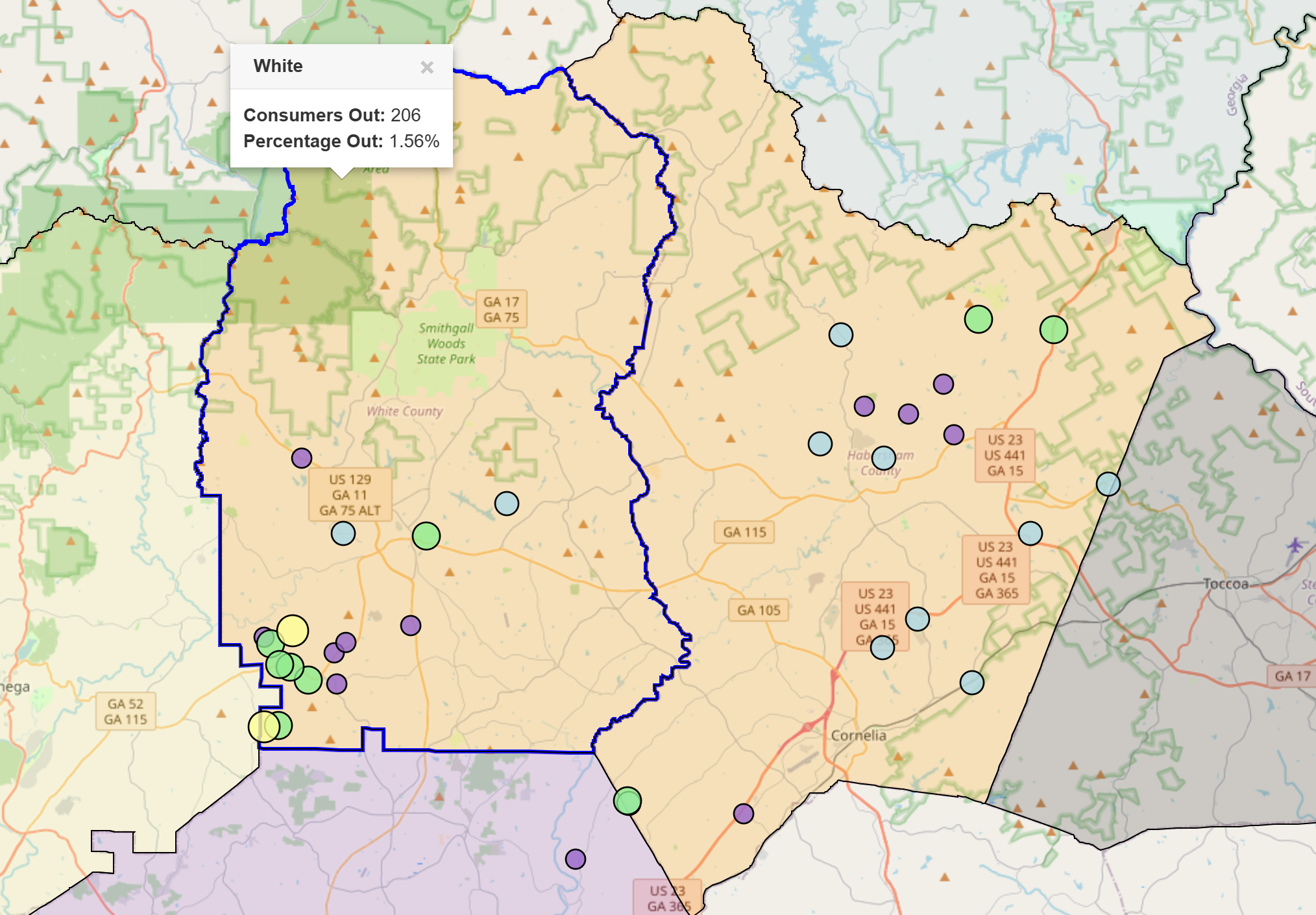
Power outages from HEMC topped out in the 400s, fortunately, much lower than we have seen with previous storms. The most concentrated outages occurred over southwestern White County, where a microburst brought down numerous trees onto roads and power lines.

Power outages at 10:12 PM Wednesday, June 25, 2025.

At the height of the storm, more than 112,000 Georgia Power customers were without power statewide, according to FindEnergy.com.

Habersham’s Wendy Hubbard Ferguson described the storm this way: “Lightning looked like a strobe light and we had hail fall for over 15 minutes.”

Hail up to marble-sized was also reported across the region. A large hail core brought mostly pea-sized hail to White County, while a large area from Clarkesville down to Cornelia saw the biggest hail reports.

Even if you didn’t see any hail or winds, you likely experienced the frequent lightning. Bolts struck as far as 4-6 miles outside the storms, with hundreds of cloud-to-ground strikes across the region.

Additional severe storms are possible again Thursday and Friday, so stay weather aware!

Severe storms remain possible Thursday and Friday

Unidentified body found in vehicle near Epps Bridge Parkway

Investigators have yet to identify the body of a man found in a vehicle parked near Epps Bridge Parkway and the Athens Perimeter.

Oconee County Coroner Ed Carson said the body was taken to the state medical examiner’s office to help with identification. Inside the man’s vehicle, police found the cremated remains of a dog, three cell phones, a sleeping bag, and other items.

A cause of death has not been released.

This article comes to Now Habersham in partnership with WUGA News 

CDC vaccine panel abruptly overhauled by RFK Jr. says it will review childhood vaccination schedules

Wednesday marks the Advisory Committee on Immunization Practices' first meeting since U.S. Health Secretary Robert F. Kennedy Jr. dismissed all 17 members of the committee and replaced them with a slate of eight hand-picked appointees. (Photo via GeorgiaRecorder.com)

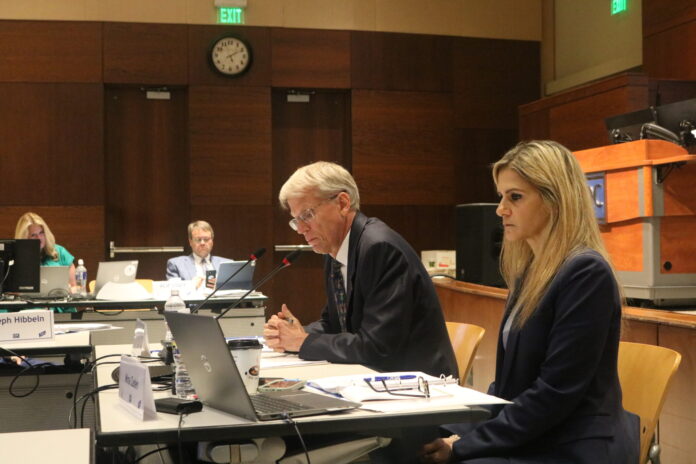
(Georgia Recorder) — The Centers for Disease Control and Prevention will reexamine current recommendations around childhood vaccination schedules and Hepatitis B immunizations, members of the CDC’s Advisory Committee on Immunization Practices announced during a meeting in Atlanta Wednesday.

The committee, which meets three times a year, does not typically garner much public interest. However, this meeting is the first since U.S. Health Secretary Robert F. Kennedy Jr. dismissed all 17 members of the committee and replaced them with a slate of eight hand-picked appointees, many of whom are seen as vaccine skeptics, launching the little-known committee into the national spotlight.

Medical experts, including the American Medical Association, expressed dismay at Kennedy’s appointment of the new committee members, which the organization said occurred “without transparency and proper vetting to ensure they have the expertise necessary to make vaccine recommendations to protect the health of Americans.”

“We urge the Administration to reconsider the removal of the 17 ACIP members who have deep expertise in vaccines so physicians can continue to have confidence in ACIP’s recommendations,” AMA President Bobby M. Mukkamala said in a statement.

Six former ACIP chairs also authored an op-ed after the former committee members’ dismissal, warning that “if relevant scientific expertise on vaccines is not maintained, access to vaccines may fundamentally change.”

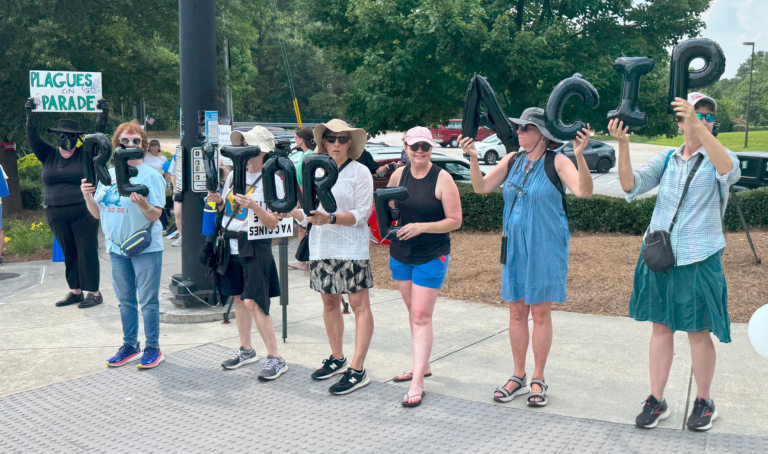
Supporters of the CDC hold balloons that spell out “Restore ACIP” at a rally outside the center Wednesday. (Jill Nolin/Georgia Recorder)

The move was also made in direct contradiction with a promise from Kennedy to Louisiana Republican Sen. Bill Cassidy ahead of the secretary’s confirmation in February. Cassidy says Kennedy pledged to “maintain the Centers for Disease Control and Prevention’s Advisory Committee on Immunization Practices without changes.”

Cassidy, a doctor who cast the deciding vote to confirm Kennedy as health secretary, called for the meeting to be delayed until members with more expertise in vaccines could be appointed to the panel, but was unsuccessful. Alaska Republican Sen. Lisa Murkowski also expressed concern about the backgrounds of the new panelists.

The committee is now chaired by Martin Kulldorff, a doctor and former Harvard Medical School professor who was fired in 2024 after declining the COVID-19 vaccine, and has spoken out against blanket vaccine mandates during the pandemic.

“Secretary Kennedy has given this committee a clear mandate to use evidence-based medicine when making vaccine recommendations, and that is what we will do,” Kulldorff said in his opening remarks. He also disputed characterizations of his skepticism of vaccine mandates as “anti-vax.”

“Some media outlets have been very harsh on the new members of this committee, issuing false accusations and making concerted efforts to put scientists in either a pro- or anti-vaccine box,” he said. “Such labels undermine critical scientific inquiry, and it further feeds the flame of vaccine hesitancy. To thoroughly scrutinize and assure the safety and efficacy of vaccines is a pro-vaccine position.”

Other appointees to the committee include Robert Malone, a doctor and biochemist who said he views the label of anti-vaxxer as “high praise” and Vicky Pebsworth, a regional director for the National Association of Catholic Nurses who also serves on the board of the National Vaccine Information Center, an organization that advocates for vaccine exemptions.

One member of the committee, Michael Ross, had already withdrawn from the committee by the time the body convened for the two-day summit in Atlanta. Kennedy, who was attending a “Make America Healthy Again” event in Oklahoma, was not present at the meeting.

‘Completely unprecedented’

As the committee met inside, dozens of people braved the sweltering heat to hold what they called a “parade of preventable diseases” to highlight the dangers of limiting the public’s access to vaccines. They also called for the committee to be restored to its previous makeup.

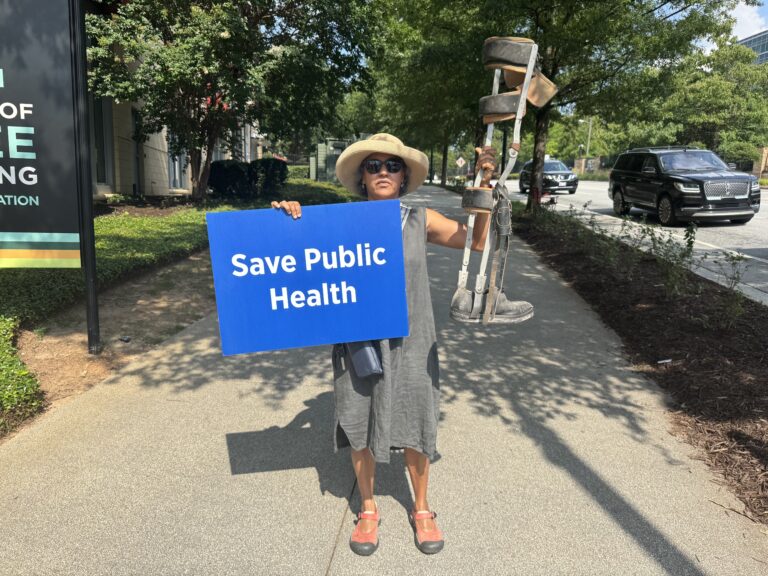
A whole colorful cast of pathogens were represented just outside the center’s entrance, from influenza to HPV to meningococcus. Dr. Deblina Datta carried a leg brace to represent polio.

“This is what we don’t want to see again. When we introduce vaccine skepticism, we are going to see people wearing this,” Datta said holding up the brace.

Dr. Deblina Datta, a former CDC worker, carried a leg brace to represent polio Wednesday. (Jill Nolin/Georgia Recorder)

Datta spent more than two decades at CDC working on immunizations, with six years with the Advisory Committee on Immunization Practices. She called the abrupt overhaul of the committee alarming.

“While a healthy skepticism of vaccine policy is good, this level of skepticism and the sources of the skeptics being put onto ACIP is calamitous,” Datta said. “And it’s absolutely eroding the public’s faith in the ACIP to dictate policy.”

Katrina Kretsinger, who retired from the CDC two years ago after working mostly on vaccine-preventable diseases, said she has major concerns about the changes made to the committee.

“This is completely unprecedented,” she said. “And I really don’t think it’s going to have any credibility.”

But she said she is also trying to have “a little bit of wait and see” attitude about the new members.

“I would say that there’s a number of them who seem like they are reasonably well qualified, and then there are others of the seven who come with a very clear anti-vaccine agenda and are well known for viewpoints that are really hard to defend based on the scientific merits,” Kretsinger said. “It’s very disappointing.”

ACIP’s new agenda

The new ACIP appointees are scheduled to spend two days reviewing safety and efficacy data on COVID-19, Respiratory Syncytial Virus (RSV), Measles, Mumps, Rubella and Varicella (MMRV), Influenza, Anthrax and Chikungunya vaccines before voting on new immunization recommendations.

However, Kulldorff said the committee also plans to commission new working groups dedicated to evaluating the impact of childhood vaccines and investigating the timeline for the recommended administration of Hepatitis B vaccines in newborns. The committee will also be reexamining vaccines that have not been reviewed within the last seven years.

“In addition to studying and evaluating individual vaccines, it’s important to evaluate the cumulative effect of the recommended vaccine schedule,” Kulldorff said.

Thursday’s agenda also includes a presentation from Lyn Redwood, the former head of Children’s Health Defense, an anti-vaccine group founded by Kennedy.

Redwood, who is not a CDC employee, is expected to argue that a preservative used in a small portion of flu vaccines, known as thimerosal, causes autism. According to the CDC, research has shown no connection between thimerosal and autism or any other source of harm, and the chemical was taken out of childhood vaccines in the U.S. in 2001.

Georgia Recorder Editor Jill Nolin contributed to this report. 

Calm before the storm

Rick Austin captured this lightning strike in the clouds at sunset over Demorest on Wednesday, June 25, 2025. (Photo by Rick Austin)

Before severe weather rained down late Wednesday, Northeast Georgians were treated to a beautiful sunset.

Two Habersham Countians captured the calm before the storm.

Demorest resident Rick Austin photographed an amazing shot of lightning in the clouds as the sunset painted the sky purple.

(Photo by Rick Austin)

Sherri Purcell captured a gorgeous photo in Clarkesville as the sun set lower in the sky drawing the day to a close.

(Photo by Sherri Purcell)

Alison Cathey captioned this purple skyscape, “The beauty before the storm in Alto.”

(Photo by Alison Cathey)

Sheila McCutcheon shared another image of a sunset before the storm.

(By Sheila McCutcheon)

Share your sunset and storm photos with us on Facebook at #NowWeather.


Soto hits 2 homers and Mets beat Braves 7-3 for 2nd victory in 12 games

A fan fields Drake Baldwin's solo shot to centerfield. (livestream image Atlanta Braves/Facebook)

NEW YORK (AP) — Juan Soto homered twice and the New York Mets finally got some production from the bottom of the lineup, beating the Atlanta Braves 7-3 on Wednesday night for their first victory over their NL East rivals in six meetings this season.

No. 8 batter Ronny Mauricio also went deep and finished with three hits as New York won for only the second time in 12 games. Center fielder Jeff McNeil robbed Marcell Ozuna of a two-run homer in the first inning.

Clay Holmes (8-4) pitched around four walks in five innings after issuing a career-high six free passes during a loss at Atlanta last week. The converted reliever allowed only a solo homer by rookie Drake Baldwin in the fourth.

One night after blowing a 3-0 lead, the Mets’ bullpen followed Holmes with three scoreless innings. Jonathan Pintaro, making his major league debut, gave up a two-run single to Ronald Acuña Jr. in the ninth before Edwin Díaz retired Ozuna with two on for his 16th save in 17 opportunities.

With the score tied 1-all, Soto sparked a five-run fourth when he homered to right-center on the first pitch of the inning from Didier Fuentes (0-2), who was making his second big league start.

Brett Baty and Brandon Nimmo each singled home a run during the rally. Starling Marte and Francisco Lindor both had a sacrifice fly.

Pitching eight days after his 20th birthday, Fuentes was charged with six runs and eight hits in 3 1/3 innings.

Soto connected again leading off the seventh against Austin Cox to make it 7-1. It was the 27th career multihomer game and fourth this season for Soto, who has 10 home runs in 23 games this month.

Braves center fielder Michael Harris II robbed Lindor of a two-run homer with a spectacular leaping catch in the eighth.

Key moment

With two on in the fifth, Holmes retired Ozuna and Austin Riley to end the inning.

Key stats

Soto broke a tie with Hall of Fame slugger Jimmie Foxx for the most multihomer games by a player 26 or younger. … Atlanta first baseman Matt Olson extended his on-base streak to a career-best 26 games — the longest active run in the majors.

Up next

Braves RHP Grant Holmes (3-6, 3.97 ERA) starts Thursday night against RHP Griffin Canning (7-3, 3.91) in the finale of the four-game series.

$1,000 ‘Trump Accounts’ for babies skewed toward the wealthy, critics say

WASHINGTON — Tucked in the “one big beautiful bill” is a proposal for tax-advantaged “Trump Accounts,” each seeded with $1,000 from the government for certain babies born in the United States over the next few years.

But financial experts and advocates for low-income children are not overly impressed.

The idea is not new and has been likened to other “baby bonds” programs aimed at reducing the growing wealth gap, like state-run trust funds in California and Connecticut. Democrats in Congress have introduced a bill to create a similar federal program.

The White House has touted the proposal in the tax and spending cut measure as “pro-family” and one that “will afford a generation of children the chance to experience the miracle of compounded growth.”

At a June 9 event to promote the “Trump Accounts” featuring CEOs of top American companies, President Donald Trump promised the pilot program will make it possible for “countless American children to have a strong start in life at no cost to the American taxpayer.”

Speaking at the same event, top House Republican tax writer Rep. Jason Smith of Missouri said “every child born under this policy will have a better shot at a future. It does not matter if they live on a city block or on a county road, this will make a significant difference to their lives.”

Critics say the accounts, as proposed, would mostly benefit children born to wealthier families.

They also say the restricted-access accounts, and the one-time government contribution of $1,000, will not help in the face of cuts to food and health programs for low-income people written into the massive budget reconciliation bill, titled the “One Big Beautiful Bill Act.”

How ‘Trump Accounts’ would work

The investment savings accounts would be available to U.S. citizens born between 2025 and 2028, and whose parent, or parents, if legally married, already have Social Security numbers.

Each year, from a child’s birth to age 18, family and friends, parents’ employers, churches and other private foundations, could contribute up to a combined $5,000 annually to the investment account that will track a stock index and gain interest accordingly.

Deposits into the account are taxed. Later on, withdrawals would be subject to the long-term capital gains tax — a tax on the profit made from selling an asset, or investment, that a person has held for longer than a year.

After reaching 18, the account beneficiary could access half the account’s value only for qualified expenses that include higher education, vocational training, the purchase of a first home, and costs associated with an enterprise for which the beneficiary has received a small business loan or small farm loan.

The beneficiary could access the remaining half of the account after age 25. At age 31, the account loses its status as a “Trump Account” and any remaining balance is taxed as income.

Drawbacks seen

The Urban Institute warns that the proposed structure of the account will mostly benefit wealthy families who already have the resources to grow the funds.

The bottom 80% of households, by income, only hold half as much cash on hand as the top 20% of households, according to the left-leaning think tank’s nationwide financial health data.

Additionally, because of penalties for early withdrawals, lower-income families would be incentivized to save in less restrictive accounts, according to the think tank’s May 27 analysis.

The institute recommends the government provide more contributions based on income level, beyond just the one-time $1,000, and lessen the penalties for accessing cash for catastrophic events.

A 2023 Democratic legislative proposal put forth by Sen. Cory Booker of New Jersey and Rep. Ayana Pressley of Massachusetts aimed to create an account that would target the benefit to children from lower-income households.

Their plan suggests accounts be initially seeded with $1,000, and then children would receive up to an additional $2,000 annually based on their family’s income level.

According to Booker’s and Pressley’s plan, a child from a family of four that brings in less than $25,100 in annual income would have an estimated $46,200 in investment savings by the time they turn 18.

Under the Trump Account proposal, a child’s one-time $1,000 deposit from the government would grow to roughly $5,000 by age 18 if no other contributions were ever made, according to the Urban Institute.

Child tax credits

Brendan Duke, senior director for federal fiscal policy at the left-leaning Center on Budget and Policy Priorities, said the GOP proposal “wasn’t particularly well thought through.”

“It’s this question of whether it makes more sense to give every family $1,000 that they can’t access in those really important years, or whether you should have expanded the child tax credit,” Duke said.

Duke criticized lawmakers’ proposals that do not expand the child tax credit to the lowest-income families in the massive GOP budget reconciliation package.

While the House version temporarily expands the credit to $2,500 per child, up from $2,000, and the Senate version permanently expands the credit by a more modest amount of $2,200, neither version expands income or refundability parameters that would benefit the poorest families.

The CBPP estimates that 17 million children are left out of the credit because of the restrictions.

Existing savings vehicles

Another criticism of the Trump Accounts is that they provide a redundant option among the several existing tax-preferred savings vehicles for Americans, including 529 education investment savings accounts, Roth and Traditional IRAs and Health Savings Accounts.

The Tax Foundation’s Alex Muresianu said the account is “a move toward complexity rather than simplification.”

“We already have plenty of savings accounts with specific purposes, and a lot of different strings attached,” said Muresianu, senior policy analyst with the right-leaning foundation.

“We don’t really need another targeted account for a specific purpose, rather than a more easily accessible account with fewer conditions.”