Chase Elliott (9) celebrates after winning a NASCAR Cup Series auto race, Saturday, June 28, 2025, in Hampton, Ga. (video screengrab NASCAR/Facebook)
HAMPTON, Ga. (AP) — Chase Elliott couldn’t have picked a better setting for a drought-breaking win.
Fans roared in approval after Elliott, the home-state favorite, passed Brad Keselowski on the final lap to end a 44-race drought by winning the NASCAR Cup Series at Atlanta on Saturday night.
Elliott’s 20th career victory pushed him to second place in the Cup Series points race, putting him in prime position to return to the top of the NASCAR world after winning his first championship in 2020.
Elliott earned a spot in the NASCAR playoffs with his first victory since April 2024 at Texas. He said he’ll always remember the win as a career highlight, in part because of the ovation from fans who chanted “Chase! Chase! Chase!”
Elliott, a Dawsonville, Georgia, native, climbed into the stands at EchoPark Speedway, formerly Atlanta Motor Speedway, to celebrate with the fans.
“It was, truthfully, a pretty surreal moment,” Elliott said. “Something I’ll remember for the rest of my life. … Saturday night under the lights, been a while since we won, just getting ourselves a win and advancing up on the playoff thing.”
It was his first Atlanta win since 2022.
Elliott has 594 points, 37 behind Hendrick Motorsports teammate William Byron, who has 631. A third Hendrick Motorsports driver, Kyle Larson, is third.
Another Hendrick driver, Alex Bowman, played a key role in Elliott’s comeback win. Bowman, who finished third, gave Elliott a push and then helped block Keselowski on the final lap.
“I’m happy for the 9 team,” Bowman said. “It’s a big win for him in his hometown. … I’m glad to have a Hendrick car in victory lane. I wish it was us.”
Elliott said he’ll try to repay the favor by helping Bowman join the other three Hendrick drivers in the playoffs.
“I recognize that he gave me a great shove,” Elliott said. “I recognize that he took his run on Brad, too, to try to get himself to second, which ultimately helped me as well.
“Yeah, those are all things that I remember.”
Elliott advanced to the second round of NASCAR’s new In-Season Challenge, a five-race, bracket-style tournament. With the field cut from 32 to 16 drivers, Elliott will be paired against John Hunter Nemechek when the Cup Series moves to the Chicago Street Race next Sunday.
A $1 million prize awaits the winner, and Elliott’s odds improved after Atlanta wrecks knocked out the top two seeds, Denny Hamlin and Chase Briscoe.
Elliott wouldn’t be the first family member to win a $1 million bonus. In 1985 his father, Bill Elliott, became the first winner of the Winston Million as a reward for claiming wins in three of the circuit’s top four races at the time. The bonus earned the elder Elliott the nickname “Million Dollar Bill.”
Now the younger Elliott is a strong contender to become first in line for another $1 million prize.
“It’d be a really cool thing to win for sure and hope it works out that way,” Chase Elliott said.
Elliott’s victory drought came after he needed surgery to repair a broken tibia in his left leg suffered in a snowboarding accident and missed six racesin 2023. He said the support of longtime crew chief Alan Gustafson was “in large part” responsible for helping him retain his confidence and reclaim his winning form.
Gustafson said the win was more important for the 2025 playoff race than for ending the victory drought.
“The points were getting tight for the playoffs, for sure,” Gustafson said. “I think that’s probably the biggest thing. I think all the cars contending to win, I don’t think any of them had won. I think that’s probably the biggest thing we needed was that cushion.”
Saturday night’s win was Elliott’s third consecutive top-five finish.
“When you’re fortunate enough to climb the mountain and be able to stand at the top of the mountain with someone, that’s an incredible achievement, right?” Elliott said. “That’s something that (Gustafson) and I will always cherish and remember that we did that together.
“For me it’s really, really important to climb that mountain with the same people that we did the first time and know that we never quit on each other. That’s just a really important piece of the puzzle for me.”
Unable to stop the march toward passage of the 940-page bill by Trump’s Fourth of July deadline, the minority party in Congress is using the tools at its disposal to delay and drag out the process.
“If Senate Republicans won’t tell the American people what’s in this bill, then Democrats are going to force this chamber to read it from start to finish,” said Senate Democratic Leader Chuck Schumer.
By Sunday mid-afternoon some 16 hours later, the clerk’s reading of the nearly foot-high bill was done.
And within moments the Senate launched debate. But it’s still going to be a while, at least 10 hours of speeches stretching late into the night. The slow-walking tactic points to a difficult days ahead.
“It’s taken a while to get here,” said Sen. Lindsey Graham, R-S.C., the Budget Committee chairman, “but we’ll have a debate worthy of this great country.”
Republicans, who have control of the House and Senate, are closer to passing Trump’s signature domestic policy package, yet there is political unease. Democratic immediately launched fresh challenges against it, decrying the way they say Republicans are hiding the true costs by using unusual budgeting.
A new analysis from the nonpartisan Congressional Budget office Sunday estimates the Senate bill would increase the deficit by nearly $3.3 trillion from 2025 to 2034, a nearly $1 trillion increase over the House-passed bill. It also found that 11.8 million more Americans would become uninsured by 2034 if the bill became law, more than with the House’s approach.
Republicans remain reluctant to give their votes, and their leaders have almost no room to spare, given their narrow majorities. Essentially, they can afford three dissenters in the Senate, with its 53-47 GOP edge, and about as many in the House, if all members are present and voting. House Speaker Mike Johnson, R-La. had sent his colleagues home for the weekend.
Trump, who has at times allowed wiggle room on his deadline, kept the pressure on lawmakers to finish. But the tense scene as voting came to a standstill for more than three hours let the internal discord play out in public.
In the end, Republicans Sen. Thom Tillis of North Carolina and Rand Paul of Kentucky opposed the motion to move ahead, joining all 47 Democrats. Trump noticed.
He threatened to campaign against Tillis, worried that Medicaid cuts would leave many without health care in his state. Trump badgered Tillis again on Sunday morning, saying the senator “has hurt the great people of North Carolina.”
Renewed pressure to oppose the bill came from Elon Musk, who criticized it as “utterly insane and destructive.”
If the Senate is able to pass the package in the days ahead, the bill would return to the House for a final round of votes before it could reach the White House. GOP leaders will need almost every one of their members on board.
Tax breaks and core GOP priorities
At its core, the legislation would make permanent many of the tax breaks from Trump’s first term that would otherwise expire by year’s end if Congress fails to act, resulting in a potential tax increase on Americans. The bill would add new breaks, including no taxes on tips, and commit $350 billion to national security, including for Trump’s mass deportation agenda.
But the cutbacks to Medicaid, food stamps and green energy investments are also causing dissent within GOP ranks. Sen. Ron Wyden, D-Ore., said the environmental rollbacks would amount to a “death sentence” for America’s wind and solar industries.
The Republicans are relying on the reductions to offset the lost tax revenues but some lawmakers say the cuts go too far, particularly for people receiving health care through Medicaid. Meanwhile, conservatives, worried about the nation’s debt, are pushing for steeper cuts.
Democrats can’t filibuster, but can stall
Using a congressional process called budget reconciliation, the Republicans can muscle the bill through on a simple majority vote in the Senate, rather than the typical 60-vote threshold needed to overcome objections.
Without the filibuster, Democrats in the minority have to latch on to other tools to mount their objections.
One is the full reading of the bill text, which has been done in past situations. Sen. Ron Johnson, R-Wis., forced a 2021 reading of a COVID relief package.
Other strategies the Democrats plan to use include using their full 10 hours of available debate time expected to launch later Sunday.
And then the Democrats are prepared to propose dozens of amendments to the package that would be considered in an all-night voting session — or all-day, depending on the hour.
A roll call full of drama
As Saturday’s vote tally teetered, attention turned to Sen. Lisa Murkowski, R-Alaska, who was surrounded by GOP leaders in intense conversation. She voted “yes.”
Several provisions in the package are designed for her state in Alaska.
A short time later, Majority Leader John Thune, R-S.D., drew holdouts Sen. Rick Scott of Florida, Mike Lee of Utah and Cynthia Lummis of Wyoming to his office. Vice President JD Vance joined in. The talks dragged on.
Then Vance led them all back in to vote.
Later, Scott said he had met with the president, adding, “We all want to get to yes.”
Lee said the group “had an internal discussion about the strategy to achieve more savings and more deficit reduction, and I feel good about the direction where this is going, and more to come.”
___
Associated Press writers Ali Swenson, Fatima Hussein, Michelle L. Price contributed to this report.
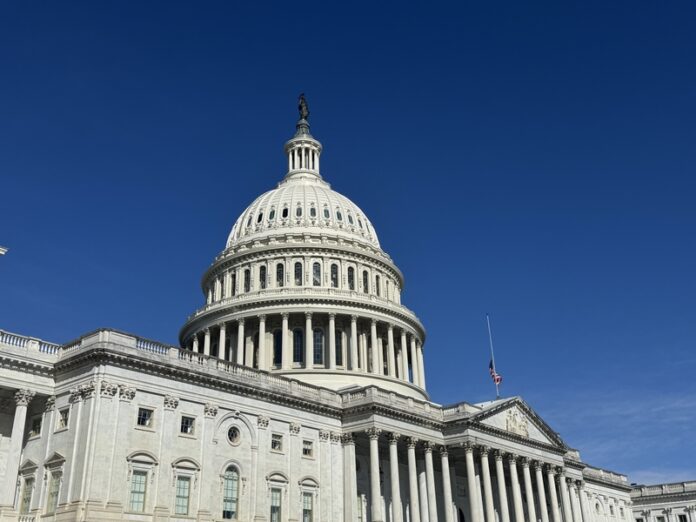
The U.S. Capitol on Sunday, June 29, 2025. (Jennifer Shutt/States Newsroom)
WASHINGTON (States Newsroom) — The U.S. Senate began floor debate on Republicans’ “big, beautiful bill” Sunday afternoon, though there are several steps to go before the legislation can become law, and any one of those could lead to additional GOP opposition — potentially dooming the measure.
Senators must wrap up an ongoing review of the bill with the parliamentarian to ensure it meets the strict rules for using the reconciliation process and then run the gauntlet during a marathon amendment voting session.
Additional changes to the sweeping tax and spending cuts package, some of which were being worked on as debate took place, need to garner the support of nearly every Republican in Congress. Otherwise, it will never become law.
Senate Majority Leader John Thune signaled during a brief hallway interview there may be enough votes for a new twist in the Medicaid changes in the bill — an amendment reducing in some way how much the federal government spends on Medicaid in states that expanded the program as a result of Democrats’ 2010 health care law. The federal government currently pays 90% of the costs for enrollees in the expansion.
“We’re going to do what we can to support the effort,” Thune said, referring to an amendment offered by Florida Sen. Rick Scott that was not yet public. “It’s great policy and something that there’s a high level of interest in our conference in getting made part of the bill, and obviously scores a substantial savings.”
But Thune, R-S.D., sidestepped a question about whether making that change would create vote-count issues if Republicans in the House with affected districts object, potentially preventing the bill from reaching President Donald Trump’s desk.
“We have had some of these conversations with (Speaker Mike Johnson) and others over there, and then also with our colleagues for some time,” Thune said. “But I think the way this is designed, and the way that Sen. Scott has written it, it should be something that I don’t know how Republicans couldn’t be in favor of what he’s trying to get done here.
“So, you know, we’ll cross that bridge when we come to it. Obviously, we’ve still got to get into the debate over here and get through the amendment process and we’ll see what the fate of the amendment is on the floor.”
Currently, 41 states, including the District of Columbia, have adopted the Medicaid expansion, according to the health care research organization KFF.
A Scott spokesperson told States Newsroom they would share his amendment once it was final.
Still fluid
Typically, when a major piece of legislation comes to the Senate floor, the text is set and amendment debate is closely controlled to ensure delicately negotiated deals don’t crumble in full public view.
That isn’t the case this time around and much could change before senators take a final passage vote later this week, potentially as soon as Tuesday.
GOP leaders using the complex reconciliation process to move their signature policy bill through Congress means every provision must have an impact on federal spending or revenue that is not “merely incidental.”
That involves Democrats and Republicans going before the Senate parliamentarian, the chamber’s official referee, to argue over dozens of provisions. She then decides if a given policy meets the strict and sometimes murky rules.
That process hadn’t yet wrapped up when debate on the megabill began and is expected to continue as the 20-hour clock ticks down toward a marathon amendment voting session.
Senate bill would add $3.2 trillion to deficits
There are also increasing concerns among Republicans, including those in the House Freedom Caucus, over how the bill will impact the federal government’s balance sheet during the next decade.
The nonpartisan Congressional Budget Office announced Sunday morning the Senate’s revised tax and spending cuts package will add $3.253 trillion to deficits during the next decade compared to current law.
Trump appeared to try to assuage concerns through a social media post.
“For all cost cutting Republicans, of which I am one, REMEMBER, you still have to get reelected,” Trump wrote. “Don’t go too crazy! We will make it all up, times 10, with GROWTH, more than ever before.”
The latest score came just hours before senators officially began floor debate on the sweeping package that will extend the 2017 GOP tax law, rework how much state governments have to contribute to the Supplemental Nutrition Assistance Program, overhaul several aspects of Medicaid and cut its spending, restructure higher education aid programs and much more.
Senators voted mostly along party lines late Saturday to proceed with the legislation, though leaders had to hold the vote open for more than three hours as they worked to get the votes needed.
Even after taking that crucial procedural step, the bill continued to evolve.
The parliamentarian ruled Sunday morning that another six provisions must be revised to comply with the rules or be removed from the 940-page package.
One Alaska sweetener knocked out
GOP senators cannot include, or might need to restructure, language meant to bring Alaska Republican Sen. Lisa Murkowski on board by enhancing the federal matching rate for Medicaid in two states with high poverty guideline levels: Alaska and Hawaii. The program for low-income people and some people with disabilities is run as a state-federal partnership.
Since Hawaii is represented in Congress by a Democratic delegation, the Republican benefit would largely have applied to Alaska’s two GOP senators.
Senate Republicans did receive some good news from the parliamentarian in her latest ruling, which cleared language that will steadily lower the maximum percent states can set for Medicaid provider tax rates from the current 6% to 3.5% in 2032.
The in-the-weeds policy has caused considerable frustration among GOP senators across the political spectrum, who argued a prior version would likely cause financial strain for rural hospitals by beginning the process one year sooner.
Planned Parenthood
The parliamentarian is still reviewing several other policy changes in the bill, including whether Republicans can prevent Medicaid funding from going to Planned Parenthood for one year, effectively blocking beneficiaries from receiving care there at all.
Federal law already bars federal taxpayer dollars from going toward abortions with limited exceptions for rape, incest, or the life of the pregnant patient. So this change would prevent Medicaid patients, who may have few other options, from using Planned Parenthood for other types of health care, like annual physicals, contraception and cancer screenings.
A prior version of the bill blocked federal funding from going to Planned Parenthood for the next decade.
Senate Finance Committee Chairman Mike Crapo, R-Idaho, did not immediately respond to a request from States Newsroom about how the rulings might impact the bill going forward.
Senate Finance Committee ranking member Ron Wyden, D-Ore., wrote in a statement the latest rulings show “that Republican attempts to give away goodies that benefit certain states will not pass muster under Senate rules.”
“Senate Democrats have also successfully challenged a giveaway to Big Pharma, as well as policies that make it harder for seniors and kids to get affordable health care through Medicaid,” Wyden wrote. “Republicans wanted to bring back the health care tactics of yesteryear, like waiting periods, lock-outs and annual limits on care, but Democrats have wrestled these out of the bill. I am disappointed that the Republican rewrite of the provider tax changes will remain in the bill: this policy will force states into devastating cuts to health care that seniors, kids and Americans with disabilities depend on. We will continue to fight any attempt to sneak through harmful health care policies in this morally bankrupt legislation.”
Amendment fights ahead
Republicans hope to pass the entire package before the Fourth of July, though they have several hurdles to jump over before they can meet that goal.
Senate floor debate can last up to 20 hours. After that, senators will begin a marathon amendment voting session where members of each political party can propose changing or removing certain pieces of the legislation.
GOP leaders generally like to avoid public disputes within the party but the rules of reconciliation don’t really allow that and several Republican senators are expected to offer amendments.
There is no time limit or cap on the number of amendments that can be offered during vote-a-rama, so that can last hours or even days in theory.
Whenever Democrats and Republicans decide they’ve debated their last amendment, they’ll move on to voting to approve the Senate’s version of the “big, beautiful bill.”
At least 50 Republicans need to vote to approve the measure, with Vice President JD Vance’s tie-breaking vote. More than four GOP senators objecting to the overall bill means it cannot pass as it’s written.
Thom Tillis, Rand Paul
Republican Sens. Thom Tillis of North Carolina and Rand Paul of Kentucky voted against moving forward with debate so it’s likely they will vote against final passage as well. Two more senators deciding not to back the bill would halt its momentum, at least until GOP leaders could make changes to get their votes.
Tillis on Sunday announced he would not run for reelection, after being attacked by Trump for voting against advancing the legislation.
Senate approval of the bill would send it back to the House for a final vote, though centrist and far-right members of the Republican Conference in that chamber have voiced concerns about changes made in the upper chamber.
Johnson, R-La., will need to keep nearly every one of the 220 House GOP lawmakers supportive if that chamber is to send the legislation to Trump for his signature before Friday.
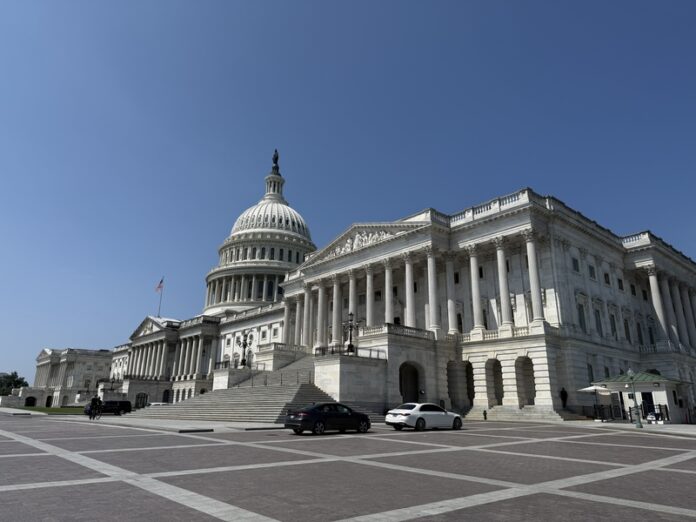
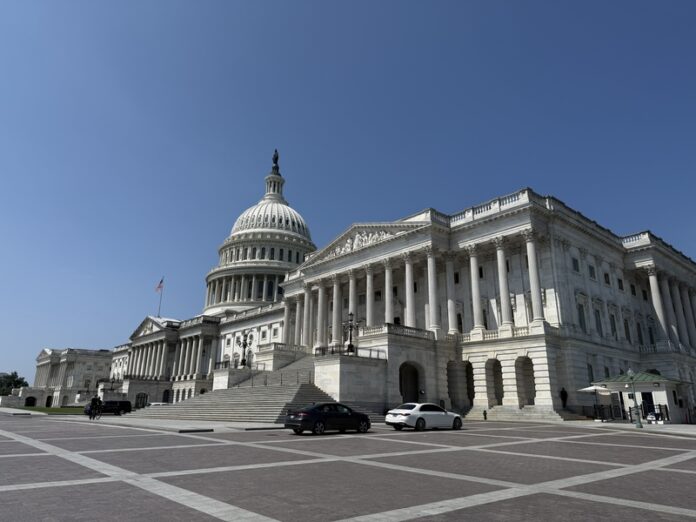
The U.S. Capitol on Sunday, June 29, 2025. (Jennifer Shutt/States Newsroom)
WASHINGTON (States Newsroom) — U.S. Senate Republicans’ revised tax and spending cuts package will add $3.253 trillion to deficits during the next decade compared to current law, according to analysis the nonpartisan Congressional Budget Office released Sunday.
The latest score came just hours before senators were set to officially begin floor debate on the sweeping package that will extend the 2017 GOP tax law, rework how much state governments have to contribute to the Supplemental Nutrition Assistance Program, overhaul several aspects of Medicaid and cut its spending, restructure higher education aid programs and much more.
Senators voted mostly along party lines late Saturday to proceed with the legislation, though leaders had to hold the vote open for more than three hours as they worked to get the votes needed.
The revised 940-page package still needs to undergo changes in the coming days, after the parliamentarian ruled Sunday morning that another six provisions must be revised to comply with the rules or be removed from the bill.
One Alaska sweetener knocked out
GOP senators cannot include, or might need to restructure, language meant to bring Alaska Republican Sen. Lisa Murkowski on board by enhancing the federal matching rate for Medicaid in two states with high poverty guideline levels: Alaska and Hawaii. The program for low-income people and some people with disabilities is run as a state-federal partnership.
Since Hawaii is represented in Congress by a Democratic delegation, the Republican benefit would largely have applied to Alaska’s two GOP senators.
Senate Republicans did receive some good news from the parliamentarian in her latest ruling, which cleared language that will steadily lower the maximum percent states can set for Medicaid provider tax rates from the current 6% to 3.5% in 2032.
The in-the-weeds policy has caused considerable frustration among GOP senators across the political spectrum, who argued a prior version would likely cause financial strain for rural hospitals by beginning the process one year sooner.
Planned Parenthood
The parliamentarian is still reviewing several other policy changes in the bill, including whether Republicans can prevent Medicaid funding from going to Planned Parenthood for one year, effectively blocking beneficiaries from receiving care there at all.
Federal law already bars federal taxpayer dollars from going toward abortions with limited exceptions for rape, incest, or the life of the pregnant patient. So this change would prevent Medicaid patients, who may have few other options, from using Planned Parenthood for other types of health care, like annual physicals, contraception and cancer screenings.
A prior version of the bill blocked federal funding from going to Planned Parenthood for the next decade.
Senate Finance Committee Chairman Mike Crapo, R-Idaho, did not immediately respond to a request from States Newsroom about how the rulings might impact the bill going forward.
Senate Finance Committee ranking member Ron Wyden, D-Ore., wrote in a statement the latest rulings show “that Republican attempts to give away goodies that benefit certain states will not pass muster under Senate rules.”
“Senate Democrats have also successfully challenged a giveaway to Big Pharma, as well as policies that make it harder for seniors and kids to get affordable health care through Medicaid,” Wyden wrote. “Republicans wanted to bring back the health care tactics of yesteryear, like waiting periods, lock-outs and annual limits on care, but Democrats have wrestled these out of the bill. I am disappointed that the Republican rewrite of the provider tax changes will remain in the bill: this policy will force states into devastating cuts to health care that seniors, kids and Americans with disabilities depend on. We will continue to fight any attempt to sneak through harmful health care policies in this morally bankrupt legislation.”
Lengthy debate, amendment fights ahead
Republicans hope to pass the entire package before the Fourth of July, though they have several hurdles to jump over before they can meet that goal.
Senate floor debate can last up to 20 hours, which means it likely will last until early Monday morning. After that, senators will begin a marathon amendment voting session where members of each political party can propose changing or removing certain pieces of the legislation.
GOP leaders generally like to avoid public disputes within the party but the rules of reconciliation don’t really allow that and several Republican senators are expected to offer amendments.
There is no time limit or cap on the number of amendments that can be offered during vote-a-rama, so that can last hours or even days in theory.
Whenever Democrats and Republicans decide they’ve debated their last amendment, they’ll move on to voting to approve the Senate’s version of the “big, beautiful bill.” That could come Monday or Tuesday.
At least 50 Republicans need to vote to approve the measure, with Vice President JD Vance’s tie-breaking vote. More than four GOP senators objecting to the overall bill means it cannot pass as it’s written.
Thom Tillis, Rand Paul
Republican Sens. Thom Tillis of North Carolina and Rand Paul of Kentucky voted against moving forward with debate so it’s likely they will vote against final passage as well. Two more senators deciding not to back the bill would halt its momentum, at least until GOP leaders could make changes to get their votes.
Senate approval of the bill would send it back to the House for a final vote, though centrist and far-right members of the Republican Conference in that chamber have voiced concerns about changes made in the upper chamber.
Speaker Mike Johnson, R-La., will need to keep nearly every one of the 220 House GOP lawmakers supportive if that chamber is to send the legislation to President Donald Trump for his signature before Friday.
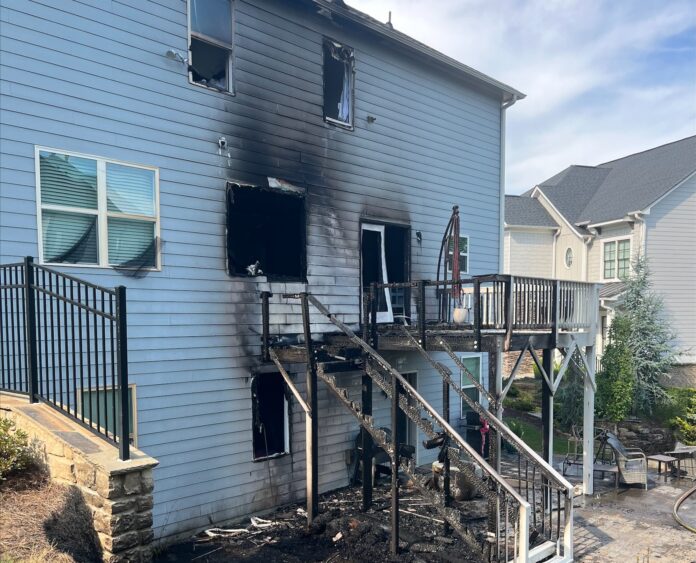
Fire broke out inside this home on Paddle Wheel Court on Saturday afternoon, June 28, 2025. (Hall County Fire Rescue)
A fire heavily damaged a home in Flowery Branch Saturday afternoon, displacing two adults, two children, and two pets.
Hall County Fire Rescue (HCFR) responded to the 7200 block of Paddle Wheel Court around 4:50 p.m. on June 28 for reports of a residential fire. When crews arrived, they found heavy smoke and flames coming from the back of a two-story home with a basement, said HCFR Public Information Officer Kimberlie Ledsinger.
Firefighters quickly worked to contain the blaze and prevent it from spreading further. The flames had extended into the attic but were extinguished once water lines were established.
The cause of the fire is currently unknown and remains under investigation by the Hall County Fire Marshal’s Office.
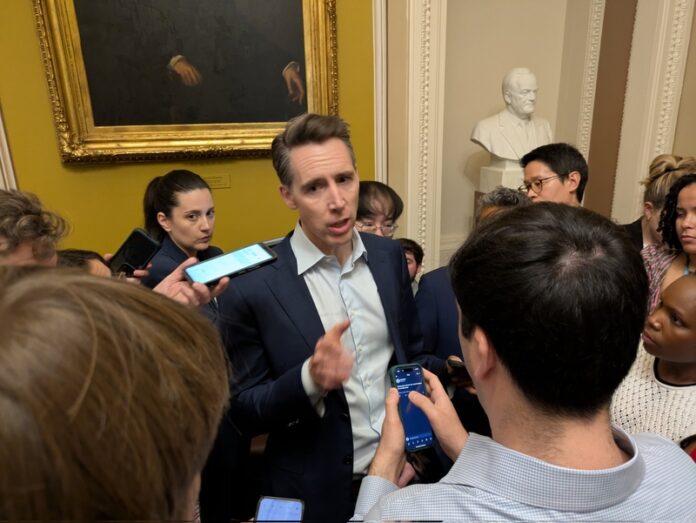
U.S. Sen. Josh Hawley, R-Mo., talks to reporters at the U.S. Capitol on Saturday, June 28, 2025. Hawley said he will vote for the budget reconciliation measure after a rural hospital fund was added. (Ashley Murray/States Newsroom)
WASHINGTON (States Newsroom) — The U.S. Senate voted mostly along party lines late Saturday night to move forward with Republicans’ “big, beautiful bill” that President Donald Trump wants on his desk in less than a week, after a dramatic three-hour pause when several GOP senators withheld their votes.
Republican Sens. Thom Tillis of North Carolina and Rand Paul of Kentucky voted against moving forward with the sweeping tax break and spending cuts package that contains many of the GOP’s campaign promises. All Democrats were opposed. Vice President JD Vance came to the Capitol in case a tie-breaking vote was required, but in the end was not needed.
Tillis, who is up for reelection in 2026, had told reporters earlier that he would vote “no” on what is called a motion to proceed and on final passage.
He said in a statement the legislation would result in tens of billions of dollars in lost funding for North Carolina and force the state to make “painful decisions” about Medicaid. Trump in a post on social media later threatened to find primary candidates to challenge Tillis.
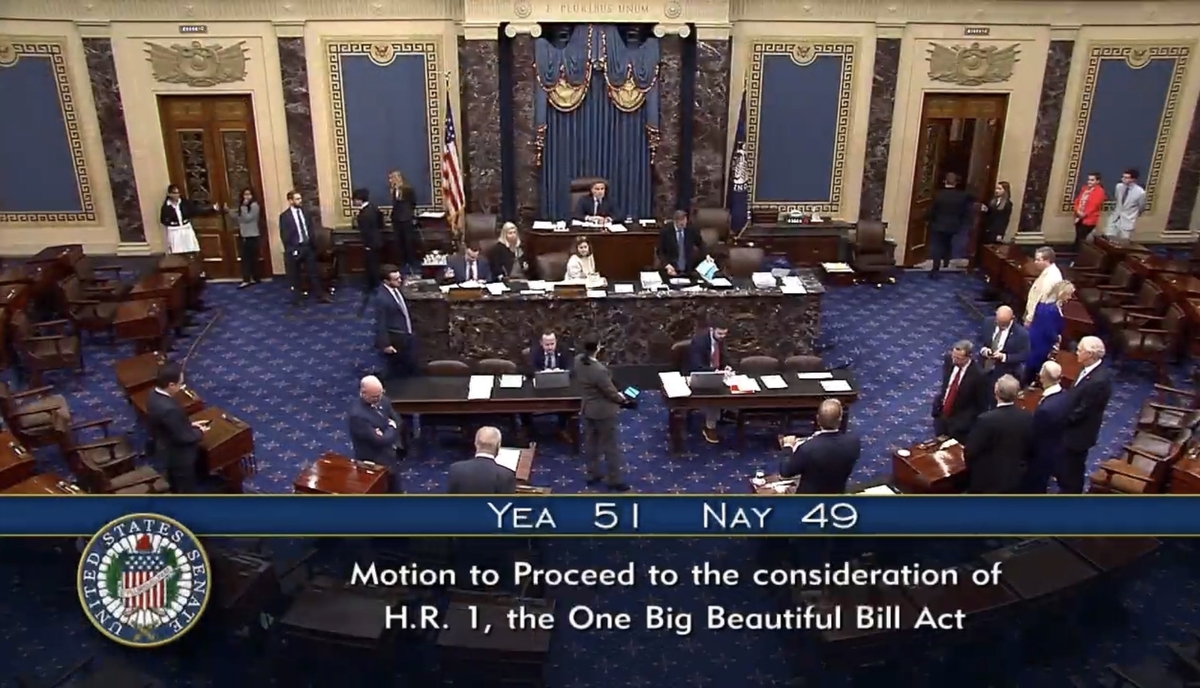
The 51-49 vote doesn’t guarantee the bill will make it through a final passage vote but does make it significantly more likely, even with Republicans’ narrow 53-47 majority.
The procedural vote kicked off a maximum of 20 hours of floor debate on the bill, with half of that time controlled by Democrats and the other half by Republicans — though Democrats after the motion to proceed vote forced a reading of the giant bill expected to take as long as 15 hours. That would mean floor debate would not begin until sometime Sunday.
Unlike regular bills, budget reconciliation packages are not subject to the Senate’s 60-vote legislative filibuster, so as long as at least 50 Republicans support the package, and Vance casts the tie-breaking vote if needed, the measure will go back to the House.
The U.S. Senate votes to advance the reconciliation package on June 28, 2025. (Screenshot from Senate webcast)
The vote on the motion to proceed that began at about 7:30 p.m. Eastern was held open for more than three hours, with the votes of four senators in suspense — Lisa Murkowski of Alaska, Mike Lee of Utah, Cynthia Lummis of Wyoming and Rick Scott of Florida. All four eventually voted aye and Wisconsin Sen. Ron Johnson switched his vote to aye after earlier voting against the measure.
Lee, however, just before the vote was over, announced he had pulled from the bill an extremely controversial proposal to sell some public lands that was opposed by other lawmakers from the West. He said because of the process being used for the bill, he was unable to obtain enforceable safeguards to ensure the land would be sold to American families and not China or foreign interests.
The latest version of the measure had set up the Interior Department to sell at least 600,000 acres of public land and up to 1.2 million acres of public land within 10 years, advocates said.
Critics, including hunters, anglers and other Western state constituents, have ripped the measure as a “land grab,” as put by Jennifer Rokala, executive director for the Center for Western Priorities.
A summary of the provisions by the Energy and Natural Resources Committee said the Bureau of Land Management “must sell a minimum of 0.25% and a maximum of 0.50% of their estate for housing and associated community needs. This will increase the supply of housing and decrease housing costs for millions of American families.”
Golfing with Trump
Senate GOP leaders released new bill text just before midnight Friday that satisfied rural state lawmakers’ worries about financial threats to rural hospitals posed by cuts in Medicaid. The bill also addresses concerns by Murkowski and Dan Sullivan of Alaska about access to food assistance for their constituents despite new restrictions on a USDA program for low-income people.
As talks continued on Capitol Hill Saturday afternoon, a handful of Senate Republicans, including Missouri’s Eric Schmitt and Lindsey Graham of South Carolina, were on the golf course with Trump, according to the White House. Graham said on social media that Kentucky’s Paul also played.
Senate Democrats said a fresh financial analysis from the nonpartisan Congressional Budget Office estimated the preliminary Senate text would result in $930 billion in cuts to Medicaid, the joint federal-state low-income health insurance and disability assistance program.
The CBO score was not yet publicly available but Sen. Ron Wyden, the top Democrat on the Senate Committee on Finance, pointed to it and slammed the Medicaid provisions as “cruel” in a statement Saturday afternoon.
Sen. Elizabeth Warren of Massachusetts, ranking Democrat on the Senate Banking, Housing, and Urban Affairs Committee, also cited the preliminary analysis, pointing to the nearly $1 trillion in Medicaid cuts.
Collins promises amendments
Senate Republicans planned to take their negotiations to the floor and push for amendments after the procedural vote that triggered official debate on the bill, which in its current public version runs 940 pages.
GOP Sen. Susan Collins of Maine, who voiced concerns throughout negotiations about rural hospitals and health cuts that would harm low-income individuals, said her vote on the motion to proceed “does not predict my vote on final passage.”
“I will be filing a number of amendments,” she told reporters as she headed into a closed-door working lunch before the Senate convened at 2 p.m. Eastern.
While Sen. Tim Sheehy wrote on social media Saturday afternoon that he was a “no” on the motion to proceed because of a provision to sell off federal public lands, the Montana Republican changed his mind nearly an hour later and declared he would propose an amendment to strip the provision — which was later removed by its sponsor.
GOP Sen. Markwayne Mullin of Oklahoma painted somewhat of a rosier picture of the mood in the Senate, telling reporters “we’re good.”
“We won’t bring it to the floor if we don’t have the votes,” said Mullin, who was the lead negotiator with House Republicans on state and local tax deductions, or SALT — a sticking point for Republicans who represent high-tax blue states like New York and California.
The lawmakers settled on a $40,000 deduction through 2029 for taxpayers who earn up to $500,000 annually. The level then reverts to $10,000, the current limit under the 2017 tax law.
Medicaid turmoil
Proposed changes to Medicaid have been strongly resisted by rural medical providers who say they are already financially strapped.
Missouri Republican Sen. Josh Hawley told reporters Saturday he would be a “yes” on both the motion to proceed vote and the final bill based on the new rural hospital “transformation program” Senate leadership included in the bill overnight. The measure has yet to be finalized.
The bill’s new version includes $25 billion in a stabilization fund for rural hospitals from 2028 through 2032. The amount is frontloaded to give more of the funds in the first two years.
Critics warn that amount will not fill the financial gaps that rural medical providers will face from losing a sizable portion of federal funding via Medicaid cuts.
While Hawley called the fund a “win” for Missouri over the next several years, he said his party needs to do some “soul searching” over the “unhappy episode” of wrangling over Medicaid cuts.
“If you want to be a working-class party, you’ve got to deliver for working-class people. You cannot take away health care for working people,” he said.
Senators had not yet agreed on other Medicaid provisions as of Saturday afternoon, including a phase-down of the provider tax rate from 6% to a possible 3.5% that’s become hugely controversial.
States use a combination of general revenues, provider tax revenues and in some cases local contributions to fund their Medicaid programs.
Advocates warn that it’s not a guarantee states would be able to backfill the lost revenue, and if they can’t, provider rate cuts and losses of benefits for patients could be on the horizon.
The nonpartisan Congressional Budget Office found that the House version’s provider tax changes — not as deep as the current Senate proposal — could lead to 400,000 people losing Medicaid benefits.
A full and final financial score for the Senate bill is not yet out as the several provisions remain up in the air.
Hawley also praised the inclusion of the Radiation Exposure Compensation Act fund, or RECA, that revives payments for survivors and victims who suffered cancer as a result of U.S. atomic bomb testing and radioactive waste dumps.
Clean energy tax credits
In what clean power advocates dubbed a “midnight dumping,” Senate GOP leadership added language to accelerate the phase out of clean energy tax credits that were enacted under Democrats’ own massive mega-bill in 2022 titled the “Inflation Reduction Act.”
The language, which wasn’t yet finalized by Senate GOP tax writers as of 6 p.m. Eastern Saturday, tightened restrictions on foreign components in wind and solar projects — and added a new tax on those that don’t comply.
Senators largely targeted wind and solar credits, ending them for projects not plugged into the electricity grid by 2028. Additionally credits for wind turbine manufacturers would terminate in 2028.
Other tax credits would be phased out at a faster pace, including those for the production of critical minerals, though a credit for metallurgical coal, used in steelmaking, was added in.
Clean energy industry manufacturers and small businesses had hoped Senate Republicans would ease up rollbacks in the House version.
Kurt Neutgens, president and chief technology officer of Orange EV, told States Newsroom in an interview Friday that any further rollbacks would amount to “cutting our legs out from underneath us.”
Neutgens, whose Kansas City, Kansas-based company manufactures heavy duty electric trucks and chargers, was watching for changes to credits to the commercial clean vehicles credit. New Senate GOP text would terminate the credit in September of this year.
Jason Grumet, president of the Clean Power Association, said in a statement Saturday that imposing new taxes on the industry “will strand hundreds of billions of dollars in current investments, threaten energy security, and undermine growth in domestic manufacturing and land hardest on rural communities who would have been the greatest beneficiaries of clean energy investment.”
Alaska carve-outs
Proposed cuts to federal food assistance remained largely unchanged in the new text released Friday night except for a few carve-outs for Alaska.
If the bill were enacted as written, Alaska’s state government could request a waiver for its citizens from stricter work reporting requirements that critics say will result in some SNAP recipients losing their food benefits.
GOP lawmakers also slightly shifted the timeline for when states will have to begin shouldering SNAP costs — the first time states will be on the hook for the federal food assistance outside of administrative costs.
States would be required to pick up a portion of the costs depending on their “payment error rate” — meaning how accurate states are at determining who needs SNAP, including both overpayments and underpayments.
States that have error rates at 6% or above would responsible for up to 15% of the food program’s cost. According to SNAP error rate data for 2023, the latest available, only seven states had an error rate below 6%.
The new text delays the cost-sharing for states until 2028 and allows states to choose the lesser of their two error rates in either 2025 or 2026.
Starting in 2029, states will be required to use their error rate from three years prior to the current year.
The new text includes the option for Alaska and Hawaii to waive their cost share burden for up to two years if their governments implement an improvement plan. In 2023, Alaska had the highest payment error rate of all states, reaching just above 60%.
Advocates for low-income families worry the cost, which will amount to billions for most state governments, will incentivize states to tighten eligibility requirements for the program, or even drop SNAP altogether.
The left-leaning Center on Budget and Policy Priorities estimates the cuts will affect up to 40 million people who receive basic SNAP assistance, including 16 million children and 8 million seniors.
The Senate bill would also increase a state’s share of administrative costs for the program to 75%, up from the previous 50% cost-sharing responsibility with the federal government.
Despite inaccurate public statements from Republicans as recently as in a bill summary released overnight, the bill does nothing to limit food assistance to immigrants without documentation because SNAP was never available to them.
SNAP benefits will remain available to legal permanent residents, and Republicans loosened some language to allow certain immigrants from Cuba or Haiti to access the program.
But if the bill passes, federal food assistance will not be available to refugees and asylees who are already in the U.S. — for example, people from Afghanistan, Ukraine and other war-torn places.
Education revisions
Republicans on the Senate Committee on Health, Education, Labor and Pensions revised or scrapped several measures that the parliamentarian deemed to not comply with the “Byrd Bath,” a Senate process named for the late Sen. Robert Byrd, according to a summary and new bill text out Friday.
Under the revised text, for any loans made starting July 1, 2026, borrowers will have only two repayment plan options: a standard repayment plan and an income-driven repayment plan. The original proposal would have applied these restrictions to existing borrowers, but the parliamentarian struck that down.
Republicans also nixed a proposal that opened up the Pell Grant — a government subsidy that helps low-income students pay for college — to institutions that are not accredited.
The new plan also scraps a restriction that barred payments made by students enrolled in a medical or dental internship or residency program from counting toward Public Service Loan Forgiveness.
‘Even worse than any draft’
Senate Democrats remain united in opposition to the bill and are expected to slow down final passage by introducing numerous amendments on the floor during what is called the vote-a-rama.
Senate Minority Leader Chuck Schumer continued to rally against the package during remarks on the Senate floor Saturday afternoon, saying it’s “hard to believe this bill is worse — even worse — than any draft we’ve seen this far.”
The New York Democrat said “it’s worse on health care, it’s worse on SNAP (the Supplemental Nutrition Assistance Program), it’s worse on the deficit.”
Schumer added that “if Republicans proceed, Senate Democrats will hold them to account.”
“We’ll gear up for another night of vote-a-rama very soon. We’ll expose this bill piece by piece. We will show how it cuts health care, raises costs, rewards the ultra rich.”
The Center on Budget and Policy Priorities condemned the cuts to safety net programs as “all in service to tax cuts that are heavily skewed toward the wealthy and corporations.”
“None of this harm has anything to do with fiscal responsibility: our deficits and debts would soar under this bill,” said Sharon Parrott, the think tank’s president, in a statement Saturday.
The Committee for a Responsible Federal Budget, a nonpartisan watchdog, released a new analysis Saturday finding the Senate version will add roughly $4 trillion to the national deficit over 10 years.
“If you thought the House bill borrowed too much — and it did — the Senate manages to make things even worse,” CRFB’s president Maya MacGuineas said in a statement.
House action
Senate Republicans have spent more than a month rewriting the bills that make up the measure in order to meet the strict rules for moving a budget reconciliation package and to earn support from enough Republicans to actually pass the legislation.
The lawmakers have been struggling to maintain spending cuts passed by House Republicans that will pay for the nearly $4 trillion price tag for extending and expanding the 2017 tax cuts.
The House voted 215-214 to approve its 11-bill version of the package in May. Many of that chamber’s GOP lawmakers hoped the Senate wouldn’t change much, though that hasn’t been the case.
The Senate has modified numerous proposals, including those addressing tax law; Medicaid; and SNAP. The Senate bill also raises the country’s debt limit by $5 trillion, a full $1 trillion more than the House version.
The revisions have led to concerns among both centrist House GOP lawmakers and far-right members of the party, muddying the waters around whether Speaker Mike Johnson, R-La., can cobble together the votes needed to clear the package for Trump’s signature.
Republicans hold a 220-212 majority in the House, so leaders there can only lose four members if all of the chamber’s lawmakers are present and voting.
Trump has encouraged Congress to approve the legislation before the Fourth of July, but with time running short and some tempers rising over how the legislation will impact the country’s deficits, that might not be possible.
“The Great Republicans in the U.S. Senate are working all weekend to finish our ‘ONE, BIG, BEAUTIFUL BILL’,” Trump posted on social media Friday.
“The House of Representatives must be ready to send it to my desk before July 4th — We can get it done,” he added. “It will be a wonderful Celebration for our Country, which is right now, ‘The Hottest Country anywhere in the World’ — And to think, just last year, we were a laughingstock. Thank you for your attention to this matter!”
Driver Chase Elliott celebrates in Victory Lane after winning a NASCAR Cup Series auto race, Saturday, June 28, 2025, in Hampton, Ga. (NASCAR/Facebook)
HAMPTON, Ga. (AP) — Home-state favorite Chase Elliott passed Brad Keselowski on the final lap and won the the crash-filled NASCAR Cup Series at Atlanta on Saturday night for his 20th career victory.
Elliott, the popular driver from Dawsonville, Georgia, earned a spot in the NASCAR playoffs with his first victory since April 2024 at Texas. It was his first win in Atlanta since 2022.
“I’ve never in my whole life, this is unbelievable,” Elliott said. “This is something I’ll remember the rest of my life.”
Keselowski was second, followed by Elliott’s Hendrick Motorsports Chevrolet teammate, Alex Bowman, and Tyler Reddick. Bowman helped block Keselowski following Elliott’s last-lap pass.
“The 48 and 9 just got together,” Keselowski said, referring to Bowman and Elliott. “… At they end they were able to double-team me.”
Elliott climbed into the stands to celebrate with fans after ending a 44-race winless streak.
“I’m happy for the 9 team,” Bowman said. “It’s a big win for him in his hometown. … I’m glad to have a Hendrick car in victory lane. I wish it was us.”
The race’s second crash early in Stage 2 took out many of the sport’s biggest names and left others with damaged cars. Pole-winner Joey Logano, who led the first 36 laps before light rain forced the first caution, was among the many drivers caught up in the big crash.
Among others knocked out of the race: William Byron, Austin Cindric, Ross Chastain, Josh Berry, Corey LaJoie and Daniel Suarez.
“It wrecked the whole field,” Logano said. “I still don’t know exactly how it started … but it was total chaos. Cars were sideways and on the brakes. I got hit from every corner possible.”
Added Denny Hamlin, who suffered damage to his Toyota in the crash: “Some zigged. Some zagged. Most crashed.”
The Atlanta race at EchoPark Speedway, formerly known as Atlanta Motor Speedway, was the debut of the 32-driver In-Season Challenge, a five-race, bracket-style tournament.
The parade of highly regarded drivers to be knocked out so early in the race showed the perils of trying to pick NASCAR winners on a March Madness-style bracket sheet. The top two seeds were among the early casualties.
Hamlin, the No. 1 seed in the tournament, finished 31st and lost to Ty Dillon, who finished eighth.
Chase Briscoe, who held off Hamlin for his first win for Joe Gibbs Racing last week at Pocono Raceway, was the No. 2 seed before being knocked out in a crash and losing to Noah Gragson in the tournament.
A $1 million prize awaits the winner as part of a new media rights deal that includes TNT.
Elliott and Keselowski were on the front row when a caution with 33 laps to go forced a decision on whether to pit for fresh tires. Both stayed on the track and Elliott faded following the restart until making his decisive charge at the very end.
Bracket busters
Ryan Blaney, the race favorite according to BetMGM Sportsbook, was knocked out on a wreck late in the first stage. Christopher Bell hit the wall, triggering the crash that ended the stage with Cindric in the lead.
Cindric was involved in the bigger crash early in Stage 2. Kyle Busch, Denny Hamlin and Bubba Wallace were among others involved in the crash.
Photo finish
Tyler Reddick beat Elliott to the finish line by .001 seconds to win Stage 2 in a battle between drivers looking for both their first stage win and overall win of the season.
Weather woes
Lightning and rain delayed qualifying Friday and the Xfinity race won by Nick Sanchez late Friday night. More lightning and rain threatened Saturday night’s race. Fans were encouraged to leave the stands about 90 minutes before the race due to severe weather in the area but were allowed to return as pre-race were conducted as planned.
Up next
The Cup Series moves to Chicago for the Chicago Street Race on Sunday, July 6.
Grover Leroy Wilson, lovingly known as Leroy, passed away and went to be with the Lord at the age of 80 on June 15, 2025.
Born on December 5, 1944, in Clayton, GA, Leroy was a strong, hard-working man who spent his life with calloused hands and a generous heart.
Leroy shared a deep, unwavering love with his late wife, Martha. Together, they built a life rooted in faith, family, and quite contentment. They gardened side by side, created crafts hand in hand, and raised four children who they loved dearly. He and his wife Martha were members at Hollywood Church of God and together built a legacy of love, humility and steadfast strength.
Leroy was happiest splitting wood, working in his garden, or tinkering with just about anything that needed fixing. He lived a life of simplicity and purpose, always guided by a strong faith and hard work. A devoted father and grandfather, Leroy or ‘Papaw’, was the steady rock of his family. He was always there when someone needed a hand – dependable, helpful and loving in ways both big and small. His kindness extended beyond people – he had deep love and appreciation for all animals. He rarely even finished his lunch, making sure to share it with the nearest animal he could find. He believed all of God’s creatures deserved care, and he lived by that belief daily.
He is now reunited with his beloved, Martha Dills Wilson, who passed five years before him, and together they rest in the peace of eternity.
He is survived by his sons, Ricky Wilson (Jennifer) of Mount Airy, Mike Wilson (Patty) of Clarkesville; daughters Marti Sutton of Turnerville and Phyllis Wilson of Turnerville; grandchildren Jessica, Jonah, Rachel, Kristin, Kaitlin, Andy, Selena, and Zeke; great-grandchildren Lily, Waylon, Macy, Salem, Reagan, and Emma; siblings, Jack Wilson of South Carolina, Kenneth Wilson of South Carolina, Barbara of Georgia, Betty Morgan of South Carolina, and Clyde Wilson of North Carolina.
Preceded in Death by Parents, Warren and Lela Wilson of Highlands, N.C., brothers, Woodrow Wilson of Highlands, N.C., and Scottie Wilson of Asheville, N.C., and great-grandchildren, Liam and Evelyn.
A Celebration of Life will be held on August 9th, at 2:oo, at Christ fellowship church in Toccoa, Georgia, 3273 GA Hwy 17, Toccoa, Ga, 30577.
Sean Murphy rounds the bases after hitting a seventh-inning grand slam against the Phillies on June 28, 2025. It was his 10th home run this season. (Atlanta Braves screenshot/Facebook)
ATLANTA (AP) — Spencer Schwellenbach struck out a career-high 12 and Sean Murphy hit a grand slam as the Atlanta Braves bounced back from an embarrassing loss to beat the Philadelphia Phillies 6-1 on Saturday night.
Schwellenbach (7-4) gave up one run, three hits and one walk in seven innings. He threw 64 of 90 pitches for strikes.
Murphy was 2 for 4 with a double. The seventh-inning slam was his 10th home run this season.
Austin Riley went 2 for 4 with an RBI and Nick Allen had a run-scoring single for the Braves, who were shut out in their previous two games — including a 13-0 defeat in the series opener Friday night.
Jesús Luzardo (7-4) gave up two runs on seven hits and two walks in five innings for the Phillies. He struck out seven and kept his team in the game by stranding five runners.
Alec Bohm knocked in Philadelphia’s run with a single in the sixth that cut Atlanta’s lead to 2-1, but Nick Castellanos flied out with two on to end the inning.
The Braves sat slumping Michael Harris II, starting Eli White in center field. Harris had started every game but one this season but is hitting .212. White was 0 for 3 with a run.
Key moment
Murphy’s grand slam broke open a 2-1 game with one out in the seventh. He hit the first pitch he saw from Jordan Romano 455 feet to left field for his second career slam and the first by the Braves this season. It came after consecutive singles by Marcell Ozuna, Riley and Ozzie Albies.
Key stat
Matt Olson’s first-inning single for Atlanta extended his on-base streak to a career-high 29 games.
Up next
Braves RHP Spencer Strider (3-5, 4.07 ERA) starts the finale of the three-game series Sunday against LHP Ranger Suárez (6-2, 2.08).
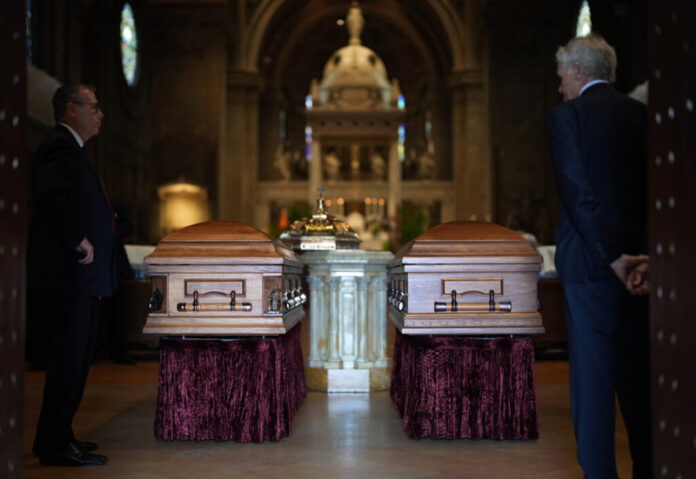
The caskets of Melissa and Mark Hortman sit at the back of the sanctuary before funeral services for Mark and Melissa Hortman at the Basilica of St. Mary in Minneapolis, Minn., on Saturday, June 28, 2025. Mark and Melissa Hortman were shot and killed in their homes on June 14, 2025. (Photo by Alex Kormann/Minnesota Star Tribune pool photo)
(Minnesota Reformer) — Minnesota House Speaker Emerita Melissa Hortman’s life embodied the American dream. She was raised in a family that owned a junkyard, became a lawyer but declined a life of comfortable wealth for public service, emerging as among the most influential legislators in Minnesota history.
Now she’s an emblem of the American nightmare, another victim — along with husband Mark Hortman and their golden retriever Gilbert — of the political violence that’s consumed America in the past decade, adding Brooklyn Park to Buffalo, El Paso and other grim signposts of a damaged democracy.
The Hortmans were remembered at their funeral Mass at The Basilica of Saint Mary in Minneapolis Saturday as kind, generous and driven by a common set of values to make the world just a little bit better.
The funeral was mostly light on politics, despite the hundreds of politicos in attendance. Father Daniel Griffith in his homily, however, highlighted the injustices that Melissa Hortman tried to ameliorate.
“In Minnesota we have been the ground zero place, sadly, for racial injustice — the killing of George Floyd just miles from our church,” Griffith said. “And now we are the ground zero place for political violence and extremism. Both of these must be decried in the strongest terms, as they are, respectively, a threat to human dignity and indeed our democracy.”
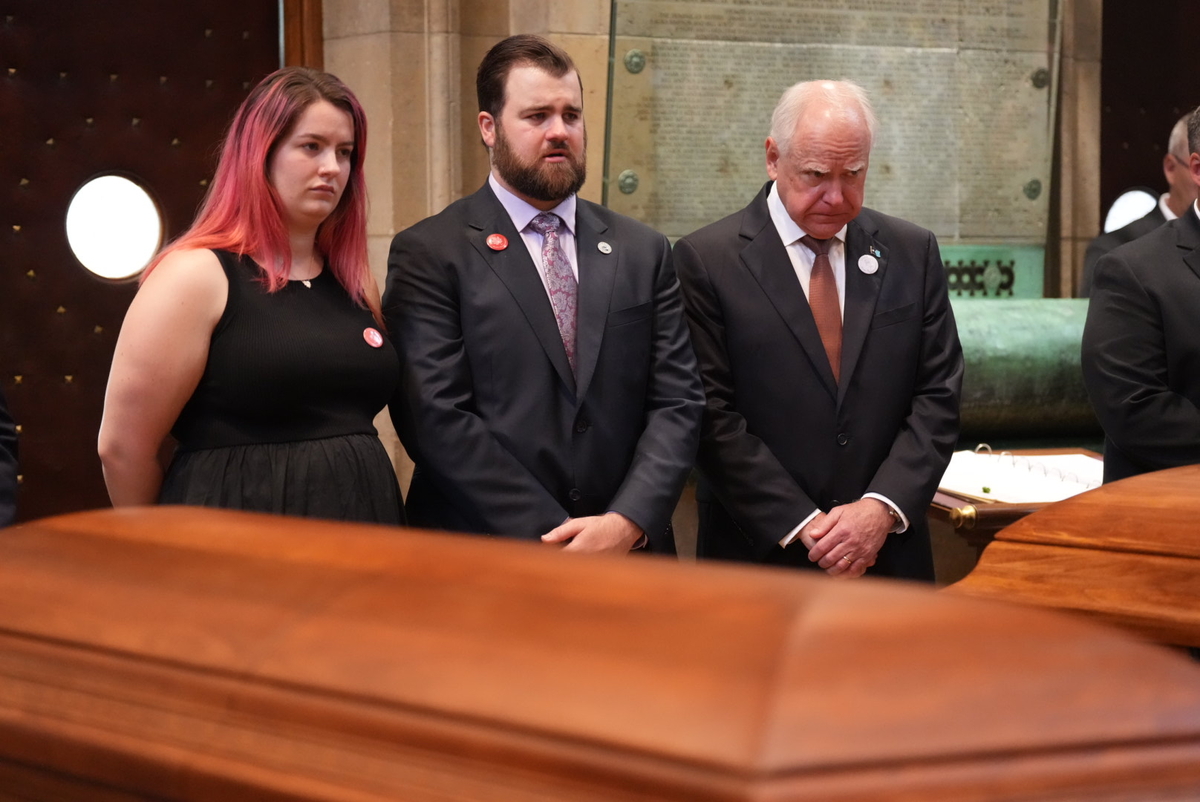
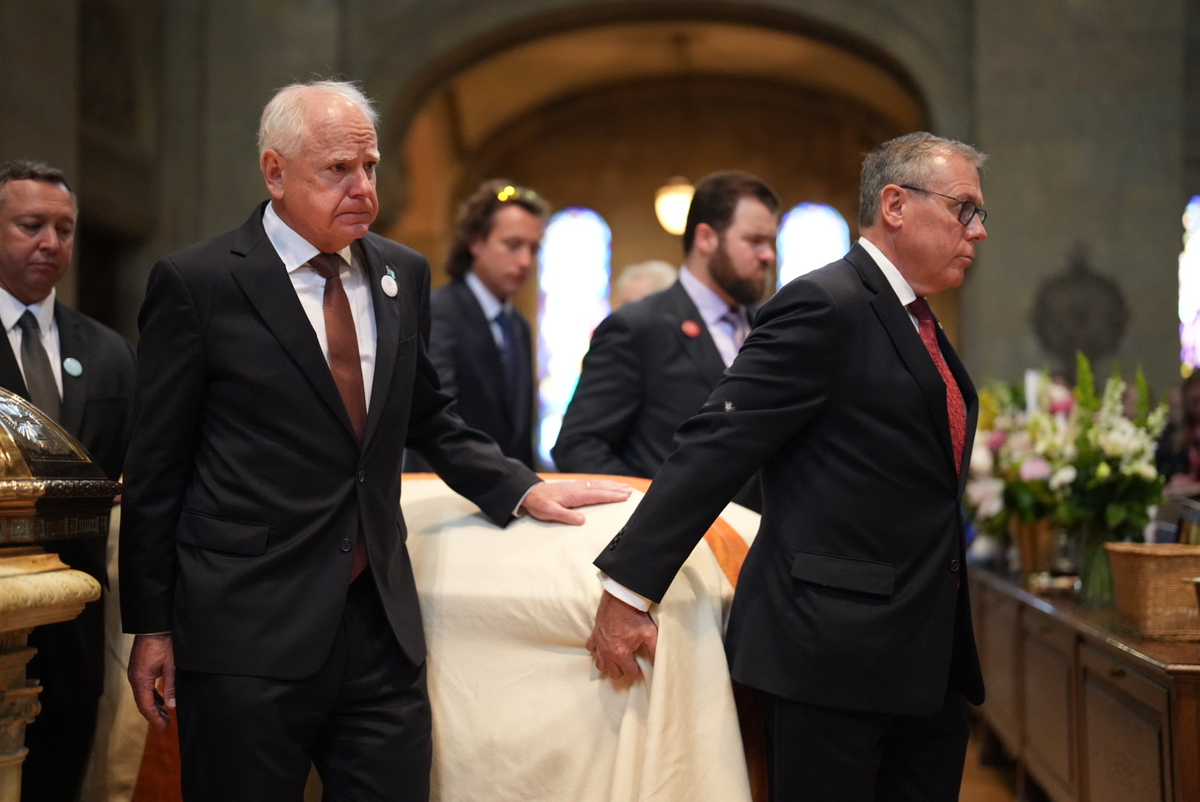
Sophie Hortman, Colin Hortman, and Gov. Tim Walz stand behind the caskets of Melissa and Mark Hortman during funeral services for Mark and Melissa Hortman at The Basilica of St. Mary in Minneapolis, Minn., on Saturday, June 28, 2025. Mark and Melissa Hortman were shot and killed in their homes on June 14, 2025. (Photo by Alex Kormann/Minnesota Star Tribune pool photo)
Gov. Tim Walz, who was both friend and governing partner to Hortman, was visibly sen while serving as a pallbearer alongside the Hortman children. The packed Basilica was filled with Hortman’s family, friends and vast political network that Melissa Hortman built over decades by way of her effectiveness at the Legislature and down-to-earth charm. Former President Joe Biden — who hosted the Hortmans at the White House — Vice President Kamala Harris, former Gov. Mark Dayton, Democratic and Republican lawmakers and state commissioners also memorialized the lives of Hortmans.
Melissa Hortman served in the Minnesota Legislature for two decades. The Democratic-Farmer-Labor legislator was beloved around the Capitol and is known for scoring major legislative victories including free school lunch for K-12 students, a new paid leave program and a mandate that Minnesota utilities use 100% carbon-free energy sources by 2040.
The Hortmans were killed on June 14 in their Brooklyn Park home in a politically motivated assassination. Their deaths have roiled Minnesota politics.
Hortman was a Catholic Sunday school teacher whose politics were shaped by Catholic social teaching. She was a devotee of the Golden Rule, from Matthew, “Do unto others what you would have them do unto you.” So she would have endorsed the choice of Gospel reading Saturday, Jesus’ Sermon on the Mount, which is a fundamental text of Christianity.
“Blessed are the peacemakers, for they will be called children of God,” Griffith said. “Blessed are they who are persecuted for the sake of righteousness.”
In his sermon, Griffith highlighted Melissa and Mark Hortman’s service and community, which he called, “the antidote to our present afflictions” and a stark contrast to the “idol of autonomy” that has ravaged America’s political landscape.
Melissa and Mark Hortman met in Washington D.C. when they were both mentoring a student. Colin and Sophie Hortman, their adult children, released a statement in the days after their killings, calling for people to honor their parents’ legacy by standing up “for what you believe in, especially if that thing is justice and peace.”
Walz during his five-minute eulogy encouraged Minnesotans to find common humanity and “build a state equal to (the Hortmans’) aspirations and a politics worthy of their example.”
“Melissa was an extraordinary legislator, and Mark was her proudest supporter,” Walz said. “It’s easy sometimes to forget, for all of its significance, politics is just people. That’s all. It is just a bunch of human beings trying to do their best. Melissa understood that better than anybody.”
Robin Ann Williams, a close friend of Melissa and Mark, eulogized them at the request of the children. She remembered the Hortmans as anything but a stereotypical political family, just as focused on their children and dog and card nights and monthly dinners for law school friends as on the latest political flareup.
Williams also captured the dynamic between Melissa and her supportive husband.
“I always saw her as a balloon bouncing around, but still tethered to the earth by Mark,” Williams said.
Williams remembered the many dinners she shared with the Hortmans, including their last together on June 6 at an Italian restaurant in Robbinsdale. Walz had just called for a one-day special session, and Melissa was often getting up from the table to take calls from the governor or her DFL caucus members. No one at the table, including Mark Hortman, minded the disruption.
Gov. Tim Walz, left, walks with Melissa Hortman’s casket as it is processed through the aisle in the sanctuary at the Basilica of St. Mary during funeral services for Mark and Melissa Hortman in Minneapolis, Minn., on Saturday, June 28, 2025. Mark and Melissa Hortman were shot and killed in their homes on June 14, 2025. (Photo by Alex Kormann/Minnesota Star Tribune pool photo)
Even though many are grieved by the Hortmans’ deaths, Williams said that the couple would have wanted people to remember them with joy, citing Kahlil Gibran’s “The Prophet”:
“Some of you say joy is greater than sorrow, and others say, nay, sorrow is the greater. But I say unto you, they are inseparable. Together they come, and when one sits alone with you at your board, remember that the other is asleep upon your bed.”
Williams then said, “We are buried in sorrow right now, but I do believe that we will experience joy again. Mark and Melissa would not want it any other way. Goodbye, my friends.”
Colin Hortman ended the service with a prayer of St. Francis, which Melissa Hortman carried in her wallet.
Lord, make me an instrument of your peace: where there is hatred, let me sow love; where there is injury, pardon; where there is doubt, faith; where there is despair, hope; where there is darkness, light; where there is sadness, joy.
The procession departed in silence, except for the massive bell of The Basilica of St. Mary tolling, tolling.
The caskets were loaded into two hearses.
Walz handed Sophie and Colin Hortman American flags in the traditional 13-fold, for the Hortmans.
When the Hortmans were lying in state at the Capitol Friday, Rep. Michael Howard, DFL-Richfield, wondered aloud what Melissa Hortman — who was famously blunt and unimpressed with grandeur — would have thought about all the pageantry.
“I think she would have said, ‘It’s a bit much.’”
Attendees take their seats before funeral services for Mark and Melissa Hortman at the Basilica of St. Mary in Minneapolis, Minn., on Saturday, June 28, 2025. Mark and Melissa Hortman were shot and killed in their homes on June 14, 2025. (Photo by Jeff Wheeler/Minnesota Star Tribune pool photo)
This composite image shows Dr. Thomas Hicks and the town of McCaysville, Georgia, where he sold more than 200 babies on the black market in the 1950s and ’60s. Hicks placed infants with out-of-state parents who paid hundreds of dollars and were listed on records as the children’s real parents. (Fannin County, GA - Historical Photos and Information/Facebook)
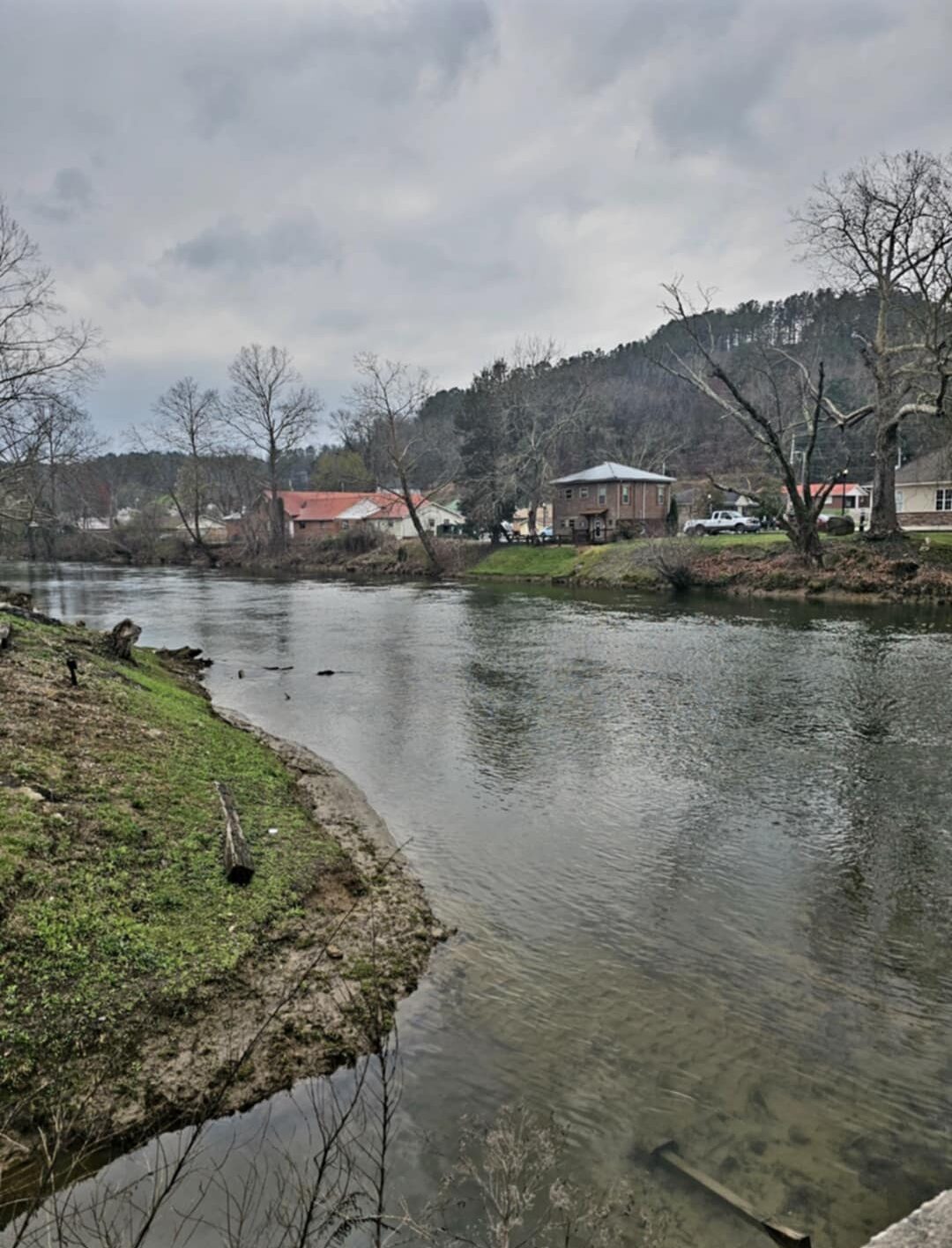
The sun doesn’t shine this day on McCaysville, a town as grim and black as the inside of a charcoal stove. As I journey past a muddy, turbulent river, its waters churned by relentless rain, a somber hue envelops the landscape under the brooding canopy of an overcast sky.
A chill permeates my spine, casting an eerie shiver that will persist until I’m four miles north of Blue Ridge on Highway 76. Yet, what brings me to McCaysville is not the pleasure of its Faulkner-esque design, but Dr. Thomas Hicks—not for an operation, but to comprehend and absorb the essence of the town and the space where a man allegedly stole and sold as many as 200 babies in an open secret.
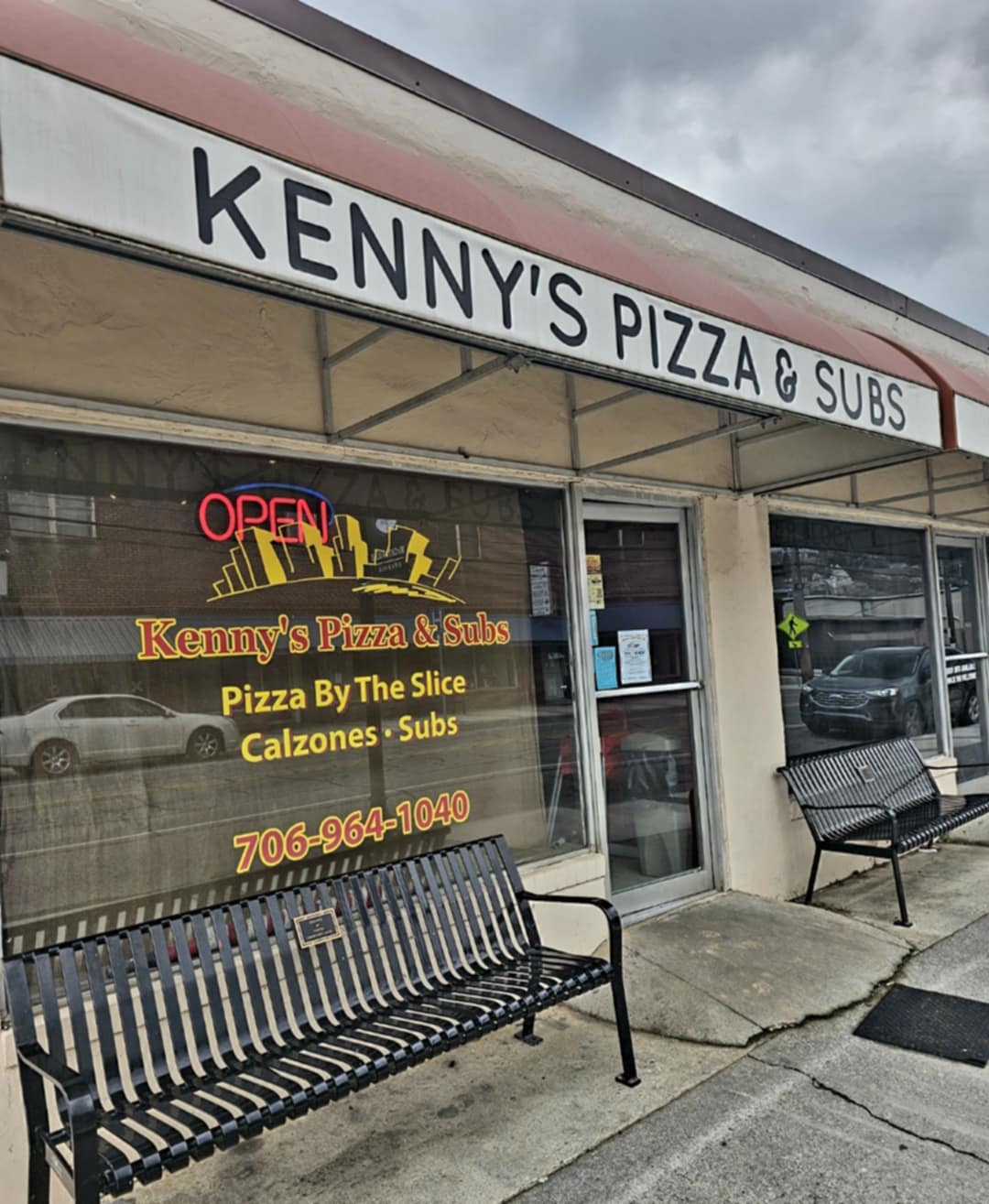
As I entered the town, I drove past a forlorn pizza joint, barely registering its name, my mind fixed on reaching my destination. However, upon noticing the absence of a dedicated marker or acknowledgment of the scandal that has profoundly affected the lives of so many in the town and beyond, I pulled into a gas station to search the internet for information. I wasn’t surprised to find that I had crossed into a dead zone.
The Toccoa River snakes through McCaysville, Georgia. (Photo by The Cute North Georgian Magazine)
Eventually, I decided to step into the convenience store and inquire with the clerk. To my surprise, before I could finish my question, she eagerly interjected, revealing that her father was one of Hicks’ alleged babies. With real excitement, she directed me to his gravesite and provided the whereabouts of his former clinic, now a pizza restaurant on Toccoa Avenue.
A vain man’s gravesite
I decided to visit the gravesite first, embarking on a journey that led me across a rickety metal bridge, initially tracing a meandering river path before winding through the densely wooded foothills. Along the way, signs of economic hardship were unmistakable, a reality further underscored by the city’s demographic data, revealing a median family income of just $30,078.00.
As the chill in my spine deepened, so did the density of the trees and the palpable sense of despair emanating from homes so dilapidated that they appeared condemned. Amidst lawns strewn with trash, children played on broken trampolines, serving as a stark reminder of the ambiguous definition of “habitable” and the compromises individuals must endure to survive.
Yet, in the middle of the desolation, pockets of beauty emerged. Lush fields painted in pastel shades of green stood in contrast to the rugged grey rock and red clay characteristic of the region. Vibrant pops of yellow wildflowers, delicate sprays of common violets, and clusters of daffodils adorned the landscape, while maples blazed in fiery red hues. The majestic silhouette of the Blue Ridge Mountains in the near distance framed all of this.
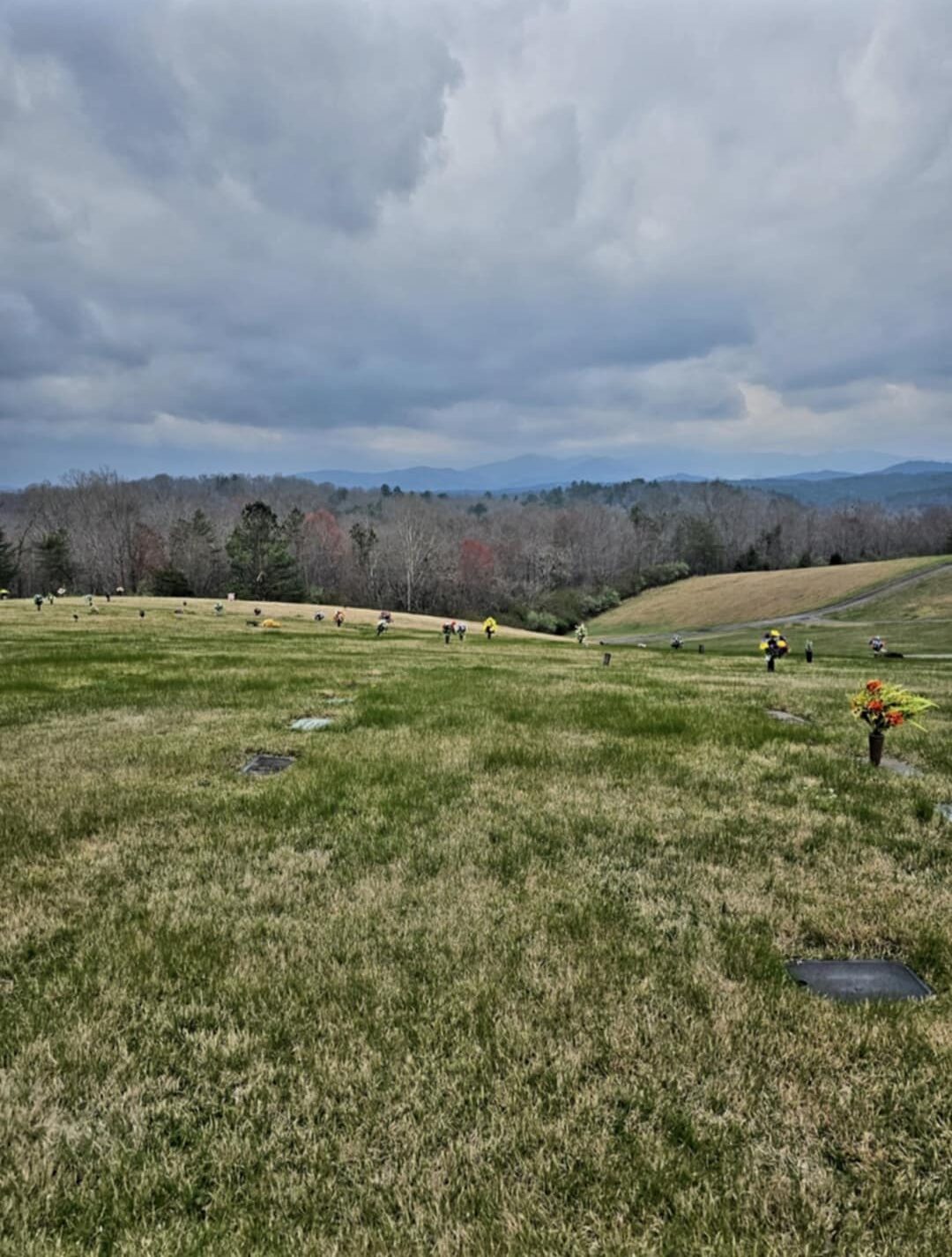
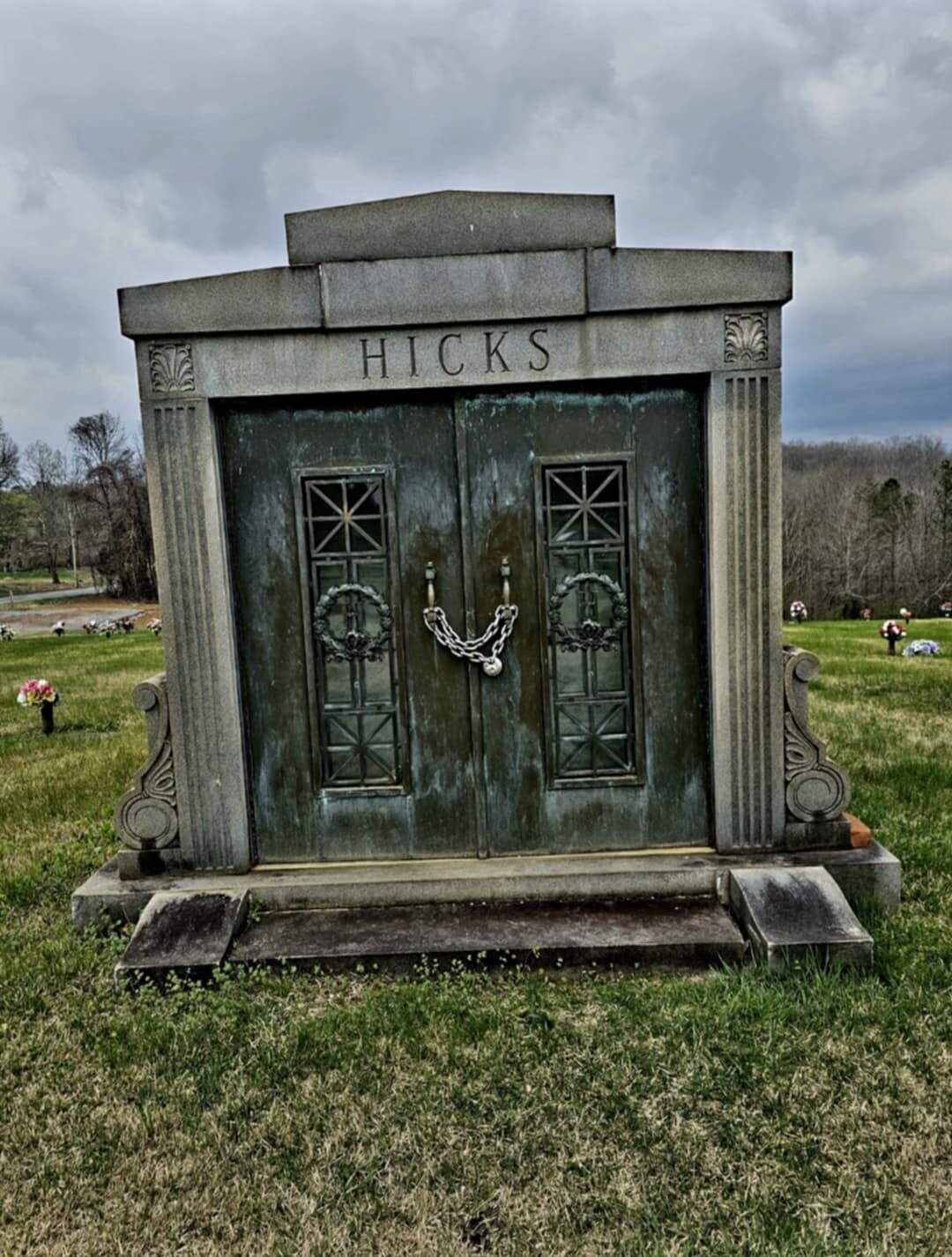
No landscape, however, rivaled the beauty of the graveyard where Dr. Thomas Hicks rested beside an ornate and conspicuous mausoleum. Like a sinister specter, the mausoleum marking his final resting place stood out as a dark blot amidst the tranquil and picturesque setting. Noteworthy is the heavy chain and padlock on the door, calling to mind images of a ghostly Jacob Marley.
The Blue Ridge Mountains frame this lonely windswept graveyard, where Dr. Thomas Hicks is buried. (Photo by The Cute North Georgian Magazine)
Thomas Hicks mausoleum, chained closed due to frequent break-ins. (Photo by The Cute North Georgian Magazine)
The gas station clerk had disclosed that the chain existed due to individuals, mistaking myth for fact, breaking in, and attempting to steal the birth records believed to be hidden within its depths. In a quest to uncover the truth about her parentage, Dr. Hicks’ adopted granddaughter initiated the exhumation of her father’s body in season 1 episode 2 of “Taken at Birth.” However, aside from the records inscribed within his DNA, no other documentation existed within. Yet, according to the documentary, the DNA was sufficient to resolve many questions among the self-identifying “Hicks Babies.” Even after this televised revelation, there are still those who believe that birth records exist within the depths of the mysterious vault.
I lingered over Dr. Hicks’ gravesite, studying the glass beneath the doors and the smooth, solid walls. I contemplated the personality that insisted on a mausoleum amidst a garden of modest headstones. It stood as the only competition to the serene mountain view, in that lonely, haunting hill, in that lonely, haunting city. Plastic Walmart flowers were insufficient for this man who dictated on a whim the lives and futures of hundreds. Standing in this vast space, I felt enveloped by the cold, ambient twilight world of this queer border town. Zipping my coat, I walked to my car as a steady rain descended.
Toccoa River in McCaysville, Georgia. (Photo by The Cute North Georgian Magazine)
Standing in the back alley
As I re-entered the city limits of McCaysville, the rain had finally ceased, leaving behind a sense of calm. Parking near the downtown bridge, I noticed a police officer stationed nearby. Contemplating the idea of jaywalking, I hesitated, despite the absence of any oncoming traffic. Opting to play it safe and abide by traffic laws, I made my way towards the bridge that spanned the swollen, snaking Toccoa River.
The river’s water level had risen considerably due to the spring showers typical of the region at this time of year. Leaning over the edge of the bridge, I peered into the murky grey waters below. A moment of curiosity washed over me as I wondered what lay hidden beneath the surface. Gazing into the churning water, I couldn’t help but ponder whether anything was watching me back.
After some moments of contemplation, the steady return of rain hastened my onward investigation. Hurrying toward downtown, I passed by a window adorned with a political and religious message, taking note of which held precedence in the mind of the store owner. My attention was then drawn to a window display featuring garish and appalling Easter bunnies, nightmare fuel for children, but seemingly the pride of elderly southern ladies everywhere.
Kenny’s Pizza & Subs exists in the space that was once occupied by Dr. Thomas Hicks. (Photo by The Cute North Georgian Magazine)
I paused to snap a photo of the diabolical leers of the Easter bunnies, then continued on my way to the building that once housed the Hicks Clinic. The building was unassuming, even anticlimactic. Only a small concrete building of no real consequence. Yet, it was within this faded, obscure establishment that over 200 babies were illegally sold.
Indeed, the documentary “Taken from Birth” alleges a disturbing practice wherein some babies were stolen from mothers who were falsely informed that their children had died at birth. Furthermore, there are credible assertions that labors were induced prematurely, not only to reduce Dr. Hicks’ commitment to the mothers, whom he kept in hotels but also to increase his supply of infants for adoption to willing parents.
As I gazed upon this nondescript building, I realized that I should not have been surprised by how ordinary it looked. Dr. Hicks started his career with illegal abortions, advertising them discreetly in phone booths and on benches. In the bustling railroad and steamboat town of McCaysville, the demand for secrecy and discretion was as prevalent as the transient population. Traveling salesmen, gamblers, and drifters would converge on the town for the night, only to vanish with the dawn. Like any railway town, McCaysville had its share of women, bars, and establishments catering to their needs. Among the prostitutes and saloon owners of the city, serving their needs was Dr. Hicks.
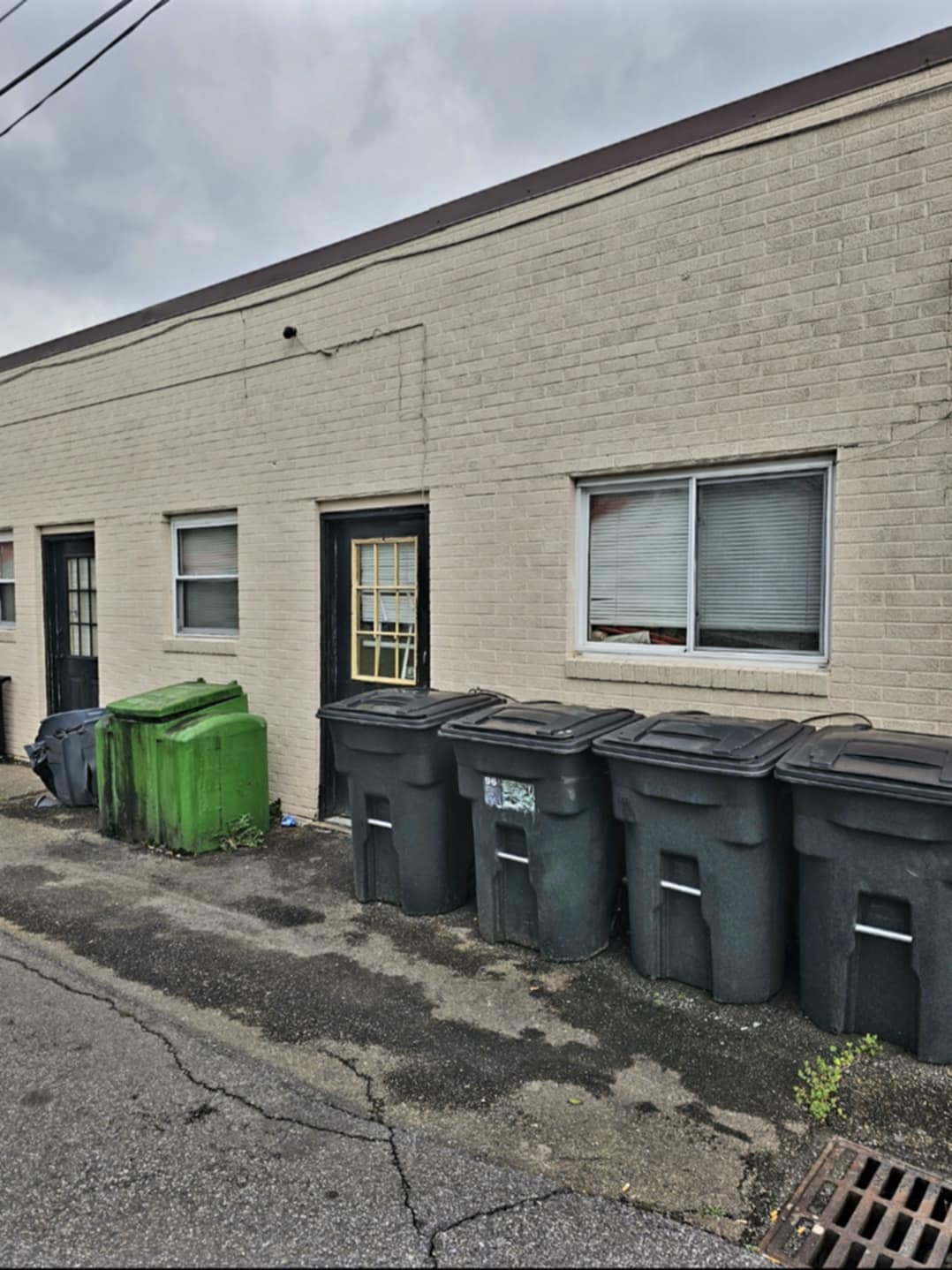
The back alley where so many lives were altered now belongs to Kenny’s Pizza & Subs. (Photo by The Cute North Georgian Magazine)
However, his earnings from abortions were limited to a mere $100 per procedure, a considerable amount between the 1950s and 1964. Yet, recognizing the potential for greater profits, Dr. Hicks shifted his focus to organizing black market adoptions. Adoptive parents would enter through the front door empty-handed and leave through the back with a baby, typically significantly under the normal birth weight. A live baby fetched as much as $1,000, a substantial sum in any year. As per the revelations in “Taken at Birth,” birth mothers were omitted from the certificates and compensated a mere $20 for their troubles if they even knew about the transaction at all. This meant that, for the cost of a new dress, they were effectively severed from any possibility of reconnecting with their children in the future. To the doctor, this probably felt like a win-win-win.
I make my way to the back alley and pause near the door where countless lives were forever altered, and in many cases, tragically ended. It’s known that many of the babies associated with Hicks were underweight and believed to be premature. In today’s medical context, premature births often necessitate lengthy stays in the Neonatal Intensive Care Unit (NICU). However, these babies were swiftly transferred from doctor to adoptive parents within mere hours or days of being born. In the event of a medical emergency, one can’t help but wonder: how could adoptive parents seek medical attention for their child when there was no record of them giving birth? I find myself pondering the grim reality that many graves may line the isolated roads of the Blue Ridge Mountains, all to fuel one man’s insatiable greed and vanity. The thought of it sends a shiver down my spine, imagining the lives lost and the families torn apart, all for the sake of lining his own pockets and adorning the walls of his elaborate mausoleum.
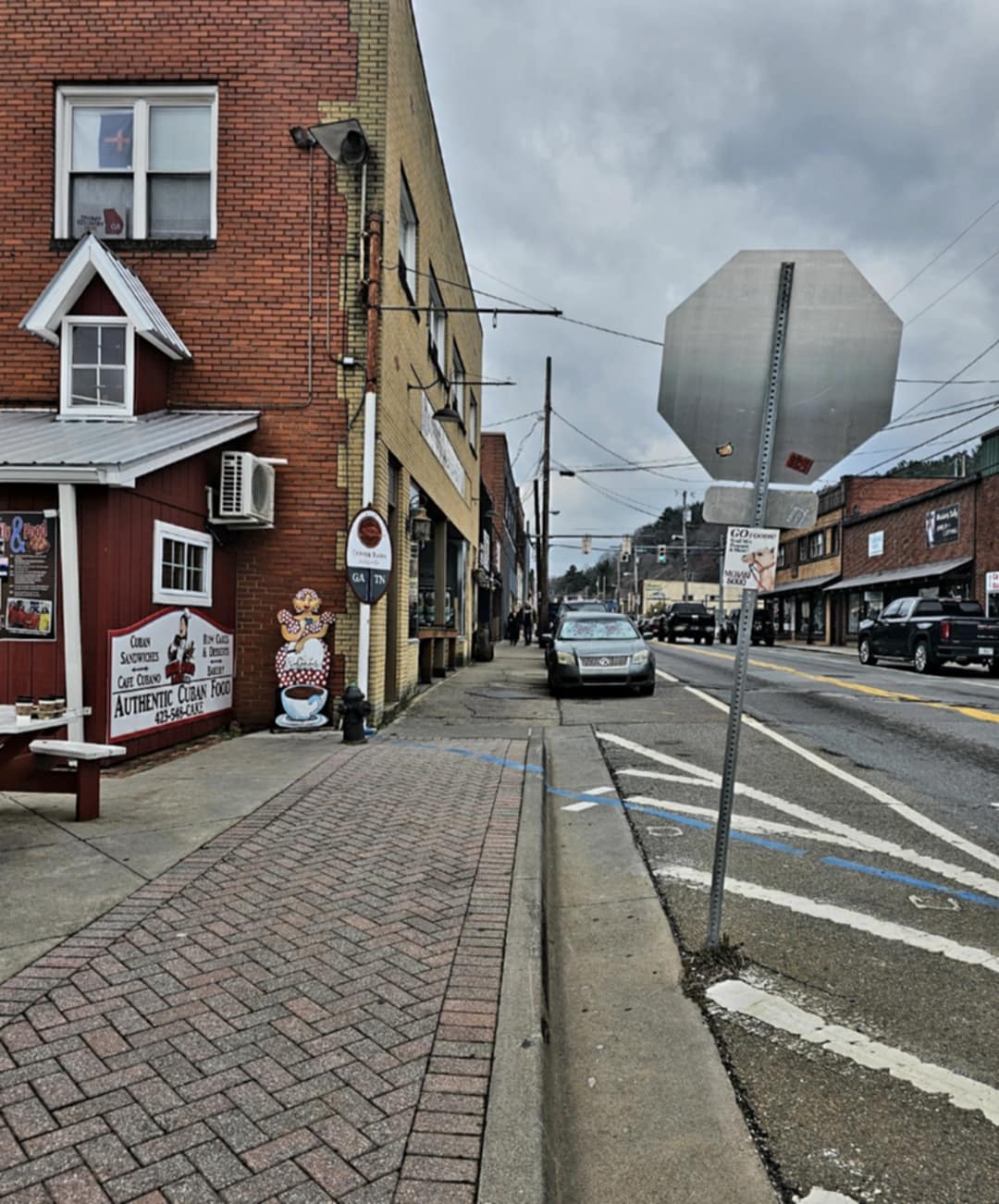
Downtown McCaysville, Georgia, which borders Copperhill, Tennessee. (Photo by The Cute North Georgian Magazine)
Remembering what others tried to forget
As I make my way back to my car, my mind is consumed with somber reflection, especially as the mother of a baby myself. I can’t help but contemplate the cold, lonely town and the surrounding region that harbored such a supply of unwanted children to sell, as well as the poverty-stricken desperation of the women who felt compelled to relinquish their infants for a mere hotel room stay and a $20 bill. It’s a haunting realization and one that fills me with a sense of despair and dread. The oppressive dampness of the mist clinging to my yellow rain jacket only adds to the eerie atmosphere, amplifying the horror of the secrets hidden within this community. As I drive away, I can’t shake a lingering sense of unease—the feeling that the ground beneath this town remembers what others have tried to forget.
Carly McCurry is the publisher of The Cute North Georgian magazine. Her work appears on NowHabersham.com in partnership with Now Network News.
A local man is facing multiple felony charges after investigators with the Hall County Sheriff’s Office Internet Crimes Against Children (ICAC) Unit said they discovered child sexual abuse material in his possession.
On Thursday, June 26, ICAC investigators executed a search warrant at the home of 29-year-old Jason Robert Lukos. The warrant was based on cybertips from the National Center for Missing & Exploited Children (NCMEC).
During the search, investigators seized a cell phone and an electronic tablet. With help from the Georgia Bureau of Investigation’s digital forensic team, the sheriff’s office said investigators found at least ten images of minors engaged in sexually explicit conduct.
Additional charges may be filed pending further analysis of the devices.
Investigators charged Lukos with ten felony counts of sexual exploitation of a minor. He is being held at the Hall County Jail without bond.