

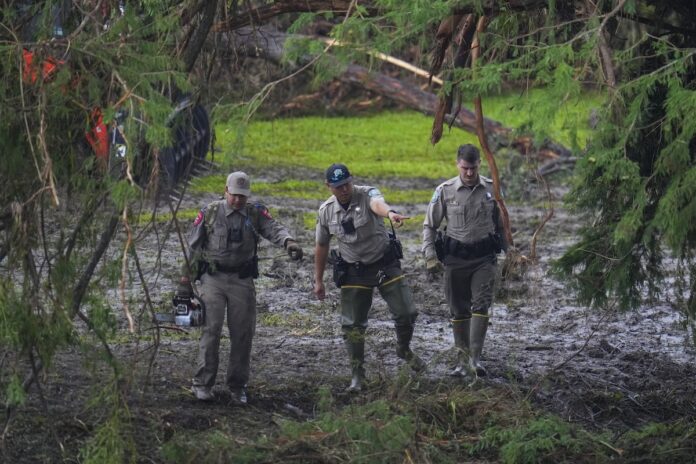
WASHINGTON (States Newsroom) — The Trump administration official running the Federal Emergency Management Agency testified Wednesday the response to flash flooding in Texas over the Fourth of July weekend served as an “outstanding” model for the rest of the country.
His conclusions about the catastrophic flooding, which had a death toll of 135 and included extensive search and rescue operations, were questioned by several members of the U.S. House Transportation and Infrastructure subcommittee holding the hearing.
David Richardson, the senior official performing the duties of FEMA administrator, told the panel that he “can’t see anything that we did wrong.”
“The response in Texas, which was community-led, state managed and federally supported, brought the maximum amount of capability to bear in Texas at the right time and the right place,” Richardson said. “We made that happen and that is a model of how response should be done.”
Richardson testified that in his view “emergency management is not a pile-on sport. It’s well coordinated, relies on personal relationships, it’s got to be exercised beforehand. And all those things came together on Texas’ worst day.”
‘Texas got what they needed’
Richardson told the panel that while he was on vacation when the Texas flooding began and for several days afterward, he “remained in my truck the whole time” making phone calls to state and federal officials.
“Texas got what they needed when they needed it,” he testified.
When asked by Texas Republican Rep. Brian Babin “what steps will FEMA take to ensure that something like this will never happen again,” Richardson said the agency works “as closely as we can with emergency managers in Texas and the local communities.”
“Through mitigation grants, resilience and those type of efforts, we work with them to build the best emergency management system we can have,” Richardson said. “And as you saw in Texas, under the secretary’s leadership and the president’s leadership, it worked very, very well.”
Arizona Democratic Rep. Greg Stanton, ranking member on the subcommittee, rejected Richardson’s characterization that the Texas response and recovery efforts were handled appropriately.
“It haunts me that we could have had more urban search and rescue pre-positioned in place,” Stanton said. “We could have saved more of those people.”
Stanton alleged that Homeland Security Secretary Kristi Noem’s requirement that any contract costing more than $100,000 get her approval hindered federal search and rescue operations.
“That bottleneck delayed urban search and rescue teams for more than 72 hours,” he said. “By the time many urban search and rescue teams reached Texas, no one had been found alive for days.”
Pennsylvania Republican Rep. Scott Perry, chairman of the subcommittee, appeared to defend FEMA’s approach to the Texas flooding, saying it’s not possible for FEMA to pre-position resources for all flood warnings.
“Flood warnings happen all across the country on a regular basis and FEMA doesn’t pre-position to every flood warning it gets because they would pre-position literally 365 days a year,” Perry said. “That having been said, with fast-moving disasters, like the one that occurred in Texas, it is not like a hurricane, which you can track, you can anticipate landfall or the location of the disaster to pre-position assets.”
Call-in center in Texas floods
Richardson defended staffing and wait times for FEMA’s call-in center during the two-hour hearing, rejecting reports that people were unable to get through to representatives following the Texas floods.
Stanton said that Noem’s sign-off policy on higher cost contracts caused issues here as well.
“On July 5, less than 24 hours after the tragedy, FEMA’s call center contract expired because of this $100,000 sign-off policy,” he said. “The result, the vast majority of calls from survivors went unanswered. Families desperate for shelter and aid were met with silence.
“Can you imagine losing a family member, losing your home and having your call go unanswered when you’re looking for a lifeline?”
Perry said that the subcommittee was told by another FEMA official that the call center prioritizes people in a disaster area when that disaster is ongoing, but emphasized the panel expected the correct information.
“So you might be getting calls into the call center from across the country, but the ones outside the disaster response area are put kind of behind the ones that are priority, which is the disaster that’s occurring now,” Perry said. “We don’t want to say that anybody is distorting the truth, but we got to make decisions on the correct information.”
Richardson testified that FEMA surged staff to the call center following the Texas flooding, but that Monday was an especially busy day for people contacting the agency.
“All calls were answered within three minutes … and no calls beyond 10 minutes. So it’s from three to 10 minutes,” Richardson said. “And the vast majority of phone calls were answered. The questions were addressed.”
Eliminate FEMA?
Richardson declined to say whether the Trump administration will try to completely eliminate FEMA, saying that the president “wants a better emergency management capability.”
President Donald Trump launched a FEMA review council earlier this year to assess how the agency, which is housed within the Department of Homeland Security, operates and where changes could be made.
Trump and Noem have repeatedly said they think the federal government could get rid of FEMA. Richardson said he expects the review council to issue its recommendations later this year.








2026 comes early: Georgia Senate prepares for mass exodus
When the Georgia Senate stunned the state Capitol and wrapped up work before the typical midnight deadline on the last night of the 2025 session, a visibly frustrated House Speaker Jon Burns took a not-so-subtle dig at his friends across the hall.
“The House is focusing on its priorities of getting the job done, and we’re not worried about moving on to some other higher office,” the powerful Republican told reporters shortly before gaveling out his own chamber. “We came here to do a job, and we did our job.”
With the exception of the presidency, just about every position in politics can be considered a stepping stone to something bigger. But it’s not often (maybe once every four or eight years) that ambitious and powerful lawmakers suddenly go from colleagues to campaign rivals as they all seek to add another title to their resume.
The tension is already creeping into Georgia’s upper chamber, where greetings on the Senate floor have started to sound more aspirational than ceremonial. It’s not out of the ordinary, a former lawmaker once said, to hear someone walk onto the Senate floor and randomly shout, “Good morning, Congressman!”
But it’s becoming more than just a joke tossed around the chamber. At least 10 state senators — Republican and Democrat — are leaving behind their seats and leadership positions to run for “some other higher office,” in the colorful words of the speaker. And that number could grow as more offices open up ahead of the 2026 elections.
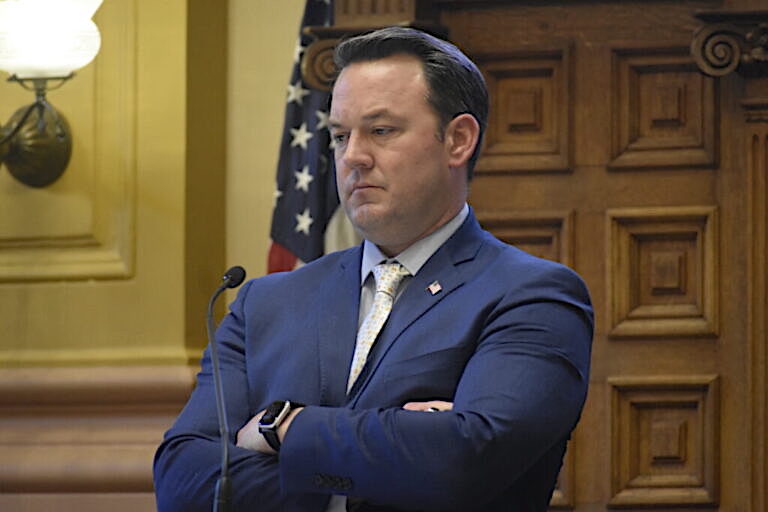
Let’s start at the top: Lt. Gov. Burt Jones, who serves as president of the senate, recently launched a bid for governor.
Three Republican state senators have already entered the race to succeed Jones: Steve Gooch of Dahlonega, John F. Kennedy of Macon and Blake Tillery of Vidalia. State Sen. Josh McLaurin, a Sandy Springs attorney, is the only known Democratic contender so far.
With Attorney General Chris Carr also fighting for the governor’s chair, Republican state Sens. Brian Strickland of McDonough and Bill Cowsert of Athens, both lawyers, are aiming to become the state’s next top prosecutor. State Sen. Emanuel Jones is challenging a longtime incumbent in a metro Atlanta congressional seat. And state Sen. Jason Esteves is running in the Democratic primary for governor.
A lot of these names aren’t “backbenchers” — they are synonymous with the levers of power in the chamber. Kennedy is the president pro tempore, Gooch is the majority leader, and Tillery chairs the budget-drafting appropriations committee. Strickland chairs the judiciary committee, and Cowsert is also a former Senate leader (and a brother-in-law to outgoing Gov. Brian Kemp).
And a change in Republican bylaws means that many of these members must immediately stand down from their roles in leadership while they campaign for a different office, which means new leaders are already being named ahead of the 2026 session.
While this mass exodus of seasoned legislators definitely says a lot about their own ambitions (and how awkward next year’s session is going to be), it’s also a sign of the power transition underway at the state Capitol with Gov. Brian Kemp entering the final year of his term.
The governor’s mansion isn’t the only big office up for grabs. Insurance Commissioner John King is running to oust Democratic U.S. Sen. Jon Ossoff. Secretary of State Brad Raffensperger and Agriculture Commissioner Tyler Harper are said to be plotting their next moves as well. More open statewide offices could lead to more lawmakers ditching their annual 40 days of work in search for higher office.
With several key senators already departing, however, the chamber is set to lose years of wisdom and institutional knowledge as key offices prepare to change hands. So the next governor and lieutenant governor won’t be the only ones learning on the job — a lot of their legislative partners will be new to their roles as well.
Strickland says the looming leadership turnover brings a great opportunity for new faces and names to step up to the plate.
“I think you’re going to see a chance for new people to step in who might have different leadership styles, but will maybe bring some needed changes in some particular areas,” he said recently while on break from court.
In the short term, lawmakers will need to convene for one more session before next November. But with so many senators running for other offices, how many of them will be focused on doing the work they were elected to do and not itching to get back out on the campaign trail?
“I think it’s incumbent on all of us who are running statewide to set [our campaigns] aside for those 40 days and to do the job we were elected to do for those 40 days,” finished Strickland.
“Obviously there’s going to be some tension. My hope is that it does not come from me.”