A newborn baby boy was discovered in a dumpster behind the Budgetel on Victory Drive late Tuesday afternoon. The baby was taken to Piedmont Midtown Hospital where he remains in good condition in the NICU department. Police did not reveal if they’ve located the parents of the newborn.
Georgia law provides a safe, legal way for a newborn up to 30 days old to be surrendered safely and anonymously. Under the Safe Place for Newborns Act, a parent may leave their baby with staff at a hospital, police station, or fire station- no identification required and no criminal charges.
Police are working with DFCS to ensure the baby’s safety and determine next steps for care.
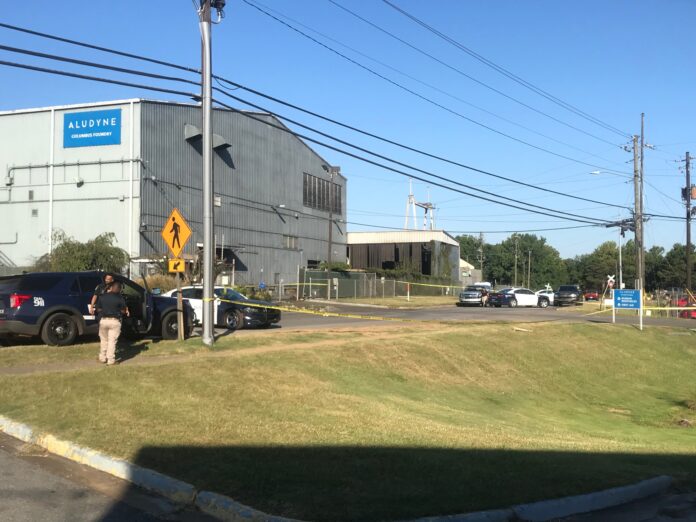
A Columbus man was shot outside Aludyne in the early morning hours of Wednesday, September 3rd, according to police. The victim was transported in a private vehicle to St. Francis Hospital, where he succumbed to his injuries.
According to the Coroner’s Office 54-year-old Lawrence Mitchell Perry was shot by his coworker in a dispute around 6 am at the Aludyne plant in North Columbus. The Columbus Police Department arrested 32-year-old Walter Bethune after he was located in Smiths Station. Bethune was booked into the Lee County jail where he is currently awaiting extradition to Columbus for murder.
This case remains under investigation. Anyone with information is urged to contact Cpl. M. Ruiz at 706-225-4379. You can remain anonymous.
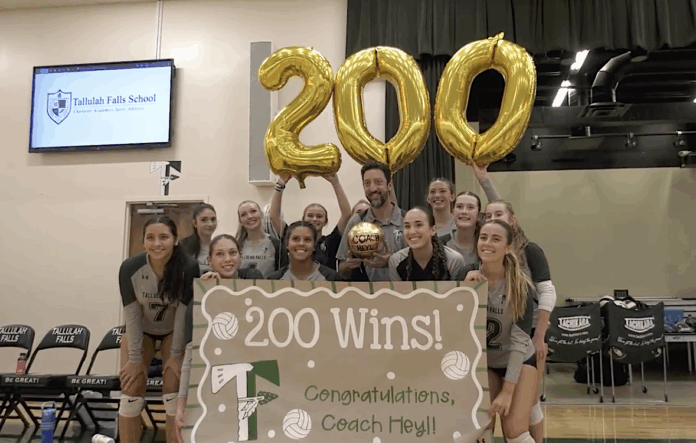
TFS volleyball Coach Matt Heyl celebrates his 200th career win with his team after a match on Tuesday, Sept. 2, 2025. (TFS Athletics/Facebook)
Tallulah Falls’ all-time winningest coach Matt Heyl reached a new milestone with his 200th career win with the Lady Indians volleyball team. The win came on September 2 with a 2-0 victory over George Walton in front of the home crowd. The team celebrated him afterwards, and TFS formally acknowledged the occasion with a mid-court recognition between the win and the 201st against Banks County.
In his eighth season over the program, he has a career mark of 201-112, good for a .642 win percentage. Since taking the reins of the volleyball program in 2018, Heyl has taken TFS to unprecedented heights. The 2022 Lady Indians won the GHSA State Championship after winning their first-ever region title and making a magical postseason run, collecting a school record 35 wins in the process. The 2023 team followed with another area championship and a Sweet 16 run, and the 2024 squad made the Elite 8.
Heyl has led a winning season that led to a playoff run in each of the seven previous campaigns, and this year’s team is well on its way to the same with an overall record of 15-5 to date. He’s coached three 30-win teams (2018, 2022, 2023), two region titles (2022-23), and in six of his eight seasons, the Lady Indians have been a top-10 ranked team in the state.
“It seems like time flew,” says Heyl on reaching the milestone of 200 wins. “We were just celebrating number 100 in that state championship season. Not sure how it happened that fast, but this is an amazing group of girls to get it with.”
As if scripted, his senior daughter Rebecca Heyl, the lone member left from the championship team, spiked a kill to clinch the 200th win.
“To have Becca get the 100th and now 200th with me, it was so much more special that way,” adds Heyl. “We didn’t plan it for her to end the match like that, but that was special.”
When asked which of the 200 wins stands out the most, Heyl acknowledged the tough task of pinpointing just a few, but he had some near the top of mind.
“Besides the state championship, obviously,” laughs Heyl. “There was one in 2021 we beat Murphy of North Carolina, the defending state champs. We beat them at home after losing to them about a month earlier on the road. They were one of the best overall teams, and to beat them the way we did [3-1 on September 20, 2021], that was awesome. Also beating Prince Avenue the season after the championship run, for the region title. That was just a dedicated group of players – we didn’t have anybody new really, just the same group after losing all those talented seniors, and we still beat them.”
Heyl now has about 8-10 matches to go this season before the postseason begins. If the win over George Walton and Banks County is any indicator, the Lady Indians should help take him on another deep run.
THE PATH TO 200 – Signature Wins for Matt Heyl
August 11, 2018 vs Bethlehem Christian Academy (1st Win)
October 20, 2018 vs Mt. Pisgah (1st Playoff Win – 1st ever Sweet 16 for TFS)
August 10, 2019 vs #10 Loganville (1st win over ranked opponent)
August 10, 2019 vs #4 Jefferson (win over highest-ranked opponent in school history)
October 21, 2020 vs Mt. Vernon (Playoff win to clinch second Sweet 16)
September 20, 2021 vs #1 Murphy (NC) (revenge win over defending state champs and first win over #1 team)
August 24, 2022 vs Apalachee (100th Career Win)
October 15, 2022 vs #6 Prince Avenue Christian (1st Region Title in school history)
October 22, 2022 vs #6 Galloway (win to clinch first-ever Elite 8)
October 25, 2022 vs Lamar County (win to clinch Final 4)
October 29, 2022 vs #1 Mt. Pisgah (electric home win to clinch State Championship against #1 team)
November 4, 2022 vs #1 Mt. Bethel (State Championship)
October 7, 2023 vs #6 Prince Avenue Christian (for Region Title (2nd), and 13th consecutive win, marks school record)
October 12, 2024 vs #9 Stratford Academy (clinching Elite 8)
September 2, 2024 vs George Walton (200th Career Win)
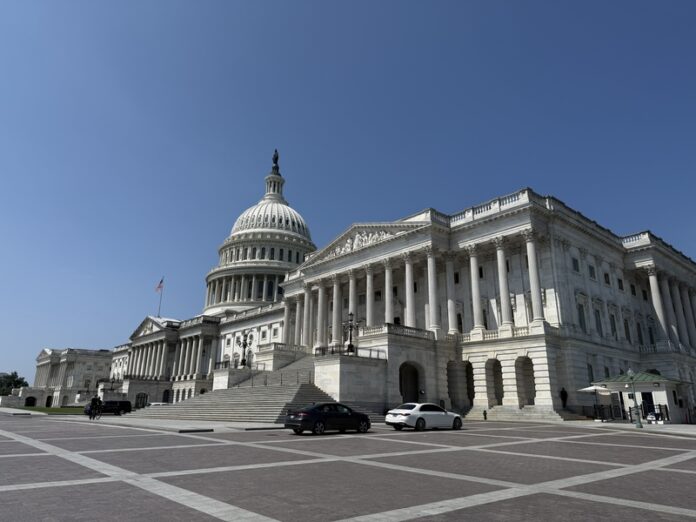
The U.S. Capitol on Sunday, June 29, 2025. (Jennifer Shutt/States Newsroom)
WASHINGTON (States Newsroom) — Congress returns to Washington, D.C., this week following an uneventful August recess where little to no progress was made on government funding, even though lawmakers have just weeks left until their shutdown deadline.
Republican leaders will need the support of several Democratic senators to approve a stopgap spending bill before Oct. 1, since lawmakers have once again failed to complete the dozen full-year bills on time.
But what was once a routine bipartisan exercise has taken on heightened stakes, with Democrats and some Republicans increasingly frustrated by the Trump administration’s unilateral spending decisions.
The nonpartisan Government Accountability Office has issued severalreports faulting the Trump administration for impounding, or refusing to spend funds approved by Congress, in violation of the law. And dozens of lawsuits have been filed, alleging the administration has acted to supersede Congress’ power of the purse.
The ongoing tension, combined with party leaders’ increasing focus on next year’s midterm elections, makes the possibility of a shutdown higher than it has been for years.
President Donald Trump said in mid-August he was open to meeting with Democratic leaders once they were back in town to negotiate a government funding deal but minimized the importance of talks.
“Well, I will, I guess, but it’s almost a waste of time to meet because they never approve anything,” Trump said.
Senate Democratic Leader Chuck Schumer and House Democratic Leader Hakeem Jeffries released a letter last week urging Speaker Mike Johnson and Senate Majority Leader John Thune to quickly begin negotiating a bipartisan stopgap bill.
“The government funding issue must be resolved in a bipartisan way,” they wrote. “That is the only viable path forward.”
Senate Appropriations Chairwoman Susan Collins, R-Maine, said last week that she wants to keep advancing the full-year spending bills, but that a short-term stopgap would be necessary to give lawmakers enough time.
“We need to avoid a government shutdown, which would be horrendous if that were to occur on October 1,” Collins said, according to remarks provided by her office. “And we also need to avoid having a continuing resolution, by that I mean a stopgap bill that just puts government on automatic pilot for the whole year.
“We’re going to have to have a short-term continuing resolution, but we’re making really good progress with overwhelming bipartisan support, and I hope that will continue.”
Another failure
Congress is supposed to complete work on the dozen annual appropriations bills before the start of the new fiscal year but has failed to do so for decades. This year is no different.
The House and Senate are nowhere near finishing their work on the bills, which provide funding for dozens of departments, including Agriculture, Defense, Education, Energy, Health and Human Services, Homeland Security, Housing and Urban Development, Interior, Justice, State, Transportation and Veterans Affairs.
The bills, which make up about one-third of federal spending, also fund smaller agencies like the National Oceanic and Atmospheric Administration, National Science Foundation and the National Weather Service.
The House has approved two of the dozen bills — Defense and Military Construction-VA. The Senate has passed its Agriculture, Legislative Branch and Military Construction-VA bills.
The House bills have only been supported by GOP lawmakers, while the Senate’s bills are broadly bipartisan, giving that chamber an upper hand if the two chambers begin conferencing full-year bills later this year.
Without a bipartisan, bicameral agreement on how much to spend on all of the bills, it’s highly unlikely Congress will be able to complete its work before the Oct. 1 deadline.
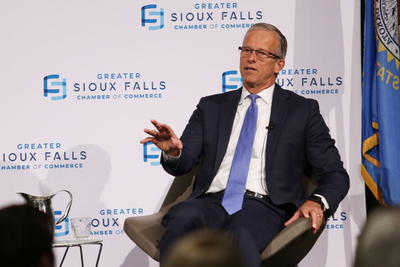
South Dakota, speaks at a Greater Sioux Falls Chamber of Commerce Inside Washington luncheon on Aug. 12, 2025. (Makenzie Huber/South Dakota Searchlight)
Leaders will instead need to reach agreement on a stopgap spending bill that essentially keeps government funding on autopilot until lawmakers can work out a final deal on the full-year bills.
The calendar doesn’t give Speaker Johnson, R-La., and Senate Majority Leader Thune, R-S.D., much time to find compromise with their Democratic counterparts.
Both chambers are in session for three weeks at the beginning of September before breaking for Rosh Hashanah. They’ll return to Capitol Hill on Sept. 29 with less than two days to fund the government or begin a partial shutdown.
Thune said in mid-August at the Greater Sioux Falls Chamber of Commerce Inside Washington luncheon that he expects lawmakers will “have a big fight at the end of September.”
Last shutdown stretched 35 days
It’s been almost seven years since some federal departments and agencies had to navigate a shutdown, when Congress and the first Trump administration were unable to broker a funding deal before a deadline.
A shutdown this year would have substantially more impact than that 35-day debacle since, when that funding lapse began, Congress had approved the Defense, Energy-Water, Labor-HHS-Education, Legislative Branch and Military Construction-VA spending bills.
The departments and agencies funded by those laws, including Congress, weren’t affected by the shutdown.
Lawmakers have failed to send any of the full-year bills to Trump so far this year, so every department and agency would need to implement a shutdown plan if Congress doesn’t approve a stopgap spending bill before Oct. 1.
Federal employees who deal with the preservation of life and property as well as national security will likely be deemed exempt and work without pay until the shutdown ends.
Workers who are not considered essential to the federal government’s operations would be furloughed until Congress and the president broker some sort of funding deal.
Both categories of employees receive back pay once the lapse ends, though that doesn’t extend to federal contractors.
On to the stopgap
Congress regularly approves a stopgap spending bill in September to gain more time to complete negotiations on the full-year appropriations bills.
That continuing resolution, as it’s sometimes called, usually lasts until the last Friday in December when both chambers of Congress are scheduled to be in Washington, D.C.
So a September stopgap would likely last until Friday, Dec. 19, assuming the House and Senate can reach an agreement and hold floor votes in the weeks ahead.
Last year, in the lead-up to the presidential election, lawmakers approved a stopgap bill in September that funded the government through mid-December.
Following the Republican sweep of the November elections, GOP leaders opted not to negotiate the full-year bills and used a second stopgap bill to fund the government until March after a raucous 48 hours on Capitol Hill.
Speaker Johnson took a go-it-alone approach on a third stopgap spending bill, leaving Democrats completely out of the negotiations and jamming the Senate with the legislation.
Schumer and several Democrats ultimately helped Republicans get past the 60-vote legislative filibuster, but most voted against actually passing the stopgap.
The dilemma over forcing a shutdown or helping Republicans pass a stopgap bill will resurface for Schumer in the weeks ahead as he tries to navigate another shutdown deadline amid unified GOP control of Washington.
FILE — Rain soaked memorials for those who died in a mass shooting sit along the roadside by Schemengees Bar & Grille, Oct. 30, 2023, in Lewiston, Maine. (AP Photo/Matt York, File)
Survivors of Maine’s deadliest mass shooting and relatives of victims are suing the federal government, alleging that the U.S. Army could and should have stopped one of its reservists from carrying out what they call “one of the most preventable mass tragedies in American history.”
Eighteen people were killed in October 2023 when Robert Card opened fire at a bowling alley and a bar and grill. An independent commission appointed by Maine’s governor later concluded that there were numerous opportunities for intervention by both Army officials and civilian law enforcement as Card’s mental health deteriorated. He was found dead by suicide two days after the shootings.
The lawsuit, filed in federal court on behalf of more than 100 survivors and victims’ family members, accuses the U.S. government of negligence, saying its conduct “directly and proximately caused the mass shooting.” It alleges that Army officials and others “failed to act reasonably, broke the promises they made to Card’s family and their community, violated mandatory polices, procedures and disregarded directives and orders.”
“By March 2023, the United States and its personnel knew Card was paranoid, delusional, violent, and lacked impulse control. The Army knew he had access to firearms. The Army promised to remove his guns but did not fulfill that promise,” the lawsuit states. “Worse, through its acts and omissions, the Army withheld information and actively misled local law enforcement, thereby preventing others from intervening and separating Card from his weapons.”
Attorneys plan to provide more details Wednesday at a news conference in Lewiston, not far from where the shootings took place.
The attorneys began the process of suing the government a little less than a year ago when they filed notices of claim, saying the Army did not act despite being aware of Card’s mental health decline. Card’s mental health spiral led to his hospitalization and left him paranoid, delusional and expressing homicidal ideations, the claim said. He even produced a “hit list” of those he wanted to attack, attorneys have said.
Family members and fellow reservists said Card had exhibited delusional and paranoid behavior months before the shootings. He was hospitalized by the Army during training in July 2023 in New York, where his unit was training West Point cadets, but Army Reserve officials have acknowledged that no one made sure Card was taking his medication or complying with his follow-up care at home in Bowdoin, Maine.
The starkest warning came in a September text from a fellow reservist: “I believe he’s going to snap and do a mass shooting.”
“From the start, the Army disregarded its mandatory policies and procedures, and regulations when dealing with Card,” the lawsuit states. “Despite the serious issues Card presented at the company or battalion level, they were not reported up the chain of command to senior military officials with the knowledge, experience, and resources to address them. Instead, low-ranking, part-time personnel mis-managed the risks, resulting in disastrous consequences.”
Army officials conducted their own investigation after the shootings that Lt. Gen. Jody Daniels, then the chief of the Army Reserve, said found “a series of failures by unit leadership.” Three Army Reserve leaders were disciplined for dereliction of duty, according to the report. When the governor’s commission released its final report last August, the Army issued a statement saying it was “committed to reviewing the findings and implementing sound changes to prevent tragedies like this from recurring.”
The Lewiston shootings led to new guns laws in Maine, a state with a long tradition of hunting and gun ownership. The laws prompted legal action on the part of gun rights advocates in the state and remain a contentious topic nearly two years after the shootings.
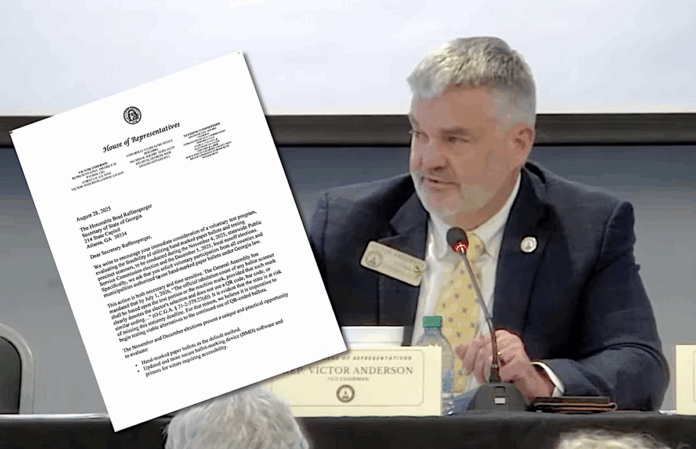
In a letter to Georgia Secretary of State Brad Raffensperger, Rep. Victor Anderson, vice-chair of the House Blue Ribbon Study Committee on Election Procedures, and Chairman Tim Fleming (R-Covington) request a test of hand-marked paper ballots in this fall's elections. They framed their request as urgent due to the upcoming deadline for ordering ballots. (NowHabersham.com)
State Rep. Victor Anderson (R-Cornelia) is urging Secretary of State Brad Raffensperger to launch a voluntary pilot program this fall that would test hand-marked paper ballots and updated voting technology ahead of Georgia’s 2026 election law deadline.
In a letter sent to Raffensperger and signed by Rep. Tim Fleming (R-Covington), Chair of the House Blue Ribbon Study Committee on Election Procedures, Anderson encouraged immediate consideration of the program during the November 4 Public Service Commission election and the December 5 local runoffs. He asked that Raffensperger solicit voluntary participation from counties and municipalities authorized under Georgia law to use hand-marked ballots.
Statutory deadline approaching
Anderson, who chairs the House Governmental Affairs Committee, cited a looming deadline in state election law that requires all official tabulations to be based on the text portion of the ballot, rather than QR codes or barcodes, by July 1, 2026.
“It is evident that the state is at risk of missing this statutory deadline,” Anderson wrote. “For that reason, we believe it is imperative to begin testing viable alternatives to the continued use of QR-coded ballots.”
According to Anderson, the November and December elections present a “unique and practical opportunity” to evaluate the following:
Hand-marked paper ballots as the default method.
Updated and more secure ballot-marking device (BMD) software and printers for voters requiring accessibility.
Updated scanner software compatible with the improved BMD systems. Ballot-on-demand printing technology.
Compatibility and accuracy of ballot-on-demand printed ballots with optical
scanners.
Operational data, including training requirements, voting times, ballot printing costs, labor costs, and voter satisfaction.
The December runoffs, he said, could serve as a follow-up pilot, refining lessons learned in November.
Fractured state election board spotlighted in hearing
Anderson’s letter comes as he plays a key role in the House Blue Ribbon Study Committee on Election Procedures, which held a contentious hearing August 28 at North Georgia Technical College in Clarkesville.
The meeting revealed deep fractures within the State Election Board (SEB), with accusations of dishonesty, partisanship, and dysfunction dominating testimony. Some witnesses called for a structural overhaul, while others cautioned against rushed reforms.
“We knew there were issues within the SEB,” Anderson said, “but we didn’t realize until testimony how deep the fractures run. Legislative action may be needed to repair these issues, and our committee will prepare recommendations to improve the processes, effectiveness, transparency, and accuracy of elections in Georgia.”
Anderson added that election reforms must “promote trust, confidence, and participation.”
Committee work continues
Anderson serves as vice-chair of the committee, which is holding six hearings across the state. In addition to the Clarkesville hearing, previous sessions took place in Atlanta and Rockmart. Upcoming meetings are scheduled for Savannah on September 18, Covington on October 2, and Americus on October 16.
All hearings are open to the public and are livestreamed. The committee will submit its recommendations to the House Speaker ahead of the 2026 legislative session.
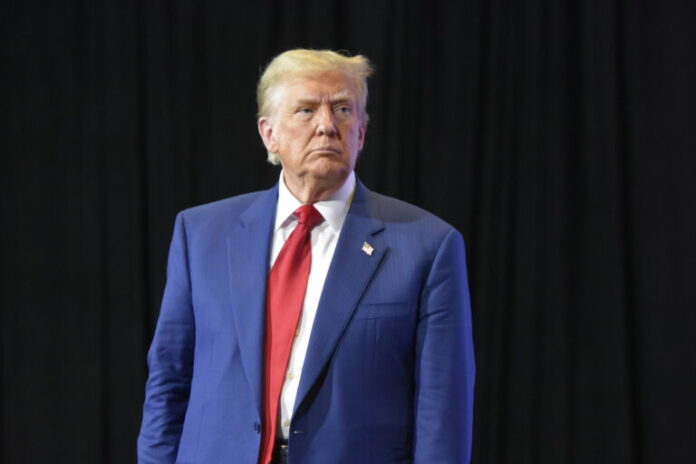
Former President Donald Trump speaks at a rally in Zebulon, Georgia, at a political rally in October 2024. (Ross Williams/Georgia Recorder)
WASHINGTON (States Newsroom) — President Donald Trump spoke at length from the Oval Office on Tuesday, proving that he is in fact alive after rumors circulated online over the long holiday weekend that he might have died.
Trump initially said he wasn’t aware of the speculation when asked about his “demise” by a Fox News reporter after the president announced he would move U.S. Space Command headquarters from Colorado to Alabama.
“Really, I didn’t see that,” Trump said. “You know, I have heard, it’s sort of crazy but last week I did numerous news conferences. All successful. They went very well, like this is going very well. And then I didn’t do any for two days, and they said, ‘There must be something wrong with him.’ Biden wouldn’t do them for months. You wouldn’t see him.”
Trump then said that he had heard about the online speculation of his death, but that he didn’t realize how extensive the rumors were.
“No, I heard that. I get reports,” Trump said. “Now you knew I did an interview that lasted for about an hour and a half with somebody, and everybody saw. That was on one of your competitors. I did numerous shows, and also did a number of truths, long truths. I think, pretty poignant truths. No, I was very active over the weekend.”
Trump added a few moments later: “I didn’t hear that one. That’s pretty serious stuff.”
The rumors that Trump had potentially died began circulating online Friday but began dissipating on Saturday, Sunday and Monday after the group of reporters that follows the president around saw him walk into his golf club in Virginia each of those three days.
A Habersham County judge on Tuesday denied bond for the man accused of stabbing three people following a domestic dispute Sunday outside of Clarkesville.
27-year-old Ethan Blue Brooks is charged with three counts of aggravated assault. He is accused of stabbing his girlfriend’s parents and cousin, Ricky and Diana Smith, and Ashley Chaffin.
Family members told Now Habersham Ricky Smith was stabbed three times in the abdomen. According to Chaffin, he remained on a ventilator in critical condition at Northeast Georgia Medical Center in Gainesville as of Monday, September 1.
Brooks, who has had previous run-ins with the law, remains in the Habersham County Detention Center.
A Clermont man was killed Tuesday afternoon in a three-vehicle crash on Highway 129 North/SR 11 near Albert Reid Road in White County.
The wreck happened just before 1 p.m. on September 2.
According to the Georgia State Patrol’s preliminary crash report, 41-year-old Julia Robinson of Gainesville was driving a Kia Forte south on Hwy. 129. The report states that “Robinson was driving distracted when she crossed the centerline and entered the northbound traffic lane.”
Robinson’s car struck a northbound Toyota Corolla driven by 26-year-old Malani Zavala of Cleveland head-on. A Lexus ES, driven by 69-year-old Marilyn Frye of Cleveland, then hit the back of Zavala’s car.
Robinson’s front-seat passenger, 51-year-old Brian Wallace of Clermont, suffered fatal injuries. Despite life-saving efforts, he was pronounced dead at the scene, GSP said.
White County EMS transported Robinson, Zavala, and Frye to Northeast Georgia Medical Center in Gainesville with non-life-threatening injuries.
Troopers said all three vehicles sustained disabling damage. Emergency crews from the Cleveland Fire Department, White County Fire Services, White County EMS, the White County Sheriff’s Office, and GSP responded to the crash.
Highway 129 North was closed for about three hours while investigators worked the scene and reopened shortly before 3 p.m. The Georgia State Patrol’s Specialized Collision Reconstruction Team is assisting with the investigation. Charges are pending.
This article corrects previous information that a driver was killed in the wreck
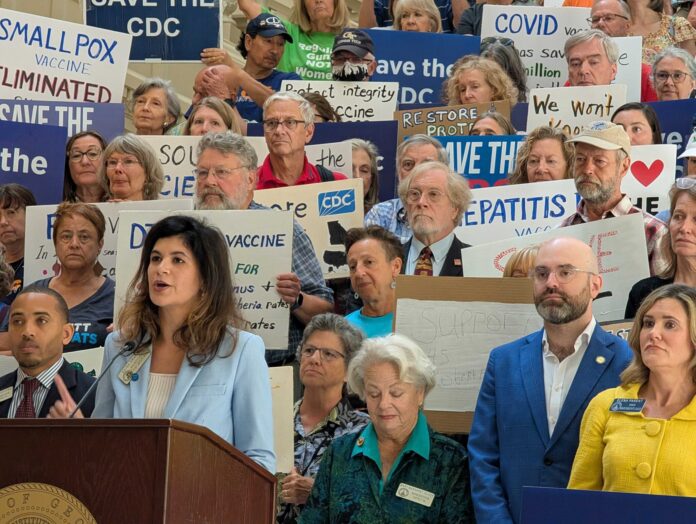
Rep. Saira Draper, an Atlanta Democrat, speaks in front of former CDC employees and allies at the Georgia State Capitol on Sept. 2, 2025. (Alander Rocha/Georgia Recorder)
The Centers for Disease Control and Prevention is in turmoil following the ouster of the agency’s director, a series of high-profile resignations, and an attack on its headquarters that killed a police officer, said former CDC staff Tuesday.
The former employees, including ex-deputy director for program and science and Chief Medical Officer Dr. Deb Houry and former director of the National Center for Emerging Zoonotic and Infectious Diseases Dr. Dan Jernigan — who both resigned Thursday — described the current environment at the CDC as a “death” where science is currently being sidelined by political ideology. Houry and Jernigan joined Georgia House and Senate Democrats at the State Capitol Tuesday to discuss the current climate at the CDC.
“You can almost see this as death by a thousand cuts: we’re cutting staff, we’re cutting resources, we’re undercutting science,” said Jernigan.
Jernigan said during a roundtable discussion before talking to the press that there has been an overall lack of transparency between the Trump administration and the CDC, saying that he has seen a shift in the CDC’s operations. Whereas past administrations, regardless of their political leanings, worked with scientists to let data guide policy, Jernigan said the current approach appears to start with a predetermined ideology and then attempts to find scientific justification to support it.
“I recognize you really can’t get politics completely out of public health. [Public health is] really a priority here. What are you putting first? And we’re asking that science go first before the policy development, and not starting with an ideology and then backing into the science,” Jernigan said.
The former CDC employees also tied the current political climate to the recent shooting at the CDC campus, which they said was fueled by years of misinformation about vaccines. Abby Tighe, who was fired from the CDC in May and is a founding member of Fired But Fighting, a coalition of terminated CDC employees and allies, said it’s “tragic to not have a stronger condemnation of this act of violence” and warned that without officials speaking out against the attack, she fears attacks on the scientific community could continue to happen.
“That could look like more attacks, and with the vaccine misinformation being the driver for this, who’s to say that this won’t lead to attacks at pediatricians’ offices or pharmacies or all of these places where vaccines are given and professionals who work in the vaccine space exist,” Tighe said.
CDC employees on Thursday were told they have to return to the office by Sept. 15, according to an email obtained by The Atlanta Journal-Constitution, just over a month after nearly 200 rounds of ammunition hit six separate CDC buildings. The building is still being repaired, but Lynda Chapman, chief operating officer who sent the notice, stated in the letter that an “alternative on-campus space” will be provided to those whose office “remains impacted.”
Houry said she left the agency because she “could no longer fight on the inside.” She expressed deep concern over decisions that she said were not being made based on data and science, as well as the loss of talented staff. She said that while she was tasked with sunsetting certain programs during her time, she did her best to archive data so that it could be “resuscitate[d]” if funding is restored.
“If there’s a surveillance system that doesn’t have funding or people, we cannot produce that data. But as we were facing sunsetting a lot of those programs, [we] did what we could to preserve it because we are hopeful that at some point we’ll be able to rebuild our agency,” Houry said.
A Nissan Maxima rests on the shoulder of Duncan Bridge Road near Pea Ridge Road, after a deputy executed a PIT maneuver during a high-speed chase on Friday, Aug. 29, 2025. The suspect fled on foot but was quickly apprehended, officials said. (Habersham County Sheriff's Office)
A 23-year-old Clarkesville man is facing 18 charges after leading deputies on a dangerous high-speed pursuit late Friday night, officials said.
According to the Habersham County Sheriff’s Office (HCSO), the chase began around 10:07 p.m. on August 29 when a H.E.A.T. deputy clocked a Nissan Maxima traveling more than 100 mph on GA 365 near Mt. Zion Road outside Alto.
When the deputy tried to initiate a stop, the driver sped off, weaving through traffic and passing vehicles on the right near Anderson Village, said HCSO spokesperson Rob Moore. The suspect vehicle turned onto Duncan Bridge Road/GA 384, continuing to drive recklessly, according to Moore, passing cars in a no-passing zone at speeds topping 100 mph.
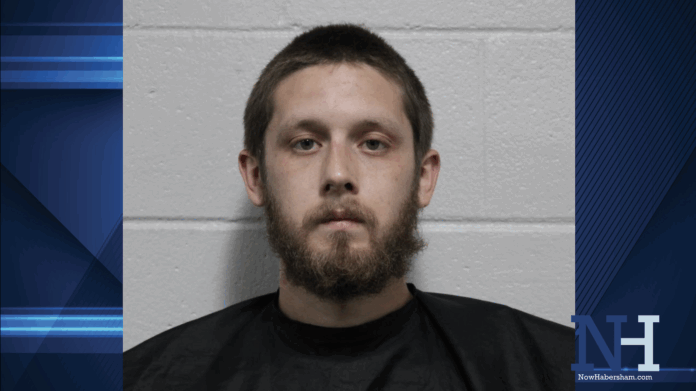
Zachary Bryan DeVincentis (Habersham County Sheriff’s Office)
Near Pea Ridge Road, the deputy executed a PIT maneuver, forcing the vehicle to stop. The driver, identified as Zachary Bryan DeVincentis, jumped out but was quickly apprehended. Authorities say he was uninjured and taken into custody within a minute of the maneuver.
DeVincentis now faces a long list of charges, including:
fleeing or attempting to elude a police officer
speeding in excess of maximum limits
driving under the influence
reckless driving
too fast for conditions (3 counts)
possession of open alcohol container
failure to maintain lane
failure to signal lane change or turn (2 counts)
improper passing in a no-passing zone (2 counts)
driving within a gore or median
failure to maintain lane
distracted driving
following too closely
speeding in excess of maximum limits
He was released from the Habersham County Detention Center on Monday, Sept. 1, on a $12,975 bond.
Ohio State offensive lineman Austin Siereveld, left, and tight end Will Kacmarek celebrate their touchdown against Texas during the first half of an NCAA college football game, Saturday, Aug. 30, 2025, in Columbus, Ohio. (AP Photo/Jay LaPrete)
Ohio State climbed to No. 1 in The Associated Press Top 25 college football poll on Tuesday, LSU and Miami moved into the top five, and Florida State jumped back into the rankings at the expense of Alabama, which plummeted to its lowest spot in 17 seasons.
The defending national champion Buckeyes received 55 of 66 first-place votes to move up two spots after their win over preseason No. 1 Texas. Ohio State is at the top of a regular-season Top 25 for the first time since November 2015.
Texas dropped to No. 7 as the media voters shuffled the rankings following a topsy-turvy Labor Day weekend. It was only the second time, and first since 1972, that two top-five teams lost in Week 1 and the first time four top-10 teams lost. Only three teams in the Top 25 are in the same spot they were in the preseason poll.
Penn State got seven first-place votes and remained No. 2. LSU, which received three first first-place votes, was followed by Georgia and Miami to round out the top five.
Oregon got the other first-place vote and was followed by Texas, Clemson, Notre Dame and South Carolina.
The biggest movers in the poll were Florida State and Alabama after the Seminoles’ 31-17victory in their head-to-head matchup: Florida State, 15 spots outside the Top 25 in the preseason, is now No. 14. Alabama dropped all the way from No. 8 to No. 21 — its lowest ranking since it was No. 24 in the 2008 preseason poll. That was the second of Nick Saban’s 17 teams in Tuscaloosa.
It’s been quite a turnabout for Florida State. The Seminoles were No. 10 in the 2024 preseason, lost their first two games, finished 2-10 and weren’t ranked again until now.
In and out
Utah, at No. 25, joins Florida State as the only newcomers this week.
The Utes had received the second-most points, behind BYU, among teams outside the preseason Top 25. Utah got more credit for beating UCLA 43-10 on the road than BYU got for hammering FCS foe Portland State. The Utes are ranked for the first time since last October, when they were at the front end of a seven-game losing streak.
Boise State, which had been No. 25, received no votes following its 34-7 loss at South Florida. The Broncos had appeared in 14 straight polls. The other team to drop out of the poll was No. 17 Kansas State, which followed up its season-opening loss to Iowa State with a last-minute home win over FCS team North Dakota.
Poll points
— Ohio State is the first team to take over the top spot in the first regular-season poll since Alabama in 2012. It was the biggest jump to No. 1 in the first regular-season poll since Southern California was promoted from No. 3 in 2008.
— Texas’ fall was the biggest for a preseason No. 1 since Auburn dropped to No. 8 in the first regular-season poll of 1984.
— LSU has its highest ranking after Week 1 since it was No. 3 in 2012, and Miami has its highest ranking after Week 1 since it was No. 5 in 2004.
— South Carolina is in the top 10 in the regular season for the first time since it was No. 8 in December 2013.
No. 15 Michigan at No. 18 Oklahoma: This weekend’s game will be the first meeting since Oklahoma beat the Wolverines in the Orange Bowl to win the 1975 national championship. Wolverines freshman QB Bryce Underwood gets put to the test in his second start.