Home Blog Page 311

‘Warrior’ Gunner Stockton to lead No. 4 Georgia against Austin Peay in final warmup for SEC schedule

Georgia quarterback Gunner Stockton (14) throws a pass during the first half of an NCAA college football game against Marshall, Saturday, Aug. 30, 2025, in Athens, Ga. (AP Photo/Colin Hubbard)

ATHENS, Ga. (AP) — Gunner Stockton showed what the 2025 Georgia offense designed for his versatile skills at quarterback may look like in last week’s 45-7 win over Marshall.

Stockton’s second chance for No. 4 Georgia (1-0) comes on Saturday when the Bulldogs face Austin Peay (1-0) in their final warmup game. On Sept. 13, Georgia opens its SEC schedule at Tennessee and returns home one week later to face Alabama.

Stockton passed for two touchdowns and ran for two scores while leading Georgia with 73 rushing yards last week, prompting coach Kirby Smart to say “He’s a warrior.”

It made for a difficult act for Stockton to follow against the Governors.

“I thought he did an excellent job of improvising when things weren’t there, or there was a breakdown,” Smart said Tuesday. “That was probably the best thing he did, was take care of the ball, protect the ball, and make plays with his legs. He continues to get better. The next step is play with a little more confidence. I think each time you start playing games, you lose some of that anxiety.”

If Stockton was anxious, he hid it well while completing 14 of 24 passes for 190 yards with no turnovers. After making one start as the replacement for injured Carson Beck last season, the start against Marshall was the first opportunity for Stockton to play in an offense designed to take advantage of his dual-threat skills.

“This was a dream come true, and I enjoyed it for sure,” Stockton said.

Rooting for Stockton

As a Duke assistant for 10 years, ending in 2021, Austin Peay coach Jeff Faris recruited in Georgia and followed Stockton at Rabun County High School.

“I’ve been a huge fan of his for a long time,” Faris said. Stockton is “a very, very talented passer, very, very athletic. … I think it’s a big challenge for our defense. And you know I’m excited for him. I’ve been rooting for him the whole time because he’s the right kind of kid, too. So you know he’s going to put us in some challenging situations and we have to make plays.”

Breakaway speed

Dwight Phillips led Georgia’s running backs with 60 yards on only five carries last week, including a 17-yard scoring run on a pitch from Stockton. A block from tight end Lawson Luckie helped set up the scoring run, but Phillips’ speed was the highlight of the play.

Cornerback Ellis Robinson IV said Phillips’ display of speed was no surprise.

“He’s been doing that in practice a lot, like he’s been having a lot of good breakaway runs and everything,” Robinson said.

Phillips also ran track at Pebblebrook High School and was a 100-meter state champion in 2022.

Feasting on FBS

Austin Peay, a Football Championship Subdivision school, ended a streak of 30 consecutive losses to FBS teams with last week’s 34-14 win over Middle Tennessee. It was the Governors’ first win over a FBS school since beating Kansas State 26-22 to open the 1987 season.

Chris Parson completed 11 of 20 passes for 142 yards and two touchdowns. The 34 points were a high mark for Austin Peay against a FBS opponent.

Second visit from Governors

In the only previous meeting between the teams, Georgia shut out Austin Peay 45-0 to open the 2018 season. Georgia led 38-0 at halftime as Jake Fromm and Justin Fields combined to pass for three touchdowns.

US immigration officers raid Georgia site where Hyundai makes electric vehicles

FILE - The Hyundai Motor Group Metaplant America is seen on March 26, 2025, in Ellabell, Ga. (AP Photo/Mike Stewart, File)

SAVANNAH, Ga. (AP) — U.S. immigration authorities on Thursday raided the sprawling site where Hyundai manufactures electric vehicles in southeast Georgia, shutting down construction on an adjacent factory being built to produce EV batteries.

The operation targeted one of Georgia’s largest and most high-profile manufacturing sites, touted by the governor and other officials as the largest economic development project in the state’s history. Hyundai Motor Group began manufacturing EVs a year ago at the $7.6 billion plant, which employs about 1,200 people.

U.S. Immigration and Customs Enforcement spokesman Lindsay Williams confirmed that federal authorities were conducting an enforcement operation at the 3,000-acre (1,214-hectare) site west of Savannah. He said agents were focused on the construction site for the battery plant but gave few other details.

Georgia State Patrol troopers blocked roads to the Hyundai site. They were dispatched to assist federal authorities in serving “a criminal search warrant,” the Georgia Department of Public Safety said in a statement.

Video posted to social media Thursday showed workers in yellow safety vests lined up as a man wearing a face mask and a tactical vest with the letters HSI, which stands for Homeland Security Investigations, tells them: “We’re Homeland Security. We have a search warrant for the whole site.”

“We need construction to cease immediately,” the man says. “We need all work to end on the site right now.”

President Donald Trump’s administration has undertaken sweeping ICE operations as part of a mass deportation agenda. Immigration officers have raided farms, construction sites, restaurants and auto repair shops.

The Pew Research Center, citing preliminary Census Bureau data, says the U.S. labor force lost more than 1.2 million immigrants from January through July. That includes people who are in the country illegally as well as legal residents.

In addition to making electric vehicles at the site facing Interstate 16 in Bryan County, Hyundai has also partnered with LG Energy Solution to build the battery plant. It’s slated to open sometime next year.

The joint venture, HL-GA Battery Company, “is cooperating fully with the appropriate authorities,” the company said in a statement. “To assist their work, we have paused construction.”

Operations at Hyundai’s EV manufacturing plant weren’t interrupted, said plant spokesperson Bianca Johnson.

“This did not impact people getting to work,” Johnson said in an email. “Production and normal office hours had already begun for the day” when authorities shut down access.

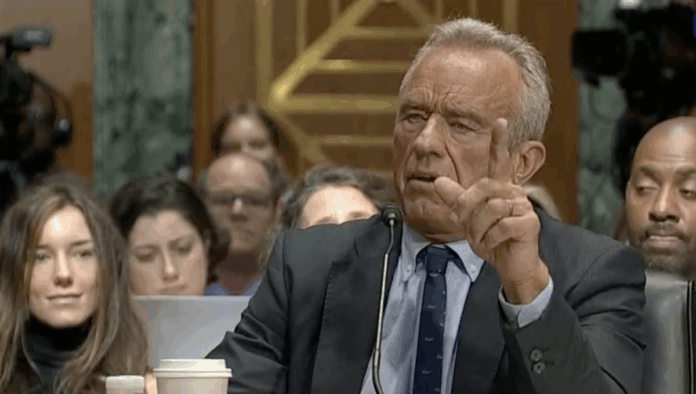
RFK Jr. battles with members of US Senate panel over vaccines, removal of CDC director

Health and Human Services Secretary Robert F. Kennedy Jr. appears before the Senate Finance Committee at the Dirksen Senate Office Building on Sept. 4, 2025 in Washington, D.C. (livestream image courtesy C-SPAN)

WASHINGTON (States Newsroom) — Health and Human Services Secretary Robert F. Kennedy Jr.  vehemently defended his actions on vaccines and other public health issues under questioning by both Republican and Democratic senators during a contentious hearing Thursday.

Kennedy, confirmed on a mostly party-line vote earlier this year, repeatedly justified firing everyone on an influential vaccine advisory panel, as well as the president’s decision to remove a Centers for Disease Control and Prevention director who’d served for less than a month after confirmation by the Senate.

“In your confirmation hearings, you promised to uphold the highest standards for vaccines. Since then, I’ve grown deeply concerned,” said Senate Majority Whip John Barrasso, R-Wyo. “The public has seen measles outbreaks. Leadership of the National Institutes of Health questioning the use of mRNA vaccines. The recently confirmed director of the Centers for Disease Control and Prevention fired. Americans don’t know who to rely on.”

Video courtesy of C-SPAN.

Barrasso, an orthopedic surgeon, sought to reinforce support for vaccines to Kennedy during the Senate Finance Committee hearing, saying they “are estimated to have saved 154 million lives worldwide.”

Louisiana Republican Sen. Bill Cassidy, a physician who received several concessions from Kennedy in exchange for voting to confirm him as HHS secretary, raised numerous questions about Kennedy’s behavior. Cassidy is the chairman of the Health, Education, Labor and Pensions Committee.

Cassidy appeared to box in Kennedy on the COVID-19 vaccine by saying President Donald Trump should receive the Nobel Prize for Operation Warp Speed, which led to the development of the shot during his first term.

Kennedy agreed Trump should “absolutely” get the prize, leading Cassidy to question why he’d taken actions as HHS secretary to erode trust and eliminate funding for vaccine development activities.

“It surprises me that you think so highly of Operation Warp Speed when, as an attorney, you attempted to restrict access,” Cassidy said. “It also surprises me because you’ve canceled, or HHS did, but apparently under your direction, $500 million in contracts using the mRNA vaccine platform that was critical to Operation Warp Speed.”

Cassidy said the cancellation represents not only “an incredible waste of money but it also seems like a commentary upon what the president did in Operation Warp Speed, which is to create a platform by which to create vaccines.”

Cassidy also questioned Kennedy’s actions eliminating everyone on the CDC’s Advisory Committee on Immunization Practices and replacing them with his own choices.

“If we put people who are paid witnesses for people suing vaccines, that actually seems like a conflict of interest,” Cassidy said.

Kennedy disagreed, testifying that “it may be a bias. And that bias, if disclosed, is okay.”

Tillis asks RFK Jr. to respond in writing

North Carolina Republican Sen. Thom Tillis asked Kennedy a series of questions but said he wanted the secretary to submit his answers in writing in order to clarify several of his positions.

“Some of your statements seem to contradict what you said in the prior hearing,” Tillis said. “You said you’re going to empower the scientists at HHS to do their job. I’d just like to see evidence where you’ve done that, and I’m sure that you will have some.”

Tillis said he wanted Kennedy to respond to reports that he’s gone back on his commitments to senators to not do anything “that makes it difficult or discourages people from taking vaccines” and that Kennedy would not “impose my belief over any of yours.”

“That, again, seems to be contradictory to the firing of the CDC director, the canceling of mRNA research contracts, firing advisory board members, attempting to stall NIH funding, eliminating funding for I think a half a billion dollars for further mRNA research,” he said, referring to the National Institutes of Health.

Tillis said he was having difficulty understanding why former CDC Director Susan Monarez, whom Trump nominated in March and the Senate voted to confirm in late July, had been fired so quickly.

“I don’t see how you go … from a public health expert with unimpeachable scientific credentials, a long-time champion of MAHA values, caring and compassionate and brilliant microbiologist — and four weeks later, fire her,” Tillis said.

CDC shooting, Monarez firing probed

Georgia Democratic Sen. Raphael Warnock questioned Kennedy at length over the firing of Monarez as well as a shooting at the Atlanta-based agency this summer.

Kennedy testified that he doesn’t believe he criticized Monarez during a meeting in late August over her comments following the CDC shooting that “misinformation can be dangerous.”

During that meeting, Kennedy said he did demand that Monarez fire career CDC scientists but testified he didn’t tell her to accept the recommendations of the vaccine advisory panel without further review.

“What I asked her about is, she had made a statement that she was going to not sign on and I wanted clarification about that,” Kennedy said. “I told her I didn’t want her to have a role if she’s not going to sign onto it.”

Monarez wrote in an op-ed published in the Wall Street Journal just hours before the hearing began that during the meeting with Kennedy she “was told to preapprove the recommendations of a vaccine advisory panel newly filled with people who have publicly expressed antivaccine rhetoric.”

“That panel’s next meeting is scheduled for Sept. 18-19,” Monarez wrote. “It is imperative that the panel’s recommendations aren’t rubber-stamped but instead are rigorously and scientifically reviewed before being accepted or rejected.”

Warnock asked Kennedy if he said that the CDC was the “most corrupt federal agency in the history of the world.”

Kennedy testified he didn’t say that exactly but did say “it’s the most corrupt agency at HHS and maybe the government.”

Warnock concluded his five minutes of questions telling Kennedy that “it’s clear you’re carrying out your extremist beliefs” and that he represents “a threat to the public health of the American people.”

“For the first time, we’re seeing deaths from children from measles,” Warnock said. “We haven’t seen that in two decades. We’re seeing that under your watch. You are a hazard to the health of the American people.”

Lankford, Daines ask about medication abortion

Several senators, including Oklahoma Republican James Lankford and Montana Republican Steve Daines, asked Kennedy about the ongoing review of mifepristone, one of two prescription pharmaceuticals used in medication abortion.

Kennedy said he spoke with FDA Commissioner Marty Makary about the topic just yesterday and committed to keeping senators informed, but didn’t appear to know much more than that.

“I don’t know if they’re going to do an insurance claim study. That’s one way to do it. I don’t know exactly whether they’re doing epidemiological studies or observational studies. I don’t know exactly what they’re doing,” Kennedy said. “But I know I talked to Marty Makary about it yesterday, and he said those studies are progressing and that they’re ongoing. So I will keep your office informed at every stage.”

Kennedy testified that he didn’t know when exactly the studies would be completed.

The FDA first approved mifepristone in 2000 before updating the prescribing guidelines in 2016 and during the coronavirus pandemic.

It’s currently approved for up to 10 weeks gestation and can be prescribed via telehealth and shipped to patients. Mifepristone is the first pharmaceutical of medication abortion and is typically followed by misoprostol.

Medication abortion accounted for about 64% of all abortions in 2023, according to research from the Guttmacher Institute.

The Supreme Court rejected an effort to limit access to medication abortion last year in a case originally filed by four anti-abortion medical organizations and four anti-abortion doctors that were represented by Alliance Defending Freedom.

Justice Brett Kavanaugh wrote the opinion that “federal conscience laws have protected pro-life doctors ever since FDA approved mifepristone in 2000.”

Numerous medical organizations, including the American College of Obstetricians and Gynecologists and the American Medical Association, wrote briefs to the Supreme Court in that case attesting to the safety and efficacy of mifepristone.

“The scientific evidence is overwhelming: major adverse events occur in less than 0.32% of patients,” the medical organizations wrote. “The risk of death is almost non-existent.”

Trump administration urges Supreme Court to quickly overturn ruling against tariffs

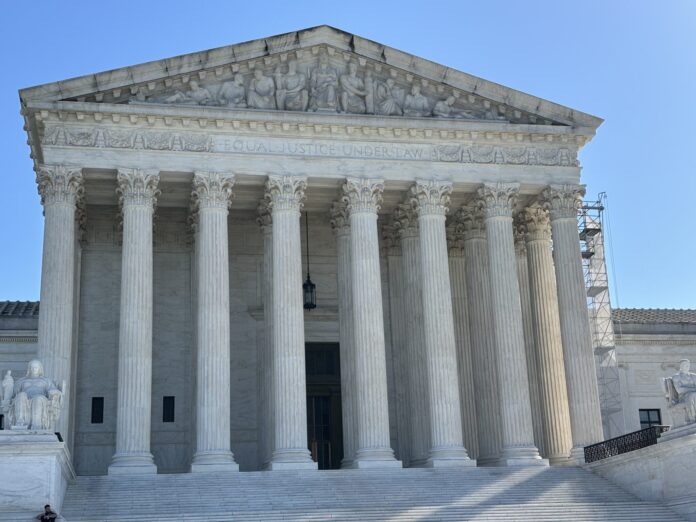
The U.S. Supreme Court (Jane Norman/States Newsroom)

WASHINGTON (States Newsroom) — The Trump administration is urging the Supreme Court to quickly take up the president’s emergency tariffs case to avoid “catastrophic” economic consequences for the United States, according to a filing.

Treasury Secretary Scott Bessent argued in the Wednesday petition that roughly $750 billion to $1 trillion in tariff revenue is at stake if the justices accept the case through the normal session timeline, which ends in June 2026. The U.S. could face having to refund the import taxes paid by U.S. companies, Bessent said.

President Donald Trump and administration officials have asked the Supreme Court to overturn Friday’s federal appellate ruling that affirmed the president does not have authority to impose tariffs under the International Economic Emergency Powers Act.

Trump is the first president to trigger tariffs under the IEEPA. The ruling upheld an earlier decision by the U.S. Court of International Trade. The decision is stayed while Trump officials appeal.

Tariffs paid by domestic purchasers, businesses

Trump began imposing wide-reaching tariffs in February and escalated them in the following months on goods from around the globe after declaring national emergencies — first over illegal fentanyl smuggling, and then declaring trade deficits an emergency. A trade deficit means the U.S. imports more goods from a country than that nation’s businesses purchase from U.S. suppliers.

Domestic businesses and purchasers now pay the U.S. government anywhere from 10% to 50% in tariffs on most imported products. The government had collected nearly $82 billion by June 30, according to U.S. Customs and Border Patrol data.

Trump’s emergency tariffs were challenged in court by several private businesses and a dozen states that sued the administration for using emergency powers to trigger the steep import taxes — the first time a U.S. president had ever done so.

Arizona, Colorado, Maine, Minnesota, Nevada, New Mexico and Oregon were among states, led by Democratic attorneys general, that brought the suit.

Businesses that sued the Trump administration include the lead plaintiff, V.O.S. Selections, a New York-based company that imports wine and spirits from 16 countries, according to its website.

Other plaintiffs include a Utah-based plastics producer, a Virginia-based children’s electricity learning kit maker, a Pennsylvania-based fishing gear company, and a Vermont-based women’s cycling apparel company.

Trade frameworks

Bessent argued the ruling from the U.S. Court of Appeals for the Federal Circuit is jeopardizing trade frameworks the administration has arranged with Japan, Indonesia, the United Kingdom, the Philippines, Vietnam, South Korea, and the European Union.

The administration has announced several unofficial deals over recent months and has touted securing hundreds of billions in investment from other nations in exchange for lower tariffs.

“World leaders are questioning the President’s authority to impose tariffs, walking away from or delaying negotiations, and/or imposing a different calculus on their negotiating positions. The court’s ruling has taken away substantial negotiating leverage for the president to achieve the best trade deals for the American people,” Bessent wrote in a declaration attached to the administration’s motion to expedite the case, should the justices agree to take it.

In asking the Supreme Court to take the case, U.S. Solicitor General John Sauer argued the tariffs are the administration’s “most significant economic and foreign-policy initiative … which President Trump has determined are necessary to rectify America’s country-killing trade deficits and to stem the flood of fentanyl across our borders.”

Sauer is Trump’s former personal defense attorney who argued on Trump’s behalf before the high court last year.

ACC Planning Commission to discuss 2 million square foot development in Greenbelt

(WUGA News)

A request to change the future land use designation and zoning of a large parcel of land north of Winterville will come before the Planning Commission Thursday night. The owners of the over 200-acre piece of farmland want to turn it into a two million square foot industrial complex. They say that change is in line with nearby pieces of land.

At a meeting of the Planning Commission in July, neighbors of the parcel opposed the designation changes. They said the land is in Clarke County’s so-called “greenbelt,” areas to the north, west, and east of the county that are expected to remain undeveloped.

Clarke County’s planning department has recommended that the Planning Commission deny changes to the parcel’s future land use and zoning designations.

The Mayor and Commission are expected to see the property on their voting agenda in early October.

This article comes to Now Habersham in partnership with WUGA 

Georgia Democrats renew push for safe gun storage on school shooting anniversary

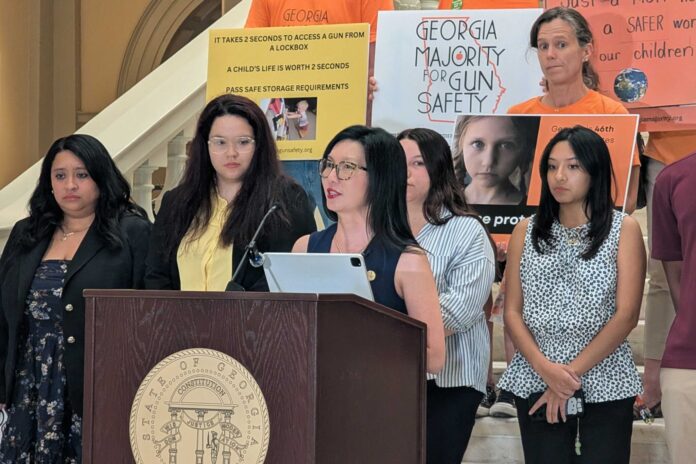
Rep. Michelle Au, a Johns Creek Democrat, at the Georgia State Capitol on Sept 4, 2025. (Alander Rocha/Georgia Recorder)

(Georgia Recorder) — Survivors of the deadly Apalachee High School shooting gathered alongside Georgia House Democrats at the state Capitol Thursday to renew calls for safe gun storage laws.

Students and family members joined state Rep. Michelle Au, a Johns Creek Democrat, and Georgia House Minority Leader Carolyn Hugley of Columbus for a press conference calling on lawmakers to pass legislation they believe is needed to prevent future attacks and arguing that current efforts are not enough to address the trauma and fear that now define their school experience. The Sept. 4, 2024, shooting in the Winder high school left two students and two teachers dead and nine other students injured.

“We all can agree in this room that we need to protect all our children. No child deserves to have the fear of having to go to school. No child deserves to experience what we have experienced. It’s not fair,” said Kyra Lynn McConatha, a recent Apalachee High School graduate who was in class during the attack. “This has followed me from high school and into college.”

Au has previously introduced a bill that would have required gun owners to secure their firearms in a locked container or with a gun lock when a minor is present. The bill failed to move in the 2025 legislative session, but it will remain active when lawmakers reconvene in January.

“To not even discuss [the bill], to not even allow bills like a pretty basic, safe storage bill to be heard in committee, to come to a vote, to be voted on the floor, is noticeable for Georgians and for voters,” Au said after the press conference.

Senate Majority Leader Jason Anavitarte, Dallas Republican, in a separate statement marked the one-year anniversary by saying that Georgia has since moved to protect schools from such deadly attacks. He pointed to House Bill 268, which he said was a result of working with victims’ families and school leaders. The new law, which went into effect on July 1, requires schools to have panic button systems for emergencies and share student data within five school days when a student transfers.

“Georgia has taken bold, practical steps to protect our children, teachers and everyone who sets foot in a school setting. We will continue to listen, learn and legislate with the conviction that school should always be a place of safety, not fear,” Anavitarte said in a statement.

Au responded to Anavitarte’s comment after the press conference, saying that the law was reactive rather than preventative.

“It’s a conspicuous omission to have a bill inspired by this event directed at school safety and have nothing in that bill or nothing in that legislative package that deals with gun safety,” Au said.

Sen. Frank Ginn, a Danielsville Republican who represents a part of Winder, said he attended the press conference after receiving an invite from Au to hear what the lawmakers and students had to say, despite not supporting the efforts to mandate safe gun storage. He said he would support a tax credit incentive for gun storage.

“The safest storage for a firearm is in the hands of somebody that knows how to use it, and I don’t want to put any obstacle in the way of a person who wants to defend themselves and protect their Second Amendment right,” Ginn said.

Layla Contreras, a 2019 Apalachee High School graduate and sister of Sasha Contreras, a current senior who was in class during the attack, said after the press conference that Au’s proposal is “a good start,” but they may have to make some changes to address Republicans’ concerns.

“We just want people to be responsible with it and to be educated on when firearms are around,” Layla Contreras said.

Sasha Contreras said that she has tried over the last year to stay positive and not let the attack define her. She has tried to keep up with schoolwork and is involved in extracurricular activities, but she said she still struggles to maintain her motivation.

“I still try my best to put my best smile on, and I enter that building as positive as I can be,” she said.

Despite shutdown deadline, little movement in Congress on spending deal

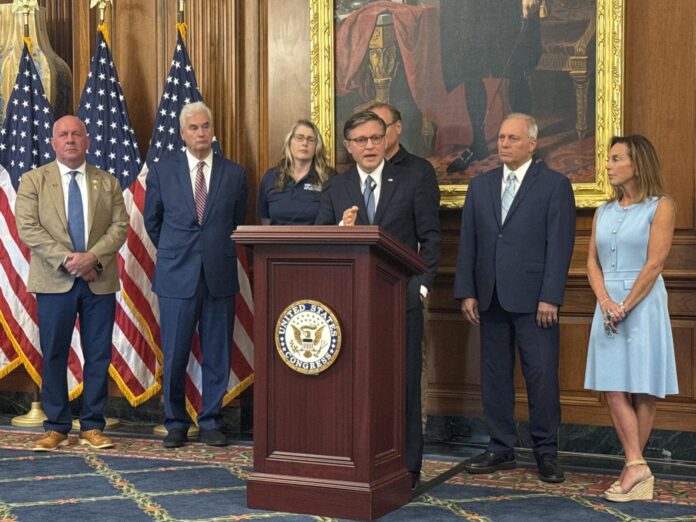
U.S. House Speaker Mike Johnson, R-La., takes questions from reporters during a press conference in the Rayburn Room of the Capitol building in Washington, D.C., on Wednesday, Sept. 3, 2025. Also pictured, from left to right, are Ohio Republican Rep. Dave Taylor; Majority Whip Tom Emmer R-Minn.; co-founders of Patriot Industries Sarah and Tom Click; Majority Leader Steve Scalise, R-La.; and Republican Conference Chairwoman Lisa McClain, R-Mich. (Jennifer Shutt/States Newsroom)

WASHINGTON (States Newsroom) — Members of Congress began searching for compromise on a short-term government funding bill Wednesday, with just a few weeks left to broker a deal before a possible shutdown.

Fresh off their August recess, congressional leaders and members of the Appropriations Committee appealed for bipartisanship from the other side while admitting they are far from a final agreement.

Speaker Mike Johnson, R-La., declined to say during a press conference whether he will negotiate a stopgap spending bill with Democrats, or use the go-at-it-alone approach that succeeded in March.

“Republicans are committed to keeping the government open, and unfortunately, it seems like not all Democrats agree with that, and they’re beginning to apply the government shutdown pressure,” Johnson said. “But I want you to remember one thing: All but one House Democrat voted to shut down the government in March, and we expect, sadly, that that may happen again.”

Johnson said he was open to negotiations with Democratic leaders as long as they “are willing to work with us and think responsibly about how we can spend less than we did last year.”

Senate Minority Leader Chuck Schumer said during an afternoon press conference that Democrats want GOP leaders to negotiate the stopgap spending bill across party lines.

“The bottom line is very simple: We Democrats want a bipartisan bill and we are pushing the Republicans very hard to do it,” Schumer said. “We’re on our front foot. We’re unified.”

Schumer, who took considerable flak for helping Republicans limit debate on a partisan stopgap bill in March, said “it’s much different than last time.”

Pressed by several reporters about what Democrats would help move through the Senate this time around, Schumer said: “We are willing to sit down and negotiate a bipartisan proposal with significant Democratic input. So far, they are not.”

Spending running on autopilot

The House and Senate are supposed to complete work on the dozen annual government funding bills by the start of the fiscal year on Oct. 1 but that hasn’t happened for decades, so lawmakers rely on a stopgap spending bill to keep federal departments and agencies running on autopilot for a couple months.

That measure, sometimes called a continuing resolution, is intended to give lawmakers a bit more time to complete bipartisan House-Senate negotiations on the full-year appropriations bills, though Congress used three CRs to fund the government this fiscal year instead of getting its work done.

Senate Majority Leader John Thune, R-S.D., said he expects lawmakers will need to approve a stopgap spending bill “for some time into the foreseeable future,” but that discussions are ongoing about how long it will last and what else might be added.

“My hope would be that whatever that CR looks like, that it is clean and that it enables us to buy some time to get a regular appropriations process done,” Thune said. “I still think the best way to fund the government is through the appropriations process.”

President Donald Trump said from the Oval Office earlier in the day that he expects Republicans will vote for a stopgap spending bill but he didn’t address how it would get through the Senate’s 60-vote legislative filibuster, which requires bipartisanship.

“I think the Republicans will vote for an extension,” Trump said. “We won’t have any Democrat votes.”

Three spending bills seen as possible

House Appropriations Chairman Tom Cole, R-Okla., told reporters he hopes to negotiate final versions of three full-year bills with the Senate before the end of the month.

Lawmakers would then use a stopgap spending bill to keep the departments and agencies covered in the other nine bills flat funded for a couple of months until the two chambers can reach final agreement on the spending levels and policy within those measures.

“We’re talking about relatively modest bills and bills where there is either broad agreement, like MilCon-VA, or LegBranch and Ag,” Cole said. “We’re not talking about major bills. You can’t really do that until you have a topline and we don’t have a topline.”

The Agriculture-FDA, Legislative Branch and Military Construction-VA spending bills are generally easier to negotiate than some of the other full-year measures, like Defense, Homeland Security and Labor-Health and Human Services-Education.

Cole said when House and Senate leaders begin negotiating a total spending level for all of the bills, or topline, is “above my paygrade.”

“I’m ready to do it at any time if they want to empower us, otherwise the leadership on both sides and the president have to” figure that out, Cole said.

The House and Senate are supposed to start off the annual government funding process in the spring by reaching bipartisan agreement on how much in total spending to spread throughout the dozen appropriations bills.

Those talks haven’t even started for fiscal 2026, which is slated to begin Oct. 1.

Instead, the House and Senate Appropriations committees have separately decided how much to spend and written vastly different versions of the bills.

House and Senate at odds

The 12 bills that have been released by the GOP-led House committee are partisan, while the eight bills released by the Senate panel have received broad bipartisan support in committee.

Senate Appropriations Chairwoman Susan Collins, R-Maine, said she’s spoken with Cole a couple of times about the three-bills-plus-stopgap strategy and supports the concept.

“I have and I agree with that approach,” Collins said.

Washington state Democratic Sen. Patty Murray, ranking member on the Appropriations Committee, said any stopgap bill “needs to be a real bipartisan compromise.”

“For the last few months we have shown a bipartisan way forward on the Appropriations Committee,” Murray said. “Democrats have shown that we are willing to work in good faith to write bipartisan funding bills that protect investments in education, life-saving research and a lot more.

“We’ve already passed eight out of the committee and three on the floor: MilCon-VA, Ag and LegBranch. As part of a bipartisan short-term CR, I support conferencing those three bills and passing them with the short-term CR for the remaining nine bills.”

House Appropriations ranking member Rosa DeLauro said “the best case scenario for us is to move forward.”

“No gimmicks, no riders, let’s clear the decks,” the Connecticut Democrat said. “Talk about how we get Republican priorities, Democratic priorities.”

Negotiations ‘for weeks now’

House Majority Leader Steve Scalise said “there’s a chance” to wrap up negotiations between the two chambers on final versions of some of the full-year government spending bills before the end of the month.

“It might not be all 12, but a few of them for sure,” Scalise said. “So let’s give the appropriators that opportunity to keep negotiating. They’ve already been having negotiations for weeks now — Tom Cole and a lot of his counterparts. I have faith they can hopefully get a lot of things done.”

Scalise, R-La., said he plans to reserve floor time later this month to  ensure whatever spending bill gets written is “the top priority.”

Rep. Robert Aderholt, chairman of the Labor-HHS-Education Appropriations Subcommittee, said he thinks most people agree there’s going to be some sort of stopgap given all 12 of the annual bills aren’t close to becoming law.

The Alabama Republican said this feat is “almost impossible” given the short number of legislative days left before the shutdown deadline.

“The solution, of course, obviously, or the only alternative, would be to have a CR, but I think the shorter the CR, the better,” he said, noting that the measure would have to be “long enough that you can have negotiations, but short enough that it doesn’t drag out until Christmas and that … we’re up here at Christmas doing an omnibus or something like that, which everybody wants to avoid.”

Congress has often bundled the final, conferenced versions of the dozen bills together into a sweeping omnibus package at the end of the year to ensure quick floor votes, though GOP leaders have tried to get away from that practice in recent years.

Rep. Chuck Edwards, a North Carolina Republican who sits on the House Appropriations Committee, said that while he hopes a stopgap spending bill is “not necessary,” the panel is “certainly prepared to put together a short-term CR if that’s what’s required to avoid a shutdown.”

Powerball jackpot soars to $1.70 billion, third largest in U.S. history

A Powerball lottery ticket is printed out of a lottery machine at a convenience store in Northbrook, Ill., Wednesday, Sept. 3, 2025. (AP Photo/Nam Y. Huh)

The Powerball jackpot has reached an estimated $1.70 billion for Saturday night’s drawing, making it the third-largest lottery prize in U.S. history. The cash option for the jackpot stands at $770.3 million before taxes.

The prize surged after no ticket matched all six numbers in Wednesday night’s drawing: 3, 16, 29, 61, 69, and red Powerball 22, with a Power Play multiplier of 2.

While no one hit the jackpot, more than 6.3 million tickets across the country won prizes. Eleven tickets matched all five white balls to win $1 million each, including two sold in Georgia, in Commerce and Atlanta.

The current jackpot chase has now rolled 41 times since it was last hit on May 31 in California, breaking the record for the most consecutive drawings without a winner.
If claimed on Saturday, the winner will choose between the $1.70 billion annuity, paid over 30 years with 5% annual increases, or the $770.3 million lump sum.

Top Powerball jackpots:
$2.04B – Nov. 7, 2022 (CA)
$1.765B – Oct. 11, 2023 (CA)
$1.70B – Sept. 6, 2025 (estimated)
$1.586B – Jan. 13, 2016 (CA, FL, TN)
$1.326B – Apr. 6, 2024 (OR)

SEE ALSO

Commerce store sells $1M Powerball ticket

GBI autopsy results final for Columbus political activist

J Nathan Smith (Facebook)

A Georgia medical examiner has confirmed that a local political activist took his own life May 21st, 2025.  The Muscogee County Coroner Buddy Bryan initially ruled the death of J Nathan Smith as a suicide but after public outcry suggesting something more sinister, the body was sent to the GBI crime lab for further investigation.

According to the final report the cause of death for Smith is a gunshot wound to the torso and the manner of death is suicide. The local political activist used a .25 caliber weapon to shoot himself in the chest after leaving an 8-page letter to his wife and pastor.

Smith was known for frequenting local government meetings. He spent his final months routinely appearing before City Council calling for the ouster of city manager Isaiah Hugley. Less than a week after Smith’s suicide councilors voted to fire the city manager.

Korean magnet facility to create more than 500 jobs

Governor Brian Kemp announced Wednesday that JS Link intends to invest about $223 million to establish a new rare earth permanent magnet manufacturing facility in Columbus. The new facility will create more than 520 jobs in Muscogee County.

Founded originally in 2000, JS Link is a Korean biotechnology company that specializes in  research and development. The company expanded its business to include the production of permanent magnets, which are a critical component in a vast array of industries including automobiles, wind turbines, elevators, home appliances, consumer electronics as well as defense systems. “JS Link America strengthens Georgia’s role in securing the U.S. supply chain in industries such as aerospace, mobility and energy” said Governor Kemp.

The new manufacturing facility will be located at the Muscogee Technology Park in Columbus. Operations are expected to begin in late 2027. JS Link America will be hiring for engineering, production, construction, administrative and management roles.

Annunciation parents to Vice President Vance: ‘Move your feet’

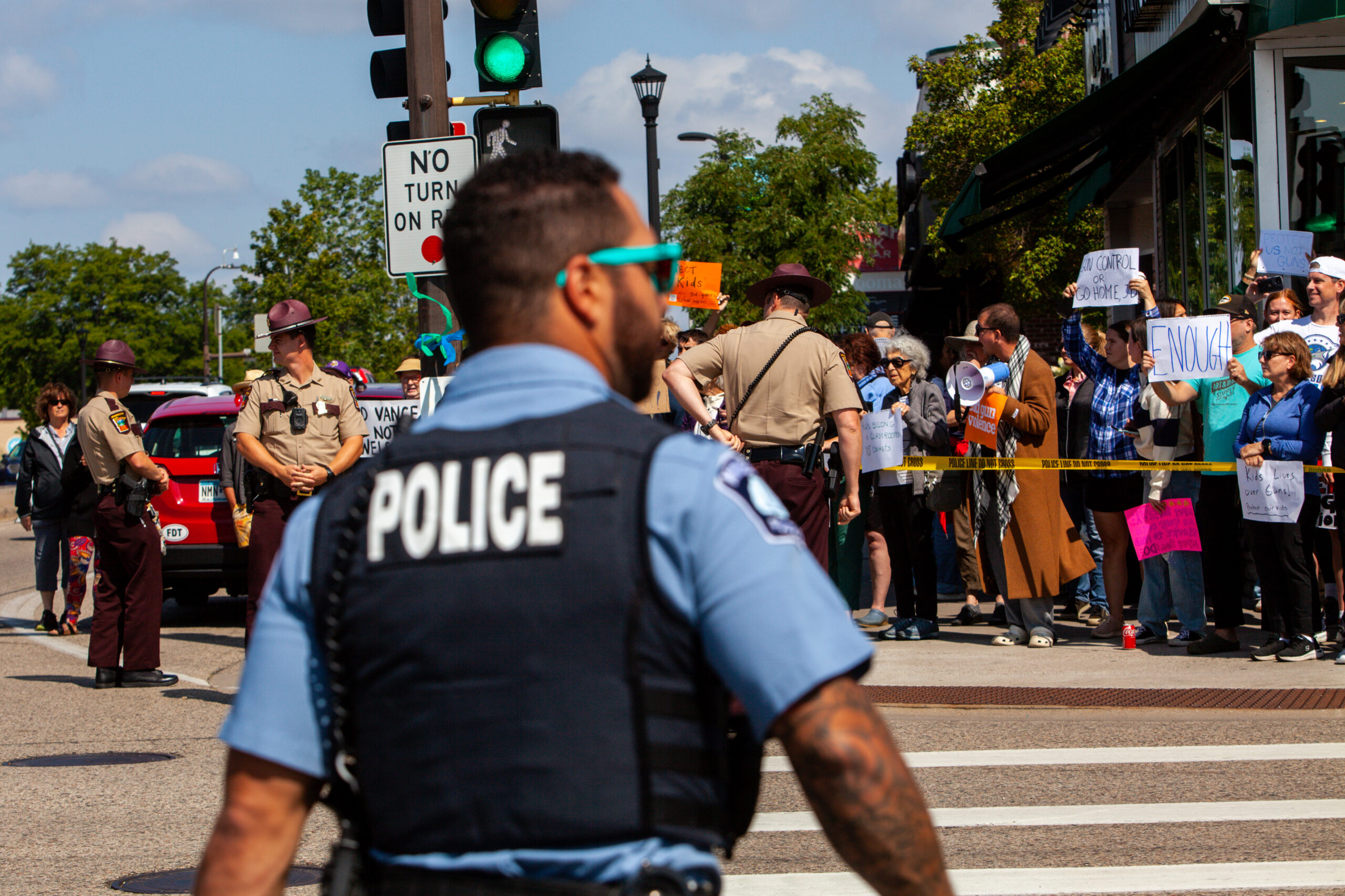
Vice President JD Vance and his wife second lady Usha Vance, arrive to pay their respects to victims of the Annunciation Catholic Church shooting in Minneapolis, Minn., Wednesday, Sept. 3, 2025. (Alex Wroblewski/ Pool via AP)

(Minnesota Reformer) — Vice President JD Vance and second lady Usha Vance visited Annunciation Catholic school and church Wednesday afternoon, one week after a shooter opened fire on the school’s first Mass of the year, killing two and injuring 21.

The Vances also visited 10-year-old Lydia Kaiser, who was critically injured in the shooting, at Children’s Minnesota in Minneapolis.

Kaiser was shot while protecting her younger “buddy,” according to the family’s GoFundMe. Her father, Harry Kaiser, is a gym teacher at Annunciation who was also in attendance at Mass; he stayed with students, reuniting families, while his daughter was rushed to the hospital.

In a press conference Wednesday afternoon at Children’s, Harry Kaiser read aloud the message that he shared with Vance during the visit:

“Will you please promise me, as a father and a Catholic, that you will earnestly support the study of our culture, that we are the country that has the worst mass shooter problem? … Will you please promise to pursue, despite powerful lobbies, some commonsense, bipartisan legislation as a starting point, so we can come out of our corners and find the values that we share, so that this time, progress is made?”

Speaking with the press before boarding his flight back to D.C., Vance said he’s “never had a day that will stay with me like this day did.” He asked the public for prayers for one child victim of the shooting who is still in critical condition — 12-year-old Sophia Forchas — and said he would honor the families affected by the shooting by hugging his children and saying he loves them.

A group of protestors gathers near Annunciation Church Wednesday, Sept. 3, 2025 as Vice President JD Vance visits the site of the school shooting that left two children dead and more than a dozen others injured in south Minneapolis. (Photo by Nicole Neri/Minnesota Reformer)

Asked about Gov. Tim Walz’s plan to call a special session of the Minnesota Legislature to address mass shootings, Vance said he won’t tell Minnesota leaders how to respond.

“I think that there’s a strong desire from across the political spectrum to do something so that these shootings are less common. I think that it’s important that they actually take steps that are favorable, that are going to work,” Vance said.

Leah Kaiser, the mother of Lydia, referenced a proverb — quoted by Annunciation Principal Matthew DeBoer shortly after the shooting — that goes, “When you pray, move your feet.”

“Vice President Vance, you have enormous authority. Please, use this moment to move your feet and transcend our political divides to promote peace, and unity, and hope,” Leah Kaiser said.

On the sidewalk outside of Annunciation, someone wrote the prayer of St. Francis — the same prayer House Speaker Emerita Melissa Hortman, who was assassinated earlier this summer, carried in her wallet:

Lord, make me an instrument of your peace:
where there is hatred, let me sow love;
where there is injury, pardon;
where there is doubt, faith;
where there is despair, hope;
where there is darkness, light;
where there is sadness, joy.

Jury awards $615K to former Piedmont professor in wrongful termination case

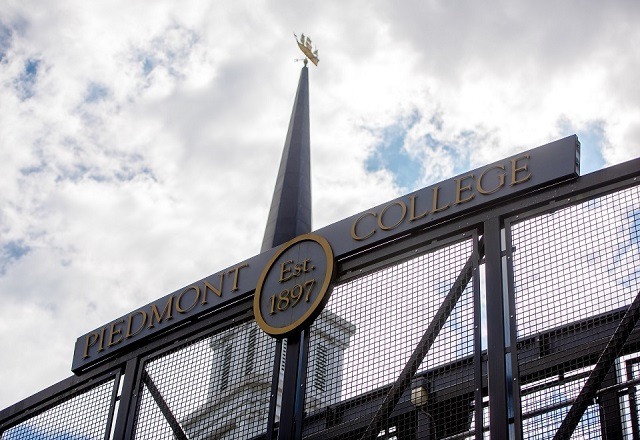
File photo (NowHabersham.com)

A jury has ruled in favor of former Piedmont College biology professor Dr. Robert Wainberg, awarding him $615,000 in his wrongful termination case against the institution. The verdict closes a major chapter in a years-long dispute that centered on claims of retaliation, breach of contract, and bad faith.

Wainberg, who taught at Piedmont from 1988 until his dismissal in 2018, argued that the college retaliated against him for speaking out against what he described as “the administration’s violations of academic integrity.” He alleged the school denied him the protections guaranteed by tenure, fired him before he was questioned, and withheld exculpatory evidence — including student testimony in his favor — from the Board that upheld his dismissal.

7 years of litigation

In his complaint, Wainberg also claimed Piedmont officials engaged in secret, closed-door conversations with the Board during his hearing, leaving him outside without the chance to respond. The loss of his job, income, and health insurance, his attorneys argued, created financial hardship and put his health at risk while dealing with a serious illness.

The 576-page lawsuit filed in Habersham County Superior Court in August 2018 claims Piedmont administrators “encouraged a disgruntled student” to file a Title IX sexual harassment complaint against Wainberg. It was a claim he steadfastly denied throughout the proceedings, which eventually wound up in federal court.

During court proceedings on Friday, August 29, Judge Mark Cohen denied defense motions to dismiss the bad faith claim and limit damages. Jurors deliberated before siding with Wainberg, opening the door for his legal team to petition the court for $2 million in attorneys’ fees.

“The jury’s verdict was a resounding rebuke to Piedmont University’s bad faith actions against Dr. Wainberg by retaliating against him for speaking truth to power,” said Wainberg’s lead attorney Julie Oinonen. “We are grateful for the opportunity to have cleared Dr. Wainberg’s good name after his thirty years of dedicated service to the institution.”

Another lawsuit still pending

Piedmont’s attorneys did not immediately respond to Now Habersham’s requests for comment. However, university president Marshall Criser issued this statement:

“At Piedmont University, the safety and well-being of our students will always be our top priority. We believe every student should feel safe, supported, and confident that their concerns will be heard. We would rather err on the side of caution than risk overlooking something important. That means taking concerns seriously, acting promptly, and ensuring the right resources are in place to provide support and resolution.”

Oinonen confirmed her client will submit the attorney fee petition within the next 30 days.

There is still another lawsuit pending against Piedmont’s former president, Dr. James Mellichamp, and several members of the university’s Board of Trustees for allegedly conspiring to violate Wainberg’s civil rights.

“We hope that Piedmont will come to the table and agree to mediate in order to fairly resolve this final dispute,” she told Now Habersham. Speaking on her client’s behalf, Oinonen added, “Dr. Wainberg thanks the many courageous former colleagues and students who showed integrity by courageously testifying truthfully on his behalf.”

Piedmont University has not said whether it will appeal.