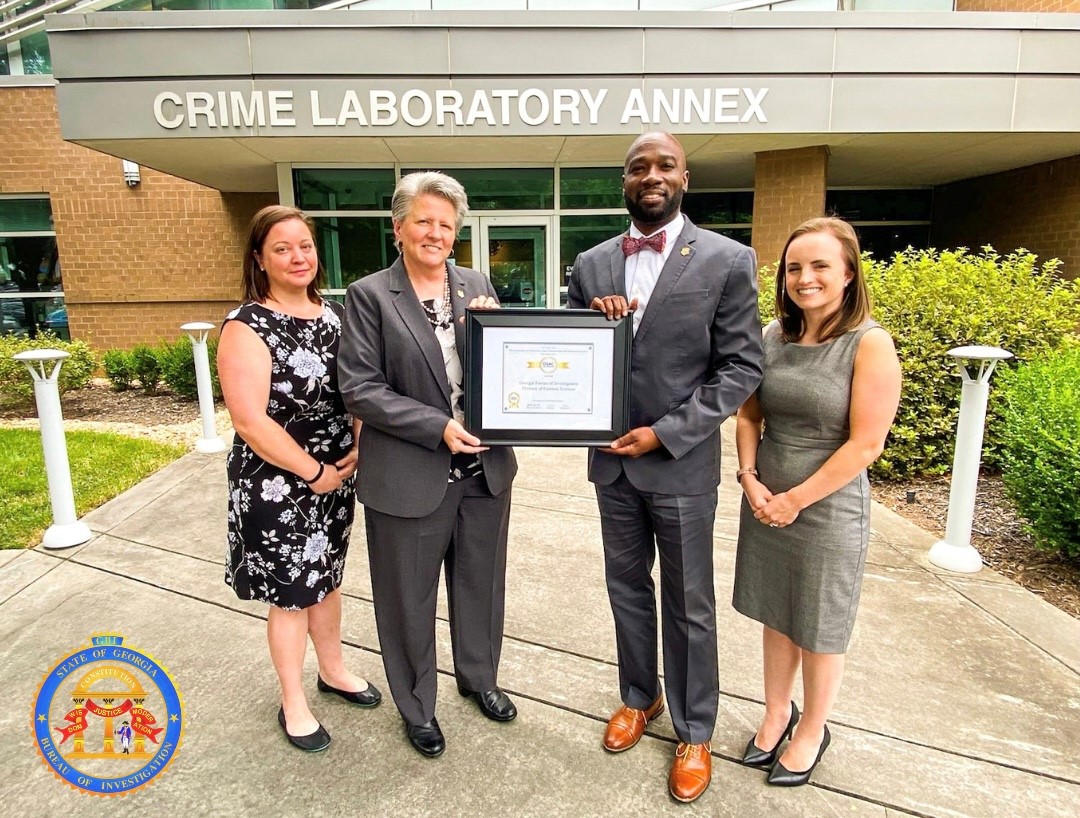
Pictured, left to right, are Lori Nix - Crime Lab Assistant Deputy Director, Tammy Jergovich - Crime Lab Assistant Deputy Director, Cleveland Miles - Crime Lab Deputy Director, Mary Katherine Clear - Crime Lab Quality Manager.
The Organization of Scientific Area Committees for Forensic Science has recognized the GBI Crime lab for implementing nationally recognized standards for its forensic laboratory system. The state agency voluntarily implemented OSAC standards in 2020.
OSAC, led by the National Institute of Standards and Technology, promotes standardization in forensic science to bolster public confidence in the work. When applicable standards are added to the OSAC Registry, scientists in the laboratory review them. If the lab is not meeting the standard, they develop a plan to meet it.
To date, 25 U.S. labs have been recognized as OSAC standard implementers. The GBI Crime Lab in Decatur received the first certificate.
“The GBI Crime Lab is committed to providing superior forensic services to our patrons and citizens,” says Crime Lab Director Cleveland Miles. “The work that we do is of the utmost importance, so, the responsibility to do our best is not taken lightly.”
Adds Miles, “We embrace the idea of self-examination and align our processes with the top standards in the forensic field. This is how we drive ourselves as a laboratory system to produce the best quality work product possible. To know better is to do better.”
The GBI Crime Lab currently has five OSAC members and affiliates representing the lab’s Trace Evidence, Drug Identification, & Impressions sections.
The Georgia Council for the Arts awarded two FY 2022 grants to the Sautee Nacoochee Community Association. The GCA grant panel commended SNCA for its handling of the pandemic, especially the quick formation of a COVID-19 Sustainability Committee. The panel also commended SNCA for offering a wide variety of arts programming to the Northeast Georgia community. (photo SNCA Facebook)
Fifteen Northeast Georgia organizations will benefit from the first round of grant funding released by the Georgia Council for the Arts this fiscal year. Tallulah Falls School, Main Street Toccoa, and the Sautee Nacoochee Community Association are among them.
The arts council awarded a total of 266 grants that will provide more than $2 million in funding to organizations statewide. Regionally, the grants will help organizations in Clarke, Habersham, Hall, Oconee, Rabun, Stephens, Union, and White counties. Other area grant recipients include Rabun County’s Southern Highlands Music Foundation and Hambidge Center for the Creative Arts and Sciences, as well as Hall County’s Arts Council, among others.
When announcing the awards, GCA Executive Director Tina Lilly said, “As we emerge from this past year’s quarantine, the arts sector is vital to restarting the economy by attracting tourists, assisting with classroom learning, and igniting events to bring communities back together.”
GCA is a division of the Georgia Department of Economic Development. Its grants are funded through appropriations from the Georgia General Assembly, the National Endowment for the Arts, and, this year, $904,000 from the American Rescue Plan.
Grant recipients include theaters, dance companies, museums, schools, cities, colleges, and multi-discipline arts entities.
“Considering the numerous challenges faced by arts organizations during the pandemic, we are particularly pleased to distribute this funding to help these organizations create, innovate, and flourish,” said state economic development director Pat Wilson. “Ultimately, these grants will be felt widely as they benefit our economy and contribute to the vibrancy of our state.”
Here’s a breakdown of where the grant funding is going in Northeast Georgia:
Bridge Grants
Funding to support non-profit arts organizations recovering from COVID-19 shutdowns.
CLARKE
Athens Choral Society, Inc
ATHICA
Canopy Studio Inc
Nuçi’s Space
The Classic Center Cultural Foundation HALL
The Arts Council, Inc. Hall RABUN
Hambidge Center for the Creative Arts and Sciences WHITE
Sautee Nacoochee Community Association
Project Grants
Funding to support one-time arts events, or a series of events. CLARKE
AthFest, Inc OCONEE
Oconee Cultural Arts Foundation STEPHENS
Main Street Toccoa UNION
Georgia Mountain Storytelling Festival
Arts Education Program Grants
Funding for arts education programs produced by organizations and/or schools located in Georgia.
CLARKE
University of Georgia Research Foundation HABERSHAM
Tallulah Falls School OCONEE
Oconee Cultural Arts Foundation RABUN
Southern Highland Music Foundation WHITE
Sautee Nacoochee Community Association
Additional grants for Vibrant Communities and Cultural Facilities programs will be awarded this fall. A complete list of the first-round fiscal year 2022 grantees can be found here.
According to GCA, Georgia’s creative industries have a reported $62.5 billion impact on the economy, generating roughly $37 billion in revenue and accounting for about 140,000 jobs in the state.
CLEVELAND – The White County Board of Commissioners has previously announced that they want to maintain the current tax millage rate of 10.75; however, since the rollback rate is lower than the current millage rate, an increase of 5.36 percent is necessary to meet the 10.75 rate.
This tentative increase will result in a millage rate of 10.750 mills, an increase of .547 mills over the rollback rate. Without this tentative tax increase, the millage rate will be no more than 10.203 mills. The proposed tax increase for a home with a fair market value of $180,000.00 is approximately $38.29. The proposed tax increase for non-homestead property with a fair market value of $140,000.00 is approximately $30.63.
State law requires municipalities and counties to “roll back” their millage rate after reassessment of property values to ensure local governments receive the same amount of revenue from property taxes after reassessment as they did before.
With that in mind, the commissioners have announced that in order to maintain the same millage rate – state law requires that they advertise to announce a potential tax increase and hold three (3) public hearings on the issue.
To meet that requirement, the commissioners will hold public hearings on Monday, July 26, at 8:30 AM and 6 PM, and Monday, August 2 at 4:30 PM. All concerned citizens are invited to any or all of the public hearings which will be held at the County Administration Building located at 1235 Helen Hwy Cleveland.
If you’re looking for help with stray animals or information about adopting a pet from the shelter in White County, there’s a new number to call.
White County Public Safety Director David Murphy says Animal Control had some issues with their old phone system, so, the shelter set up a new phone using the county’s VOIP system.
The new number is 706-219-7881. Please make a note of the new number in case you need to contact them.
To view pets currently up for adoption from the White County animal shelter, click here. The shelter is located at 680 Industrial Boulevard in Cleveland.
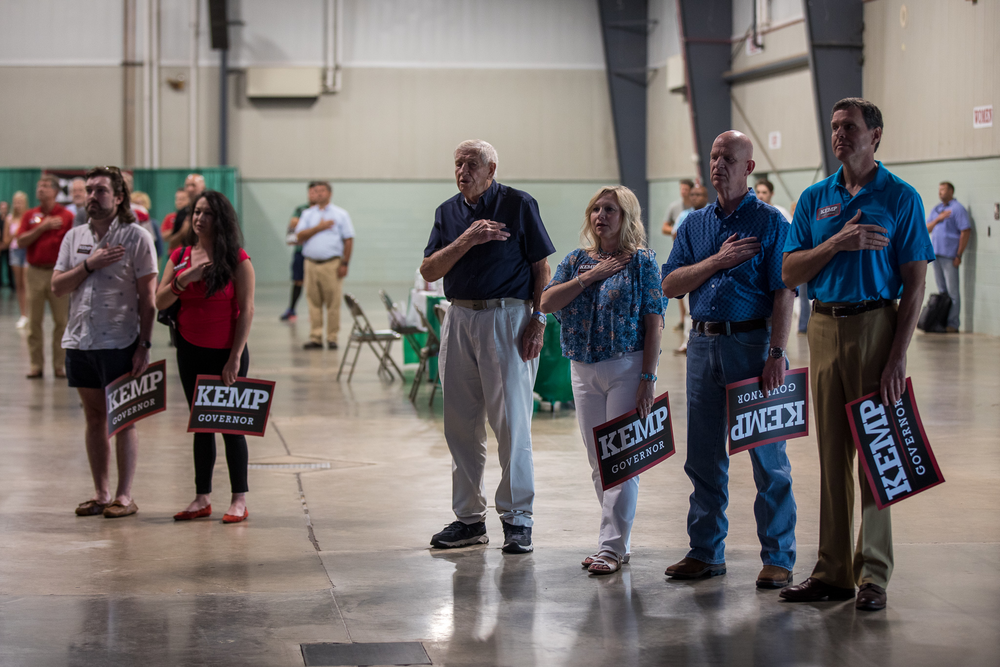
Gov. Brian Kemp kicks off his reelection campaign at the Georgia National Fairgrounds on July 10, 2021. (Riley Bunch/GPB News)
PERRY (GPB) — Attacked by some Republicans for not supporting the former president enough and vilified by Democrats for being too much like Donald Trump, Gov. Brian Kemp formally launched his reelection bid Saturday fighting back against his detractors.
The Athens Republican ticked through his accomplishments to a roomful of supporters at the Georgia National Fairgrounds in Perry, from an historic teacher pay raise to cracking down on street gangs to managing Georgia’s growing economy, especially outside metro Atlanta.
“I’ve also held my commitment to fight for rural Georgia, to strengthen rural Georgia,” he said. “We have created a promise of a rural strike team; we have been laser-focused on rural broadband.”
Conservative voters in rural Georgia are a core constituency for Republicans, and even the slightest drop in turnout and support could prove the difference-maker in a closely divided state — something the party saw firsthand in the dual Senate runoffs.
“In Houston County alone, David Perdue got 41,428 votes [in November]. … In January, he got 36,700,” U.S. Rep. Austin Scott (R-Tifton) said. “Let me tell you something: We can’t let that happen again.”
Former President Trump in particular spent months attacking Georgia, its election system and any leader who refused to overturn its results, including Kemp.
That rift within the Republican Party has complicated his reelection bid and led to at least two challengers, including former Democrat-turned Pro-Trump insurgent Vernon Jones, who has launched blistering attacks on Kemp and the state’s voting system. A favorite target of the former president’s anger after losing the November election, the governor has since launched a string of efforts to win back his deep-red base.
In recent weeks, Kemp has waded into the fray over “Critical Race Theory,” banned vaccine passports and took a trip to the U.S.-Mexico border while attacking the “woke mob” and “cancel culture” after multiple groups sued over Georgia’s sweeping new voting law.
“I will make this commitment to you: I will not waver in that fight,” he said. “I don’t care if it’s the Justice Department, Major League Baseball or anyone else. Every single Republican voted for that bill. And we’re going to continue to defend it, because the truth is on our side.”
Gov. Brian Kemp touted his track record as governor during the launch of his reelection campaign in Perry, Ga., on July 10. (Riley Bunch/ GPB News)
After the slim margins of the 2020 election, Georgia’s politics have been thrust into the national spotlight. Kemp doesn’t mind.
“I know there’s some that are worried about the race getting nationalized,” Kemp told reporters after his speech. “I personally think the Democrats did a good job in nationalizing races in the state of Georgia [in 2020]. And Republicans didn’t have a good message to combat that.”
But the governor said this time, he feels the script has flipped and national Democratic policies could end up hurting them in Georgia.
Kemp said his message is going to be the same in Perry as it is inside the Perimeter: He’s the one that will make a safer, stronger Georgia.
“Voters are smart. They’re gonna figure out where people stand,” he told reporters. “I’m just reminding people today of what I campaigned on, what was accomplished and really what the fight is for the future.”
Speaking of the future, Kemp enters the second half of 2020 with more than $9 million in the bank and a fresh ad attacking the decision to move the Major League Baseball All-Star Game and a defense of the new voting law.
Betty Bryant, who serves on the Spalding County election board, said Kemp was a man of integrity who hasn’t let conservatives down, despite disappointment from some grassroots voters that the governor certified the election for President Joe Biden.
“I think for reasons that are unknown to us, he did the things he did,” she said. “He knows the law; we don’t. And I’m going to be supporting him again.”
After Democrats flipped the state’s electoral votes and both U.S. Senate seats, Bryant said Republicans are pulling out all the stops to keep control of the state.
“The tables have turned, and we are determined to not let the state go blue,” she said. “We are not going to let it happen. It’s going to stay red and Kemp will stay in the governor’s mansion.”
Forsyth resident Ann Haines has also supported Kemp since 2018 and said he has since given her no reason to change her mind.
“He’s always been truthful,” she said. “I’ve not heard him tell a lie or try to hide anything. He’s been very open and that gives me reason to support him.”
Supporters of Republican Gov. Brian Kemp gather at the Georgia National Fairgrounds in Perry, Ga., on July 10, 2021, to support his reelection bid. (Riley Bunch/GPB News)
As COVID-19 sickened hundreds of thousands, the first-term governor struggled to manage the pandemic and faced harsh scrutiny for reopening the state. But Georgia’s economy rebounded, giving him a key talking point for his campaign.
In rural areas, where Georgians pushed back against the dangers of the pandemic and the vaccination rates continue to fall short of that in metro areas, Haines said the Republican governor did his best to control the spread of the virus.
“It was a challenge from the get-go in Georgia. A lot of people didn’t think it was happening. I, for one, was kind of on the bubble,” she said. “Then I realized I had friends getting sick. So you had to realize things had to be done. I think he did as well as any governor could have.”
While some Republicans are keen on stoking the fires of division in an effort to excite the base, others have credited Kemp for not wavering to the pro-Trump conspiracies that have taken over Georgia politics.
“The Republican Party needs to pull together instead of pushing apart,” Forsyth resident Haines said. “And the only way to do that is find what we have common ground on.”
This story comes to Now Habersham through a reporting partnership with GPB News, a non-profit newsroom covering the state of Georgia.
There’s no real profile for the victims. They don’t appear to fit into any particular economic, racial, or ethnic grouping.
The rising numbers of opioid overdoses “seem to hit everyone,’’ says Dr. Dan McCollum, an emergency medicine physician at Augusta University Medical Center. “It hits all economic strata.’’
Even age is no longer the factor it used to be. Overdose patients coming into ERs are increasingly middle-aged and older, as compared to youthful drug users in past decades, he said Friday.
“We’re seeing a great deal of fentanyl being used,’’ he added. “The scary thing is that it hits so fast. It can stop your breathing so quickly.’’
The opioid overdose stats have jumped statewide, alarming public health and medical experts.
McCollum
According to data from the state Department of Public Health released last week, Georgia saw a big jump in opioid-related overdose deaths last year, fueled by a doubling of the number of fatalities involving fentanyl.
Overall, opioid overdose deaths rose by 36 percent in 2020.
And those increases have continued in the early months of this year, with fentanyl again a major driver.
The COVID-19 pandemic has played a large role in the overdose spike, experts say.
The pandemic has created “a perfect storm’’ for the opioid crisis, said Hannah Cooper of Emory’s Rollins School of Public Health.
A synthetic scourge
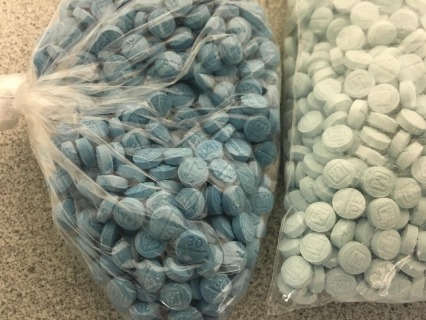
Fentanyl is a powerful synthetic opioid that’s 50 times more potent than heroin. It is a prescription drug that is made and used illegally and is commonly found at the street level in counterfeit pills or powder form. Fentanyl is often mixed with other drugs.
“Just about everything, from cocaine to meth to heroin, has fentanyl and [its derivative] carfentanil in it,’’ Neil Campbell, executive director of the Georgia Council on Substance Abuse, said Friday. “There are some really dangerous chemicals out there that are killing people.’’
The areas of the state with the highest rates of opioid deaths last year include the northwest region of the state, the East Central district – based in Augusta — and the Cobb/Douglas health district in metro Atlanta.
This year, a high number of emergency room visits related to opioid overdoses have come in other areas as well, including Macon/Bibb County and Carroll County in west Georgia.
Suspected overdoses in Chatham County numbered 368 in 2020, but this year, from Jan. 1 to April 19, there have already been 336 suspected overdoses, the Savannah Morning News reported.
“I don’t think that there is any overwhelming demographic for drug use or overdose. It attacks all,” Chatham Emergency Services CEO Chuck Kearns told the newspaper. “It’s nondiscriminatory.”
Not just Georgia’s problem
The spike has occurred nationally as well. The CDC reported that more than 81,000 drug overdose deaths occurred in the United States in the 12 months ending in May 2020, the highest number of overdose deaths ever recorded in a 12-month period.
While overdose deaths were already increasing in the months before the pandemic, the CDC said, the latest numbers suggested an acceleration of overdose deaths as the virus spread.
Cooper
Cooper, who is Rollins Chair of Substance Use Disorders at Emory’s Rollins School of Public Health, said fentanyl had already become more widespread than ever when COVID hit.
Because of the pandemic shutdowns, she said, the availability of the dangerous drug was coupled with a decrease in access to drug treatment and social services.
In addition, Cooper said, the pandemic’s “shock to the economic and social systems’’ helped lead to isolation, creating depression and anxiety, which can increase drug use.
She called for wider access to Naloxone, a medication that can rapidly reverse an opioid overdose, and to test strips for users to detect whether fentanyl is present in a drug.
Cooper added that drug treatment services should be available “on demand,’’ and the problem of homelessness should be addressed.
The opioid crisis “is creating tremendous suffering in our communities,’’ she said. “Georgia is trying to mount more of a response to overdoses,’’ Cooper added.
Addictions appear to be rising across the board, she and others say.
McCollum said he’s seeing an increase in alcohol-related problems as well.
“We’re seeing a great deal of suicidality,’’ he said. “We’re going to have to approach [the crisis] from multiple directions.’’
The Boss Baby 2: Family Business is another animated sequel that pretty much delivers everything it’s supposed to except one thing — a reason for existing. This is another example of a movie becoming a franchise just to see how much it can drain the cash cow before it’s empty.
Alec Baldwin returns as the voice of Ted Templeton and James Marsden is his brother, Tim. The movie is set 30 years after the first one and both babies are now adults going different ways in life: Ted is a successful CEO while Tim is a stay-at-home dad.
Tim tries so hard to be a great dad, but his oldest daughter Tabitha (Ariana Greenblatt) is now a teenager and distancing herself from him. It isn’t long before Ted reenters the picture due to that tired old cliché of someone in the family in “trouble” and needing his help.
Amy Sedaris is the voice of Tina, an undercover Boss Baby as well as Tim’s daughter and Tabitha’s sister. She’s asked the two brothers to go undercover at Tabitha’s school because she suspects something is wrong. The brothers are given a magic formula that will turn them into babies again for 48 hours so that they can investigate. Thus, they are babies once more.
Jeff Goldblum is the voice of Dr. Armstrong, the head of the school who wants to eliminate all adults in the world and have it run by babies. This is a plot device where its execution is so derivative that Gru from Despicable Me would probably think it’s lame.
Family Business is one of those movies that is so off-the-wall in terms of its energy and so dull when it comes to humor. Baldwin and Co. try to make the most out of the material, but they never reach escape velocity.
A lot of time and attention is given to its zany antics and its forced message about the importance of family being there for each other. Not to mention, the pop culture references to The Shawshank Redemption, Gladiator, and Lord of the Rings feel completely unnecessary and out of place.
This isn’t a bad movie — it’s more misguided. I think kids will enjoy it, but everyone else will hope that if this series continues, the next one will have a better script.
Grade: C+
(Rated PG for rude humor, mild language and some action.)
Campmeeting in the City was held in a large tent on the church grounds two years ago. (Photo provided by FUMC)
First United Methodist Church of Clarkesville, Georgia, has been holding campmeeting for years and years. Jennifer Boydstun, a staff member of the church, recalls campmeetings were going strong when she and her family came to the church in the mid-1980s. Boydstun remembers, “Usually what that looked like was informal dress (leave the suit and tie at home!) and singing songs from the Cokesbury Hymnal. It was a time of celebrating the heritage of the Methodist Church and incorporating the historic campground meeting feeling inside the sanctuary on a Sunday morning.” Boydstun said that even the Sunday bulletin would have a different “vintage” look to it.
Pastor Keith Cox changed the terminology from Campmeeting Month to Campmeeting in the City. Two years ago, camp meetings were held in a large tent on the church grounds. This year, concerned about the weather and the bugs, the church has planned the event to be held inside Fellowship Hall. The Fellowship Hall will be transformed to have a “campmeeting feel” without the dirt on the floor.
Campmeeting in the City will be held each Sunday in August. Three of the evening meetings will be community worship services led by pastors and choirs from three other Habersham churches.
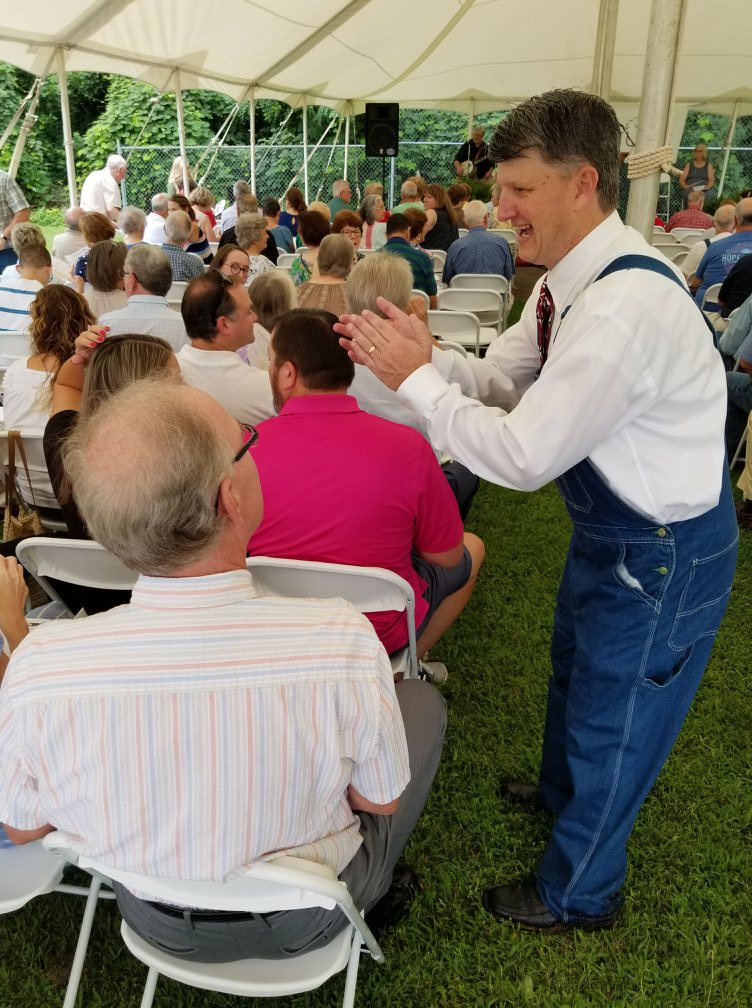
Rev. Keith Cox, pastor of Clarkesville FUMC, greets the crowd at Campmeeting in the City in 2019. (Photo provided by FUMC)
Campmeeting schedule is:
August 1 – 10 am: One Worship followed by a covered dish luncheon
August 8 – 9AM and 11AM worship. 6PM worship led by Clarkesville FUMC.
August 15 – 9AM and 11AM worship. 6PM worship led by Shady Grove Baptist Church of Cornelia, Georgia.
August 22 – 9AM and 11AM worship. 6PM worship led by Life Church of Cornelia, Georgia.
August 29 – 9AM and 11AM worship. 6PM worship led by Ebenezer United Methodist Church of Clarkesville, Georgia.
For more information, contact Rev. Keith Cox at 706-754-2677. Clarkesville First United Methodist Church is located at 1o8 Washington Street in Clarkesville, Georgia.
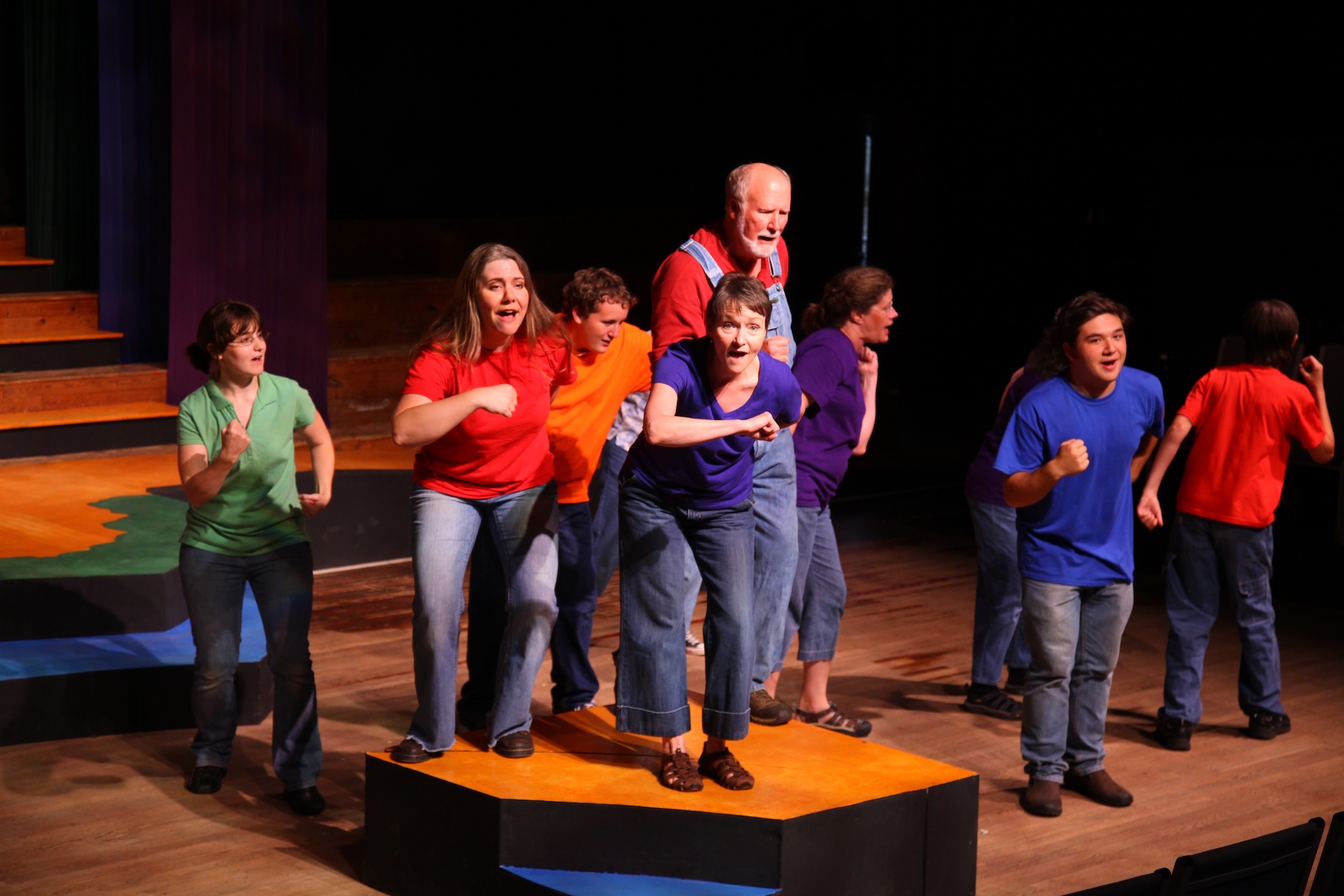
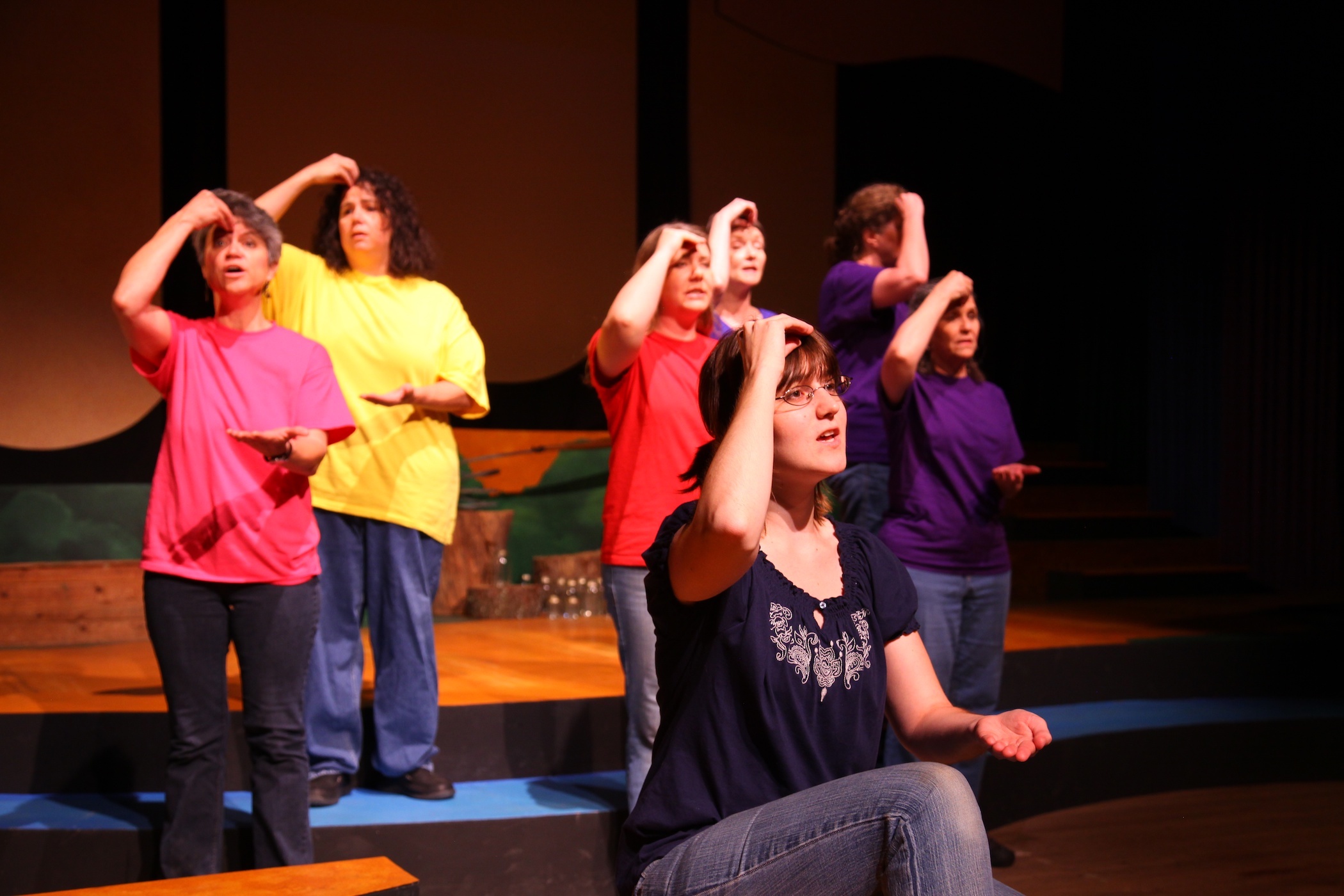
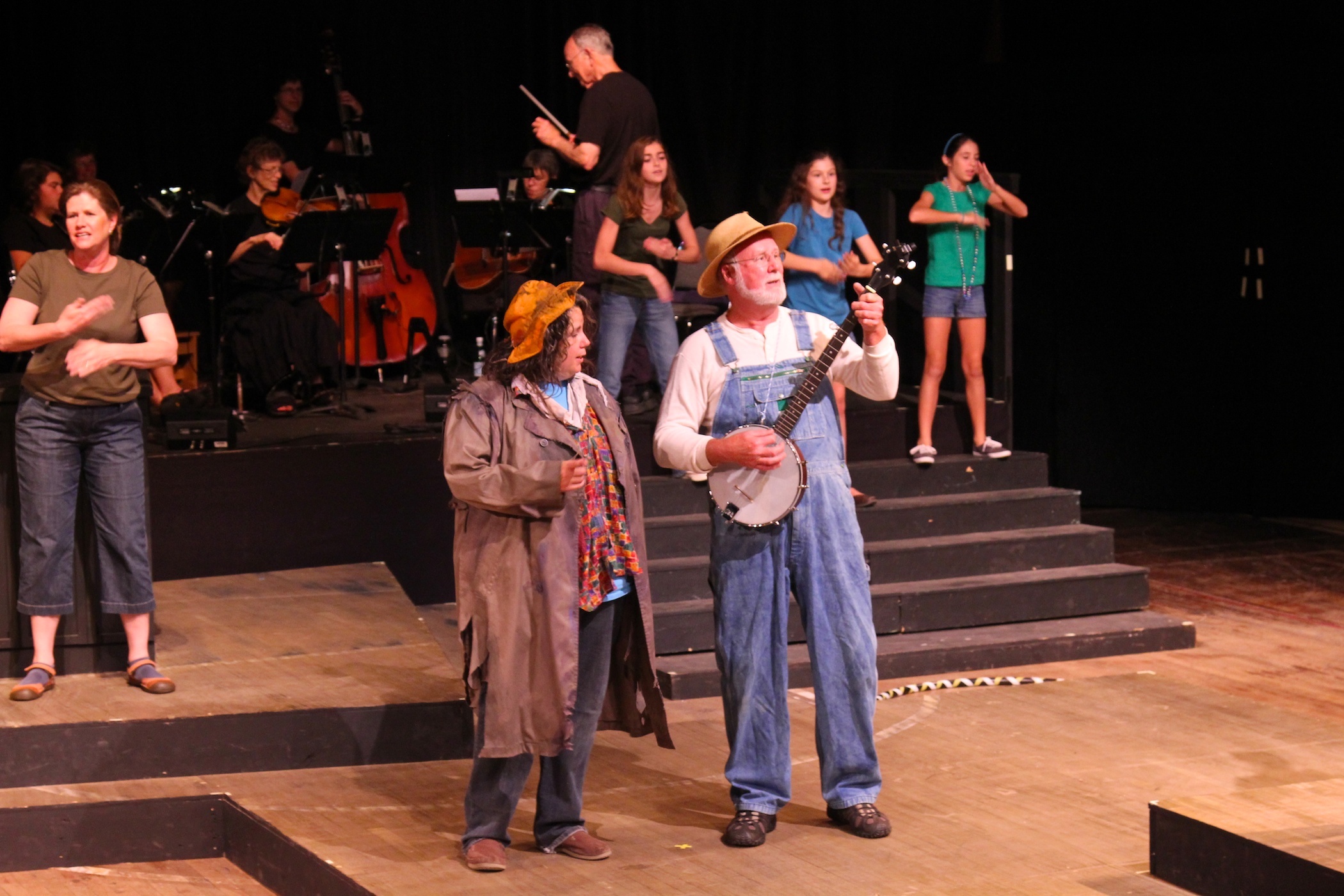
Sautee Nacoochee Cultural Center announces Headwaters Reunion Concert, July 17-18 (Photo SNCC)
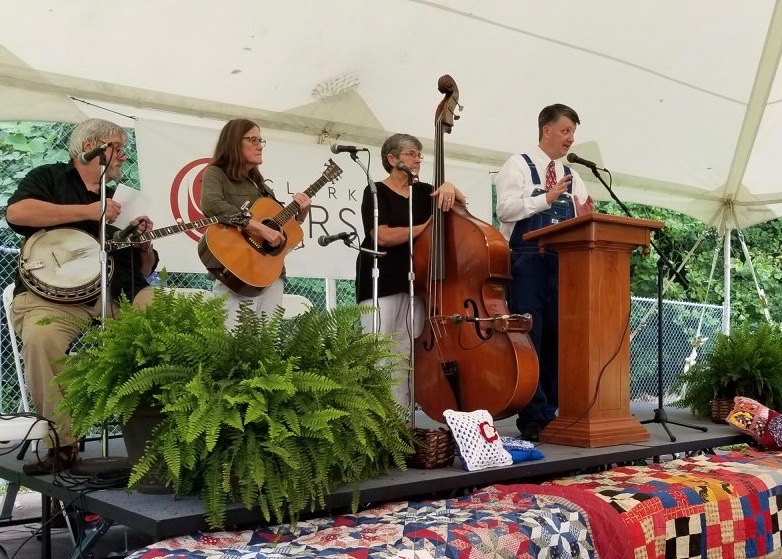
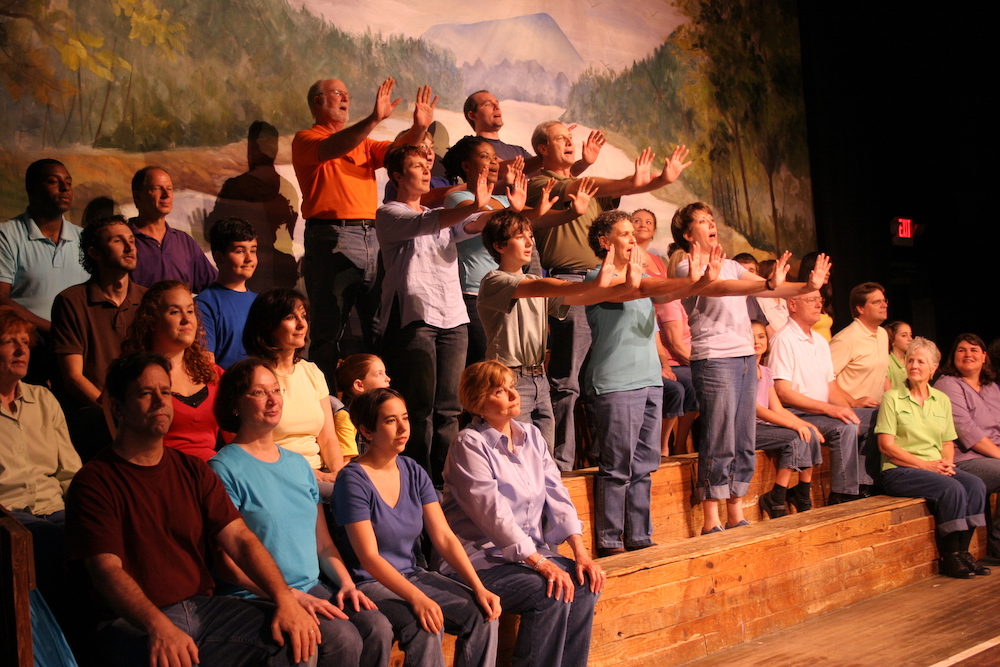
From 2007-2013 the Sautee Nacoochee Cultural Center produced a remarkable community story play, under the banner of Headwaters, which celebrated the twelve different rivers that begin in our Goodly Portion of Beautiful Northeast Georgia, and so much more.
DeDe Vogt, the Performing Arts Director for the center, has announced that members of those Headwaters casts will come together for two reunion performances, featuring music and stories and laughter, to continue to honor the generations of people who have called these mountains their home. Vogt explains the specialness of the concert, “Simply put, there ‘ain’t no place anything like this place anywhere ’round this place, this must be the place.”
1 of 3
Photos are of past performances of Headwaters (Photos SNCC)
Photos are of past performances of Headwaters (Photos SNCC)
Photos are of past performances of Headwaters (Photos SNCC)
Two performances in the Historic Gym are set for Saturday, July 17, at 7:30 pm, and Sunday, July 18, at 4 pm. Tickets are $15.00 for adults and $5.00 for students. Tickets ar on sale now. Call 706-878-3300 or purchase online at www.snca.org.
The Sautee Nacoochee Cultural Center is located at 283 Highway 255 North, Sautee, Georgia 30571.
The number of Georgians receiving unemployment benefits ticked up at the end of June as the effects of the tate's decision to cut extended federal benefits remain to be seen.
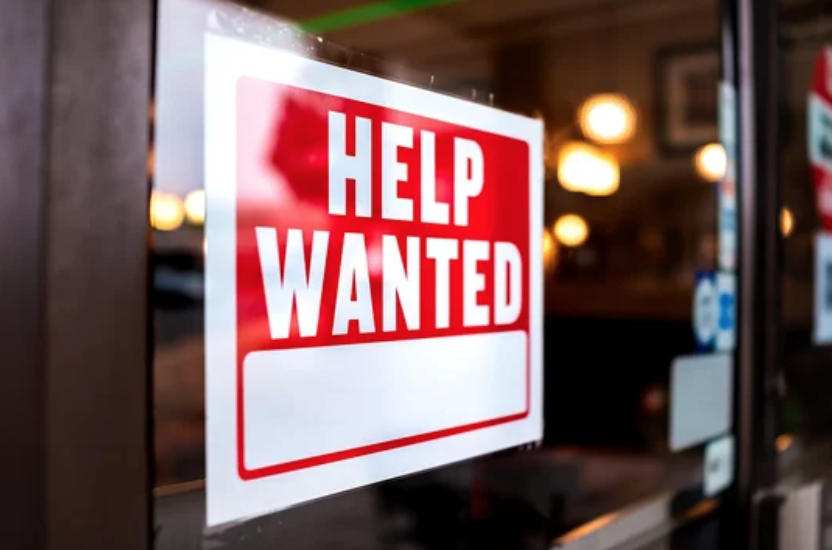
ATLANTA (GA Recorder) — Like others working in Georgia’s tourism industry, Hilda Thomason, general manager of the Georgia Mountain Fairgrounds in Towns County, says she’s seeing more customers than ever before, but getting nowhere near enough job applicants.
She’s made two hires in the last month, but she needs another six to eight people to help maintain the fairgrounds during the busy summer season.
“I don’t think it’s just Hiawassee, Towns County, I think it’s a lot of different counties in different states,” she said. “Everywhere you travel, everybody’s having the same issue. They’ll only open the bar or they’ll only make to-go orders because they don’t have enough hands. They don’t have cooks, they don’t have servers, simply because they’ve been drawing unemployment.”
The spread of COVID-19 vaccines is spurring more and more Georgians to get back to the workplace, but unemployment still remains historically high. A total of 176,688 Georgians were receiving unemployment benefits as of June 26, according to the state labor department. That represents an increase of about 22% from the week before when 144,750 Georgia residents received an unemployment check.
That number is much higher than it was before the pandemic — about 25,000 in January and February — but still nowhere near as high as it was this time last year when about 786,000 Georgians were receiving unemployment benefits as businesses imposed major layoffs as COVID-19 restrictions cut off customers.
Late last month, Georgia pulled out of extended federal unemployment benefits, including an additional $300 in weekly benefits, and reinstated work search requirements for displaced workers filing for unemployment benefits.
Gov. Brian Kemp and Labor Commissioner Mark Butler said they expect the reduction will push Georgians who have been drawing unemployment back to the workplace and help employers like Thomason. Worker advocates say many Georgians have good reasons not to go back to work, including a lack of child care and fear of COVID-19 variants.
On Thursday, Butler said only about 10% of new claims lately are the result of layoffs, with the majority coming from workers being fired or quitting instead.
At the height of the pandemic last April, 49% of those initial claims were due to employers lacking work for the employee and laying off staff, according to the state labor department. In January, that dropped to a quarter.
The bad news is that those claims for reasons other than layoffs take longer to process.
“Claims filed due to layoffs are determined quickly and payments can be released without delay,” Butler said in a statement. “However, we are not seeing many simple layoff claims at this time and we must review each claim thoroughly to ensure a claimant is eligible for payments, protecting the employer from wrongful claims and avoiding a potential overpayment for the claimant.”
The unprecedented number of unemployment filings created long delays for Georgians seeking benefits since the pandemic began, leading to lawsuits against the state.
The latest unemployment data was collected before Georgia’s exit from the federal program that supplemented state benefits by $300 a week whether or not the displaced worker was looking for a job. Once those new numbers are reported, Georgia could actually see its unemployment rate jump, said David Sjoquist, a professor of economics at the Andrew Young School of Policy Studies at Georgia State University.
That’s because the unemployment rate measures people who are out of work and seeking a job.
“With the change in policy, to continue to collect unemployment benefits, the person has to look for work, and thus will now be classified as in the labor force and unemployed,” Sjoquist said. “Some of these formerly non-working recipients of unemployment benefits will now look for and find a job; thus the number of employed individuals will increase. But in the near term, the increase in people actively seeking employment but not taking a job will be larger. Thus, the unemployment rate will increase. But the increase will not reflect a weakening labor market; it will just be the result of how people collecting unemployment benefits are classified.”
Thomason said she’s hopeful the change will reduce that number.
“I do think that they’re going to either starve to death or come out and work sooner or later because when the money runs out, they’re gonna have to do something,” she said. “So I think you’ll see a difference, but I think it’s going to take a little while.”
Just under 20,000 Georgians filed an initial unemployment claim during the week ending July 3, representing a decrease of about 4.8% from the week before, according to Georgia Department of Labor data released Thursday.
Nationwide, initial claims remained relatively flat with 373,000 initial claims for the week ending July 3, an increase of about 2,000 from the week before. A total of 3.2 million Americans received unemployment benefits during the week ending June 26, down by about 49,000 from the previous week.
The COVID-19 Delta variant is already causing a surge in cases in at least half of states. Hospitalizations are predictably on the rise, with almost all admitted COVID-19 patients being unvaccinated.
As the Delta variant takes hold, the unvaccinated are in for a rude awakening. Unfortunately, thanks to them, vaccinated Americans are now being put more at risk, too.
The Delta variant is a mutant strain of the SARS-CoV-2 virus. Early estimates suggest the new strain may be 35% to 60% more transmissible than the Alpha variant, another mutated strain that was already 43% to 90% more transmissible than the original. In simple terms, it’s not great.
As expected, the Delta variant is already causing a surge in cases in at least half of the states. Hospitalizations are predictably on the rise, with almost all admitted COVID-19 patients being unvaccinated. In Missouri — the state with the lowest vaccination rate of only 39.4% — hospitalizations increased a whopping 30% over the Fourth of July weekend alone.
Apparently, none of this deters the unvaccinated, who remain willing Petri dishes. Alas, the following questions are for those who care enough to get vaccinated.
Are vaccines still working against the delta variant?
Yes, the vaccines still work against the Delta variant — but only if you’re fully vaccinated.
The Pfizer vaccine — which is similar to Moderna’s — is currently showing an 88% effectiveness against the delta variant, with early evidence suggesting it holds up to 96% effectiveness against hospitalization. Even though it’s slightly reduced in efficacy, these are still excellent protections.
Meanwhile, partially vaccinated people may see as little as 33% efficacy for protecting against illness, and they join the unvaccinated in being more likely to get hospitalized. In short, getting the vaccine in full is key, and you should get the second dose if you haven’t yet.
Should I wear a mask?
Maybe. Although Atlanta’s Centers for Disease Control and Prevention has yet to issue an update, given that even mild cases might be associated with long-term health effects, it’s wise to be cautious. Particularly if you live in a region with low full vaccination rates — which still constitutes over half the U.S. — wearing a mask might make sense.
As a general guideline, if you are entering an indoor space and cannot verify the vaccine status of those in the room, wear a mask. If, however, you are entering a well-ventilated space with others who are vaccinated and equally cautious, the risk is substantially lower and may not warrant face coverings.
Should I travel?
It is possible to travel reasonably safely if you are vaccinated, but your travel might look a little different than usual. Just as you may consider the weather or time of year for destinations, now you may want to avoid destinations with low vaccination rates or active outbreaks — particularly if you have children under age 12 who cannot yet be vaccinated. You may also want to avoid crowded spaces, bring a mask, and if you must fly, select airlines that require vaccination for boarding.
My family won’t get vaccinated. Can I still visit?
Visiting an unvaccinated family member comes with higher risk, especially to the person who is unvaccinated. Even with the vaccine, it might be possible for a vaccinated member to transmit the Delta variant due to slightly lower efficacies. Accepting this risk is your family’s choice; however, the price of the gamble is high. Working to get family members vaccinated is the best bet, and reminding them of the risks to themselves amid the more transmissible Delta variant may help.
Could delta lead to new variants that fully evade vaccines?
Possibly. Experts have repeatedly warned that if we do not reduce cases and increase our herd immunity against the virus, we are likely to see more mutations. While some mutations are irrelevant, some are not. Already there is a Delta-plus variant on the heels of this one. As cases increase, we could easily see more.
The science behind vaccines is solid, and at least for now, they are holding out against variants. But this may not always be the case. Getting vaccinated soon is absolutely our best defense against not only this variant but also against variants to come.
About the author: Trish Zornio is a scientist and lecturer in behavioral neuroscience and research methodology at the University of Colorado Denver. She has worked for some of the nation’s top universities and hospitals and has focused her personal efforts on enhancing the intersection of science and policy, as well as women in STEM. Her column appears here in partnership with Georgia Recorder.
A Helen waterpark is among the best in the country, according to Parade Magazine. The magazine this week released its list of the 101 Best Water Parks Across the US. Featured from Georgia are Splash in the Boro in Statesboro and Helen Tubing & Waterpark in White County.
The magazine writers said, “Sure, Helen Tubing & Waterpark has plenty of tall slides and lazy rivers like other water parks, but what makes it stand out? It gives you the chance to go tubing down the Chattahoochee River!”
The magazine featured two water parks from each of the fifty states (with an extra one thrown in from Virginia). It says, every single one of them “has a wow factor that will make you want to visit them.”
We found the list to be quite interesting: Check it out for yourself at parade.com.
When you’re in the neighborhood, you may also want to check out the Helen Water Park and see for yourself why it made the list. Guests can enjoy the water park seven days a week from 10 a.m. to 6 p.m. Tubing is offered seven days a week from 9 a.m. to 5 p.m., weather permitting. Tickets range from $12.99 to $24.99 per person.










Delta variant Q&A
As the Delta variant takes hold, the unvaccinated are in for a rude awakening. Unfortunately, thanks to them, vaccinated Americans are now being put more at risk, too.
The Delta variant is a mutant strain of the SARS-CoV-2 virus. Early estimates suggest the new strain may be 35% to 60% more transmissible than the Alpha variant, another mutated strain that was already 43% to 90% more transmissible than the original. In simple terms, it’s not great.
As expected, the Delta variant is already causing a surge in cases in at least half of the states. Hospitalizations are predictably on the rise, with almost all admitted COVID-19 patients being unvaccinated. In Missouri — the state with the lowest vaccination rate of only 39.4% — hospitalizations increased a whopping 30% over the Fourth of July weekend alone.
Apparently, none of this deters the unvaccinated, who remain willing Petri dishes. Alas, the following questions are for those who care enough to get vaccinated.
Are vaccines still working against the delta variant?
Yes, the vaccines still work against the Delta variant — but only if you’re fully vaccinated.
The Pfizer vaccine — which is similar to Moderna’s — is currently showing an 88% effectiveness against the delta variant, with early evidence suggesting it holds up to 96% effectiveness against hospitalization. Even though it’s slightly reduced in efficacy, these are still excellent protections.
Meanwhile, partially vaccinated people may see as little as 33% efficacy for protecting against illness, and they join the unvaccinated in being more likely to get hospitalized. In short, getting the vaccine in full is key, and you should get the second dose if you haven’t yet.
Should I wear a mask?
Maybe. Although Atlanta’s Centers for Disease Control and Prevention has yet to issue an update, given that even mild cases might be associated with long-term health effects, it’s wise to be cautious. Particularly if you live in a region with low full vaccination rates — which still constitutes over half the U.S. — wearing a mask might make sense.
As a general guideline, if you are entering an indoor space and cannot verify the vaccine status of those in the room, wear a mask. If, however, you are entering a well-ventilated space with others who are vaccinated and equally cautious, the risk is substantially lower and may not warrant face coverings.
Should I travel?
It is possible to travel reasonably safely if you are vaccinated, but your travel might look a little different than usual. Just as you may consider the weather or time of year for destinations, now you may want to avoid destinations with low vaccination rates or active outbreaks — particularly if you have children under age 12 who cannot yet be vaccinated. You may also want to avoid crowded spaces, bring a mask, and if you must fly, select airlines that require vaccination for boarding.
My family won’t get vaccinated. Can I still visit?
Visiting an unvaccinated family member comes with higher risk, especially to the person who is unvaccinated. Even with the vaccine, it might be possible for a vaccinated member to transmit the Delta variant due to slightly lower efficacies. Accepting this risk is your family’s choice; however, the price of the gamble is high. Working to get family members vaccinated is the best bet, and reminding them of the risks to themselves amid the more transmissible Delta variant may help.
Could delta lead to new variants that fully evade vaccines?
Possibly. Experts have repeatedly warned that if we do not reduce cases and increase our herd immunity against the virus, we are likely to see more mutations. While some mutations are irrelevant, some are not. Already there is a Delta-plus variant on the heels of this one. As cases increase, we could easily see more.
The science behind vaccines is solid, and at least for now, they are holding out against variants. But this may not always be the case. Getting vaccinated soon is absolutely our best defense against not only this variant but also against variants to come.
About the author: Trish Zornio is a scientist and lecturer in behavioral neuroscience and research methodology at the University of Colorado Denver. She has worked for some of the nation’s top universities and hospitals and has focused her personal efforts on enhancing the intersection of science and policy, as well as women in STEM. Her column appears here in partnership with Georgia Recorder.